Wednesday, July 15, 2026

‘It’s Rule of Law or Barbarism,’ Says Francesca Albanese After Rubio Attack on ICC

“All states and people who care for freedom must rise up in defense of the ICC and international justice now, before it’s too late,” the UN Palestine expert implored.
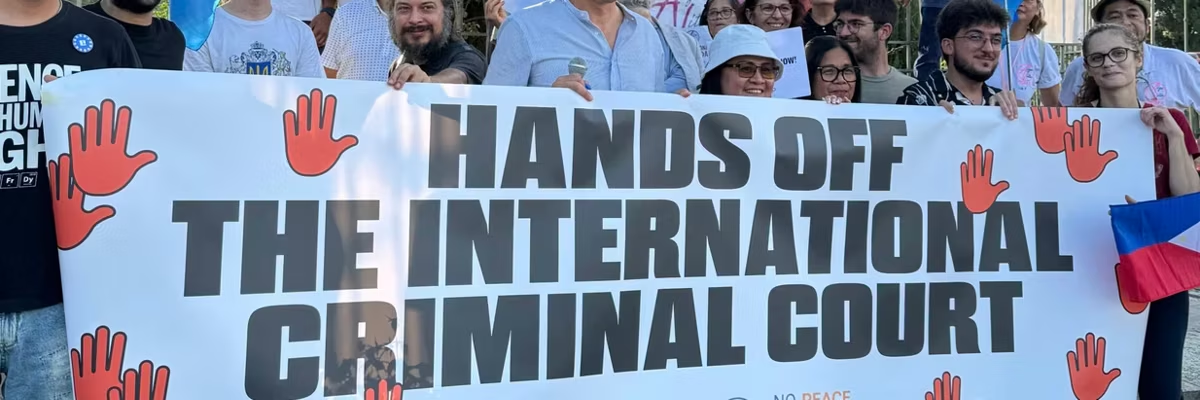


Defenders of the International Criminal Court, led by the pan-European group Eumans, rally in Rome on July 17, 2025.
(Photo by Eumans/X)


Brett Wilkins
Jul 14, 2026
COMMON DREAMS

More defenders of human rights and the rule of law weighed on Tuesday after US Secretary of State Marco Rubio’s announcement of a “campaign to dismantle” the International Criminal Court, many of whose judges and prosecutors have already been sanctioned by the administration of President Donald Trump.

Rubio raised eyebrows around the world by accusing the International Criminal Court—which is based in The Hague, Netherlands—of “waging a war against our country—not with bullets or missiles, but with statutes, compacts, and the force of so-called international law,” and cryptically vowing that the Trump administration “will teach the ICC the full meaning of American resolve.”

On Tuesday, Francesca Albanese, the United Nations special rapporteur for the occupied Palestinian territories, called Rubio’s announcement “utterly shocking but not a surprise.”

“All states and people who care for freedom must rise up in defense of the ICC and international justice now, before it’s too late,” added Albanese, who is under legally contested sanctions imposed by the Trump administration for her outspoken criticism of Israel’s genocidal war on Gaza. “It’s rule of law or barbarism.”


Responding Monday to the secretary of state’s remarks, Congresswoman Ilhan Omar (D-Minn.) said on social media that “Rubio’s announcement that he will dismantle the International Criminal Court is reckless and dangerous. It undermines the rule of law, weakens global accountability, and turns America’s back on the values we claim to champion.”

“The ICC is an international court of last resort, intended to prosecute only the most horrific crimes—war crimes, genocide, and crimes against humanity—when countries are unable or unwilling to do so themselves,” Omar added. “The best way to avoid ICC scrutiny is simple: Don’t commit atrocity crimes, and if credible allegations arise, investigate them transparently and hold those responsible accountable.”

The Trump administration has already hit ICC judges with sanctions, including asset freezes, travel bans, and other penalties for ordering the arrest of Israeli Prime Minister Benjamin Netanyahu and former Israeli Defense Minister Yoav Gallant for alleged crimes against humanity and war crimes in Gaza, as well as for seeking to investigate US atrocities in Afghanistan.

ICC Chief Prosecutor Karim Khan and two deputy prosecutors, as well as eight judges, have been sanctioned by the US.

While the US and Israel are not parties to the Rome Statute governing the ICC and do not recognize the tribunal’s legitimacy, the treaty states that individuals from nonsignatory nations can be held liable for crimes committed in the territory of a member state.

State Department spokesperson Tommy Piggott echoed Rubio’s remarks, telling Newsmax on Tuesday morning that “if the ICC continues to try to threaten our sovereignty, they will know the full power of American resolve.”

Responding to the interview, independent journalist Aaron Rupar asked, “Are we going to, like, bomb the International Criminal Court?”

Astute observers noted that the American Service Members’ Protection Act—passed during the George W. Bush administration and known colloquially as the “Hague Invasion Act”—authorizes the president to use “all means necessary and appropriate,” including military intervention, to secure the release of American or allied personnel held by or on behalf of the ICC.

“The ICC is not doing great. There’s a lot to complain about. But this, we cannot allow. We cannot allow these hegemons and bullies to run this project into the ground because there is something worthy of protection and improvement in it,” Iva Vukušić, an assistant professor of international history at Utrecht University in the Netherlands, said Tuesday on Bluesky in response to Rubio’s threat.


“The arrogance of this man, his boss, and their corrupt administration is insufferable,” Vukušić said in a separate Bluesky post. “The empire must fall for a thousand reasons, but this childish arrogance is among the most important ones.”

Journalist Thor Benson also took to Bluesky, writing: “I hope Marco Rubio eventually gets tried before the ICC. That would be a good way for this to go.”

Rubio Threatens to ‘Teach the ICC’—Which Prosecutes War Crimes—the ‘Full Meaning of American Resolve’

“Is the secretary of state worried because he knows US personnel committed war crimes in Iran?”
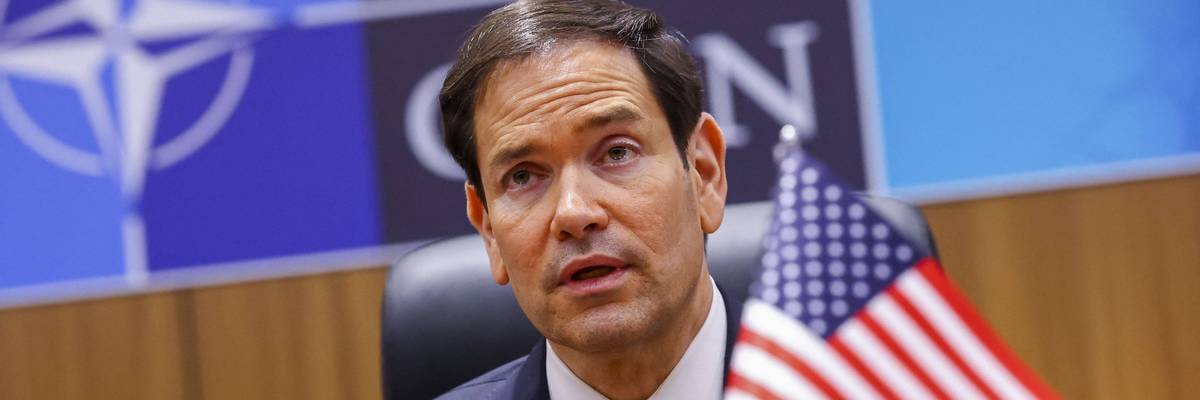


US Secretary of State Marco Rubio attends a meeting in Ankara, Türkiye on July 7, 2026.
(Photo by Yves Herman/Pool/AFP via Getty Images)

Jake Johnson
Jul 13, 2026
COMMON DREAMS

US Secretary of State Marco Rubio on Monday announced what he characterized as a “campaign to dismantle” the International Criminal Court, the Hague-based tribunal tasked with investigating and charging individuals with war crimes and other violations.

In a video posted to social media, Rubio accused the international court of “waging a war against our country—not with bullets or missiles, but with statutes, compacts, and the force of so-called international law.” The top American diplomat threatened that the US “will teach the ICC the full meaning of American resolve.”

The US State Department said in a statement that Rubio’s new campaign against the ICC would “feature a whole-of-government response to systematically disable” the court’s “ability to operate, target American servicemen or officials, or otherwise threaten American sovereignty.” The US is not party to the Rome Statute, the 1998 treaty that established the ICC.

US President Donald Trump and his subordinates, who have been accused of myriad violations of international law, have adopted an increasingly aggressive posture toward the ICC since taking power last January.

In a February 6, 2025 executive order, Trump declared “a national emergency to address” the purported “threat” posed by the ICC and announced sanctions against court officials, including its judges. The president’s order cited the ICC’s “investigations concerning personnel of the United States and certain of its allies, including Israel,” which is also not party to the Rome Statute.

In November 2024, the ICC issued arrest warrants against Israeli Prime Minister Benjamin Netanyahu and his former defense minister, Yoav Gallant, for alleged war crimes committed in the Gaza Strip.

Rubio warned in an op-ed in The Wall Street Journal on Monday that US officials accused of international crimes could be next to face ICC action.

“Border Patrol agents working to remove violent criminals from our country, US Marines risking their lives to restore order in the Western Hemisphere, federal prosecutors working to dismantle terror networks plotting attacks on the American homeland—all would face the constant risk of persecution for the ‘crime’ of defending our country,” Rubio wrote. “Using all the tools at our government’s disposal, working beside every ally with whom we can make common cause, we will dismantle the ICC—brick by brick, if necessary.”

Raed Jarrar, advocacy director of the human rights group Democracy for the Arab World Now (DAWN), said in response to Rubio’s op-ed that “when the world’s most powerful country aims to dismantle the world’s only permanent international court, it sends the message that the powerful are above the law.”

“It is not the ICC that Rubio is dismantling brick by brick, but the rules-based international order that grew out of the ashes of World War II,” said Jarrar. “Rubio’s attack doesn’t just underscore US hypocrisy, but undermines access to justice across the globe, from Ukraine to Sudan and could amount to obstruction of justice, a crime under the Rome Statute in and of itself.”

In his op-ed, Rubio pointed to DAWN’s call earlier this year for Iran and other Middle East nations to grant the ICC jurisdiction to investigate apparent war crimes committed during the conflict launched in late February by Trump and Netanyahu.

Omar Shakir, DAWN’s executive director, said Monday that Rubio mischaracterized the group’s call as focusing solely on actions by US personnel. That move, said Shakir, “begs the question: Is the secretary of state worried because he knows US personnel committed war crimes in Iran?”

Under Rubio’s plan, the State Department is threatening to impose “increased sanctions against the ICC and affiliated organizations,” hit court personnel with “visa revocations and travel bans,” and pressure other nations that aren’t party to the Rome Statute to “leverage their diplomatic networks to take similar actions alongside” the Trump administration.

Kenneth Roth, the former executive director of Human Rights Watch who has demanded international accountability for the Trump administration over its illegal assault on Iran, wrote Monday that Rubio “can’t even make an honest case for attacking the International Criminal Court.”

“He makes it sound like the ICC acts out of the blue anywhere it wants when in fact it acts only against crimes committed on the territory of states that have invited it,” Roth wrote. “He never explains why the United States should be able to commit crimes on the territory of those states with impunity, contrary to the desire of their sovereign governments for an international backstop to reinforce justice for such crimes.”





As Trump Announces New Round of Sanctions Against Cuba, Democrats Warn Country Is Being ‘Strangled to Death’

Four members of Congress returned Monday from an oversight trip to Cuba, which they described as a “silent Gaza.”


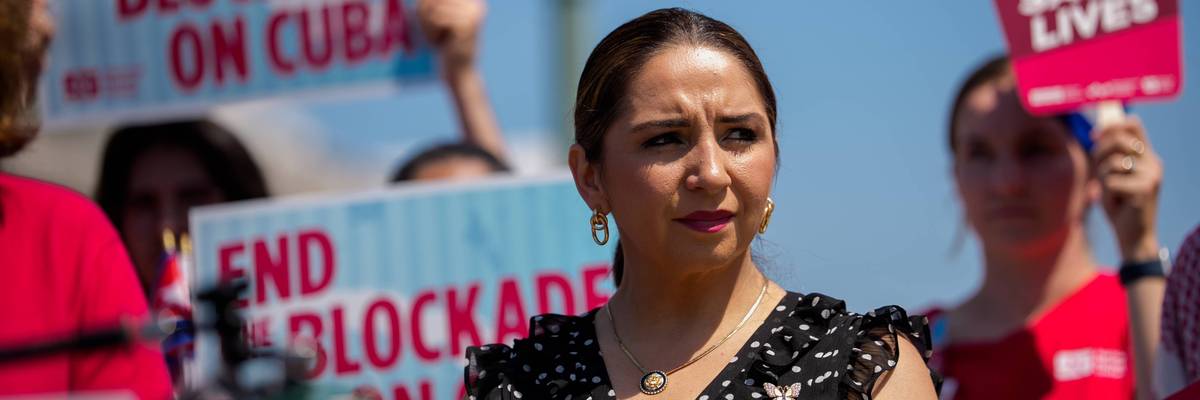
Rep. Delia Ramirez (D-Ill.) attends a news conference calling for the end to the blockade on Cuba on Capitol Hill on June 30, 2026 in Washington, DC.
(Photo by Andrew Harnik/Getty Images)


Julia Conley
Jul 14, 2026
COMMON DREAMS


As the Trump administration announced a new round of sanctions on Cuba’s tourism ministry, energy companies, and other entities on Monday, four Democratic members of Congress returned from a trip to the island and described how the oil blockade the US has imposed there for nearly six months “is producing indiscriminate pain for the most vulnerable Cubans.”

“As elected lawmakers tasked with oversight of US foreign policy, we traveled to Havana to meet with Cubans of all walks of life and political perspectives to hear about the hardships the Trump administration’s maximum pressure policies are creating for Cuban citizens,” said Reps. Delia Ramírez (D-Ill.), Teresa Leger-Fernández (D-NM), Mark Pocan, (D-Wis.), and Maxine Dexter (D-Ore.). “In our meetings with religious leaders, entrepreneurs, civil society organizations, humanitarian groups, medical professionals, and farmers, everybody we heard from... agreed on one thing: that they are being strangled to death under the current executive orders and longstanding economic blockade.”

The four Democrats traveled to Cuba last Thursday and spent several days meeting with local leaders, touring the streets of Havana, and speaking with President Miguel Díaz-Canel as the country grapples with the effects of President Donald Trump’s January executive order that baselessly claimed Cuba poses an “extraordinary” threat to US national security and threatened tariffs against any country that provides oil to the communist country.

The president had already cut off Cuba’s main energy supply by invading Venezuela, abducting its president and charging him with drug trafficking, and taking control of its vast oil reserves.

The lawmakers described how the energy blockade is “contributing to nationwide electrical blackouts—including one during our trip—buildups of trash on street corners; severe shortages of food, medicine, and public transportation; and widening inequality on the island.”

Dexter, a physician, noted that Cuba’s lauded healthcare system “is buckling under sanctions that the White House has unleashed on the Cuban people. This is creating a humanitarian catastrophe.”

“Cuba created a free, universal healthcare system that millions of Cubans and others around the world have come to expect and depend on,” said Dexter. “I will be using all the tools at my disposal to remove the barriers to delivering healthcare to the Cuban people.”

As Common Dreams has reported, the blockade has left hospitals struggling to provide care, with 96,000 people, including 11,000 children, on waitlists for surgeries.

“Over 300 pediatric surgeries per week are compromised by shortages of drugs, oxygen, anesthetics, and consumables,” wrote more than 8,000 Italian medical and scientific professionals in an open letter in June.

Leger-Fernández called Trump’s policy in Cuba, which has intensified sanctions that have been in place for years, “a siege.”

“We’re blocking medical supplies, fuel, and other essential inputs, leading its infant mortality rate to rise nearly 150% in recent years, from 4 to 9.9 per 1,000 live births,” said the congresswoman. “I doubt any American wants innocent Cuban babies to die due to our policies.”

Pocan told The Associated Press that one person he spoke to in Cuba called the crisis a “silent Gaza.”

“There may not be bombings, but there are certainly conditions that prevent people from going about their daily lives,” said Pocan. “They can’t go to work, they can’t preserve their food, they can’t access medical supplies, or live as they did before.”

Since imposing the blockade, Trump has repeatedly expressed a desire to take over the island by force and has doubled down on claims that Cuba poses a national security threat to the US.

On Sunday, United Nations Ambassador Michael Waltz claimed in a Fox News interview that China and Russia are “collecting information around our military bases in Cuba.” In May, an anonymous White House official told Axios that Cubans were “discussing plans” to launch drones at the US—even as the reporting acknowledged the country was thought to be preparing defensive, not offensive, capabilities.

As the members of Congress returned to the US and reported on the suffering they witnessed in Cuba on Monday, the administration announced a new round of sanctions on the country’s Ministry of Tourism, energy firms, a state-owned financial services company, a major foreign trade firm, and a maritime transportation company. Foreign banks, insurers, and companies will be exposed to potential penalties if they work with the entities under the sanctions.

The Trump administration, said Cuban Foreign Affairs Minister Bruno Rodríguez Parrilla, “continues to intensify the war against the people of Cuba, their living conditions, and their sources of livelihood.”

“The announcement on July 13 of additional coercive measures is a clear manifestation of the criminal and genocidal intent with which US rulers are determined to punish the entire population of the country,” he said.

The sanctions demonstrated the Trump administration’s “zeal to strangle our economy,” added Díaz-Canel. “They reinforce the aggression in search of greater harm to the people. We are facing a genocidal design plan.”


Don’t Pull the Trigger: Say, ‘No!’ to New Plutonium Pits

The rush to increase production at 80 pits per year by 2030 unnecessarily increases the risk to workers and sidelines necessary environmental cleanup at the sites that already have ongoing release of radioactive waste into the air, water, and soil from legacy activities.


An aerial view of Los Alamos National Laboratory is shown.
(Photo by Los Alamos National Laboratory)

Robert Dodge
Jul 15, 2026
Common Dreams

Plutonium pits are the radioactive core “trigger” of every US nuclear weapon. On detonation, the plutonium sets off a nuclear chain reaction initiating a nuclear explosion. The Department of Energy’s National Nuclear Security Administration, or NNSA, plutonium pit production Programmatic Environmental Impact Statement, or PEIS, public comment period ends this Friday, July 16. Our input regarding this major component of today’s nuclear arms race is critical.

Paradoxically, on that same day, 81 years prior in 1945, the nuclear arms race began when the United States bombed New Mexico with the Trinity test. The PEIS released in April this year provides an incomplete and non-comprehensive environmental review of this accelerated race to develop new plutonium pits by 2030. The justification put forth stems from a Cold War mentality of Congress from 2014 requiring the United States to develop the capacity to produce 80 plutonium pits per year by 2030, subsequently bolstered by the 2018 Trump administration’s Nuclear Posture Review requiring the US to produce 80 pits per year by 2030; 30 at the Los Alamos National Laboratory (LANL) and 50 at the Savannah River Site.

As background, the majority of current plutonium pits completed production at the contaminated Rocky Flats plant outside of Boulder, Colorado by 1989. Therefore most plutonium pits are roughly 30-40 years old. Currently there are over 15,000 plutonium pits in reserve at the Pantex Plant near Amarillo, Texas, and over 5,000 which are suitable for use in strategic reserve. These large grapefruit size pits have at their core the incredibly hazardous radionuclide plutonium 239, which has a half life of 24,000 years.

Concerns over the aging of the current stockpile have been the impetus for building new pits. That concern was largely put to rest with the congressionally mandated 2006 JASON study, which confirmed that plutonium pits would last at least 100 years, and a subsequent 2012 Lawrence Livermore National Lab study found “...no unexpected aging issues are appearing in plutonium pits artificially aged to 150 years of age…” and they “...performed as designed.” This scientific evidence deemed as inconvenient was ignored. A subsequent new JASON Study was completed in 2025, and the NNSA has refused to release the results despite congressional demands and watchdog agency lawsuits, presumably due to the inconvenient results threatening their multibillion dollar windfall.

Historically the only thing that can be guaranteed in this proposed increased plutonium pit production plan is that it will be significantly delayed and far over budget.

As noted, this current race to rapidly expand pit production will occur at the existing, and already contaminated, sites at Savannah River in South Carolina, and the Los Alamos National Lab in New Mexico. It’s as though these communities are expendable.

The current draft PEIS only gives lip service to addressing the environmental impacts, failing to adequately take into account the dangers posed by the production of these pits to surrounding communities. According to the Union of Concerned Scientists, while the PEIS “clearly highlights an increased risk of radiation in the environment and across communities near facilities and workers it dismisses them as negligible continuing the most harmful and risky option of continued multi-site operations…. with only passing acknowledgement of the increased impacts at other sites, including nationwide transportation and impending waste management bottlenecks.”

According to a peer reviewed study published last week in the journal Science and Global Security, the Department of Energy has underestimated the potential deadly consequences if plutonium were to escape the Los Alamos National Laboratory. In the most serious case, if more than one kilogram of plutonium was to escape, the town of Los Alamos could become unlivable, and radioactive particles could spread across state lines. As many as 3,200 people could eventually get cancer with an estimated 1,000 deaths. Under certain circumstances, particles could travel as far north as Central Colorado and as far south as Southern New Mexico.

The draft PEIS fails to address the “no action” option of not producing plutonium pits, thus dismissing it outright, presuming that production moving forward is a foregone conclusion. The rush to increase production at 80 pits per year by 2030 unnecessarily increases the risk to workers and sidelines necessary environmental cleanup at the sites that already have ongoing release of radioactive waste into the air, water, and soil from legacy activities on site. In addition, most reviews have concluded that this deadline is not realistic.

In addition, the proposed production will add fuel to the current ongoing arms race and proliferation disregarding the purported mission of the NNSA to “promote international nuclear safety and non-proliferation, and reduce global danger from weapons of mass destruction.” This will further erode confidence in the sincerity of the United States and its legal obligation under Article VI of the 1970 Treaty on the Non-Proliferation of Nuclear Weapons, NPT, to work in good faith with other nations to abolish nuclear weapons.

Historically the only thing that can be guaranteed in this proposed increased plutonium pit production plan is that it will be significantly delayed and far over budget.

Imagine the international capital that could be gained by placing the entire plan on hold. Our national security would not be compromised. And there would be massive financial savings to be realized.

We must demand a more complete and transparent PEIS that addresses the entire environmental, economic, and health impacts to the communities directly at risk, as well as our entire nation and world. Absent that, we are not dealing with science, but rather opinion, conjecture, and fearmongering. Use your voice today by submitting your comments via email to PitPEIS@nnsa.doe.gov, being sure to reference Doc: DOE/EIS-0573.


Our work is licensed under Creative Commons (CC BY-NC-ND 3.0). Feel free to republish and share widely.


Robert Dodge
Robert Dodge, MD, is a family physician practicing in Ventura, California. He serves on the board of Physicians for Social Responsibility Los Angeles (www.psr-la.org), and serves as the cochair of the Committee to Abolish Nuclear Weapons of National Physicians for Social Responsibility (www.psr.org). Physicians for Social Responsibility is the US Affiliate of the International Physicians for the Prevention of Nuclear War who received the 1985 Nobel Peace Prize and is a partner organization of ICAN, recipient of the 2017 Nobel Peace Prize. He also serves on the Back from the Brink (www.preventnuclearwar.org) steering committee.
Full Bio >

Why Is War the Father and King of All?


 July 15, 2026

War, painting by Evi Sarantea.

For a variety of reasons, humans often resort to killing each other. Instead of resolving their differences peacefully, they arm themselves and kill each other until one of them wins the conflict, that is, he has killed most of his opponents. This deadly tradition survives and thrives to this day – in 2026.

Despite international organizations designed to prevent wars like the United Nations, there are alliances like NATO and the European Union, which still prepare and crown war. NATO is basically an American war alliance against Russia. It is an extension of US hegemony in Europe. Meanwhile, deadly conflicts are wrecking Africa, the Middle East and Europe. The war in Ukraine is to some degree WWIII. It has been funded and armed by NATO. This abhorrent race to war justifies the sixth century BCE philosopher Herakleitos who said, “War is the father and king of all” (Hippolytos, Refutation 9.9.4).

True, it is, but why? Wars have been the greatest forces shaping civilization and history. The question is, why are humans incapable of learning to live with each other without mayhem? Such behavior negates civilization. Therefore, what we call civilization to praise ourselves has become civilized barbarism.

Wars in Hellas / Greece

The Greeks discovered democracy, science and beautiful culture. They tried to avoid war through the Olympics and other Panhellenic games and festivals as well as the Oracle at Delphi, which constantly reminded them of their eusebeia / piety for the gods, the speaking of the same Greek language and their Hellenic identity. But these worthwhile institutions and efforts of reconciliation often failed. The result was a series of dehumanizing and de-Hellenizing civil wars like the Peloponnesian War, 431- 404 BCE. This very destructive mayhem started not because of any aggression on the part of the strongest Hellenic city states: Athens, Sparta, Thebes or Corinth. No. The spark for the war came from Sparta because of its fear of rising Athenian influence and power. And once the deadly conflict started, Persia funded Sparta.

After the Greek victories over the Persian invasions of Hellas in 490 and 480-479 BCE, Athens allied with other city states in Ionia / Asia Minor and the Aegean concerned about more Persian invasions. This leadership of Athens gave it international prestige, influence and money with which Athens rebuilt the Parthenon, which the Persians had burned. Sparta did not appreciate a strong rival in Hellas, hence it started the Peloponnesian War that had catastrophic consequences for all Greeks.

The internal strife in Hellas weakened the Greeks and invited conquerors like the Greek Macedonians from Northern Greece and the Romans from the West. The Roman emperor Constantine embraced Christianity in the fourth century. That caused a political and cultural earthquake that demolished nearly all of Hellenic civilization. Christians and other barbarians undid Hellas, overthrowing its temples, architecture, science, schools, libraries and way of life. The Christianization of Hellas was a global catastrophe that sunk Western Europe into darkness: the burning of libraries, crusades and the triumph of barbarism for several centuries.

A very small number of Greek manuscripts survived the march of Christianity into Hellas. These treasures sparked the Renaissance among the Arabs in the 8th century and among the Western Europeans in the 15th century. But the Greeks themselves, made Christians by force, failed to repel the attacks of the Mongol Turks and, in 1453, they lost their freedom. The Western Christian Europeans did not go to the assistance of the Greeks because of theological divisions. Some 400 years later, in the 1820s, the Greeks fought a heroic struggle and won their freedom.

Wars in Europe

Wars continued in Europe. The Greeks spent most of the 19th and early 20th centuries to recapture their land. World War I and especially WWII almost annihilate Greece. In addition, the British and the Germans sowed the seeds of civil war in Greece, 1943-1949. Communist class struggle and American and British capitalist ideologies fought a ferocious conflict in impoverished Greece.

The United States founded the European militarist alliance of NATO, that also included the perennial enemy of Greece, Turkey. This meant that the hot wars of the first half of the 20th century would continue as Cold War conflicts between NATO and the Soviet Union, both armed with the genocidal and extermination nuclear bombs. Islamic Turkey was the only beneficiary of this meaningless regime of tensions and conflicts in Europe. Turkey continued to play one Western Christian country against another and against the communist Soviet Union.

As for Greece, the game was desperate. German occupation, 1941-1944, almost wiped out the country. The civil war, 1943-1949, became another Peloponnesian War: destructive and fratricidal. And just like the Mongol conquest of 1453, when most Greek scholars escaped to Florence, Padua, Venice and Rome, many Greeks left their country in the 1950s and 1960s for other countries in Europe, Australia and America, especially America.

The misfortunes of modern Greece started in 1831. Local enemies of the first president of modern Greece, Ioannes Kapodistrias, did not like him. He came to Greece in 1828 after a brilliant career in Russia, where he was the Secretary of State, 1816-1822. Kapodistrias was also the preeminent diplomat of Europe. In Greece, he tried to create an independent nation state. However, he set the foundations of the modern Greek national state, using his own wealth and Philhellenic contributions for funding the army, schools, courts, hospitals, post office and the expansion of the national borders. He was just to the landless peasants by giving them land. Nevertheless, on September 27, 1831, his local and foreign enemies assassinated him. Britain might have funded the assassins.

After Kapodistrias, the “great” European powers (Britain, France, Russia) sent kings and monarchical institutions to Greece, which undermined the country’s democracy, facilitated the looting of Greek archaeological treasures and weakened ancient traditions. The outcome, as I said, was NATO that included Turkey.

The US, Turkey and NATO

The US was so incense by the influence of the gigantic communist Soviet Union that overlooked the genocidal legacy and policy of Turkey. Like Britain, the US treated Turkey as a fence for the Soviet Union. This blind bias encouraged Turkey’s 1955 pogrom against 85,000 Greek residents of Constantinople / Istanbul. Turkish state-led mobs, armed with torches, knives and iron rods, smashed everything Greek: churches, cemeteries, schools, hospitals, orphanages and thousands of business and commercial stores.

The same disregard for Greece and admiration for Turkey was the reason the US ordered Greece to remove its army from Cyprus. To facilitate such a cowardly act, the Greek army took over the government from 1967 to 1974. The Greek military gave the green light to Turkey, which, in 1974, invaded Cyprus and occupied about 40 percent of the Greek island.

Meanwhile, NATO and the European Union remain silent about Turkish aggression. Even the Greek Prime Minister Kyriakos Mitsotakis downplays the Turkish war threat. If his country dares to expand sovereignty to sea waters that belong to Greece in the Aegean., Turkey threatens war. Mitsotakis mumbled this apocryphal message in early July 2026 NATO conference in Ankara: “My country is in a very delicate neighborhood, facing geopolitical challenges.” NATO and the EU are well aware of this “delicate” situation developing into a volcano in the Aegean but keep silent. The United Nations also treat Turkey like a “normal” state, more than 50 years after Turkey occupied Greek and EU territory.

The Trump administration also has no trouble with genocidal Turkey. In fact, Trump seems to like Erdogan, who continues threatening Greece. Erdogan reads the lips of Trump. In the Ankara NATO meeting, July 7-8, 2026, Erdogan welcomed his distinguished guests with music from an Ottoman-era orchestra.

Evolution of war

Demetrios Karkamanis, a Greek war expert who spent his professional life in the Swedish armed forces, published a couple of articles about the immorality of NATO. None of its nation state members had the courage to raise the human rights violations the government of Erdogan inflicted on Turkish citizens primarily because of the NATO summit in Ankara, much less the systematic violence Turkey has been inflicting on the Greek population and institutions in occupied northern Cyprus for more than 50 years. NATO in early July 2026 was repeating the Trump obsession of spending about $ 50 billion for additional armaments. One wonders all these new guns are going to fight whom? Certainly the Europeans are not deluded or insane to think of fighting Russia directly, though they have been doing that indirectly through the arming and destruction of Ukraine.

The Greek Swedish military expert talked extensively on what Greece needs to do to face the inevitable military confrontation with NATO-embolden Turkey.

I read Karkamanis carefully. He is a strategic thinker. He knows the weapons manufactured and used today. He agreed it was a good idea that Greece purchased 4 very advanced technology warships from France, the so-called Belharra. But he raised critical questions about warfare and strategy. He said that Greece must become self-reliant in weapons and the manufacture of weapons. Her dangerous neighbor, Turkey, has been investing in its military industry and especially in the development of drones, sea and air drones carrying explosives for the annihilation of the enemies they attack. Would the French warships in the Greek navy be able to withstand the ferocity of the drone attacks, the explosive powers of wave after wave of explosives-armed kamikaze drones? And what if the warship destroyed the cheap drones with expensive bullets or missiles? And then he speculated about the algorithmic warfare of tomorrow. Where would such mechanical killing nightmare push humans? Back to the dark ages and mountain caves?

Extinction is the other side of the high tech warfare coin, the potential outcome of still maintaining thousands of “modernized” nuclear weapons by several nation states: US, Russia, China, Pakistan, India, Britain, France, North Korea and Israel: flying them in military aircraft and filling submarines with missiles loaded with the dreadful weapons of extinction; keeping them in air force bases and elsewhere. But instead of discussing disarmament, showing off nukes is becoming fashionable once again.

Nuke fever is unsettling Britain. The Bulletin of the Atomic Scientists, which for decades is acting like the canary in the mine, is warning that Britain is up to something dangerous: “In the last five years,” the Bulletin says, “Britain has quietly moved to increase the maximum size of its nuclear stockpile and revise its nuclear doctrine, and it is now acquiring an additional nuclear capability. In concert with the United States, the UK government is expanding the deployment of non-strategic (tactical) nuclear weapons in a way that could destabilize the strategic balance in Europe.”

Yes, but why is Britain moving around “tactical” nukes? To scare Iran? Ireland? Russia? the EU? We don’t know the depths of insanity behind this extremely dangerous and provocative “doctrine” and policy of Britain. Of course, Britain works closely with its younger brother, the United States, which she educated so well that the US replaced her as world hegemon.

Epilogue

The dogma of Britain to rearm its nuclear forces confirms that war is not about to take a vacation. In such a new jungle of enemies armed to the teeth with a variety of high tech AI weapons, Hellas / Greece must merge her ancient virtues of daring, courage and passion for freedom with the latest high tech technologies of war. No doubt, fighting Turkey in the Aegean will be complex, demanding weapons, daring and strategy. The geography of the Aegean is a tremendous asset to Hellas. Arm each island to defend and fight any invader. The Greeks defeated much larger armies and navies because they had centuries of experience fighting for their freedom. They had studied their potential enemies and knew their strength and weakness. The Turks have a large army but very little experience in fighting naval battles. The Greeks practically lived in the sea for millennia. Belharra, drones, submarines, missiles, air force, electronic warfare and radars become heroic if they are monitored and guided by heroes.

I am not praising warfare. But we live surrounded by danger and enemies. The Greeks are not aggressive. They prefer peace to war. However, their neighbors, the Turks, want what the Greeks have. That’s why the Greeks must develop a strategy to defeat the Turks decisively.

Turkey does not belong to the West and NATO. It’s a jihadist state that has been oppressing non Turks and non-Muslims for centuries. Why is the US and its Western allies refuse to learn this simple truth? Don’t they learn from history? It would be a good idea to talk to the Armenians and Kurds.

Evaggelos Vallianatos, Ph.D., is a historian and ecological-political theorist. He studied zoology and history, Greek and European, at the University of Illinois and Wisconsin. He did postdoctoral studies in the history of science at Harvard. He worked on Capitol Hill and the US Environmental Protection Agency; taught at several universities, and authored hundreds of articles and several books, including Poison Spring (2014), The Antikythera Mechanism (2021), Freedom (2025) and Earth on Fire: Brewing Plagues and Climate Chaos in Our Backyards (World Scientific, 2026).

The US Kicks Off World’s Largest Naval War Games: RIMPAC, China, and the Cost of War

Rather than making the region safer, the pursuit of “deterrence” risks turning the Pacific into a battlefield while diverting resources away from the urgent challenges that communities are actually facing today.


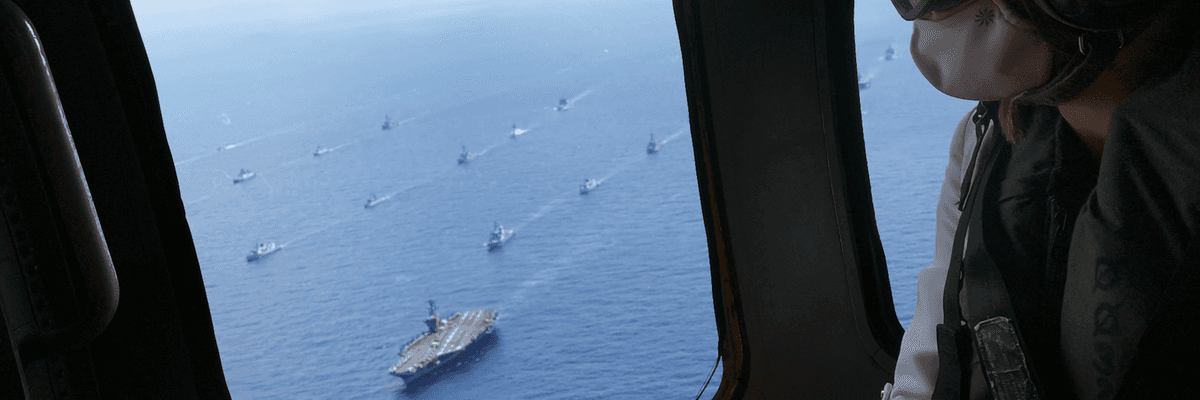
RIMPAC training exercises are shown in a still from Earth’s Greatest Enemy.
(Image via Empire Files)

Megan Russell
Jul 14, 2026
Common Dreams

June 24 marked the start of the biennial Rim of the Pacific, or RIMPAC, exercises, the world’s largest international naval war games. Led by the US, the military exercises bring together 31 countries and include more than 25,000 personnel, 40 surface ships, five submarines, and 140 aircraft. The event, which will run until July 31, marks the newest escalation of US preparations for war on China, further militarizing the Pacific and normalizing the prospect of conflict through increasingly large-scale exercises and an ever-expanding web of alliances and military bases.

At the same time, the US and partner nations kicked off the 10-day Valiant Shield 2026 exercises across Guam, the Northern Mariana Islands, Japan, and surrounding seas, submerging the entire Pacific into an intensive military operation zone.

At a moment of intensifying climate disasters and growing economic insecurity, the message from Washington is clear: There is always more money for war. RIMPAC comes as Congress is attempting to approve a staggering $1.5 trillion war budget, even as communities across the world are facing deadly heatwaves, floods, and other climate-fueled disasters.

This past week, while US military vessels practiced war off their coasts, super typhoon Bavi pummeled Guam and the Northern Mariana Islands. Coming only a week into the typical typhoon season, this is already the second major typhoon to hit the islands. Many locals were still without power from the last super typhoon Sinlaku, which killed 17 people and caused over $1.5 billion in damages.

Rather than protecting local communities, militarization leaves them more vulnerable. All the while, massive military spending diverts resources away from urgent needs such as climate relief.

Climate scientist Kristina Dahl remarked, “In both of these cases we can see the fingerprint of climate change on the storms and that has really devastating consequences for the people who are repeatedly in their paths.”

These overlapping crises reveal a profound imbalance in priorities. As Pacific communities contend with increasingly severe climate disasters, the United States continues to invest staggering sums in military expansion and war preparations. The irony is especially stark given that the US military is the world’s largest institutional consumer of fossil fuels and one of the largest institutional greenhouse gas emitters, while decades of US military activity have caused lasting environmental and human harm across Pacific Island communities.

Instead of pouring resources into preventing climate change and protecting people on the frontlines of the climate crisis, the US continues to pump money into its bloated war budget. In the Pacific, military expansion is justified by the increasing push toward war on China. The 2026 National Defense Strategy committed to “deterring China in the Indo-Pacific through strength” by “erect(ing) a strong denial defense along the First Island Chain” so that “Joint Force always has the ability to conduct devastating strikes and operations against targets.”

The US conception of “deterrence” is both illogical and hypocritical in nature. In the name of “protecting” the Pacific from a future imaginary threat, the United States is harming the very communities it claims to defend through military buildup, environmental degradation, and the transformation of islands into staging grounds for war. The narrative of an imminent Chinese takeover of the Pacific is often treated as a foregone conclusion despite there being no evidence that China seeks to invade or occupy Pacific nations. Rather than making the region safer, the pursuit of “deterrence” risks turning the Pacific into a battlefield while diverting resources away from the urgent challenges that communities are actually facing today.

A recent report by the Institute for Policy Studies found that the US military’s economic benefits to Hawaiʻi have been significantly overstated and that local communities bear enormous hidden costs from its presence. The report estimates that military demand for housing drove Oʻahu rents up by 7.1% in 2024 alone, costing non-military renters an additional $234.8 million. It also found that cleaning up PFAS contamination at just three military installations could cost at least $493 million, with broader health and environmental damages potentially reaching into the billions. Meanwhile, the Pentagon has leased more than 46,000 acres of Hawaiian land for just $1 leases, despite the land’s estimated fair market value reaching as high as $133.7 billion. Far from protecting Pacific communities, the US military buildup has contributed to housing insecurity, environmental contamination, and the dispossession of Indigenous lands.

Similarly, US militarization of Guam has severely impacted local communities. The US military controls roughly 27% of the island’s land, while decades of military activity have left behind contaminated groundwater, hazardous waste, and damaged ecosystems. PFASforever chemicals” linked to military firefighting foam have been detected in Guam’s drinking water wells, threatening the island’s primary freshwater source. Military expansion has also endangered coral reefs, sensitive coastal habitats, and wildlife.

These events, which are just a few of many examples of the environmental and human costs of militarization, reveal the deep hypocrisy of the US strategy of “peace through strength.” Rather than protecting local communities, militarization leaves them more vulnerable. All the while, massive military spending diverts resources away from urgent needs such as climate relief.

The proposed $1.5 trillion war budget will only deepen these harmful priorities, while large-scale military exercises like RIMPAC intensify US-China tensions, heighten the risk of dangerous encounters at sea, and increase the possibility of pulling the Pacific into a devastating war.


Our work is licensed under Creative Commons (CC BY-NC-ND 3.0). Feel free to republish and share widely.


Megan Russell
Megan Russell is CODEPINK's China is Not Our Enemy Campaign Coordinator. She graduated from the London School of Economics with a Master’s Degree in Conflict Studies. Prior to that, she attended NYU where she studied Conflict, Culture, and International Law. Megan spent one year studying in Shanghai, and over eight years studying Chinese Mandarin. Her research focuses on the intersection between US-China affairs, peacebuilding, and international development.
Full Bio >