Abstract
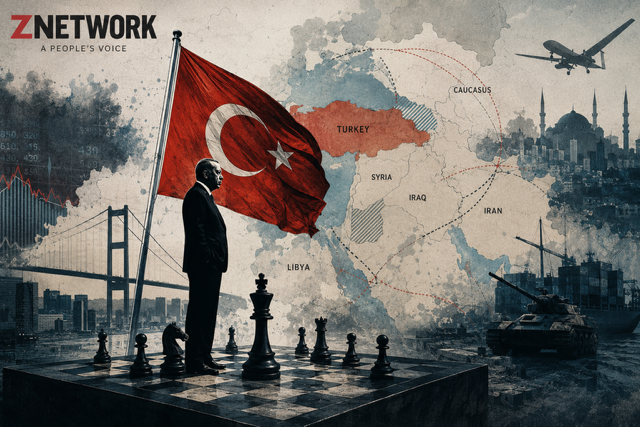
This article examines Turkey’s geopolitical position through the lens of world-systems theory, drawing on the Marxist theory of imperialism. Its central argument is that Turkey, as a semi-peripheral power, is attempting to strike a fragile balance between structural dependence on the core centers of global capital and its drive to expand regional influence, all under conditions of a multidimensional crisis of U.S. hegemony.
Turkey is neither a core power in the world system nor a peripheral state simply subject to the will of the great powers. It occupies an in-between position: on one hand, it possesses considerable industrial, military, and geopolitical capacity; on the other, it remains dependent on foreign capital, technology, global markets, and financial networks dominated by the centers of capitalism.
The article shows that Turkish foreign policy cannot be explained solely through traditional geopolitical concepts. That policy has taken shape in conjunction with domestic political economy, the pattern of capital accumulation, shifting class alliances, and Turkey’s place in the global division of labor. From this vantage point, the article examines the role of the Justice and Development Party (AKP), the Anatolian bourgeoisie, export capital, and networks of state-linked business in the reconstruction of Turkish political and economic power.
From military interventions in Syria and Libya to the “Turkic World” project and rivalry in the Caucasus, Turkey’s regional policy forms part of an effort to raise the country’s standing within the hierarchy of global capitalism. Yet Turkey’s experience shows that the crisis of American hegemony does not necessarily lead to liberation from the existing order, or to the emergence of a more just one — it can instead produce competition among powers that themselves operate within the very logic of capital accumulation, geopolitical rivalry, and spheres of influence.
1. Introduction: Hegemonic Crisis and the Return of Regional Power Rivalry
American hegemony after the Second World War rested on three main pillars: economic and financial supremacy, military power, and the capacity to produce ideological legitimacy. The Bretton Woods system, the dominance of the dollar, international financial institutions, the NATO alliance, and the spread of market liberalism together created a set of mechanisms that made it possible to stabilize capital accumulation on a global scale for several decades.
Since the start of the twenty-first century, however, this hegemony has entered a phase of erosion. The wars in Afghanistan and Iraq, the 2008 financial crisis, the rise of China, the shift of a portion of the world economy’s center of gravity toward Asia, mounting U.S. debt, and Washington’s declining capacity to directly manage regional crises have all been signs of this shift.
This crisis is not simply a relative decline in U.S. power; it is rooted in the internal contradictions of global capitalism itself — a crisis of accumulation, a falling rate of profit, the financialization of the economy, rising inequality, and the erosion of the neoliberal model’s political legitimacy.
Under these conditions, semi-peripheral powers have found greater opportunity to expand their role in the world system. But this opportunity does not necessarily mean a break with existing structures. Many of these powers are not trying to transform the global capitalist order, but rather to improve their own position within it.
Turkey is one of the most significant examples of this dynamic. Its geographic position, NATO membership, economic ties with Europe, complex relations with Russia and China, and active presence in the Middle East, the Caucasus, the eastern Mediterranean, and Africa have turned it into an actor that simultaneously exploits the fractures of the global order and carries the constraints of that same order with it.
The central puzzle of this article is precisely this contradiction: how can a semi-peripheral power expand its sphere of influence during a period of hegemonic crisis, while remaining unable — because of structural dependencies — to become a fully independent power?
To answer this question, the article combines world-systems theory, Marxist political economy, and critical geopolitics to show that Turkey’s regional power is the product of an interaction between the crisis of global capitalism, its domestic class structure, and geopolitical competition.
2. Turkey and the Logic of Semi-Peripheral Power
In Immanuel Wallerstein’s world-systems theory, global capitalism is a single, hierarchical system in which countries occupy different positions based on their place in the international division of labor, their productive capacity, their control over technology, and their ability to shape global rules.
Semi-peripheral powers occupy an ambiguous, dual position within this system: unlike peripheral countries, they possess greater industrial, military, and political capacity, but unlike core powers, they remain dependent on the capital, technology, and markets of the core centers.
Turkey is a clear example of this position. It has diversified industries, extensive infrastructure, a powerful military, and considerable export capacity — yet it simultaneously depends on foreign capital, advanced technology, the European market, the global financial system, and energy imports.
This dual position has shaped Turkish foreign policy: an effort to increase independence and bargaining power, alongside the necessity of maintaining ties to the core centers of global capital.
In recent years, Turkey has used the crisis of American hegemony to expand its own room for maneuver. Maintaining NATO membership, deepening economic relations with Europe, cooperating with Russia, growing closer economically to China, expanding its presence in Africa, and pursuing regional interventions have all been part of this strategy.
Yet analyzing Turkey merely as a country seeking “independence” is incomplete. From the standpoint of the Marxist theory of imperialism, semi-peripheral powers are not only victims of unequal global relations — in certain respects, they also reproduce those same relations.
Capital export, the operations of construction firms abroad, defense-industry exports, the pursuit of new markets, and military interventions are all instruments that semi-peripheral powers use to advance their standing in the global hierarchy.
Seen this way, Turkey exemplifies a power striving to capture a larger share of global power and wealth — yet one whose efforts still unfold within the logic of global capitalism.
3. Turkish Capitalism After 2008: Crisis of Accumulation and the Reconstruction of Class Alliances
The 2008 global financial crisis marked a turning point in Turkey’s development trajectory. Recession in Western economies, falling interest rates in the core centers of capitalism, and a shift of capital toward emerging economies created opportunities for semi-peripheral powers. The AKP sought to use these conditions to consolidate its own development model — one built on absorbing foreign capital, expanding construction, growing industrial exports, and deepening integration into global value chains.
During this period, privatization, expansive bank credit, the facilitation of foreign capital inflows, and massive infrastructure projects formed the main engine of capital accumulation. Airports, bridges, highways, housing projects, and urban development schemes were not simply development programs; they were mechanisms for transferring public resources to segments of private capital and for shaping a new economic alliance within Turkey.
One of the most significant developments of this period was a shift in the balance of forces within the capitalist class. By relying on the Anatolian bourgeoisie — conservative capitalists from Turkey’s interior cities who had previously stood at the margins of economic power — the AKP created a new counterweight to the traditional hegemony of the secular, Istanbul-centered bourgeoisie.
The transfer of state contracts, investment opportunities, and financial resources to this segment paved the way for a network of state-linked capitalists to emerge. Turkey’s economic growth, in this sense, was not simply an increase in output and trade; it also represented a reordering within the capitalist class and a shift in the relationship between the state and private capital.
Yet Turkey’s growth model carried significant internal contradictions. Heavy reliance on short-term foreign capital, private-sector foreign-currency debt, a focus on construction rather than the development of high-technology industry, and dependence on energy and capital-goods imports made the foundations of this growth fragile.
From the second half of the 2010s onward, these constraints became more visible. The depreciation of the lira, rising inflation, capital flight, the growing cost of external debt, and declining investor confidence all showed that the previous accumulation model had reached its limits.
The 2016 Turning Point: From the Anatolian Bourgeoisie to a State-Party Oligarchy
The failed coup attempt of July 2016 marked a turning point in the transformation of Turkey’s political and economic structure. Its consequences were not confined to the security sphere; they also reshaped the relationship among the state, capital, and political institutions.
The state of emergency, the sweeping purge of the bureaucracy, the military, universities, and the judiciary, and the subsequent transition to a presidential system, all concentrated power in the presidency. As a result, a new form of relationship between political power and economic capital took shape — one that can be described as a “state-party oligarchy.”
Within this structure, large construction firms, state banks, media outlets close to the government, and capitalists affiliated with the AKP came to play a significant role in national projects, state contracts, and the allocation of economic resources.
The state was no longer merely a regulator of the market; it became an active agent in organizing pathways of capital accumulation. This transformation, on one hand, increased the state’s capacity to carry out large domestic and regional projects; on the other, it deepened its dependence on sustained economic growth, the preservation of capitalist alliances, and the management of social discontent.
Seen from this angle, Turkey’s assertive foreign policy cannot be understood apart from its domestic political economy. The expansion of its regional presence, the growth of its defense industries, its entry into new markets, and its efforts to control energy and trade routes were not merely security or geopolitical objectives — they were also part of an effort to sustain and expand a model of capital accumulation under conditions of crisis.
4. NATO, Structural Dependence, and the Politics of “Managed Dependency”
Turkey’s NATO membership since 1952 made it one of the key pillars of Western security architecture in the eastern Mediterranean, the Black Sea, and the Middle East. The end of the Cold War did not diminish Turkey’s geopolitical importance; rather, new regional crises, Russian-Western rivalry, and the significance of energy transit routes have kept Ankara central to great-power calculations.
With the AKP’s rise to power, Turkish foreign policy entered a new phase. The Erdoğan government sought to balance maintaining strategic ties with the West against expanding relations with non-Western powers.
The purchase of the S-400 missile system from Russia, cooperation with Moscow in the Astana process on Syria, deepening energy relations with Russia, and, at the same time, continued active NATO membership are all examples of this balancing act.
Yet this balancing does not amount to structural independence. Turkey’s economy remains dependent on the European market, foreign capital, Western technology, and the global financial system. A significant portion of Turkey’s export industries are integrated into production chains led by European capital, and a complete break with the West would carry heavy costs for the Turkish economy.
For this reason, AKP foreign policy can be described as “managed dependency.” At the discursive level, the Turkish government emphasizes independence, multipolarity, and the end of the unipolar order — yet at the structural level, it continues to operate within the same global economic relations.
This contradiction characterizes many semi-peripheral powers: they seek to expand their room for maneuver, but deep economic and technological dependencies prevent them from fully breaking free of the dominant structures.
5. The Kurdish Question: The Contradiction of the Semi-Peripheral Nation-State
The Kurdish question is one of the deepest internal contradictions of the Turkish nation-state. It cannot be analyzed solely in security or ethnic terms, since its roots trace back to the historical process of Turkish state formation and its particular model of nation-building — a state constructed around identity homogenization and a definition of citizenship centered on Turkish identity.
In the early decades of the republic, the denial of Kurdish identity, cultural and political restrictions, and uneven economic development between regions laid the groundwork for the persistence of this question. Despite shifts in official state policy across different periods, the Kurdish question has remained one of Turkey’s most significant political challenges.
Regional developments after 2003 in Iraq, and especially the Syrian war after 2011, elevated this question from the domestic to the geopolitical level. The formation of the Kurdistan Region in Iraq, the rise of Kurdish forces in northern Syria, and their role in the war against ISIS heightened Ankara’s security concerns.
Turkey’s military operations in northern Syria — including Operation Euphrates Shield in 2016 and Operation Peace Spring in 2019 — were officially framed as targeting the PKK and preventing security threats. But these interventions also served broader geopolitical goals: controlling border areas, preventing the formation of a contiguous Kurdish territory, and expanding Turkish influence over the postwar order in Syria.
From a political-economy perspective, the Kurdish question is also tied to the uneven development pattern of Turkish capitalism. The concentration of capital, industry, and infrastructure in the west of the country — particularly in Istanbul and the industrial coastal regions — set against the historical underdevelopment of the southeast, has produced gaps that are not merely cultural or identity-based, but part of the logic of uneven accumulation within a semi-peripheral economy.
A lasting resolution of the Kurdish question is therefore not possible through security measures or limited cultural reforms alone; it requires a deeper transformation in the relationship between center and periphery, in resource distribution, and in the political structure of the nation-state itself.
6. Regional Rivalry: Syria, Libya, and the Caucasus
The crisis of American hegemony has turned the Middle East into an arena of intensifying rivalry among regional powers. Washington’s diminished capacity to directly control every development does not mean American withdrawal from the region — rather, it has opened space for regional actors to become more assertive in expanding their own influence.
Turkey, Iran, and Israel are three important examples of regional powers operating with different sources of strength. Israel relies on military superiority, technology, and strategic U.S. backing; Iran relies on a network of regional allies and geopolitical depth; and Turkey relies on a combination of military power, defense industries, economic capacity, geographic position, and historical-cultural ties.
This rivalry became clearly visible in Syria. The Syrian war turned into an arena where regional and global powers moved to redefine the balance of power. Turkey through direct military operations, Iran through allied forces, and Russia through direct military presence each sought to secure their position in Syria’s postwar order.
Turkey’s intervention in Libya is likewise an example of the intertwining of geopolitical and economic objectives. Support for the Government of National Accord, the deployment of forces, and the use of domestically produced drones were not simply a response to Libya’s civil war; they were also connected to goals such as consolidating Turkey’s position in the eastern Mediterranean, securing energy interests, maritime boundary agreements, and expanding the activity of Turkish companies in North Africa.
In the Caucasus, Turkey’s support for Azerbaijan in the Second Nagorno-Karabakh War likewise went beyond ethnic or political ties. The transfer of military technology, defense cooperation, and diplomatic backing for Baku were part of Ankara’s effort to expand its role in Eurasia and strengthen its position along the connective routes between Europe and Asia.
Yet these policies do not signal Turkey’s full independence. Just as core powers use economic, military, and political instruments to preserve their influence, semi-peripheral powers turn to similar instruments to advance their own position within the world system. The difference lies in their place in the hierarchy of power, not in the underlying logic of competition itself.
7. The “Turkic World” Project: Between Identity, Geopolitics, and Economics
The “Turkic World” project is one of the most significant elements of Turkish foreign policy in recent years. On its surface, the project emphasizes linguistic, historical, and cultural ties among Turkic-speaking communities, but in practice it carries much broader geoeconomic and geopolitical dimensions.
The expansion of the Organization of Turkic States, the development of transport corridors, trade and financial cooperation, infrastructure investment, and growing defense cooperation all indicate that Ankara is building a network of relationships meant to strengthen Turkey’s position as a connective link between Europe and Asia.
The “Middle Corridor,” intended to develop trade routes between China and Europe via Central Asia, the Caspian Sea, and Turkey, is one example of Ankara’s effort to raise its own geopolitical and economic importance.
Yet this project is not purely economic. The Erdoğan government draws on a combination of pan-Turkism, neo-Ottomanism, and conservative Islamism to legitimize it. This discourse seeks to present Turkey not merely as a nation-state, but as the center of a civilizational sphere.
There is, however, a fundamental gap between this ideological narrative and the reality of Turkey’s political economy. Turkey’s economy remains dependent on European markets, foreign capital, Western technology, and the global financial system. The government’s discourse of independence, then, is less a sign of a break with the global capitalist order than a tool for increasing its bargaining power within that same order.
Moreover, the Turkic World project faces real geopolitical constraints. Russia continues to preserve its historical influence in Central Asia, China plays an increasingly prominent economic role in the region through the Belt and Road Initiative, and Iran, given its geographic position, remains an important actor along transit routes.
The Turkic World should therefore not be understood as an independent, cohesive bloc, but rather as a network of cooperation and competition operating within the existing global order.
8. The Political Economy of Crisis and the Limits of Semi-Peripheral Power
Turkey’s regional power cannot be understood apart from its domestic political-economic crises. The AKP’s development model — built for more than two decades on absorbing foreign capital, expansive credit, growth in the construction sector, and deep integration into the global economy — has in recent years run up against structural limits.
Chronic inflation, the depreciation of the lira, rising external debt, dependence on energy and capital-goods imports, declining productive investment, and worsening social inequality all show that Turkey’s current crisis is not merely a short-term economic problem, but a symptom of a broader crisis in its model of capital accumulation.
For a time, the AKP’s growth model was able to project an image of economic success by relying on foreign capital inflows, infrastructure expansion, and growing domestic consumption. Yet this growth rested less on rising productivity, technological development, and industrial independence than on foreign capital flows, cheap credit, and sectors such as construction.
As global conditions shifted and foreign capital inflows declined, the contradictions of this model became more apparent. Turkey’s economy has faced a currency crisis, rising production costs, falling purchasing power, and mounting pressure on lower and middle classes.
This economic crisis has been accompanied by intensifying class tensions. While segments of state-linked capital — large construction firms, defense industries, and export capital — have benefited from state contracts and economic policy, workers, employees, and lower-income groups have borne the heaviest costs of inflation and falling real wages.
Seen this way, Turkey’s political economy in recent years has moved toward a form of crony state capitalism, in which the state directly organizes profitable channels of accumulation, and networks close to political power gain privileged access to economic resources.
Yet Turkish society is not simply a site for the reproduction of domination. The 2013 Gezi Park protests, labor strikes across various sectors, and protests by teachers, miners, and public-service workers all show that social tensions remain active.
Although the state has been able to contain many of these protests through security measures, legal restrictions, and media control, the persistence of social discontent shows that economic crisis and political-legitimacy crisis remain closely intertwined.
Under these conditions, Turkey’s assertive foreign policy serves a dual function. On one hand, it aims to expand regional influence, open new markets, secure energy access, and strengthen the country’s geopolitical position; on the other, at the domestic level, it also helps reinforce nationalist discourse and manage social discontent.
Turkey’s central contradiction, then, is not a lack of military or diplomatic capacity, but the gap between its geopolitical ambitions and the structural limits of its domestic political economy.
9. Conclusion: Turkey and the Limits of Power in an Age of Hegemonic Crisis
Over the past two decades, Turkey has become one of the most significant examples of semi-peripheral power in the contemporary world. It has been able to use the relative crisis of American hegemony to expand its regional role, while remaining, at the same time, embedded within the very structure of global capitalism that reproduces its economic dependencies and political constraints.
Turkey is neither a core power on par with the dominant states of the world system, nor a peripheral country simply subject to the will of the great powers. Its position lies between these two poles: a country with considerable industrial, military, and political capacity, striving to raise its standing within the global hierarchy.
Yet this ascent faces a fundamental contradiction. To increase its own power, Turkey relies on the same instruments historically used by great powers: expanding economic influence, projecting military presence, controlling trade routes, and creating spheres of political influence. For this reason, the rise of a semi-peripheral actor does not necessarily represent a break with the logic of imperialism.
Turkey’s experience shows that the crisis of American hegemony does not, by itself, produce a more just order or liberate dependent states. In many cases, this crisis merely intensifies competition among different actors — actors who, even as they resist certain policies of the core powers, continue to operate within the logic of capital accumulation, geopolitical rivalry, and the expansion of spheres of influence.
This matters greatly from a left and anti-imperialist standpoint. Critiquing American hegemony should not translate into uncritical support for the projects of regional powers. Turkey, like other semi-peripheral powers, can simultaneously resist certain forms of external domination while reproducing unequal regional and global relations.
The progressive alternative lies not in shifting between blocs of power, but in strengthening social forces from below: independent labor movements, democratic forces, struggles against militarism, the defense of the rights of oppressed groups, and the building of new forms of transnational solidarity.
In the end, Turkey’s experience offers an important lesson for understanding a world order in transition: the decline of a hegemon does not necessarily mean the end of the logic of domination. As long as the fundamental structures of global capitalism, the competition over accumulation, and unequal power relations persist, a change in actors will not necessarily produce a change in the rules of the game.
The central question for the future is not which power will replace the previous hegemon, but whether social forces can build an alternative that goes beyond the rivalry of powers and the logic of capital accumulation. In this sense, the horizon of liberation lies not in the rise of new powers within the existing order, but in the struggle for an order grounded in social justice, democracy, and international solidarity.Email