It’s possible that I shall make an ass of myself. But in that case one can always get out of it with a little dialectic. I have, of course, so worded my proposition as to be right either way (K.Marx, Letter to F.Engels on the Indian Mutiny)
Thursday, July 16, 2026
SPACE/COSMOS
Faintest planet ever imaged from Earth found after more than 10 years of hide-and-seek
This image, taken with ESO’s Very Large Telescope (VLT) shows Beta Pictoris d, a new planet found orbiting the star Beta Pictoris. The star is at the centre of the frame, and was subtracted when processing the data, revealing the environment around it. The new planet, indicated with an arrow, is the third one found around this star. The other two are Beta Pictoris b –– the bright source to the left, and Beta Pictoris c, orbiting much closer to the star and not seen here.
The image was taken with the ERIS instrument at the VLT. Based on its infrared brightness and colour, the new planet appears to be a gas giant, about 2.4 times more massive than Jupiter.
The diffuse horizontal band in this image is a debris disc around the star, seen here edge-on, the leftover material of planetary formation.
A team of astronomers have discovered a third planet orbiting the star Beta Pictoris. The new planet, Beta Pictoris d, is 100 times fainter than Beta Pictoris b — the first planet discovered in the same system — and is among the lightest exoplanets ever to be imaged from the ground. After spotting the planet using the European Southern Observatory’s Very Large Telescope (ESO’s VLT), the team found it had been hiding in archive observations spanning more than a decade.
“This was a serendipitous discovery,” says Ben Sutlieff, co-lead of the study published today in The Astrophysical Journal Letters and astronomer at the University of Edinburgh, United Kingdom. “We initially wanted to look more at a known planet in the system, Beta Pictoris b, to see how it changed over time,” he adds. However, when the team went to analyse their images of the system, they noticed something else, separated from Beta Pictoris b, that led them down an entirely new path.
“‘There’s something else there, did you see it?’” Markus Bonse, ESO astronomer in Germany and the other co-lead of the study, recalls saying when looking at the data. To confirm the nature of their detection, the team looked through the ESO archive, a catalogue of past observations made with ESO facilities. They found a new planet, Beta Pictoris d, in multiple images dating back as far as 11 years ago, including one where it was only just visible against the glare of its larger neighbour Beta Pictoris b. “Planet d, it seems, has been playing a game of hide-and-seek with us for over a decade and only now can we say ‘found you!’” says Jayne Birkby, co-author of the study and astronomer at the University of Oxford, United Kingdom.
The newly discovered planet, like the two others in the system, is a gas giant like Jupiter or Saturn. However, Beta Pictoris d has a much wider orbit than the planets Beta Pictoris b and Beta Pictoris c. Moreover, while the first two planets are each around ten times the mass of Jupiter, the new planet is only 2.4 times more massive than Jupiter, making it one of the lightest ever imaged from the ground. The planet is also relatively cold and, hence, extremely faint relative to its host star.
Direct imaging, where the light from an object is captured as in a photograph, only works for planets bright enough to show up next to their much brighter host stars. Taking a direct image of a planet as faint as Beta Pictoris d, therefore, represents a significant achievement. “The new planet is 100 times fainter than Beta Pictoris b, the famous planet in the same system, making it the faintest exoplanet ever imaged directly from Earth,” explains Bonse [1].
This first clear detection of Beta Pictoris d, which is 63 light-years away from us, was made with the ERIS instrument on the VLT by Sutlieff, Bonse and their team. An independent team led by Aidan Gibbs at the University of California, US, also discovered the same planet using the James Webb Space Telescope (JWST), a facility of the US, European and Canadian space agencies. Their results are also published today in The Astrophysical Journal Letters.
To confirm a planet’s discovery from a detection, astronomers usually have to make follow-up observations. However, this system had been extensively studied, with several images stored in the ESO and JWST science archives. “To our joy, out it popped in previous SPHERE observations,” says Birkby, referring to another VLT instrument previously used to observe the Beta Pictoris system. The planet was also spotted in archival observations from NIRCam, a JWST instrument. Now that the team knew where to look for the potential new planet, “it turns out it was hiding in the data all along!” says Birkby. Co-author Valentin Christiaens, researcher at CEA Paris-Saclay, France, adds: “The detections in the archival SPHERE data are not only very exciting on their own, but also because they suggest a number of treasures are still hidden in the archives of VLT instruments!”
Beta Pictoris is now the second system, after HR 8799, where more than two planets have been directly imaged. “Systems with multiple directly imaged exoplanets are the ‘holy grails’ of discoveries, because they can teach us a lot about what different exoplanets are like in the same formation environment,” says Sutlieff [2]. Beta Pictoris d also clears up a mystery in its planetary system, as it has exactly the right mass and position to explain the particular shape of the surrounding debris disc, made of the leftovers of planet formation.
The discovery of Beta Pictoris d in this way encourages further direct imaging of planetary systems where faint planets may have been hiding in plain sight, including with ESO’s upcoming Extremely Large Telescope (ELT). “Planets seem to have friends,” says Beth Biller, also a co-author of the paper and astronomer at the University of Edinburgh, “many of the famous directly imaged exoplanet systems seem to have multiple giant planets in the same system, and likely there are even more lower mass planets hiding in these systems that might be revealed with instruments on the ELT.”
Notes
[1] Beta Pictoris d is the faintest exoplanet ever imaged from Earth when corrected for the distance to the system — faintest in absolute magnitude (owing to its size and temperature only) not in apparent magnitude (where distance also contributes to faintness).
[2] Beta Pic is part of a group of stars all with the same age, and some of them have planets too. Beta Pic d seems to be almost a twin of one of these planets, 51 Eri b, meaning astronomers can use them both to anchor their models of how planets evolve and grow over time.
This paper, co-led by B. J. Sutlieff and M. J. Bonse, involves over 90 authors from around the world, including Belgium, France, Germany, Ireland, Italy, the Netherlands, Switzerland, the United Kingdom and Chile.
The European Southern Observatory (ESO) enables scientists worldwide to discover the secrets of the Universe for the benefit of all. We design, build and operate world-class observatories on the ground — which astronomers use to tackle exciting questions and spread the fascination of astronomy — and promote international collaboration for astronomy. Established as an intergovernmental organisation in 1962, today ESO is supported by 16 Member States (Austria, Belgium, Czechia, Denmark, France, Finland, Germany, Ireland, Italy, the Netherlands, Poland, Portugal, Spain, Sweden, Switzerland and the United Kingdom), along with the host state of Chile and with Australia as a Strategic Partner. ESO’s headquarters and its visitor centre and planetarium, the ESO Supernova, are located close to Munich in Germany, while the Chilean Atacama Desert, a marvellous place with unique conditions to observe the sky, hosts our telescopes. ESO operates three observing sites: La Silla, Paranal and Chajnantor. At Paranal, ESO operates the Very Large Telescope and its Very Large Telescope Interferometer, as well as survey telescopes such as VISTA. Also at Paranal, ESO will host and operate the south array of the Cherenkov Telescope Array Observatory, the world’s largest and most sensitive gamma-ray observatory. Together with international partners, ESO operates ALMA on Chajnantor, a facility that observes the skies in the millimetre and submillimetre range. At Cerro Armazones, near Paranal, we are building “the world’s biggest eye on the sky” — ESO’s Extremely Large Telescope. From our offices in Santiago, Chile we support our operations in the country and engage with Chilean partners and society.
July 15, 2026, Mountain View, CA -- On July 16, 2024 a daytime meteor shook New York City with a sonic boom as it passed just south of the Statue of Liberty. Now, an international team of researchers reports in the journal Science Advances that a short time later, a more than two-pound meteorite crashed through the roof of a house in the town of Hillsborough, New Jersey.
“A forensic study of the fragments revealed that they contained preserved bits from near the surface of a primitive asteroid where it experienced concentrated salty fluids—a process not previously known from this type of proto planet world,” said lead author and meteor astronomer Peter Jenniskens of the SETI Institute and NASA’s Ames Research Center in California’s Silicon Valley.
On that day, a rock the size of a heavy airline bag entered the Earth’s atmosphere at a speed of 32,000 miles/h (14.4 kilometers per second). Sixty observers from New York, New Jersey, Connecticut, Rhode Island and
Pennsylvania reported seeing the meteor to the American Meteor Society, while sixteen in New York and New Jersey felt the shockwave.
“Our cameras in Northford, Connecticut, and Douglassville, Pennsylvania, as well as a doorbell camera in Wayne, New Jersey, captured the meteor, and from that we measured its trajectory,” said American Meteor Society operations manager Mike Hankey. “The path traced back to low in the asteroid belt.”
The rock was fragile and quickly broke into pieces. The meteor stopped being visible at an altitude of 22 miles (35 kilometers). After it faded, a Doppler weather radar at Newark Airport briefly detected a long cloud of falling pebbles stretching from Staten Island into New Jersey. Hillsborough was at the far end of that cloud, where the largest rocks came down. Only one was recovered because it hit a house.
The owner of the house described the scene as follows: “I was at home at the time, heard a loud crash and found a hole in the ceiling of the master bedroom. I smelled a strong sulfur-like odor and saw many black fragments along with debris and black dust that covered my bed, carpet and surrounding areas.”
He then immediately preserved and documented the entire scene using disposable gloves and aluminum foil to place the meteorite fragments in glass jars.
When scientists examined the rocks, they determined it belonged to one of two known types of primitive meteorites called CM-type carbonaceous chondrites, where the letter “M” refers to the Mighei meteorite that fell in Ukraine in 1889.
According to paper co-author Mike Zolensky, a meteoriticist at NASA’s Johnson Space Center in Houston, analysis of the Hillsborough meteorite found fragments that were more extensively altered by water on the meteorite’s parent asteroid than is typically seen in CM2 carbonaceous chondrites and classified the specimen as a CM1/2 carbonaceous chondrite, an intermediate classification between petrographic types CM1 and CM2.
Hillsborough is the 22nd observed CM-type meteorite fall, but only the second witnessed fall of a CM1/2 carbonaceous chondrite, following the Kolang meteorite that fell in North Sumatra, Indonesia, in 2020. All others are CM2-types. No CM1-type falls have been witnessed.
“Thanks to the homeowner’s quick reaction, these are the most pristine CM1/2 meteorites we know of,” said Jenniskens.
Another prominent primitive type of carbonaceous chondrite is called CI, with “I” after the meteorite Ivuna that fell in Tanzania in 1938. Samples of this type were brought back in pristine condition from asteroid Ryugu by JAXA’s Hayabusa 2 mission and from asteroid Bennu by NASA’s OSIRIS-REx mission. They were found to contain ample evidence of the influence of briny fluids from just below the surface of their parent asteroid.
Zolensky and colleague JangMi Han found small salt-rich CM1 fragments within the Hillsborough meteorite, suggesting they originated from a near-surface region of the parent asteroid where liquid water evaporated and concentrated salts. They are now working to identify the salt minerals for comparison with similar phases found among samples returned to Earth from asteroids Ryugu and Bennu.
The high concentration of salt in briny fluids can potentially create molecules crucial to life on Earth. Brines allow phosphate to remain in solution and can catalyze chemical reactions between organics and precipitate minerals.
“Isotope studies of carbon and nitrogen suggest that primitive carbonaceous chondrites, including CM-types, delivered organic matter to the early Earth,” said cosmochemist Queenie Chan of Royal Holloway University of London, England, and biogeochemist Nana Ogawa of the Biogeochemistry Research Center at the Japan Agency for Marine-Earth Science and Technology. “The Hillsborough meteorite contained 1.8% by weight of carbon and 0.07% of nitrogen, and had carbon and nitrogen isotopes typical for CM-type meteorites.”
The meteorite contained a wide variety of soluble organic compounds, and its compositional range confirms that the Hillsborough meteorite was more altered by water than most other CM-type meteorites.
“A high fraction of compounds were the product of organic chemistry with minerals,” said organic mass spectrometry specialist Phil Schmitt-Kopplin of Technical University Munich. “We do not know if these magnesium organic compounds were contributed by brine chemistry or were simply left over from earlier impact shock processes.”
In living organisms, organo-metallic compounds are found in blood and used in photosynthesis. Among the soluble organic compounds were also many amino acids, similar to those found in more moderately altered CM2 chondrites.
Astrobiologist Danny Glavin of NASA’s Goddard Space Flight Center in Greenbelt, Maryland, and his team in Goddard’s Astrobiology Analytical Lab, concluded that the delivery of amino acids, carboxylic acids, and other soluble organic molecules by CM-type bodies may have contributed to the prebiotic organic inventory that preceded the emergence of life on Earth. Their analysis suggests the complex distribution of amino acids observed in the Hillsborough meteorite formed within the parent body, likely assisted by brine fluid chemistry.
Some of the meteorite fragments will be curated at the American Museum of Natural History in New York City.
“We are thrilled that nature delivered such a precious asteroid sample on our doorstep,” said curator Denton Ebel.
Daytime meteor (left), impact site and a fragment of the Hillsborough meteorite.
Scientists discovered that this bit of the Hillsborough meteorite is rich in salts and came from near the surface of the parent body asteroid.
Credit
SETI Institute
About the SETI Institute
Founded in 1984, the SETI Institute is a non-profit, multi-disciplinary research and education organization whose mission is to lead humanity’s quest to understand the origins and prevalence of life and intelligence in the Universe and to share that knowledge with the world. Our research encompasses the physical and biological sciences and leverages expertise in data analytics, machine learning and advanced signal detection technologies. The SETI Institute is a distinguished research partner for industry, academia and government agencies, including NASA and NSF.
PASADENA — NASA’s Perseverance Mars rover has uncovered evidence that a 245-foot-thick (75-meter) stack of ancient rock on the rim of Jezero Crater was built by repeated asteroid impacts. Referred to as the “Broom Point member” by the rover’s science team, this sequence of layered bedrock is likely more than 3.9 billion years old, making it among the oldest terrain ever examined by a Mars rover.
The findings, released Wednesday in the Journal of Geophysical Research: Planets, offer a window into one of the most tumultuous chapters in the history of the solar system.
“Since leaving the crater, Perseverance has been exploring a brand-new frontier, both geographically and geologically — a chapter of Martian time that predates the crater itself,” said Ken Farley, Perseverance deputy project scientist at Caltech in Pasadena, California. “On Earth, our earliest geologic history has been fundamentally broken up, deformed, and erased by plate tectonics. Because Mars lacks plate tectonics to recycle its crust, this ancient record remains intact, giving us a rare glimpse into a geological time period that doesn’t exist on our own planet.”
Reading between layers
After descending the western rim of Jezero Crater in early 2025, Perseverance began examining Broom Point with its science instruments. Their data revealed six distinct rock types, including breccias — rocks built from angular fragments — alternating with layers of fine-grained, pulverized rock dust. Rock fragments within the breccias are pocked with gas-bubble cavities, indicating they were once molten.
The presence of tiny, dark, glassy beads within the layers offered an important clue about how these rocks formed. While volcanoes can produce similar glassy droplets, they rarely occur in such high abundance, pointing to asteroid impacts, instead, as the primary architect. In fact, the largest beads rival those flung out by the dinosaur-killing Chicxulub asteroid’s impact on Earth.
Because these distinct rock types repeat multiple times throughout this thick sequence of rock, it indicates that high-energy impact events happened again and again across this region of early Mars.
“The different rock layers are a record of variable-sized impacts occurring at different distances from where this rock sequence was accumulating,” said Alex Jones, a Ph.D. student in planetary geology at Imperial College London and lead author of the paper. “Some large impacts took place very far away, some small impacts nearby. Their debris all ended up landing here, constructing this thick section of rock.”
How these layers formed may suggest an interaction with water or ice. Several of the layers look like they may have been formed by fast, ground-hugging debris flows. On Earth, these powerful, fluid-like surges can occur when molten rock hits water or ice that instantly flashes into steam.
Cosmic one-two punch
Some of Broom Point’s layers tilt at angles exceeding 80 degrees — nearly vertical — which is far too steep to be caused by the impact that created Jezero Crater.
Instead, scientists suspect a cosmic “one-two punch” shaped this landscape long ago. First, a colossal asteroid impact created the 1,200-mile-wide (1,900-kilometer-wide) Isidis Basin, one of the largest impact basins on Mars, upending and tilting the once-flat rock layers. Later, a second asteroid likely struck, forming Jezero Crater, which measures 28 miles (45 kilometers) across. This second impact fractured and uplifted the already-tilted rocks into the dramatic formations the rover sees today.
To pin down exactly when these events took place, the Perseverance team collected two core samples, dubbed “Bell Island” and “Main River.” If a future mission were to return them to Earth, laboratory dating could determine when and how often impacts were striking early Mars — and, by extension, the infant Earth, whose own early impact record has been erased by billions of years of plate tectonics.
“During this violent era, it wasn’t rain or snow falling from the sky, but an almost constant barrage of molten rock droplets and pulverized dust kicked up by asteroid impacts,” said Jones. “If we can pin down the ages of these layers, it would be like reading a cosmic weather report from 4 billion years ago.”
Notes for journalists:
This study is published in Journal of Geophysical Research: Planets, an AGU journal. View and download a PDF of the study here. Neither this press release nor the study is under embargo.
Paper title:
“Stratigraphy Preserved on the Jezero Crater Rim Reveals Repeated Impacts on Early Mars”
Authors:
Alexander J. Jones, Department of Earth Science & Engineering, Imperial College London, London, UK
Sanjeev Gupta, Department of Earth Science & Engineering, Imperial College London, London, UK
Robert Barnes, Department of Earth Science & Engineering, Imperial College London, London, UK
Samantha Gwizd, Jet Propulsion Laboratory, California Institute of Technology, Pasadena, California, USA
Kathryn M. Stack, Jet Propulsion Laboratory, California Institute of Technology, Pasadena, California, USA
Briony Horgan, Department of Earth, Atmospheric, and Planetary Sciences, Purdue University, West Lafayette, Indiana, USA
Sanna Alwmark, Department of Earth and Environmental Sciences, Lund University, Lund, Sweden
Athanasios Klidaras, Department of Earth, Atmospheric, and Planetary Sciences, Purdue University, West Lafayette, Indiana, USA
Eleni Ravanis, University of Hawaiʻi at Mānoa, Hawaiʻi, USA
Sarah Fagents, University of Hawaiʻi at Mānoa, Hawaiʻi, USA
Gerhard Paar, Joanneum Research Institute for Digital Technologies, Graz, Austria
James F. Bell III, School of Earth and Space Exploration, Arizona State University, Tempe, Arizona, USA
Justin N. Maki, Jet Propulsion Laboratory, California Institute of Technology, Pasadena, California, USA
Margaret Deahn, Department of Earth, Atmospheric, and Planetary Sciences, Purdue University, West Lafayette, Indiana, USA
Candice Bedford, Department of Earth, Atmospheric, and Planetary Sciences, Purdue University, West Lafayette, Indiana, USA
Nicolas Mangold, Laboratoire Planétologie et Géosciences, CNRS UMR6112, Nantes Université, Univ Angers, Nantes, France
Michael Bramble, Jet Propulsion Laboratory, California Institute of Technology, Pasadena, California, USA
Justin I. Simon, Astromaterials Research and Exploration Science Division, NASA Johnson Space Center, Houston, Texas, USA
Lisa Mayhew, Department of Geological Sciences, University of Colorado Boulder, Colorado, USA
Cathy Quantin-Nataf, Laboratoire de Géologie de Lyon: Terre, Planètes, Environnement, Université de Lyon, Université Claude Bernard Lyon, Ecole Normale Supérieure de Lyon, Université Jean Monnet Saint Etienne, CNRS, Villeurbanne, France
Larry Crumpler, New Mexico Museum of Natural History & Science, Albuquerque, New Mexico, USA
Christoph Traxler, VRVis GmbH, Vienna, Austria
Chris Herd, Department of Earth and Atmospheric Sciences, University of Alberta, Edmonton, Canada
Olivier Beyssac, Institut de Minéralogie, de Physique des Matériaux et de Cosmochimie, CNRS, Sorbonne Université, Muséum National d’Histoire Naturelle, Paris, France
Nicolas Randazzo, Department of Earth and Atmospheric Sciences, University of Alberta, Edmonton, Canada
Uni Árting, Jarðfrøðingur, Faroese Geological Survey, Faroe Islands
Roger C. Wiens, VRVis GmbH, Vienna, Austria
Kenneth A. Farley, Division of Geological and Planteary Sciences, Caltech, Pasadena, California, USA
More about Perseverance:
NASA’s Jet Propulsion Laboratory in Southern California, which is managed for the agency by Caltech, built and manages operations of the Perseverance rover on behalf of the agency’s Science Mission Directorate in Washington, as part of NASA’s Mars Exploration Program portfolio. Arizona State University leads the operations of the rover’s Mastcam-Z instrument, working in collaboration with Malin Space Science Systems in San Diego, on the design, fabrication, testing, and operation of the cameras. SuperCam is led by Los Alamos National Laboratory in New Mexico, where the instrument’s Body Unit was developed. The rover’s SHERLOC (Scanning Habitable Environments with Raman and Luminescence for Organics and Chemicals) instrument was built at NASA JPL, and its WATSON (Wide Angle Topographic Sensor for Operations and eNgineering) camera was built at Malin Space Science Systems in San Diego. For more information on NASA’s Perseverance, visit: https://science.nasa.gov/mission/mars-2020-perseverance
AGU (www.agu.org) is a global community supporting more than half a million professionals and advocates in Earth and space sciences. Through broad and inclusive partnerships, AGU aims to advance discovery and solution science that accelerate knowledge and create solutions that are ethical, unbiased and respectful of communities and their values. Our programs include serving as a scholarly publisher, convening virtual and in-person events and providing career support. We live our values in everything we do, such as our net zero energy renovated building in Washington, D.C. and our Ethics and Equity Center, which fosters a diverse and inclusive geoscience community to ensure responsible conduct.
Listening to the 'ringing’ produced by black holes after they collide and merge could allow scientists to test Einstein’s theory of General Relativity under the most extreme conditions in the Universe whilst unlocking the secrets of these mysterious objects.
Leading a major international review with the Institute of Physics, astrophysicists at the University of Birmingham, Johns Hopkins University and Intituto Superior Tecnico of Lisbon showcase how black hole ‘spectroscopy’ is rapidly evolving from a theoretical concept into powerful experimental science.
During the ‘ringdown’ phase following collision and merger, a newly formed black hole emits characteristic gravitational-wave vibrations known as ‘quasinormal modes’. By measuring these frequencies, scientists can determine the black hole's mass and how fast it is spinning, as well as investigating whether Einstein's theory is correct.
Since the first detection of gravitational waves in 2015, the LIGO-Virgo-KAGRA collaboration has observed hundreds of black hole mergers and measured tens of black hole ringing down according to their characteristic tones.
So far, every observed ringdown agrees with general relativity, but current detectors are limited. Future observatories - including the European-led Einstein Telescope, the US Cosmic Explorer and the space mission LISA - may find fresh evidence for new physics.
Review co-lead Dr Gregorio Carullo, from the University of Birmingham, said: “By listening to the ringing of newly formed black holes, we are turning gravitational waves into a tool for exploring some of the deepest questions in physics, from the nature of gravity itself to the possibility of discovering entirely new forms of matter and energy.”
Black hole collisions generate intense gravitational fields that cannot be recreated in laboratories on Earth. Researchers have discovered:
Multiple ringing overtones, analogous to harmonics in musical instruments, in LIGO data.
Mode interactions, where vibrations influence one another.
Dynamical modes excitations.
Exceptional points, where modes merge and behave in unusual ways.
“Tails” of emission, amplified by mergers in crowded astrophysical environments.
The review identifies black hole ringdowns as potential ways of testing phenomena beyond the Standard Model of particle physics, including:
Beyond-Einstein gravity theories
Dark matter
Quantum-scale effects near black hole horizons
The review brings together more than 70 experts from institutions across the UK, Europe, North America, Asia and South America to provide the most comprehensive assessment yet of the field and was spurred by the largest international workshop dedicated to the topic, hosted by the Danish Architectural Center, Copenhagen, in 2024.
The next generation of detectors is expected to transform the field, giving scientists instruments that should detect many more black hole mergers and measure multiple vibration modes routinely. These future observatories should allow astrophysicists to uncover black hole formation mechanisms challenging current models, test Einstein's theory far more precisely and search for new particles and forces.
Reflecting on these upcoming advancements, Carullo said: "As gravitational-wave detectors become more sensitive, black hole spectroscopy promises to transform black holes from mysterious objects into precision laboratories to study challenging astrophysical processes and uncover new fundamental physics phenomena."
ENDS
For more information, please contact Tony Moran, International Communications Manager t.moran@bham.ac.uk or +44 (0)7827 832312
'Black hole spectroscopy: from theory to experiment' - Emanuele Berti et al is published by the Institute of Physics.
The University of Birmingham is ranked amongst the world’s top 100 institutions. Its work brings people from across the world to Birmingham, including researchers, teachers and more than 40,000 students from over 150 countries.
England’s first civic university, the University of Birmingham is proud to be rooted in one of the most dynamic and diverse cities in the country. A member of the Russell Group and a founding member of the Universitas 21 global network of research universities, the University of Birmingham has been changing the way the world works for more than a century.
Participating institutions: University of Birmingham, UK; Johns Hopkins University, USA; Niels Bohr Institute, Denmark; Universidade de Lisboa, Portugal; Beijing Institute of Mathematical Sciences and Applications, China; University of Waterloo, Canada; Friedrich-Schiller-Universität, Jena, Germany; INFN sezione di Torino, Italy; Columbia University, New York, USA; Universidad Complutense de Madrid, Spain; Radboud University, Nijmegen, The Netherlands; Scuola Normale Superiore, Pisa, Italy; The Barcelona Institute of Science and Technology, Spain; Universitat de Barcelona, , Spain; Syracuse University, USA; University of Massachusetts Dartmouth, USA; University of Maryland, USA; Astroparticle Physics Laboratory, NASA/GSFC, USA; Center for Research and Exploration in Space Science and Technology, NASA/GSFC, USA; Universidade Federal do ABC, Sao Paulo, Brazil; Wake Forest University, Winston-Salem, USA; University of Illinois at Urbana-Champaign, USA; University of Southampton, UK; Universita di Pisa, Italy; Max Planck Institute for Gravitational Physics, Potsdam, Germany; Stony Brook University, USA; Flatiron Institute, New York, USA; California Institute of Technology, Pasadena, USA; and Université Paris Cité, France.
Journal
Classical and Quantum Gravity
Method of Research
Literature review
Subject of Research
Not applicable
Article Title
Black hole spectroscopy: from theory to experiment
Risks of solar storms may be underestimated warn researchers
Illustration of solar wind streaming from a fuming sun drives auroras bright enough to be seen far from the poles, a dazzling signature of an extreme geomagnetic storm
Credit: Nithin Sivadas NASA Goddard Space Flight Center
The effects of extreme space weather may be larger than previously thought reveals research in the journal Nature.
The Nature paper entitled “Regression to the mean can explain saturation of geomagnetic storms” is led by Dr Nithin Sivadas of NASA’s Goddard Space Flight Center and co-authored by Dr Maria Walach from Lancaster University.
Space weather – caused by fluctuating electric fields in Earth’s magnetic field and upper atmosphere - can affect technologies on and around Earth in several ways. Extreme geomagnetic storms make up some of the less frequent but extreme cases of space weather.
An example of space weather are extreme geomagnetic storms which are temporary disturbances in the plasma and magnetic field around the Earth causing disruptions in global satellite communication, extensive power outages, and even how much radiation astronauts and pilots are exposed to.
For decades, scientists have thought that there is an upper limit to how Earth responds to solar storms. Electric currents in the Earth’s upper atmosphere are widely understood to reach an upper limit with increasing solar wind strength.
But now research suggests the upper limit is an illusion resulting from uncertainty in the measurement of the solar wind strength, as the true value regresses towards the mean. If so, this means solar storms could have far worse effects on our technology than previously thought.
Dr Walach said: “Our planet’s magnetic field does a really great job of protecting us against many space weather effects and so they often just show up as glitches or beautiful aurora. There are however extreme cases, where satellites unexpectedly fall back to Earth, or we lose communication and GPS signals.”
The solar wind is a never-ending stream of hot gases flowing from the Sun, which can strengthen during solar eruptions. Observations have suggested that, as the solar wind strengthens, electric currents in the Earth’s upper atmosphere — which can affect satellites, communications, and navigation signals — increase to a certain point but then, on average, level off.
The team say this apparent limit is merely an effect of uncertainties in solar wind measurements.
They claim the issue is that most solar wind measurements of extreme events are taken by spacecraft at Lagrange point one, which is a million miles closer to the Sun than the Earth. Hence the solar wind that strikes the Earth is likely weaker due to a regression to the mean effect. Averaging observations from many events makes it look like strong solar winds do not produce equally strong currents because on average weaker solar winds arrive at Earth.
The team found evidence from more than a million solar wind measurements taken by Earth-orbiting NASA spacecraft, very close to our planet. Analysis of these observations showed a direct relationship between the strength of the solar wind and the currents in the upper atmosphere, suggesting there is no upper limit but rather Earth’s response will continue to increase along with the solar wind strength, and impacts to technology can increase as well.
Dr Walach said: “If there is no upper limit to our planet’s response to the solar wind, modelling for extreme cases needs to take this into account and we should be vigilant of space weather effects. Fortunately, these very extreme cases are rare, but this also means we have limited data to work with and only time will tell what happens at the very extreme one-in-a-thousand-year kind of event.”
The lead author Dr Sivadas said: “We usually assume the truth may be around its measurement. But probability theory says it leans one way. That's why space weather risks appear underestimated.”
A Southwest Research Institute-led study has connected a specific asteroid collision in the main belt to an inner-solar-system-wide bombardment episode that may have had measurable biological and geological consequences on Earth and Mars. The research linked the catastrophic breakup of the Eulalia parent body with an impact shower that struck the Moon and terrestrial planets 800 million years ago.
SAN ANTONIO — July 15, 2026 — A Southwest Research Institute-led study has proposed a connection between a specific collision in the main asteroid belt and an inner-solar-system-wide bombardment episode that may have had measurable biological and geological consequences on Earth. The research suggests that the catastrophic breakup of the Eulalia parent body could be linked to an impact shower that struck the terrestrial planets about 800 million years ago.
“The role impacts have played in shaping the origin and evolution of life in our solar system is poorly understood,” said Dr. William Bottke, an executive director in SwRI’s Solar System Science and Exploration Division in Boulder, Colorado. He also directs the Center for Lunar Origin and Evolution (CLOE), SwRI’s team in NASA’s Solar System Exploration Research Virtual Institute, and is lead author of a paper describing this research. “The heavily cratered surface of the Moon serves as a reminder of the large impacts in Earth’s past, but so far, only the Chicxulub impact event 66 million years ago has been strongly linked to a specific effect on life, namely the mass extinction of the dinosaurs.”
Finding geological evidence of impacts older than 650 million years ago on Earth is challenging due to the constant renewal of the surface of our home planet. The Earth’s landscape constantly changes as constructive forces such as volcanoes and plate tectonics build it up, while destructive forces such as weathering wear it down. One way researchers have searched for clues about Earth’s past is to study asteroid shower events.
“These rare events, triggered by large, well-positioned collisions in the main asteroid belt, bombard all inner solar system worlds,” Bottke said. “So, evidence preserved on the Moon’s static surface can be used to infer what happened on Earth and Mars in ancient times.”
Scientists have proposed that a substantial surge in large lunar impacts occurred approximately 800 million years ago, based on the ages of large lunar craters and the age distributions of impact glass materials found by the Apollo missions. The key challenge has been identifying and testing a plausible source for this impact spike.
“Our cosmic forensics team used collisional and dynamical models to link these to the formation of the Eulalia asteroid family, when a primitive carbonaceous chondrite-like object collided with another object,” Bottke said. “The location of the parent asteroid was key — it broke up on the brink of the gravitational 3:1 mean motion resonance with Jupiter.”
This orbital configuration, known as J3:1, describes when an asteroid completes three orbits around the Sun for every single orbit of Jupiter. The J3:1 resonance serves as a gravitational escape hatch for the asteroid belt, delivering objects into planet-crossing regions. Many present-day near-Earth asteroids have come from the J3:1 region.
The simulations indicated that half the collision fragments reached J3:1 almost immediately, spraying planetary shrapnel across the inner solar system and leading to elevated bombardment of the Moon and terrestrial planets. Then, over the next 100-150 million years, another 25% of the fragments drifted into the J3:1 resonance due to non-gravitational thermal forces in a process known as the Yarkovsky effect.
The results demonstrate that the Eulalia breakup can plausibly account for the observed lunar craters formed around 800 million years ago and may have had widespread repercussions across the inner solar system. Research indicates that for every large impact that occurred on the Moon, roughly twenty similar-sized or larger impacts occurred on Earth.
“Given that the peak of this barrage coincides with a period of widespread cooling and major shifts in our biosphere, it is tempting to suggest that the former produced the latter,” Bottke said. “On Mars, these impacts would have triggered substantial episodes of seismic shaking and can be linked in time with a surge in volcanic activity. Together, this showcases how certain catastrophic collisions in the main belt could have had far-reaching consequences for the history of the terrestrial planets.”
To read the Planetary Science Journal paper titled “An 800-Million-Year-Old Impact Shower on the Terrestrial Planets from the Breakup of the Eulalia Parent Body,” go to https://doi.org/10.48550/arXiv.2606.05036 or DOI 10.3847/PSJ/ae74cc.
For more than two decades, the Global Positioning System (GPS) constellation has silently monitored high-energy electrons in Earth's radiation belts—but inconsistencies among its satellites have prevented scientists from fully trusting the combined data. Now, researchers have performed the first systematic cross-calibration of energetic electron flux measurements from 25 GPS satellites, producing a unified, long-term dataset that spans two full solar cycles. This breakthrough transforms the GPS constellation into a powerful, multi-platform observatory for studying how space weather threatens satellites in medium Earth orbit (MEO).
Earth's outer radiation belt is a hostile environment where relativistic electrons—those with energies exceeding 1 MeV—can surge dramatically during geomagnetic storms, posing serious risks to satellites through internal charging and electrostatic discharge. The Global Positioning System (GPS) constellation, orbiting at about 20,200 kilometers, has carried particle detectors since the late 1990s, offering near-continuous observations across multiple solar cycles. Yet different satellites often report vastly different flux values for the same electron populations, with some deviating by orders of magnitude in low-flux regions. To address these challenges, the research team recognized an urgent need to systematically reconcile these inter-satellite discrepancies and unlock the full scientific potential of the GPS dataset.
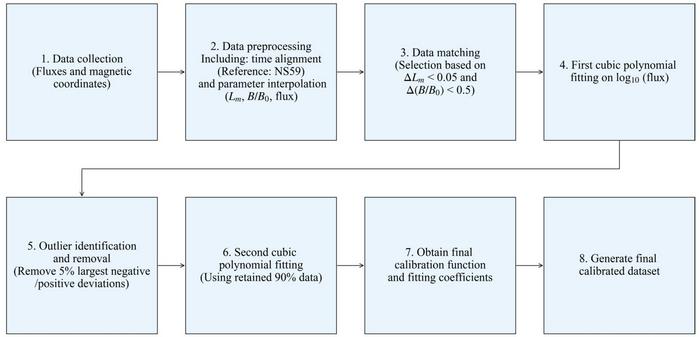
A team led by scientists from Beihang University and the Chinese Academy of Sciences has now tackled this long-standing problem. Their findings, published (DOI: 10.1186/s43020-026-00203-1) on July 6, 2026, in the journal Satellite Navigation, demonstrate a robust method to harmonize energetic electron measurements across the GPS constellation. Taking the 2.0 MeV differential fluxes and the ≥2.0 MeV integral fluxes as test cases, the researchers established a calibration framework that can be extended to all energy channels, providing a consistent foundation for radiation belt modeling and space weather forecasting.
The team chose NS59 as the reference satellite due to its extensive data record and significant temporal overlap with most other GPS satellites. Using a magnetic-coordinate conjunction method—matching observations at the same (Lm, B/B₀) positions—they applied a two-step cubic polynomial fitting to log-transformed flux data. The first fit established an initial relationship; then, the lowest and highest 5% of data points were discarded to eliminate outliers before a second fit produced the final calibration curve. For the 2.0 MeV differential fluxes, the root-mean-square deviation (RMSD) improved by a factor of 3.08 on average, while correlation coefficients (CC) increased by 14%. The ≥2.0 MeV integral fluxes showed RMSD improvements of 1.68-fold. Notably, satellites NS41 and NS48—which carry different detector types—showed dramatic improvements: NS48's RMSD dropped from 3.79 to 0.107, and its CC jumped from 0.255 to 0.992. However, NS74 remained problematic even after calibration, with persistently scattered data, leading the authors to recommend against its use.
"The GPS constellation has been an underutilized treasure trove for radiation belt science," the authors said. "By establishing this calibration framework, we've essentially turned 25 individual sensors into one cohesive, long-term observatory. The improvement is most striking for satellites that previously looked like outliers—now their data falls neatly into place. This isn't just about fixing numbers; it's about giving the space weather community a reliable, decades-long record that can finally be used with confidence for forecasting and anomaly studies."
The calibrated dataset spans 2000 to 2020, covering two complete solar cycles and providing an unprecedented resource for studying the long-term dynamics of relativistic electrons in medium Earth orbit (MEO). This work lays the groundwork for extending the calibration to all remaining energy channels—14 differential and 29 integral channels—and the methodology has already been applied to cross-calibrate GPS data with BeiDou and Van Allen Probes observations. For satellite operators and space weather forecasters, this means more accurate predictions of electron flux enhancements that can damage electronics and disrupt missions. The study also offers a template for calibrating data from other satellite constellations, potentially revolutionizing how we monitor and model the hazardous particle environment in Earth's radiation belts.
This work was funded by the China Postdoctoral Science Foundation 2025M784268, the National Natural Science Foundation of China Grants 42441809, the National Natural Science Foundation of China Project U2106201, and the NSFC Regional Innovation and Development Joint Fund U25A20784.
Satellite Navigation(ISSN: 2662-1363; ISSN: 2662-9291) Satellite Navigation is the official journal of the Aerospace Information Research Institute. The aims to report innovative ideas, new results or progress on the theoretical techniques and applications of satellite navigation. The journal welcomes original articles, reviews and commentaries.
Scientists have painted the most detailed portrait yet of the planetary system orbiting Barnard’s Star – the Sun’s closest neighbour after Alpha Centauri, just under six light-years from Earth.
Discovered in 2025, the four planets orbiting Barnard’s Star are all smaller than Earth and Venus, but larger than Mars – a type of planet not found anywhere in our own Solar System.
By analysing the chemical make-up of the star, the researchers, from the University of Cambridge, found that its planets are rich in a rare mineral called periclase, which on Earth is only found hundreds of kilometres below the surface.
“Barnard’s Star has an enormous amount of the element magnesium compared to other stars, so its planets are likely to be rich in magnesium too,” said lead author Xander Byrne from Cambridge’s Institute of Astronomy. “On Earth, that magnesium goes into making minerals called olivines, which are really important for storing water within the planet.”
On the Barnard’s Star planets, however, the researchers found that the abundance of magnesium creates huge quantities of periclase, which does not store water as well. To make matters worse, they found the chances of Bernard’s Star’s planets having atmospheres to be unlikely.
“These planets were always going to be hostile, because they’re really close to their star” said Byrne, “Even the outermost planet orbits ten times closer than Mercury orbits the Sun. When you’re that close to your star, and have such little gravity, your atmosphere just gets blown off.”
The researchers say that the planets could have held on to their atmospheres for at most two billion years – much shorter than the system’s 10-billion-year age. Their results are reported in the Monthly Notices of the Royal Astronomical Society.
Being so close to the star has another consequence for the planets: the researchers found that the planets are all tidally locked. In the same way that the Moon only shows one face to the Earth, the Barnard’s Star planets each only show one face to their star. As a result, each planet has one hemisphere locked in eternal daylight; the other, eternal night.
Planetary systems as compact as the one around Barnard’s Star are often unstable, with gravitational interactions between the planets sometimes leading to them colliding, falling into the star, or being ejected from the system.
However, the researchers found that a phenomenon called orbital resonance might be helping to stabilise the Barnard’s Star system. The lengths of the ‘years’ of the inner three planets are in a 9:12:16 ratio: musically, this is equivalent to two consecutive perfect fourths. These orbital harmonies are responsible for stabilising the orbits of the moons of Jupiter, and may be protecting the Barnard’s Star system from gravitational disarray.
Upcoming missions, such as the European Space Agency’s Plato mission, may find many more small planets like those around Barnard’s Star.
“Larger planets are much easier to detect than small ones, so we know about very few sub-Earth planets like the ones in this system,” said Byrne. “But the sensitivity of these new missions will help to reduce this bias, allowing us to discover more and more planets that are small and rocky, like Earth.”
Although the Barnard’s Star planets are extremely uninhabitable, the team say that their analysis linking the compositions of the star and planets could be an important consideration in determining whether other planets could support life.