Sunday, August 23, 2026

Overflowing Bins in Bethlehem Tell a Bigger Story

They are telling the story of a city under pressure, a story of institutions struggling to maintain essential services, a story of workers trying to do their jobs under increasingly difficult circumstances.
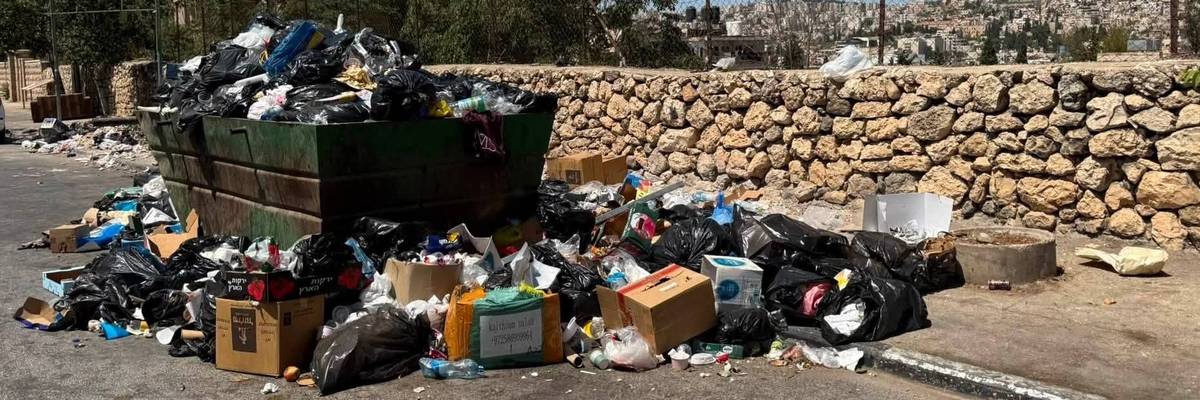


A waste collection point overflows in Bethlehem.
(Photo by Mahmoud Ibrahim)

Mahmoud Ibrahim
Aug 23, 2026
Common Dreams

The world knows Bethlehem as the city of the Nativity. It is a city of churches, olive groves, ancient stone streets, and a history that attracts pilgrims and visitors from across the globe. For many, Bethlehem symbolizes peace, hope, and human resilience.

Yet in recent weeks, another image has emerged. Overflowing garbage containers. Piles of waste left uncollected for days. Unpleasant odors drifting through neighborhoods. Stray dogs searching through torn plastic bags. Flies, rodents, and growing public concern about health and sanitation.

For residents, these scenes are disturbing. For visitors, they are difficult to reconcile with the image of one of the world’s most recognized and beloved cities. But the garbage accumulating in Bethlehem’s streets is not the real story. It is merely the most visible symptom of a much larger crisis. The question is not why a container is overflowing. The question is what happened to the system behind it.

At first glance, it may seem like a simple municipal problem. A shortage of fuel. A broken truck. Workers on strike. Delayed collection rounds. The reality is far more complicated.

The environment does not understand politics. It understands only what we do—or fail to do—to protect it.

Waste management depends on an entire chain of institutions, workers, vehicles, roads, fuel supplies, disposal facilities, municipal revenues, and public cooperation. When enough pressure is placed on that chain, it begins to break. And in Bethlehem, pressure has been building for years.

The city has suffered repeated economic shocks. The tourism sector, once a major source of income, was devastated by the Covid-19 pandemic. Before it could fully recover, the war and the broader economic crisis brought new hardships. Businesses struggled. Workers lost jobs. Household incomes declined. Many families found themselves prioritizing food, rent, and basic necessities over municipal fees.

As revenues declined, local institutions found it increasingly difficult to sustain essential services. At the same time, operational costs continued to rise. Fuel became more expensive and, at times, harder to secure. Vehicles required maintenance. Equipment aged. Service providers struggled to balance growing needs with shrinking resources.

The crisis does not stop there.

Road closures, military gates, and movement restrictions have increasingly complicated daily life throughout Bethlehem Governorate. What should be a routine collection route can suddenly become longer, slower, or more expensive. A delayed truck today may become an overflowing container tomorrow.

Even the final destination of the waste is not immune from these pressures.

The Al-Minya landfill, which serves communities in southern parts of the West Bank, represents a critical component of the region’s waste management system. Any disruption affecting access, transportation, security, or operations along this chain eventually reaches the streets of Bethlehem and surrounding communities.

The result is a problem that residents experience every day. A container left uncollected. A street corner filled with waste. A smell that lingers in the summer heat. A growing sense that something is no longer working as it should.

When waste accumulates, the consequences extend beyond appearance.

Overflowing garbage attracts stray dogs, insects, rodents, and other disease vectors. It increases environmental risks and can create fire hazards during hot weather. It affects public health, community well-being, and the quality of life in neighborhoods already facing multiple challenges.

This is why waste management should never be viewed as a secondary service. It is not simply about removing garbage from the street. It is about protecting public health. It is about preserving human dignity. It is about maintaining the environmental quality of cities and communities. It is also about protecting the people who perform this difficult work.

One night, at around 2:00 am in the morning, I drove into Bethlehem to take my wife to catch an early bus to Allenby Bridge Boarder with Jordan. While most of the city slept, sanitation workers were already on the streets. Wearing reflective orange uniforms, they swept roads, emptied containers, and loaded waste onto trucks. Few residents would ever see them. By sunrise, most traces of their work would have disappeared.

Their presence reminded me that waste management is not an abstract system. It depends on real people working under difficult conditions, often exposed to hazards that most citizens never think about.

But workers alone cannot solve this crisis, neither can municipalities, nor can citizens. Responsibility is shared.

Citizens must reduce the waste they generate, support cleaner public spaces, and contribute to the sustainability of essential services whenever possible.

Municipalities and service providers need stronger planning, better resource management, and long-term financial stability.

National institutions must support local governments struggling under extraordinary economic and political pressures.

And international partners should recognize that environmental services are not luxuries. They are fundamental to public health, social stability, and human dignity.

There is another reason this issue deserves greater attention. Pollution does not recognize borders. Smoke from burning waste does not stop at a checkpoint. Contaminated water does not respect political divisions. Air pollution travels wherever the wind takes it.

The environment does not understand politics. It understands only what we do—or fail to do—to protect it. That is why environmental protection requires cooperation, shared responsibility, and long-term vision.

Bethlehem does not simply need more garbage trucks or more containers. It needs investment in sustainable solutions. It needs stronger institutions. It needs public awareness. It needs serious efforts to reduce waste generation, expand reuse and recycling, and create economic opportunities through a circular economy approach.

Most importantly, it needs recognition that environmental challenges are not isolated technical problems. They are deeply connected to economic conditions, governance, public services, and the daily lives of ordinary people.

The overflowing containers seen today across Bethlehem are telling a much bigger story. They are telling the story of a city under pressure, a story of institutions struggling to maintain essential services, a story of workers trying to do their jobs under increasingly difficult circumstances, a story of economic hardship, environmental vulnerability, and a community searching for sustainable solutions.

And perhaps they are also reminding us of something simple: Garbage does not appear overnight. Neither do environmental crises. Both are the result of problems left unresolved for too long.

If Bethlehem is to remain the beautiful city that the world knows and cherishes, addressing those problems can no longer wait.


Our work is licensed under Creative Commons (CC BY-NC-ND 3.0). Feel free to republish and share widely.


Mahmoud Ibrahim
Mahmoud Ibrahim is a Palestinian humanitarian and environmental professional based in the Bethlehem area of the occupied West Bank, Palestine.
Full Bio >


‘Palestine Is Being Erased Before Our Eyes’: 100 Former French, British Diplomats Say End Weapons Sales, Trade With Israel


The abuses by the Israeli government and military are “a stain on the conscience of humanity, requiring the UK and France to act.”
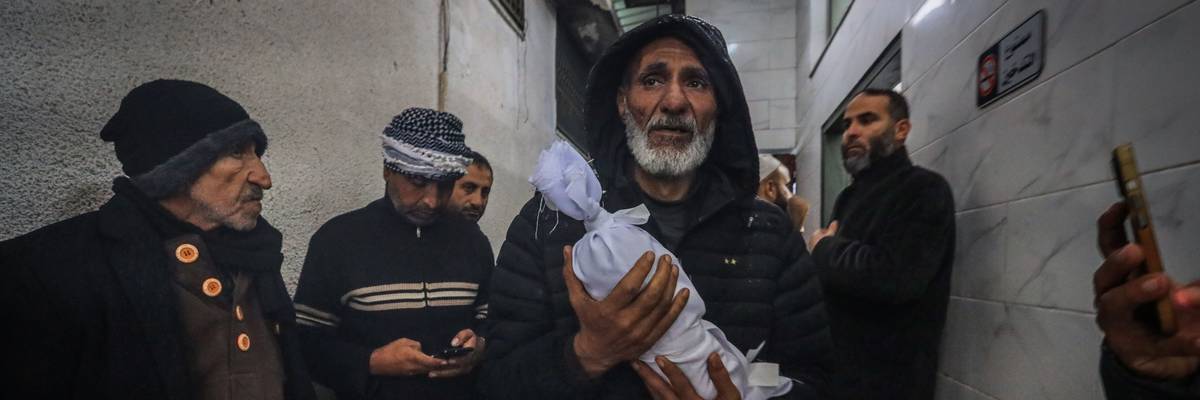


Palestinians mourn for a three-month-old baby named Tim El Khavaja, who lived in a tent in the Shati Camp lost his life due to cold weather conditions in northern Gaza Strip, Gaza on December 12, 2025. The body of the baby was brought to Al-Shifa Hospital in Gaza City for funeral arrangements.
(Photo by Hamza Z. H. Qraiqea/Anadolu via Getty Images)

Jon Queally
Aug 23, 2026
COMMON DREAMS

While critics of the French and British governments say they are doing too little to confront the crimes and human rights violations of Israel against the Palestinian people, about 100 former diplomats of the two nations penned an open letter published over the weekend agreeing that much stronger actions must be taken to end the atrocities taking place in both the Gaza Strip and Occupied West Bank.

Published in Le Monde on Saturday, the joint op-ed by the former UK and French ambassadors and foreign diplomats argues that because their two nations “played a decisive role in the shaping of the Middle East,” it is incumbent upon them to “make common cause over the region’s fundamental faultline: equal rights for Israelis and Palestinians”—a dynamic grossly lacking as Palestinians are starved and bombed in Gaza, with their rights endlessly under assault in the West Bank.

According to the letter:
In Gaza, two million Palestinians are kettled into 30% of their devastated land, hungry, lacking medicine and housing. Over 1,200 Palestinians have been killed since the so-called “ceasefire” of October 2025. In East Jerusalem and the rest of the West Bank, Palestinian house demolitions and rampant settler violence—with the connivance of the Israeli army and police—amount to ethnic cleansing. Palestine is being erased before our eyes.

This policy of occupation and destruction extends to Lebanon—where many villages have been razed—and Syria. It is a stain on the conscience of humanity, requiring the UK and France to act.


While human rights groups have steadfastly demanded accountability for Israel—including tougher sanctions, suspension of trade agreements, a halt to weapons transfers, and enforcement of rulings by the International Court of Justice (ICJ) and proceedings at the International Criminal Court—for its ongoing criminal behavior against the Palestinians, European governments, the United States, and other western allies have resisted such calls.

While noting that much can be done to help Palestine become “a fully functioning democratic nation,” the letter from the former diplomats makes a call for seven specific action designed to end Israeli impunity and bring the government back into compliance with international law. The policy recommendations directed at the UK and French governments are:Uphold the decisions of the International Court of Justice and the International Criminal Court;
Suspend the EU-Israel Association Agreement and the UK-Israel Trade and Partnership Agreement for breach of human rights provisions;
Suspend arms transfers to and from Israel and all bilateral military cooperation;
Insist on unrestricted aid access to Gaza, led by UNRWA, other UN agencies and international NGOs, with consequences for non-compliance; access too for journalists, diplomats and parliamentarians;
Ban all trade with settlements, including goods, investment, insurance and other financial services;
Warn potential bidders for the red-line “E1” area [east of Jerusalem, in the occupied territories] or other settlement financing/construction that their interests in and with our countries will suffer;
Make it an offense for our citizens to buy property on stolen Palestinian land and remove charitable status from “charities” funding settlements.


Nicholas Hopton, a former UK ambassador to Iran, Qatar and Yemen and one of the signatories of the letter, said that the language they used was not invented by the diplomats themselves.

“The words are not our own,” Hopton explained to Al Jazeera. “They are taken from the international legal bodies, the UN, those who have been observing from a neutral position and with expertise.”

What’s key to understand, said Peter Millett, a former British ambassador to Libya who also signed the letter, is that what the signatories are asking for “is action, not words.”

Foreign ministers of the France and Britia “over the last few months and years have issued statements of criticism, of condemnation and so forth,” Millett told Al-Jazeera, “but as the letter makes clear, this is the time now where we need to see action on trade, action on settlements, more support for aid to go into Gaza, and the ending of the arms trade.”

At the heart of the letter is the idea that world leaders, whether in Europe or elsewhere, must now act aggressively to bring the suffering of the Palestinians to an end and bring Israel’s violations and abuses to a halt.
"These proposals reflect our shared values—international law and equal rights—which are in our interest," the letter concludes. "Where there is no law, none of us is safe."
‘Appalling and Fundamentally Dishonest’: Ruffalo Rejects Antisemitism Charges by Paramount Amid Merger Warning

“Now is the time to dive boldly into all these issues,” said the Avengers actor and social justice activist, “not step back or concede.”


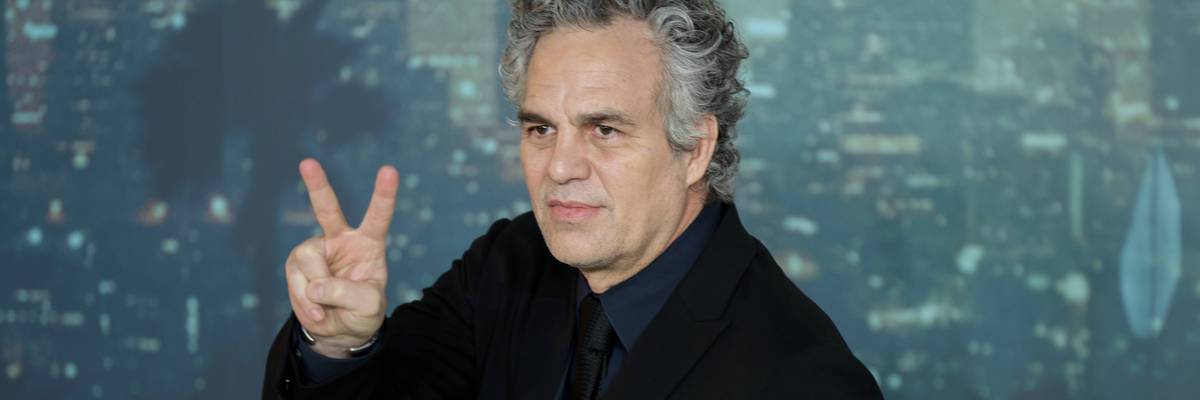
LONDON, ENGLAND - JANUARY 28: Mark Ruffalo attends the "Crime 101" UK gala screening at Odeon Luxe Leicester Square on January 28, 2026 in London, England.
Photo by Simon Ackerman/Getty Images

Jon Queally
Aug 23, 2026
COMMON DREAMS

Mark Ruffalo, the actor known worldwide for both his role as the Incredible Hulk in the Avengers movie franchise as well as his work as a dedicated humanitarian and voice for social justice, did not back down Saturday after his criticism of the pending merger between Paramount Skydance and Warner Bros. was cast as antisemitic by executives at Paramount, largely owned by billionaire Larry Ellison and run by his son, David.

While Ruffalo has been outspoken in his opposition to the Paramount-Warner Bros. deal for months—warning like many other critics that further consolidation by such media behemoths will hurt consumers, squeeze workers in the entertainment industry, minimize the range of viewpoints and creativity available, and further entrench right-wing control of the nation’s media system—what apparently sparked the accusation against him was the recent sharing of a years-old video clip of Paramount board member Safra Catz discussing “really profoundly scary technologies” that Oracle, which offers software and database services and the company upon which Larry Ellison built his vast wealth, provided to the Israeli military over recent years.

While the Instagram post Ruffalo shared has expired, the clip of Catz has been circulating on time for quite some time, seen as evidence of the close and well-documented ties that Oracle has had with the Israeli military:


In Ruffalo’s post, in which he reportedly warned that the Ellisons were “powering some of the most destructive and inhuman forces in the world,” he also made reference to the genocide in Gaza being carried out by the Israeli military as well as the apartheid under which Palestinians live in the Occupied West Bank.

“This merger has real consequences for real people, and for the entire country. Scrutinizing the Ellisons, including Oracle’s business built on data, surveillance technology and government contracts, and the serious threat to editorial freedom and the loss of a livelihood for thousands of families, is fair and necessary.”

Noting Catz’s comments in the video about Oracle, Ruffalo said, “This is the company that Larry Ellison is using to fund his son David’s Warner Bros acquisition.” And the “really profoundly scary technologies” that Catz mention, he continued “will most likely be merged into one of the largest media conglomerates in the world and one day used on you. Look how she revels in what we now have come to see as a genocide, which was built on an apartheid system of oppression powered by Oracle.”

In apparent reaction to Ruffalo’s post, which Variety characterized as the actor going “scorched earth on Paramount-Warner Bros. merger,” a spokesperson for Paramount issued a statement on Saturday saying that the company is “troubled when antisemitic tropes are invoked in purported service of a business dispute. Words like ‘genocide’ and ‘apartheid,’ applied to a corporate transaction, aren’t just wrong—they’re a bridge too far, and they cheapen the very real suffering those words are meant to describe. This doesn’t deserve a response in kind—and to be clear, we don’t tolerate prejudice of any kind, against anyone.”

But in a response to these accusation of antisemitism on Saturday, Ruffalo issued a new post on social media. It reads in full:
The accusation that I am antisemitic is appalling and fundamentally dishonest. Criticizing the actions of the Israeli prime minister, a military technology contract or the executives who supply it is not the same as criticizing Jewish people. This critical and necessary dialogue is then dishonestly framed as being anti-Israel. To be clear, my views come from my own political convictions and should never be interpreted as hostility toward Jewish people, for whom I have deep love and respect. Everything I know about acting, activism and humanism has been profoundly shaped by the Jewish friends, colleagues and loved ones who have been integral and family throughout every point of my life.

This merger has real consequences for real people, and for the entire country. Scrutinizing the Ellisons, including Oracle’s business built on data, surveillance technology and government contracts, and the serious threat to editorial freedom and the loss of a livelihood for thousands of families, is fair and necessary. The $111 billion deal would hand one family control over CNN, HBO and Warner Bros., backed in part by foreign money whose influence on editorial decisions has never been fully explained to the public.

Lawmakers on both sides of the aisle have called for serious national security review, and regulators still haven’t given the public a real answer. Until they do, the merger shouldn’t move forward. Now is the time to dive boldly into all these issues, not step back or concede.

Commentators on social media also came to Ruffalo’s defense, calling Paramount’s accusations nothing more than a smear against well-founded criticisms of Oracle’s business model, the crimes of the Israeli government, and warnings about what powerful, right-wing billionaires like the Ellison’s could do with what could become one of the largest media corporations on the planet.

“Despicable to call Ruffalo antisemitic,” said John Abrams, an entertainment editor. “Hi, I’m Jewish. I will be the one to tell you when something is antisemitic, you dishonest clowns. It is not antisemitic to decry Israel’s crimes. In fact, it is our moral obligation—as Jews, and as human beings.”

Journalist Mehdi Hassan called the accusations “truly cynical, shameless, and dangerous.”


“The Israel crybully lobby will try, as they always do,” wrote author and media critic Adam Johnson, “to make an example out of Ruffalo because he had the temerity and integrity to note the Ellisons’ open advocacy and financial support for a military every major human rights group on earth had determined committed genocide.”

“My unsolicited advice,” Johnson continued. “Don’t give these cynical assholes an inch. Don’t accept their ‘antisemitism’ shrieking as good faith.”

Noting that “Ellison put out a press release EXPLICITLY BOASTING about how his Paramount purchase would be good for Israel and his financial support for the IDF,” Johnson argued that somebody “cannot do this THEN CRY ANTISEMITISM when they are held responsible for the actions of the state and military they support.”
Defeating the Donroe Doctrine: Latin America Can Resist Trump’s Gunboat Racketeering

Performative violence—aka executions without trial at sea—overshadows how the administration is building a new US policy towards the hemisphere: acts of murder as a tool to create permanent structures of dominance and extraction.


A boat burns after being bombed by US forces in the Pacific Ocean on May 29, 2026.
(Photo by US Southern Command/screen shot)
Michael Paarlberg
Aug 22, 2026
Common Dreams

“American dominance in the Western Hemisphere will never be questioned again,” declared the State Department in a new video tying, somewhat improbably, the Monroe Doctrine of 1823 to killing people on boats in the Caribbean and Pacific 200 years later. Blowing up speedboats supposedly to stop fentanyl smuggling—which notably does not come to the US on speedboats—appears senseless. As a counter-narcotics strategy, it is ineffective, an assessment echoed by the DEA. The performative violence overshadows its role in building a new US policy towards the hemisphere: acts of murder as a tool to create permanent structures of US dominance and extraction.

Laid out in the December 2025 National Security Strategy (NSS), the “Donroe Doctrine” aims to restore US preeminence in a region where it has been eclipsed by China, convert security claims into exceptional military authority against “narco-terrorists,” institutionalize that authority through permanent commands, “enlist and expand” governments aligned with Washington, and use it to secure strategic and commercial access. The desired end: military cooperation, trade agreements, access to critical minerals and rare earths, likely accompanied by shady personal deals for the Trump family. Democratic backsliding, in a region where democracy is still relatively young, is a necessary condition for its success.

The Donroe Doctrine’s architecture is still under construction. Latin American governments can still resist Washington’s pressures, refusing to co-create his transactional order. Greater regional integration would rebalance that bargaining power, helping less powerful countries impose conditions, defend constitutional limits, reject particular operations, and withstand the costs of US pressure. More than 100 legislators, political leaders, and experts from 15 countries are gathering at the Third Pan-American Congress in Montevideo this weekend to strengthen regional collaboration, the basis for an alternate architecture to one premised on US domination.

- YouTube

Resistance to US coercion, however, also depends on democratic repair within the region. Governments captured by authoritarian leaders cannot provide a durable basis for sovereignty. Corruption erodes state capacity and public trust, making foreign military solutions more appealing. The Trump administration is betting on a hemispheric doctrine that favors authoritarian leaders, eager to share in corruption.

The Donroe Doctrine’s highest profile proof of concept began with airstrikes on boats off the coast of Venezuela, to the killing of fishermen in the Pacific—since revealed to be a covert CIA program—to August’s announcement of a new Joint Task Force-Western Hemisphere, establishing a standing headquarters for efforts to turn such extrajudicial killings into joint operations with allied governments. This maps onto the administration’s Shield of the Americas, a coalition of right-wing Latin American governments allied with the Trump administration. From the abduction of Venezuela’s President Nicolás Maduro to the boat strikes murders, all leaned on two forever wars framing and justification that long predated Trump: The War on Drugs and the War on Terror.

The Trump administration is betting on a hemispheric doctrine that favors authoritarian leaders, eager to share in corruption.

Targeting supposed smugglers, many of them probably fishermen, as “narcoterrorists” is a way to move trafficking from the framework of criminal law into the claimed authorities of war. Suspects become targets not of investigation but of immediate execution, secret assessments replacing due process and evidence in courts. The urgency of national security puts executive discretion over judicial authority. The boat strikes publicly declare exceptional authority of the executive. The Pentagon’s and CIA’s programs institutionalize it.

Like the War on Terror, this framing pictures an enemy and creates an industry to manage. It creates quid pro quo partnerships with other governments who leverage military cooperation into access to US foreign assistance, weapons, intelligence, and diplomatic cover for unsavory ends, whether domestic repression, corruption, or state murder of their own. With public opinion showing falling trust in all institutions but the military, stoking fears of all-powerful narcoterrorists serve mutual interests of reactionaries in Washington, Bogotá, and Tegucigalpa. The main risk is that it creates bureaucratic structures that outlive sitting administrations. With multilateral cooperation and institutions on the decline, this new military-industrial complex makes it nearly irreversible.

It also creates tools for meddling in domestic partisan politics. The success of Trump’s “Shield of the Americas” is predicated on Latin America’s continued turn to the right. Ecuador and Colombia have already agreed to “joint” military strikes on their territory, which are likely to become unilateral US strikes. Trump openly intervened in supporting the election of Nasry Asfura in Honduras, as it is currently doing with Flávio Bolsonaro in Brazil. That many of these allies are themselves tied to the drug trade is of little consequence: Colombia’s President de la Espriella made a career as a defense attorney for top narcos, Ecuador’s president Noboa’s family’s fruit business was found to be transporting cocaine, and Honduras’ former president Juan Orlando Hernández won a Trump pardon after his US conviction on drug-trafficking charges.

The project functions more easily where democratic foundations are weak and leaders face fewer constraints from citizens, legislatures, courts, and independent institutions, reflecting Trump’s own effort to weaken checks on executive authority inside the United States. Bukele in El Salvador provides a marquee case for using the specter of crime to consolidate a permanent “state of exception” and authoritarian rule. Such regimes can authorize operations, share intelligence, sign agreements, allocate land, and suppress opposition with less scrutiny.

Democratic scrutiny can expose the climate costs of extraction, contest land allocations and territorial interventions, demand transparency over contracts, and insist that resource wealth benefit the public. Corruption circumvents those checks by connecting external power with local gatekeepers able to transfer public resources and protect the bargain. The lack of transparency surrounding more than $13 billion collected by the United States from Venezuelan oil sales illustrates the scale of the accountability problem.

For the region, the emerging system depends on governments choosing to participate and institutions holding its authority. As progressives in the United States, we must challenge the false counternarcotics claims, unchecked lethal force, and waste of public resources sustaining this project, and hold our government accountable. Regional resistance and democratic repair must proceed together.


Our work is licensed under Creative Commons (CC BY-NC-ND 3.0). Feel free to republish and share widely.


Nancy Okail
Nancy Okail is the president and CEO of the Center for International Policy.
Full Bio >

Michael Paarlberg
Michael Ahn Paarlberg, Ph.D., is an associate professor of political science at Virginia Commonwealth University and an associate fellow with the Institute for Policy Studies who studies migration and security issues in Latin America and the US. He was previously a postdoctoral fellow with the Center for the Study of Ethnicity, Race and Immigration at the University of Pennsylvania. Paarlberg was the Chief Latin America Policy Adviser to the Bernie Sanders campaign in 2020. A former journalist for the Guardian, he regularly publishes his work in news outlets such as Foreign Policy, Slate, El Faro, and the Washington Post.
Full Bio >


US Progressives to Challenge Trump ‘Donroe Doctrine’ at Pan-American Congress


“We need to build a durable and lasting coalition of progressives that can take on the right-wing forces and answer them with the necessary call of the people,” said Congresswoman Pramila Jayapal.


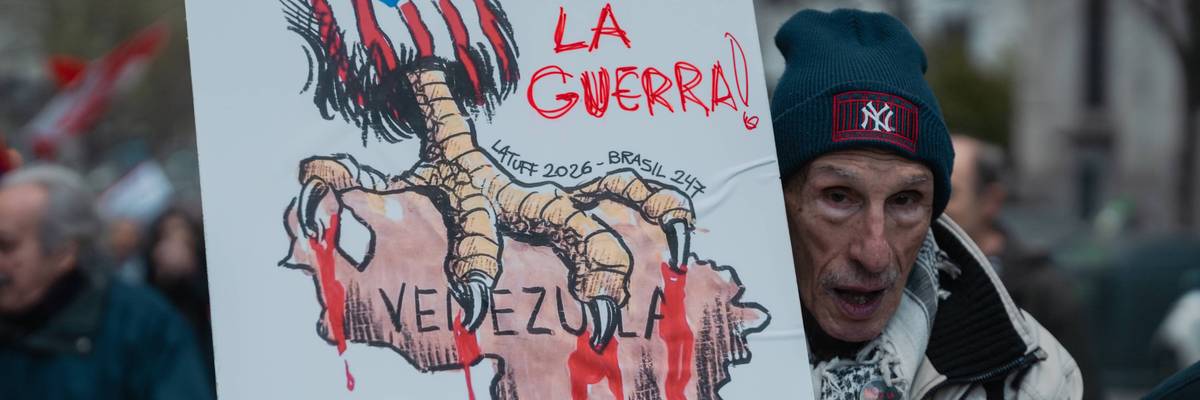
A protester holds a sign denouncing US aggression against Venezuela during a March 14, 2026 demonstration in Madrid.
(Photo by Olmo Blanco/Getty Images)

Brett Wilkins
Aug 17, 2026
COMMON DREAMS

A delegation of progressive congressional lawmakers and candidates is set to head to Uruguay this week to take part in a conference focused on Pan-American solidarity amid the resurgence of both US imperialism and right-wing governments in the hemisphere.

The third Pan-American Congress, to take place in the Uruguayan capital Montevideo, will bring together progressive legislators from North, Central, and South America and the Caribbean to discuss what organizers describe as hemispheric cooperation based on “solidarity between peoples” and “sovereignty among nations”—a vision sharply at odds with what critics have dubbed US President Donald Trump’s “Donroe Doctrine” militant imperialism.

The US delegation will be led by Rep. Pramila Jayapal (D-Wash.), joined by Rep. Jesús “Chuy” García (D-Ill.), Democratic congressional candidate Dr. Adam Hamawy of New Jersey, and three members of Democratic Socialists of America also running for Congress: Claire Valdez and Darializa Avila Chevalier of New York and Chris Rabb from Pennsylvania.

“We need to build a durable and lasting coalition of progressives that can take on the right-wing forces and answer them with the necessary call of the people,” Jayapal said in a video posted to social media.


Sen. Bernie Sanders (I-Vt.) is slated to address the conference remotely. Congressional Progressive Caucus Chair Greg Casar (D-Texas) will not attend but expressed his support for “pushing back against right-wing radicalization, tackling the climate crisis, and addressing our joint economic crisis.”

In an interview with El País published over the weekend, Japayal called the conference “an opportunity to hear from our Latin American counterparts about what is happening on the ground: how US foreign policy is affecting them and how we can work together to build a progressive movement and combat far-right disinformation. The United States is doing a lot of pain with our Donroe Doctrine.”

Jayapal is leading a letter signed by Sanders, Casar, García, and seven other progressive Democrats asking Secretary of State Marco Rubio “to answer for the regional implications of the ‘Trump Corollary’ to the Monroe Doctrine, and ground US foreign policy toward the Western Hemisphere on the principles of mutual respect and advancement of human rights.”

“The interventions conducted under the banner of the ‘Donroe Doctrine’ appear to follow a partisan playbook: the endorsement of favored candidates, the placement of political allies, the weaponization of tariffs and sanctions, and, where those fail, the application of direct military force,” the lawmakers wrote. “These are tactics that destabilize our hemisphere and endanger our neighbors.”


Two of the letter’s signatories, Reps. Nydia Velázquez (D-NY) and Delia Ramirez (D-Ill.), earlier this year introduced the New Good Neighbor Act, a bill inspired by the short-lived period when the Franklin D. Roosevelt administration pursued policies of nonintervention and improved diplomatic relations with Latin America in the 1930s.

Since returning to the White House just last year, Trump—who campaigned as the “peace president”—has bombed and invaded Venezuela to abduct President Nicolás Maduro and his wife, launched airstrikes against what he claims without evidence are drug-smuggling boats in the Caribbean Sea and Pacific Ocean, and deployed troops to Ecuador as part of a joint campaign against alleged drug gangs dubbed Operation Total Extermination.

Trump has also ordered the military to plan an invasion to seize the Panama Canal, threatened to “take” Cuba, possibly attack Mexico and Colombia, invade and annex Greenland, and somehow make Canada the “51st state.”

That’s just in the Western Hemisphere. Overall, Trump has bombed seven countries around the world since returning to the White House and 10 nations over the course of his two terms—including Iran, where he launched an increasingly protracted illegal war in concert with Israel.


Just last week, Ramirez dismissed as a “cheap piece of imperialist propaganda” a video published by the State Department hailing the Monroe Doctrine, which was cited to justify numerous US wars of aggression, conquest, destabilizing invasions, the overthrow of democratically elected governments, and support for pro-Washington military dictatorships.

Issued in December 1823 by President James Monroe as Spanish colonies in the Americas won their independence, the eponymous doctrine states that European powers should not establish new colonies or interfere politically in the independent states of the Western Hemisphere. While it was partly a response to European attempts to restore colonial rule in Latin America, the Monroe Doctrine also asserted US hegemony over the Americas.

According to John Coatsworth, a historian specializing in Latin America, the US has launched at least 41 interventions that successfully overthrew governments in the Americas since 1898. The number of US military interventions in the region is much higher.

Former Colombian President Ernesto Samper, who is attending the conference, told The Hill on Monday that the resurgence of right-wing leaders, including Abelardo de la Espriella in his country, is “leading us toward a form of neofascism.”

Samper said that Trump’s “hegemonic aggression” in the Americas shows that the hemisphere “deserves a progressive and sensible response, which I hope will emerge from this forum.”


102 Rights Groups Call on Rubio to Secure Release of US Citizen Sama Safi, Imprisoned in Israel Since June

“The Israeli military had no right to take Sama in the first place, let alone repeatedly hold her in such inhumane conditions.”


Sama Safi is seen in a family photograph.
(Photo courtesy of Safi family)

Julia Conley
Aug 18, 2026
C0MMON DREAMS

More than 100 faith-based and civil society groups are calling on US Secretary of State Marco Rubio to fulfill one of his department’s top obligations—protecting the security of US citizens abroad—by securing the “immediate release” of 20-year-old Sama Safi, an American psychology student who was violently detained by armed Israeli soldiers in the West Bank 77 days ago and has been held in a military prison ever since.

The Institute for Middle East Understanding (IMEU), one of the signatories of a letter sent to Rubio on Monday, emphasized that “The Israeli military had no right to take Sama in the first place, let alone repeatedly hold her in such inhumane conditions” as those she’s been subjected to.


Safi, a student at Birzeit University in the West Bank, was abducted from her family’s home in the occupied territory at 3:00 am on June 2, after Israeli Defense Forces soldiers broke down the door in a raid.

Safi and three other women who were abducted on the same night have been accused of “hostile terrorist activity and additional terrorist-related activities” due to alleged involvement with a student group, but Safi has not been charged with any crimes.

Despite that, the groups said, “the Israeli military has illegally transferred Sama out of the West Bank to the Damon Israeli military prison near Haifa, which amounts to a grave breach of Article 147 of the 4th Geneva Convention.”


Article 147 bans the unlawful transfer, deportation, or confinement of protected persons from an occupied territory to the territory of the occupying power, and constitutes a war crime, wrote the groups, which include the Council on American Islamic Relations, Jewish Voice for Peace, and the Center for Constitutional Rights.

The groups also emphasized that Safi has been arbitrarily detained for nearly three months while suffering a severe chronic complex health condition, putting her “at risk of rapid deterioration without specialized ongoing care abroad.”

“Interruption of Sama’s specialized care abroad places Sama at high risk of clinical deterioration, severe inflammatory relapse, progressive organ damage, hospitalization, and potentially life-threatening repercussions,” said the groups.

Her condition causes “fevers up to 105°F and requires daily medication and a quarterly injection she travels abroad to receive,” Drop Site News reported in June.

The letter included a statement from Safi in which she described being “shackled, blindfolded, driven around for several hours” on the night she was abducted.

“I was given no food or water for the first 24 hours,” she said. “I was subjected to repeated verbal abuse... I was blindfolded, shackled, and placed in painful stress positions.”

Israel’s military prisons have been called a “network of torture camps” by the Israeli human rights group B’Tselem, and human rights groups and the United Nations have documented the widespread use of torture against Palestinians in the prisons, including sexual abuse and denial of medical care, food, and water.

According to Drop Site News, a new report released Monday by the Palestinian Prisoners’ Society found that at least 10 Palestinian women at Damon prison have contracted scabies “amid overcrowding, poor ventilation, and shortages of basic supplies.

“Sama has always been fascinated by people, and her deep love for others is what led her to study psychology,” reads the letter. “Sama just celebrated her 20th birthday in April. She should be focusing on building her future, not being unjustly abducted by the Israeli military and enduring this nightmare.”

Nearly 10,000 “security” inmates are being held in Israeli prisons as of this month, according to the human rights group HaMoKed.

Last week, Israeli forces abducted 46-year-old Hussein Jabarin, a US citizen, from his family’s home in the West Bank. He was detained for several days before being released Sunday.

Another American citizen, 16-year-old Mohammed Ibrahim, spent nearly 10 months in an Israeli prison last year after being detained for allegedly throwing rocks at vehicles. He was not permitted to speak to his family the entire time he was imprisoned.

“This is how adversaries, not allies, act,” said Anthony Zenkus, a professor at Columbia University, of Safi’s abduction.
Conservationists Back Crowley in Wisconsin Over ‘Extremist Pro-Corporate Polluter’ Tiffany

“Tom Tiffany has put corporate profit ahead of local communities time and again.”


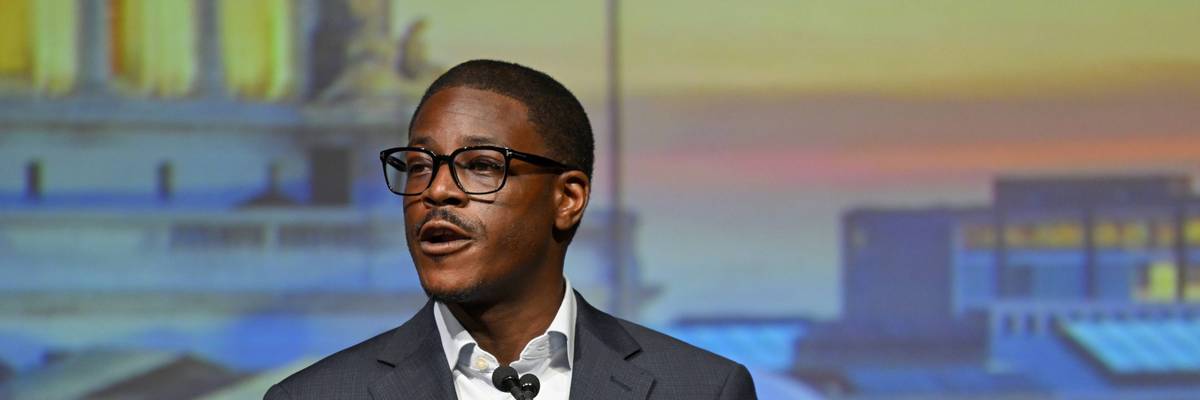
Wisconsin gubernatorial candidate David Crowley speaks onstage during Wisconsin Democrats’ 2026 Convention on June 14, 2026 in Madison, Wisconsin.
(Photo by Daniel Boczarski/Getty Images for WisDems)

Jake Johnson
Aug 18, 2026
COMMON DREAMS

The advocacy group Wisconsin Conservation Voters on Monday endorsed Milwaukee County Executive David Crowley in the state’s closely watched gubernatorial contest, arguing he is the obvious choice over “extremist pro-corporate polluter” Tom Tiffany, who has recently attempted to posture as anti-data center despite his voting and fundraising record.

“The momentum across Wisconsin is clear—voters are ready for leaders who will hold corporate polluters accountable, stand up to corporate greed, regulate data centers, and protect our natural resources,” said Seth Hoffmeister, deputy director of Wisconsin Conservation Voters (WCV). “David Crowley has proven he understands the struggles of Wisconsin families. From cutting Milwaukee County’s carbon footprint in half to taking a firm stand against predatory data center growth, David is the leader we need to protect our environment and keep energy bills affordable.”

By contrast, according to WCV, Tiffany—who currently represents Wisconsin’s 7th Congressional District in the US House—has shown “a consistent pattern of prioritizing corporate interests, out-of-state polluters, and special interests over regular Wisconsinites.”

“Tiffany’s record is toxic,” the group said. “He took $75,000 from mining interests in exchange for introducing an open-pit mining bill. He voted to defund the Knowles-Nelson Stewardship Program—a popular and effective bipartisan conservation program. He gutted the [Wisconsin Department of Natural Resources’] scientific authority, and he voted for budget legislation that raised healthcare and electricity costs. Tom Tiffany has put corporate profit ahead of local communities time and again.”

The conservation group’s endorsement of Crowley came on the same day that Tiffany released an ad attacking Crowley’s position on data centers, part of a broader effort by the Tiffany campaign to take advantage of widespread voter backlash against the energy-devouring facilities.

But Tiffany’s critics and the Crowley campaign say the Republican nominee is obscuring his own record and misrepresenting the views of his Democratic opponent on an issue that has captured the attention of communities in Wisconsin and across the US.

Tiffany—who, like Crowley, opposes a moratorium on new data center construction—has characterized the facilities as “exciting new technology,” suggested they are necessary to compete with China, and voted as a member of Congress in favor of budget legislation that included a 10-year ban on state-level artificial intelligence regulations. (The US Senate later stripped the ban from the bill.)

Tiffany pledged on Monday that, if he wins in November, every proposed data center project in Wisconsin would have to meet “strict environmental standards,” despite his putrid voting record on environmental issues.

Crowley, unlike Tiffany, devotes a section of his website to data center policy.

“As governor, I will let communities decide for themselves whether they want a data center at all—and if they say no, that decision would be honored,” Crowley’s website states.

If a local community opts to support new data center construction, Crowley said he would require the developer to eschew non-disclosure agreements that hide the details of the project, fully cover the “costs of infrastructure and grid upgrades,” build with union labor, and contribute to a fund aimed at bringing down Wisconsinites’ utility costs.

“Wisconsinites are looking for practical solutions to real challenges, like rising utility rates and unsafe drinking water,” Hoffmeister of WCV said Monday. “David Crowley will put our communities first and advocate for policies that make our state cleaner, safer, and more affordable.”
Iran Denounces Trump as ‘Delusional’ for Posting False Strait of Hormuz Map

The Iranian Parliament speaker said the strait will stay closed until the US blockade and oil embargo are lifted, and any party continuing its “aggression or threats” would face a “more severe defeat.”


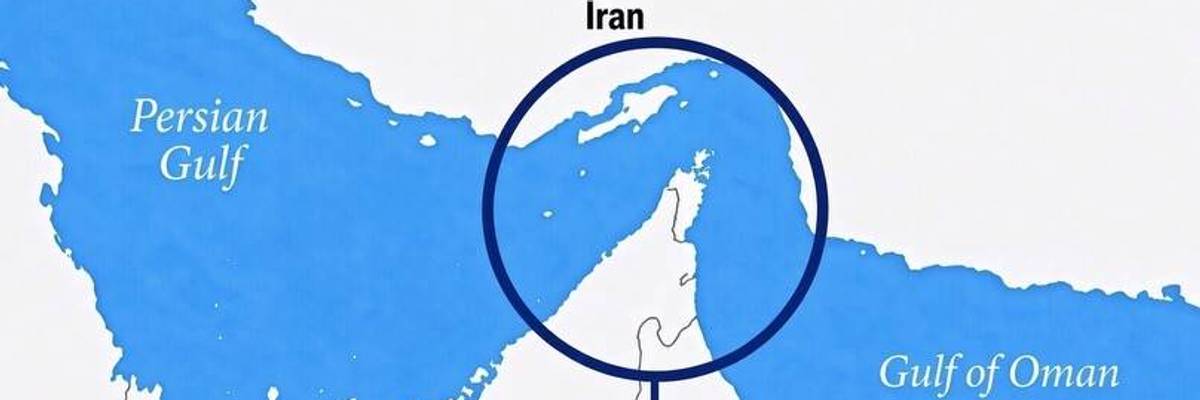
President Donald Trump shared this map labeling the Strait of Hormuz a “new US territory” on his Truth Social platform on August 18, 2026.
(Image by Donald Trump/Truth Social)

Jessica Corbett
Aug 18, 2026
COMMON DREAMS

Just days after threatening to declare the Strait of Hormuz a US territory, President Donald Trump on Tuesday posted a map on his Truth Social platform with that label over the crucial waterway—and was swiftly called out by a top Iranian diplomat.

“Just as Trump correctly wrote the name of the Persian Gulf, his illusion about the Strait of Hormuz will soon be corrected—or we will correct the delusions of this delusional individual,” Iran’s deputy foreign minister, Kazem Gharibabadi, responded in Arabic on X.

Gharibabadi included a screengrab of Trump’s post featuring a map that shows the strait, which is south of Iran and runs between the Persian Gulf and Gulf of Oman.


Since Trump and Israel began illegally bombing Iran on February 28, the Middle East country has restricted traffic through the strait, a key shipping route, particularly for fossil fuels. That has driven up fuel prices worldwide, including in the United States, where the cost for a gallon of gasoline just hit a record high for mid-August.

Despite the economic toll at home, the range of impacts across the Middle East—where nearly six months of war have killed thousands of people—and a plummeting approval rating, Trump said last week that “I’ll never apologize, I did the right thing.”

That declaration and Trump’s threat over the strait came in a Friday speech on Long Island, after which critics across the United States and beyond condemned the president as a “completely unhinged lunatic” and “sadistic violent menace to the world” who ought to be impeached again.

By Monday, a 60-day ceasefire deal expired, and neither side has signaled any progress on talks to end the war—which Trump claims is aimed at stopping Iran from building nuclear weapons, even though his own intelligence agencies have said it wasn’t trying to do so. Trump notably ditched the Obama administration’s Iran nuclear deal during his first term.

According to Palestine Chronicle, Iranian Maj. Gen. Mostafa Izadi, deputy commander-in-chief of the Islamic Revolutionary Guard Corps, said Tuesday that “the enemy failed to destroy Iran’s defensive capabilities and nuclear industries.”

As for the strait, Iranian Parliament Speaker Mohammad Bagher Ghalibaf said that it will stay closed until the US blockade and oil embargo are lifted, and warned that any party continuing its “aggression or threats” would face a “more severe defeat.”
‘Flashing Red Warning Sign’ for Lawmakers: Poll Shows Voters Reject US-Israel Military Integration

“It is the height of absurdity that Congress is even considering a proposal to become more entangled with the Israeli military and use our tax dollars to subsidize their weapons companies.”


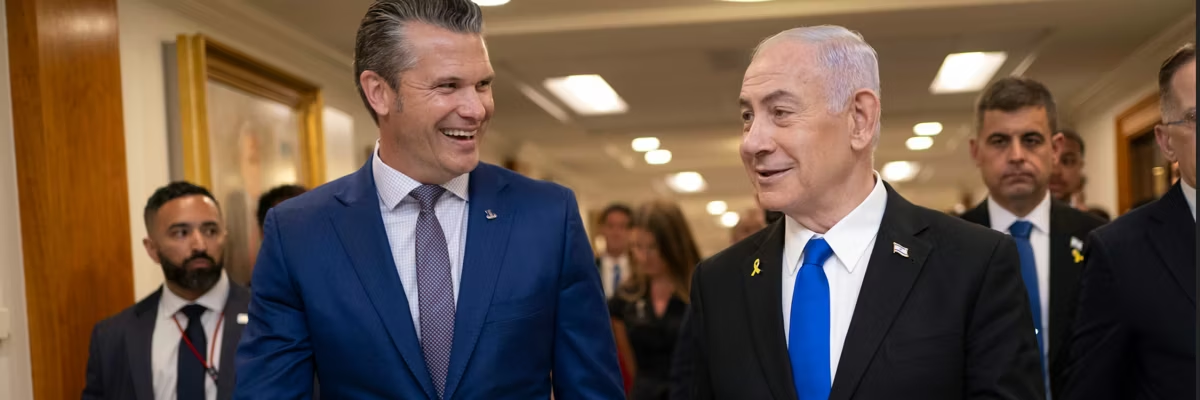
US Defense Secretary Pete Hegseth walks with Israeli Prime Minister Benjamin Netanyahu prior to a meeting at the Pentagon in Washington, DC on July 9, 2025.
(Photo by US Navy Petty Officer 1st Class Alexander Kubitza/Department of Defense)

Brett Wilkins
Aug 18, 2026
COMMON DREAMS

A new poll of US voters published on Tuesday offers a warning for congressional lawmakers backing a plan to deepen military ties between the United States and Israel, finding that a clear majority of voters oppose the proposal—which some critics have called “treasonous.”

The Data for Progress survey of 1,217 likely US voters—conducted August 3–7 for Demand Progress and the Institute for Middle East Understanding (IMEU) Policy Project—revealed that 61% of respondents oppose legislation in the National Defense Authorization Act (NDAA) for 2027 that would integrate Israeli weapons companies into the Pentagon at a level exceeding that of any other country. That figure rose to 78% among Democrats and 73% among independents.

“This poll is a flashing red warning sign for any member of Congress who supports the defense authorization bill,” Demand Progress senior policy adviser Cavan Kharrazian said in a statement. “A clear majority of voters do not support further integrating the Israeli military and Israeli military companies into the Pentagon, which the NDAA is set to do.”


The Republican-controlled House of Representatives voted last month 216-212, mostly along party lines, in favor of a record $1.15 trillion NDAA. The military spending bill contains Section 219, a provision that would create a US–Israel Defense Technology Cooperation Initiative, accelerating joint defense research, development, testing, and integration of technologies including artificial intelligence, missile defense, and counter-drone systems.

Reps. Thomas Massie (R-Ky.) and Ro Khanna (D-Calif.) submitted an amendment to strip Section 219 from the NDAA. The measure failed to pass.

Congresswoman Ilhan Omar (D-Minn.), who voted against the NDAA, described Section 219 as “an outrageous threat to our country’s security and autonomy.”

The Senate version of the military spending authorization bill has a related provision—Section 1217, the United States-Israel FUTURES Act—and the two chambers will need to reconcile their NDAA legislation before the final language is decided. Reconciliation is not expected to occur before November at the earliest.

“It’s time for Congress to listen to the American people for once, and not the same voices who always want to cut Israel a blank check,” Kharrazian said. That “blank check” has totaled more than $174 billion in non-inflation-adjusted aid since the modern state of Israel was founded in 1948.

The new poll found that 57% of respondents believe the Israeli military and Israeli weapons companies should not receive increased access to US military systems. Fifty-one percent said Israel benefits more from the US-Israel relationship, compared with just 12% who said the United States benefits more.

Although Republican voters support the Pentagon provision by a 16-point margin, when asked about it without additional context, they are considerably less enthusiastic about the idea of granting any foreign military special access, opposing it 62%-27%.

Forty percent of surveyed voters said they believe that the US-Israeli relationship is “too close,” compared with 42% who say it is “about right.” Among Democrats, 56% say relations are too close, versus just 23% who say about right. Twenty-two percent of Republicans and 43% of Independents said US-Israeli relations are too close.

Asked if they think President Donald Trump is too supportive of Israel’s right-wing government, 49% said yes, compared with only 33% who said the president is giving Israel the right amount of backing and just 8% who believe he’s not giving the key ally enough support.

Respondents’ views of Israel itself have deteriorated markedly, with 44% saying they now view the country less favorably than they did three years ago—compared with just 17% who say their views have improved amid the war of annihilation in Gaza that United Nations experts, human rights groups, and a South Africa-led case currently before the International Court of Justice call a genocide, as well as the wider Israeli occupation, colonization, ethnic cleansing, and apartheid in Palestine.

Looking only at the past six months, 41% of respondents said their view of Israel has become less favorable, versus 16% who say it has become more favorable. Among Democrats, the split is 56%-13%; among Independents it’s 42%-11%.

“Israel is a nation committing genocide that just dragged the American people into a disastrous war that is still hitting our pocketbooks,” IMEU Policy Project executive director Margaret DeReus said, referring to the Iran War. “Senators take an oath to do what is best for the American people above all; to uphold that oath, they must scrap this ridiculous proposal.”

“It is the height of absurdity,” DeReus added, “that Congress is even considering a proposal to become more entangled with the Israeli military and use our tax dollars to subsidize their weapons companies.”
‘Eight Million Americans Have Lost Their Healthcare’: Trump-GOP Cuts Wreak Havoc in All 50 States

New fact sheets detail how people in every US state are suffering from the Republican Party’s assault on Medicaid and the Affordable Care Act.


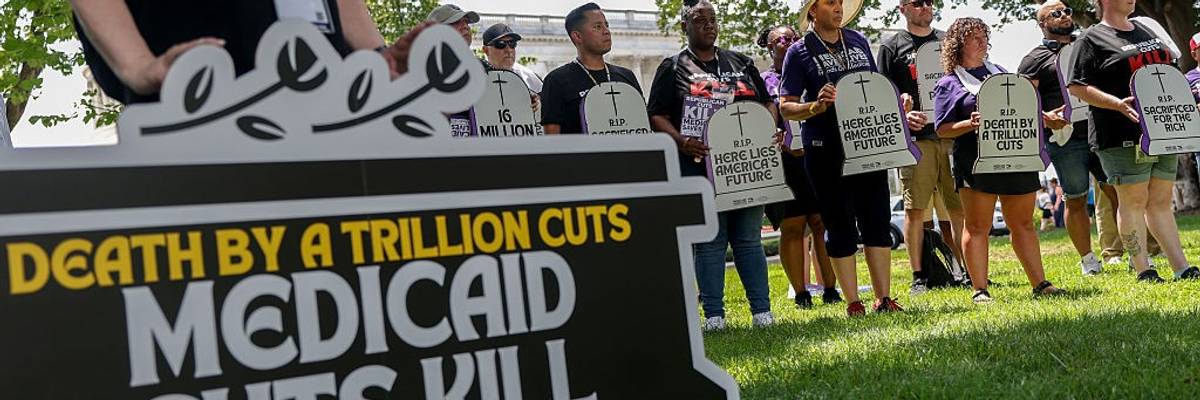
Workers protest Republican Medicaid cuts on June 23, 2025 in Washington, DC.
(Photo by Joe Raedle/Getty Images)

Jake Johnson
Aug 18, 2026
COMMON DREAMS

The unprecedented healthcare cuts that President Donald Trump and the Republican Party enacted last summer have impacted people in all 50 US states, stripping insurance coverage from around 8 million Americans total and wreaking havoc on hospitals and other providers nationwide.

The advocacy group Protect Our Care on Tuesday released state-by-state fact sheets detailing how many people have lost Medicaid, Children’s Health Insurance Program (CHIP), and Affordable Care Act coverage due to Republican policy decisions, including the party’s roughly $900 billion in cuts to Medicaid and decision to let enhanced ACA subsidies expire, sending premiums skyrocketing.


“Eight million Americans have lost their health care because Donald Trump and Republicans decided they would rather hand out tax breaks to billionaires than protect working families,” said Brad Woodhouse, the president of Protect Our Care. “Every day that healthcare becomes more expensive, a family is forced to make an impossible choice between putting food on the table and staying covered, a senior is forced to ration their medication, and an expectant mother has to travel farther to access maternity care.”

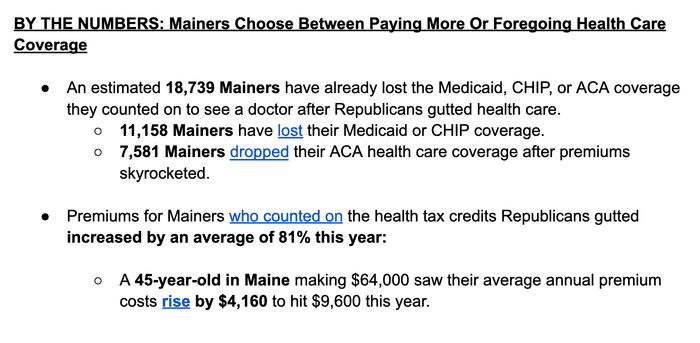
In Maine, where Democrats are looking to finally unseat vulnerable Sen. Susan Collins, more than 18,700 people have lost Medicaid, CHIP, or ACA coverage under the Republican budget law. Included in that total are the more than 7,500 Mainers who dropped ACA marketplace coverage after premiums soared due to the lapse of enhanced subsidies at the end of 2025.

Collins voted to advance GOP budget legislation that included the devastating Medicaid cuts, but voted against final passage.

Protect Our Care noted that “Maine hospitals and clinics are facing a $38 million loss in funding and a 6.7% spike in uncompensated care demand that will affect their ability to keep their doors open.”

“As of August 2026, 20 Maine healthcare providers are at-risk, announced cuts, are closing, or have closed,” the group added.


More than 25,600 Alaskans have lost health coverage under the Republican budget law and premiums have surged by an average of 346% this year, according to Protect Our Care’s fact sheets.

US Sen. Dan Sullivan (R-Alaska), who along with Collins is seen as one of the most vulnerable Republicans this election cycle, voted for the more than $900 billion in Medicaid cuts.

“From Alaska to Florida, these people are our neighbors, our parents, our kids, and they’re sick of paying the price for Republicans’ greed,” Woodhouse said on Tuesday. “They deserve better, and in November they will demand it at the ballot box.”
Over a Month After ICE Killing in Biddeford, Maine; Grieving Family Waits for Answers

“I ask only of God and of the justice system that my son’s case be brought to light, along with the cases of the many others who have had to go through something like this,” said the father of Johan Sebastián Durán Guerrero.


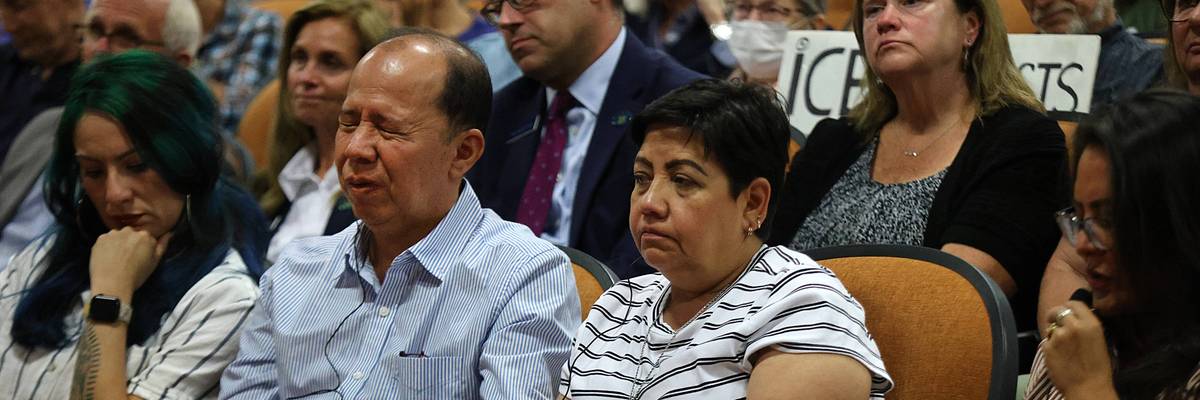
The parents of Johan Sebastián Durán Guerrero, Omar Durán and Dora Guerrero, attend a hearing at Biddeford High School on August 17, 2026.
(Photo by Suzanne Kreiter/The Boston Globe via Getty Images)

Julia Conley
Aug 18, 2026
COMMON DREAMS

With Republican lawmakers refusing to use their congressional authority to investigate a federal agent’s fatal shooting last month of Johan Sebastián Durán Guerrero in Biddeford, Maine, Democratic leaders assembled a “shadow hearing” on Monday at a local high school, where the 25-year-old’s grieving father was among those who spoke to a crowd of about 200 people and pleaded for answers about his son’s killing.

“The death of Johan Sebastián, under those conditions, at the hands of ICE, filled our community with fear and uncertainty,” said Omar Durán, referring to US Immigration and Customs Enforcement. “That is why I ask only of God and of the justice system that my son’s case be brought to light, along with the cases of the many others who have had to go through something like this.”

Durán Guerrero was at least the 11th person to be fatally shot by federal agents since President Donald Trump began deploying ICE and other agencies under the Department of Homeland Security (DHS) to cities and towns across the US to carry out his mass deportation operation.

Federal agents have shot at more than 20 people on US streets under the Trump administration; Durán Guerrero was among several who have been shot at while driving a vehicle, which is against ICE’s own policies.

Rep. Chellie Pingree (D-Maine) reported Monday that the ICE agents who were operating in Durán Guerrero’s neighborhood in Biddeford on the morning of July 13 were actually looking for his roommate, who owned the car he was driving.


Pingree said agents did not have a final removal order for the person who was the target of their operation, contrary to what DHS has said about the case.

“This shocking revelation in clear contradiction to what ICE and DHS have been saying about the operation raises fundamental questions,” Pingree said. “How is ICE deciding who to target and detain in Maine? What information are agents relying on?”

“If ICE cannot accurately determine a person’s immigration status or circumstance before taking enforcement action, that is a profound failure of competence and accountability,” the congresswoman added.

Even in cases where ICE has a deportation order for a person, agents are prohibited from using deadly force unless they have reason to believe the target of the operation poses an imminent threat to an officer’s or someone else’s safety.

An agent identified as David Michael Brouillette shot Durán Guerrero, who had a 3-year-old daughter with his partner, and DHS has claimed that the officer fired his weapon because Durán Guerrero was trying to flee and Brouillette feared “for public safety.”

The agents involved in the operation were not wearing body cameras that were turned on at the time of the shooting, but an eyewitness reported that Durán Guerrero said, “I tried to stop” when the officers pulled him out of his vehicle, bleeding profusely from his head. Surveillance footage taken from a nearby store showed a white car circling an intersection after the shooting before agents stopped it.

“If there were active body cameras on every law enforcement member who was participating there, we wouldn’t be looking at some scratchy videos from one store that’s over here, or one person that’s standing in their doorway that’s trying to get it,” Pingree said at a news conference after Monday’s hearing. “We would actually know every moment that’s happened at the scene.”

Durán Guerrero worked as a delivery driver and a cleaner at a veterinary clinic, and had a valid work permit and a pending asylum case.

A lawyer for Durán Guerrero’s family said state investigators have interviewed his partner, Karolina Rojas, but no federal agencies have ever contacted her following the killing.

“Any reasonable investigation would include interviewing the family and eyewitnesses,” the lawyer, Ben Gideon, said Monday.

DHS said after the shooting that its inspector general would investigate, but both the agency and the Justice Department refused to answer questions from The New York Times about whether the probe had begun.

The office of Maine Attorney General Aaron Frey is investigating the shooting, and is expected to present its findings to the Maine Deadly Force Review Panel. The panel can make recommendations to DHS, but it does not have jurisdiction over the federal agency.

Durán Guerrero’s parents traveled from his home country of Colombia for the shadow hearing. His mother did not speak publicly, while his father described the “deep pain” of hearing his young granddaughter ask where Durán Guerrero is.


“Our dream was always to be reunited and to hold each other again,” he said. “Today, that dream can no longer come true.”