Sunday, August 23, 2026

Trump's first Grand Prix DC race draws instant ridicule: 'Clowns need attention'

Bennito L. Kelty
August 22, 2026 
RAW STORY



The site of the Freedom 250 Grand Prix IndyCar series race in Washington D.C., U.,S., August 22, 2026. REUTERS/Aaron Schwartz

President Donald Trump's IndyCar race in Washington, D.C., drew early criticism and mockery as cars were still making their first laps.

On Saturday, drivers started doing practice, qualifying, and other preliminary races for the Freedom 250 Grand Prix, which Trump touted as D.C.'s first-ever IndyCar race. The marquee race, which Trump is expected to attend, will start on Sunday, but the negative reviews started coming in as the drivers raced on bumpy roads, and critics called out the administration for organizing the unsolicited event.

"Turning the National Mall into a race track for the Freedom 250 is a reckless spectacle that puts public spaces at risk because clowns need attention," blasted speaker and advocate Khary Penebaker.

Progressive political commentator Brian Tyler Cohen lamented, "They'll give us literally anything other than healthcare."

"Anyone who has ridden a bicycle in Washington, DC, could tell you this is a terrible idea," activist Alex Palombo wrote in response to a post by NASCAR racer and GOP congressional candidate Jerrod Sessler that noted the "VERY bumpy" track.


"No one in DC is happy about this," journalist Aaron Parnas added.


"August 2026. The streets are now a racetrack," lamented veteran and political commentator Mike Nelson.

Reacting to a post touting the event, Topher Spiro, a senior fellow at American Progress, asked, "Why do you think DC residents want anything to do with this? How much did this promotion cost?"

Reacting to a video from the track, author Erin Page joked, "I have genuinely driven faster through DC, come on now."


"This is any driver from the DMV area," writer Ashley Reese agreed.

"Now just add some MD drivers for the full DC experience," added writer Joe Flood.

Pollster Jake Rubenstein noted that the event is "not packed. But all the people seeing the actual track are blocked by the trees."


Potentially dangerous problem flagged ahead of Trump’s Freedom 250 Grand Prix

Alexander Willis
August 22, 2026 
RAW STORY


Aug 22, 2026; Washington, D.C., USA; A.J. Foyt Enterprises driver Caio Collet (4) races past the U.S. Capitol during practice for the Freedom 250 Grand Prix on the street circuit of National Mall. Mandatory Credit: Amber Searls-Imagn Images

Just hours ahead of President Donald Trump’s IndyCar race in Washington, D.C., NBC News’ Sahil Kapur flagged a potentially dangerous problem that could pose a risk to drivers.

Dubbed the Freedom 250 Grand Prix, the race has been touted by Trump as D.C.’s first-ever IndyCar race, with the president expected to attend. Drivers hit the course Saturday for practice and qualifying races, but as flagged by Fox Sports, already ran into trouble. A bump in the course sent a number of racers into a runoff area after briefly losing control of their vehicles, as seen in a video compilation shared by “IndyCar on Fox.”

“It’s not an authentic DC street track without bumps!” wrote Kapur, NBC News’ senior national political reporter, in a social media post on X Saturday night. “That said, this is a big one in a flat-out section that caused a bunch of IndyCar drivers problems today – and will be a thing in tomorrow’s race.”

Trump’s big race has already received scrutiny from countless critics, some of whom called the event a “terrible idea” given D.C.’s “very bumpy” roads.

Even former NASCAR driver Jerrod Sessler, a Trump-aligned ex-congressional candidate who lost his primary race earlier this month, warned that the race could pose serious issues for drivers.

“The BUMPS are most certainly going to be the talk of the Freedom 250 in DC,” Sessler wrote in a social media post on X. “The track is VERY bumpy! Not just bumps but cars jumping off the ground sort of bumps!”

The Freedom 250 Grand Prix marks the first-ever IndyCar street race held in the nation's capital, run on a 1.66-mile, seven-turn temporary circuit weaving past the U.S. Capitol and Washington Monument. Trump formally established the race through a Jan. 30, 2026, executive order directing the Departments of Transportation and Interior to designate a race route through the National Mall and surrounding city streets, in honor of the United States Semiquincentennial.



SHARIA HYSTERIA
Abdul El-Sayed claps back at JD Vance’s blatantly false attack: ‘Man, this guy is boring’


Alexander Willis
August 22, 2026 
RAW STORY


Abdul El-Sayed (right) appears on MS NOW, Saturday, Aug. 22, 2026. (Screengrab / MS NOW)

Democratic Senate nominee Abdul El-Sayed clapped back at Vice President JD Vance Saturday in response to a false claim the vice president issued earlier this week.

Speaking Friday at a steel plant in Ohio, Vance attacked El-Sayed over past remarks that the vice president both mischaracterized and fabricated.

“[El-Sayed] once argued not too long ago that criticisms of Sharia law were rooted in white supremacy,” Vance said, who went on to falsely claim that El-Sayed has said the United States “should have Sharia law,” which is a broad reference to religious law derived from the Quran, the central text of the Islamic faith

In 2022, El-Sayed criticized a 2010 ballot measure that sought to ban courts from considering Sharia law in its decisions, but mentioned “white supremacy” only in the context of criticizing broader efforts to “uproot Muslims Americans” and other marginalized groups in the United States. However, El-Sayed has explicitly come out against incorporating “faith laws into the laws of our country” and believes in separation of church and state.

El-Sayed has also never advocated for implementing Sharia law in the United States, and when asked to react to Vance’s comments during an appearance Saturday on MS NOW, El-Sayed smirked before answering.

“Every time JD Vance opens his mouth, the first two things I can think is, 'man, that guy is boring,' and second, Peter Thiel had to spend a ton of money to get that man elected – barely – in the state of Ohio,” El-Sayed said.

El-Sayed added that he took Vance’s shot “somewhat confusedly,” and characterized it as a misguided attempt to distract from the failings of the Trump administration.

“This is about trying to change the channel, they're trying to dissuade us from actually paying attention to the issues that we see laid bare when we talk about our kitchen table budget every single month,” he said.

“The question Michiganders are asking is not about my parents, it's not about Sharia law, it's about whether or not you can afford your groceries, your gas, whether or not you can see a doctor if you get sick.”


'Missing' Epstein files report spurs Dem to accuse Todd Blanche of illegal activity

Alexander Willis
August 23, 2026 
RAW STORY


Newly-released documents from disgraced late financier and sex offender Jeffrey Epstein, including a sheaf of entirely redacted pages, are seen in this handouts released by the U.S. Justice Department and printed and arranged for a photograph by Reuters in Washington, D.C., U.S., December 19, 2025. REUTERS/Jonathan Ernst

Rep. Ted Lieu (D-CA) openly accused Attorney General Todd Blanche of illegal conduct Saturday on the heels of a new report that an alleged trove of “missing” handwritten FBI notes related to Jeffrey Epstein had been sitting online for months, fully unredacted, and accessible to anyone.

The supposed notes stem from a 2019 FBI interview with a South Carolina woman who accused President Donald Trump and Epstein of sexually and physically abusing her starting when she was 13 years old. Referred to as “Jane Doe 4,” the woman was interviewed by the FBI four times and was found credible by the agency, a Justice Department source told the Miami Herald.

Trump is not facing any criminal charges and has repeatedly denied any and all wrongdoing as it relates to his conduct with Epstein.

The Justice Department (DOJ) has not released the sought-after handwritten FBI notes, which are among the Epstein-related files being sought by former MSNBC host and attorney Katie Phang with her ongoing lawsuit. The agency has justified withholding Epstein-related files by describing them as “duplicative” of material already released.

On Saturday, however, data researcher and writer Rye Howard-Stone released a new report regarding nearly two dozen of the FBI notes – which he claimed had been uploaded by journalist Kaelan Deese of the conservative Washington Examiner. The notes themselves also revealed, according to Phang, that they were not, in fact, “duplicative” of any documents released thus far.

Lieu took to X to publicly call out Blanche.

“Dear [Blanche]: Please tell us the exception under the Epstein Files Transparency Act that allowed you to withhold the below FBI interview notes from the American people,” Lieu wrote Saturday in a social media post on X, tagging Blanche’s account on X and resharing commentary related to the discovery of the FBI notes.

“You can’t, because you are an unethical lawyer and illegally withheld those notes. November is coming.”

The Daily Beast’s Roger Stollenberger called the entire ordeal “inexcusable,” and said he’d “never seen something like this.”


‘Missing’ Epstein files containing major allegations against Trump discovered: report

Alexander Willis
August 22, 2026 
RAW STORY


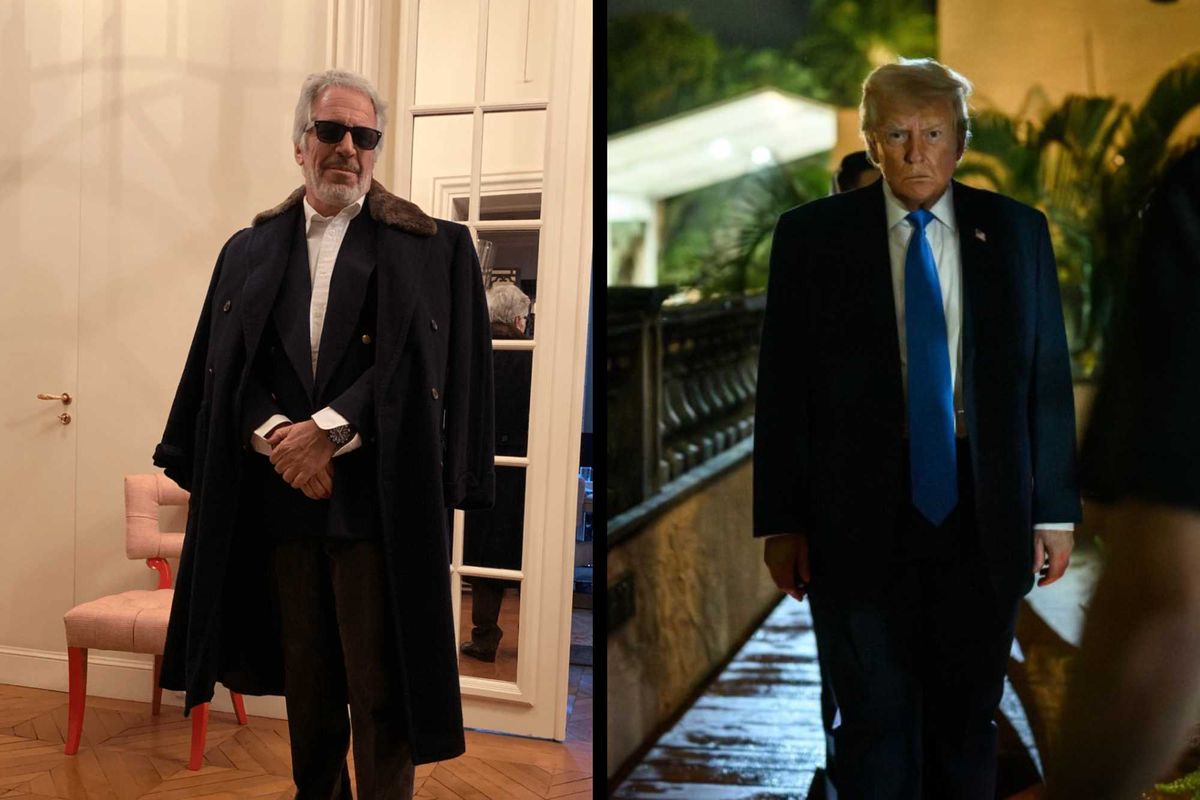
Left: Jeffrey Epstein in an undated photograph released by the Justice Department (DOJ).
Right: President Donald Trump addresses the nation on the shooting of two National Guard soldiers in Washington, D.C. (White House)

Supposed FBI files that have previously been referred to as “missing” were recently discovered sitting on an online document-sharing platform, files that former MSNBC host Katie Phang said Saturday contain “allegations of sexual abuse committed by Donald Trump” against a 13- to 15-year-old victim, according to a report published Saturday.

Back in February, the Justice Department (DOJ) announced it was investigating claims that it had withheld a select trove of files related to Jeffrey Epstein. The DOJ had justified withholding some of the files by describing them as "duplicative" of material already turned over, a characterization that has since come under scrutiny.

A growing number of critics increasingly pointed to a trove of 37 pages of FBI handwritten notes taken during a 2019 interview with “Jane Doe 4,” a South Carolina woman who accused Trump and Epstein of sexual and physical abuse beginning when she was 13 years old.

The woman was interviewed four separate times by the FBI and was found credible by the agency, according to a DOJ source who spoke with the Miami Herald. While some details of her account have since been verified, her specific allegations against Trump remain unsubstantiated, and Trump is not being criminally investigated and has denied any wrongdoing as it relates to Epstein.

The “missing” 37 pages were aggressively pursued by investigators, including Phang, whose ongoing lawsuit against the DOJ specifically sought the release of said pages, alongside a trove of foreign-language documents related to Epstein.


This week, however, New York-based writer Amy Gabrielle appeared to have uncovered an online archive containing some of the sought-after FBI files. Writer and data researcher Rye Howard-Stone picked up where Gabrielle left off and, in a detailed write-up published on his Substack Saturday, revealed the alleged source of the mysterious upload: Kaelan Deese, a journalist with the conservative outlet Washington Examiner.


The Washington Examiner published a report written by Deese on March 7 titled: “What’s still missing from the Epstein files,” but according to Howard-Stone, Deese had “quietly released” 22 pages of the missing 37 on Scribd – the online document-sharing platform – just one day before. Those pages would go unnoticed by major media outlets for months.

“This meant that, for the last five months, anyone with internet access could view the notes, which had Jane Doe 4’s real name all over them, as well as significant biographical details and the names of childhood friends and family members who she said could corroborate elements of her story – all of which she gave the FBI in confidence, and all of which the DOJ had redacted,” Howard-Stone wrote.

“But Deese, who regularly publishes articles with a favorable conservative gloss, was part of a small, select group of people that DOJ brass secretly decided were – unlike the public and members of Congress – able to be trusted with these allegedly ‘duplicative,’ ultra-sensitive files. Entirely unredacted.”


Howard-Stone claimed that while Deese “took the files down shortly after” he contacted a Washington Examiner editor, Deese had also shared additional FBI handwritten notes with “one random person who had discovered the posts.”

“We found that person, who shared his text message exchanges with Deese,” Howard-Stone wrote.

Phang was contacted for comment on the revelation, and told Howard-Stone that the “timing of the discovery and release of these unredacted handwritten notes” was “interesting,” and that it also undermined the DOJ’s rationale for withholding them.


“There also remains an open question as to the authenticity of these published notes. That question could be readily answered if the FBI would just comply with the Epstein Files Transparency Act and release the notes they’ve been legally required to do,” Phang said.

“Regardless, what these notes DO show is that they are not 'duplicative' of the FBI 302s as Blanche has asserted and they clearly contain allegations of sexual abuse and physical abuse committed by Donald Trump with a victim who was 13-15 years old at the time. So the Trump DOJ has no incentive to release them.”


Trump makes his great escape from the Epstein files
 Raw Story
August 20, 2026 


Nick Anderson/Raw Story


Trump's escape trick is utilized to get him out of the Epstein files.


The latest from Raw Story's Nick Anderson, a Pulitzer Prize-winning editorial cartoonist.
Rebel Republican uncovers potential motive behind Trump’s mysterious beef plan: ‘bailout?’

Alexander Willis
August 22, 2026
RAW STORY


U.S. President Donald Trump looks on while hosting a reception for the reigning Major League Baseball (MLB) World Series champion Los Angeles Dodgers in the Rose Garden at the White House, Washington, D.C., U.S., July 23, 2026. REUTERS/Evelyn Hockstein


President Donald Trump confused and angered onlookers Friday after announcing a plan to combat surging beef prices, but by Saturday, one Republican lawmaker believes they may have discovered the real motive behind the unorthodox arrangement.

Trump revealed Friday morning that he had “concluded a deal” that would see as much as 300,000 metric tons of ground beef – the equivalent of more than 2.6 billion quarter-pound hamburger patties – imported into the United States over a 90-day period. As part of the deal, Trump said his administration would waive tariffs on the imported goods, which would be sold at 25% below “current market prices.”

When asked by a reporter Friday where the beef would be imported from, Trump declined to answer.

"I don't want to say," Trump said.

A viral and lengthy post on X written by a user who claims to be a medical student and former research scientist alleges the beef import plan of being a “stealth bailout for meat companies,” a theory that Rep. Thomas Massie (R-KY) appeared to agree with after sharing the post and asking a pointed question of his own: “Could this be considered a fast food bailout?”

Massie also singled out fast-food chains such as McDonald’s, Wendy’s and Burger King as potential beneficiaries of a surge of cheap ground beef, all three of which have been squeezed by surging beef prices, with beef costs increasing by 48% as of March when compared with the previous 12 months.

In a separate social media post, Massie called Trump’s plan a “slap in the face to American cattlemen and consumers.”

“Dumping foreign beef in U.S. markets can temporarily lower prices but it won’t incentivize American farmers to raise more beef. Bring back Country Of Origin Labels & pass my PRIME Act,” Massie wrote, referring to his bill that would loosen restrictions around the sale of meat directly to consumers.


How Riding the Subway as a Kid Changed the Way I See the World

At the time, I hated riding on the subway. But more than 50 years later, I’m grateful for that commute—for the way it forced a visceral reminder of our shared humanity.


Passengers ride the New York subway in 1973.
(Photo by Erik Calonius / US National Archives and Records Administration)

Sarena Neyman
Aug 23, 2026
Common Dreams


It was 1974. The Bronx was burning. Abandoned cars littered the streets, and New York City teetered on the brink of bankruptcy. I’m still surprised my overprotective Holocaust-survivor parents let their preteen daughter ride the subway to school every day, but somehow they did.

For five years—from eighth grade through high school—I took the No. 5 Dyre Avenue train from our apartment in the Pelham Parkway neighborhood of the Bronx to my Jewish day school on the Upper East Side of Manhattan. The commute was nearly an hour each way and always coincided with rush hour.

Mornings weren’t so bad; I lived near the beginning of the line and could usually get a seat. But heading home, the 86th Street platform was packed five to eight people deep.

When it was my turn to board, I would throw my entire body weight onto the person in front of me, as the person behind me did the same. We all pushed forward together, forcing ourselves into an already crammed car, as more people tried to pack in behind us.

The more choices we have about how we travel or whether we go to private schools or fancy gyms, the easier it becomes to spend our lives among people much like ourselves. Distance makes it easier to dehumanize.

Once the doors closed, we stood packed together in a dense sea of bodies. When the train lurched, the entire crowd swayed as one. Usually, I breathed through my mouth to avoid the smell of sweat and bad breath. I tried to pull away from a hand on my behind that might have been accidental, but probably was not. I remember thinking I was too young for this.

At the time, I hated riding on the subway. But more than 50 years later, I’m grateful for that commute—for the way it forced a visceral reminder of our shared humanity.

Now, like three-quarters of Americans, I go everywhere by car. It’s faster and more convenient but I never see my fellow travelers—only their vehicles speeding past on the highway. And while I don’t miss the discomfort of the subway, I feel more cut off from other people’s lives.

When you don’t see people, you know them less. When entire groups remain unseen it becomes easier to turn them into abstraction—to fear them, dismiss them, or vilify them. It’s much harder to do that when you’ve stood shoulder to shoulder with someone, both of you grasping the pole as the train jolts you from side to side.

These were the days before smart phones or even portable music players. There was little to distract me from just looking and listening to the people around me. For two hours a day, I heard people speaking Spanish. I absorbed its rhythms long before I understood the words. Years later, when I finally learned the language, I picked it up quickly.

The subway exposed me to a depth of poverty I hadn’t seen in my own working-class Jewish neighborhood. I saw people asleep on the seats, curled around garbage bags that held everything they owned. There was a young man with no legs or lower torso who moved through the cars on a wheeled platform, collecting money. I watched him cross the treacherous gaps between cars as the train rattled and swayed.

The subway also showed me where people lived. Unlike highways, which are designed to bypass neighborhoods, the elevated train trestle cuts straight through them.

The No. 5 ran through the South Bronx at a time when more than 80% of buildings had burned or been abandoned. On dark winter evenings, we passed through blocks of hollowed-out shells, with the occasional occupied apartment. From the train I could see into people’s living rooms, glowing blue from the television.

As a teenager, I didn’t know much about redlining, disinvestment, or the policies that had helped create those conditions. I only knew that children my age lived there and I wondered what it was like to grow up in what felt like a war zone.

There are, of course, other ways to encounter difference. My husband, a nurse in one of the poorest communities in Massachusetts, has cared for people from all walks of life. But that’s a different kind of interaction. People meet him when they’re sick, in pain, or in crisis. When you commute, you’re simply sharing space.

But not all forms of transportation create the same kind of shared space. Recently, riding the Amtrak train home from Philadelphia, I watched miles of rundown brick rowhouses slide past the window. Some were boarded up. Inside the train, however, the conversations I overheard were about road races in Cancun and the best spin classes in Manhattan. The passengers’ lives appeared far removed from the neighborhoods we were passing through.

Having last lived in a city decades ago, my rural life is now quieter, more controlled. I move from one place to another sealed inside a car. It’s comfortable and efficient. But it’s made my life smaller. It’s made it possible to live a life where one rarely sees anyone outside one’s own orbit.

How can that not affect one’s ability to empathize—if your neighbors, coworkers, and classmates all reflect some version of yourself? The more choices we have about how we travel or whether we go to private schools or fancy gyms, the easier it becomes to spend our lives among people much like ourselves. Distance makes it easier to dehumanize.

Which is not to say that riding the No. 5 Dyre Avenue made me a kinder person. I still judge people; I could be nicer and more patient. But the commute gave shape and texture to lives I might otherwise reduce to stereotypes. Day after day, it reminded me that everyone, just like me, was simply trying to get home.


Our work is licensed under Creative Commons (CC BY-NC-ND 3.0). Feel free to republish and share widely.


Sarena Neyman
Sarena Neyman, who writes a syndicated column for PeaceVoice, is a Massachusetts grant writer.
Full Bio >
New York’s Childcare Expansion Could Redefine Early Education

The question is not only how many seats we create, but what those seats make possible and whether we are willing and able to build the systems needed to sustain them.


Students from Little Scholars await the arrival of New York City Mayor-elect Zohran Mamdani on December 11, 2025 in New York City.
(Photo by Michael M. Santiago/Getty Images)
Joaniko Kohchi
Aug 22, 2026
Common Dreams

Imagine 2-year-old Malek, growing up in an Arabic-speaking home, entering childcare for the first time. At home, language carries feeling, memory, and family connection. In care, it may be the first time he learns that only one language is recognized and that the other must stay behind. As New York City expands care for 2-year-olds, the public conversation has largely centered on key logistics: seats, speed to implementation, and salaries for home-based providers. Another fundamental question is how this expansion will shape children’s relationships to language, community, and belonging, especially for multilingual families whose experience with formal education is associated with estrangement from their home culture and language.

For decades, growing up with more than one language was wrongly framed as a deficit; it was once described as “semilingualism.” A large body of research has documented the social, communicative, and educational benefits of multilingualism, including stronger connections to family and community, and broader cultural and economic opportunities. The evidence is clear: Multilingualism is an asset, not a liability, supporting not only how children learn, connect, and participate in the world, but also adding to their professional pathways in the future.

Anyone who works in education knows the pattern of language loss that begins when a child enters the school system. Over time, heritage languages begin to fade, a loss that is often normalized as an inevitable part of schooling and assimilation. Research, including our own, shows that heritage language attrition follows a predictable pattern when children enter settings where one language dominates socially and institutionally, causing the dominant language to expand at the expense of the other. This is not only a cultural issue; it is foundationally developmental. Sustained exposure to both languages supports more stable language development, while early shifts away from the heritage language can disrupt that balance.

In one of the most linguistically diverse cities, we continue to reproduce monolingualism despite overwhelming evidence of the benefits of multilingualism. New York City’s 2-K program, with its focus on community- and home-based providers, is significant not only for expanding access, but for reshaping how early education is experienced. These programs, and their providers, who are often members of the same community as the families, offer services that are qualitatively different from formal institutional care, offering environments where language, culture, and relationships are not separated from learning, but are its foundation. They are truly a child’s home away from home.

Taken together, the expansion of 2-K home-based care can reshape how language, culture, and education interconnect as a foundation for learning.

In home-based settings, children are more likely to hear and use multiple languages in meaningful, everyday interactions with caregivers and children across ages. Care is organized around relationships and participation, rather than standardized expectations of academic performance. These are not incidental features. They are developmental conditions that support how language is sustained, how children come to belong, and how communities reproduce themselves across generations.

If supported intentionally with professional development opportunities, mentorship, and resources, these community environments could play a critical role in addressing one of the most persistent and overlooked challenges in US education: the systematic erosion of heritage languages beginning in early childhood. One proven way to enhance language development in home-based settings is strengthening the quality of adult-child interactions. In a randomized controlled trial we conducted in linguistically diverse communities, we found that babies in home-based child care vocalized far more when their providers used a program designed to strengthen relationships than did babies in the control group. We also found that the program led to reductions in background noise (such as television and other electronic sounds).

Together, these transformations in the babies’ language environment point to a simple lesson: When caregivers are intentionally supported in building warmer, more responsive interaction patterns, children’s language environments improve in measurable ways. This matters because early language development lays the groundwork for school and lifelong success. Providers can be supported to embed language-rich emotionally responsive interactions across home and care settings, and to facilitate collaboration between families and early learning environments. This potential will not realize itself; it requires deliberate investment.

In addition, home-based settings may address a critical gap in New York’s Early Intervention (EI) system. EI under federal law, is intended to provide support early in a child’s life, before small differences become larger barriers. Each state defines its own criteria. In New York, children with mild delays in a single developmental area, such as communication, often do not qualify for services. The result is inequity: Families with resources turn to private providers, while others must wait until delays become severe enough to meet eligibility thresholds. What is intended as early intervention becomes, in practice, delayed access.

Language can also be supported through family-centered approaches that sustain bilingual exposure when designed from a strengths-based perspective. In our work with Arab American families in New York, this meant creating community-based spaces where parents strengthened their children’s bilingual language use and their own sense of belonging, along with a renewed commitment to bilingualism, and greater confidence in navigating and engaging with public institutions such as libraries and educational spaces. In clinical treatment settings, birth-to-five therapists strive to provide both treatment and supervision in the home languages; it is simply best practice.

As early care becomes more widely available for younger children, providers in these settings are increasingly positioned to notice differences in children’s development, support social participation, and guide families toward resources. This requires ongoing professional support, not only in developmental frameworks, but in approaches that are culturally grounded, transdisciplinary, inclusive, and evidence-based. This means building an interprofessional, holistic, and community-based system of care that brings speech-language pathologists, early childhood educators, mental health professionals, and other healthcare providers to work alongside home-based caregivers and families collaboratively as partners embedded in the same communities.

Evidence from community-based programs shows that when caregivers are supported in building responsive, relational environments, children’s communication skills increase. They grow not through more instruction, but through more meaningful engagement. The question, then, is not only how many seats we create, but what those seats make possible and whether we are willing and able to build the systems needed to sustain them. Home-based providers are already embedded in the communities they serve, often sharing language, culture, and lived experience with families. With intentional and focused support, they will be uniquely positioned to sustain children’s languages, relationships, and development. Without it, expansion risks reproducing the very inequities it seeks to address.

Taken together, the expansion of 2-K home-based care can reshape how language, culture, and education interconnect as a foundation for learning. This direction challenges approaches that pathologize differences and individualize the effects of poverty. It offers a possibility we can realize in New York, where children thrive without giving up who they are, and systems, not families, are accountable.

For Malek, this means entering childcare without being pulled away from his language, home, and identity. Arabic does not stop at the classroom door; it lives in caregivers’ voices and neighborhood interactions. His mother is not measured against narrow expectations of “engagement,” but recognized as a partner in his learning through everyday interactions grounded in their culture. She is not positioned as lacking. Malek does not have to choose between belonging and opportunity because he grows within both.


Our work is licensed under Creative Commons (CC BY-NC-ND 3.0). Feel free to republish and share widely.


Reem Khamis
Dr. Reem Khamis is professor of communication sciences and disorders at Long Island University Brooklyn and director of the Culture, Language, and Society (CLaS) Lab. Her research focuses on Arabic language development, culturally responsive clinical practice, and equity in communication sciences. She has led community-based research with Arab American families in New York City on heritage language maintenance and bilingualism, and co-led randomized controlled research in home-based childcare demonstrating how strengthening caregiver-child interactions improves infants' and toddlers' language environments. She is managing co-editor of the Journal of the Critical Study of Communication and Disability and chair of the American Speech-Language-Hearing Association's Middle East and North Africa (MENA) Caucus.
Full Bio >

Chin R. Reyes
Dr. Chin R. Reyes is assistant professor at the Yale Child Study Center and executive director of the Climate of Healthy Interactions for Learning & Development (CHILD) Program. She is an applied developmental psychologist by training. Dr. Reyes’ scientific work centers around the application of developmental science to inform and improve educational practice, programming, and social policymaking. Dr. Reyes serves as expert panelist on several research study committees and advisory board councils around issues of quality and equity in early education both domestically and globally. Her primary area of interest is the promotion of social and emotional learning skills in young children. She is executive director of the Climate of Healthy Interactions for Learning & Development (CHILD) Lab at the Yale Child Study Center.
Full Bio >

Joaniko Kohchi
Joaniko Kohchi is director of the Institute for Parenting at Adelphi University and president of the Alliance for the Advancement of Infant Mental Health. Ms. Kohchi is a clinical social worker with broad experience in multiple domains of infant- and child-serving systems and the interventions that contribute to healthy development and trauma resolution. She is endorsed as an Infant and Early Childhood Mental Health Clinical mentor, and enjoys teaching, training, supervising, consulting, and supporting programming for parents and caregivers of young children, as well as providing dyadic trauma treatment for families in need. As director of the Institute for Parenting at Adelphi University, Ms. Kohchi has contributed to the design and implementation of consultative services that support professional frameworks in early care and education, working closely with programs across the five boroughs and Long Island.
Full Bio >
A Top Law Firm Is Suing Animal Activists So That a Restaurant Can Keep Serving Foie Gras

Force feeding is not kindness. It’s a violence against living beings that must be stopped.


Animal rights activists in Chicago outside the Galit restaurant where foie gras, produced from ducks force fed and held in torturous conditions, is routinely served.
(Photo: Animal Activist Collective / via Facebook)


Samuel Mosley
Aug 22, 2026
Common Dreams


Since last fall, I and a group of fellow animal rights activists have been holding protests at the upscale Lincoln Park restaurant Galit, urging it to stop serving foie gras. Each weekend, activists hold signs, chant, shout through a megaphone, write on the sidewalk with chalk, and pressure Galit to remove foie gras from its menu. We are a grassroots group of people from all walks of life who care about animals. Our group is made up of people with diverse occupations and perspectives, but we are united by an opposition to the worst abuses animals face. Now, Galit and one of the top law firms in the country have dragged us into court, calling our protests “harassment.”

Our group chose to protest at Galit—after emailing the restaurant for two months, initially seeking to remove foie gras from its menu through dialogue—because of its progressive values. The restaurant prides itself on paying its workers well, and providing a robust benefits package, including paid time off, substantially subsidized health insurance, and retirement benefits. The restaurant is closed on major holidays, allowing employees to have a holiday as well. It reports inclusive hiring practices and provides harassment and bystander intervention training. Galit’s website notes that its two co-owners have Israeli and Palestinian-Cuban-Spanish backgrounds. Galit is rightly proud of these practices, which are uncommon in service industries. But all too often, such values exclude the most vulnerable of all: animals.

Foie gras is a luxury product made from the fattened liver of ducks and geese, using a process called gavage, in which birds have a pipe forced down their throats in order to force-feed them to the point that their livers become painfully engorged and diseased. It is, frankly, systematic torture. That’s why entire countries, states, and cities have banned it, including nearly all of Europe, the UK, Australia, Israel, Türkiye, India, Argentina, California, New York City and, just last month, Portland, Oregon. Each of these bans is based primarily on the cruelty involved in foie gras production.

In the US, animal rights activists have been protesting this for around 30 years. Over the last few years, these protests have intensified and largely focused on specific restaurants—holding protests just like those I’ve participated in at Galit. Our movement has succeeded in getting 400 restaurants across the world to permanently remove foie gras from their menus. Our protests urge Galit to join the ranks of restaurants that have made this ethical choice, extending the same concern to animals as it has to so many other important values.

Instead, Galit went to court. After attempting to limit our protests by urging police to issue tickets to demonstrators—each of which has been dismissed—Galit and its general manager have filed for anti-stalking orders against me and other protesters.

The restaurant is represented, for free, by the top law firm Jenner & Block. This is rather stunning. Jenner & Block is known for handling major litigation, including arguing several cases before the US Supreme Court. The firm is also notable for the stand it took early in the second Trump administration, refusing to cave to Trump’s demands that it not represent the president’s political foes, while other large law firms folded. Jenner & Block described its position as a principled stance against political interference with a client’s right to vigorous, uncompromising representation. For this, it was targeted by a Trump executive order. The firm vowed to remain “fearless.” But once again, when it comes to animals, principles go out the window. Jenner & Block knows full well that protesting is not harassment or stalking, that it is protected by the First Amendment. Yet the firm has provided its prestige legal services—and attached its name—to an effort to protect a local restaurant from a dozen animal advocates armed with megaphones and chalk.

There is yet another odd twist to this story. While Galit has refused to remove this single product, the result of extreme animal cruelty, from its menu, some have begun accusing us of protesting not to stop it from serving foie gras, but because we are antisemitic. They argue that, because we are protesting against Galit and not other Chicago restaurants that serve foie gras, we are targeting it because one of its owners is Israeli (the critics do not explain how such a motivation makes sense in light of Galit’s own website reporting that the other owner identifies at Palestinian-Cuban-Spanish). But some members of the group protesting against foie gras at Galit, too, are Jewish and Israeli, and Israel itself is among the countries that have banned the production of foie gras.

Accusations of antisemitism are cynical at worst and intentionally ignorant at best. First, it underscores how so many people simply cannot see that animals might be worthy of treatment short of torture. Apparently, it makes more sense that we would target Galit due to antisemitism than that we chose to protest there because we want it to bring its treatment of animals into line with the restaurant’s otherwise admirable values. Antisemitism makes more sense than that a commitment to values like workers’ rights, community, and equality should include a commitment to animal welfare. It is not out of hatred for Galit, but out of respect for its stated values, that we chose to press it to stop serving foie gras.

It also saddens me because I, myself, am halachically Jewish. That is to say, I am Jewish on my mom’s side of my family. In recent years, I have been a regular at a Chabad house. For a while, I was there every shabbos evening. I have spent the last year teaching middle school math at a haredi school in West Ridge, wearing a kippah every day at work.

To be clear, across the country, protests to stop restaurants from selling foie gras have proceeded one restaurant at a time. This is a decision based on strategic value and activist capacity, and it has proven remarkably successful. Were Galit to provide a written commitment to, and stick to, a foie gras free policy, we will move on to another restaurant.

In the meantime, activists will continue to protest Galit. (Unfortunately, for now, I cannot personally participate in these protests because of Galit’s baseless lawsuit against me.) The judge presiding over Galit’s request for a protection order—again, oddly, filed by the top law firm Jenner & Block—threw out the complaint. But Galit has amended its complaint and continues to seek restraints on our protests.

It is worth wondering why one of the nation’s top law firms is representing a local restaurant, pro bono, in an effort to restrain the protests of a dozen animal rights activists. We may also wonder why Galit is so committed to serving a product that multiple entire countries have deemed too cruel to allow its production. All of this, rather than simply adopting a foie gras free policy.

I do believe there will come a time when Galit sees foie gras for what it is, and agrees to a foie gras-free policy. Force feeding is not kindness. It’s not food, it’s violence.


Our work is licensed under Creative Commons (CC BY-NC-ND 3.0). Feel free to republish and share widely.


Samuel Mosley
Samuel Mosley is an animal rights activist with Animal Rights Collective of Chicago. He is represented in the Galit case by the Animal Activist Legal Defense Project at the University of Denver Sturm College of Law.
Full Bio >


Trumpworld plots secret meetings with foe in anticipation of possible impeachment: report

Kathleen Culliton
August 23, 2026 
RAW STORY


FILE PHOTO: Jared Kushner applauds during U.S. President Donald Trump's State of the Union address in the House Chamber at the U.S. Capitol in Washington, D.C., U.S., February 24, 2026. REUTERS/NATHAN HOWARD/File Photo

President Donald Trump's son-in-law held a secret meeting with a high-ranking Democrat to discuss "common ground" as the White House grapples with the possibility of a future impeachment, the New York Times reported Sunday.

Jared Kushner met privately with House Minority Leader Hakeem Jeffries (D-NY) in New York City to discuss issues that included immigration and the high cost of living, five sources told the New York Times.

"Its timing underscored that those around Mr. Trump were well aware of the likelihood of a Democratic-led House, and trying to foster as much of a working relationship as possible before any change," according to the report. "Mr. Jeffries is in line to be the speaker, were Democrats to win the majority."

Publicly, Trump and Jeffries maintain a hostile relationship.

Trump has referred to Jeffries as a "low IQ" "thug," the report noted. Jeffries routinely calls Trump a corrupt "crook."

But Jeffries and Kushner reportedly have maintained a relationship after working together on a criminal justice bill in Trump's first term, according to the report.


"Mr. Kushner suggested that Mr. Jeffries should meet with the White House chief of staff, Susie Wiles, two sources told the Times.

In a statement, Jeffries did not admit to the meeting but openly discussed his views on negotiating with the Republican Party.

“Throughout this Congress, Republicans have adopted a my-way-or-the-highway approach to governing that has failed the American people,” he said. “In every conversation that we have with the Trump administration, we will continue to make it explicitly clear that the affordability crisis is not a hoax, and nothing short of transformational policy change is acceptable."

The Times noted Jeffries will face extreme pressure in 2027, should Democrats regain control of the House, to both keep the government funded and pursue a possible impeachment.

"Mr. Jeffries has remained noncommittal about any plans to pursue a third impeachment of the president, and has not discussed publicly what oversight could look like if his party were to win the majority," the report noted.

But Jeffries told the Times last month, “We’ve not ruled anything in and not ruled anything out in terms of accountability."

The report suggested Trump's social media presence might make it more difficult for Kushner to negotiate a working relationship with a Jeffries led House, pointing to a Truth Social post made after a meeting with the House minority leader.

"Mr. Trump posted an A.I.-generated meme of a mustachioed Mr. Jeffries wearing a sombrero," the report stated. "drawing an angry response from the House minority leader, who called the image racist and dared Mr. Trump to insult him next time 'to my face.'"

Forget ‘No Kings’ Placards, Given What Trump Is Plotting Impeach Him This Minute


Trump’s plans to steal the 2026 midterm elections are already underway. It’s not alarmism to say this. He is saying it out loud and the Republican Party has shown just how far they will go for this fascist. If people do not mobilize now, it may be too late.


Demonstrators hold protest signs during a rally at the Atlanta Civic Center on October 18, 2025 in Atlanta, Georgia. Organizers expect millions to participate in cities and towns across the nation for the second “No Kings” protest to denounce the Trump administration.
(Photo by Julia Beverly/Getty Images)

Ralph Nader
Aug 22, 2026
Common Dreams


You’d never know it by the title “Dancing in the Dark,” but the Washington Spectator’s recent investigation is about the various steps (mostly illegal) Trump is taking, including the use of enforcement tools and violence, to prepare to reverse any overall Democratic victory in the November Congressional races. The authors, Mark Medish and Joel McCleary, believe Trump needs such a coup to save himself from impeachment, congressional investigations and subpoenas seeking more proof of crimes throughout his lawless, corrupt, dictatorial regime.

Currently, Trump’s polls are so low that he is endangering enough Republican seats in the House and Senate to give the feeble, corporate money-indentured Democratic Party a chance to win control of Congress. This is precisely what Trump fears, even though he has control of the Executive Branch and the immunity given him by six Injustices of the Supreme Court. Take note, he knows that impeachment and removal from office in the Senate are final, not reviewable in the federal courts.

In 23 single-spaced pages, Medish and McCleary walk readers through the events, directives, ballot seizures, and draft emergency orders Trump could use to assert federal control over a midterm election and use a domestic paramilitary force of unprecedented size and budget. Trump and his minions have already expanded their dictatorial control of our democratic institutions. (See: The V-Dem Institute’s Democracy Report 2026.)

To obstruct the vote in key precincts, then fabricate a need for national-security powers to purge and miscount ballots, falsely charge fraud, illegally seize ballots, threaten precinct workers, and claim without evidence foreign interference are preparations for instant escalation.

They then describe the “Devil’s Accordion File” meaning “the elements of a ramified, radical strategy to hold on to power at almost any cost as we approach the test of the 2026 elections…” Although they describe Trump as a brilliant mastermind concentrating extraordinary power in his hands, they remind us that he is also in “full command of his office, directing the Justice Department, the FBI, ICE (the largest new federal police force in American history) the IRS, the Securities and Exchange Commission and the Federal Communications Commission, the intelligence community and the armed forces. [Under total acolyte Pete Hegseth.] He is using each agency in a coordinated attack on his political adversaries in ways that would have been dismissed as fantasy only a few years ago.”

Trump’s iron grip on institutional controls was further strengthened by the Trump/Musk DOGE criminal enterprise which tore through federal agencies in 2025, closing some, shredding others, grabbing huge troves of personal data on Americans, and destroying the non-partisan civil service that could have used federal laws to resist his coup d’état.

Focusing on swing electoral districts—including those politically redistricted earlier this year—and on the various junctures between now and the final certification process in the House of Representatives on January 3, 2027, the authors write that “the political will, personal motivation, legal architecture and technical infrastructure by now [are] all in place.” They could have added Trump’s unlimited pardon power to facilitate the violence and theft by his criminal operatives.

Trump has also precluded any opposition from corporations and the “contented classes” with tax cuts, non-regulation, subsidies and other inducements from which his family also lavishly benefits. (In 2025 Trump took in $1.1 million an hour when measured over a 40-hour workweek —see my column $1.1 MILLION AN HOUR!!—Trump’s Personal Profit in 2025.)

To obstruct the vote in key precincts, then fabricate a need for national-security powers to purge and miscount ballots, falsely charge fraud, illegally seize ballots, threaten precinct workers, and claim without evidence foreign interference are preparations for instant escalation.

Trump tried a dress rehearsal in his July 16 national televised address, pushing his Save America Act, which is stalled in Congress. The speech “bombed” drawing widespread criticism, ridicule and dismissal even by the mainstream media along with some of his Republican partisans.

Undeterred and personally deeply fearful of losing, Trump plunges ahead. He makes the notion that “it can’t happen here” the Achilles heel of Democratic Party opposition, which had better prepare—and work overtime.

The authors warn: “The full election subversion strategy mixes subtlety and brutality, subterfuge and open tactics. It represents unprecedented intensification and escalation of the attack on our once seemingly settled Constitutional order…”

Led by Stephen Miller, his fascistic White House adviser, Trump and his Injustice Department have already launched attacks on so-called “antifa” advocates labeling them “domestic terrorists.” Trump could falsely use this moniker to include any of his selected political opponents. Remember, in 2025, he called for the execution of six Democratic Members of Congress, including two Senators, for reminding U.S. soldiers that they have under Army law a legal obligation to resist illegal orders from their superiors. Hegseth filed charges against Senator Mark Kelly (Dem. Ariz.), a retired Navy Captain for making such a statement; the case was dismissed in federal court.

Trump has often mentioned using the vaguely worded Insurrection Act, which he claims could enable him to quell unrest, including by using unrest as the pretext for his own false-flag operation. Imagine the chilling effect of Trump arbitrarily and illegally deploying federal soldiers to a city or region.

In their conclusion, “What Is to be Done,” the authors have numerous suggestions for the citizenry and state officials. However, they omit the need to mount an Impeachment drive, which, as it intensifies, can serve as a deterrent to Trump. He knows that his blatant disregard for the Constitution and his mounting impeachable offenses could further provoke the public and Congress to use this final remedy provided by our Founding Fathers—telling Trump: “You’re Fired.” This is Trump’s biggest nightmare. Remember the stubborn Richard Nixon, who after winning 49 of 50 states in 1972, was forced to resign when his Republican base collapsed in Congress before the 1974 elections.

In my podcast interview with Joel McCleary, I suggested that he and his allies (he served in the Carter White House) press some House Democrats to conduct a public “shadow hearing” on Impeaching Trump, an effort that polling shows is already supported by 90% of Democratic voters and two-thirds of Independents. (See our July 22, 2026 Symposium on Impeachment.) He replied: “I think that’s a fantastic idea.” We’ll see if these savvy authors can move from words to action. As a 14th century Chinese philosopher once wrote: “To Know and Not to Do is Not to Know.”

Furthermore, the group Indivisible seems to be planning another mass protest march in the Fall. It should replace its weak, obsolete name of “No Kings” with “Impeach Trump Now.”
‘Have Your Friend Elon Build One at Mar-a-Lago,’ Says Sanders After Trump Comments on Data Centers

“Trump thinks that every community in America should welcome a data center.” If so, said Sanders, “Lead by example.”


An AI-generated mockup of a data center suspended over President Donald Trump’s Mar-a-Lago estate in Florida.
(Image: AI/via ChatGPT)

Jon Queally
Aug 22, 2026
COMMON DREAMS

Despite growing opposition to Big Tech data centers from coast to coast, US President Donald Trump said this week that every community should want one, and Sen. Bernie Sanders (I-Vt.) responded on Friday.

“Trump thinks that every community in America should welcome a data center,” said Sanders. “Great idea. Lead by example. Have your friend Elon build one at Mar-a-Lago.”

Poll after poll has shown people in the US are not comfortable with the rapid expansion of data centers, built by large tech companies to manage the computing power and energy needed for artificial intelligence and an increasingly digitized world.

With local protests popping up in states nationwide against plans to establish large-scale data centers without proper guardrails or regulations in place, the issue has become a lightning rod in the midterms with the deep pockets of Silicon Valley—including tech giants like Google, OpenAI, Meta, and other behemoths—emerging as villains willing to spend millions in campaign contributions and lobbying efforts to sway candidates and lawmakers toward their profit-seeking aims.

In Congress, Sanders has led the charge for deeper conversations about the impact AI and demanded that any buildout of the technology, including data center construction, be done with the health of workers, communities, and society overall front and center.

A poll released Thursday showed that 75% of Americans oppose large data centers being built in their community, with 61% of those saying they are “strongly” opposed.

In July, Trump said local elected officials have to convince their constituents that data centers are good for them and that opposition is futile. “You can’t fight it,” Trump said. “You have to go with it.”

Asked earlier this week what he thinks about the growing opposition, Trump suggested people didn’t know what was good for them, saying, “If I were the mayor of a town or the governor of a state, and I had a chance to get a big plant in, an AI plant, or a data center, I would absolutely want it.” Trump said the industry needed better public relations, but said nothing about the need for stronger regulations or better ways for the corporations behind these centers to actually mitigate the legitimate concerns people have.


On Friday, Trump was asked again about his support for data centers and said more of the same.


It was these comments which apparently led to Sanders and other critics to denounce Trump’s position as either insincere or out of touch.

While Palm Beach County is home to a number of relatively small data centers—which are ubiquitous across the US—it has no large-scale or hyperscale data centers, which are the ones drawing so much scrutiny and opposition nationwide.

As The Guardian reported, a proposal for a “huge” hyperscale data center in Palm Beach County, known as Project Tango, actually exemplifies why such projects are so controversial, largely due to how they may impact air and water quality, as well as the potential for them to eat up water resources and impact energy costs for local utility customers.

“Local environmentalists warn that the proposed 600MW data center in western Palm Beach County could damage the wetlands,” reported the newspaper, “which the federal government and the state of Florida have spent a combined $6bn to restore after decades of drainage and development.”

Opponents of Project Tango—including educators, homeowners, conservationists, and local lawmakers—cite threats to local drinking water, algae blooms in the nearby, fragile Everglades ecosystem, increased air pollution, and concerns about impacts on health and family budgets as worrying factors.

“We don’t want our bills to go up, but it’s more than that,” Sue Ellen Loyzelle, who lives in the planned community of Arden next door to the Project Tango site and is a founding member of Western Palm Beach Community Alliance, explained to The Guardian.

“I would like to not see them at all,” she said, but if “there was to be one, it would have to be far away from homes because of the sound and the health impacts of air pollution. But the water, I don’t think Florida could handle it anywhere with the water issues.”

On July 15, after 12 hours of public testimony from citizens, a majority of whom were outraged over the proposal, including many who identified as Republicans otherwise aligned with Trump politically, the county commissioners voted 5-1 against the proposed expansion.