It’s possible that I shall make an ass of myself. But in that case one can always get out of it with a little dialectic. I have, of course, so worded my proposition as to be right either way (K.Marx, Letter to F.Engels on the Indian Mutiny)
Sunday, August 23, 2026
Fired Federal Employees Are Bringing Climate Change Info Back to the People
Scientists are preserving vital climate-related information amid the Trump administration’s attacks on climate science.
An employee of National Hurricane Center looks at the multiple hurricane models displayed on the monitors at the National Oceanic and Atmospheric Administration's (NOAA) National Hurricane Center in Miami, Florida, on May 30, 2025.CHANDAN KHANNA / AFP via Getty Images
Since June 23, a group of former employees of the communications branch of the National Oceanic and Atmospheric Administration (NOAA) have been busily resurrecting one of the government’s premier educational websites on climate change.
Climate.gov was started in the early 2010s by communicators with NOAA, and for more than a decade it consistently produced high-quality graphics and other charts documenting rising global temperatures, changing rain patterns, drought conditions, El Niño impacts, and other climate-related data. If you were a layperson and wanted to understand the parameters of human-induced global warming, the website rapidly became a go-to spot. By the 2020s, it was logging more than 1 million visitors per month, according to Rebecca Lindsey, a West Virginia-based communications specialist with an undergraduate degree in biochemistry and a master’s degree in journalism who used to work as the site’s lead writer and editor.
In February 2025, as the so-called “Department of Government Efficiency” (DOGE) purges accelerated, most of the staff and contractors attached to the website, Lindsey included, were fired — part of a NOAA culling that saw the agency’s workforce cut by roughly 600 in the first couple months of the new administration. By May of last year, the website had been officially taken down. Try to access it today and you get redirected to a NOAA site with this Orwellian message:
In compliance with Executive Order 14303 (‘Restoring Gold Standard Science’), the White House Office of Science and Technology Policy’s June 23, 2025 Memorandum (‘Agency Guidance for Implementing Gold Standard Science in the Conduct & Management of Scientific Activities’), 15 USC § 2904 (“National Climate Program’), 15 USC § 2934 (‘National Global Change Research Plan’), and 33 USC § 893a (‘NOAA Ocean and Atmospheric Science Education Programs’), you have been redirected to NOAA.gov. Future research products previously housed under Climate.gov will be available at NOAA.gov/climate and its affiliate websites.
Calling it “gold standard science” is, of course, something of a stretch; peruse this site and you’ll find no mention of human-induced global warming, no mention of CO2 emissions exacerbating climate change, no mention even that global warming is accelerating.
Lindsey and her colleagues have, however, refused to go quietly into the night. They believe their educational mission was too important for them to simply fold in the face of Donald Trump and Elon Musk’s hostility. “We worked very hard for 15 years to build Climate.gov, and had a relationship with our readers,” Lindsey explained to Truthout. “And we wanted that to continue. We decided too much had been invested and too much was at stake to let it go without a fight.”
A year after Climate.gov’s demise, Lindsey and several of her erstwhile colleagues resurrected the vast majority of its materials. Left out of the mix were only a few data sets, the information from which they are still trying to access, that were removed early in the DOGE purges because they ostensibly violated anti-DEI mandates or because they referred to the Gulf of Mexico despite Trump’s executive order renaming it the Gulf of America. The new, privately run site is Climate.us and it contains a wealth of sophisticated data sets and graphics on the world’s climate. Each week, new parts of the site come online— including, most recently, a blog titled the El Niño Southern Oscillation (ENSO), recreated just in time to help website visitors grapple with the likely consequences of what is shaping up to be the most powerful El Niño in decades.
Their work has proven to be an inspiration for ex-government employees in a number of other different agencies and branches of government. Former Environmental Protection Agency (EPA) communicators are, Lindsey says, now looking to resurrect climate-related EPA pages that have been taken down; a group called the Public Environmental Data Partners is attempting to rescue specialist environmental monitoring tools — it has some information online, but not yet a fully interactive website. Another group, the Environmental Data and Governance Initiative is working to save specialized environmental justice screening tools. As the Trump administration deliberately shreds decades of climate-related research, ex-government employees are attempting to ride to the rescue by creating a sort of shadow information-dispersal system. The American Geophysical Union, which most U.S. Earth scientists are members of, has been instrumental in putting the Intergovernmental Panel on Climate Change back on track after the Trump administration pulled support for its annual reports.
Lindsey says that the Climate.us site now is seeing close to a million visitors a month, putting it up there with where the NOAA-run site was before its demise. Teachers use it frequently, she says, as do an array of others simply trying to get an accurate read on what is happening to the climate.
As with the old government-run website, Climate.us has a network of scientific advisers around the country willing to lend their expertise to the project and to make sure that what the communications people write up is scientifically accurate. The network is made up of people such as Rick Thoman, a long-time National Weather Service employee in Alaska, who left the government in 2018 and moved over to the University of Alaska Fairbanks, where he is now a climate specialist with the Alaska Center for Climate Assessment and Preparedness.
Thoman used to work as an editor with the Arctic Report Card — another vital international project that the Trump administration has, scientists involved in it tell me, recently decided to withdraw from — and had provided Lindsey’s Climate.gov team with detailed scientific input on Alaska-related phenomena. “When, in February 2025, disaster occurred and Climate.gov goes away, and out of the ashes rises Climate.us, for me it was natural; I was happy to continue in the role in this new form,” Thoman told Truthout. “Because they are so skilled at turning complex environmental information into accessible graphics, the work they do is really important in conveying to non-specialists the changes that are happening.”
An Earth scientist who used to work for NASA (and who asked to remain anonymous) told Truthout that he was now volunteering to be an external reviewer of Climate.us content “because they’re continuing an essential curated and recognized database of how the climate is changing — and where it’s likely to go in the future.” The scientist expressed dismay at the Trump administration’s shuttering of critical climate change work that would be “useful to the U.S. military, to the states,” and that ought to serve as background material upon which Congress based informed legislative decision-making around environmental policies. Now, he said, “not only are [members of the Trump administration] not making good decisions, but they don’t want good information to be readily available.”
For Lindsey, the preservation of this vital climate-related information in an era of administration-enforced environmental ignorance has become a mission. “Climate information shouldn’t be available to the public just on a political basis or a whim,” she said. Instead, there ought to be a way to “promote public climate literacy and to equip people to turn knowledge into meaningful conversations and climate-conscious actions.”
Most discussions about the Democratic Party in this election cycle focus on the remarkable rise of progressive Democrats (such as Florida state Rep. Angie Nixon, a democratic socialist who yesterday scored an upset win in the Democratic contest for the Florida Senate).
An equally big story is the remarkable decline of corporate Democrats.
Some Democrats worry about this. My old friend Democratic strategist James Carville compares the current wave of progressive primary wins to progressive campaigns in 2016 — especially that of Bernie Sanders — that he believes fractured the Democratic coalition.
“Bernie Sanders is the reason that Donald Trump is president,” Carville said recently, claiming that Bernie’s primary challenge to Hillary Clinton convinced voters in battleground states that establishment Democrats were no different from establishment Republicans, thereby weakening her prospects in the general election.
Even if James is right about 2016 (and I don’t believe he is) his assessment is irrelevant now because we’re at a radically different point in American politics than we were 10 years ago.
The silver lining on the dark storm cloud of Trump and his detestable regime is that it has exposed the greed, venality, cupidity, and corruption of America’s corporate elite.
Trump has allowed the CEOs of giant corporations and the titans of Wall Street to do whatever they want as long as they suck up to him. And he’s providing all sorts of corporate welfare to those who generously bribe him — no-bid government contracts, exclusive licenses, tax loopholes, tariff exemptions, use of public lands, and permission to become even bigger monopolies.
Trump has thereby unveiled a truth about corporate America that for many years has been hidden behind a soothing blanket of corporate PR bullsh*t about social responsibility, corporate charity, and “trickle-down” economics.
That truth is the captains of corporate America are so rapacious that they’re willing to throw average working Americans under the bus to make billions more.
Corporate avarice under Trump has become so blatant and corporate America’s contempt for the needs of average Americans so flagrant that most Americans are now catching on.
They’re voting for progressive Democrats not because they want socialism, support the Democratic Socialists of America, or reject candidates called “moderate.”
They’re voting for candidates whom they believe will fight to make housing, food, healthcare, and childcare affordable to average working families. And who’ll take on Trump’s billionaire backers, CEOs, and Wall Street titans who are rigging the economy against them.
Much of the corporate media won’t tell this story. When Dr. Abdul El-Sayed won Michigan’s Democratic primary over Haley Stevens, the media overflowed with accounts of how much smaller El-Sayed’s margin of victory was than polls had predicted.
Yet the most remarkable thing about El-Sayed’s victory was that he won despite being dramatically outspent by super PACs arrayed against him.
Stevens benefited from tens of millions of dollars in outside spending, including the largest investment in a senatorial race ever made by the American Israel Public Affairs Committee, which traditionally supports pro-Israel candidates but in recent election cycles has supported candidates most favored by corporate America. AIPAC’s ads in favor of Stevens and against El-Sayed never even mentioned Israel.
Outside super PACs poured an estimated $54 million to $60 million into backing Stevens and opposing El-Sayed, compared to only about $5 million for El-Sayed. Pro-Stevens groups outspent El-Sayed on TV advertising alone by more than 12 to 1 ($26.9 million to $2.1 million) in the closing weeks. An average of $95 was spent for every vote against El-Sayed versus just $9 per vote for him.
The race between Stevens and El-Sayed was a proxy fight over the future of the Democratic Party. Senate Minority Leader Chuck Schumer backed Stevens and encouraged donors to back her campaign, as did other corporate-aligned politicians such as Michigan senator Gary Peters. On the other hand, Sen. Bernie Sanders and U.S. Rep. Alexandria Ocasio-Cortez supported El-Sayed, as did progressives such as Sens. Chris Van Hollen and Elizabeth Warren.
El-Sayed justifiably made a campaign issue out of how much corporate money was backing his rival. He argued that Democrats should reject corporate influence and embrace an agenda that helps average Americans. His campaign centered on providing Medicare for All, lowering prescription drug costs, and banning corporate PAC money. “We’re in a situation right now where the rich keep getting hyper-rich on the backs of figuring out how to monetize everyday people,” El-Sayed told AP during a Sunday afternoon march, as his supporters chanted behind him, “Money out of politics! Money in your pockets!”
El-Sayed’s victory marked a turning point for the corporate wing of the Democratic Party.
I saw the start of the corporate Democrats in the early 1980s, when Democrats in congress began drinking from the same campaign funding trough as the Republicans, mostly from big corporations.
“Business has to deal with us whether they want to or not” crowed Democratic Rep. Tony Coelho, who then headed the Democratic Congressional Campaign Committee. Democrats had controlled Congress since 1955, and assumed they’d continue to run the House for years. They thought they could take advantage of their seemingly permanent power to raise cash for their campaigns.
Coelho’s Democrats soon achieved a rough parity with Republicans in contributions from corporate and Wall Street campaign coffers, but it proved a Faustian bargain as big corporations and Wall Street gained increasing influence in the party. It is a truism in politics as in nature: One dares not bite the hands that feed.
Corporate Democrats thereafter stopped the Democratic Party from pursuing an agenda that would have dramatically helped America’s working class.
To be sure, over the last three decades Democrats have scored some important victories for working families — the Affordable Care Act, an expanded Earned Income Tax Credit, and the Family and Medical Leave Act, for example.
Yet they’ve done little to alter the widening economic inequalities that have taken a huge toll on working-class families.
Both Clinton and Barack Obama ardently pushed for free-trade agreements, for example, but didn’t provide the millions of blue-collar workers who thereby lost their jobs means of getting new ones that paid at least as well.
They also stood by as corporations hammered trade unions, the backbone of the white working class. Clinton and Obama failed to reform labor laws to impose meaningful penalties on companies that violated them, or to enable workers to form unions with a simple up-or-down vote.
In his 1992 campaign, Clinton promised such reform but once elected didn’t want to buck corporate Democrats by spending political capital on it. In his 2008 campaign, Obama made the same promise but never acted on it.
Partly as a result, union membership sank from 22 percent of all workers when Clinton was elected president to fewer than 10 percent today, and the working class lost bargaining leverage to get a share of the economy’s gains.
The Obama administration also protected Wall Street from the consequences of its gambling addiction through a giant taxpayer-funded bailout but left millions of underwater homeowners to drown.
Both Clinton and Obama allowed antitrust enforcement to ossify — with the result that large corporations have grown far larger and major industries far more concentrated.
And they turned their backs on campaign finance reform. In 2008, Obama was the first presidential nominee since Richard Nixon to reject public financing in his primary and general election campaigns. And he never followed up on his reelection campaign promise to pursue a constitutional amendment overturning Citizens United v. FEC, the 2010 Supreme Court decision that opened the floodgates to big money in politics.
What happens when you combine free trade, shrinking unions, Wall Street bailouts, growing corporate monopoly power, and the abandonment of campaign finance reform? You get an economy favoring the wealthy and a political system favoring the powerful, while workers without college degrees suffer declining real wages and dwindling job security.
John F. Kennedy was the last Democratic president to depend on the votes of working-class Americans while losing the votes of white, college-educated Americans by 2 to 1. Sixty years later, Joe Biden depended on the votes of college-educated Americans while losing the votes of the white working class by 2 to 1. Kamala Harris lost the working class by an even larger margin.
Trump has exposed the venality and cupidity of corporate America, while large swaths of the working middle class struggle to make ends meet. As a result, Republicans appear likely to face some major defeats in the midterm elections. Corporate Democrats are on the defensive because their campaign cash isn’t working the way it used to.
Now, finally, the Democratic Party has an opportunity to once again become the party of working Americans, as it was under Franklin D. Roosevelt, rather than the party of corporate America. It is more urgent than at any time since the Great Depression that Democrats act on this opportunity.
Robert Reich is a professor of public policy at Berkeley and former secretary of labor. His writings can be found at https://robertreich.substack.com/.
Trump is threatening the Center for American Progress, a prominent liberal think tank, with a $5 billion defamation lawsuit over a report concluding that his deployment of the National Guard to cities across the country has had little effect on reducing violent crime.
This is nuts, for several reasons.
First and most obviously, his lawsuit violates the First Amendment. Even if the Center for American Progress’s report is factually wrong — and all the studies I’ve seen on the subject suggest that it’s accurate — the Center has a constitutional right to publish it.
It’s bad enough for a sitting president to file defamation lawsuits against news organizations like the BBC and The New York Times, as Trump has done. It’s utterly absurd for him to file a defamation lawsuit against a research organization that’s come up with an analysis and conclusion he dislikes.
If this lawsuit ever reaches a federal court — and I hope it does — the court should not only throw it out but impose a fine on Trump for filing such a completely frivolous complaint.
Second, for a president of the United States to employ a personal lawyer to make such a legal threat takes Trump’s rage to a new and bizarre level.
It’s also irresponsible for any lawyer to agree to carry out this threat. This alone is grounds for disbarring the lawyer in question, Alejandro Brito. Brito has filed multiple failed suits on Trump’s behalf. Last month, a federal judge in Florida referred Brito for potential disciplinary proceedings after ruling that a suit he filed for the president against the IRS amounted to an improper exercise in self-dealing.
Third, if anyone wanted evidence that Trump has lost it — I mean, truly lost it, as in totally nuts — this is the smoking gun. Trump’s rage at opponents has now morphed into an attack on a group for merely trying to issue a report, the conclusions of which he finds offensive. No sane president would do this.
I’m going to say this as clearly as I can: Trump’s mind has gone. He is capable of doing almost anything, and evidently the people around him are unable to control him. His continuation in the presidency constitutes a clear and present danger to the United States. The 25th amendment must be invoked, or he needs to be impeached and convicted of high crimes and misdemeanors. Now.
Robert Reich was a professor of public policy at Berkeley and former secretary of labor. His writings can be found at https://robertreich.substack.com/
Alaska sees 'awfully good' sign of GOP midterm disaster: conservative
Republicans have been taking desperate steps to ensure the long-deep-red state of Alaska doesn’t flip blue in the coming midterms, but with its primary underway, there are “awfully good” signs emerging that the GOP has reason to worry as November approaches. This is according to conservative political analyst Chris Stirewalt, a longtime contributor to right-wing media outlets like Fox and NewsNation, who wrote in the Hill on Friday about how the strong primary performance of Alaskan Democrats could provide an “invaluable look at where voters are heading in a general election.”
Currently, Alaska is in the middle of its nonpartisan primary, in which candidates from all parties duke it out on a ranked-choice ballot. As Stirewalt notes, Trump ally and donor Elon Musk has provided financial backing to an effort to repeal the state’s nonpartisan system and end its campaign finance laws, which would eliminate the requirement that candidates disclose “dark money” contributions. The widespread conservative support for this endeavor makes it clear that Republicans believe they will benefit from the traditional two-party ballot and unregulated campaign financing.
But if Musk’s effort succeeds, asserts Stirewalt, election forecasters will miss Alaska’s current system. “With one of the latest primaries on the calendar,” he writes, “Alaska gives us an invaluable look at where voters are heading in a general election now just 74 days away.” And according to Stirewalt, things are heading in the Democrats’ direction.
“As of this writing, with perhaps as much as 20 percent of the vote presumably still drifting in on malamute dogsleds or carried like abalone in the paws of adorable sea otters,” explains Stirewalt of the race for the Senate seat, “former Democratic Rep. Mary Peltola is the top vote-getter in Alaska’s nonpartisan primary, leading incumbent Republican Sen. Dan Sullivan by more than 5 points.” What’s more, he notes that when you add up the present standings for all Republicans vs. all Democrats on the ballot, it comes to 48 percent vs 50 percent, respectively. So not only is a blue candidate leading, but so is the Democratic Party overall.
“This is hardly to say that this means that Peltola will win in November by 2 points, but this is an awfully good indication of how the electorate is looking with the general election very nearly upon us,” says Stirewalt. “Good polling, as we have often observed and has been proven quite right of late, is very hard to come by these days. But in a nonpartisan primary, you get a live feed on how persuadable voters are breaking.”
According to Stirewalt, “This is the third cycle in which Alaska has had its everyone-in-the-pool primary in effect, and in contested statewide races, most notably the 2022 gubernatorial race, primary results have been strongly predictive of the general. And with Peltola proving herself to be a savvy campaigner with moves like saying thanks, but no thanks to an unsolicited endorsement from former Vice President Kamala Harris, Peltola definitely looks like she’s in the driver’s seat.”
The GOP is forecasted to take major losses in the midterms due to the historic unpopularity of President Donald Trump, with many predicting the party will lose its majority in the House and possibly even the Senate. If Stirewalt is right, then Republicans have good reason to worry about the latter, which will upend the balance of power in Washington and sharply curtail Trump's agenda.
MISOGYNY 101
'These women': Republican bemoans young female voters 'stealing' elections
Kansas State Rep. Pat Proctor (R) (Photo: Kansas state legislature site)
"There's like, all these, like, women, uh, like 20 to 30-year-old women, who, you know, that you never saw at the polls before, and it's like a long line, the long line, and they're all there to vote," Proctor said.
"And it's just the — they're stealing it fair and square," Proctor said about the female voters, acknowledging that they were all legal voters. "And they all came back out, cause I can see 'em. You know, you had 700 unaffiliated female voters, 20-30, that all came out just to circle, in one circle because it was the only question on the ballot."
Procter made the statement while drawing a "circle" with his hand.
"And they all came back out for the general to vote again," said Proctor about the young female voters.
As of the last count on the Secretary of State's website, there are 575,983 unaffiliated voters in Kansas. Republican voter registration has slightly decreased in the state since January 2025, dropping by about 10,000 voters. A Kansas Reflector report noted that the vote over the ballot measure was "historic."
"Overall, Kansas women made up almost 56 percent of voters in the August 2022 election. And the younger the voters, the more women dominated. Voters between 18 and 24 years old were 61 percent female," the report said.
Retired researcher Earl F. Glynn pointed to a significant discrepancy in the gender of voters in Kansas using U.S. census data and reports after the 2022 election.
"A recent Kansas voter file with 1,975,884 voters shows 1,027,582 females, 937,011 males and 11,291 voters who did not select a gender," Glynn wrote. That math shows that there were 90,000 more female voters in Kansas than male voters.
MS NOW reporter Alex Tabet says there’s a very obvious reason the state of Iowa is slipping out of Republicans’ grasp this midterm, and it has everything to do with the Trump economy.
“It's chaos,” said Iowa Farmers Association President Aaron Lehman, speaking with Tabet on a Saturday morning show. “You know, we are just not on the right path at the time. When farmers are dealing with all this uncertainty, we should be doing more to help them bring stability.”
“We should be passing a farm bill that's three years overdue to provide some stability for farmers. No passage in sight yet. We should be doing more to have a trade policy that gets to fair prices for farmers with fair practices for farmers. We're not getting any closer to that,” Lehman added. “It's just chaos. So, the chaotic situation makes it so hard for farmers to plan on how they can put a crop in the ground, harvest it and expect a reasonable return.”
Tabet, reporting from Lehman’s fifth generation corn, soybean and hay farm, said life on the farm is more expensive than ever.
“This farm operates three tractors … and about a year ago, it was $3.50 per gallon for diesel. Now it's $5.40. Each of these things guzzle about 100 gallons a day. So some quick math will show you for each tractor during harvest season, that's an additional $200 per tractor, $600 in total,” said Tabet.
But that is just one of the many factors that farmers are having to contend with, he added. Equipment and machinery purchase and repairs are significantly more expensive under Trump’s tariffs, and the food they grow, including corn and soybeans are contenting with retaliative tariffs from other countries due to Trump’s tariffs.
“Not to mention the fact that every single farm in America has to purchase fertilizer, and fertilizer costs are up 12 percent in the first quarter of 2026 because of this war in Iran, because of the strait of Hormuz,” said Tabet.
When asking Lehman and other farmers at the Iowa State Fair if their farm was profitable last year, the most common answer was ‘No.” The answer remained a solid “no” when asked if they expected to break even this season, as well.
Lehman, as president of the organization did not say who he voted for in the last election, but the state of Iowa — and farmers in particular — were deep in the fold for President Trump in the last election.
“What I can tell you is we are here in Iowa President Trump won 98 of the 99 counties in the caucuses. He won the state, beating Kamala Harris by 14 points in 2024,” said Tabet. “This is Trump country. But at the same time, the Cook Political Report just put the gubernatorial race as “lean Democratic” for [candidate] Rob Sand and a “toss up” for [Senate candidate] Josh Turek. These are races that shouldn't be this close. But because of these economic conditions, at least according to the Cook Political Report, they are.”
Trump’s military disrespect hits new low — and troops are finally revolting
Members of the military wait for President Donald Trump to arrive for a meeting convened by Defense Secretary Pete Hegseth, at Marine Corps Base Quantico, in Quantico, Virginia, September 30, 2025. REUTERS/Kevin Lamarque
In recent weeks, reports have emerged revealing the alarming conditions aboard the USS Abraham Lincoln, a vessel that has been stationed in the Middle East since November and is nearing the record for the longest ever deployment, set back in the Vietnam War. Aboard the ship, troops and officers are reportedly dealing with worsening food and resource shortages, as well as deteriorating physical conditions, with some areas becoming infested with mold. Driven to extreme desperation, some troops have also reportedly attempted to jump overboard to escape the conditions onboard.
When pressed about these stories, Trump and his officials have largely been dismissive. Defense Secretary Pete Hegseth said that the conditions on the Abraham Lincoln were an old story, and claimed that they have already been addressed. Trump, meanwhile, said that the reports were a "fake CNN story." He also insisted that the Abraham Lincoln had not been deployed long enough when asked if its deployment had gone on too long.
In a Saturday piece for The New Republic, deputy editor Jason Linkins connected this latest disrespect towards the military to other emerging reports about troops leaving "anonymous graffiti" messages ripping the ongoing Iran war, written into the dust left on an aircraft wing flap. Among the messages left were “Operation Epstein Fury,” “Peace deal #64 incoming … ALL THIS FOR THE HOLY LAND,” and other insults implying Trump's subservience to Israeli leaders.
"Whether these sentiments are new is indeed unclear, but it’s not without a frame of reference," Linkins wrote. "Trump has always been fairly explicit in his disrespect for the grunts who do most of the work—and all of the dying—in this racket that we call 'war.' But only now is a seemingly unwinnable war bringing this all to a head. It’s no longer possible to pretend that the president doesn’t have boundless contempt for U.S. service members. They’re trapped in a war that was essentially kicked off to distract from all the other terrible news the Trump administration generates—or at least to turn attention away from the Epstein files. (Though if these dust etchings are any guide, Trump failed in this attempt to wag the dog.)"
He added later: "As it happens, this trouble is not confined to the USS Lincoln: Crews on the USS Benfold, Carl Vinson, and Tripoli have also reported miserable conditions in recent weeks. Pete Hegseth, our self-styled 'secretary of war,' has gone to great lengths to downplay and even deny these accounts, characterizing them as misrepresentations while covering up the reason the Lincoln, which is now finally coming home, wasn’t resupplied. The dust scribbles ... tell a different story."
Trump just made the world a far more dangerous place: analysis
President Donald Trump’s ongoing bromance with North Korea’s dictator, Kim Jong Un, is literally putting the world at risk of nuclear war, at least according to one political analyst.
“Trump and administration officials have taken to declaring that the economic sacrifices Americans are making for his war are patriotic gestures to ensure that Iran will never have a nuclear weapon — a pledge that had already been successfully obtained through the 2015 Iran nuclear deal negotiated under President Barack Obama, which Trump tore up upon taking office the first time, and then supposedly obtained again through the force of several bunker-buster bombs in 2025,” wrote Salon's Heather Digby Parton on Sunday. “According to the polls, most Americans aren’t buying that claim.”
Parton added, “At the same time, still sulking that U.S. allies didn’t rush to jump into his Iran quagmire, Trump has decided to pick up where he left off in 2020 with his alleged good pal Kim Jong Un and punish America’s longtime ally South Korea by canceling some military exercises after the country, in his words, ‘refus[ed] to join us in the Denuclearization of the Islamic Republic of Iran.’ Anyone else would have seen how insensitive such a comment would be to a country that has been forced to stand by as the unhinged, totalitarian dictatorship to its north built up a nuclear arsenal aimed at them and their allies, all while the U.S. brayed about ‘denuclearization.’”
She then pointed out that, between North Korea's first successful underground nuclear test in 2006 and the start of Trump’s first term in 2017, “the country had enough fissile material for 60 weapons and they were rapidly developing a ballistic missile program. At first Trump did his usual insult-and-threat routine, and he then hit upon the idea that he could personally talk Kim out of the program. The famous bromance began.”
She added, “When Trump held his first summit with the North Korean leader, giving him the international prestige he had always wanted while getting nothing in return, the president was asked how long he thought it would take for North Korea to denuclearize. ‘Well, I don’t know, when you say a long time,’ he said. ‘I think we will do it as fast as it can be done scientifically, as fast as it can be done mechanically . . . It’s a 15-year process. Assuming you wanted to do it quickly, I don’t believe that . . . You’re talking about a very complex subject. It’s not just like, ‘Oh, gee. Let’s get rid of the nukes.’’”
Ultimately she concluded “there’s a question historians will one day ask of this era: Who started the global nuclear arms race? The answer to that is complicated, but one name will always rise to the top of any list: Donald Trump.”
Parton is not alone in condemning Trump’s North Korea policy. Writing earlier this month for The Wall Street Journal, Trump’s former national security adviser John Bolton said that “Trump put North Korea and its rogue nuclear-weapons program back in the spotlight on Sunday. The president ordered the Defense Department ‘to substantially reduce’ this week’s annual U.S.-South Korean military field exercises to defend against a potential attack by the North. He made the same unilateral concession in his first term, a mistake that is even worse now.”
As far back as 2019, experts have warned that Trump’s attitude toward North Korea constitutes playing with fire.
“When I was in North Korea [President] Kim Jong-il, the father of the current president there, said that he didn’t have any problems with us having our troops in South Korea,” Secretary of State Madeleine Albright told this journalist for Salon in 2019.
She added, “I do think that what is worrisome to me is, in an effort to be flattered by Kim Jong-un, that he gives away something that might have a longer term effect for the next administration.”
Trump trapped in an ultra-wealthy 'bubble' as signs of 'doom' encroach
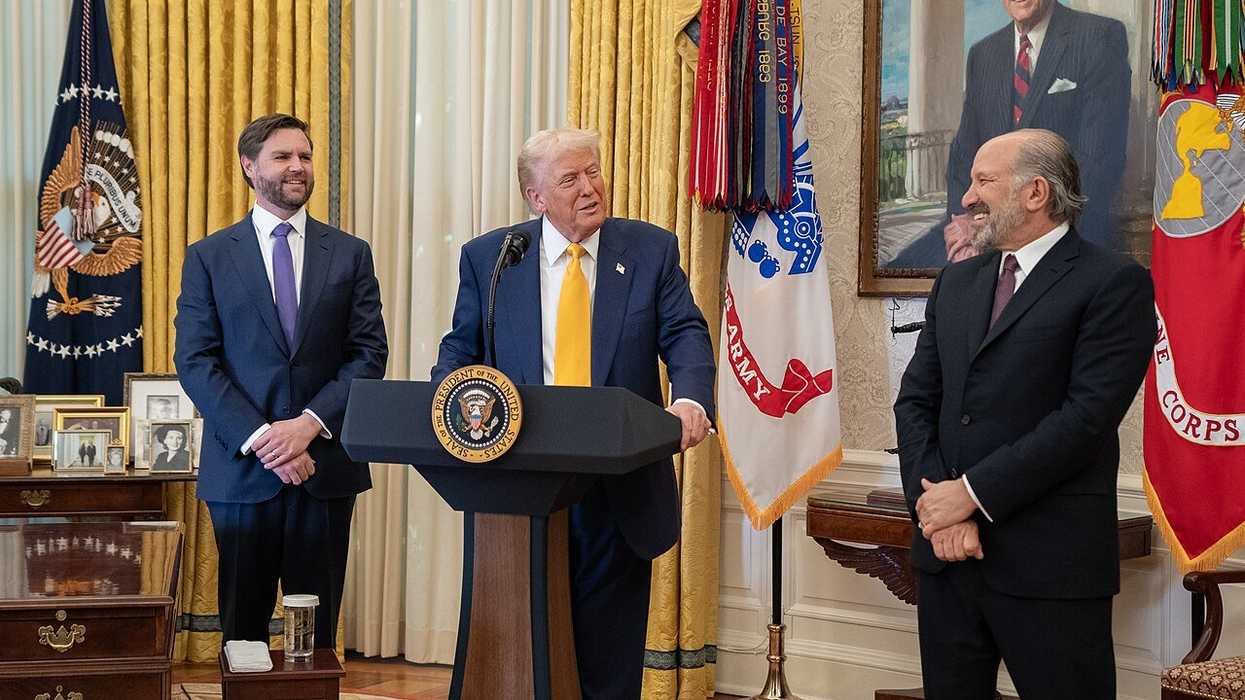
President Donald Trump with Vice President JD Vance and Commerce Secretary Howard Lutnick on February 21, 2025 (Wikimedia Commons)
In a piece published Saturday morning, MS NOW producer Charlie Herman argued that while Trump has long claimed to be more in touch with average Americans than normal politicians, his actions this week "offered signs that he may be out of step with public opinion, especially when it comes to the economy."
The president seems particularly invested in supporting technologies that have grown increasingly "toxic" among voters, largely because they are backed by his ultra-wealthy allies. As these ideas capture his attention, everyday voters and consumers are struggling under the weight of the Trump economy, with the president almost willfully blind to these "warning lights" that could spell political doom for himself and the GOP.
"Trump is embracing cryptocurrency even as Americans express concern about his financial ties to the industry," Herman wrote. "He’s touting artificial intelligence data centers that have become politically toxic. And his administration is filled with multimillionaires and billionaires to a degree unmatched by his predecessors."
He continued: "Outside the White House bubble, warning lights are flashing. Gas prices keep climbing. The national debt just passed $40 trillion. And investors are pushing long-term interest rates to levels not seen in nearly two decades, reflecting concerns about inflation, borrowing and the economy. Taken together, these developments raise questions about how removed the president may be from the economic concerns of many Americans."
Herman further argued that this blindness is being exacerbated by Trump's "K-shaped" administration. This term was in reference to the idea of a "K-shaped economy," a phenomenon in which conditions improve for the wealthy while deteriorating for the rest of the consumer base, and which experts have asserted is the current shape of the U.S. economy under Trump. The president has staffed his White House with 57 individuals worth $100 million or more, vastly more than his immediate predecessors.
"Trump told middle-class voters he would represent their interests and tackle high prices on Day 1," Herman wrote. "Instead, he has gilded the White House not just in gold but with the ultra-wealthy."
The worsening economic conditions have also laid the groundwork for something economists call a "doom loop," a situation in which investors demand higher interest rates when taking on American debt, meaning the government has to borrow more to make those payments, causing the national debt to explode even more. Herman noted that "Investors’ fears about inflation, the federal debt now totaling more than $40 trillion, and billions in corporate borrowing to finance AI are pushing yields (basically, long-term interest rates) on U.S. government bonds to new highs," pushing Trump's economy closer to this doom scenario.
Dan Rather torches Trump's latest 'grift' as 'king of debt' boast backfires
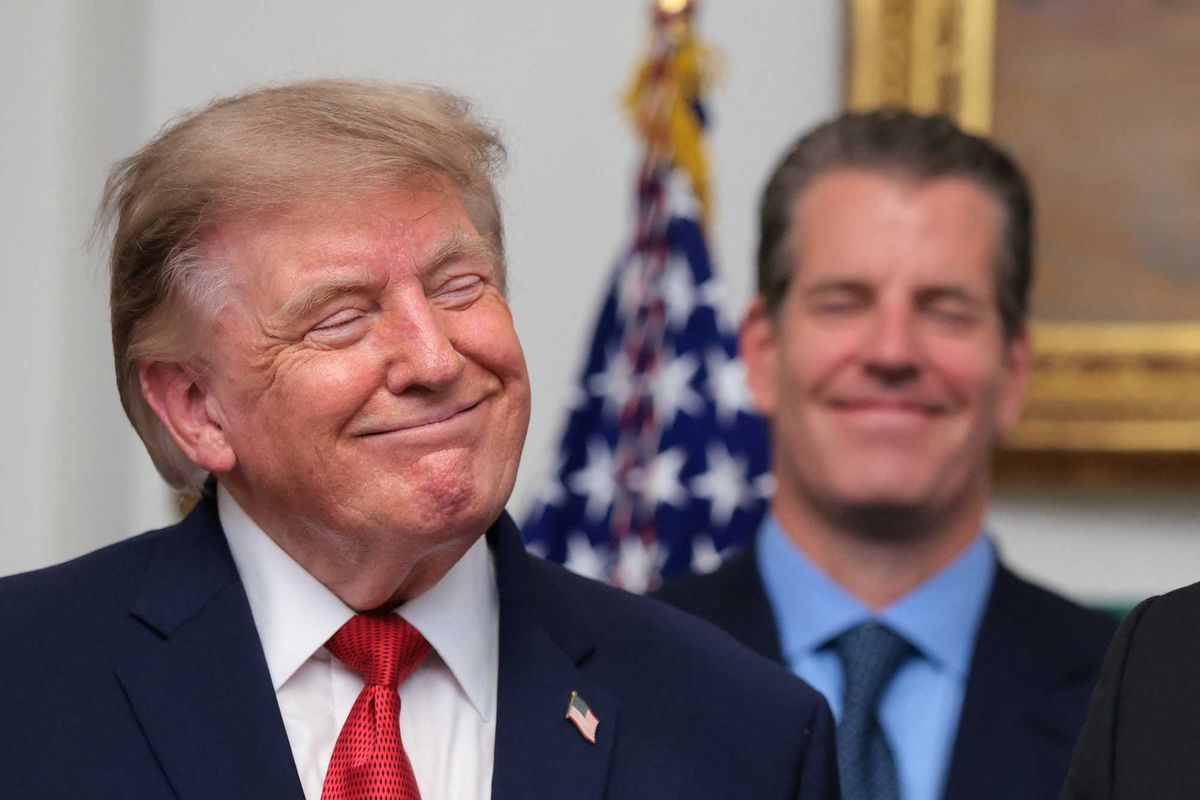
U.S. President Donald Trump reacts during a press conference with cryptocurrency executives in the Roosevelt Room at the White House in Washington, D.C., U.S., August 19, 2026. REUTERS/Kylie Cooper
On Tuesday, the U.S. national debt surpassed $40 trillion, a level that has alarmed economists. Rather argued in a new article for his Substack, "Steady," that Trump once promised to eliminate the national debt during his first term. However, that appears to be just another unfulfilled promise.
"You may remember back in 2016 when Trump proclaimed himself the 'king of debt,' promising to eliminate it in eight years," Rather wrote. "Forty trillion dollars later, that was just another grift. Meanwhile, he is treating the U.S. Treasury like his own personal piggy bank, gleefully spending close to a billion dollars in taxpayer dollars to glorify himself with gilded pieces of junk, mega-ballrooms, and monuments for which no one asked.
The national debt crossed the $40 trillion mark at a time when many Americans are most concerned about affordability ahead of the midterm elections. Rising debt levels will likely increase the cost for Americans to borrow money to buy goods like cars and appliances, according to some experts.
Trump's first Grand Prix DC race draws instant ridicule: 'Clowns need attention'
The site of the Freedom 250 Grand Prix IndyCar series race in Washington D.C., U.,S., August 22, 2026. REUTERS/Aaron Schwartz
President Donald Trump's IndyCar race in Washington, D.C., drew early criticism and mockery as cars were still making their first laps.
On Saturday, drivers started doing practice, qualifying, and other preliminary races for the Freedom 250 Grand Prix, which Trump touted as D.C.'s first-ever IndyCar race. The marquee race, which Trump is expected to attend, will start on Sunday, but the negative reviews started coming in as the drivers raced on bumpy roads, and critics called out the administration for organizing the unsolicited event.
"Turning the National Mall into a race track for the Freedom 250 is a reckless spectacle that puts public spaces at risk because clowns need attention," blasted speaker and advocate Khary Penebaker.
Progressive political commentator Brian Tyler Cohen lamented, "They'll give us literally anything other than healthcare."
"Anyone who has ridden a bicycle in Washington, DC, could tell you this is a terrible idea," activist Alex Palombo wrote in response to a post by NASCAR racer and GOP congressional candidate Jerrod Sessler that noted the "VERY bumpy" track.
"No one in DC is happy about this," journalist Aaron Parnas added.
"August 2026. The streets are now a racetrack," lamented veteran and political commentator Mike Nelson.
Reacting to a post touting the event, Topher Spiro, a senior fellow at American Progress, asked, "Why do you think DC residents want anything to do with this? How much did this promotion cost?"
Reacting to a video from the track, author Erin Page joked, "I have genuinely driven faster through DC, come on now."
"This is any driver from the DMV area," writer Ashley Reese agreed.
"Now just add some MD drivers for the full DC experience," added writer Joe Flood.
Pollster Jake Rubenstein noted that the event is "not packed. But all the people seeing the actual track are blocked by the trees."
Potentially dangerous problem flagged ahead of Trump’s Freedom 250 Grand Prix
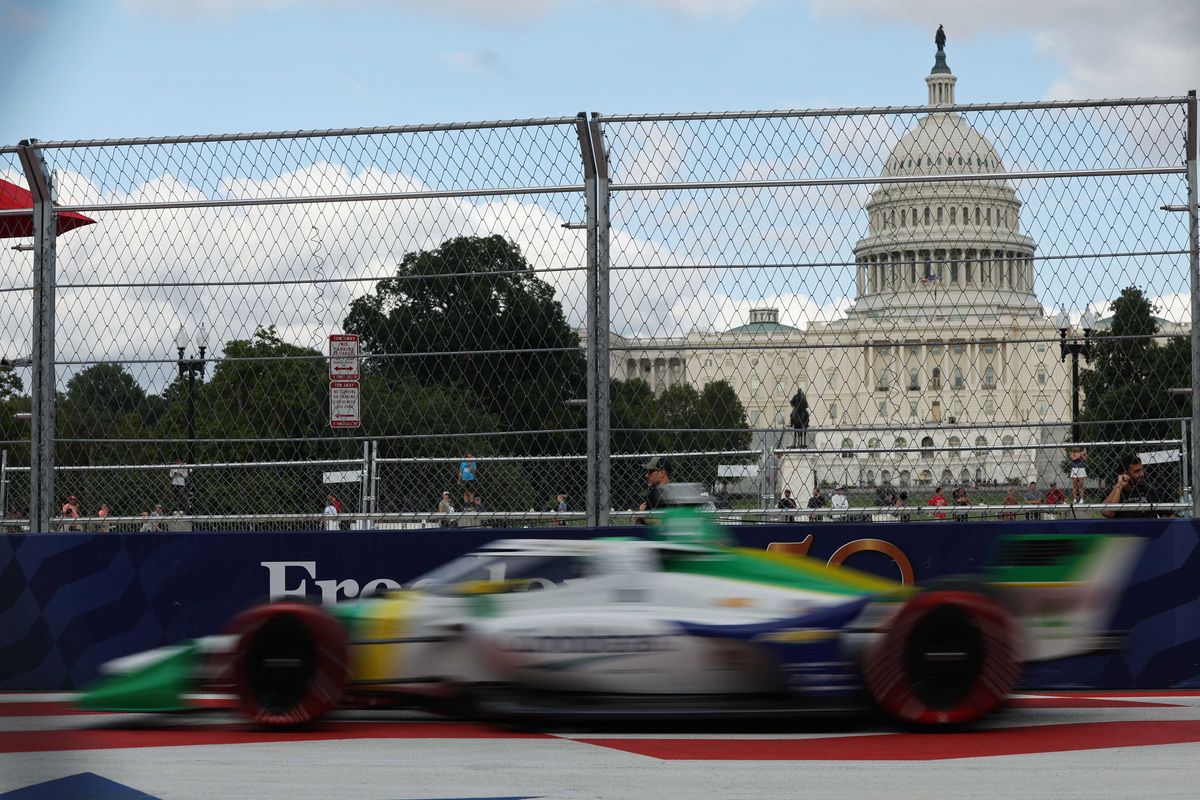
Aug 22, 2026; Washington, D.C., USA; A.J. Foyt Enterprises driver Caio Collet (4) races past the U.S. Capitol during practice for the Freedom 250 Grand Prix on the street circuit of National Mall. Mandatory Credit: Amber Searls-Imagn Images
Just hours ahead of President Donald Trump’s IndyCar race in Washington, D.C., NBC News’ Sahil Kapur flagged a potentially dangerous problem that could pose a risk to drivers.
Dubbed the Freedom 250 Grand Prix, the race has been touted by Trump as D.C.’s first-ever IndyCar race, with the president expected to attend. Drivers hit the course Saturday for practice and qualifying races, but as flagged by Fox Sports, already ran into trouble. A bump in the course sent a number of racers into a runoff area after briefly losing control of their vehicles, as seen in a video compilation shared by “IndyCar on Fox.”
“It’s not an authentic DC street track without bumps!” wrote Kapur, NBC News’ senior national political reporter, in a social media post on X Saturday night. “That said, this is a big one in a flat-out section that caused a bunch of IndyCar drivers problems today – and will be a thing in tomorrow’s race.”
Trump’s big race has already received scrutiny from countless critics, some of whom called the event a “terrible idea” given D.C.’s “very bumpy” roads.
Even former NASCAR driver Jerrod Sessler, a Trump-aligned ex-congressional candidate who lost his primary race earlier this month, warned that the race could pose serious issues for drivers.
“The BUMPS are most certainly going to be the talk of the Freedom 250 in DC,” Sessler wrote in a social media post on X. “The track is VERY bumpy! Not just bumps but cars jumping off the ground sort of bumps!”
The Freedom 250 Grand Prix marks the first-ever IndyCar street race held in the nation's capital, run on a 1.66-mile, seven-turn temporary circuit weaving past the U.S. Capitol and Washington Monument. Trump formally established the race through a Jan. 30, 2026, executive order directing the Departments of Transportation and Interior to designate a race route through the National Mall and surrounding city streets, in honor of the United States Semiquincentennial.