Saturday, February 07, 2026

Trump greenlights media merger critics say will have ‘devastating consequences’

Alexander Willis
February 7, 2026 
RAW STORY
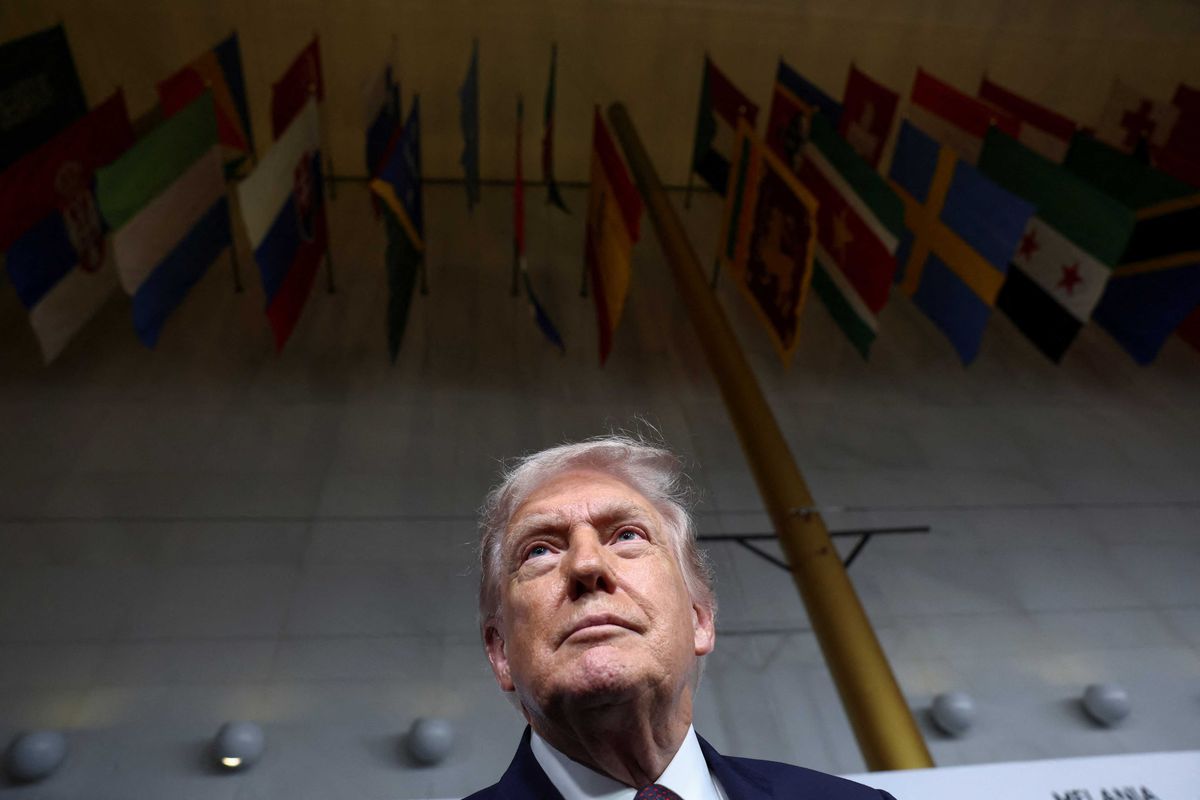


U.S. President Donald Trump attends the premiere of the documentary film "Melania" at the John F. Kennedy Center for the Performing Arts, recently renamed to include U.S. President Donald Trump's name, in Washington, D.C., U.S., January 29, 2026. REUTERS/Kevin Lamarque

President Donald Trump gave the greenlight Saturday to the proposed media merger between broadcasters Nexstar and Tegna, a merger that critics warn would have “devastating consequences” for the media landscape.

“We need more competition against THE ENEMY, the Fake News National TV Networks,” Trump wrote Saturday on his social media platform Truth Social.

“Letting Good Deals get done like Nexstar – Tegna will help knock out the Fake News because there will be more competition, and at a higher and more sophisticated level. Those that are opposed don’t fully understand how good the concept of this Deal is for them, but they will in the future. GET THAT DEAL DONE!”

The proposed merger has proved controversial, with Sen. Michael Bennet (D-CO) and Rep. Joe Neguse (D-CO) warning that the deal would “directly” violate federal law by giving the hypothetical merged company a collective reach of around 80% of U.S. households, far above the Federal Communications Commission’s cap of 39%.

Nexstar executives have directly appealed to Trump in their efforts to have the merger approved, even adopting “buzzword language that Trump often uses” in its plea for approval.

“To be clear, in an age of disinformation and political agendas, we are the anti-fake news,” reads Nexstar’s application to the FCC.

“Our news is delivered by trusted, familiar voices – journalists who live in the community – not a chat-bot or social media influencers. And yet, we are prohibited from broadcasting trusted local news and programming to hundreds of communities across the country because of antiquated regulatory constraints.”

‘Industry Cronies’ at Trump’s EPA Reapprove Dangerous Pesticide Dicamba

“It’s hard to see how Making America Healthy Again was anything but another broken campaign promise,” said one critic.


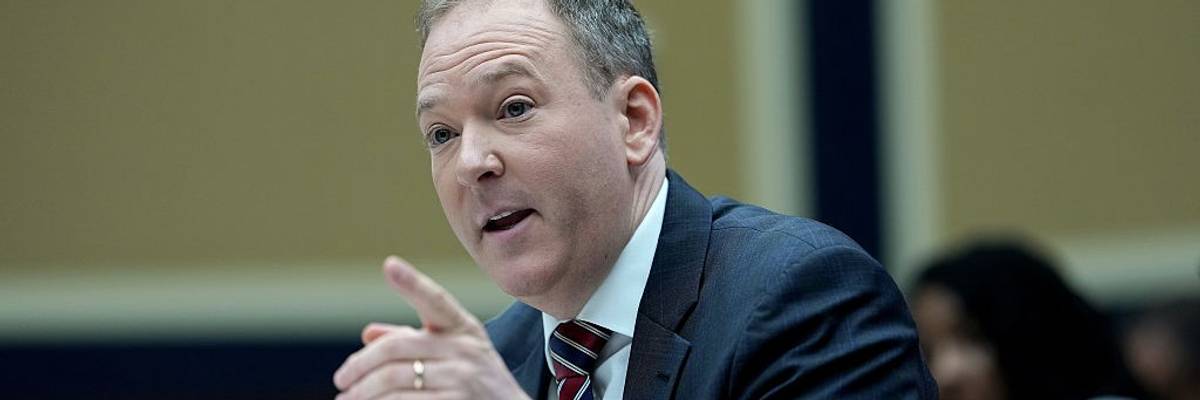
US Environmental Protection Agency (EPA) Administrator Lee Zeldin testifies before Congress on Capitol Hill in Washington, DC on May 20, 2025.
(Photo by Kevin Dietsch/Getty Images)

Brett Wilkins
Feb 06, 2026
COMMON DREAMS


The US Environmental Protection Agency on Friday announced its anticipated reapproval of dicamba for two key crops, a move which, given the pesticide’s proven health risks, places the EPA at apparent odds with President Donald Trump’s vow to “Make America Healthy Again.”

“The industry cronies at the EPA just approved a pesticide that drifts away from application sites for miles and poisons everything it touches,” Nathan Donley, environmental health science director at the Center for Biological Diversity, said in response to Friday’s announcement.

“With the EPA taking aggressive pro-pesticide industry actions like this, it’s hard to see how Making America Healthy Again was anything but another broken campaign promise,” Donley added. “When push comes to shove, this administration is willing to bend over backward to appease the pesticide industry, regardless of the consequences to public health or the environment.”


The EPA said in a statement that the agency “established the strongest protections in agency history for over-the-top (OTT) dicamba application on dicamba-tolerant cotton and soybean crops,” and that “this decision responds directly to the strong advocacy of America’s cotton and soybean farmers.”

While scientific studies have linked exposure to high levels of dicamba to increased risk of cancer and hypothyroidism and the European Union has classified dicamba as a category II suspected endocrine disruptor, the EPA said Friday that “when applied according to the new label instructions,” it “found no unreasonable risk to human health and the environment from OTT dicamba use.”

This is the third time the EPA has approved dicamba for OTT use. On both prior occasions, federal courts blocked the approvals, citing underestimation of the risk of chemical drift that could harm neighboring farms.

The agency highlighted new restrictions on dicamba use it said will reduce risk of drift.

“EPA recognizes that previous drift issues created legitimate concerns, and designed these new label restrictions to directly address them, including cutting the amount of dicamba that can be used annually in half, doubling required safety agents, requiring conservation practices to protect endangered species, and restricting applications during high temperatures when exposure and volatility risks increase,” it said.

Critics noted that the EPA during the Biden administration published a report revealing that during Trump’s first term, senior administration officials intentionally excluded scientific evidence of dicamba-related hazards, including the risk of widespread drift damage, prior to a previous reapproval.

Others pointed to the recent appointment of former American Soybean Associate lobbyist and dicamba advocate Kyle Kunkler as the EPA’s pesticides chief.

“Kunkler works under two former lobbyists for the American Chemistry Council, Nancy Beck and Lynn Dekleva, who are now overseen by a fourth industry lobbyist, Doug Troutman, who was recently confirmed to lead the chemicals office following endorsement by the chemical council,” the Center for Food Safety (CFS) noted Friday.

The Trump EPA has also come under fire for promoting the alleged safety of atrazine, a herbicide that the World Health Organization says probably causes cancer, and for pushing the US Supreme Court to shield Bayer, which makes the likely carcinogenic weedkiller Roundup, from thousands of lawsuits.

CFS science director Bill Freese said that “the Trump administration’s hostility to farmers and rural America knows no bounds.”

“Dicamba drift damage threatens farmers’ livelihoods and tears apart rural communities,” Freese added. “And these are farmers and communities already reeling from Trump’s [Immigration and Customs Enforcement] raids on farmworkers, the trade war shutdown of soybean exports to China, and Trump’s bailout of Argentina, whose farmers are selling soybeans to the Chinese—soybeans China used to buy from American growers.”
As Amazon Sees Record Profits, Customers Say ‘Start Delivering Climate Action’

“Amazon has an extraordinary opportunity and an obligation to act more swiftly on climate change,” one member of Prime Members for a Cleaner Amazon said.


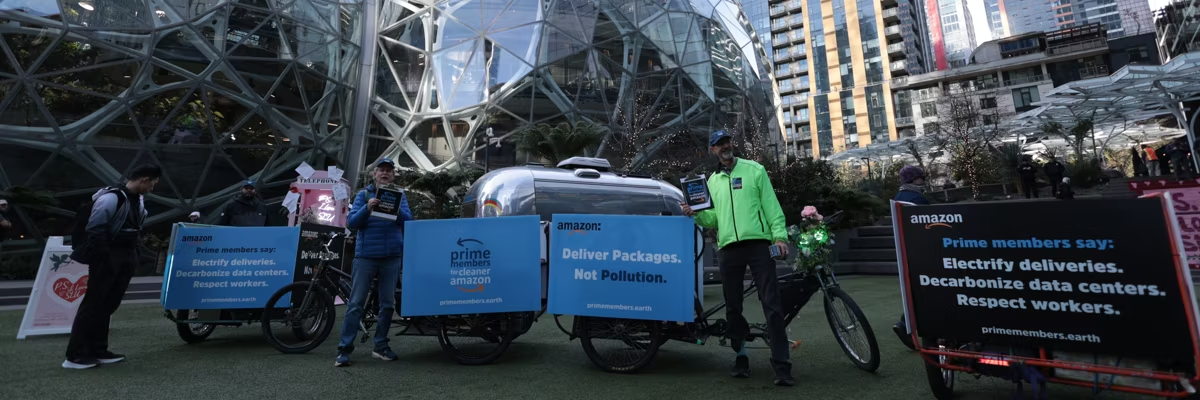
Prime Members for a Cleaner Amazon protest outside Amazon headquarters in Seattle, Washington on February 6, 2026.
(Photo by Aaron Taylor)

Olivia Rosane
Feb 06, 2026
COMMON DREAMS

Friday, the day after Amazon revealed record 2025 profits, 10 members of Prime Members for a Cleaner Amazon staged a pedicab protest in front of its Seattle headquarters, calling on the company to raise its climate ambition to the level of its earnings.

In its fourth quarter report, released Thursday, the tech giant announced that its 2025 income had soared to $77.7 billion, up from $59.2 billion in 2024.


Trump-GOP Law Slashes Amazon’s Tax Bill by 87% as Company Fires 30,000 Workers, Profits Soar

“Amazon has an extraordinary opportunity and an obligation to act more swiftly on climate change,” participant Michael Lazarus told Common Dreams. “It’s a leading provider of consumer goods to consumers who want climate action. It has made broad pledges to take action on climate change, it has made some small steps, but it needs to deliver on immediate action.”

Concerned customers are demanding the company put some of those profits toward speeding up the electrification of its delivery fleet, powering its data centers with renewable energy, and improving working conditions for its employees while respecting their collective bargaining rights. A Morning Consult poll found that 80% of Prime members surveyed wanted the company to reduce its transport and delivery emissions, and 75% would accept slower delivery times in exchange for less climate pollution.

“Profits are up. So is pollution. Prime members say: Deliver more climate action.”

“Amazon’s success is built on us, its customers. Now, we’re asking the company to stop celebrating profits and start delivering climate action,” said Dr. Chris Covert-Bowlds, a Seattle-based member of Prime Members for a Cleaner Amazon and Washington Physicians for Social Responsibility.

The protest took place outside Amazon’s Day 1 building, where CEO Andy Jassy has his office, from around 8:00 am to 10:30 am Pacific time. Participants rode four pedicabs as a subtle suggestion to the company of how to move goods without fossil fuels. The cabs were decorated with billboards with messages such as, “Deliver packages. Not pollution,” and “Profits are up. So is pollution. Prime members say: Deliver more climate action.”

Participants also handed out hundreds of stickers and flyers to Seattle residents and Amazon employees.

Amazon has a history of making sustainability promises it does not keep and retaliating against employees who call it to account. While it has pledged to reach carbon neutrality across its operations by 2040, it is increasingly unclear how it will achieve this given its buildout of energy-intensive data centers and artificial intelligence.

“We’ve been calling attention to Amazon’s failure to align its emissions reductions with the latest climate science for years,” Stand.earth campaigner Joshua Archer told Common Dreams.

However, he said what “makes this moment really unique” is that Amazon is now failing three distinct groups of people: consumers like those at the protest who want it to do better on climate, investors who are concerned about returns from the AI buildout, and the 30,000 employees it laid off since October despite its record profits.

“The company is not respecting the employees on whose backs the company has built its success” just as it’s “not respecting the latest climate science,” Archer said.

Lazarus said that many employees expressed interest in the protesters’ demands. While some zipped past in headphones, others “lit up and were clearly engaged and simpatico.”

He noted that Amazon employees have been organizing for years to pressure the company to increase its climate ambitions through Amazon Employees for Climate Justice, and hoped the addition of consumer advocacy would help “Amazon realize that there’s a groundswell of support for taking more aggressive measures to reduce their climate impact... which is becoming quite monumental given the growth in data cents and the influence that they carry.”

Lazarus told Common Dreams it was also important to him that Amazon ramp up its climate ambitions given President Donald Trump’s determination to double down on fossil fuels and inhibit renewable energy.

“We know that we’re not going to see much climate action at the federal level,” he said. “It becomes all the more important for corporate actors like Amazon to demonstrate that it remains committed to and acts upon its need to reduce emissions.”
Bad Bunny Is An Environmental Justice Educator: Here’s What His Music Can Teach Us

As a recording artist, the world is his classroom, and his performances function as public pedagogy.


Puerto Rican singer Bad Bunny attends the premiere of “Caught Stealing” at the Regal Union Square in New York on August 26, 2025.
(Photo by Angela Weiss / AFP via Getty Images)

Kimi Waite
Feb 07, 2026
Common Dreams


While the NFL is promising the American public a Super Bowl they can dance to, keep in mind that half-time show headliner Bad Bunny is way more than just the world’s most-played recording artist of 2025 and Latin Grammy and Grammy winner: Benito Antonio Martínez Ocasio is also a bona fide environmental justice educator.

As a former public school educator, a professor, and an author of two books on teaching climate change and environmental justice, I know that climate change disproportionately impacts marginalized communities, which means you can’t teach about the climate crisis without also teaching about equity, race, and justice.

Bad Bunny knows this, too.

Consider that Mr. Ocasio was born in Puerto Rico (where he recently held an extensive concert residency that reportedly boosted the economy of the unincorporated US territory by up to $400 million), where he reportedly has held or holds property, along with Los Angeles, Miami, and San Juan. It is not lost on Bad Bunny that all of these areas face severe climate change impacts, from record-breaking wildfire seasons to rising waters to extreme heat.

His call to action also aligns with the environmentally just future that Puerto Ricans have been envisioning.

Mr. Ocasio frequently incorporates commentary about social and political issues into his music and has spoken out about Immigration and Customs Enforcement Raids, transphobia, and racial justice. As a recording artist, the world is his classroom, and his performances function as public pedagogy. K-12 teachers, college professors, and environmental leaders alike may draw inspiration from his work to develop their own environmental justice curricula, projects, and investigations as they take action in their communities.

Bad Bunny’s music video, El Apagón, embeds an 18-minute documentary featuring investigative journalist Bianca Graulau and provides evidence of unparalleled gentrification driven by outsiders, the widespread displacement of families with decades of roots in their lost communities, and the purposeful and profound persistence of colonialism.


Moreover, the video takes its title from the rolling blackouts that occurred in Puerto Rico after Hurricane Maria in 2017. Hurricane Maria resulted in the largest blackout in US history and the second-largest in the world.


Puerto Rico’s power grid was devastated by Hurricane Maria, prompting privatization by LUMA Energy, which was met with fierce resistance and protest. However, since privatization, blackouts have persisted, including those caused by a 6.4-magnitude earthquake in 2020, Hurricane Fiona in 2022, and a blackout in 2025. Even without natural disasters, Puerto Ricans lose about 27 hours of power per year.

More than just time spent in the dark, blackouts disrupt access to clean water and air conditioning, both of which are essential in tropical climates. In addition, reliance on generators during blackouts has increased respiratory health impacts, such as asthma.

Children are among the most vulnerable, and blackouts have also resulted in mental health impacts for Puerto Rico’s K-12 students, such as a sense of hopelessness and isolation.

Add it all up, and you get systemic environmental racism. And it leads to the disproportionate impact of environmental hazards on people of color. A concerted push toward environmental justice is the only antidote.

The preparation of students and community members to work toward environmental justice began more than 30 years ago at the First National People of Color Leadership Summit. The 1,100-person delegation drafted 17 Principles of Environmental Justice and the Principles of Working Together. They significantly redefined the meaning of what constitutes the “environment.”

Historically, “environment” referred to pristine natural areas outside cities. At the summit, “environment” was redefined to capture the places where people (particularly those of color) live, work, study, play, and pray. This enabled the inclusion of issues such as toxic pollution, worker safety, transportation, housing, health, and recurring blackouts, such as those in Puerto Rico.

To combat local environmental racism in any community, it is imperative to begin with community-generated solutions and to view residents through a lens of self-determination, as they are the most knowledgeable about the issues that directly affect their communities. This includes K-12 students, who are capable and eager to take action.

Young students can apply an investigative journalism lens to their communities by conducting research to address environmental issues of concern. For example, students can interview residents and conduct community surveys in their neighborhood to identify environmental injustices. Students can also create an oral history project to archive local perspectives of environmental injustices and partner with their local public library to host a showcase or a display of their findings.

Elementary, middle, and high school teachers can also encourage students to develop their historical literacy, social consciousness, and critical thinking skills by comparing the US response time to Hurricane Maria with that of other natural disasters, with particular attention to US states versus US territories.

Again, look no further than Bad Bunny. He is intentionally and powerfully elevating Puerto Rico to the national consciousness while simultaneously using his global platform to highlight environmental racism.

Bad Bunny has turned his global stage into a worldwide classroom.

More pointedly, his call to action also aligns with the environmentally just future that Puerto Ricans have been envisioning. Teachers, students, and environmental leaders are well-positioned to respond to this call. However, we can’t rely on our global pop stars to teach our K-12 students about environmental racism and environmental justice; it must start in public schools.


Our work is licensed under Creative Commons (CC BY-NC-ND 3.0). Feel free to republish and share widely.


Kimi Waite
Kimi Waite is the author of the book, “Teaching Environmental Justice in the Elementary Classroom: Entry Points for Equity Across the K-5 Curriculum” (Routledge, 2026), and co-author of the book “What Teachers Want to Know About Teaching Climate Change: An Educator’s Guide to Nurturing Hope and Resilience (K-12)” (Corwin Press, 2025). She is a 2021 Public Voices fellow on the climate crisis with the OpEd Project and the Yale Program on Climate Change Communication.
Full Bio >


When Racism Becomes Spectacle: Distraction in an Age of Climate Crisis

In the end, the question is not whether a single post is offensive—it is whether we allow cycles of warranted outrage to consume the very attention required for collective survival.


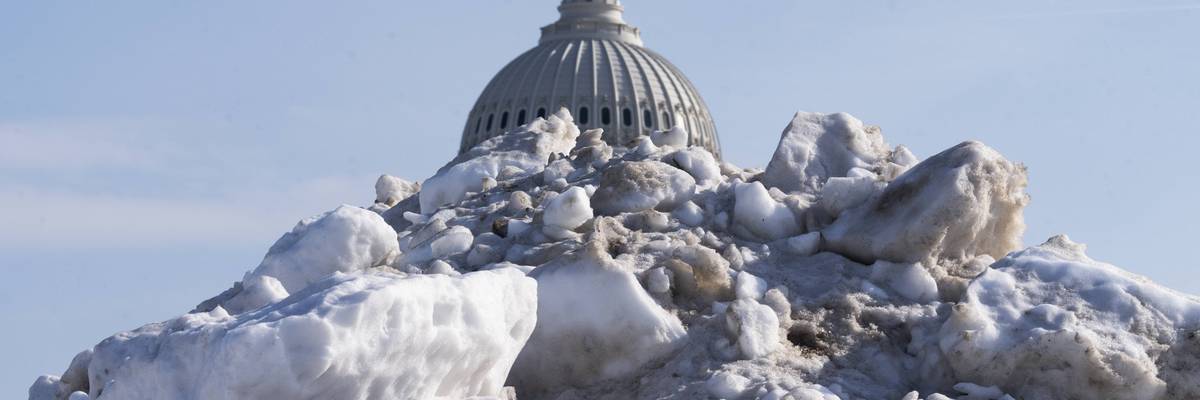
The US Capitol dome is seen over snow and ice that is piled near the Capitol Reflecting Pool on Tuesday, February 3, 2026, over a week after a storm passed over the area.
(Photo by Tom Williams/CQ-Roll Call, Inc via Getty Images)


Peter Scaramuzzo
Feb 07, 2026
Common Dreams

The recent posted image by President Donald Trump depicting the Obamas as primates is unsurprising. This image represents what is believed, what is undoubtedly said behind closed doors. What remains unreal to me is that a sitting president flagrantly posted this. If the Republican Party does not denounce this, they are proclaiming what they truly value. Perhaps that’s just as well: The racism has truly not been covert for some time. For so many, this is just another day at the office—another way racist ideology within the Republican Party asserts itself. In posting this, one must question whether the president is unhinged and strategic at the same time. I believe that, surely, he is laughing about just how much he is able to get away with, as befits his temperament and historically documented pattern of behavior.

Already, the White House defends the indefensible: White House press secretary Karoline Leavitt has publicly defended the president’s sharing of the video by framing it as a meme inspired by The Lion King—saying critics should stop what she calls “fake outrage” and focus on more important issues. The White House has repeatedly expressed that the imagery was taken from an internet meme meant to depict the president as “King of the Jungle” and Democrats as animal characters, not intended as racist content.

This disgusting portrayal is distraction while simultaneously challenging the masses to disbelieve what they see with their own eyes. Fascist politics often relies on propaganda and media spectacle to distract the public, undermine shared reality, and redirect attention away from policy consequences toward emotionally charged narratives (Stanley, 2018). This pushes any thinking person to ask, about what are the masses being distracted?

Advancements to curtail Immigration and Customs Enforcement seems the most apt and logical answer. Indeed, politicians must remain steadfast and resolved in their efforts to contain ICE. However, as an education environmental researcher, I am convicted to take a step back to examine the broader landscape and the long-term trends.

If distraction is the strategy, then sustained attention is resistance.

The planetary boundaries framework reminds us that Earth’s stability is shaped by interconnected systems—climate, biodiversitywater, land, and chemical cycles—whose disruption increases the risk of large-scale ecological destabilization. Seen in this light, the severe and lingering cold snaps recently experienced in the US Northeast do not contradict global warming but rather illustrate the volatility of a climate system pushed beyond its historical range of variability. As scientists note, destabilizing the climate system can intensify extremes across seasons, producing not only heatwaves but also disrupted jet streams, polar air incursions, and unusual persistence of cold events. Situating a regional cold spell within this broader planetary context reframes it from an isolated anomaly to a symptom of systemic strain: local weather variability unfolding against a backdrop of transgressed ecological limits. In other words, the discomfort and disruption of a harsh winter can be read as a lived reminder that Earth’s regulatory systems are under pressure, and that climatic instability—whether expressed as heat, cold, drought, or flood—is part of the same planetary story.

Despite overwhelming scientific consensus that climate change is real and accelerating, the current White House under President Trump has repeatedly signaled opposition to aggressive climate mitigation, undercutting efforts to address the crisis while publicly downplaying its urgency. At the United Nations General Assembly in September 2025, Trump referred to climate change as “the greatest con job ever perpetrated on the world,” dismissing expert predictions and climate science in broad terms even as global averages continue to rise and impacts intensify. Domestically, his administration has pursued policies that limit federal engagement in climate leadership—such as rescinding foundational greenhouse gas regulations by challenging the Environmental Protection Agency’s scientific endangerment finding and refusing to send senior officials to the COP30 climate summit—and rolling back environmental protections while promoting expanded fossil fuel extraction.

These actions illustrate a pattern of rhetoric and policymaking that accepts the existence of environmental change but rejects concerted governmental action to confront the climate crisis at the scale scientists say is necessary.

Unchecked climate change is already reshaping Earth’s systems in ways that pose severe risks to human and ecological well-being, often in counterintuitive ways. In the northeastern United States, unseasonably severe cold spells have contributed to fatalities and widespread disruption, reflecting how a destabilized climate system can produce more extreme and erratic weather patterns even as the planet warms overall. Scientific assessments show that critical components of the climate system—such as the Atlantic Meridional Overturning Circulation (AMOC), a major ocean current system that redistributes heat around the globe—are showing signs of disruption associated with warming and freshwater influx from melting ice, with potential large-scale impacts on regional climates, precipitation patterns, and food security if thresholds are crossed. Researchers warn that such a weakening of ocean currents could intensify weather extremes and disrupt agricultural systems and ecosystems worldwide, compounding other alarming indicators like mass species loss and coral reef die-off under thermal stress.

Reflecting the convergence of climate change, geopolitical tension, and emerging technological risks, the Bulletin of the Atomic Scientists has moved the symbolic Doomsday Clock closer to midnight than at any point in its history, signaling growing vulnerability to existential threats driven by human actions and inaction. As of the latest update, the clock stood at a historically high proximity to midnight—indicating an elevated sense of global peril tied in part to the accelerating impacts of climate change alongside nuclear and disruptive technologies—underscoring that societies worldwide have not yet mounted an adequate policy or governance response to the mounting evidence of planetary destabilization.

Far from being speculative or alarmist rhetoric, these warnings are grounded in measurable scientific trends that reveal cascading risks to ecosystems and societies, even as elites prepare for worst-case futures: Reports describe wealthy investors and defense planners expanding private bunkers and survival retreats in anticipation of climatic and geopolitical disruption, while the broader public’s attention is often diverted to the latest political scandal rather than sustained policy engagement with structural risks.

There is circumstantial evidence that the current White House is using distraction as a communication strategy, one consistent with well-studied political diversion tactics, but there is no direct proof that this is an intentionally orchestrated White House policy without formal investigation. Analysts and critics of Project 2025—the extensive conservative policy blueprint authored by the Heritage Foundation and many associates of this administration—have raised alarms about proposals that would restructure media oversight, diminish independent journalism, and alter technology and communications policies in ways that could reduce scrutiny of executive power, a move some see as creating fertile terrain for distraction over accountability.

Political commentators have documented how sensational statements and provocative posts often dominate headlines at the expense of in-depth coverage of systemic risks like climate change or immigration enforcement priorities, consistent with agenda-setting research showing how political actors can shift public attention.

Additionally, scholars studying messaging patterns around scandals suggest that shifts in provocative communications often occur simultaneously with increased media focus on crisis narratives, although establishing intentional coordination by an administration would require formal oversight or committee inquiry, not journalistic inference alone. In short, critics interpret these developments as strategic distraction tactics, but distinguishing intent from effect is a matter for official investigation and evidence beyond public reporting.

In the end, the question is not whether a single post is offensive—it is whether we allow cycles of warranted outrage to consume the very attention required for collective survival. Racism must be named and opposed wherever it appears, especially when amplified by the highest office, but we must also recognize when spectacle functions to fracture public focus. The climate crisis does not pause for political theater, nor do ecological thresholds wait for electoral cycles. If distraction is the strategy, then sustained attention is resistance. The work before us is to hold moral clarity and planetary reality together, refusing to let either be eclipsed by the churn of the news cycle, and insisting that democratic accountability includes safeguarding the conditions for life itself.


Our work is licensed under Creative Commons (CC BY-NC-ND 3.0). Feel free to republish and share widely.


Peter Scaramuzzo
Peter Scaramuzzo, Ph.D., is an education scholar and former K-12 teacher whose work focuses on ecocentric environmental education, climate justice, and the politics of curriculum. His research examines how schooling, policy, and public discourse shape collective responses to ecological crisis.
Full Bio >
Canada ramps up anti-Trump policies with new Greenland consulate


Canada's Foreign Affairs Minister Anita Anand in Nuuk, Greenland, February 6, 2026. REUTERS/Stoyan Nenov

February 06, 2026 
ALTERNET

Since U.S. President Donald Trump's return to the White House, the United States' relations with Canada have deteriorated considerably. Canadian Prime Minister Mark Carney is making it abundantly clear that he has no desire for Canada to become "the 51st state," and he is highly critical of Trump's push for a U.S. takeover of Greenland.

Carney, during a speech at the 2026 World Economic Forum (WEF) in Davos, Switzerland in January, lamented that a "rupture" has occurred in relations between the U.S. and its longtime North Atlantic Treaty Organization (NATO) allies. And Trump was so offended by Carney's comments that he withdrew his invitation for Canada to join his new Board of Peace.

Now, Canada's expression of solidarity with Greenland is escalating with the Friday, February 6 opening of a new Canadian consulate in Nuuk, the Danish territory's capital city.

The opening, according to The Independent's Brendan Rascius, signals "stronger diplomatic ties" between Canada and Greenland "as President Donald Trump pursues his bid to acquire the Arctic island."

Rascius notes that although the new Canadian Consulate in Nuuk "had been in the works for over a year," the opening "comes during a period of heightened tension between the Trump Administration and Greenland, Denmark and other NATO allies."

Nuuk Mayor Avaaraq Olsen is quoted as saying, "It's really important for us to know that we are not alone in this, that we actually have people from other countries who care about us. People are scared and they are more and more concerned. Because of Trump's statements, they get very worse and worse."

The opening is generating a lot of discussion on X, formerly Twitter.

CBC reporter Olivia Stefanovich tweeted, "A delegation of 65 Inuit are travelling to Greenland with Makivvik for the official opening of the Canadian consulate in the capital Nuuk. They say they're going to stand in solidarity with Kalaallit, Greenlandic Inuit, amidst threats from U.S. President Donald Trump."

Stefanovich also posted, "Every passenger on board Air Inuit has flags from Canada and Greenland to celebrate the official opening of the Canadian consulate in Nuuk on Friday."

Bloomberg News noted, "Canada and France will open consulates in Greenland on Friday, underscoring NATO allies' heightened interest in the region after Donald Trump asserted his desire to see the US to take control of the island."

Al Jazeera English described the consulate as a "strong show of support for NATO ally Denmark…. in the wake of US efforts to secure control of the Arctic island."

Toronto-based Dr. Raghu Venugopal, a board member for Médecins Sans Frontières Canada (Doctors Without Borders Canada), tweeted, "Canada's Foreign Affairs Minister Anita Anand, Governor General Mary Simon and a delegation of Canadian Inuit today open the new Canadian Consulate in Nuuk, Greenland. A proud day for Canada — standing up to American aggression and bottomless greed."


In show of support, Canada, France open consulates in Greenland


By AFP
February 5, 2026


Greenland is an autonomous territory within the Kingdom of Denmark - Copyright AFP Ina FASSBENDER


Camille BAS-WOHLERT, with Nioucha ZAKAVATI in Nuuk

Canada and France, which both adamantly oppose Donald Trump’s wish to control Greenland, will open consulates in the Danish autonomous territory’s capital on Friday, in a strong show of support for the local government.

Since returning to the White House last year, Trump has repeatedly insisted that Washington needs to control the strategic, mineral-rich Arctic island for security reasons.

The US president last month backed off his threats to seize Greenland after saying he had struck a “framework” deal with NATO chief Mark Rutte to ensure greater American influence.

A US-Denmark-Greenland working group has been established to discuss ways to meet Washington’s security concerns in the Arctic, but the details of the talks have not been made public.

While Denmark and Greenland have said they share Trump’s security concerns, they have insisted that sovereignty and territorial integrity are a “red line” in the discussions.

“In a sense, it’s a victory for Greenlanders to see two allies opening diplomatic representations in Nuuk,” said Jeppe Strandsbjerg, a political scientist at the University of Greenland.

“There is great appreciation for the support against what Trump has said.”

French President Emmanuel Macron announced Paris’s plans to open a consulate during a visit to Nuuk in June, where he expressed Europe’s “solidarity” with Greenland and criticised Trump’s ambitions.

The newly-appointed French consul, Jean-Noel Poirier, has previously served as ambassador to Vietnam.

Canada meanwhile announced in late 2024 that it would open a consulate in Greenland to boost cooperation.

The opening of the consulates is “a way of telling Donald Trump that his aggression against Greenland and Denmark is not a question for Greenland and Denmark alone, it’s also a question for European allies and also for Canada as an ally, as a friend of Greenland and the European allies also,” Ulrik Pram Gad, Arctic expert at the Danish Institute of International Studies, told AFP.

“It’s a small step, part of a strategy where we are making this problem European,” said Christine Nissen, security and defence analyst at the Europa think tank.

“The consequences are obviously not just Danish. It’s European and global.”


– Recognition –


According to Strandsbjerg, the two consulates — which will be attached to the French and Canadian embassies in Copenhagen — will give Greenland an opportunity to “practice” at being independent, as the island has long dreamt of cutting its ties to Denmark one day.

The decision to open diplomatic missions is also a recognition of Greenland’s growing autonomy, laid out in its 2009 Self-Government Act, Nissen said.

“In terms of their own quest for sovereignty, the Greenlandic people will think to have more direct contact with other European countries,” she said.

That would make it possible to reduce Denmark’s role “by diversifying Greenland’s dependence on the outside world, so that it is not solely dependent on Denmark and can have more ties for its economy, trade, investments, politics and so on”, echoed Pram Gad.

Greenland has had diplomatic ties with the European Union since 1992, with Washington since 2014 and with Iceland since 2017.

Iceland opened its consulate in Nuuk in 2013, while the United States, which had a consulate in the Greenlandic capital from 1940 to 1953, reopened its mission in 2020.

The European Commission opened its office in 2024.


Greenland villagers focus on ‘normal life’ amid stress of US threat


By AFP
February 6, 2026


Dorthe Olsen holds up traditional clothing at her home in Sarfannguit 
- Copyright ${image.metadata.node.credit} 


Nioucha ZAKAVATI

Proudly showing off photographs on her tablet of her grandson’s first hunt, Dorthe Olsen refuses to let the turmoil sparked by US president Donald Trump take over her life in a small hamlet nestled deep in a Greenland fjord.

Sarfannguit, founded in 1843, is located 36 kilometres (22 miles) east of Sisimiut, Greenland’s second-biggest town, and is accessible by boat in summer and snowmobile or dogsled in winter if the ice freezes.

The settlement has just under 100 residents, most of whom live off from hunting and fishing.

On this February day, only the wind broke the deafening silence, whipping across the scattering of small colourful houses.

Most of them looked empty. At the end of a gravel road, a few children played outdoors, rosy-cheeked in the bitter cold, one wearing a Spiderman woolly hat.

“Everything is very calm here in Sarfannguit,” said Olsen, a 49-year-old teacher, welcoming AFP into her home for coffee and traditional homemade pastries and cakes.

In the background, a giant flat screen showed a football match from England’s Premier League.

Olsen told AFP of the tears of pride she shed when her grandson killed his first caribou at age 11, preferring to talk about her family than about Trump.

The US president has repeatedly threatened to seize the mineral-rich island, an autonomous territory of Denmark, alleging that Copenhagen is not doing enough to protect it from Russia and China.

He nevertheless climbed down last month and agreed to negotiations.

Greenland’s health and disability minister, Anna Wangenheim, recently advised Greenlanders to spend time with their families and focus on their traditions, as a means of coping with the psychological stress caused by Trump’s persistent threats.

The US leader’s rhetoric “has impacted a lot of people’s emotions during many weeks”, Wangenheim told AFP in Nuuk.

– ‘Powerless’ –

Olsen insisted that the geopolitical crisis — pitting NATO allies against each other in what is the military alliance’s deepest crisis in years — “doesn’t really matter”.

“I know that Greenlanders can survive this,” she said.

Is she not worried about what would happen to her and her neighbours if the worst were to happen — a US invasion — especially given her settlement’s remote location?

“Of course I worry about those who live in the settlements,” she said.

“If there’s going to be a war and you are on a settlement, of course you feel powerless about that.”

The only thing to do is go on living as normally as possible, she said, displaying Greenland’s spirit of resilience.

That’s the message she tries to give her students, who get most of their news from TikTok.

“We tell them to just live the normal life that we live in the settlement and tell them it’s important to do that.”

The door opened. It was her husband returning from the day’s hunt, a large plastic bag in hand containing a skinned seal.

Olsen cut the liver into small pieces, offering it with bloodstained fingers to friends and family gathered around the table.

“It’s my granddaughter’s favourite part,” she explained.

Fishing and hunting account for more than 90 percent of Greenland’s exports.

– No private property –

Back in Sisimiut after a day out seal hunting on his boat, accompanied by AFP, Karl-Jorgen Enoksen stressed the importance of nature and his profession in Greenland.

He still can’t get over the fact that an ally like the United States could become so hostile towards his country.

“It’s worrying and I can’t believe it’s happening. We’re just trying to live the way we always have,” the 47-year-old said.

The notion of private property is alien to Inuit culture, characterised by communal sharing and a deep connection to the land.

“In Greenlandic tradition, our hunting places aren’t owned. And when there are other hunters on the land we are hunting on, they can just join the hunt,” he explained.

“If the US ever bought us, I can for example imagine that our hunting places would be bought.”

“I simply just can’t imagine that,” he said, recalling that his livelihood is already threatened by climate change.

He doesn’t want to see his children “inherit a bad nature — nature that we have loved being in — if they are going to buy us”.

“That’s why it is we who are supposed to take care of OUR land.”

Carney scraps Canada EV sales mandate, affirms auto sector’s future is electric

By AFP
February 5, 2026


Canadian Prime Minister Mark Carney says his country remains a leader in the fight against climate change - Copyright AFP/File Dave Chan


Ben Simon

Prime Minister Mark Carney on Thursday cancelled a mandate for all vehicles sold in Canada to be electric by 2035, while announcing major investments to support the auto industry’s EV transition.

In unveiling his plan to transform the sector, Carney said Canada’s auto industry needed to be ready for a future where EVs are dominant, and where US President Donald Trump’s tariffs have made cross-border vehicle production unworkable.

Carney’s decision to scrap EV mandates also marked another departure from policies backed by his climate-focused predecessor, Justin Trudeau.

Trudeau’s government had mandated that 20 percent of vehicles sold this year be electric, with a 60 percent target by 2030 and the 100 percent target for 2035.

Those targets were applauded by some environmental groups but faced criticism from automakers, as well as concern that Canada had nowhere near the charging infrastructure needed to support full electrification across a vast landmass.

Carney argued his new automotive strategy would prioritize “results and solutions.”

His plan includes a CAN$5,000 (US$3,700) subsidy for individuals who choose to buy an EV, CAN$1.5 billion to improve charging infrastructure, and CAN$3 billion “to help the auto industry adapt, grow, and diversify to new markets,” his office said.

“We know where the auto industry is headed. We’re going to support that transition,” Carney told reporters.

Progress in the global EV market has been patchy.

Trump scrapped tax credits for EV purchases last year, jarring automakers that invested heavily in electrification during Democrat Joe Biden’s presidency.

The European Union in December also proposed scrapping a planned 2035 ban on new combustion-engine vehicles.

Carney said his goal was 75 percent EV sales by 2035, and a 90 percent target by 2040.

The Global Automakers of Canada, an industry group, praised Carney for providing “greater clarity” on the government’s electrification plans, including “a commitment to aggressively build out the charging infrastructure.”

Since taking office last year, Carney has also scrapped Trudeau’s carbon tax on individual households and advanced plans to build a new oil pipeline from Alberta to the Pacific coast — infuriating environmental groups.

Asked Thursday if he still considered Canada a leader in the fight against climate change, Carney said: “Absolutely.”


– ‘Serious liability’ –


Canada’s auto industry supports half a million jobs, and concern about its future has intensified since Trump returned to office last year.

The president’s broad approach on trade with Canada has shifted, but his administration has maintained a fairly consistent message on autos, insisting it wants to see vehicles made exclusively inside the United States.

Carney on Thursday said “there’s no greater symbol of how closely the Canadian and American economies have been intertwined than automobiles.”

Parts cross the US-Canada border up to eight times during production, but Trump’s auto tariffs are threatening the viability of such integration.

“That trade relationship that once was a great strength has now become a serious vulnerability,” Carney said.

Since April, Canadian-made vehicles have faced a 25 percent tariff on their non-US components, a levy Canada insists violates the existing North American free trade agreement, known as the USMCA.

USMCA revision talks are set for this year.

“Our objective is to remove all tariffs in the auto sector,” Carney said, but stressed Canada’s industry needed to start planning for an entirely domestic production chain.

Canada has large deposits of the critical minerals needed for EV battery production and says it wants to develop an end‑to‑end production chain, from mining to mineral processing to vehicle battery production.
Trump orders more prayer in schools — after mocking GOP leader for praying


February 05, 2026
ALTERNET

At the 2026 National Prayer Breakfast, President Donald Trump imposed new directives regarding prayer in public schools. And he did so after making fun of a top Republican for praying.

The Daily Beast reported Thursday that Trump rolled out elements of his "Make America Pray Again" agenda at the event, which has taken place on the first day of every February since 1953 and features members of both political parties and various faith leaders. The Beast reported that Trump conditioned federal money on schools allowing students "to pray privately and quietly by themselves, whether in class, at an athletic event or before a meal," all of which is currently religious expression openly permitted by the First Amendment.

The "Make America Pray Again" plan also encourages students to "pray in groups," and to "pray in a speaking voice on the same terms as any other student might engage in non-religious speech." While it's illegal for schools to force students to partake in prayer, public schools must now certify in writing that they are protecting students' right to pray, and state education officials are required to report any violations to federal authorities.

Trump's new rules regarding school prayer came at the same event where he attacked the small number of Democrats who were in attendance. He also openly mocked House Speaker Mike Johnson (R-La.) for his propensity to pray before meals.

"Mike Johnson's a very religious person and he does not hide it," Trump said. "He'll say to me sometimes at lunch, 'sir, may we pray?' I say, 'excuse me? We're having lunch!'

The 79 year-old president also used part of his speech to wonder about his own mortality, asking the audience if they felt he would get into heaven.

"I really think I probably should make it,” Trump said. "I mean I’m not a perfect candidate, but I did a hell of a lot of good for perfect people. That’s for sure."


The Working Class versus an Authoritarian Police State

Resisting Operation Metro Surge is expanding working-class consciousness about the corporate state’s responses to people’s resistance to oppression.


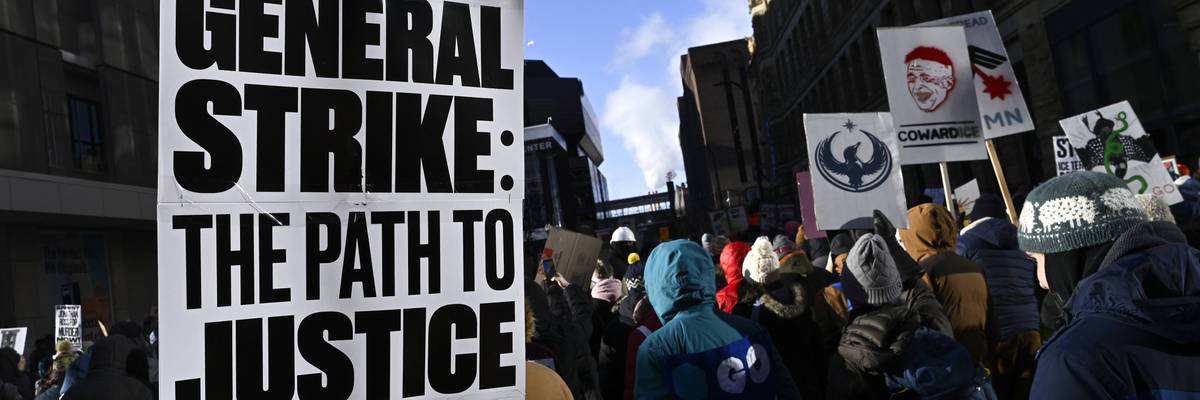
Demonstrators participate in a rally and march during an “ICE Out” day of protest on January 23, 2026 in Minneapolis, Minnesota.
(Photo by Stephen Maturen/Getty Images)

Seth Sandronsky
Feb 07, 2026
Common Dreams


As people are watching online and in person, American federal immigration enforcement is stepping up a policy of an authoritarian police state using violence against immigrants and their native-born backers. Operation Metro Surge in Minneapolis is a primary case in point. It’s a thing of beauty to see the multiracial working class resistance rising there and across the US.

Let us pay tribute to those who have lost their lives at the hands of federal immigration enforcement. Federal immigration agents have killed two US citizens—Renee Good and Alex Pretti—in 2026. Meanwhile, six immigrants—Heber Sanchaz Domínguez, Victor Manuel Diaz, Parady La, Luis Beltran Yanez-Cruz, Luis Gustavo Nunez Caceres, and Geraldo Lunas Campos—have died in Immigration and Customs Enforcement (ICE) detention in 2026.

One thing is clear to me. Resisting Operation Metro Surge is expanding working-class consciousness about the corporate state’s responses to people’s resistance to oppression. The political point is that given such current circumstances, conditions of adversity can and do serve as a basis for working-class solidarity across demographic differences. Working-class people of all backgrounds struggle against an authoritarian police state of brute force waging a “might makes right” battle against freedoms enshrined in the Constitution.

Whether born abroad like Maryse Balthazar, a Haitian journalist and elder-care nurse caring for a World War II veteran, or stateside, like ICU nurse Alex Pretti, a union employee for the Veterans Administration whom ICE agents executed, workers sell their labor services to buyers, or employers. This marketplace transaction defines the class relationship between employees and employers, sellers and buyers of labor services.

Organized labor’s awakening is a positive action for the working class.

Halting this buying and selling of labor services, or “shutting it down,” hits at the power of the capitalist marketplace to rule people’s lives. In our time of a decaying US empire, the capitalists ruling the marketplace are the billionaires and monopoly corporations that fund Democrats and Republicans, America’s political duopoly. Their voter coalitions differ demographically but are similar economically. Both coalitions are majority working class, sellers of labor services, but the ruling class funds the two political parties. The so-called left-right, blue-red demographic lacks a political party that advances its material interests. Why? The donors’ votes cast with millions of dollars before elections set the policies of both political parties.

Additional differences between the sellers of labor services range from gender to race (a biological fiction) to religion and sexual orientation. These identities matter. However, class relations are at the center of these identities. The Democratic Party and GOP weaponize their coalitions’ identities as political strategies to compel voters to oppose their class interests.

Ideology from the start plays a big part in this political equation. In the US, for example, its beginning gets ideological spin as a great founding of democracy and freedom versus a slave-holding republic waging genocide against the native inhabitants. This fictionalized national history whitewashes (heh) the meaning of democracy and freedom so central to a national narrative. We hear some working-class people say the following in the face of an authoritarian police state waging war on US soil: “This isn’t America. We are a nation of immigrants.”

It’s easy to blame, deservedly, the GOP’s attack on the teaching of history. Republicans’ efforts to ban some books is a transparent attempt to miseducate a new generation of Americans about the past. (S)he who controls the past controls the present. The Trump administration’s bid to end the teaching of chattel slavery is a case in point. It’s as if 250 years of enslaved Africans toiling for the wealth of a Caucasian slavocracy never happened stateside.

Against this backdrop, the corporate state’s use of force to attack workers trying to organize to bargain collectively is a consistent theme in US history. While collective bargaining is not center stage in Operation Metro Surge, corporate state-sanctioned violence against the working class is a chip off the block of coercive measures against dissent.

Organized labor is pushing back against Operation Metro Surge flooding Minneapolis with violent federal immigration enforcement agents. “The Minneapolis Regional Labor Federation, AFL-CIO along with regional bodies throughout the state, including the Saint Paul Regional Labor Federation, the West Area Labor Council, the North East Area Labor Council, and the East Central Labor Council, have joined in solidarity to endorse a powerful unified statewide action on January 23: Day of Truth and Freedom.” A US working-class pushback didn’t stop there.

One week later, working class people of all backgrounds, in and out of unions, across the US took part in a national action: “Shut It Down. No work, no school, no shopping.” Hundreds of thousands of adults and youth protested peacefully against the violence of federal immigration forces following the marching orders of the White House. Those orders to target brown people for arrest and deportation flow from a white supremacist orientation that fundamentally misinterprets that fact the US itself lies on lands stolen from the native inhabitants and enriched via the unpaid labor of enslaved Africans.

Organized labor’s awakening is a positive action for the working class. Yet it would be remiss of us to ignore the role of the AFL-CIO in supporting the Democratic Party’s backing of the US empire and its dozens of militarized foreign interventions since the end of World War II.

The violence of federal fiscal policy is also a weapon to discipline the working class. Take the Trump administration’s Department of Health and Human Services’ announcement on January 5 that it would freeze over $10 billion in federal funding for childcare providers in five Democrat-led states based on baseless and racist claims of fraud against Somali childcare providers. In the Golden State, this fiscal move represents over $2.2 billion dollars in annual funding that could be lost during a freeze. Working families would have to borrow money to bridge the funding gap, relying in part on credit cards with their 22-plus percent interest rates that enrich the big banks.

Meanwhile in California, there has been a rise in harassment from white supremacists against San Diego’s Somali community, including its childcare providers, according to the United Domestic Workers (UDW/AFSCME Local 3930). San Diego is home to the country’s second-largest Somali community, after the Twin Cities. Immigrants who perform caring labor there and across the US are essential workers.

Johanna Hester is the UDW deputy executive director and co-chair of Child Care Providers United. “For over a month,” she said in a statement, “Somali childcare providers have endured harassment by internet vigilantes who are dead set on exposing fraud in California’s highly regulated government childcare system. In the process, they are stalking and intimidating our members at their homes and places of business.”

“These provocateurs are sowing seeds of hatred and distrust of our neighbors after taking cues from the president who referred to Somalians as ‘garbage.’ We treasure our Somali members and their contributions to our families, our union, and our communities,” she concluded.

Using one part of the working class to control other parts of it is a proven method of class control. In this way, the capitalist class can and does attempt to weaken workers’ solidarity. In contrast, the capitalist class does not fund the control of corporations. The corporate state’s mission is to free the millionaires and billionaires from working-class influence. Economically speaking, the corporate state’s political duopoly has shifted income and wealth from the working class to the capitalist class since the end of the Vietnam War.

Recently in California, citizens pushed back against the AI warlords behind the scenes of violent federal immigration enforcement.
For example, around 50 people interrupted a talk by Andrew Abranches, the vice president of wildfire mitigation for Pacific Gas & Electric, demanding the company immediately end its contract with Palantir Technologies, a Silicon Valley firm that sells mass surveillance software to ICE. Palantir also provides the Israel Defense Forces (IDF) with militarized AI tools to maim and murder Palestinians.

There are four main products that Palantir provides. Here’s one, dubbed Gotham, according to the American Friends Service Committee. Gotham is “Palantir’s flagship product for military, intelligence, and law enforcement applications. It ingests, integrates, and organizes large amounts of data from many sources to detect patterns and insights. Gotham can also integrate with sensors and autonomous systems like drones and give them tasks.”

War abroad, directly in the case of military operations to capture Venezuelan President Nicolas Maduro and his wife, and by proxy to fund the IDF’s extermination campaign against Palestinians in Gaza, is the flip side of the class war underway globally. Stateside in the guise of federal immigration enforcement agents rampaging against workers who dare to dissent on the streets of American cities, class war is raging as a workforce from around the world laboring on US soil is finding its legs.

Our work is licensed under Creative Commons (CC BY-NC-ND 3.0). Feel free to republish and share widely.


Seth Sandronsky
Seth Sandronsky is a Sacramento journalist and member of the freelancers unit of the Pacific Media Workers Guild.
Full Bio >
Reflections on the End of Democracy: The Orbán-Trump Connection

As academics based in Hungary who have closely followed the trajectory of Orbánism, we urge American citizens to reflect deeply on the nature of the political crossroads facing them.


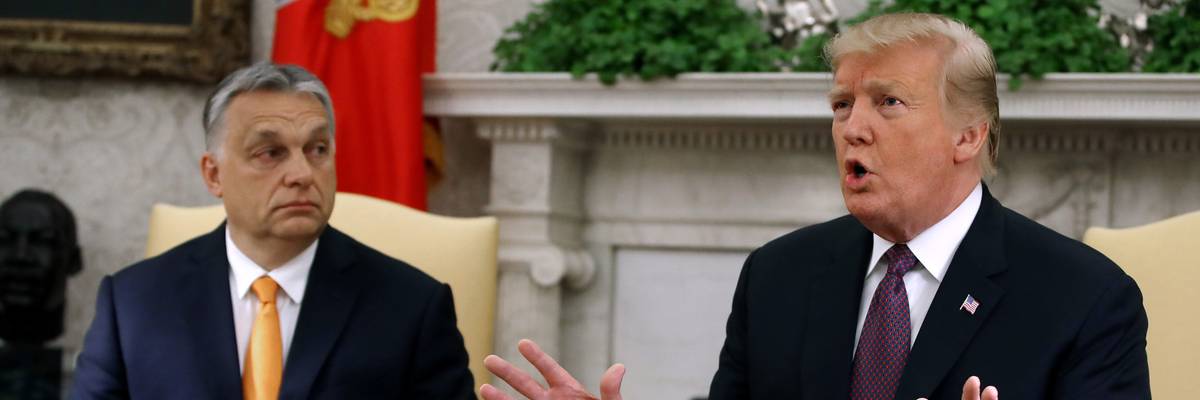
US President Donald Trump speaks to the media during a meeting with Hungarian Prime Minister Viktor Orban, in the Oval Office on May 13, 2019 in Washington, DC. President Trump took questions on trade with China, Iran and other topics.
Photo by Mark Wilson/Getty Images

Andrew Ryder
Feb 07, 2026
Common Dreams

For some time, there has been something of a political ‘bromance’ between Prime Minister Viktor Orbán of Hungary and US President Donald Trump. Orbán has been a frequent visitor to the US to meet Trump even meeting him during the election campaign in the run up to Trump’s second term. During a visit in late 2025 Trump lauded Orbán “You are fantastic. I know a lot of people don’t agree with me, but I’m the only one that matters.” In response Orbán (2025) spoke of a “golden age between the United States and Hungary.” Such is the high regard Orbán is held in by Trump that Budapest was touted as a possible venue for a peace summit for the Ukraine war between Putin and Zelenskyy.

Vice President Vance has long praised Orbán for promoting conservative family policies and the exertion of greater control over higher education which critics claim is undermining academic freedom. Vance, like Orbán, has also been critical of Ukraine. Tucker Carlson, Fox News, and other elements of the MAGA media network often heap praise on Orbán as a visionary and outrider that America could follow.

This article seeks to inform readers about what Orbán represents and highlights the similarities between him and Trump and where this might take America. We speak from a position of experience being academics and civic voices based in Hungary who have closely followed the trajectory of Orbánism.

Cultural – Economic Drivers

Deindustrialization and decline in rustbelt areas in both countries exacerbated by the global financial crisis of 2008, creating unprecedented unemployment and anxiety, formed a significant group of ‘have-nots’ (people at the margins) in both countries, susceptible to nativist and exceptionalist rhetoric. More broadly cultural insecurities prompted by an ever-changing highly globalized world have been disorientating for some, especially older voters or those in the countryside. These are the demographic groups that have played an active role in forming the electoral base for authoritarian populism in both countries.

Although Orbán is something of a poster boy for the MAGA network, in Europe his reputation is more controversial. Hungary has experienced frequent criticism and sanction from the European Union for rule of law violations most notably relating to media, civil and academic freedoms and independence of the judiciary during the premiership of Orbán.

One point of difference is Hungary has a limited tradition of liberal democracy which existed for a brief twenty-year period from the end of communism in 1990 up to Orbán’s second premiership that started in 2010. With the interwar autocratic leader Admiral Horthy and the postwar Communist leader János Kádár authoritarianism could be seen as the norm for Hungary unlike the USA that until recently was seen as a model of liberal democracy and rule of law conventions. However, things are changing rapidly with a second Trump term terms being marked by an assertive and rapid upending of the political system.

That Authoritarian Style

Both Orbán and Trump are classified as being authoritarian populists. Both are framed as strongman, battling modern day folk devils, namely immigrants, liberals and other minorities cast as an ‘enemy within’ in an emergency politics where the strongman through a performative hypermasculinity takes assertive and often polarizing action, championing a perceived majority of the ‘good’ and ‘pure’ people.

At the centre of the political narrative of these two leaders is a sense of exceptionalism. The Make America Great Again slogan reveals a sense that the US is losing its place in the world and is in need of reorientation. Of course, Hungary was never a superpower, but it sees itself as a bridge to the East and West and an out-rider, or champion, to the challenge of liberalism. Both have a nostalgic and rigid conception of national identity which for them makes migration and diversity an anathema to their monocultural and conservative conception of national identity.


Decision Making and Public Sphere

Both Orbán and Trump can be viewed as counter-enlightenment figures in the sense that their analysis is not driven by scientific and rationalist decision-making principles where decisions might be based on a proper evaluation of evidence and notion of public good. Both display an element of what has come to be called ‘Post Truth Politics’, where emotions and conspiracy theory shape political narrative. Orbán and Vance have for example actively espoused the ‘replacement theory’ that contends there is a shadowy plan to flood Europe with migrants to replace domestic European workers and reverse demographic decline but also weaken sovereignty through diluting national identities enabling the creation of a European super-state.

Disregard for fact has led to both Orbán and Trump nurturing a partisan public sphere, in Hungary this is more advanced with newspapers and television stations largely in the control of figures loyal to Orbán, it has been estimated that 80 percent of the Hungarian media is aligned to Orbán, often providing a platform to campaigns steered by polarizing rhetoric which at its core is guided by a ‘politics of fear’ hence immigrants, especially if Muslim, LGBTQI, George Soros and the European Union have been framed as an existential threat, with the media failing to challenge these assertions or giving space to counterviews and generally replicating such views in reporting.

Orbán and Trump also view academia as a bootcamp for liberalism and as bastions of the tyranny of political correctness, thus in Hungary Orbán government has placed most of the public universities in the control of appointed cronies through what has been described as model change. In addition, the government has refused to validate courses like Gender Studies, seeing it as a threat to conservative conceptions of the family. The George Soros supported Central European University was pushed out of Hungary because Orbán, feared the political and intellectual influence of a university with a commitment to open society in its mission. Trump’s attacks on universities with accusations of left-wing bias and the withholding of Federal funding can be seen as a similar effort to exert great control over academia.

Policy Positions


In terms of a number of key policy areas there are some striking similarities between Orbán and Trump. Orbán has accused the EU of undermining national sovereignty and the recent and controversial US security strategy indicated that America in its international relations would prioritize alliances with countries like Hungary that place a strong premium on sovereignty. It is a view of state power and sovereignty that relies on a strong executive unencumbered by checks and balances, hence both Orbán and Trump have been accused of rule of law violations that weaken the guardrails and safeguards of democracy, creating a ‘Deep State’ in the sense that public officials are expected to be obedient and align closely to the political narrative and interests of these two leaders. This has created profound constitutional shocks in both countries.

The nativism of Orbán and Trump has led to the securitization of migration, both have constructed ramped up border protection, basically walls, with increased border enforcement often framed as a masculinized and militarized show of strength and determination to keep migrants out and most recently demonstrated in the performance of ICE roundups in some parts of America.

As noted earlier both leaders court moral conservativism and have formed a strategic alliance with traditional and conservative Christian leaders, with both seeking to limit reproductive rights. In 2025 Orbán banned the annual LGBTQ Pride march in Budapest and threatening to fine those who attended with fines based on biometric surveillance, an act that was heavily denounced by the European Union and civil rights defenders like Amnesty International.

In terms of economics both Orbán and Trump have been prepared to use state power to intervene in markets. Orbán has been willing to use state power to freeze utility bills and Trump has interfered with market freedom through protectionism and tariffs. Both, despite their rhetoric and appeals to the ‘have-nots’ seem to support tax, welfare and regulatory frameworks, that favour the interests of oligarchs over workers in a ‘race to the bottom’ of social protection. The alliance with oligarchs in both countries reflects a relational conception of economic strategy where political power is used to further the interests of sections of the economic elite willing to express loyalty and put patronal networks at the service of political leaders.

Putin, Europe, and the World

Trump with his desire to annex Greenland and sympathy for Putin’s expansionism in Ukraine and disparagement of the value of NATO to US interests is perceived as turning his back on the postwar international order of global rules to deter the aggressive expansionism that triggered World War Two. Critics of this postwar order might question whether America really was the ‘Shinning Beacon’ it was held to be, but some would argue this framework strove to give the world a sense of order and stability and stemmed the advance of Soviet totalitarianism.

Orbán has drawn strong criticism for continuing to court Putin and his use of veto power to thwart within the EU support for Ukraine and sanctions against Russia. The sympathy and alliance with Russia are a surprising and contradictory phenomena given Hungary’s historic antipathy to Russian expansionism as reflected by the 1956 uprising where Hungarians sought to eject Soviet occupiers. Such sympathies toward Putin by Trump are surprising too given that in America a deep political consensus once existed in postwar US politics that Russian expansionism, especially in the Cold war, was a major threat to global security. In this new global order both Orbán and Trump seem to support a world dominated by regional hegemons, with the US and Russia appearing to have the right to impose regional hegemonies capable of interfering in the affairs of its neighbors, a Monroe doctrine for the 21st century.

In terms of the Putinization of America and Hungary one of the most significant features may be the spread of cronyism and corruption. As noted, both Orbán and Trump have created a network of cronyism giving patronage and protection to influential supporters. Orbán’s family and network of friends have grown fabulously rich and some would argue Trump has not been averse to using presidential power to advance his business interests and the Trump brand.


Framing the Democratic Decline


There are different possible framings of democratic backsliding, which started in smaller countries, such as Hungary, but after reaching the US as the main geopolitical power, and once the model for democracy, it became a worldwide threat. The first possibility is to call Trump and Orbán populists. Indeed, in their rhetoric they often refer to the ‘people’ in a moral battle against the ‘elites’ to which they both belong to. But as opposed to some pluralist populists their main characteristics are that they are illiberal autocrats willing to use unlimited executive power disregarding any checks and balances and fundamental rights. Moreover, Orbán’s ‘mafia state’ and Trump’s own family and business interests, which some would argue are the main determinators of his decisions as President. And this is not just tyranny, but also oligarchy, the other deviant form of government according to Aristotle.

One may ask, why is it important to emphasize that Trump’s and Orbán’s systems are not only populist and authoritarian but also oligarchic. Because restoring democracy requires different resilience capacities in the three cases. Populism is the easiest to remedy. Sometimes it only requires taking back democratic politics to the needs of ordinary citizens, for example ‘farmers’ and ‘workers’ as the Populist Party sought to in the US in the late 19th century. For reversing democratic backsliding, strong institutional resilience and resistance are necessary, which also presupposes the longstanding structural elements, such as constitutional culture, civil society. The almost 250 years long endurance of the US constitution will most probably enough to preserve constitutional democracy, but the twenty years of liberal constitutionalism in Hungary after 1989 isn’t a guarantee for the same. But the hardest task ahead for both countries will be to get rid of oligarchy, as long as Wall Street supports Trump rather than a democratic populist.


Hungary at a Crossroads


The outcome of the April election in Hungary will determine if Hungary is willing to turn a page, the moderate Conservative leader Péter Magyar seems to be riding high in the polls. If Orbán losses in Hungary it will be an important setback for authoritarian populism that could have impact on the US mid-terms. The turning point in Hungary was that the public stopped believing the Orbán narrative, scandals and corruption eroded public trust. The pardoning of an orphanage manager who had attempted to cover up pedophilia by close supporters of Orbán gave a deeply dark insight into the nature of Hungarian politics which a large section of the public found deeply disturbing. It remains to be seen whether personal and public scandals hovering around Trump provide an equally revelatory moment.

In the USA, worries about an executive overreaching its authority, perhaps most evident in the manner of ICE roundups in some major cities are prompting American citizens to deeply reflect on the nature of the political crossroads facing them. Perhaps in both countries there is a realization that the politics of demagoguery is a distraction from the genuine crises facing the world today, namely ruthless and corrupt leaders who do not respect the rule of law, a failing and unfair economy and global warming and environmental change. There is indeed an emergency, a global one or ‘polycrisis’ and a need for exigency, the problem is we are following the wrong plan in Hungary and America.


Our work is licensed under Creative Commons (CC BY-NC-ND 3.0). Feel free to republish and share widely.


Gábor Halmai
Gábor Halmai is Professor Emeritus at Eötvös Loránd University and the European University Institute, Florence, and a visiting professor at LUISS Guido Carli in Rome.
Full Bio >

Andrew Ryder
Professor Andrew Ryder is Director of the Institute of Political and International Studies at Eötvös Loránd University in Budapest, Hungary. Prior to this he held academic positions at Corvinus University Budapest and the universities of Bristol and Birmingham.
Full Bio >