Friday, August 28, 2026

 Top Iranian, Qatari Diplomats Hold Talks In Tehran


Qatari Foreign Minister Mohammed bin Abdulrahman Al Thani with Iranian counterpart Abbas Araqchi in Tehran. Photo Credit: Tasnim News Agency

August 27, 2026

By Eurasia Review


Qatari Foreign Minister Mohammed bin Abdulrahman Al Thani held a meeting with his Iranian counterpart Abbas Araqchi in Tehran on Thursday, focusing on bilateral ties and regional de-escalation, reports Iranian media.

According to IRGC-linked Tasnim News Agency, Al Thani met with Araqchi as part of ongoing Iran-Qatar consultations aimed at expanding bilateral relations and strengthening peace and security in the region, Iranian Foreign Ministry Spokesman Esmaeil Baqaei said.

Baqaei has also pointed to Qatar’s efforts in recent months to help prevent further escalation in the region following the US-Israeli military aggression against Iran.

According to Qatar’s Foreign Ministry, Al Thani and Araqchi discussed efforts to reduce tensions and create conditions conducive to dialogue, Tasnim reported, adding that the two sides also discussed a proposed phased framework for establishing a temporary joint shipping corridor through the Strait of Hormuz, the Qatari Foreign Ministry said.

Al Thani has stressed the need to respect the sovereignty of neighboring countries and freedom of navigation, according to the Qatari ministry, Tasnim said.


Iran's Araghchi says US pressure won't work after Qatar talks in Tehran

Iran's Araghchi says US pressure won't work after Qatar talks in Tehran
/ bne IntelliNewsFacebook
By bne IntelliNews August 28, 2026

Iran's Foreign Minister Abbas Araghchi said diplomacy could be revived only if the United States accepted that pressure did not work, after talks with Qatar's prime minister in Tehran, in a post on X on August 27.

The comment casts Iran's terms for any return to negotiations in stark form as the war with the United States and Israel nears its sixth month, with Qatar among the mediators pressing both sides back towards talks that collapsed after a June memorandum of understanding. The message also comes as Iranian officials have cautiously welcomed a move to away from war with the US as Washington continues to add further constraints on Iran's economy. 

Araghchi said he had held what he called creative discussions with Qatari Prime Minister and Foreign Minister Sheikh Mohammed bin Abdulrahman Al Thani, and that putting diplomacy back on track was not impossible.

He said it hinged on Washington building trust, speaking respectfully, acknowledging Iran's rights and upholding its commitments.

The Qatari visit was one of a series by regional mediators, alongside Oman and Pakistan, seeking to ease tensions and reopen the Strait of Hormuz. Qatar's foreign ministry said the two discussed a proposed phased framework including a temporary shipping corridor through the strait and a joint project to clear it of mines.

The exchanges came as Washington leaned harder on economic pressure in recent days, according to previous reporting by IntelliNews.

US President Donald Trump said on Truth Social that Iran was a failing nation and was begging for a deal, while the White House said no negotiations were under way and that all options remained open. US Treasury Secretary Scott Bessent said Iran should spend money on its own population rather than on allied armed groups abroad.

The Treasury this week announced a sanctions campaign it called Operation Economic Outcast, threatening penalties on Iran's trading partners across sectors including digital assets, technology and shipping, though it held off on major new listings. Iranian officials have played down the effect.

Aragchi’s comments come as Bessent plans to discuss increasing economic pressure on Iran and imposing secondary sanctions on countries that continue to trade with Tehran at his upcoming meetings with G20 finance ministers, a US Treasury Department spokesperson told Reuters.

"This issue is expected to be raised at every bilateral meeting the Secretary holds with his G20 counterparts in the coming days. This is a critical aspect of our economic campaign against Iran, so we want to ensure that all G20 members are aligned," the spokesperson said to the agency.

The meeting of G20 finance ministers and central bank governors will take place from 31 August to 1 September.

On August 20, Donald Trump announced the start of a large-scale economic campaign against Iran aimed at isolating it internationally. 


The Mecca Pact Redraws Asia’s Security Map – Analysis


Credit: OpenAI / Ramesh Jaura


August 27, 2026

By Ramesh Jaura

Key Takeaways:

Saudi Arabia, Türkiye, and Pakistan pledged in Mecca that an attack on one would be treated as an attack on all; they are now adding ministerial mechanisms, exercises, and defense-industry ties—but the pact still lacks NATO-style command, definitions, or automatic obligations.

The deal grew from Gulf insecurity after Iran-related strikes and doubts about U.S. guarantees; Washington has welcomed it as burden-sharing, while China, Iran, Egypt, and India each read it through their own interests.

Ambiguity is both deterrent and risk: members do not share the same rivals, nuclear implications are unofficial and unproven, and a crisis involving India, Iran, Yemen, or the Mediterranean could test whether the promise holds.


Saudi Arabia, Türkiye and Pakistan have pledged to treat an attack on one as an attack on all. Egypt is weighing membership, Washington has welcomed the move, Iran wants reassurance, China sees opportunity, and India is watching closely. A new security order may be forming, but its direction is unclear.

The place was chosen with care: Mecca, Islam’s holiest city, where Saudi Crown Prince Mohammed bin Salman, Turkish President Recep Tayyip Erdoğan and Pakistani Prime Minister Shehbaz Sharif met on 7 August and declared: “Any armed attack against any one of the three States shall be regarded as an attack against them all.”

It was a short sentence with a long shadow.

For Saudi Arabia, it offered protection when American guarantees no longer felt sufficient. For Türkiye, it gave Erdoğan another route to make his country an independent centre of power. For Pakistan, poor but militarily important, it reminded others that Islamabad cannot be ignored.

Together, they bring a rare mix. Saudi Arabia has wealth, energy power and influence across the Arab and Muslim worlds. Türkiye has NATO’s second-largest army and a fast-growing defence industry. Pakistan has a large, battle-tested military—and the only nuclear arsenal held by a Muslim-majority country.

It did not take long for commentators to call the new grouping an “Islamic NATO,” or sometimes a “Sunni NATO.” The description is tempting. It is also misleading.

NATO was built over decades. It has integrated command, military plans, shared procedures and a bureaucracy that works even when leaders disagree. The Mecca pact has none of that yet. It does not define an attack, say who decides one has occurred, or spell out what each member must do.

Would military support be automatic? Could one member decline to fight? Would Türkiye’s obligations under the new pact conflict with its duties as a NATO member? The agreement leaves these questions open.

But dismissing the pact as a ceremonial gesture would now be equally misleading.

Six days after the signing, Türkiye’s Defence Ministry began giving the pact substance. The partners plan political and military mechanisms linking foreign ministers, defence ministers and commanders. They intend to hold exercises on land, sea, air and cyberspace, and to cooperate on drones, artificial intelligence, electronic warfare, military production and technology transfer.

Reuters reported that the three defence industries would also be brought closer together.

The Mecca Agreement is not yet an Islamic NATO. But neither is it merely a piece of paper. It is an alliance being built while the surrounding region burns.Subscribe
A pact born in a frightened region

The agreement emerged, at least in part, from fear.

The United States and Israel attacked Iran on 28 February 2026, triggering a confrontation that crossed borders and sea routes. Iranian missiles and Tehran-aligned armed groups threatened Gulf states, oil facilities and commercial shipping. The Houthis intensified attacks from Yemen. The Strait of Hormuz and Bab el-Mandeb again became places where one strike could raise prices and shake governments.

Soon after the pact was signed, three Pakistanis were killed in a Houthi attack on a vessel in the Bab el-Mandeb Strait. Their deaths underlined a hard truth: conflicts in the Gulf, Red Sea and South Asia can no longer be kept apart.


The immediate danger explains why they signed the agreement. But behind it lies an older anxiety: can the United States still be trusted to protect its partners?

For decades, Gulf monarchies lived under an American security umbrella. US troops, intelligence, weapons and political commitments sustained the regional order. That relationship still matters. Saudi Arabia buys vast quantities of American arms, and no regional combination can easily replace America’s military reach.

But trust has thinned.

The 2019 attacks on Saudi oil facilities Abqaiq and the Khurais oil field exposed how vulnerable the kingdom had become to inexpensive missiles and drones. Washington did not retaliate directly against Iran. Riyadh remembered.

Then came America’s chaotic withdrawal from Afghanistan in 2021. Regional governments watched how US forces left. The circumstances were different, but the question travelled beyond Kabul: if American priorities changed, who might be left next?


Washington was turning towards China while its Middle Eastern partners dealt with Iran, proxy forces, missiles, drones and the aftershocks of the Gaza war.

Donald Trump’s return to the White House did not remove uncertainty. His administration has shown it is willing to use enormous force. But that does not mean partners always know when America will act, how far it will go or what they will endure when it does.

Saudi Arabia is not breaking with Washington. It is doing something more careful: ensuring Washington is no longer its only option.

The kingdom has strengthened relations with China, restored diplomatic ties with Iran, kept channels open to Russia and invested heavily in its defence industry. The Mecca pact adds two more layers of protection: Türkiye and Pakistan.

It does not announce the end of American power in the Gulf. It shows that American power is no longer accepted as the only pillar on which security rests.
America applauds—but may not control what follows

Washington’s response has complicated the idea that the pact is an act of rebellion against the United States.

On 16 August, Trump said he was “very happy” that Saudi Arabia, Türkiye and Pakistan had “recently, and finally” signed the agreement. He called it a “big, bold, and important first step” and praised the three governments for becoming better able to defend themselves. Anadolu Agency reported his remarks.


Trump has long argued that America’s allies should spend more and carry more of their own defence burden. From that angle, the Mecca pact is useful. It could allow regional states to handle more of their security without repeatedly calling on Washington.

The arrangement does not immediately threaten America’s position. Türkiye remains in NATO. Saudi Arabia still depends heavily on American weapons, intelligence and logistical support. Pakistan continues to work with Washington on terrorism and regional diplomacy.

For the moment, the United States can welcome the pact as burden-sharing.

But there is a catch.

If the three countries produce weapons together, exchange intelligence and build crisis procedures, they will need less American permission and protection. Greater capability will give them more freedom to make choices Washington may dislike. The pact may not be designed to push America out, but it could help create a region where America is no longer central to every calculation.
What the three partners want

Each of the three countries sees something different in the agreement.

For Saudi Arabia, the attraction is protection—and access.

Pakistan has trained Saudi officers and soldiers for decades. Pakistani troops have served in the kingdom before. The military relationship is not new; the pact gives it a more formal and politically stronger shape.

Türkiye offers something else: a defence industry that can supply weapons more cheaply and often with fewer conditions than Western governments impose. Its drones, missiles, warships, armoured vehicles and electronic-warfare systems have attracted buyers across Europe, Asia, Africa and the Middle East.

Saudi Arabia wants to produce more of its own weapons under Vision 2030. Joint ventures with Turkish and Pakistani companies could help reduce its dependence on expensive Western imports.

For Türkiye, the pact is an opportunity to expand its reach.

Erdoğan does not want Türkiye seen merely as NATO’s difficult southeastern member. He wants it recognised as a power in its own right, with influence from the Black Sea and Mediterranean to the Middle East, the Red Sea, and the Indian Ocean.

Weapons are now an important part of that ambition. Turkish drones have affected the course of several wars. Defence exports bring money, influence and long-term political relationships. The Mecca pact opens a much larger field for all three.


Pakistan’s gains are different but just as important.

Islamabad’s economy remains fragile. Saudi loans and deposits have helped it through crises. Türkiye has supported Pakistan politically, especially over Kashmir, and the two countries have developed close defence ties.

By standing beside the rulers of Saudi Arabia and Türkiye in Mecca, Pakistan sent a message: whatever its economic troubles, it remains a country whose military strength and nuclear weapons give it strategic value.

The agreement also confirms the weight of Pakistan’s military establishment. Field Marshal Asim Munir has been publicly credited with helping to bring it about. In Pakistan, the most important ties with China, Saudi Arabia, Türkiye and the United States are rarely shaped by civilian diplomacy alone.

Yet the three partners do not share the same enemies.

Pakistan’s principal conventional rival is India. Türkiye is preoccupied with Syria, Kurdish armed groups and its disputes involving Greece, Cyprus and Israel. Saudi Arabia is focused on Iran, the Houthis, missile and drone attacks, Red Sea shipping and the security of its oil installations.

Sooner or later, those differences will matter.

Would Türkiye and Saudi Arabia regard an Indian strike on Pakistan as an attack on all three? Would Pakistan be expected to help Türkiye in a clash with Greece, another NATO member? If the Houthis struck Saudi Arabia, would Islamabad and Ankara be required to join a war in Yemen? What if a Saudi–Iranian confrontation escalated?

The pact does not answer.

Ambiguity can deter. An adversary may hesitate if it cannot predict how three countries will respond. But it can also tempt an ally to take risks, expecting support that may not arrive.

Even NATO’s celebrated Article 5 does not automatically send every member to war. It allows each ally to take “such action as it deems necessary.” Political leaders still decide what solidarity means.

The Mecca pact will face the same test. Promises made in a palace are one thing. Keeping them when soldiers may die is another.
The nuclear question no one can avoid

Pakistan’s nuclear weapons hover over every discussion of the agreement.

Has Islamabad quietly placed Saudi Arabia or Türkiye under a nuclear umbrella? Would Pakistan threaten nuclear retaliation if the Saudi state faced an overwhelming attack?


Nothing in the public text says so. Pakistan has announced no nuclear guarantee. No evidence shows it has transferred weapons or control to either partner. Saudi officials insist the agreement is not tied to nuclear ambition or an arms race.

That caution matters. Speculation should not be mistaken for fact.

Saudi Arabia is a non-nuclear member of the Nuclear Non-Proliferation Treaty. Türkiye is also an NPT member and already participates in NATO’s nuclear arrangements. Any transfer of nuclear weapons would create an international crisis.

But nuclear deterrence depends as much on uncertainty as on published doctrine.

A country considering a devastating attack on Saudi Arabia must ask whether Pakistan would remain uninvolved if the kingdom’s survival were at stake. The absence of an answer may be part of the deterrent.

It may also make the region less safe.

Israel has an undeclared nuclear arsenal. Iran has advanced nuclear capabilities. Pakistan has tested weapons. Türkiye belongs to a nuclear alliance. American forces are spread across the region. Now a new defence pact enters this crowded landscape with unclear nuclear limits.

There is another source of concern. The Trump administration has pursued a civilian nuclear agreement with Saudi Arabia that reportedly drops safeguards Washington previously demanded, including a categorical Saudi renunciation of uranium enrichment and reprocessing and acceptance of the International Atomic Energy Agency’s Additional Protocol.

Reuters reported that arms-control advocates and members of Congress feared that the proposed terms could weaken non-proliferation standards.

A civil nuclear programme is not a nuclear-weapons programme. But in this region, intentions are viewed through a lens of fear. Iran’s capabilities, Pakistan’s arsenal and weaker safeguards around Saudi nuclear development would inevitably be considered together.

A shield built to make Saudi Arabia feel safer could deepen the nuclear anxieties of everyone around it.
Is Iran the enemy—or a neighbour to be reassured?

Because the three signatories are Sunni-majority countries, the pact has often been described as an alliance against Shia-majority Iran.

The timing strengthens that interpretation. Iran and armed groups aligned with it have attacked Saudi interests. Türkiye cooperates with Tehran in some areas while competing with it in Syria, Iraq, Central Asia and the Caucasus. Pakistan shares a difficult border with Iran and has exchanged cross-border strikes with it.


But the relationship cannot be reduced to an old sectarian divide.

Turkish Foreign Minister Hakan Fidan says the pact identifies no enemy. Pakistan calls it “purely defensive.” Iranian Foreign Ministry spokesman Esmaeil Baghaei initially responded with caution rather than outrage. Iran, he said, need not fear regional self-reliance if it remained inclusive and addressed the real causes of insecurity.

Hard-line voices in Tehran were less forgiving. They asked how Pakistan could join a defence agreement with Saudi Arabia while claiming to be an honest mediator between Iran and the United States. Others warned Riyadh that a written pact would not guarantee its safety.

Erdoğan then demonstrated how the new allies hope to use their position.

On 17 August, Erdoğan urged Trump to return to talks with Iran and offered Türkiye’s help. Ankara said it would keep working with the United States, Iran, Pakistan, Qatar and other mediators. At the same time, Erdoğan praised the Mecca pact as a contribution to regional security—Reuters reported Türkiye’s attempt to combine deterrence with diplomacy.

Pakistan is trying to do the same.

Field Marshal Munir was due in Tehran on 24 August for talks with senior Iranian officials. The agenda was expected to include Pakistan’s efforts to mediate between Washington and Tehran, the Mecca Agreement, the Houthis and the dispute over the Strait of Hormuz. Reuters reported that the planned visit to Washington would pave the way for another round of punishing sanctions against Iran.

Munir’s visit carries special weight. He is not only Pakistan’s most powerful soldier but also a central figure behind the Mecca pact. Iranian officials will want to hear from him directly: is this alliance a shield, a sword or both?

Pakistan has placed itself in a difficult position. It must persuade Saudi Arabia that it is a dependable defence partner while convincing Iran that it has not joined a hostile front. It must keep Washington engaged without becoming an instrument of American pressure.

The pact’s first serious test may therefore come not on a battlefield but in a room in Tehran. Can Pakistan and Türkiye help deter Iran without making dialogue with Iran impossible?
Egypt stands at the door

Türkiye has made clear it does not want the alliance to remain a three-member club. Egypt is the most obvious prospective member.

Cairo is no longer merely observing. Egyptian Foreign Minister Badr Abdelatty says his government is studying membership “very seriously,” though any decision must fit Egypt’s constitution and legal commitments. Chatham House sees the hesitation as political as well as legal. Egypt has long avoided binding military blocs and wants to preserve its role as mediator. Joining could look like taking sides against Iran, Israel, the UAE, Greece, Cyprus or India without giving Cairo clear security gains. For now, Egypt has reason to wait, watch how the pact works in a crisis and keep its options open.


The Gulf states face the same problem. Saudi Arabia and the United Arab Emirates do not always agree on regional priorities. Qatar and its neighbours recently emerged from a bitter blockade. Oman prizes its independence and role as mediator.

The Mecca pact is therefore unlikely to become a military organisation embracing all 57 members of the Organisation of Islamic Cooperation.

A smaller core is more plausible, surrounded by looser arrangements for tasks: protecting Red Sea shipping, sharing intelligence, coordinating missile defence, countering drones, fighting terrorism and producing weapons.

That may sound less dramatic than an Islamic NATO. It could prove more useful.
China: The Power Outside the Pact

China did not sign the Mecca Agreement, and no evidence shows Beijing designed it. Yet its influence is impossible to ignore.

Pakistan’s “all-weather” partnership with China is one of Asia’s deepest military relationships. Beijing supplies aircraft, missiles, air-defence systems and warships, and the two countries jointly produce the JF-17 fighter. In April, Pakistan commissioned the first of eight planned Chinese-designed Hangor-class submarines, four to be built in Pakistan under a technology-transfer deal. According to the Stockholm International Peace Research Institute⁠, China supplied 80 per cent of Pakistan’s major arms imports between 2021 and 2025.

The pact could bring Chinese, Turkish and Western systems into the same network. Türkiye offers drones, missiles, electronic warfare and a growing defence industry. Saudi Arabia brings money but still relies mainly on American and other Western equipment. Making these systems work together will require compatible communications, command procedures, maintenance chains and training.

That helps explain why Türkiye’s Defence Ministry has put joint exercises, production, technology cooperation and “sustainable maintenance and logistics support” at the centre of the deal. Reuters reported⁠ that cooperation will span land, sea, air and cyber operations, with attention to drones, electronic warfare and artificial intelligence. Over time, this could create a military-industrial network that Beijing does not control, but that depends less on the West.

China’s economic presence matters too. The China–Pakistan Economic Corridor links western China to Gwadar on the Arabian Sea. China is also a major buyer of Saudi oil and an investor in the kingdom’s infrastructure, telecommunications and renewable energy. Its mediation of the Saudi–Iranian rapprochement in 2023 showed it can exercise influence in a region long dominated by Washington.

Saudi Arabia does not expect China to replace the United States as its military protector, and Beijing has shown little interest in assuming that burden. But China offers trade, investment, technology and another option. Türkiye’s ties with Beijing are more guarded because of NATO, Europe and differences over Uyghurs. Even so, Erdoğan values relationships that widen Ankara’s room for manoeuvre.


Beijing can stay outside the pact and still benefit. It may gain from a less American-centred region, finance infrastructure and supply weapons without defending the alliance. For India, already facing China’s military partnership with Pakistan, that is hardly reassuring.
India has reason to watch—but not to panic

India’s ties with China have steadied slightly. Talks on the disputed frontier have resumed, but the damage from Galwan remains: troops are still deployed, claims unresolved and mistrust deep.

China’s support for Pakistan adds another layer to India’s concerns.

The China–Pakistan Economic Corridor runs through territory India claims. New Delhi sees it as both an economic project and a breach of sovereignty. Indian planners must still weigh pressure from Pakistan and China at once, even if neither side wants a two-front war.

The Mecca pact could connect this tense South Asian picture to West Asian politics.

Pakistani forces, already heavily supplied by China, may gain access to Turkish technology, Saudi money, shared intelligence and joint planning. Such shifts rarely appear overnight; they gather force slowly.

India’s government has said it is examining the pact’s implications for national security and regional stability and will take the necessary steps to protect Indian interests.

New Delhi is right to seek clarity.

Türkiye has backed Pakistan on Kashmir. The two countries cooperate on warships, exercises, training and aircraft modernisation. Saudi Arabia’s 2025 defence agreement with Pakistan laid the ground for the trilateral pact.

In a future crisis, Pakistan could invoke the Mecca Agreement even if Riyadh and Ankara had no wish to fight India.

Would the pact apply only after an unprovoked attack? Could Islamabad invoke it after a terrorist incident or an exchange across the Line of Control? Who would decide who started the conflict?

India is asking those questions quietly without turning concern into panic.

Saudi Arabia’s ties with India have deepened. The kingdom supplies energy, invests in India and hosts a large Indian community. The two governments cooperate on trade, terrorism, technology, maritime security and defence.

Riyadh has no reason to sacrifice this relationship for Pakistan. Saudi foreign policy has become practical and flexible. It can maintain a defence pact with Islamabad while expanding relations with New Delhi.


India appears to be taking the same approach: deepen Gulf ties, seek assurances, monitor Pakistan’s defence links with Türkiye and China, and strengthen its naval presence in the Arabian Sea.

The Ministry of External Affairs has dismissed reports that India sought an urgent mutual-defence pact with Israel as fabricated. India already has close defence ties with Israel. Turning them into an openly anti-Muslim alignment would damage decades of careful diplomacy across the Arab world.

India’s strength has long been its ability to deal with rivals at the same time: Saudi Arabia and Iran, Israel and the Arab states, the United States and Russia.

The Mecca pact makes that balancing act harder—and more necessary.
A promise waiting to be tested

The agreement does not prove that a new regional order has arrived. Its members may find unity easier to declare than to practise.

But it does show that the old order is fading.

Saudi Arabia, Türkiye and Pakistan are not abandoning old relationships; they are adding new ones. They want choices and no longer want security to depend on a single power whose priorities can shift after an election, war or crisis.

Trump sees burden-sharing. China sees opportunity. Iran wants to know whether the pact targets it. Egypt is weighing membership. India is asking whether Pakistan’s reach has grown.

The pact remains several things at once: a shield, a warning, an arms partnership, a diplomatic tool, and a claim to greater independence.

It could make the three countries safer. It could also spread conflicts across regions.

An India–Pakistan crisis could gain a Middle Eastern dimension. A Saudi–Iranian confrontation could draw in Pakistan and Türkiye. A Turkish dispute in the Mediterranean could test commitments Riyadh and Islamabad never expected to keep.

The stronger the alliance becomes, the more restraint it will need.

Its members must define aggression, set clear consultation procedures, keep politics in control of military decisions and clarify where conventional cooperation ends and the nuclear shadow begins.

Mecca produced a dramatic promise: an attack on one will be treated as an attack on all. Weapons, exercises and political machinery now support it. Its meaning, however, will remain uncertain until someone asks the three countries to keep it.

When that day comes, the question will not be what leaders signed in Mecca, but what they are prepared to sacrifice—and whether their shield makes a frightened region safer or gives it new reasons to fear.


About Ramesh Jaura
Ramesh Jaura is a journalist with 60 years of experience as a freelancer, head of Inter Press Service, and founder-editor of IDN-InDepthNews. His work draws on field reporting and coverage of international conferences and events.
View all posts by Ramesh Jaura →
AU CONTRAIRE

The Truth About Data Centers – OpEd


August 28, 2026
By FEE
By Stephen Weese


Key Takeaways:

The author argues data-center water use is a tiny share of U.S. supply and power-cost claims are often overstated from outlier wholesale spikes; the real failures are bad sites and unethical developers.

Cited problems include xAI’s Colossus near Memphis (unpermitted gas turbines and delayed water promises) and Tucson’s Project Blue (deception over water and secrecy); Microsoft’s Phoenix campus is treated as ethically more open but still poorly located in an arid basin.

Quincy, Washington, is the counterexample: hydro power, tax revenue funding public works, industrial users paying more of the rate increase, and water reuse—supporting the claim that well-sited, transparent centers can be ordinary infrastructure rather than a crisis.


It seems that everyone is talking about data centers these days; they’ve taken over the Internet with memes and conspiracy theories. As a computer professor, I decided to apply an academic research regimen to the situation and cut through the exaggeration and emotion that often accompany these current polarizing issues.

Two important points to begin with: AI’s water and power usage. As I have demonstrated in my previous article, data centers use about 0.02% of the water supply in the US according to recent sources, and most future data centers are already planned to use advanced cooling technology that requires very little water. While it is true that data centers require a lot of electricity, their impact on power systems and customers has been greatly exaggerated. Bloomberg’s often-cited piece on the subject mentions that at the highest instance, one area of the country experienced a 267% increase in wholesale costs. This data describing one area in one instance has been used incorrectly to state that it is the expected or average raise (rather than the high end), and it doesn’t even account for the fact that this is wholesale power costs, which does not translate directly into consumer costs. (Often the tech companies will offset these increases.) What this data does tell us is that there are places where we simply should not build data centers. This is one problem that should be avoided. The other problem is companies acting unethically.


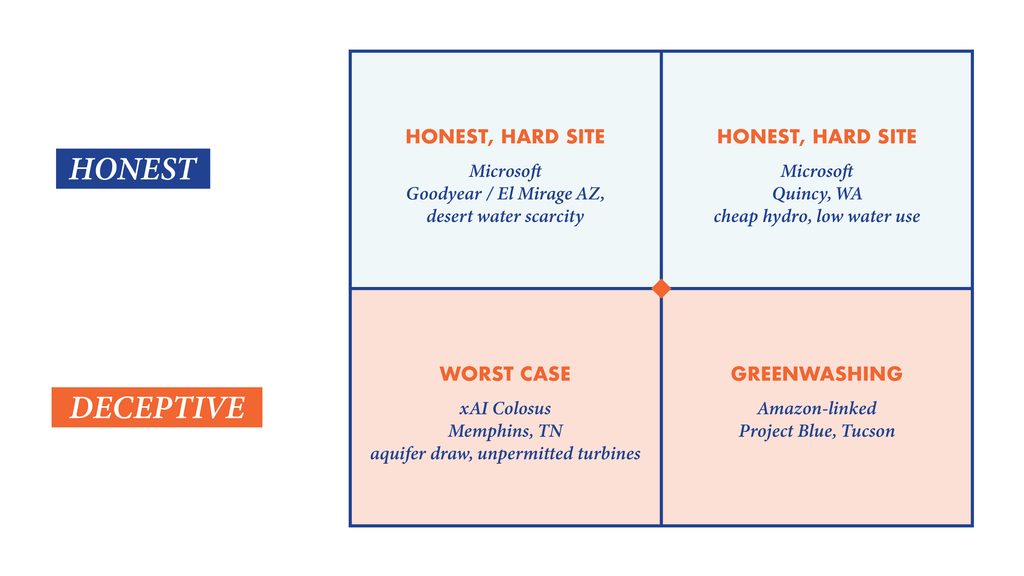
One of the most egregious examples of unethical data center implementation is xAI’s Colossus near Memphis, Tennessee. The company promised years ago that it would not rely on local water supply for cooling. Not only does it continue to use local water daily, but the proposed solution has been delayed. In addition, xAI ran as many as 35 unpermitted methane gas turbines at Colossus 1 beginning in June 2024, generating up to 421 MW without any preconstruction or operating air permits under the Clean Air Act. If there was ever an example of how not to build a data center, it is this one.

Another prime example is Project Blue in Tucson, Arizona. Beale, the project developer, actively deceived the city and used the local water supply to clean dust from the data center. And they used a lot of it. This caused Tucson to shut down its water supply. Not only that, but city staff and Amazon had signed an agreement to keep knowledge about the center secret from its residents for three years. It’s no wonder that many communities are suspicious of tech companies coming into their neighborhoods and deceiving them about their plans and the benefits they will bring.

There are cases where companies are unethical in their approach to data centers, and there are cases in which the location is just not suitable. Sometimes, both points of failure occur. Colossus 1 is an example of both, where the deception was extreme and its use of water is actively causing problems with the local aquifer.


An example of poor location choice but good ethics is Microsoft’s West US 3 in the Phoenix area. Microsoft separately agreed to invest $40 million directly into the water utility. Microsoft is testing a new zero-water cooling strategy, and it published its water use and other relevant information in its Environmental Sustainability Report. However, it built these data centers in the middle of an extremely arid, low-water area. There are reasons for doing this, but, generally speaking, drawing water from a nearby desert city’s supply is not ideal. It’s not entirely bad news, in that it has spurred Microsoft to invest in new cooling strategies that do not draw on the local water supply. This problem should not affect future data centers as much because of the new cooling technologies that require little to no water from the local supply.

You probably haven’t heard of too many examples of successful data center developments, and that’s partly because “something worked; everything is just fine” is not a common news story. However, CNN recently reported on exactly that: Quincy, Washington, is home to over 30 data centers and has experienced an incredible boom as a result.

The data centers now cover an estimated 57% of Quincy’s property tax revenue, funding a wave of public infrastructure projects: a $15 million aquatic center, a 143,000-square-foot indoor sports complex, a $120 million high school, a new hospital, library, police and fire stations, paved sidewalks, sewage systems, and a wastewater treatment plant.

Residential electricity rates in the county rose 3.5% last year, while large industrial users, such as the data centers themselves, absorbed a 9.1% increase. The data centers there are paying for their own added infrastructure and generation costs rather than spreading those costs to households.

Another advantage of this site is that it has abundant cheap hydroelectric power. As for water, Microsoft partnered with the city to build a $30 million water reuse facility. The only real caveat here is that the data centers generated so much revenue and development that housing prices have risen across the area.


Data Center Location and Ethics Matrix

As you can see, there are definitely ways to build, and examples of ethical and beneficial data centers. The benefits to a local community are substantial. Not only do local tax revenues increase, but data centers come with the benefit of being a generally low-traffic, relatively quiet development. Revenues can increase without needing to build many new roads, or bring large amounts of noisy traffic.

This goes along with the fact that we simply need more data storage. Yes, AI is driving much of the current surge, but we have continually created more data and need a place to store it. We take pictures with our cell phones, leave voice notes, and write emails. With self-publishing, so many people now are writing books. So many songs are written and digital videos made. All of that goes into data centers. All of your apps: data centers. All of the Internet: data centers. Nearly all human knowledge is now stored in these data centers; they are the modern archives of human creativity, education, and achievement.

Efficiency gains in AI are real and dramatic. OpenAI’s Sam Altman has pointed out that ChatGPT models have become roughly 1,000 times more efficient at a given level of intelligence in less than two years. But this doesn’t mean data center demand will eventually shrink; it means the opposite. Every time a computing resource has gotten this much cheaper, historically we haven’t used less of it; we’ve found a thousand more uses for it. Drops in data-storage prices didn’t lead to people using less data; now no one deletes anything. Altman’s prediction that we will use AI and data in the same way that we use utilities such as water and the Internet will likely come true, and in some ways, it already has.

This is not only happening in the United States. China, Europe, the Middle East, and Southeast Asia are all rushing to build data centers, and they are encountering very similar issues. This is a global phenomenon, and, the way things are going, data centers will be as much a part of modern infrastructure as airports, phone lines, and railroads, which people once opposed. Farmers once believed sparks from railroad tracks would burn their land, and doctors at the time warned the human body couldn’t survive driving at speeds over 20 miles per hour. We see the same patterns of resistance to new technology repeated throughout history.

The truth is, data centers themselves aren’t the problem. Poor location choices and unethical business practices cause the failures we’ve seen. If we’re wise about where we build and who we trust, we can avoid the pitfalls and reap the rewards.


About the author: Stephen Weese is a computer professor and consultant in CS, IT, and AI. He also works in media and is the CEO of Marvelous Spiral Studios.

Source: This article was published by FEE

AI Can Discover New Materials Faster Than Science Can Validate Them – Analysis


Image: ChatGPT

August 27, 2026

By Burak Oktenli

Key Takeaways:

Generative AI is turning materials discovery from scarcity into abundance—proposing vast numbers of candidate structures far faster than labs can synthesize, characterize, and manufacture them.

A computational prediction of stability is not the same as a usable technology; real materials must clear successive hurdles of synthesizability, reproducible manufacturing, and performance under operating conditions.

The author argues the next bottleneck is evidence infrastructure—such as a standardized “materials AI evidence passport” that tracks model uncertainty, synthesis, independent measurement, and qualification—so scarce experimental resources go to the candidates most worth proving.

Generative models are rapidly expanding the search for new batteries, semiconductors, catalysts, aerospace materials and defense technologies. The next bottleneck is no longer finding candidates. It is proving that a predicted material can actually be synthesized, manufactured and trusted in the real world.

Materials science has traditionally suffered from a scarcity problem. Researchers could explore only a small fraction of the almost unimaginable number of possible compounds, structures and compositions that might possess useful properties.

Artificial intelligence is beginning to reverse that problem.

The emerging challenge may be abundance.

Machine-learning systems can now screen enormous chemical spaces, predict properties and increasingly generate candidate materials designed around specified characteristics. What once required researchers to select a relatively small number of hypotheses can increasingly become a computational search across thousands, millions or even more possible structures.

That is a remarkable scientific advance.

It also creates a new question: What happens when artificial intelligence can propose promising materials much faster than laboratories can determine whether those materials are real, manufacturable and useful?

The answer matters far beyond materials science.

Advanced materials sit beneath many of the technologies governments now consider strategically important: batteries, semiconductors, solar cells, carbon capture, aerospace systems, nuclear technologies, medical devices and defense equipment. The countries and companies that learn to convert AI-generated candidates into reliable physical materials will possess an advantage that cannot be measured simply by the number of structures their algorithms produce.

The new race is therefore not only to discover materials faster.

It is to validate them faster without confusing prediction with proof.
From Scarcity to Abundance

The scale of the shift became visible with Google DeepMind’s GNoME project.

In a 2023 Nature paper, the researchers reported more than 2.2 million crystal structures stable relative to previously known materials, with approximately 381,000 appearing on an updated stability frontier. The study represented an extraordinary expansion of the computationally accessible materials landscape.

But the same work also illustrates the distinction between discovering a computational candidate and possessing a usable material.

The paper reported 736 structures that had been independently experimentally verified. Its authors also identified synthesizability, dynamic stability and phase behavior among the remaining challenges between computational discovery and real-world application.

That gap is not a weakness of the research. It is the next scientific problem.

The transition is already visible in practical materials research. AI-guided, high-throughput experiments have been used to search enormous molecular spaces for improved photovoltaic materials, combining computational selection with automated synthesis and direct measurement in working solar cells. The important part of that workflow is not AI alone. It is the closed loop between prediction, synthesis and experiment.

Microsoft’s MatterGen provides another indication of where the field is heading. Rather than merely screening existing candidates, MatterGen can generate inorganic materials conditioned on desired characteristics, including mechanical, electronic and magnetic properties.

Its researchers went an important step further: they experimentally synthesized one AI-designed material and found its measured property to be within roughly 20 percent of the intended target.

That experiment is significant precisely because it crossed the boundary from computational proposal to physical evidence.

As generative systems improve, however, the number of proposals could grow much faster than the number of candidates that can receive comparable experimental attention.

A model can create another structure almost instantly. A laboratory cannot create another characterization campaign almost instantly.

Synthesis requires equipment, expertise, raw materials and time. Characterization requires instruments. Manufacturing introduces defects and process variability. Environmental testing requires additional facilities. Component qualification may take months or years.

AI can compress one part of the scientific pipeline without automatically compressing the rest.
A Stable Crystal Is Not Yet a Technology

One source of confusion is that the word “discovery” can describe very different stages of evidence.

A machine-learning model may predict that a crystal structure is energetically stable. That is scientifically useful. But stability under a computational method does not automatically establish that the material can be synthesized economically, manufactured reproducibly or maintained under operating conditions.

Different layers of uncertainty enter at different stages.

First comes model uncertainty. A machine-learning system is most reliable in regions sufficiently represented by its training and validation data. Materials discovery is difficult precisely because genuinely interesting candidates may lie outside that familiar domain.

Then comes reference-physics uncertainty. Machine-learning models are often trained against calculations based on methods such as density functional theory. Those calculations are extraordinarily valuable, but they remain approximations whose accuracy can vary with chemistry, structure and the property being predicted.

Next comes physical and manufacturing uncertainty. A perfect computational crystal is not necessarily the material produced by an industrial process. Defects, grain boundaries, impurities, temperature histories and manufacturing tolerances can change behavior.


Finally comes application uncertainty.

A battery material must survive repeated electrochemical cycling. A turbine material must tolerate extreme heat and mechanical loading. A semiconductor must perform reliably at manufacturing scale. A space material may face radiation, vacuum and severe temperature cycling. A defense material may need to survive shock, vibration, corrosion, aging, extreme thermal conditions or other highly demanding environments.

No single confidence score from a discovery model can represent that entire chain.
The Missing Infrastructure Is Evidence

This suggests that the next important innovation in AI-enabled materials science may be less glamorous than another generative model.

The field needs a common way to record what has actually been demonstrated.

One approach would be a materials AI evidence passport: a standardized evidence record that follows an AI-generated candidate from computational discovery through experimental validation and, where appropriate, manufacturing and qualification.

The passport would not decide whether a material is “good” or “bad.” It would make the status of the evidence legible.

At the computational stage, it could record the model and version used, the relevant training-data domain, the reference calculation, the conditions under which the model was validated and an empirically tested estimate of uncertainty.

If a candidate lies substantially outside the model’s validated domain, that fact should travel with the candidate rather than disappearing behind a high prediction score.

Recent work on AI-assisted alloy discovery points in the same direction: useful discovery systems increasingly need to distinguish confidence from uncertainty and identify regions where the available evidence is insufficient, rather than merely rank candidates.

The next layer would document independent computational verification where appropriate.

After that would come the physical record: whether synthesis has been achieved, whether composition and structure have been confirmed, whether the predicted properties have been measured and whether results have been reproduced independently.

Later stages could record whether a manufacturing route has been demonstrated and whether the material has survived testing under conditions representative of its intended use.

A scientist, investor, manufacturer, government laboratory or program manager should be able to look at a candidate and immediately distinguish between three very different statements:


The model predicts this should work.

We have made it and measured the relevant property.

We can manufacture it reproducibly and it works in the environment for which it is intended.

All three statements are valuable. They are not equivalent.
Why This Would Accelerate Science Rather Than Slow It

Standardized evidence can sound bureaucratic, particularly in a field whose attraction lies partly in accelerating discovery. But the purpose would be the opposite.

As computational candidate generation becomes cheaper, experimental capacity becomes relatively more scarce.

The scientific problem becomes one of allocation.

Which candidates deserve expensive synthesis? Which deserve synchrotron time? Which should proceed to manufacturing experiments? Which require additional calculation first? Which apparently spectacular result is simply too far outside a model’s validated domain to justify immediate investment?

An evidence passport would allow laboratories to direct scarce physical resources toward candidates with the strongest combination of potential value and credible supporting evidence.

It could also make results more portable.

Different universities, national laboratories and companies do not need to use identical AI models or surrender proprietary datasets. But they could use a common grammar for describing what a model has established and what physical tests remain incomplete.

That distinction is important. Scientific standardization does not require methodological uniformity.

Researchers can disagree about models while still agreeing that provenance, uncertainty, synthesis and physical validation should be visible.

The same principle already operates throughout mature engineering disciplines. A component rarely becomes trustworthy because its designer announces a confidence score. Trust accumulates through documented testing, traceability, calibration, independent measurement and experience under increasingly representative conditions.

AI-generated materials should not be exempt from that logic simply because the front end of discovery has become computational.

The Strategic Implications Are Larger Than Defense

My original interest in this problem came from defense applications, where the consequences of weak validation can be unusually severe.

AI can help search for energetic compounds, thermal-protection materials, armor, radiation-tolerant components and materials designed for extreme environments. But a computational prediction cannot substitute for the destructive and environmental testing required before such materials enter operational systems.

Defense is therefore a useful stress test for the broader problem. It is not the only sector facing it.

The energy transition will depend on new battery chemistries, catalysts, photovoltaic materials and materials for electricity transmission and storage.

Semiconductor progress increasingly depends on materials with carefully controlled electrical and thermal characteristics.

Fusion systems require materials capable of surviving environments that are extraordinarily difficult to reproduce.

Space exploration requires lightweight structures, radiation tolerance and long-duration reliability.

Medical technologies introduce their own requirements for safety, biocompatibility and reproducibility.

Across all of these fields, AI can accelerate the search. Physics still decides whether the result works.
The Next Bottleneck

The history of technological development repeatedly shows that discovery and deployment operate at different speeds. Artificial intelligence may make that mismatch far more visible.

The computational side of materials science is entering an era in which proposing a new candidate can become extremely cheap. That does not make experimental science obsolete. It makes experimental science more valuable.

When millions of possible candidates compete for limited laboratory attention, the ability to determine which computational claims deserve physical verification becomes a strategic scientific capability in its own right.

The most successful AI-for-science systems will therefore not simply generate the largest number of new materials. They will create better loops between prediction and experiment.


Models will propose. Experiments will test. Failures will return information to the models. Manufacturing will reveal forms of uncertainty invisible in idealized calculations. Real operating environments will expose limits that neither simulation nor laboratory characterization could fully anticipate.

That closed loop – not generation alone – is where the real acceleration of materials science will occur.

AI may be able to propose tomorrow’s battery cathode, semiconductor, radiation shield, catalyst or armor material in hours.

The important question is whether science can tell, nearly as quickly, what has actually been proved.


NATO’s Next Supply-Chain Vulnerability Has No Factory Floor – Analysis


Credit: NATO


NATO’s post-Ankara industry strategy correctly stresses scalable, interoperable, and resilient physical production, but the same standards must now extend to the digital layer—AI models, cloud services, identity systems, and software dependencies—that modern military capability increasingly rests upon.

Vendor diversity does not equal dependency diversity: a portfolio can appear multinational while still containing single points of failure in models, clouds, authentication, updates, or jurisdictions; commercial digital services can become unavailable overnight due to export controls, outages, or policy changes even when hardware remains intact.

Critical AI-enabled systems should carry an explicit dependency budget and be stress-tested for substitution time rather than supplier count, so allies can practice controlled dependence—using the best available technology while ensuring rapid, operable fallbacks—before the October implementation plan is finalized.


Ankara’s new industry strategy is designed to make defense production more scalable, interoperable, and resilient. The same discipline should apply to the AI models, clouds, identity services, and software dependencies that can disappear without a factory shutting down.

A missile shortage is easy to see. A missing cloud service may not become visible until the capability depending on it stops working.

That difference matters as NATO turns the commitments made at its July summit in Ankara into an implementation plan for a stronger transatlantic defense industrial base. The Alliance’s new Strategy for Industry-NATO Cooperation is unusually concrete: it calls for modularity and open architectures, stronger interoperability, more resilient supply chains, and tabletop exercises that stress-test whether production can surge and endure under crisis conditions.


Ankara also produced two practical mechanisms. The NATO Front Door for Industry is intended to simplify how companies find procurement, innovation, testing, and engagement opportunities. The NATO Engine is meant to connect industrial demand with available manufacturing capacity across the Alliance. Both respond to the same strategic reality: deterrence depends not only on possessing capability, but on being able to scale, sustain, and replace it.

There is one layer of the industrial base that deserves the same treatment before the October implementation plan is completed: the digital infrastructure underneath AI-enabled military capability.

Modern military AI increasingly arrives as a stack rather than a box. A system may depend on one company for the model, another for cloud hosting, a third for identity and access management, proprietary interfaces for integration, external services for updates and evaluation, and data pipelines governed in yet another jurisdiction. The nationality of the prime contractor tells only part of the story.

A procurement portfolio can therefore look diversified while retaining a single digital point of failure.

Vendor Diversity Is Not Dependency Diversity

The problem became visible in June when a U.S. export-control directive required Anthropic to restrict access to its Fable 5 and Mythos 5 models for foreign nationals. Because the order took effect immediately and the company said it had no reliable way to verify nationality in real time, Anthropic suspended the models for all users. The controls were lifted on June 30, and access began returning the next day.


The point is not that NATO should avoid American AI services, nor that this particular episode predicts a future alliance crisis. The lesson is narrower and more useful: a commercially available digital capability can change availability because of a government order, export restriction, licensing decision, security incident, provider outage, contract dispute, or technical change even when every physical component remains intact.

Replacing the service may require much more than buying another subscription. A second model may expose different interfaces. Its outputs may need fresh validation. Security controls may have to be rebuilt. Data may need to move between jurisdictions. Operators may require retraining. Existing software may have been optimized around one provider’s architecture.

A replacement that exists commercially may therefore be unavailable operationally for weeks or months.

This is the digital equivalent of discovering that several weapon systems depend on the same scarce component. NATO already treats concentration risk in physical supply chains as a resilience problem. Digital concentration deserves the same precision.

Five contractors do not create resilience if all five ultimately rely on the same cloud, the same model provider, the same authentication layer, the same update service, or the same jurisdiction for a mission-critical function. A multinational supply chain can still contain a single switch.

Give Critical AI Capabilities a Dependency Budget

NATO’s implementation plan offers an opportunity to make that exposure measurable. Every critical AI-enabled capability should carry a dependency budget: an explicit account of how much operational capability rests on any single provider, technical service, interface, or jurisdiction, and how quickly that dependence can be substituted.


This does not require one universal percentage. A logistics-planning tool can tolerate a different dependency profile from cyber defense, intelligence analysis, air defense, or command-and-control support. What matters is that concentration becomes visible before a system is embedded deeply enough to make replacement prohibitively difficult.

For each critical capability, planners should map the model provider, compute environment, cloud operator, identity service, update authority, proprietary interfaces, data dependencies, evaluation services, cryptographic credentials, jurisdictional constraints, and fallback options.

Then ask operational questions. How much capability remains if the primary provider disappears for 24 hours? What remains after 30 days? Can an allied operator move to another model without rebuilding the surrounding software? How long would revalidation take? Can the system continue in a degraded local mode? Who controls the credentials, keys, updates, and interfaces required to make the transition?

Those questions turn digital sovereignty from a political slogan into an engineering property.

They also create a more useful measure than national origin alone. An American service may be entirely appropriate for a European military mission if substitution paths are credible and the conditions governing access are understood. A nominally European system may create greater vulnerability if its compute, software dependencies, or update chain ultimately converge on one external provider.
Stress-Test Substitution Time, Not Supplier Count

The Ankara strategy already calls for tabletop exercises that stress-test defense production under heightened demand and crisis conditions. Digital dependency should be added to those exercises.

One scenario could remove a major cloud or model provider from an allied workflow without warning. Another could impose a jurisdictional restriction on a critical software component. A third could assume that a commercial provider remains online but stops issuing trusted security updates.

The metric should be substitution time, not whether an alternative vendor exists on paper.

A fallback model that requires three months of integration and validation offers little resilience during the first week of a crisis. The same is true of an alternative cloud environment that cannot accept existing data, identities, credentials, or workloads without extensive reengineering.

This is where NATO’s emphasis on modularity, open architectures, digital standards, testing, verification, and lifecycle interoperability becomes strategically important. Open interfaces reduce switching costs. Common evaluation procedures make alternative models easier to qualify. Portable data and identity architectures reduce migration time. Contract terms can require providers to document critical dependencies and preserve workable exit paths.

Controlled Dependence, Not Digital Autarky


None of this requires NATO to abandon American technology or ask every ally to reproduce the frontier-AI ecosystem nationally. That would consume enormous resources and could fragment the Alliance technologically.


The more practical objective is controlled dependence.


Allies can continue using the best available models, clouds, and software while designing systems that remain operable when one layer changes. The United States benefits as well: allied confidence in American technology is stronger when reliance comes with tested continuity arrangements rather than an assumption of permanent availability.

The strategic issue is larger than procurement preference. Software services and AI infrastructure will increasingly determine whether physical military assets can be coordinated, maintained, upgraded, and used effectively. A defense industrial strategy that measures only factories, inventories, and production lines will miss part of the capability chain.

Ankara gave NATO a serious framework for strengthening the industrial base behind deterrence. The implementation plan due in October should recognize that part of that industrial base has no factory floor.

A missile shortage is visible in the warehouse. A digital dependency becomes visible when the mission stops. NATO should find it first.


Science Has Discovery Thresholds, It Also Needs Stop Rules – OpEd

Science Has Discovery Thresholds, It Also Needs Stop Rules - OpEd

Key Takeaways:

  • Science is skilled at defining what would count as a discovery but often fails to specify in advance what evidence would close, downgrade, or pause an extraordinary claim; historical cases such as OPERA and BICEP2 show that the disappearance of an anomaly is itself a scientific success.
  • AI makes anomaly hunting nearly limitless by generating unlimited candidates from vast datasets, which shifts the scarce resource from detection to adjudication and risks turning research programs into narratives that continually relocate rather than face decisive tests.
  • Critical AI-enabled or high-profile searches should therefore carry explicit exit conditions—discriminating observables, conventional alternatives, calibration failures, independent replication standards, and null-result sensitivity thresholds—so that closure, downgrade, or pause become recognized scientific outputs rather than after-the-fact improvisations.

AI can make anomaly hunting nearly limitless. Researchers should define in advance what would close, downgrade, or pause an extraordinary claim not only what would count as a discovery.

Science is very good at celebrating the moment a result becomes interesting. It is less practiced at deciding when continued pursuit is no longer justified.

When the OPERA experiment reported a neutrino timing result that appeared to challenge the speed of light, the scientific response was not to protect the anomaly. Researchers attacked the timing chain, checked the instrumentation, and sought independent measurements. Later measurements were consistent with neutrinos traveling at light speed. The disappearance of the anomaly was not a failure of science. It was the science.

The BICEP2 episode made the same point in a different way. An apparent B-mode polarization signal was widely discussed as possible evidence of primordial gravitational waves. A joint BICEP2/Keck and Planck analysis later found strong evidence for dust and no statistically significant evidence for tensor modes in the analyzed data. The valuable result was not simply that a spectacular interpretation weakened. Science had narrowed what the observation could responsibly mean.

These cases expose a missing half of falsifiability. Scientists spend enormous effort defining what would count as evidence for a claim. High-cost and high-profile searches should also define what would count as enough evidence to close, downgrade, or pause one.

Falsifiability Needs an Exit Condition

Before an extraordinary physical claim consumes years of attention, researchers should be able to answer uncomfortable questions in advance. What observation would materially weaken the hypothesis? What calibration failure would invalidate the signal? What conventional explanation would be sufficient to end the extraordinary interpretation? At what sensitivity would a null result close the parameter range being tested? How many genuinely independent failures to replicate would lower the priority of the claim?

“More data” is not a falsification criterion.

There are good reasons to resist rigid stopping rules. Premature termination can bury real discoveries. Instruments improve. Background models change. A null result at one sensitivity may become a detection at another. Some theories remain scientifically valuable even when the decisive experiment is not yet technically possible.

But the opposite failure is real as well: a research program can become structurally incapable of losing. An anomaly appears and a conventional explanation removes most of it, so attention moves to a residual. The residual disappears and the search moves to another dataset. A replication fails and the failure is attributed to different conditions. A predicted signature is absent and the parameter range moves. None of those moves is automatically illegitimate. Taken together without an exit condition, however, they can turn an empirical program into a narrative that changes faster than it can be decisively tested.

A scientific program that cannot say what would make it stop is in danger of protecting a claim rather than testing it.

Stopping also does not have to mean abandoning a field. It can mean changing the status of a claim. “Discovery” becomes “candidate.” “Candidate” becomes “calibrated anomaly.” “New physics” becomes “model preference under stated assumptions.” One parameter region can close while another remains open. A team can conclude that an instrument lacked sufficient sensitivity, that a proposed signature was not discriminating, or that a conventional mechanism explains the observation without meaningful residual structure.

Those are scientific outputs. Closure is not the opposite of discovery; it is one way evidence becomes useful.

AI Makes Anomalies Cheap

Particle physics already recognizes part of this problem through stringent significance conventions and corrections for the look-elsewhere effect. Searching many channels makes an apparently striking local fluctuation less surprising, which is why the scope of the search has to be part of the evidence rather than an afterthought.

Artificial intelligence makes the broader stopping problem more urgent because it changes the economics of anomaly hunting. A system can scan enormous collections of spectra, images, light curves, detector events, candidate materials, or simulated physical states and rank the strangest examples. That is useful. It also means the supply of interesting outliers can become effectively unlimited.

When finding candidates becomes cheap, adjudicating them becomes the scarce resource.

An AI system can always produce another unusual point, another model fit, another candidate cluster, or another corner of parameter space worth inspecting. If every failed lead merely authorizes the next search without changing the status of the underlying claim, automation can make an already weak scientific habit scale much faster.

Synthetic data sharpen the problem. Imagine a classifier trained to distinguish simulated wormholes from simulated black holes. It performs spectacularly on a synthetic test set and then flags a real astronomical observation as wormhole-like. That may justify follow-up. It does not establish that a wormhole was detected. There are no confirmed wormhole examples on which to validate the label. The classifier may have learned differences between simulation pipelines, omitted astrophysical effects, or artifacts of the generators. Its success proves that it can separate the synthetic worlds it was given. Nature has not promised to resemble either one.

This is why anomaly detection and claim authority should remain separate. A search system can help decide where scientists look next. It should not decide what the observation is called—or whether a search has earned unlimited continuation.

Make Stopping a Scientific Output

The practical discipline is straightforward. Before the result becomes institutionally or emotionally expensive to lose, a project should specify the discriminating observable, the serious conventional alternatives, the calibration failures that would invalidate the signal, the search scope that must be corrected for, what replication would count as independent, the sensitivity at which a null result closes the tested region, and what evidence would trigger a downgrade or pause.

For expensive or extraordinary-claim programs, funders and review panels could ask for those continuation and termination conditions alongside the discovery criteria. The purpose would not be to impose a bureaucratic kill switch on scientific curiosity. It would be to make it harder to invent a new survival condition only after the old one fails.

The same principle should shape publication. Null results should be treated as positive scientific products when they close a meaningful parameter range. A calibration failure can close an anomaly. A conventional explanation can close an extraordinary interpretation. A failed replication can identify which dependency mattered. A search that reaches its prespecified sensitivity without detecting the predicted effect has produced information even if it does not produce a headline.

This matters increasingly in AI-assisted science because search capacity is growing faster than the scientific community’s capacity to investigate every candidate. The bottleneck is shifting from finding unusual things to deciding which unusual things deserve continued belief, money, instrument time, and attention.

Discovery is one way science advances. Elimination is another.

A mature research program should know not only what would make it celebrate, but what would make it stop.


About Burak Oktenli

Burak Oktenli holds an MBA and a Master of Professional Studies in Applied Intelligence from Georgetown University. His research addresses the governance of authority in autonomous and AI-enabled systems, and his writing has appeared at the Modern War Institute at West Point, RUSI, RealClearDefense, RealClearMarkets, and Geopolitical Monitor. He is the author of Authority Architectures for Autonomous Systems, a ten-volume series on how authority in autonomous systems is delegated, monitored and recovered, at authority-architecture.me.
View all posts by Burak Oktenli