Is It Just About AIPAC’s Money, or Does the US-Israel Rot Run Far Deeper?
Two major stories regarding the United States and Israel in recent days represent profound watershed moments in the history of the relationship between both countries.
The first incident occurred on July 8 when US Congressman Ro Khanna (D-CA) and his delegation were detained by armed, illegal Israeli settlers in the occupied West Bank.
“These hoodlums come in with machine guns – an M4, an American-made machine gun – and they detain us,” Khanna recounted in a stunning statement. “They block off the road. And then they call the IDF, and the IDF is on their side, not on the side of the Americans.”
Equally shocking to the congressman’s direct encounter with the raw, lawless reality of the occupation was the response of US Ambassador to Israel, Mike Huckabee. Rather than defending an elected American lawmaker, Huckabee dismissed Khanna’s harrowing experience as a mere “stunt.”
This defiance of old taboos, however, is not confined to progressive factions. In an even more unprecedented development on July 15, US Vice President JD Vance used an appearance on The Joe Rogan Experience to deliver some of the sharpest criticism of Israel ever uttered by a sitting, top-tier US official.
Addressing a reported Israeli government-funded online influence campaign aimed at sabotaging the administration’s diplomatic efforts, a furious Vance accused “certain elements within the Israeli government” of actively trying to derail peace negotiations and manipulate American public opinion. He went so far as to target the operators behind the foreign-backed campaign, telling them directly to “go to hell.”
Yet, even as fierce criticism of Israel reaches the very apex of American politics, a profound, schizophrenic rupture divides Washington. While the American public, influential media personalities, and top-tier politicians are openly turning against Israel’s unbridled violence, the traditional power structures continue to toe the line.
This is explicitly evident in Congress, where establishment politicians remain busy acting as defense contractors for Tel Aviv. Lawmakers are quietly pushing forward with Section 219 of the National Defense Authorization Act (NDAA) for Fiscal Year 2027. Far from distancing the US from the ongoing regional bloodbath, this legislation aims to permanently integrate and synchronize the US and Israeli militaries under a joint “Defense Technology Cooperation Initiative.”
This institutional blind spot is why the entire alliance is beginning to look utterly ridiculous.
Traditional foreign policy theory views Israel as an American ‘vessel’ or ‘unsinkable aircraft carrier’\ in the Middle East, policing the region on behalf of Western hegemony. Whether that was ever true is highly debatable. Today, the ongoing genocide in Gaza, the relentless war on Iran, and the escalating aggressions against Lebanon and Syria have yielded zero strategic value to the American people. Instead, the United States has paid a massive financial and moral largesse to fund bloody regional wars that disrupt the global economy and make Washington a direct, complicit partner in the destruction of the Palestinian people.
Yet, the American administration continues to offer unquestioning support, with the exception of occasionally leaked, manufactured accounts of ‘tense’ phone calls between Donald Trump and Benjamin Netanyahu. No matter the physical, economic, or reputational damage inflicted on the US, Washington continues to march blindly toward the precipice.
To believe this subservience is a recent phenomenon is to misunderstand history. For many, the physical detention of Congressman Khanna by Israeli forces evokes the memory of Rachel Corrie – the 23-year-old American peace activist who was brutally crushed to death by an Israeli military bulldozer in Rafah on March 16, 2003, while peacefully shielding a Palestinian family home from demolition. In both cases, the message from Tel Aviv was clear: American status offers no protection.
Yet, this dependency runs deeper, rooted in the 1967 USS Liberty incident. During the Six-Day War, Israeli forces launched a relentless two-hour attack on an unarmed US intelligence ship, killing 34 American sailors and wounding 171. Instead of demanding accountability, the Johnson administration accepted Israel’s excuse of a “mistake” and covered up the truth to protect its ally. This established a decades-long precedent: Washington would act as a political and military shield for Israeli actions, even at the cost of American lives.
It is often argued that Israel’s stranglehold on American policy stems entirely from the financial power of its lobby in Washington, particularly the American Israel Public Affairs Committee (AIPAC). Conventional wisdom holds that AIPAC’s true dominance as the ultimate kingmaker began in 1981, when it waged a historic, ferocious battle to block President Ronald Reagan’s proposed sale of AWACS early-warning surveillance aircraft to Saudi Arabia.
But the USS Liberty incident occurred long before the lobby wielded such immense power. The truth is that the US government has simply lost control of the very creature it has nurtured and shielded for decades. Blaming this dependency solely on campaign contributions no longer suffices; the rot is far deeper. It is driven by a deep-seated fear and trepidation among American politicians who have spent their entire careers learning that political survival requires absolute obedience to Tel Aviv.
This is precisely why JD Vance’s recent remarks are so critical. It proves that the armor of absolute impunity is cracking, and the language of genuine, systemic criticism of Israel has officially been normalized in mainstream political discourse.
There must be a profound political awakening in America. If the American public and its leaders fail to reclaim their foreign policy from this destructive alliance, the only path forward will be one of perpetual conflict, economic ruin, and endless war.
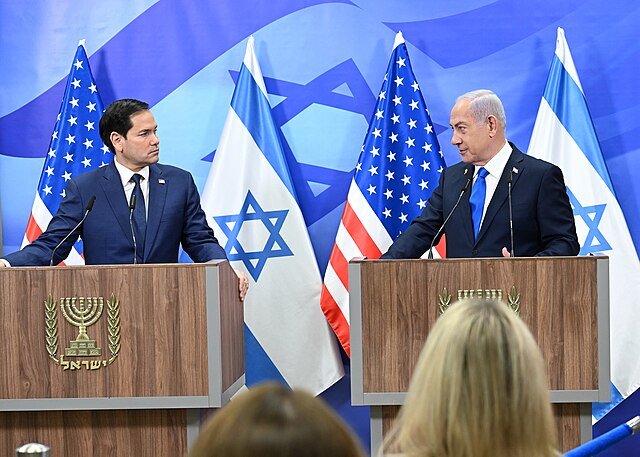
On July 22, the House of Representatives approved the National Defense Authorization Act (NDAA), H.R. 8800, for fiscal year 2027, which includes a provision expanding defense cooperation and integration between the United States and Israel.
The vote was 216-212, largely along party lines, but six Democrats joined the Republican majority: Reps. Henry Cuellar D-TX), Don Davis (D-NC), Jared Golden (D-ME), Vicente Gonzalez (D-TX), Adam Gray (D-CA), and Marie Gluesenkamp Perez (D-WA).
The bill included a provision titled Section 219 which would “expand and enhance intelligence sharing” with Israel, establish joint ventures for the co-production of weapons, promote joint military exercises, and integrate Israeli weapons into existing U.S. systems and programs. Critics say it amounts to integrating the U.S. and Israeli militaries.
Rep. Thomas Massie (R-KY) and Rep. Ro Khanna (D-CA) introduced an amendment to remove Section 219 from the legislation, but the House Rules Committee blocked debate on it. Massie was the only House Republican to vote against H.R. 8800.
Human rights groups and lawmakers have been sounding the alarm over the proposal and are fighting to have it removed from the final version of the NDAA.
What is Section 219?
Last month, former State Department official Josh Paul and co-founder of the political action committee A New Policy, told Mondoweiss that Section 219 could ultimately enable the Israeli government to steer U.S. foreign policy.
“This integration of the U.S. and Israeli defense industrial bases would expose our most sensitive technologies to a country – and an industry – with a track record of industrial espionage, and would give Israel leverage over U.S. foreign and defense policy through making us reliant on their supply chain,” said Paul.
In Responsible Statecraft, Ben Freeman, Director of the Democratizing Foreign Policy program at the Quincy Institute, says the provision could strengthen Israel’s influence in the U.S. beyond the military.
“It would give the Israeli government the opportunity to greatly expand one of the most powerful levers of influence in U.S. politics: jobs in the U.S. By expanding or starting new co-production facilities like it already has in Mississippi and Arkansas, the Israeli government could boast of providing jobs on U.S. soil, thereby securing allies among members of Congress who represent the districts where those jobs lie,” he noted.
An Institute for Middle East Understanding (IMEU) explainer on the effort cites recent Israeli actions as further reason to oppose further cooperation with the country.
“For over two years, Americans have been horrified by the images live-streamed from Gaza. Israel’s violence against Palestinians has played a large part in historic decreases in support for Israel and in historic degrees of sympathy for Palestinians,” it reads. “Now Israel is explicitly exporting its model of violence from Gaza to Lebanon, where Israel is killing thousands of Lebanese people, attacking hospitals and first responders, demolishing entire Lebanese villages, and forcibly displacing more than 1 million people–just like in Gaza. And Israeli Prime Minister Benjamin Netanyahu dragged the U.S. into an unconstitutional and illegal attack against Iran, which has killed thousands of Iranian civilians and greatly aggravated the affordability crisis for people in the U.S.”
“Considering this context, Congress should not deepen military ties to Israel.”
Congressional opposition
Leading up to the vote, multiple lawmakers criticized the provision across social media.
“While Americans are focused on other things, like how to make ends meet in the face of a rapidly rising cost of living, tomorrow the House will vote to merge our military technology and supply chains with Israel’s,” wrote Massie. “Our Founder’s would be appalled at what Congress is doing now.”
“The NDAA includes a provision that would deepen military ties with Israel. This is an outrageous threat to our country’s security and autonomy,” said Rep. Ilhan Omar (D-MN). “Americans want no part in Netanyahu’s genocidal regime. Congress cannot continue to bankroll Israel’s campaign of terror.”
“This amendment is an existential threat to American sovereignty and democracy,” declared Rep. Alexandria Ocasio-Cortez (D-NY).
Israel’s role
In a letter to Rep. Marlin Stutzman (R-OK) last month, Israeli Prime Minister Benjamin Netanyahu referred to the provision that ultimately became Section 219 as “my plan.”
For months, Netanyahu has publicly stated that he wants to wean Israel off military aid and “reset” the U.S./Israel relationship through deeper integration. “I want to draw down to zero the American financial support, the financial component of the military cooperation that we have,” he told 60 Minutes earlier this year.
This push comes amid talks to between the U.S. government and the Israeli government to establish a “new security cooperation framework,” as Israel memorandum of understanding (MOU) on military aid is set to expire in 2028.
The vote also comes amid a deepening skepticism of Israel among the U.S. population.
An AP-NORC poll released earlier this month shows that 40% of U.S. adults believe the country is “too supportive” of Israel, while a Gallup poll from February shows more Americans sympathize with Palestinians than Israelis. A Pew survey from August found that 60% of Americans now hold a negative view of Israel, up from 53% in 2025.
What comes next
The proposed NDAA, with its own version of the Israel provision, will soon face a vote in the Senate, where Sens. Chris Van Hollen (D-MD) and Bernie Sanders (I-VT) are leading an effort to call for an amendment vote to strip it out.
“Americans are saying loudly and clearly: No more US military support for the extremist Netanyahu government,” said Sanders after the House vote. “That is why Congress must vote NO on the defense spending bill, which brings the US and Israeli militaries even closer together.”
Pending the Senate vote and negotiations between the two chambers on the details of the military bill, Congress could pave the way for a redefined U.S.-Israel relationship.

No comments:
Post a Comment