'Lisbon is not a sauna': Environmentalists demand climate shelters throughout Portugal
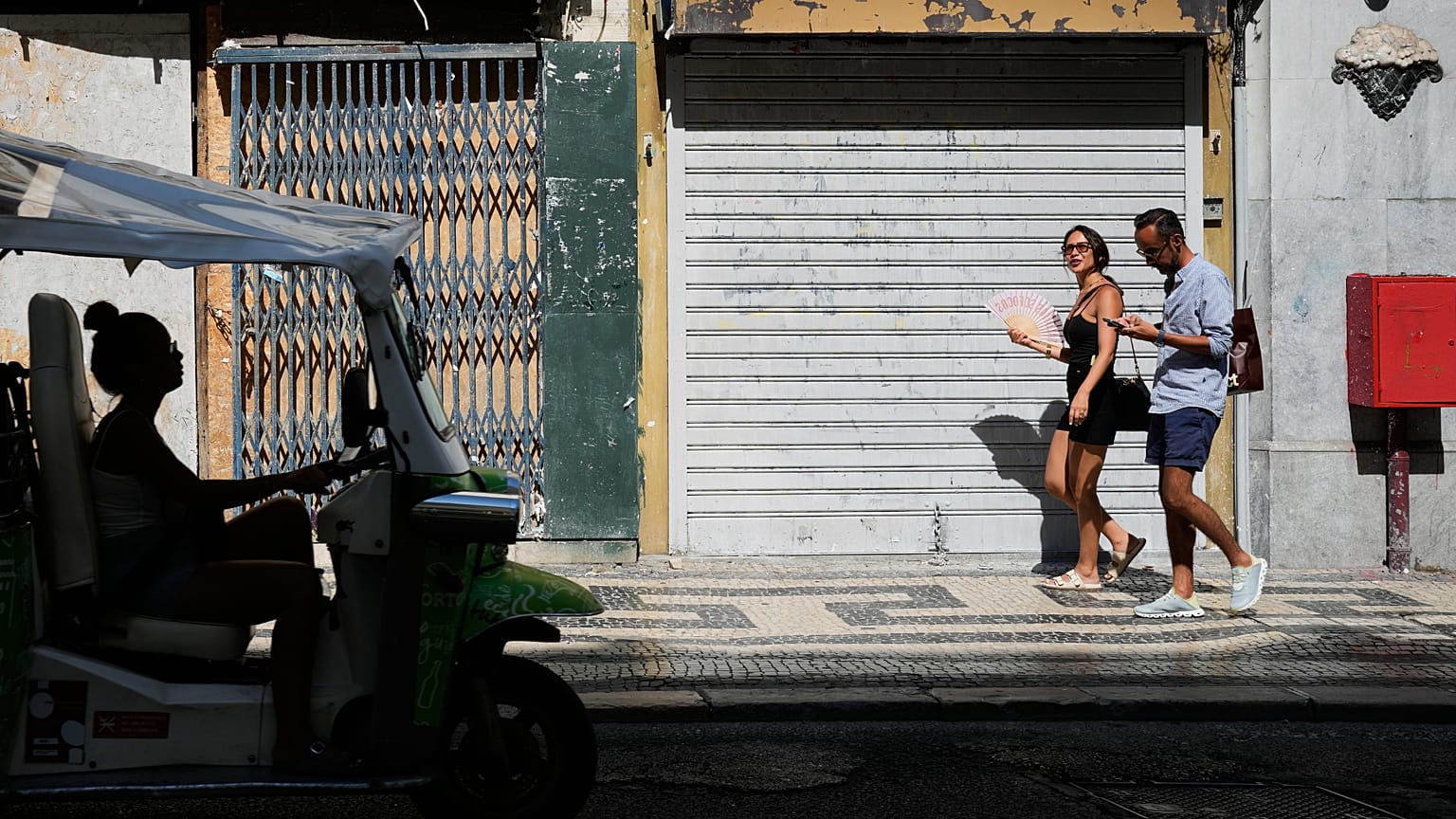
On the European Day for Victims of the Global Climate Crisis, several groups signed an open letter to the state and councils urging swift action to adapt cities to heatwaves.
More frequent, more extreme and more deadly heatwaves. That is the picture of a Europe battered by high temperatures which, during June, saw record after record broken on the thermometers.
"We have already had six heatwaves, the same as the total for last year. And we are only in July. On top of that, the intensity – in other words, the difference in temperatures compared with what is normal – is greater," Francisco Ferreira, president of the environmental association Zero, told Euronews.
Faced with a problem that experts attribute to greenhouse gas emissions and the resulting climate change, environmental organisations say it is urgent to find solutions that not only seek to mitigate the cause, but also help the population adapt to a scenario that is only going to get worse.
"It is inevitable that we have to look not only at cutting greenhouse gas emissions, which we call mitigation, but also, of course, at adaptation," explains Francisco Ferreira.
"It is crucial that we build and develop cities that are prepared for this, with the capacity to adapt. That basically means taking a very close look at the building stock, which in many cases reflects situations of energy poverty, where we cannot keep homes warm in winter, but we also cannot keep them cool in summer."
An open letter delivered to the government
Zero is one of the signatories of the open letter that today, on the European Day for the Victims of the Global Climate Crisis, will be delivered to the Government headquarters at Campus XXI in Lisbon.
The letter is addressed to the prime minister, the ministries of Environment and Energy, Health, and Infrastructure and Housing, and to the National Association of Portuguese Municipalities, labelling extreme heat a public health emergency while demanding intervention measures in urban centres.
"This has to do with the way and the priorities that we have had in many cities. We believe that there really has not been sufficient care given to these circumstances," the association’s president said.
Handing over the document will also be a symbolic moment, in a street action where participants will wrap themselves in towels and hold up placards bearing the message "Lisbon is not a sauna!"
Alongside Zero, 11 organisations have signed the document, including Quercus, Geota, Greenpeace Portugal, WWF Portugal and the Portuguese Network of Ambassadors of the European Climate Pact, setting out concrete measures for adapting to heat in Portuguese cities.
These include the creation of a national network of climate shelters - the identification by each municipality of existing public and private spaces (libraries, swimming pools, parks) that can offer protection during heatwaves, speeding up the renovation of buildings and even installing air‑conditioning in nurseries, care homes and day centres.
"The idea is to really have assets available, climate refuges – meaning shaded areas, green spaces, air‑conditioned zones – which can take different forms, from services and shops to public institutions," he tells Euronews.
The letter states that municipal climate adaptation plans are "a fundamental step" for local resilience and stresses that implementing them is essential.
"In Portugal we are obliged to draw up Municipal Climate Action Plans, which should have been ready by February 2024, and yet here we are in 2026," the president of Zero stressed. "More than these plans, what is really needed is to move into practice, because with the summer we are having and also with the situations we have already seen in recent years, the need to respond is increasingly urgent if we are to reduce morbidity."
Climate emergency not a priority and changes are "expensive"
According to the president of Zero, there are several reasons that explain the lack of action in cities. "Municipal priorities are sometimes elsewhere, and they have not given this response the prominence and importance it deserves," he explains. "In some cases, especially in small municipalities, there is a lack of technical capacity. It is not easy to prepare this kind of plan, whether in terms of reducing emissions or in terms of climate adaptation.
In addition, the costs associated with structural measures place obstacles in the way of decision‑making, redirecting "political will".
"The changes sometimes involved in climate adaptation are expensive. In the future they will work out cheaper, there is no doubt. They will improve the quality of life of residents and of everyone who uses the cities. But they require costly investment and are therefore often difficult for local authorities to approve."

Heatwaves increasingly frequent and deadly
"Extreme heat is no longer a distant risk. It is a threat to public health, quality of life and the safety of our cities. We also know that this risk is not distributed equally. Those who live in neighbourhoods with little green space, streets that are excessively paved, heavy traffic and scarce shade are more exposed," the letter addressed to the Portuguese prime minister states.
By early July, Portugal had already recordedsix heatwaves in 2026, amounting to 59 days under heatwave conditions in the first six months of the year — episodes that occurred in February, March (twice), April, May and June, according to IPMA.
"A rising trend can be seen in the maximum number of days under heatwave conditions, with 2009 standing out with 93 days, followed by 2017 with 83 days and 2023 with 80 days. In 2025 there were 74 days under heatwave conditions and 59 days in the first six months of 2026," the Portuguese meteorological service said in a statement.
These episodes of extreme temperatures, also recorded in other European countries such as the United Kingdom, France and Spain, are also driving up mortality.
During the most recent heatwave in the country, recorded at the beginning of July, there was excess mortality. According to figures from the Death Certificate Information System (SICO), excess deaths were observed between 2 and 8 July, when the country was under high temperatures. Calculating the difference between the number of deaths observed and the baseline, the period from 2 to 8 July saw approximately 539 excess deaths.
Between 3 and 6 July 2026, when the government declared an alert situation across mainland Portugal, 313 excess deaths were recorded.
In June, considered one of the hottest months on record in Europe, there were more than ten thousand excess deaths in Europe.
According to data published on Monday by EuroMOMO, a mortality monitoring service supported by the European Centre for Disease Prevention and Control and the World Health Organization, 27 countries recorded 10,650 excess deaths between 22 and 28 June.
The World Health Organization has already issued a warning: this is only the beginning, with the organisation reporting that the coming summers will be more difficult.
"This heatwave is a dress rehearsal," said Hans Henri Kluge, the WHO regional director for Europe.

No comments:
Post a Comment