It’s possible that I shall make an ass of myself. But in that case one can always get out of it with a little dialectic. I have, of course, so worded my proposition as to be right either way (K.Marx, Letter to F.Engels on the Indian Mutiny)
Sunday, July 26, 2026
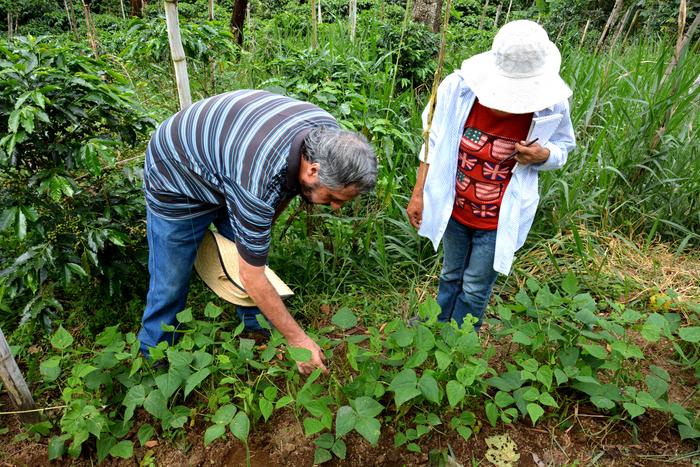
Trust among farmers is key to scaling climate-smart innovations
The Alliance of Bioversity International and the International Center for Tropical Agriculture
Credit: Alliance of Bioversity International and CIAT
Palmira, Colombia, July 21, 2026. A recent study published in Agricultural Systems provides new evidence on the role of social relationships in knowledge sharing among farmers and proposes a new way of understanding how the responsible scaling of climate-smart agricultural innovations begins.
As the climate becomes increasingly variable and extreme events more frequent, accelerating the use of innovations that can strengthen agricultural resilience has become a priority for agrifood systems. Science has made progress in developing solutions with the potential to help farmers address these challenges. However, ensuring that knowledge about these innovations reaches more farmers and is understood, adapted, and scaled remains one of the major challenges in research for development.
Addressing this challenge requires understanding not only which innovations work, but also how knowledge about them begins to circulate among farmers. The study Trust, support, and knowledge sharing: The role of social capital in responsible scaling of climate-smart agriculture, published in Agricultural Systems, provides new evidence that this process depends not only on the technical characteristics of an innovation, but also on relationships of trust, mutual support, and knowledge sharing among farmers.
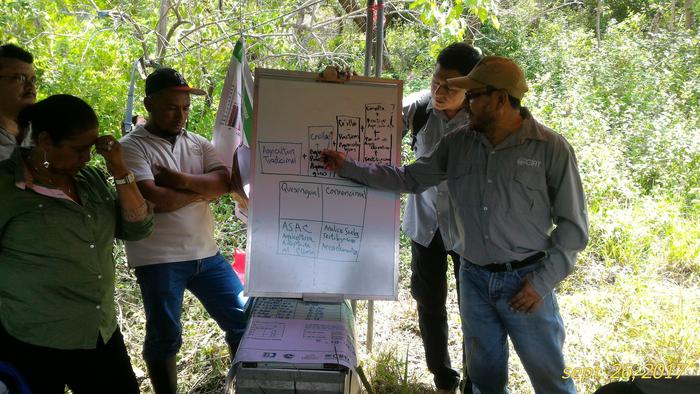
To examine this question, researchers from the Alliance of Bioversity International and CIAT, the University of Copenhagen, and the Gates Foundation analyzed data from 514 smallholder farmers participating in Climate-Smart Villages—known in Spanish as Territorios Sostenibles Adaptados al Clima (TeSAC)—in Guatemala and Honduras. The aim was to understand how different dimensions of social capital influence knowledge sharing about climate-smart agriculture and what this process means for the responsible scaling of innovations.
Beyond sharing information, one of the study's main contributions is a new way of examining how agricultural innovations begin to spread. The findings suggest that innovations do not begin to diffuse solely because of their technical characteristics. They also depend on social relationships that enable knowledge to circulate among farmers, allowing new practices to be understood, discussed, and adapted to different contexts.
The success of an innovation is traditionally assessed once it has already been adopted by large numbers of people. This study, by contrast, focuses attention on a much earlier stage: when farmers begin to share experiences, discuss new practices, address questions, and learn from one another.
The study proposes that knowledge sharing can be understood as an observable sign of the early stages of responsible scaling. Examining how knowledge circulates among farmers can provide a better understanding of how the processes that may later support broader adoption and expansion of innovations begin to take shape.
From this perspective, knowledge sharing is not limited to the transmission of technical information. It is a social process through which experiences are shared, discussed, and adapted to different production realities. Understanding these dynamics makes it possible to analyze how knowledge about innovations begins to circulate before adoption becomes visible at scale.
"Our study shows that the success of scaling does not depend solely on the technical characteristics of an innovation. It also requires understanding the social dynamics that enable knowledge to circulate among farmers. Trust, close relationships between people, and mutual support create conditions that foster knowledge sharing, a process that can be observed as a signal of the early stages of responsible scaling." Dr. Deissy Martínez-Barón, Researcher in Scaling for Impact and Climate Action, Alliance of Bioversity International and CIAT.
What does the research reveal?
Trust among farmers plays a fundamental role in enabling knowledge sharing about climate-smart agricultural practices. When farmers trust other members of their community, they are more likely to share experiences, discuss new practices, and learn from one another.
Close relationships among farmers strengthen learning networks, making it easier for knowledge and experience to circulate within communities. These connections create an enabling environment in which knowledge about innovations can be shared, discussed, and adapted to different contexts.
One of the study's most important findings concerns the role of mutual support. The researchers found that it becomes particularly important in communities where levels of trust remain low. Under these circumstances, guidance, collaboration, and the exchange of experiences help sustain the flow of knowledge among farmers.
By contrast, the study found that trust in organizations had less influence than trust built among farmers themselves, highlighting the importance of relationships developed within communities in promoting knowledge sharing.
Finally, the researchers identified a positive association between the adoption of climate-smart agricultural practices and knowledge sharing, reinforcing the close relationship between the two processes.
What does this mean for farmers and decision-makers?
In practice, these findings help explain how knowledge begins to circulate among farmers. For example, a farmer may observe a neighbor implementing a new practice to cope with drought, discuss the results, adapt the practice to the conditions on their own farm, and later share that experience with other community members. Although the study does not examine individual cases such as this one, it provides evidence that knowledge about innovations begins to circulate among farmers and is an important component of the processes that may support their subsequent expansion.
For governments, development organizations, and innovation programs, these findings provide evidence of the need to place social dynamics at the center of innovation-scaling processes, as this supports local ownership and, in turn, sustained results and impact over time. The findings also support the responsible scaling approach by showing that understanding how knowledge circulates among farmers can contribute to the design of innovation strategies that are more inclusive, context-sensitive, and better able to anticipate and manage potential unintended consequences that may arise as innovations are scaled up.
In a context where agrifood systems need to accelerate the adoption of solutions to climate change, this research highlights that the impact of an innovation depends not only on its technical quality, but also on people's ability to share knowledge, learn from one another, and build relationships of trust that enable knowledge to circulate.
Understanding these processes creates new opportunities to design more effective and inclusive innovation and scaling strategies that are adapted to local realities.
The findings show that trust among farmers is a key factor in increasing the likelihood of knowledge sharing about climate-smart agricultural practices.
A Yale-led research team has proposed a less expensive — and more environmentally friendly — method for removing certain “forever chemicals” from millions of acres of farmland in the United States and around the world.
The new process, which is based on data from agricultural sites in Maine. They say it has the potential to address two connected environmental challenges: remediating per- and polyfluoroalkyl substances (PFAS) that have contaminated agricultural land for decades and scaling up the use of enhanced weathering to remove carbon dioxide from the atmosphere.
Just as important, the new approach allows previously contaminated cropland to once again be used for an agricultural purpose — unlike current remediation methods.
“There is an obvious need for new tools to help farmers affected by ‘forever chemicals’ contamination,” said Noah Planavsky, a professor of Earth and planetary science in Yale’s Faculty of Arts and Sciences and the son and brother of farmers. He is also a faculty member of the Yale Center for Natural Carbon Capture and principal investigator for a new study published in the journal Proceedings of the National Academy of Sciences which describes the new method.
“We outline a path that allows farmers to continue to work their land while restoring soil health,” Planavsky said.
The research was supported by Yale Planetary Solutions (YPS), a campus-wide initiative that helps advance novel and impactful projects tackling environmental challenges, and Yale Ventures, the university’s hub for innovation and entrepreneurship.
PFAS, also known as “forever chemicals,” are a class of toxic, man-made chemicals that have been used for decades in hundreds of products, from dental floss and lipstick to frying pans and pizza boxes. PFAS are ubiquitous in the United States, having made their way into groundwater and soil, and then eventually croplands. Only in recent years have scientists begun to understand the full scope of PFAS contamination not just nationally but worldwide.
“Though this study is U.S.-focused, based on the available data, PFAS are a challenge globally,” said Jake Thompson, an associate researcher in the Planavsky Lab and first author of the study. He is a postdoctoral researcher in Yale’s Department of Earth & Planetary Sciences.
“This issue — the contamination of agricultural land with PFAS — disproportionately hurts small farmers and organic farmers, who used fertilizers with PFAS before the full extent of the problem was known,”Thompson said.
How did contamination of “forever chemicals” become so widespread? For years, individuals and factories would flush PFAS into their local sewer system, as part of wastewater. Because forever chemicals don’t decay, they made their way into sewage sludge, which was marketed to farmers as a natural fertilizer.
That cycle continued for decades, until scientists and public health officials began raising concerns. PFAS, which accumulate in the body over time, have been linked to certain cancers, fertility problems, and immune response issues. The state of Maine, where forever chemicals were found in milk from a dairy farm in 2016, banned the application of sewage sludge on agricultural land in 2022. (Perfluorooctanoic acid [PFOA], the most widely studied PFAS, was classified as a human carcinogen in 2023, according to the National Institutes of Health.)
Thompson estimated that 1.2 million hectares (2.96 million acres) of U.S. cropland may be significantly impacted by PFAS.
Meanwhile, current remediation options for farmland have been limited — and expensive.
Farmers can excavate the contaminated soil, for instance, or use machines to essentially burn the soil. The cost for such remediation is $800,000 to $1.6 million per hectare, meaning the bill for removing PFAS from American farmland would run to $8 trillion.
The Yale-led remediation model requires only a fraction of that cost. It is based on two of the most well-known PFAS — perfluorooctanoic acid (PFOA) and perfluorooctanesulfonic acid (PFOS).
The system’s first step involves spreading a thin layer of crushed, alkaline rock to the area. This raises the soil’s pH level, which, in turn, accelerates the removal of PFOS from the soil via plants growing there.
The next step is to create “biochar” — a specialized form of charcoal — from the harvested plants, which destroys both PFOS and PFOA chemicals. This is done by heating the plants with either a large, stationary machine or a smaller, mobile unit.
Researchers estimate that remediation using this new model costs $1,460 per hectare. Since the process would be repeated each year for up to 20 years, the total cost would be just over $29,000 per hectare — which includes compensation for the farmer’s lost income during treatment.
The system also has the added benefit of removing carbon dioxide — a greenhouse gas and main contributor to climate change — via enhanced weathering of the crushed rock applied to the soil and biochar generated from biomass. At a national scale, the system could remove 10.5 million metric tons of carbon dioxide per year, the researchers estimate.
“This is a real pathway to actually give farmers in this situation some agency over their land and leave the soil in better condition than it was before,” Thompson said.
The research project recently received a Yale Planetary Solutions Impact Accelerator (PSIA) grant. The grants, recently introduced by Yale Planetary Solutions and Yale Ventures, provide mentorship and commercialization guidance to transformative projects that aim to address the root causes of environmental challenges.
The research is also supported by the Schmidt Family Foundation and the UK-based Natural Environment Research Council.
Co-authors of the study are Tim Jesper Suhrhoff, Chloe Kent, and Ella Milliken of Yale, Millie Dobson and Rachel James of the University of Southampton in the UK, Yoshiki Kanzaki and Christopher Reinhard of the Georgia Institute of Technology, and Lucinda Bryce of Brown University.

No comments:
Post a Comment