
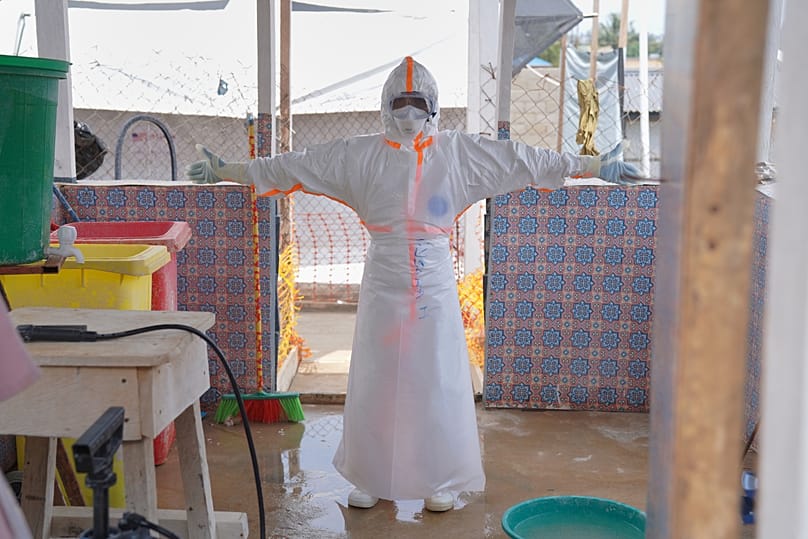
Health workers prepare for work at a newly-opened Ebola treatment centre in Bunia, DR Congo. Photo Credit: WHO
August 14, 2026
By Africa Defense Forum
Key Takeaways
The outbreak, declared in May 2026, has become the second-deadliest and fastest-growing in the country’s history, with more than 1,500 deaths by the end of July, while misinformation spread online and locally (including claims that Ebola is not real or that responders are deliberately infecting people) continues to hinder containment.
Aid organizations and African health officials stress that rebuilding community trust, engaging local leaders, ensuring safe burials and countering false information are essential to protecting responders and stopping the outbreak.
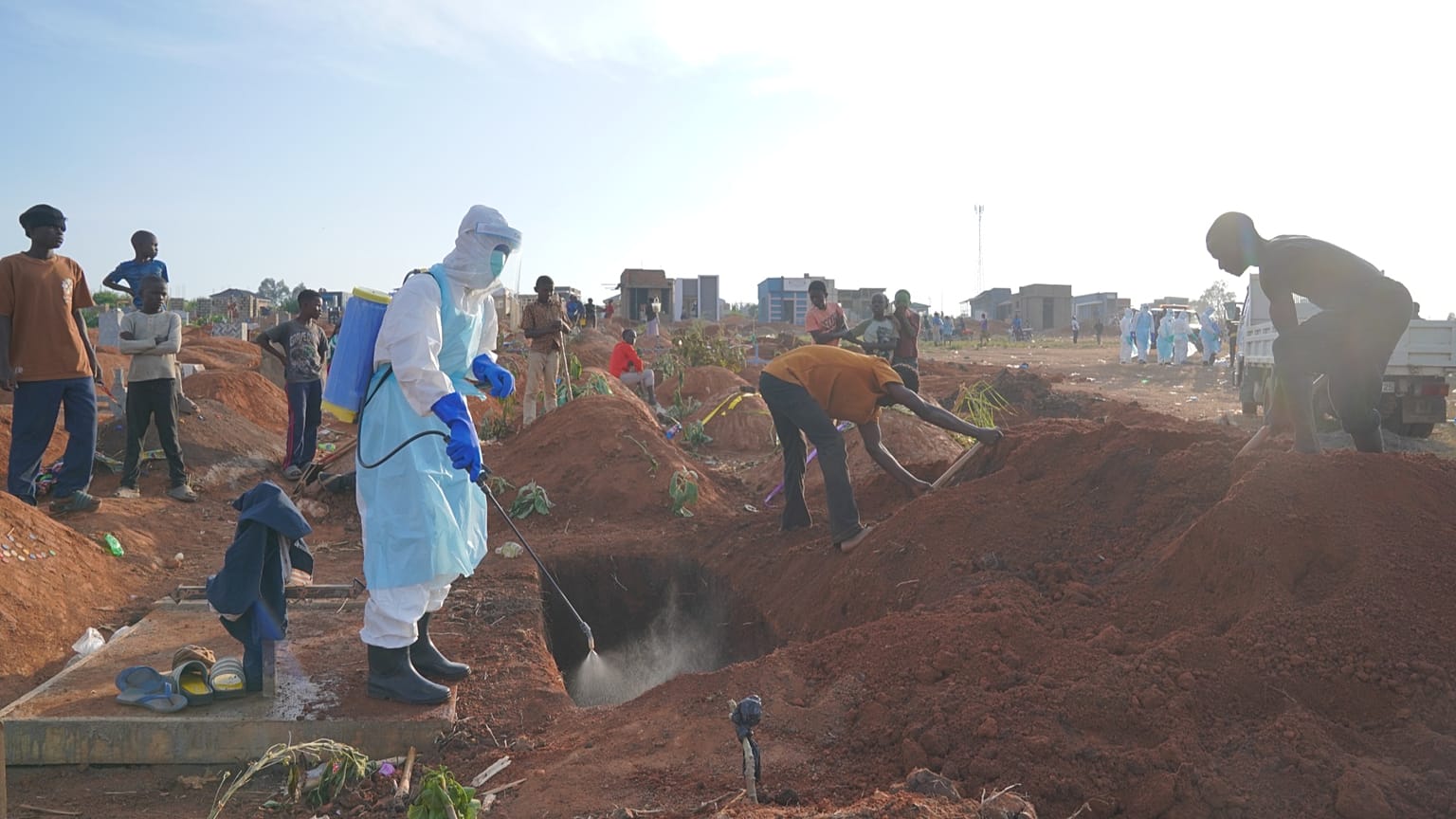
Daniel Uyirwoth Welo, dressed in full-body protective gear, can be seen in a recent viral video running for his life when a crowd in a cemetery turned violent during the burial of an Ebola victim. He was one of four Red Cross volunteers who were injured in the June assault in the Democratic Republic of the Congo city of Bunia. The attack was triggered by rumors that the coffin was empty.
“They grabbed me from behind and started punching me, hitting me with spades and machetes,” he told the BBC for a July 9 article, recalling how people in the crowd said, “Ebola doesn’t exist,” while others claimed that the aid workers were there “to get money.”
The attack was one of several incidents linked to false information since the DRC declared the outbreak on May 8. Fear and suspicion of outside organizations swirled through communities in the eastern provinces. Rioters set fire to a treatment center in May, one of at least a dozen facilities that have been attacked.
Healthcare workers and aid groups say false information spread locally and online hampers their efforts to contain the virus. Meanwhile, the deadly disease is raging. With more than 1,500 deaths through the end of July, the outbreak has become the second-deadliest in the DRC’s history and the fastest growing on record.
In a June 5 statement, the Red Cross expressed shock at the Bunia attack, in which two of the four injured volunteers were so severely wounded that they had to be airlifted to the capital, Kinshasa, for treatment.
“We recognise the fear, uncertainty and frustration felt by many people,” the Red Cross said. “Building trust and maintaining dialogue with communities through community engagement remain essential to bringing the outbreak under control. Attacks against volunteers not only endanger lives, they also undermine efforts to contain the outbreak and protect communities.”
On social media, false claims have circulated rapidly, including claims that Ebola isn’t real, that health workers are deliberately infecting people, or that the humanitarian response is a moneymaking scheme. Doctors reportedly have resorted to debunking claims on the WhatsApp platform, which hosts groups centered in eastern DRC, some of which have thousands of members.
“In this era of social media, information spreads rapidly,” Mohammed Saani Yakubu, ActionAid’s director in the DRC, told The Wall Street Journal for a July 16 article. “Within a very short time, these voice notes circulate around entire WhatsApp groups. They are very harmful.”
Red Cross spokesperson Alex Lock said the attacks disrupt containment efforts and put community members at greater risk.
“An immobilised colleague means a direct reduction in response capacity,” he told The Guardian for a July 10 article. “This hinders our operational effectiveness and benefits no one, neither the community in need nor those of us working tirelessly to support them in containing and eradicating the virus.”
In a July 30 media briefing, Africa Centres for Disease Control and Prevention Director-General Jean Kaseya said that community leaders should be enlisted to help prevent attacks against healthcare workers, ensure safe burials and encourage case contacts to come forward for monitoring.
“We need to rethink the way to work with the community if we really want to stop this outbreak,” he said. “There is no magical solution unless we really work with communities.”
Ebola spreads to sixth DR Congo province raising fears it could spread to South Sudan
The DRC's deadliest Ebola outbreak from 2018-2020 killed nearly 2,300 people out of 3,500 recorded cases.
An Ebola outbreak that is on track to become the deadliest in the Democratic Republic of Congo's history has spread to a sixth province, raising fears it could spill into South Sudan.
The outbreak, which began in the conflict-scarred northeastern province of Ituri, is already considered the largest ever in the vast central African country.
Declared on 15 May, it is thought to have already been spreading for several weeks and is the DRC's 17th Ebola outbreak.
The DRC's deadliest Ebola outbreak from 2018-2020 killed nearly 2,300 people out of 3,500 recorded cases.
So far, authorities say the current outbreak has killed more than 2,128 people, out of 4,566 confirmed cases.
Until now, five Congolese provinces had been affected: Ituri, which borders Uganda and South Sudan, North Kivu and South Kivu, Haut-Uele and Tshopo.
A person has now died from the virus in northern Bas-Uele province after travelling from neighbouring Haut-Uele, Jean Kaseya, the head of Africa Centres for Disease Control and Prevention (ACDC), told reporters on Thursday.
The outbreak is spreading at an unprecedented rate, Africa CDC added.
Three months after it was declared, seven times more cases and five times more deaths were recorded in the DRC than during the first three months of the largest Ebola outbreak in history, which hit west Africa in 2014, Africa CDC said.
However, the World Health Organisation on Wednesday said it hoped to reverse the spread of Ebola in the DRC within three months.
Mercy Corps NGO warned on Thursday about the risk of the virus spreading to South Sudan, which borders both Ituri and Haut-Uele.
"Confirmed cases now sit just 35 kilometres from the South Sudan border, along high-risk travel corridors," it said in a statement.
The response in the DRC is hampered by stretched health services, insufficient clean water and safe toilets, fragile trust and insecurity, it added.
Some of the provinces where Ebola is present are densely populated and have only a weak government presence and largely lacking health infrastructure.
North Kivu and South Kivu are also split by the front lines between the Congolese army and the anti-government armed group M23, backed by Rwanda, which has seized vast swathes of territory.
Ebola, which spreads through contact with bodily fluids and causes a haemorrhagic fever, has killed more than 15,000 people in Africa over the past 50 years.

No comments:
Post a Comment