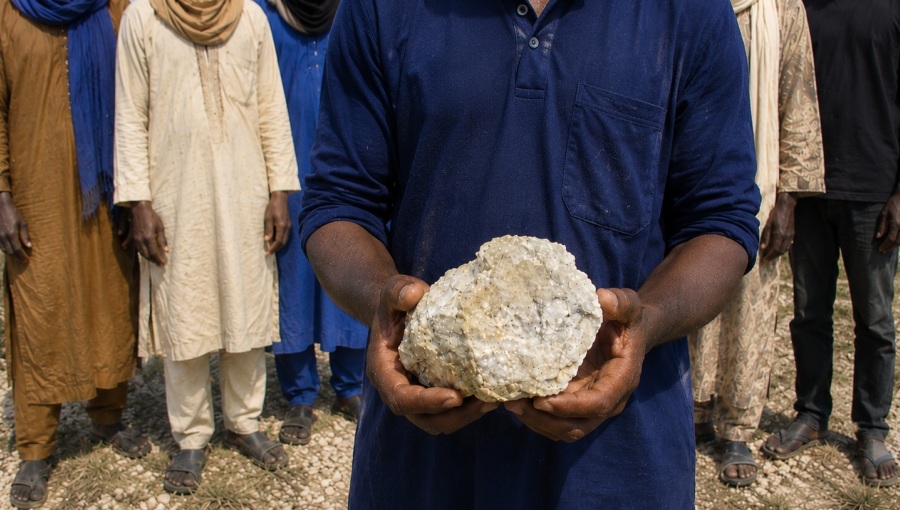
Expanding lithium production across the Sahel could create new revenue streams for jihadist and criminal groups as weak regulation, informal mining and porous borders expose emerging supply chains to exploitation, according to research by Bradley A. Mortin of King’s College London.
Mortin, a researcher in the Department of War Studies, examined lithium mining in Nigeria, Mali, Burkina Faso, Niger and Chad, arguing that rapid development of the sector is intersecting with insurgencies, organised crime and established mineral smuggling networks. His research was published this year in the African Journal of Terrorism & Insurgency Research and in The Conversation.
Mortin warned in the paper that “weak governance and insecurity threaten to transform this resource into a new avenue for terrorist financing.”
Africa’s lithium industry is expanding rapidly as demand grows for batteries used in electric vehicles, electronics and energy storage, with new mines and processing projects advancing across several countries.
Mortin argues that the same conditions that make parts of the Sahel difficult to govern — weak state control in remote regions, informal mining, cross-border smuggling routes and armed insurgencies — could allow militant groups and criminal networks to extract revenue from the lithium trade.
The risk would not necessarily require armed groups to operate mines themselves. They could benefit through taxation, extortion, protection payments, control of transport routes and participation in illicit trading networks.
In Nigeria, Mortin identifies the largely artisanal lithium sector as particularly vulnerable to criminal groups seeking protection payments or access to legal and illicit mineral supply chains.
Mali already has an industrial lithium industry. Ganfeng Lithium (SZSE: 002460; HKEX: 1772) brought the first phase of its Goulamina spodumene project into production in December 2024 and shipped its first lithium concentrate to China in 2025. Ganfeng currently lists its interest in the project at 100%.
Phase I of Goulamina has planned annual capacity of about 506,000 tonnes of lithium concentrate, potentially rising to around 1mn tonnes under a second phase.
The Bougouni project is operated through a partnership between Kodal Minerals (AIM: KOD) and China’s Hainan Mining. Kodal owns 49% of Kodal Mining UK, while Hainan holds 51% and ultimate control. That company in turn owns 65% of Les Mines de Lithium de Bougouni, with the Malian government holding the remainder. Kodal describes Bougouni as a producing lithium project.
The emergence of Goulamina and Bougouni has positioned Mali as one of Africa’s most important new hard-rock lithium producers despite the country’s continuing political instability and jihadist insurgency.
Mortin argues that armed groups already familiar with taxing and extorting gold miners could apply similar methods as lithium production expands, particularly where mining and transport take place beyond effective state control.
Nigeria’s sector is less mature but is attracting substantial investment. In July, President Bola Tinubu commissioned a $250mn lithium mining and processing plant in Nasarawa State developed by privately held Chinese company Diamond New Energy in partnership with the state government and Chinese groups Jiuling and Canmax. The government says the plant can process 6,000 tonnes of material a day.
Chariot Corporation (ASX: CC9) is also building a Nigerian hard-rock lithium portfolio after acquiring a 66.7% interest in projects at Fonlo, Gbugbu, Iganna and Saki across Oyo and Kwara states. The company says all four areas have a recent history of artisanal lithium mining, highlighting the overlap between formal exploration and the informal supply chains identified in Mortin’s research.
The study says Burkina Faso faces comparable risks because jihadist groups have already generated revenue from artisanal gold production and informal trading networks during the country’s long-running insurgency.
In Niger, the research argues that routes long used to move gold, weapons and other contraband could also provide channels for illicit lithium shipments as domestic production develops.
Chad has yet to develop a lithium industry on the scale of Mali, but Mortin identifies weak institutions, corruption and porous borders as factors that could leave future mineral supply chains vulnerable to criminal exploitation.
Burkina Faso, Niger and Chad remain much earlier-stage lithium jurisdictions, with no industrial projects comparable with Goulamina or Bougouni currently operating. Their relevance to Mortin’s study lies more in prospective mineralisation, informal extraction and the security risks surrounding future development than in established listed-company production.
The paper also warns that armed groups are “exploiting the governance void surrounding artisanal lithium mining.”
The concern echoes the experience of other African minerals. Diamonds helped finance conflicts in Sierra Leone and Angola, while gold mining and trading have provided revenue to armed groups across parts of West Africa and the Sahel.
Lithium is becoming strategically more important as governments and manufacturers seek secure supplies for the global energy transition, but forecasts for African and global output vary depending on whether they measure contained lithium, lithium carbonate equivalent or spodumene concentrate.
Mortin argues that governments should formalise artisanal mining, strengthen mineral tracking systems and improve intelligence sharing across borders before lithium production expands further.
The study also calls for stronger state authority in mining regions and tighter traceability to make it harder for armed groups to extract revenue or move illegally mined material into legitimate export channels.
Greater domestic processing could also allow African producers to capture more of the value generated by lithium rather than relying largely on exports of raw ore or concentrate.
The challenge for governments is to develop a potentially valuable new source of export earnings without allowing lithium to replicate the security problems associated with gold and other minerals in poorly governed parts of the Sahel.

No comments:
Post a Comment