Missile War Monitor: two economies being taken apart, target by target
Two target sets now define this war, and neither of them is military. Ukraine hits Russian oil refineries and the warehouses of its two big online retailers. Russia hits Ukraine's power system and its shops. Both sides describe the other's campaign as terrorism and their own as a legitimate military targets.
On the Russian side the refinery campaign has moved from raids that cost a plant a few days of repairs, to outages that last weeks. Ufa, Nizhnekamsk, Perm, Novokuybyshevsk, Afipsky, Novoshakhtinsk, Volgograd and now Kstovo have all been hit since mid-August, and the whole of Lukoil's major domestic refining is currently shut. Petrol, diesel and jet fuel exports are banned, motor oil prices are up 40%, a second wave of the fuel crisis is building and July crude output was the lowest in six years.
The retail campaign is the more expensive one. Between July 18 and August 24, the warehouse war got underway and drones hit 15 Wildberries logistics sites totalling about 1.8mn square metres, roughly a third of the company's entire warehouse estate, Kommersant calculates. Ozon has since been added to the target list, and its shares fell 28% in the last week.
Sellers on the two platforms now put their combined losses above RUB600bn ($7.1bn). Data Insight puts lost stock alone at between RUB517bn ($6.1bn) and RUB580bn ($6.9bn) for Wildberries sellers, and between RUB88.5bn ($1.05bn) and RUB107bn ($1.27bn) for Ozon's. Rebuilding the destroyed warehouses would cost a further RUB186bn ($2.2bn) to RUB344bn ($4.1bn) and RUB30bn ($356mn) to RUB62.5bn ($742mn) respectively.
On the Ukrainian side the power system is the constant target and the shops are the newer one. The Kryvyi Rih thermal power station can no longer generate at all after an August 18 strike; 90,000 customers lost supply in Kyiv on August 20; Kernel, the country's largest grain exporter, says it has lost about half its own generation. Two Epicentr megastores were hit in Odesa on August 24, three retail chains' Kyiv warehouses on August 20, and the largest shopping centre in Kryvyi Rih on August 21, killing 16 people.
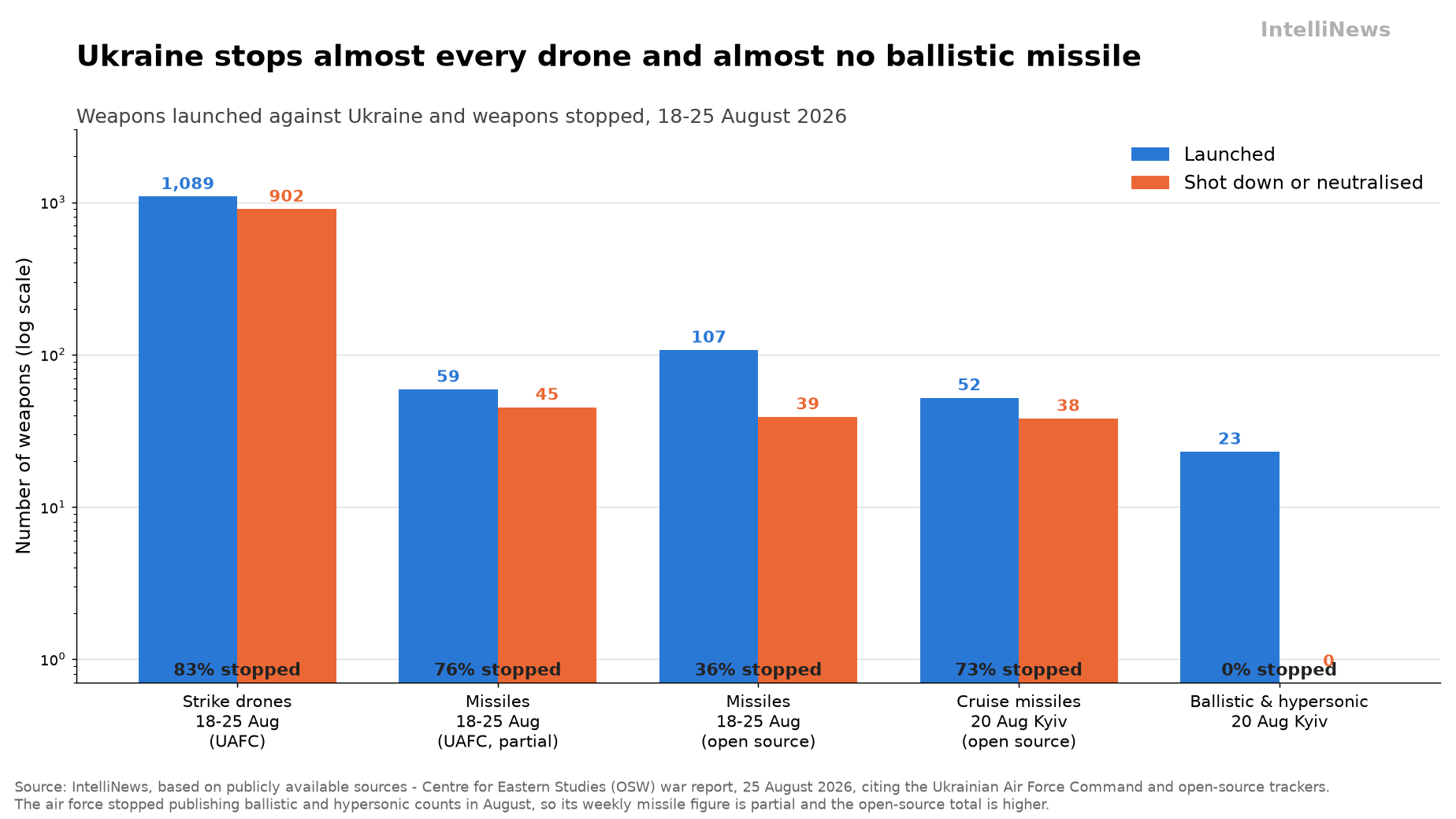
Interception rates for the week of 18-25 August 2026. The Ukrainian Air Force stopped publishing its ballistic and hypersonic counts during August, which is why its weekly missile figure is partial and the open-source total is higher. Source: IntelliNews, based on publicly available sources.
Drones are still being shot down at better than four in five. Missiles are not, and against the ballistic and hypersonic weapons that carry the heaviest warheads the rate on August 20 was zero out of 23, with only two Patriot interceptors fired in the capital's defence. That is not a failure of the system but the absence of ammunition for it, and it is the reason the interceptor shortage has become the single most consequential number in the war.
Russia's own claims run the other way and are not credible as counts: its defence ministry says it neutralised 1,671 fixed-wing drones in the 24 hours to August 18 and 1,504 on August 20. It also says it shot down all eight to 11 Flamingo cruise missiles Ukraine fired on August 24.
Major strikes & targets
Strikes on economic infrastructure since 1 June 2026. Compiled by IntelliNews based on publicly available sources, including our own reporting and the Centre for Eastern Studies' war reports. Dates are of the strike where known and of first report otherwise; the list is of significant strikes on economic targets and is not exhaustive.
The pattern in the dates is a conversation. The Tambov warehouse strike of July 18 killed seven people and was followed the next day by the heaviest Russian bombardment of the war to that point. The Novorossiysk grain terminals went down in mid-August; the Odesa ports and the Danube crossings were hit through the rest of the month. Each side is now answering the other inside 48 hours, and both are aiming at the part of the other's economy that generates foreign currency.
Neither campaign is winning in the sense either government uses the word. Russia's refining is being removed faster than it can be rebuilt and its crude cannot be exported instead, because the ports and the tankers are being hit too. Ukraine's grain cannot leave and its power stations cannot be replaced before winter. The monitor exists to keep count of a process that has no obvious stopping point.
Russia Steps Up Multi-Front Pressure On Ukraine With Drones, Decoys, Missiles, And North Korean Forces – Analysis
Drone factory in Russian Republic of Tatarstan. Photo Credit:
August 27, 2026
Hudson Institute
By Can Kasapoğlu
Key Takeaways:
Ground fighting remains heavy, with more than 200 daily engagements focused on Kostiantynivka, Pokrovsk, and other eastern axes.
The UK authorized release of classified Storm Shadow/SCALP data so France and Ukraine can set up local assembly, shifting support toward Ukrainian production capacity; Moscow has already threatened UK arms factories in response.
1. Battlefield Assessment
Long-range salvos enabled by missile and drone warfare continued to shape the war. Overnight on August 25, a Russian Shahed drone struck the Vynohradivka international road crossing between Ukraine’s Odesa Oblast and Moldova. The strike damaged infrastructure, temporarily closing the checkpoint and redirecting traffic elsewhere.
The strike was Russia’s third attack in two weeks on a Ukraine–Moldova border crossing. This pattern suggests a coordinated Kremlin campaign rather than a series of isolated strikes. Moscow is likely targeting the connective tissue of Europe’s eastern frontier.
On the night of August 24–25, Russia also attacked Ukraine with 150 Shahed-Gerbera loitering munitions. Moscow launched Iskander-M and Kh-31 missiles, as well as Parodiya decoy drones, including jet-powered variants. Ukrainian aircraft, missile and electronic-warfare units, interceptor drones, and mobile teams neutralized 124 unmanned aerial vehicles involved in the attacks. Nonetheless, Russia struck 17 locations in Ukraine.
The barrage illustrated how Russia has organized its concept of operations around mixed-vector pressure designed to exhaust Ukraine’s layered defenses. In May 2026, Ukrainian intelligence services estimated that Russia intended for half of its Shahed drone-warfare deterrent to be jet-powered variants of the loitering munition. Russian planners aimed to produce 500 such jet-powered drones per month and launch 60,000 long-range attack drones and 50,000 decoy drones over the course of a year. Ukraine’s recently unveiled jet-powered Alexa Spatium interceptor is one part of Kyiv’s answer to Russia’s strategy.
Additionally, North Korea’s role in Russia’s war continued to expand into the robotic warfare domain. Major General Vadym Skibitskyi, the deputy head of Ukraine’s Defense Intelligence (GUR), reported that the Kremlin has deployed 8,500 North Korean personnel in Russia’s Kursk Oblast, including 400 drone operators assigned to reconnaissance and attack missions. A North Korean missile unit in Russia’s Voronezh Oblast could field six launchers and 120 ballistic missiles, supplementing the KN-23 and KN-24 missiles Pyongyang has already delivered.
The land-warfare segment of the conflict remained consistent with recent patterns. Combat activity remained elevated. Officials reported more than 200 tactical engagements daily. Kostiantynivka and Pokrovsk bore the brunt of the fighting. The axes of Lyman, Sloviansk, Kupiansk, and Huliaipole also remained highly active.
2. Ukraine’s Storm Shadow Moment
On August 24, UK Prime Minister Andy Burnham made a major announcement in Kyiv. He revealed that the United Kingdom had authorizedMBDA, a European multinational corporation that specializes in the design and production of missiles, to release classified data on the Storm Shadow/SCALP components. The decision enables France and Ukraine to establish local assembly lines to produce the missile, which to date has been produced primarily in the UK.
The UK first supplied Ukraine with the munition in 2023 and replenished its stocks in 2025. Storm Shadow, the UK variant of the joint Anglo-French cruise missile, has enabled Kyiv to strike command centers, air-defense positions, shipyards, logistics nodes, and hardened infrastructure beyond the front lines. Burnham’s announcement shifts British support for Ukraine from weapons transfers toward giving Kyiv greater control over its own strike capacity. The ability to manufacture the missile locally could reduce Ukraine’s dependence on European inventories and allow production to reflect Kyiv’s own adaptations and targeting priorities.
Moscow recognized the importance of Burnham’s announcement: Kremlin adviser Andrei Fedorov threatened British arms factories with “semi-military” attacks by “unknown sources.” This cryptic comment signaled Moscow’s potential willingness to expand the Ukraine conflict into Europe’s industrial rear through familiar methods of obscuring attribution, testing allied resolve, and raising the costs of supporting Kyiv. Russian strikes on UK manufacturing nodes could create production bottlenecks affecting engines, seekers, guidance systems, warheads, certification, financing, and launch aircraft.
Nonetheless, Russian threats only highlight the importance of the Storm Shadow/SCALP missile. MBDA describes the weapon as an air-launched deep-strike system for high-value fixed targets, including hardened bunkers and infrastructure. The missile operates in all weather, day or night, and combines inertial navigation, Global Positioning System capabilities, terrain referencing, low-altitude flight, and infrared image matching.
The munition provides Ukraine with precision, penetration, and survivability while allowing Kyiv to keep its launch aircraft beyond the reach of Russian air defenses. The missile’s dual-stage warhead can defeat hardened targets. Its principal limitation is that it is optimized for pre-planned fixed targets rather than mobile battlefield hunting. Regardless, domestic production of Storm Shadow/SCALP, previously available only in limited quantities, would allow Ukraine to sustain pressure on Russia’s operational depth.
3. What to Monitor in the Coming Weeks
Russia may intensify its shadow war against the UK in response to the transfer of Storm Shadow technology. Russian retaliation could include cyber intrusions, surveillance of MBDA-linked facilities, arson and sabotage carried out by criminal proxies, disruption of defense logistics, and attempted assassinations of senior British political, military, intelligence, or defense industry officials.
Source: This article was published by the Hudson Institute
About Hudson Institute
Hudson Institute is a nonpartisan policy research organization dedicated to innovative research and analysis that promotes global security, prosperity, and freedom.
View all posts by Hudson Institute →
Sloviansk, the anchor of Ukraine's Donbas fortress belt, has been designated an active combat zone by its own regional authorities.
The Donetsk Regional Military Administration made the designation on August 21, according to the Sloviansk has become a combat zone war report published on August 25 by Warsaw's Centre for Eastern Studies, or OSW.
It followed a heavy bombardment of Sloviansk and neighbouring Kramatorsk the day before, which killed one person and injured 24, and Russian troops pushing into the town of Mykolaivka, where the Sloviansk thermal power station sits idle.
The declaration is important after Kostiantynivka fell to the Armed Forces of Russia (AFR) earlier this month – the first of the three so-called Donbas Fortress cites to be captured by Russia. Sloviansk and Kramatorsk are the other two cities.
The change of status for Sloviansk triggers a mandatory evacuation planning (including monetary compensation for residents), for the withdrawal of civil services and for the emergency legal regime that has preceded the loss of every large Ukrainian town since Bakhmut. Kyiv has spent two and a half years insisting the fortress belt would hold, but the defences of the strategic important cities appear to be crumbling.
The shape of the attack
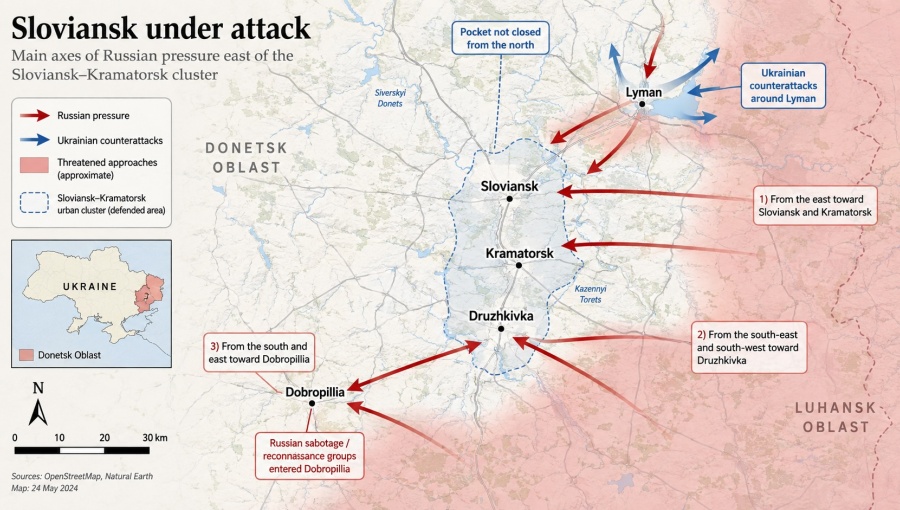
Russian forces have made further gains on a broad front east of both cities but cannot yet close the pocket from the north, where Ukrainian counterattacks around Lyman are working, OSW said.
Four lines of pressure have taken shape: from the east towards Sloviansk and Kramatorsk, from the south-east and south-west towards Druzhkivka, from the south and east towards Dobropillia, and from the north and east through Lyman. Russian sabotage and reconnaissance groups have entered Dobropillia itself.
Increased volumes of drone around these towns have moved the frontline. FPV drones attacking Dobropillia and its surroundings have reached 1,200 a day, and those hitting Druzhkivka and its supply routes 1,500 to 2,000 a day, according to Ukrainian sources cited in the report. At that density the roads into a defended town stop working before the town does.
In Zaporizhzhia region the fighting is around Orikhiv, where Ukrainian counterattacks have pushed Russian infiltrators back out of the eastern districts, though the Russians have advanced to the north-east and, by some accounts, crossed the Verkhnia Tersa river.

No comments:
Post a Comment