Tuesday, February 22, 2022

‘Shoot them’: Indian state police accused of murdering Muslims and Dalits

Ahead of key Uttar Pradesh elections, state police accused of being ‘mercenaries’ of hardline Hindu nationalist government
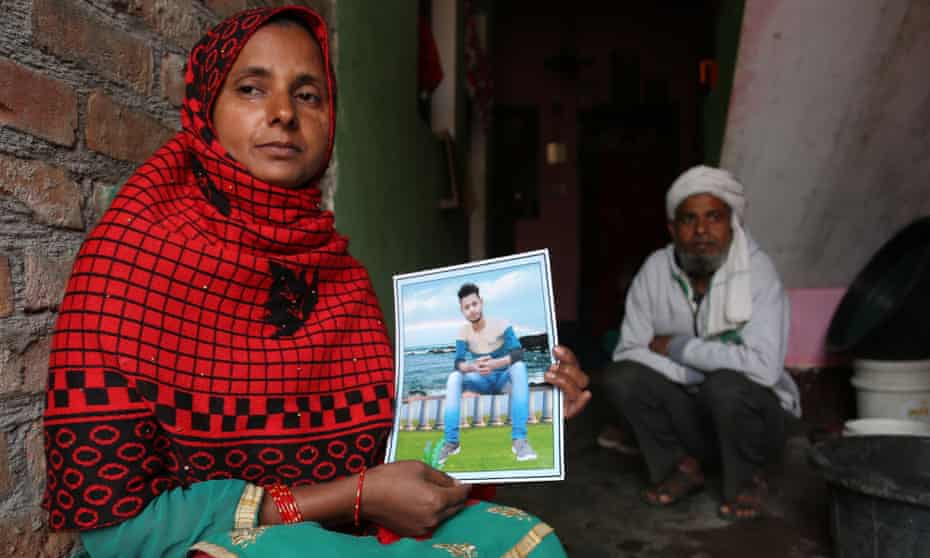

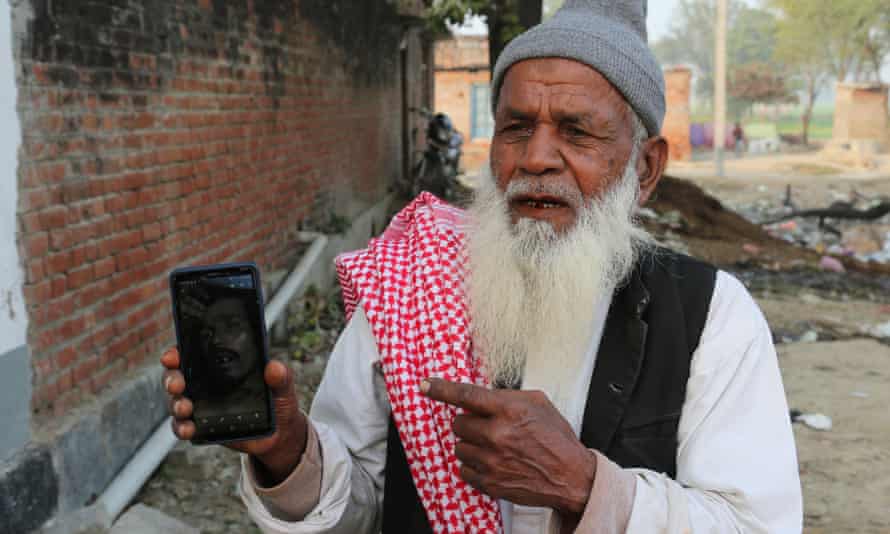
Fatima Begum’s son, Altaf, was said to have hanged himself in prison, but his family tell a different story. 
Photograph: Shaikh Azizur Rahman/The Guardian

Rights and freedom is supported by
About this content

Hannah Ellis-Petersen and Shaikh Azizur Rahman in Uttar Pradesh
Tue 22 Feb 2022 06.45 GMT

According to police in the Indian state of Uttar Pradesh, it was suicide. The young Muslim man they had brought into their custody had, out of despair, killed himself in the police station toilets. But, as photos of the scene emerged, so too did suspicions.

The 22-year-old man, Altaf, was 165cm (5ft 5in) tall and weighed 60kg (9.5 stone), but the toilet tap he had supposedly hanged himself from was just 76cm off the ground and made of flimsy plastic. And why, as the police later claimed in court, was the CCTV in the police station mysteriously not working that day?

Family and friends tell a very different story: that Altaf, a Muslim man living in the town of Kasganj, was in love with and planned to marry a Hindu girl. That powerful local Hindu vigilante groups opposed to interfaith unions found out and reported him to the police. And that on 9 November 2021, Altaf was arrested and tortured to death in police custody and his family pressured to keep quiet.

“The police murdered my son and then gave me money to say he was depressed and took his own life,” says Altaf’s father, Chand Miya, an illiterate mason who has taken the case to the state high court. “But I will not stay quiet, I want justice.”

Last Friday, the courts ordered Altaf’s body to be exhumed and a new postmortem examination to be carried out.

Altaf was not the first to die in such circumstances in Uttar Pradesh, India’s most populous state, which is holding a high-stakes election this month.

In six cases examined by the Guardian of deaths in custody and police shootings of suspects, allegedly in self defence, from 2018 onwards, those accused of carrying out and covering up killings are the same: the Uttar Pradesh police, under the rule of the state’s chief minister, Yogi Adityanath, and his Bharatiya Janata party (BJP) government.
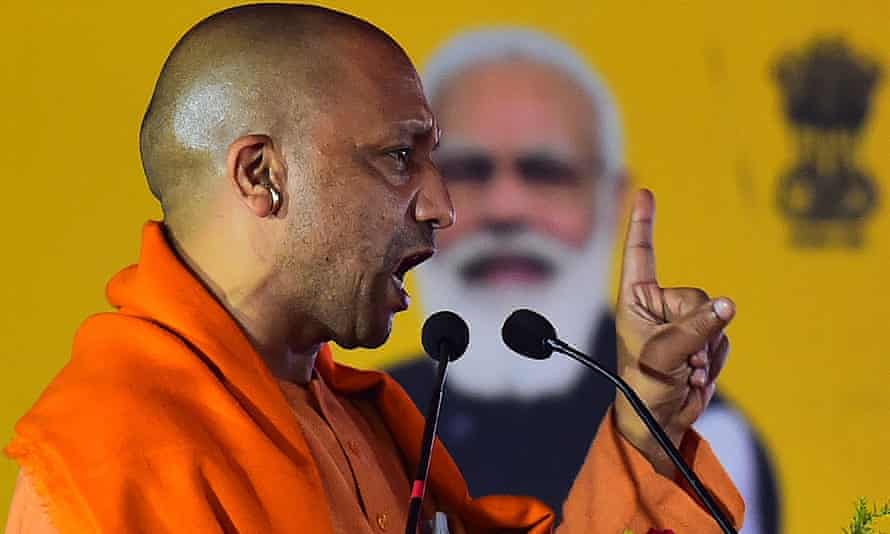
Polls this month will decide if Yogi Adityanath, who has pursued a fiercely Hindu nationalist agenda, will remain Uttar Pradesh’s chief minister. 
Photograph: Sanjay Kanojia/AFP/Getty

The victims of these alleged unlawful killings were all from the communities that Adityanath’s government, with its sectarian Hindu nationalist agenda, is accused of routinely targeting and oppressing: Muslims, who make up 20% of the state’s population and who have been subjected to increased lynchings, hate speech and prejudicial legislation, and Dalits, who are at the bottom of India’s oppressive Hindu caste system and were previously referred to as “untouchables”.

The elections will decide whether to return Adityanath’s state government to power for another five years. It is being seen as a referendum on Hindu nationalist politics – the push for India to become a Hindu, rather than secular, nation – on both a state and national level, and is happening against a backdrop of rising religious intolerance and anti-Muslim hate speech in India.
Not one officer who fatally shot someone in Uttar Pradesh in the past five years faced disciplinary action

Not long after he took office in 2017, Adityanath, a hardline Hindu monk, made it clear that his agenda would be twofold: a fierce promotion of Hindu nationalism and a tough crackdown on crime. “Agar aparadh karenge, toh thok diye jayenge [If anyone commits a crime, he will be knocked down],” he said in June 2017.

From that point on, lawyers, activists and ex-police officers allege that “thok denge” – slang for “shoot them” – became unofficial policy in Uttar Pradesh. Police allegedly began carrying out “instant justice”, maiming or executing those they deemed to be criminals, and were professionally rewarded for doing so.

Lawyers and families of victims describe an atmosphere of terror in Uttar Pradesh, where Muslims and lower-caste men are picked up on the streets and killed with alleged impunity by police, either in what are known as “encounter killings”, in which officers fatally shoot their captives and claim it was in self-defence, or in police custody, where they are beaten or tortured to death.

The same police accused of the murders are often then responsible for the investigations. Subsequently, police reports are often not lodged, evidence and CCTV footage routinely disappears, charges filed to the courts are watered down to “accidental death” and some cases disappear altogether.

“The police are now mercenaries of the Yogi government,” says Rajeev Yadav, an activist running for a seat in the forthcoming election in Azamgarh, which has a large Muslim population and has experienced multiple “encounter killings” by police.

In the past five years, according to the government, there have been more than 8,700 shootings by police in the state, including more than 3,000 incidents when allegedly escaping suspects were shot, often in the knees, and more than 150 deaths. There are rarely any eyewitnesses to these encounters, according to human rights organisations that have examined many of the cases. Not a single officer who fatally shot someone in Uttar Pradesh in the past five years has faced disciplinary action.

Two former police officers told the Guardian that in their experience most so-called “encounter killings” were falsified by police.

In the case of Kamran, a 40-year-old Muslim water-seller from Azamgarh, police claimed he was apprehended on his way to commit a crime in Lucknow, 200 miles from his home, and then killed after a shootout with an anti-terrorism unit.

Nasim Ahmed with a photo of his dead son, Kamran. Police say Kamran died in a shootout, but his family say he was tortured and killed in custody. 
Photograph: Shaikh Azizur Rahman/Guardian

But a lawyer, Ashma Izzat, says the evidence, including a leaked police photograph that appears to show him alive and in police custody – a direct contradiction of the police account of events – demonstrated the events in November 2021 were covered up.
Advertisement


Kamran’s body was returned to his family with signs of torture. “He had a perforated eye, dark bruising around his neck and body, a broken collar bone and leg, and four of his front teeth knocked out,” said his 87-year-old father, Nasim Ahmed.

Police later filed a report that Kamran had been an absconding criminal in multiple cases with a 25,000 rupee (£250) reward on his head. But Kamran made daily visits to the police station to deliver water as part of his job, including on the day he was killed.


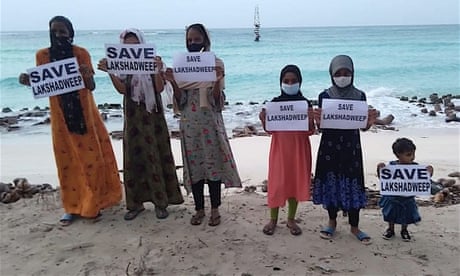
Trouble in paradise: Indian islands face ‘brazen’ new laws and Covid crisis

Uttar Pradesh has the highest number of deaths in police custody in the country. Officially, there have been 23 deaths over the past three years but Mehmood Pracha, one of the few lawyers who has taken cases of custodial killings to India’s highest court, said this was likely to be a “significant undercount”.

“The police hide these custody deaths when they can get away with it, and won’t even tell the family,” says Pracha.

In several cases, grief-stricken families said they have been pressurised or threatened by police to withdraw charges and stay silent. Faisal Husain, an 18-year-old Muslim vegetable seller from Unnao, was among those allegedly beaten to death in police custody in May 2021. The case is now in the supreme court and the Guardian listened to recordings of threats and offers of money made to Hussain’s sister, Khushnuma Banu, 28, over the phone, to pressure her to withdraw the case.
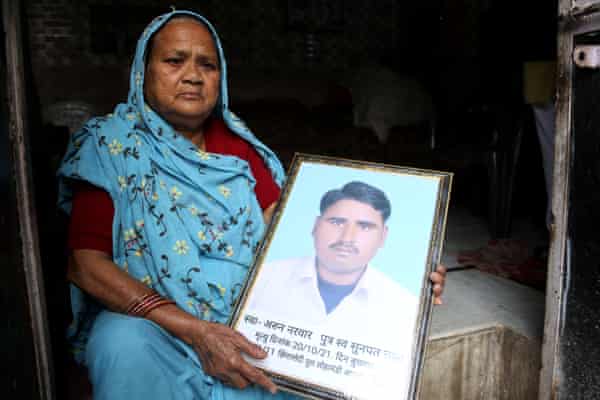
Kamla Devi’s son, Arun Valmiki, died in custody. Police say he died of a heart attack, but have withheld the postmortem report
. Photograph: Shaikh Azizur Rahman/Guardian

In another two cases of killings in custody examined by the Guardian, the police had not given families details of the postmortem examination, despite them being legally bound to do so.

Police claim that Arun Valmiki, a 30-year-old Dalit man from Agra, died of a heart attack in police custody in October 2021, but withheld the postmortem report from his family, who allege he was tortured and electrocuted to death by police. “Police put pressure on me to say that my brother had heart problems but it’s not true – he was strong and healthy,” says his brother Sonu Narwal.

Ziauddin, a 38-year-old Muslim businessman, died in police custody in March 2021 after being picked up by police for alleged theft. The police claimed he died from a heart attack during questioning despite him being in robust health.

When Ziauddin’s body was returned to his family, it was covered in torture wounds, including cigarette burns, bruises around his neck and across his body, and signs he had been electrocuted, visible in photographs viewed by the Guardian. Despite almost a year of requests, the police continue to withhold the postmortem report from his family and have not submitted the legally mandated “charge sheet” to the courts. The family say they were offered money by the police to withdraw the case.
Police put pressure on me to say that my brother had heart problems but it’s not true – he was strong and healthySonu Narwal

“He was the most kind, honest, gentle man, who had never committed a crime,” said Alauddin, Ziauddin’s father. “I feel so terrible that he was murdered and we will never get justice for him.”

The Uttar Pradesh government denied all the allegations. “There are judicial systems in place and no extrajudicial killings have taken place. This narrative is totally false and we deny such baseless accusations,” it said in a statement.
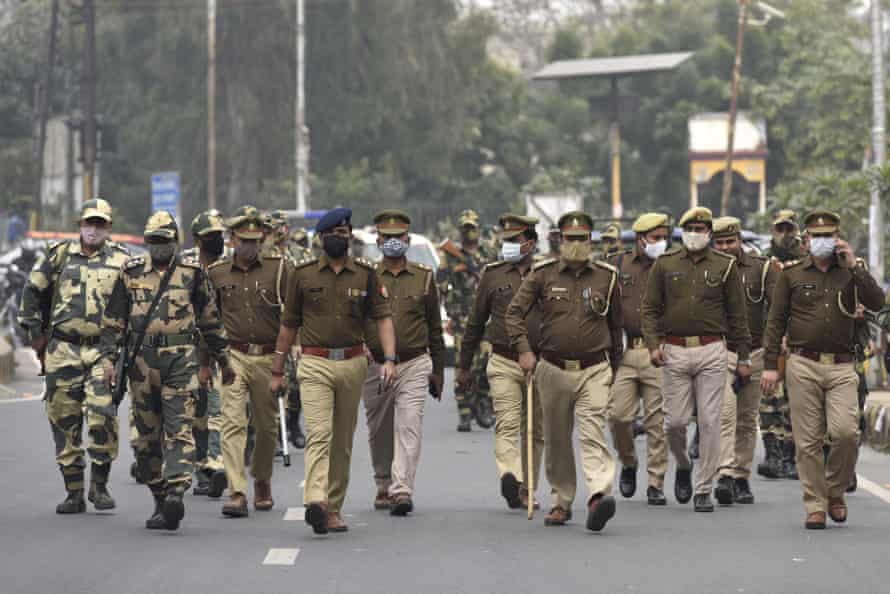
A police ‘flag march’, or show of strength, in Noida, a town in Uttar Pradesh near Delhi, last month ahead of the forthcoming state election. 
Photograph: Sunil Ghosh/Hindustan Times/Getty

Prashant Kumar, the additional director general of police in Uttar Pradesh, said the Uttar Pradesh police strictly follow all procedures and guidelines laid out by the courts and the National Human Rights Commission.
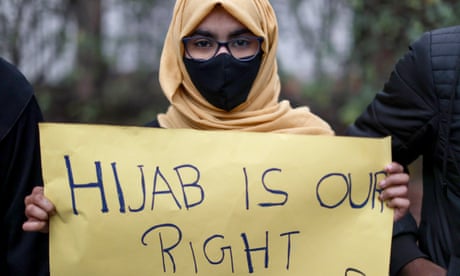

Violent clashes over hijab ban in southern India force schools to close

Kumar described a “zero-tolerance” approach to custodial killings in which guilty officers are always suspended and jailed. However, in several of the custodial death cases examined by the Guardian, junior officers were suspended but none were in prison. No senior officer or government official under the Adityanath government has faced disciplinary action for either “encounter killings” on the street or deaths in police custody.

Kumar said there was no religious or caste bias in the police force, and no culture of silencing victims. “How can we distinguish between our own citizens? It is not possible and it is wrong,” he said. “No government can ask us to do anything which is wrong or illegal.”

 Environmental issues spark large-scale protests in Serbia

The resistance of the Balkans meets global extractive companies.

Over the past couple of months, crowds in Serbia have gathered in the streets and sometimes blocked major roads and bridges. The main reason for the protests is opposition to the proposed lithium extraction project in the Jadar River Valley in Western Serbia. Some of the slogans they have used include “Stop the Investors; Save Nature,” “Rio Tinto, Get Away from the Drina River,” “For Land, Water and Air.” The protests that have captured the most attention were those in which people congregated at important intersections or on bridges and peacefully blocked traffic for an hour or longer. The protests were uncharacteristically decentralized; in addition to several locations in Belgrade, people gathered in other major cities, but also in small, and usually sleepy, towns. While exact numbers are hard to come by, it is safe to say that thousands — if not tens of thousands — of people have participated.

The mining company Rio Tinto has been buying land in the Jadar River valley and running exploratory drilling for several years now. According to its website, the company hopes to produce 2.3 million tons of lithium carbonate over 40 years and has committed $2.4 billion to the project.

This project had not been officially approved by the relevant authorities when the protests started, but Rio Tinto had been gathering support from the Serbian government and embassies of several countries in Belgrade. While Rio Tinto and the Serbian government lauded the project and the necessity of ramping up lithium production, many people in Serbia were vocal in their opposition to it, questioning the environmental bona fides of the company and the negative consequences of mining in a fertile and water-rich area.

Despite a petition to stop the Jadar project, the ruling regime seemed poised to go ahead with the project before the protests started. Several developments late last year seemed to be clearing the way for it—most recently, changes to rules governing expropriation and referenda.

The amendments to the expropriation act were passed by the Parliament and sent to the President to sign. Critics point out that the new rules lower the bar for declaring any big development project to be “in the public interest,” which would render the necessary space subject to expropriation in as little as five days. In response to the blockades over the past weeks, the President returned the act to the Parliament after which it was withdrawn. Thus, the protests scored their first victory.

The amendments to the referendum act, however, have been signed into law. According to the old referendum act, a referendum was only valid if turnout was higher than 50% plus one vote of the eligible voters. The recent amendments removed that requirement, making it potentially easier to pass unpopular measures when the voting public is apathetic, as is usually the case in Serbia due to the ruling regime’s tight grip on institutional politics.

In Serbia, the ruling Serbian Progressive Party (SPP) has held power for years despite its undemocratic behavior, which has included control over the majority of media outlets, attacks on opposition politicians, and claims of voter fraud. Additionally, the ruling party has set up a complex patronage system whereby membership in the party is often a necessary precondition for employment in the public sector. According to some recent reporting, the party has over 700,000 members in a country with a population of fewer than 7 million. The party machinery efficiently springs to action, not only in times of elections, but also to publicly display support for the regime’s policies.

In these conditions, it is understandable that protests offer Serbian citizens the only outlet for their discontent. In recent years, there have been several large-scale protests. In 2017, protesters took to the streets after SPP’s Aleksandar Vučić won the presidency to question the legitimacy of the election. Over several weekends in 2019, people protested the beating of an opposition leader. Last year, crowds gathered to oppose draconian lockdown measures that, in hindsight, seem more like an attempt to look competent in the face of the COVID-19 pandemic than a serious attempt to limit the spread of the virus. There is a throughline that connects all of these protests: existing institutions are insufficiently democratic to accommodate people’s frustrations and the opposition is too fragmented to mount a serious challenge to the ruling party.

This dynamic seems to be shifting as protesters zero in on environmental issues. In April 2021, a large-scale protest under the headline “Ecological Uprising” brought dozens of environmental organizations and thousands of people to the streets of Belgrade. They focused on mounting environmental issues that the ruling regime has exacerbated: the building of small hydro-power plants in the mountains, the poor air quality situation in urban areas across Serbia, Rio Tinto’s proposal to build a lithium mine, deforestation, the harmful effects of tire production, and out-of-control landfills. The same topics brought more protests to the streets of Belgrade in September, this time under the headline “Uprising for Survival.” Over the past several months, significant protests have also been organized on the topic of air pollution alone. As Belgrade frequently ranks among the top ten cities in the world with the most polluted air, this has arguably been the most potent individual concern, in addition to the opposition to the Rio Tinto lithium mine.

In the previous years’ protests, the main focus was on the deficiencies of the existing institutions and undemocratic behavior of the ruling party. However, environmental protests have been identifying issues that are more substantial and closer to people’s everyday experience. Thus, they are identifying tangible pressure points on the current government. The organizers of the recent protests and blockades have cautiously declared a series of victories. The fact that the government has been forced to react to the protests is in and of itself a victory. Additionally, the first major victory was the withdrawal of the amendments to the expropriation act. Furthermore, the city of Loznica, where the lithium mine project is located, is poised to abrogate the land use plan adopted in July 2021 that has zoned the area in question in the Jadar River Valley for mining. Following recent statements by the Prime Minister Ana Brnabić about the government’s intention to cancel the permits given to Rio Tinto, the company seemed to be continuing with their plans, although with a revised timeline; the company has pushed back the timeline for the start of the production to 2027 due to delays in securing an exploitation field license. However, quickly thereafter PM Brnabić announced that the government is officially abrogating the land use plan regulating mining in the Jadar Valley. Environmental groups are celebrating the decision, while remaining vigilant about the prospect of its reinstatement after elections that are planned for April 2022.

The case of the opposition to Rio Tinto shows that this topic presents significant openings for the left. Underlying issues — privatization and dispossession, the weakening of regulatory institutions in favor of private and corporate interests, the sacrificing of a clean and livable environment to economic development—should be confronted with an ecosocialist vision, rather than reduced to opposition to the ruling regime. Such a vision would need to champion the expansion of democratic institutions to give voice to those affected by harmful consequences of economic development as well as to reap its material benefits. Simultaneously, it cannot give up on the need to rapidly transition away from fossil fuels and build up capacity for clean energy generation.

The times of anthropogenic climate breakdown we are living in call for a strong focus on environmental issues. A transition away from fossil fuels to cleaner energy sources is a tremendously important political question. Add to that the requirement for the transition to be just, not only for workers in the fossil fuel sector, but also populations in areas affected by mining and construction of new cleaner energy facilities… the puzzle that needs to be solved gets mind-blowingly complex. And yet, these contradictions will not go away.

Take the case above: many places in Serbia would benefit tremendously from not burning coal, which is currently the country’s most important energy source. However, what happens when the cost of that transition is lithium mining and its accompanying negative externalities, such as mountaintop removal and poisoned soil and water? Can anyone blame the people using NIMBY arguments against it if there seems to be no alternative?

Moreover, there are forces on the right of the Serbian political spectrum that are participating in and trying to capitalize on these protests. While some want to undermine them, others are genuinely against the anticipated environmental destruction. This topic is a fertile ground for arguments based on nationalistic pride and focus on the relationship between the people and its land. Some decades ago and in a different context, these arguments proved to be seductive and co-opted rising discontent with the economic situation in the former Yugoslavia, which resulted in a bloody breakup of the country.

The leftists who are participating in the ecological protests of today need to be vigilant about this problem and counter it. Environmental protests have opened up a terrain of struggle that the left has to be present on and turn what Gramsci called common sense into ecosocialist good sense.

This article was originally published on 31 January 2022 at LeftEast and is republished as part of the Barricade’s cooperation with ELMO – the network of left-wing media in Southeastern Europe.
The Barricade is an independent platform, which is supported financially by its readers. If you have enjoyed reading this article, support The Barricade’s existence! See how you can help – here!

Also, you can subscribe to our Patreon page. The Barricade also has a booming Telegram channela Twitter account and a YouTube channel, where all the podcasts are hosted. It can also be followed in RumbleSpotifySoundCloud and Instagram.

“Solving the flaws” – RSF’s unprecedented report on protective mechanisms for journalists in Latin America


© Yuri Cortez/AFP


ORGANISATION
RSF_en

The Latin America bureau of Reporters Without Borders (RSF) is today releasing the findings of a lengthy investigation and analysis of protective mechanisms for journalists in Latin America’s four most dangerous countries for the media – Mexico, Honduras, Colombia and Brazil.


READ THE EXECUTIVE SUMMARY IN ENGLISH

Entitled Solving the flaws – For a new generation of protective mechanisms for journalists in Latin America, the report is the outcome of an unprecedented comparative analysis of the protective mechanisms in these four countries, where 90% of the murders of journalists in the past decade took place. In one of them, Mexico, no fewer than five journalists have already been murdered since the start of 2022.

Launched in 2021 with support from UNESCO, this survey’s goal has been to better determine how these measures work, their effectiveness, and their impact on the journalists who have been threatened and who request help.

“Journalists in Latin America must cease to be targets,” said Emmanuel Colombié, the director of RSF’s Latin America bureau. “It is urgent to stem this spiral of violence with dramatic consequences for the region’s democracies. The vulnerability of journalists is not inevitable. RSF is proposing concrete ways to improve the effectiveness of protective mechanisms in Brazil, Honduras, Colombia and Mexico, and aims to help initiate the necessary changes and provide them with lasting support.”

To carry out this detailed diagnosis, RSF conducted 75 interviews with the various actors involved – the beneficiaries of protection measures, those responsible for implementing them, and civil society representatives working on this issue. On the basis of these interviews and its regional expertise, RSF has produced a total of 80 recommendations aimed at helping to resolve the flaws identified and improve the effectiveness of the protective mechanisms.

This report provides, for the first time, an authoritative regional overview of existing protection policies, without losing sight of the specificities of each country. Identification and analysis of the flaws – which have direct and sometimes very serious consequences for the beneficiaries of these programmes – should ensure that the report becomes an essential tool not only for regional advocacy but also for technical cooperation. The goal is for the recommendations to be quickly implemented by the authorities in the four countries concerned.


Read the report’s executive summary HERE

The full report is available in Spanish and Portuguese.


Brazil, Colombia, Mexico and Honduras are ranked 111th, 134th, 143rd and 151st respectively in RSF's 2021 World Press Freedom Index.

China warns Ireland to ‘stop interfering’ as leader of persecuted Uyghurs attends meeting with Irish officials in Dublin
Dolkun Isa, President of the World Uyghur Congress, was labelled a "terrorist" by the Chinese Embassy in Ireland on Monday. 
Photo: REUTERS/Denis Balibouse.


Eoghan Moloney
February 22 2022

Ireland has been urged to “respect China’s sovereignty” and to “stop interfering in China’s internal affairs” after an Uyghur leader attended a meeting in the Department of Foreign Affairs on Monday.

Dolkun Isa, President of the World Uyghur Congress (WUC), urged Ireland to “take action on Uyghur genocide” when he met with UN Special Rapporteur on Human Rights Defenders Mary Lawlor and with officials from the Department of Foreign Affairs.

In response, the Chinese Embassy in Dublin said they “strongly condemn the anti-China separatist activities of the so-called ‘World Uyghur Congress’ in Ireland, and firmly oppose Irish government officials’ meeting with Dolkun Isa”.

The Embassy also accused “a few” Irish politicians of spreading “lies on Xinjiang and support for terrorist and separatist activities” and jumping “on the bandwagon of dirty political farce against China”.


The Chinese Embassy labelled the WUC as an “extremist organisation” and said its leader Dolkun Isa is a “terrorist” who is suspected of “organising and committing a series of violent terrorist activities and serious crimes in China”.

Rights groups and some western governments have called for China to end what the United States deems its genocide against ethnic Uyghurs and Muslim minorities in eastern China. United Nations researchers and rights activists estimate more than one million Muslims have been detained in camps in Xinjiang.

China rejects accusations of abuse, describing the camps as vocational centres designed to combat extremism, and in late 2019 said all people in the camps had "graduated".

“The issues concerning Xinjiang are not about human rights, nationality or religion, but about fighting terrorism, separatism and religious extremism. The so-called "genocide", "cultural extermination" or "forced labour" in Xinjiang, which are based on flat lies and disinformation, are political manipulations with hidden motives,” a statement from the Chinese Embassy said.

“We urge the Irish side to respect China's sovereignty and territorial integrity, and stop interfering in China's internal affairs under the guise of “human rights”. For those Irish politicians who have jumped on the bandwagon of dirty political farce against China, we urge them to stop parroting disinformation,” the statement continued.

In a response to Independent.ie this evening, the Department of Foreign Affairs said the protection and promotion of human rights is “a cornerstone of Ireland’s foreign policy” and Ireland always emphasises to China their “obligation to act in a manner that ensures the full respect for the rule of law”.

“Ireland consistently raises the treatment of Uighurs and other ethnic minorities in the province of Xinjiang bilaterally with China and in multilateral fora such as the United Nations Human Rights Council,” the department said.

“The protection and promotion of human rights is a cornerstone of Ireland’s foreign policy. Ireland emphasises to the Chinese authorities their obligation to act in a manner that ensures the full respect for the rule of law and complies with China's human rights obligations under national and international law,” a spokesperson for the Department said.
Chinese firms caught using spyware to track employee job-hunting and identify staff who may be about to resign

FEBRUARY 22, 2022
SOUTH CHINA MORNING POST

Pexels

Ma, 27, recently resigned from her editor position at a private internet company in Beijing for an “iron bowl” job — a Chinese term used to describe a secure position — at a state-owned media company.

Ma’s decision to resign, which surprised her direct supervisor and coworkers, was already known to her manager, who told her he had been aware she was seeking another role since last year when she updated her resume on job search websites.More from AsiaOneRead the condensed version of this story, and other top stories with NewsLite.

“How is that possible?” Ma wondered.

Ma went to great lengths to prevent her employer from knowing that she was seeking another job. She updated her resume at home on her personal computer, scheduled all interviews online, never requested time off for an interview, and performed her duties as usual.

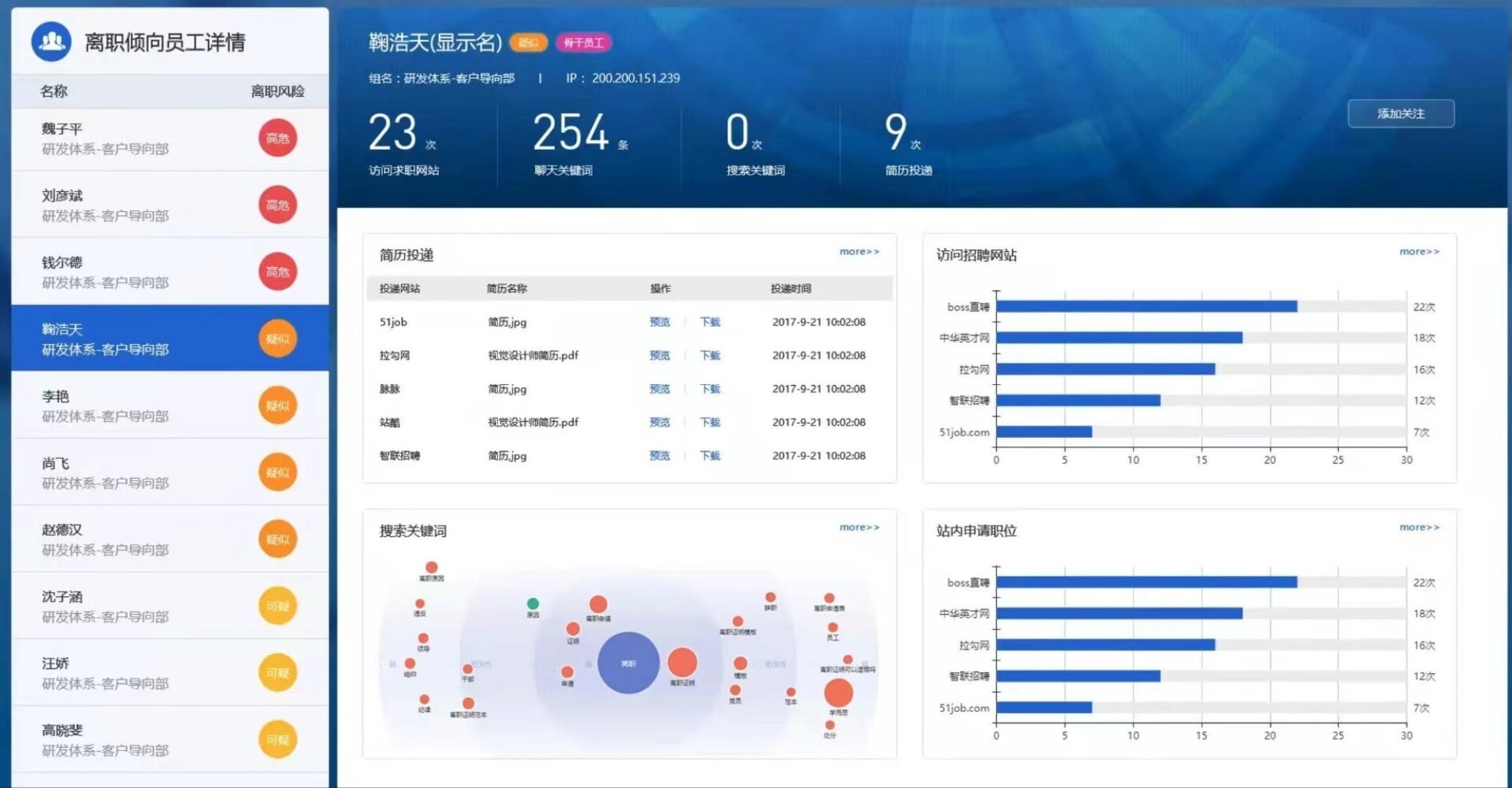
A screenshot showing employee job hunt tracking software.
PHOTO: South China Morning Post

Until recently Ma thought it would remain under wraps.

A recent news report revealed that another company was using software developed by Sangfor, a Shenzhen-based technology firm, to monitor its employees’ job-seeking activities.

“Either my company is using the same software, or my manager learned of my job-seeking activities through through a personal network with HRs,” Ma said.

Either way, Ma realised her employer is keeping a close eye on staff.

According to screenshots posted online, the software keeps track of the resumes a person submits and the job search websites they visit.

Based on the data, the software ran an analysis of job-hunting activity and labelled the person’s intention to resign as “suspected” in orange.

Surveillance is more common in Chinese technology behemoths according to employees with many saying they believed they were being monitored by their employers even before the news report about the job hunting software.

“Generally, the computer you’re using has some so-called security software installed that monitors all of your actions,” said a programmer who recently left ByteDance, the company that owns TikTok. “The company can completely record any data about you as long as you are connected to the intranet.”

However, because the final interpretation of the rules rests with the company, employees have no choice but to be cautious.

According to another ByteDance employee, he rarely posts on social media platforms such as WeChat, Weibo, and even Maimai, which allows employees of the tech giants to communicate anonymously.

“Even though it’s claimed to be anonymous, there’s still a chance you’ll be discovered,” he said.

Aside from the technology used, the intertwined networks of tech executives are another weapon in the hands of the companies.

Last year, a programmer at Pinduoduo, China’s largest agriculture-focused technology platform, was fired after anonymously posting a picture of an ambulance waiting outside the company’s building on Maimai with the caption: “Another fierce man has fallen.”

Being spied on has become so prevalent in the tech sector that many people have accepted it as part of their normal working conditions.

“It appears that once you join the company, you have to accept such a fact,” a Didi employee explained. “It has gradually become self-monitoring and reflected in my subconscious reaction to every action; for example, I may spend 0.1 second to think about where some information should be sent and where not.”

Personal information protection is a relatively new concept in China.

According to the Personal Information Protection Law, which was implemented in mainland China in November 2021, companies should inform their employees about the monitoring and obtain their consent first, and failing to do so will constitute illegal handling of personal information, according to Shi Yuhang, a lawyer from Shanghai-based Huiye Law Firm.

However, its application boundaries, according to Shi, are not yet clear.

“I believe that as the number of cases increases, we will be able to see more clearly where the boundaries are and assist workers in protecting their privacy,” Shi said.

This article was first published in South China Morning Post.
Africa: New Who/ILO Guide Urges Greater Safeguards to Protect Health Workers


21 FEBRUARY 2022
World Health Organization (Geneva)

PRESS RELEASE

The World Health Organization (WHO) and The International Labour Organization (ILO) have published a new guide on developing and implementing stronger occupational health and safety programmes for health workers, as the COVID-19 pandemic continues to exert great pressure on them.

Even before the COVID-19 pandemic, the health sector was among the most hazardous sectors to work in- Dr Maria Neira, Director, Department of Environment, Climate Change and Health"

"Even before the COVID-19 pandemic, the health sector was among the most hazardous sectors to work in," said Dr Maria Neira, Director, Department of Environment, Climate Change and Health, WHO. "Only a few healthcare facilities had programmes in place for managing health and safety at work. Health workers suffered from infections, musculoskeletal disorders and injuries, workplace violence and harassment, burnout, and allergies from the poor working environment."

The COVID-19 pandemic has taken an additional heavy toll on health workers and demonstrated dangerous neglect of their health, safety and wellbeing. More than one-in-three health facilities lack hygiene stations at the point of care. Fewer than one-in-six countries had in place a national policy on a healthy and safe working environment in the health sector.

"COVID-19 has exposed the cost of this systemic lack of safeguards for the health, safety and wellbeing of health workers. In the first 18 months of the pandemic, about 115,500 health workers died from COVID-19," said James Campbell, Director WHO Health Workforce Department."Sickness absence and exhaustion exacerbated pre-existing shortages of health workers and undermined the capacities of health systems to respond to the increased demand for care and prevention during the crisis," he added. "This guide provides recommendations on how to learn from this experience and better protect our health workers."

WHO and ILO recommend developing and implementing sustainable programmes for managing occupational health and safety for health workers at national, sub-national and health facility levels. Such programmes should cover all occupational hazards - infectious, ergonomic, physical, chemical, and psycho-social.

The guide also outlines the roles that governments, employers, workers and occupational health services should play in promoting and protecting the health, safety, and wellbeing of health workers. It emphasizes that continuous investment, training, monitoring and collaboration are essential for sustaining progress in implementing the programmes.

"Effective mechanisms should be put in place to ensure continuous collaboration between employers, managers and health workers, with the aim of protecting health and safety at work" said Alette van Leur, Director, ILO Sectoral Policies Department. "Health workers, like all other workers, should enjoy their right to decent work, safe and healthy working environments and social protection for health care, sickness absence and occupational diseases and injuries."

Countries that have developed and are actively implementing occupational health and safety programmes for health workers have experienced reductions in work-related injuries and diseases and sickness absence, as well as improvements in the work environment, work productivity and retention of health workers.

"Such programmes are a core element for the effective management of occupational safety and health, as informed by ILO Convention No. 187, and provide an opportunity for coordinated action by all stakeholders through social dialogue towards common objectives for promoting decent work in the health sector and increasing the resilience of health institutions," said Vera Paquete-Perdigao, Director, ILO Governance and Tripartism Department.

WHO and ILO will continue to provide guidance and assistance to countries to develop and implement occupational health and safety programmes for health workers.

Note to editors:

The 74th World Health Assembly resolution on Protecting, safeguarding and investing in the health and care workforce, requests the Director-General "to engage Member States and all relevant stakeholders" in the development of a "global health and care worker compact", consisting of a succinct compilation based on existing documents of relevant international organizations. The compact which will be discussed at the World Health Assembly in May 2022, will include the applicable instruments on occupational health and safety.

Read the original article on WHO.
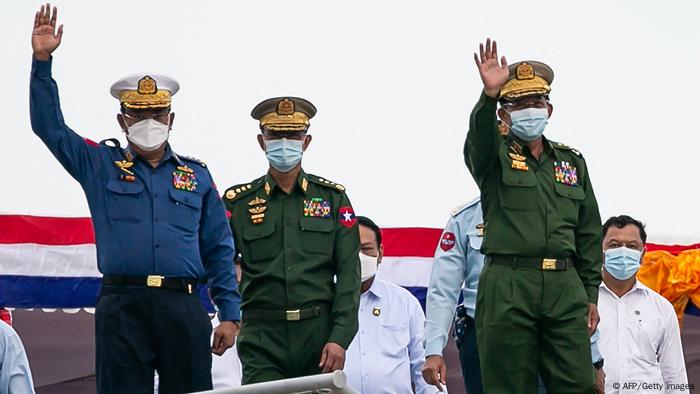
China, Russia arming Myanmar junta, UN expert says

The military junta is still receiving fighters jets and armored vehicles used against civilians since last year's coup, the UN's special rapporteur to Myanmar has said.


The United Nations expert on Myanmar has said that China and Russia are among those arming Myanmar's military junta.

Thomas Andrews, a former US congressman serving in the independent post, said on Tuesday that the two countries were providing the junta with fighter jets and armored vehicles.

"Despite the evidence of the military junta's atrocity crimes being committed with impunity since launching a coup last year, UN Security Council members Russia and China continue to provide the Myanmar military junta with numerous fighter jets, armored vehicles," he said in a statement.

Andrews also named Serbia among the weapons vendors.

"During this same period, Serbia has authorized rockets and artillery for export to the Myanmar military," he said.


Andrews called on the UN security council to halt the arms supply.

"It should be incontrovertible that weapons used to kill civilians should no longer be transferred to Myanmar," he stressed.

He also urged that the military's access to oil and gas and foreign exchange reserves be cut and called for preventing states and private sector from buying resources such as timber and rare earths products when funds are funneled to the junta.

dvv,rt (AFP, Reuters)
British prisoner's sketches offer lighthearted take on life during Japanese Occupation 80 years ago

His drawings are proof of the resilience and resourcefulness of prisoners of war.


Tanya Ong | February 18, 2022


This year, Singapore commemorates the 80th anniversary of the Fall of Singapore and the Japanese Occupation. Over the course of this week, Mothership will be republishing stories that highlight the key events that marked one of the darkest moments in Singapore's history.

During the Japanese Occupation, the Imperial Japanese Army held numerous prisoners of war (POWs) and internees at Changi Prison and several camps.

Former police inspector William R.M. Haxworth, an internee at Changi Prison and Sime Road Camp, was among them.

During his time there, he secretly drew over 300 small paintings and sketches.

His artworks give us a glimpse into life in the POW camps. They not only document the difficult living conditions but often provide a light-hearted (and sometimes humorous) spin on the prisoners' daily lives.

People came to know about Haxworth and his drawings when his wife donated his entire set of sketches to the National Archives of Singapore in 1986.

We share some of them here.

Resourcefulness
Haxworth's drawings are proof of resilience and resourcefulness shown by people in times of war and shortage.

When faced with a lack of art materials, Haxworth used whatever he could lay his hands on to create various sketches and watercolour paintings.

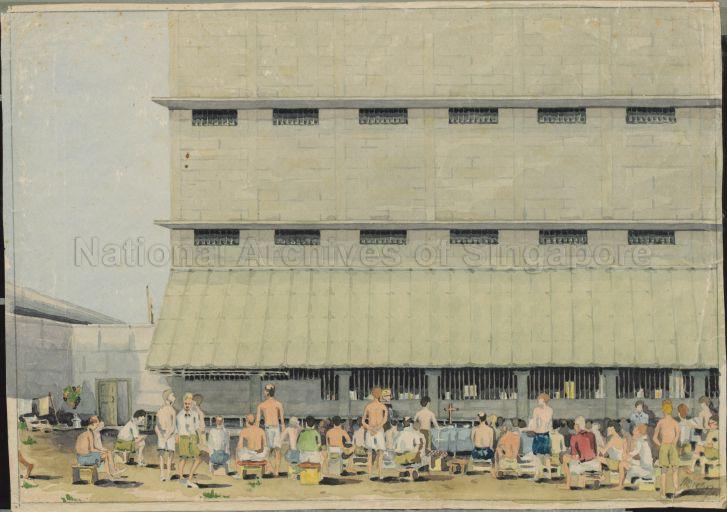
"Internees at Changi Prison," from NAS

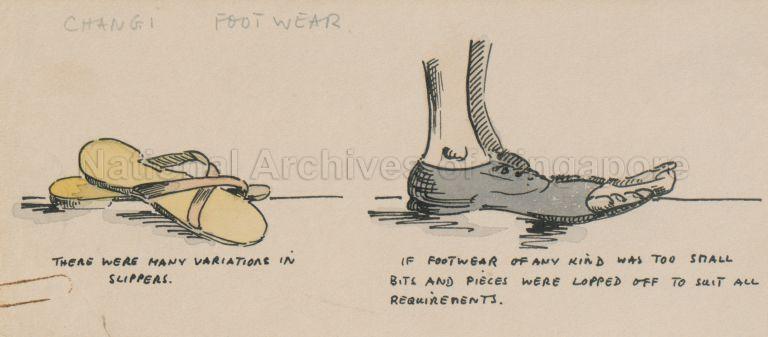
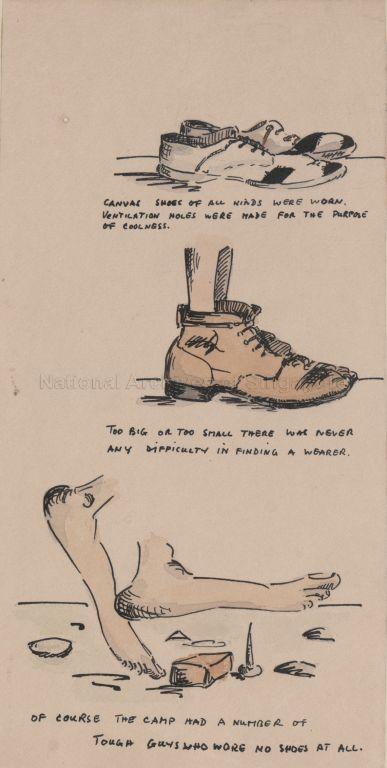
His drawings also document the resourcefulness of the internees regarding footwear.

For instance, bits of a shoe would be cut off if the shoe size was too small:

Photo from NAS

While some made modifications to canvas shoes "for the purpose of coolness," there were also some who did not wear any shoes.

Photo from NAS

Harsh conditions


Haxworth's drawings serve as a record of life as an internee, including the harsh conditions that they lived through.

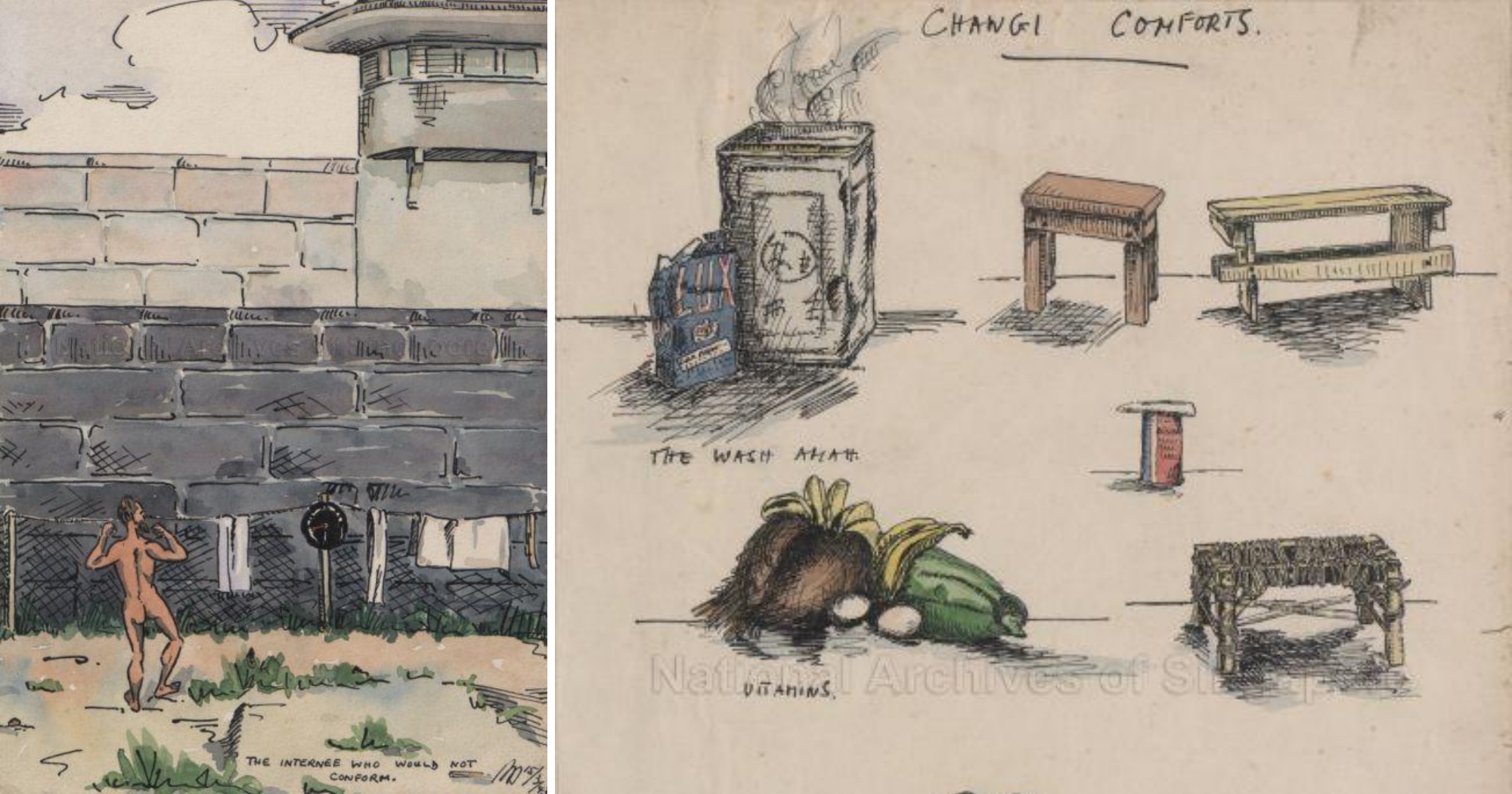
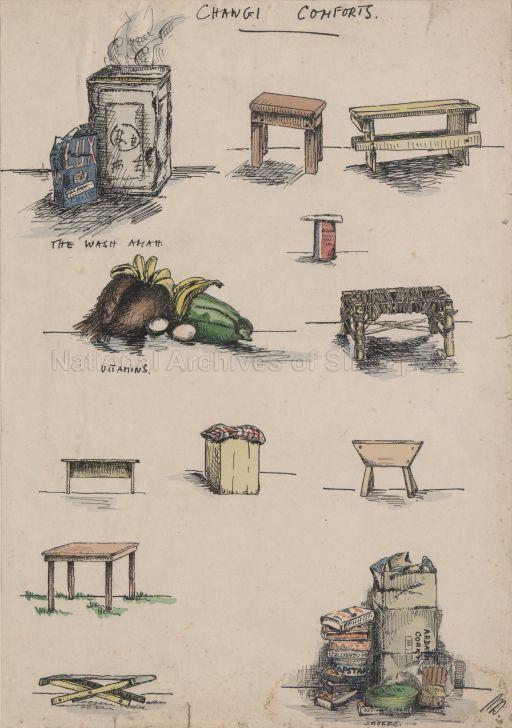
For instance, in a piece called "Changi Comforts", he drew a series of simple objects which were considered to be objects of comfort during that time.

These included stools, fruits and cigarettes — things that could easily be taken for granted in everyday life.

Photo from NAS


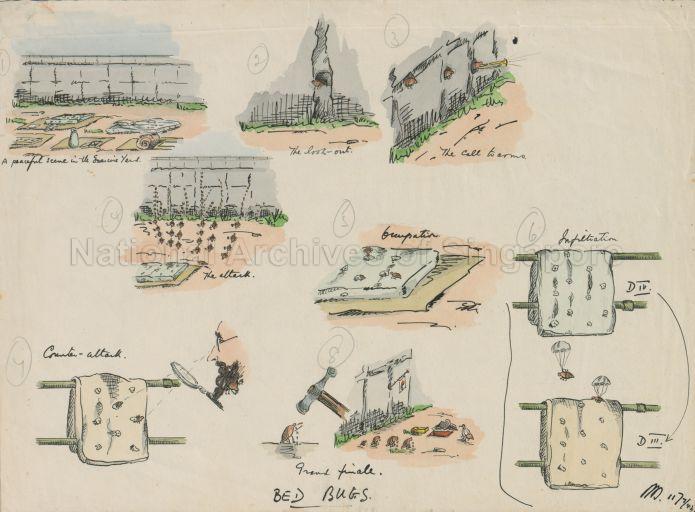
Internees also had to endure bed bug infestations.

Photo from NAS


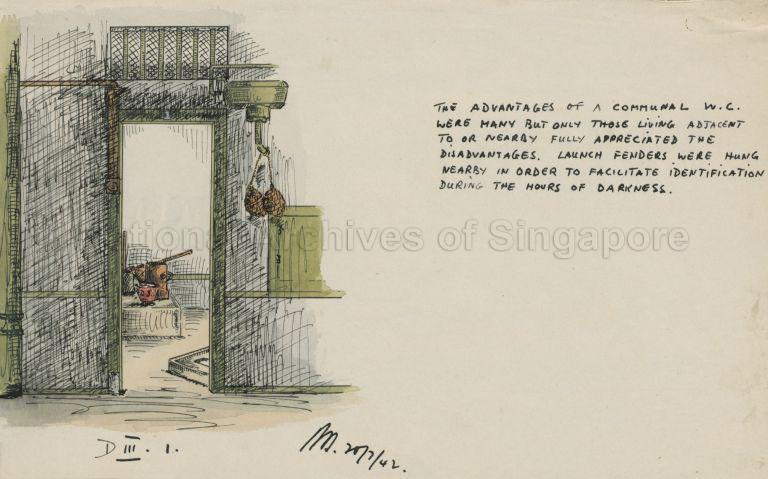
Haxworth also stated that the communal toilets had many advantages, but "only those living adjacent to or nearby fully appreciated the disadvantages." Due to overcrowding and unhygienic conditions, one can only imagine the state of the communal toilets.

Photo from NAS

Due to the rough living conditions, many of the internees transformed from gaunt figures to mere skin and bones by the end of the war.

Mischievous spin


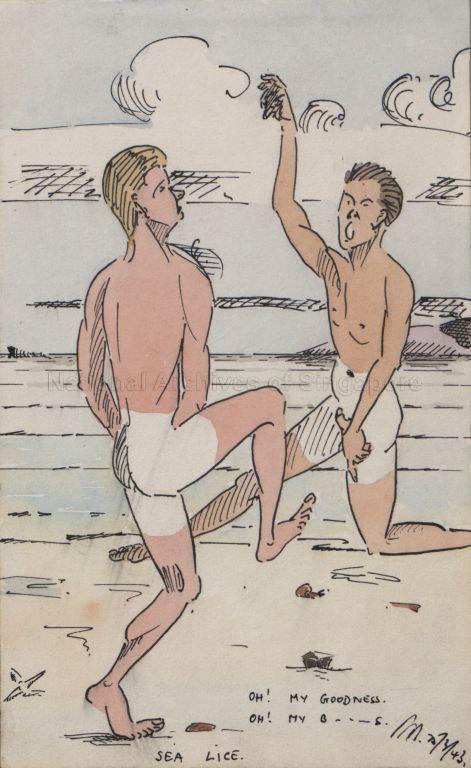
Despite these circumstances, Haxworth managed to find humour in many situations. Some of his drawings took a lighthearted approach. One drawing was of internees getting bitten by sea lice:

Photo from NAS


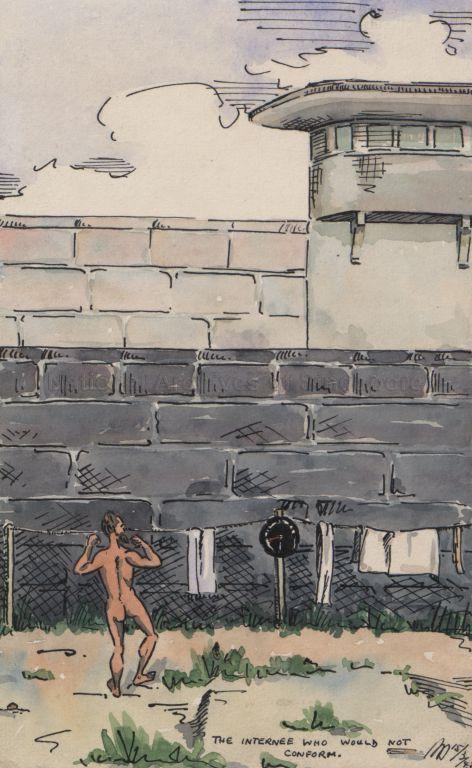
Another cheekily portrayed the back view of a naked internee, whom Haxworth called "the internee who would not conform":

Photo from NAS

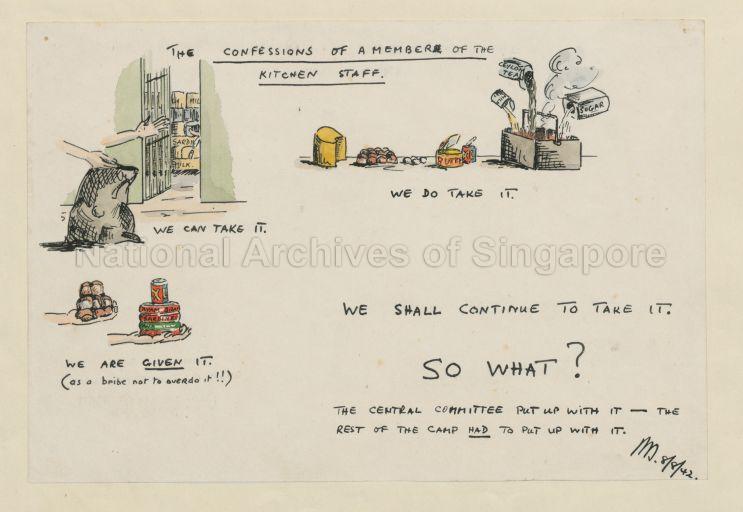
In a piece called "Confessions of a member of the kitchen staff", Haxworth revealed that internees who worked in the kitchen secretly plundered the food stock.

In fact, they were bribed (with food) to not overdo it.

Photo from NAS

Haxworth's creative artworks are a testament to the resilience and adaptability of the people who survived the difficult conditions of war.

You can view his works at the National Archives Online.


Top photos adapted from sketchs by William Haxwoth, via NAS. This article was originally published as "British prisoner's artworks offer rare lighthearted take on life under the Japanese" in 2017.
Indonesian ambassador to M'sia claims domestic workers face 'modern-day slavery' in country

Hermono also claimed that the number of cases handled by the Indonesian embassy were a fraction of the actual number of incidents.


Matthias Ang | February 22, 2022


Indonesia's ambassador to Malaysia, Hermono, has claimed that domestic workers from his country face "modern-day slavery" and "forced labour".

In an interview with Malaysian media Free Malaysia Today (FMT), Hermono said that maids were more likely to face abuse as they worked alone and lived in the houses of their employers.

He also listed out various abuses that Indonesian domestic workers had been subjected to in Malaysia, including:

Multiple cases of domestic workers working for their employers with no pay, sometimes for more than a decade,]

Having their identification papers confiscated by their employers,

Long working hours, with no off days, and

Physical abuse.

The ambassador added that in 2021, the embassy provided help for a total of 206 cases, with over RM2 million (S$642,200) paid off by the employers.

There are also more than 40 cases currently before the courts.

As for 2022, the embassy has already assisted 16 cases thus far, and facilitated the return of over RM300,000 (S$96,337) in unpaid wages.

He added, "We have domestic workers in Singapore, Hong Kong and Taiwan, but we don’t have serious problems like here (in Malaysia). So why do we have these problems here?"


Cases handled by embassy are fraction of real number

Hermono also claimed that the number of cases handled by the Indonesian embassy were a fraction of the actual number of incidents.

According to the ambassador, many Indonesian domestic workers either could not flee from their employers or faced challenges in raising their case to the embassy's attention.

FMT further quoted him as saying, "They’re warned that if they run away, the police will catch them and the immigration will send them to their depot. These kinds of threats are pure elements of forced labour."

Hopeful that upcoming signing of memorandum will address the issue

The ambassador acknowledged Malaysia's government for coming up with a national plan on forced labour however, noting that that it showed a recognition of the issue.

The ambassador also expressed his hope that the upcoming signing of a Memorandum of Understanding (MoU) between Malaysia and Indonesia will provide better protections for domestic workers.

Hermono elaborated that the MoU will include a "one-channel system", under the control of Indonesia, which will allow it to keep track of the whereabouts of domestic workers and maintain communication with them.

Called in by Malaysia's Foreign Ministry to clarify comments

According to The Star, Indonesia has stopped the flow of domestic workers to Malaysia, with its resumption contingent on the signing of an MoU regarding the recruitment and placement of such workers.

Bernama further reported that following the interview, Hermono was summoned by Malaysia's Foreign Ministry to clarify his remarks, specifically those pertaining to the MoU.

In a statement released on Feb. 21, the foreign ministry said that any issues which have been raised will be channelled to the respective ministries or agencies.

The ministry said, "Such an act is important to avoid any misunderstanding and confusion among the public."

In addition, following the meeting, an "understanding" has been reached between the two parties, to continue with a "positive and constructive" approach in addressing the issue of domestic workers' recruitment and their protection, the ministry added.
CRIMINAL CAPITALI$M 
HSBC Under Investigation in U.S. Over WhatsApp Use


(Bloomberg) -- HSBC Holdings Plc is being investigated by U.S. regulators over bankers’ misuse of services such as WhatsApp.

The London-based bank is co-operating with the Commodity Futures Trading Commission probe into the use of “non-HSBC approved messaging platforms for business communications,” according to its annual report published alongside earnings on Tuesday.

HSBC Chief Executive Officer Noel Quinn told Bloomberg News the CFTC’s work was part of a broad investigation by U.S. authorities. “I don’t think it’s specific, I think it’s general across all financial institutions,” said Quinn in a phone interview.

“They’re looking at the use of mobiles and WhatsApp and text messages to make sure it’s appropriate,” he said.

In December, the CFTC and Securities and Exchange Commission fined JPMorgan Chase & Co. $200 million after finding that staff at the bank had for years shrugged off their surveillance duties and sent work-related messages using platforms such as WhatsApp or their personal email addresses.

“We obviously have internal procedures and requirements as to the use of non-bank platforms,” HSBC Chief Financial Officer Ewen Stevenson said in a phone interview.

©2022 Bloomberg L.P.