Friday, December 02, 2022

WAGE THEFT
A lawyer for fired Twitter staff says Elon Musk is trying to 'tap-dance' his way out of paying severance, and threatens a 'fun as hell' arbitration campaign

Pete Syme
Fri, December 2, 2022 

Elon Musk has reduced Twitter's workforce by almost 70%.
Muhammed Selim Korkutata/Getty Images

A lawyer representing laid-off Twitter staff sent a fiery letter to Elon Musk's lawyer, Alex Spiro.

Akiva Cohen claimed his clients weren't receiving the severance package they had been promised.

Cohen tweeted that he hoped Musk would do the right thing, otherwise "it'll be fun as hell."


A lawyer for fired Twitter staff has given Elon Musk a deadline of December 7 to confirm that he will pay them full severance as promised, or face an arbitration campaign to settle the dispute.

Akiva Cohen — a partner at law firm Kamerman, Uncyk, Soniker & Klein — tweeted a copy of his letter which addresses Musk as the "Chief Twit."

He accused the world's richest person of "attempting to tap-dance your way out of Twitter's binding obligations to its employees."

"If you don't unequivocally confirm by Wednesday, December 7 that you intend to provide our clients with the full severance Twitter promised them, we will commence an arbitration campaign on their behalf," Cohen said.

Since Musk took over the company, Twitter's workforce has fallen from 7,500 to 2,300, per Insider's Kali Hays.

That means almost 70% of staff were laid-off, mostly during the first round when Musk halved employee numbers, and his ultimatum to commit to working "extremely hardcore" or be laid-off with three months severance.

The cuts resulted in the closure of Twitter's office responsible for complying with European misinformation laws, and just one employee left on the Asia child safety team.

One executive has also been reinstated after she was dismissed for not responding to the "hardcore" ultimatum.

Musk now stands accused by some former Twitter staff of failing to provide the severance package they were promised, as alleged in a previous lawsuit.

Cohen said that his clients weren't receiving their full benefits, like 401k deductions.

His fiery letter says: "To be clear, Elon, you will lose, and you know it."

He adds that even if Musk did win, it would be "Pyrrhic" because "Twitter will pay far more in attorneys' fees and arbitration costs than it could possibly 'save' in severance due our clients."

In a tweet, Cohen added: "You can only violate people's legal rights and your own word so far before they lawyer up and come after you."

"I really do hope Musk changes his mind and does the right thing — the employees deserve that. But it'll be fun as hell if he doesn't."

The letter was also addressed to Alex Spiro, the acting general counsel at Twitter, who previously defended Musk after he called a British diver "pedo guy."

Cohen told Musk he still had time to avoid a legal case, "or you can double down on breaking your word and screwing over your ex-employees as they head into the holidays."

Spiro and Twitter did not immediately respond to requests for comment.


Twitter says it's reinstated an exec who says she was effectively dismissed after she didn't respond to Elon Musk's 'hardcore' ultimatum

Grace Dean
Fri, December 2, 2022

Twitter exec Sinéad McSweeney said she was effectively dismissed for failing to respond to Elon Musk's "hardcore" ultimatum.

The company told an Irish court it has reinstated McSweeney as its global VP for public policy.

McSweeney said she didn't respond to the email due to confusion around her contract, The Irish Times reported.


Twitter says it has reinstated an executive who says she was effectively dismissed for failing to respond to Elon Musk's "hardcore" ultimatum.

The social-media giant told the Irish High Court on Wednesday that it had reinstated Sinéad McSweeney as its global vice president for public policy, a number of Irish publications including The Irish Times reported. She has worked at the company since 2012, according to her LinkedIn.

McSweeney had previously told the court that the company had told her she had submitted a "voluntary resignation" after failing to respond to a company-wide email by new owner Elon Musk, even though she didn't intend to resign.

The email, sent late on November 15, told workers that they would need to be "extremely hardcore" and work "long hours at high intensity" to stay on at the company and asked them to respond to Google form committing to Musk's vision for "Twitter 2.0." If they didn't respond by the end of the business day on November 17, they would be laid off and given three months severance, Twitter said.

McSweeney said she didn't respond because of confusion related to her contract of employment, The Irish Times reported.

The day after the ultimatum's deadline, Twitter emailed McSweeney on her personal account, acknowledging her "voluntary resignation" and saying it accepted her severance package, she said. The company also locked her out of its systems, email, and Dublin office.

After her solicitors sent a letter to the company, Twitter's lawyers acknowledged that she hadn't intended to resign and said the company would restore her access to its systems, but failed to do so, McSweeney had claimed.

A High Court judge granted McSweeney a temporary injunction last Friday to stop Twitter from terminating her contract based on the ultimatum email.

Twitter's lawyers told the court on Wednesday that the company would restore McSweeney's access to its IT systems and Dublin office, per The Irish Times.

Lawyers for both Twitter and McSweeney didn't immediately respond to Insider's request for comment on whether McSweeney had regained access.

Insider previously reported that fewer people committed to Twitter 2.0 than Musk and his team had expected, leading to the company's vice-presidents and Musk himself calling some "critical" workers in a desperate bid to persuade them to stay on. Since taking ownership of Twitter in late October, around three-quarters of the company's workforce has been laid off, fired, or has resigned.


FINED NO MANSLAUGHTER CHARGE
Top exec at pharmacy in deadly meningitis outbreak sentenced


Fri, December 2, 2022 

BOSTON (AP) — A former co-owner of a Massachusetts compounding pharmacy at the center of a nationwide fungal meningitis outbreak that resulted in more than 100 patient deaths has been sentenced to a year in prison for conspiring to defraud the federal government.


Gregory Conigliaro, 57, as the vice president and general manager of the New England Compounding Center, was the company's primary point of contact with federal and state regulators, federal prosecutors said in a statement after sentencing Thursday.

He and other company officials lied to the federal Food and Drug Administration and the Massachusetts Board of Registration in Pharmacy by saying the business was dispensing medications for patient-specific prescriptions.

The truth, according to prosecutors, is that the company was evading regulatory oversight through fraud and misrepresentation from 2002 until 2012, routinely shipping drugs to customers without patient-specific prescriptions and even creating fraudulent prescriptions to fool regulators.

About 800 patients in 20 states were sickened with fungal meningitis or other infections and about 100 died in 2012 after receiving injections of medical steroids manufactured by the now-closed New England Compounding Center in Framingham, Massachusetts, according to federal officials. The drugs were mostly intended to treat back pain.


“Mr. Conigliaro and his co-conspirators repeatedly made the choice to put their greed over patient safety,” U.S. Attorney Rachael Rollins said in a statement. “In turn, nearly 800 patients suffered terribly and over 100 died. Today’s sentence sends a clear message to health care executives — if you lie to regulators, the outcomes can be deadly and we will hold you accountable.”

Conigliaro was among 14 company officials indicted in the case. The indictment did not charge Conigliaro with having any role in the manufacturing process. He was convicted by a jury in U.S. District Court in Boston in December 2018 of conspiracy to defraud the United States.

Barry Cadden, another co-owner who was also the head pharmacist, was sentenced in July 2021 to 14 1/2 years in prison, ordered to forfeit $1.4 million and pay restitution of $82 million. Former supervisory pharmacist Glenn Chin was sentenced in July 2021 to 10 1/2 years in prison and ordered to pay $82 million in restitution.

Both were convicted of fraud, racketeering and other crimes but acquitted of second-degree murder under under the federal racketeering law.

The Associated Press
DECRIMINALIZE DRUGS
Rhode Island latest state to allow recreational pot sales


Thu, December 1, 2022 


PROVIDENCE, R.I. (AP) — Customers started lining up to buy recreational marijuana in Rhode Island on Thursday, a little more than six months after Gov. Dan McKee signed legislation permitting such sales to people 21 and older.

Five stores are currently allowed to sell recreational cannabis products, but the state could eventually have as many as 33 stores, according to the law. The stores authorized to open by the state Office of Cannabis Regulation so far are in Central Falls, Providence, Pawtucket, Portsmouth and Warwick. All five had already been selling medical marijuana.

“This milestone is the result of a carefully executed process to ensure that our state’s entry into this emerging market was done in a safe, controlled and equitable manner,” the Democratic governor said in a statement last week.

Mother Earth Wellness in Pawtucket normally opens at 8 a.m. but people were already waiting outside when it opened at 5 a.m. on Thursday, co-owner Joe Pakuris said. The store made its first recreational sale at 5:18 a.m.

The store had welcomed about 300 customers by mid-morning, about 80% of whom were recreational buyers, he said.

“We've had a very successful day," he said. “I think it has been a smooth transition and the state has done an excellent job of rolling out this program. Everything's great."

The law imposes a 10% state cannabis excise tax in addition to the 7% state sales tax and 3% local tax for the city or town in which the sale takes place. It's expected to generate about $15 million in tax revenues in the first full fiscal year of sales.

The law prohibits smoking or vaping cannabis products in any public place where smoking or vaping of tobacco products is prohibited, and anywhere where there is potential harm to children. People are also not allowed to operate a vehicle while under the influence of cannabis.

The legislation also provides for the expungement of any prior conviction for possession of cannabis that will be decriminalized.

About 20 states nationwide had approved recreational marijuana sales, including neighboring Massachusetts where it's been legal for about four years. In Connecticut, recreational pot has been legalized but sales are not expected to start until next year.

Not everyone is happy. State law enforcement agencies have expressed concern about the potential for more impaired motorists on the roads.

The Associated Press
CRIMINAL CAPITALI$M
US House panel says lax screening helped facilitate PPP fraud

Thu, December 1, 2022 


WASHINGTON (AP) — Financial technology firms abdicated their responsibility to screen out fraud in applications for a federal program designed to help small businesses stay open and keep workers employed during the pandemic, a report by a House investigations panel said Thursday.

The House Select Subcommittee on the Coronavirus Crisis launched its investigation of the firms in May 2021 after public reports that the firms were linked to disproportionate numbers of fraudulent loans issued under the Paycheck Protection Program.

Former President Donald Trump rolled out the Paycheck Protection Program to help small businesses stay open and keep their workers employed. President Joe Biden maintained the program and directed money to more low-income and minority-owned companies. All told, $800 billion was spent on the program.

The financial technology firms reviewed PPP applications for lenders, which would ultimately distribute PPP money to businesses.

The report said two start-ups, Blueacorn PPP and Womply Inc. — which reviewed one in every three funded PPP loans in 2021 — were connected to significant percentages of PPP loan applications with indicators of fraud.

It said the firms used questionable screening procedures and business practices in reviewing the loans, leading to “the needless loss of taxpayer dollars,” the report said. The firms “took billions in fees from taxpayers while becoming easy targets for those who sought to defraud the PPP.”

Neither firm responded immediately to a request for comment.

The report said Womply's fraud prevention practices were so lax that lenders describe its systems as “put together with duct tape and gum.” It said Womply's software became a preferred product for criminal enterprises seeking to defraud the government of PPP loans. The firm also received over $5 million in PPP loans for itself, which the Small Business Administration later determined it was ineligible to receive.

Womply said in a statement sent to the committee in January that the firm's role in the screening process was limited. “Womply did not approve PPP loan applications, issue PPP loans, or otherwise serve as a lender in the PPP. Womply helped connect borrowers with PPP lenders, which were responsible for reviewing, approving, submitting, funding, and servicing the PPP applications and loans,” the company's lawyers wrote.

Womply referred 128,813 PPP applicants to lenders in 2020, and 2,584,420 applicants to lenders in 2021.

“We must learn from this inexcusable misconduct to erect guardrails that will help ensure that federal programs — including emergency assistance programs in future crises — are administered more effectively, efficiently, and equitably while keeping waste, fraud, and abuse to an absolute minimum,” said Rep. Jim Clyburn, D-S.C., who chairs the coronavirus crisis subcommittee.

Clyburn said the committee’s findings were sent to the Justice Department and the Small Business Administration.

In March, the Government Accountability Office reported that while agencies were able to distribute COVID-19 relief funds quickly, “the tradeoff was that they did not have systems in place to prevent and identify payment errors and fraud” due in part to “financial management weaknesses.”

Billions have been fraudulently claimed through various pandemic relief programs — including Paycheck Protection Program loans, unemployment insurance and others that were rolled out in the midst of the worldwide pandemic that shut down global economies for months.

The U.S. Secret Service in August said it has recovered $286 million in fraudulently obtained pandemic loans and returned the money to the Small Business Administration.

Fatima Hussein, The Associated Press
FUEL VS FOOD
Biden Proposes Overhaul of US Biofuel Law to Boost EV Makers Like Tesla
  
Jennifer A. Dlouhy and Kim Chipman
Thu, December 1, 2022 


(Bloomberg) -- The Biden administration is opening the door to a sweeping rewrite of the 17-year-old US biofuel mandate, including a plan to encourage use of renewable natural gas to power electric vehicles, which could benefit Tesla Inc. and other automakers.

An Environmental Protection Agency proposal released Thursday invites public feedback on an array of changes to the Renewable Fuel Standard, initially designed in 2005 to push more ethanol, biodiesel and other plant-based alternatives into vehicles. The plan may spur an overhaul that could shift the program from one narrowly focused on gasoline, diesel and other liquid fuels to an initiative broadly aimed at decarbonizing transportation.

The EPA will also seek public feedback on the best way to promote next-generation low-carbon biofuels, while protecting American oil refining assets after a wave of pandemic-spurred closures and the Russian invasion of Ukraine underscored the strategic importance of these facilities.

The measure “will set the stage for further growth and development of low-carbon biofuels in the coming years,” the EPA says in its proposal. During the transition, “maintaining stable fuel supplies and refining assets will continue to be important to achieving our nation’s energy and economic goals as well as providing consistent investments in a skilled and growing workforce.”

Biofuel Boost

The agency is proposing to raise the amount of biofuel that must be mixed into gasoline and diesel over the next three years to as much as 22.68 billion gallons in 2025, up from this year’s 20.87 billion gallons. Under the measure, conventional ethanol may be used to fulfill as much as 15.25 billion gallons. But that exceeds what oil refiners call the “blend wall,” or the 10% ceiling on the amount that can be blended into the most commonly available E10 gasoline.

The EPA is asking the public for feedback on whether it should actually set the conventional renewable fuel requirement below the blend wall. It also wants public comment on how the quota plan will affect the “continued viability of domestic oil refining assets,” including so-called merchant refiners with limited blending facilities that can’t easily generate compliance credits.

Administration officials took pains to emphasize their desire to protect oil refining capacity while fostering alternative fuels. EPA Administrator Michael S. Regan said the agency was “focused on strengthening the economics of our critical energy infrastructure” even as it seeks to diversify the nation’s fuel mix. And Energy Secretary Jennifer Granholm cast the proposal as a way to “drive forward fuel innovations while balancing the need to maintain and strengthen critical domestic refining capacity, and support the union workers who operate these facilities.”

Nevertheless, the measure drew criticism from some oil refining supporters as well as biodiesel advocates.

Soybean and corn futures fell in Chicago, with soy oil sliding as much as 6.3%, the biggest decline since early July.

Crop trading giants Archer-Daniels-Midland Co. and Bunge Ltd., both of which have expanded their presence in the market for climate-friendly diesel, saw steep declines on Thursday. Bunge shares dropped as much as 7.7%, their biggest intraday pullback since March 29, while ADM fell as much as 6.4%, the most since September.

Shares of ethanol producers such as Green Plains Inc. swung between gains and losses.

The proposed EPA volumes for crop-based fuels came in below market expectations, StoneX risk management consultant Matt Campbell said. “The market is not taking the news well,” particularly for soybean oil, since “requirements were well short of trade estimates,” Campbell added.

The proposal was also a blow to oil refining champions, who said it would increase the industry’s compliance costs, undermining the economics of some operations. Senator Chris Coons, a Democrat from Delaware, called the proposed quotas “unachievable” and said they foster uncertainty for skilled union workers.

“The cost of complying with the Renewable Fuel Standard is at a record high because the volumes don’t align with what our country can actually produce and consume,” Coons added in an emailed statement.

Refiners prove they have fulfilled annual blending quotas by relinquishing tradeable credits known as “renewable identification numbers” or RINs, which are generated with each gallon of biofuel.

Under a court settlement, the EPA is obligated to finalize the biofuel quotas by June 14 next year. A senior administration official said public feedback could determine the shape of the final rule, prompting the EPA to revise initially proposed blending requirements or even revisit past policy decisions tied to RIN holding thresholds, disclosure requirements and market liquidity.

eRIN Credit

The EPA would also create an eRIN credit awarded when electricity from certain renewable sources -- such as natural gas harvested from landfills and at farms -- is used as fuel to power EVs. Under the proposal, automakers alone could generate the credit, though its value could be shared with other parties, such as the generators of biogas-powered electricity.

As designed, the eRIN plan would add another incentive for automakers such as Ford Motor Co. and General Motors Co. to produce electric vehicles, building on tax support in the just-enacted Inflation Reduction Act and other air pollution policies.

The plan is likely to set off furious lobbying as charging station operators, biogas producers and utilities vie for a piece of the eRIN credit. Even before the EPA released its proposal, the eRIN concept was opposed by some environmentalists and congressional Democrats who say it would subsidize large industrial livestock operations.

Biodiesel producers also took aim at the proposed quotas, which would offer only a modest boost over the current 2.76-billion-gallon requirement, despite a predicted surge in demand and new production capacity next year. The plan “significantly undercounts existing biomass-based diesel production and fails to provide growth for investments the industry has already made in additional capacity, including for sustainable aviation fuel,” said Kurt Kovarik, vice president of federal affairs at the Clean Fuels trade group.

(Updates with further details on EPA proposal starting in second paragraph and prices.)

Most Read from Bloomberg Businessweek
FIGHTING MONOPOLY CAPITALI$M
Farm, consumer groups urge U.S. to block Kroger's planned $25 billion buy of Albertsons

Thu, December 1, 2022 

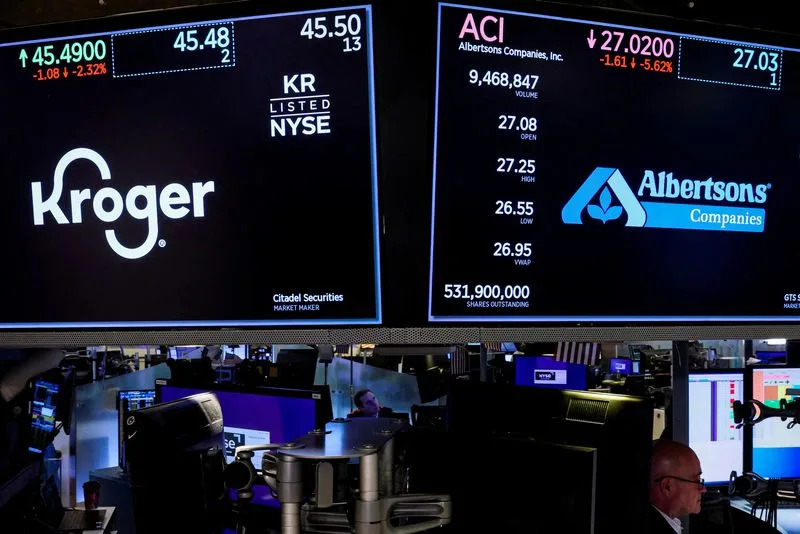
Traders work as screens display the trading information for Kroger and Albertsons on the floor of the NYSE in New York

WASHINGTON (Reuters) -Advocacy groups, including the Open Markets Institute and National Farmers Union, on Thursday asked U.S. antitrust enforcers to stop Kroger Co's planned $25 billion purchase of rival grocery giant Albertsons Companies Inc.

In a letter to Federal Trade Commission Chair Lina Khan, the groups argued that the deal would raise prices in some parts of the United States and hurt some grocery store and warehouse workers.

"As organizations representing farmers, workers, consumers, and advocates for fair food systems, we urge the Federal Trade Commission to block Kroger's acquisition of Albertsons," the letter said.

Kroger said in a statement that it did not expect the deal, if it goes forward, to lead to any store closures, which would hurt workers.

"With a broader network and even more customers to serve, we believe the merger will benefit our suppliers, including farmers, as it will allow for a more efficient distribution chain, provide opportunities to grow sales together and reduce waste," the company said.

Kroger Chief Executive Rodney McMullen argued this week in a congressional hearing that even after the deal, his company would remain smaller than Walmart.

The FTC declined comment.

The groups, which include Food and Water Watch, argued that the biggest food companies pay fees to Kroger and Albertsons to ensure shelf space for their products, leaving little room for new or community-based suppliers.

"Combining Kroger and Albertsons will also create a new mega-grocery buyer with exceptional buyer power to squeeze its suppliers, shrinking farmers' and workers' share of the food dollar," the letter added.

The deal has faced skepticism from lawmakers who have expressed concern that the tie-up could raise already-high food prices. It also comes as the Biden administration takes a more aggressive approach to antitrust enforcement.

The groups also said that workers, including those at the stores, could lose jobs or bargaining clout if the deal goes forward. "Many Kroger and Albertsons store workers already struggle to meet their basic needs," they said, noting that a 2021 study of Kroger workers found that 75% had trouble buying groceries.

(Reporting by Diane Bartz; editing by Diane Craft and Deepa Babington)
Ramaphosa Scandal Leaves Quest to Revive South Africa in Tatters

Antony Sguazzin
Thu, December 1, 2022 


(Bloomberg) -- A scandal engulfing Cyril Ramaphosa is threatening to take down more than just the South African president. Hanging in the balance are the fate of his party and his government’s reform agenda that was to have kick-started a stagnating economy.

On Wednesday, an advisory panel established by parliament found grounds for lawmakers to consider impeaching Ramaphosa, an icon of the anti-apartheid struggle, over his alleged failure to properly report a robbery at his game farm -- during which he says $580,000 hidden in a sofa were stolen -- and potential violations of the constitution. Several senior officials within his African National Congress have joined opposition parties in calling for him to resign, something Ramaphosa is weighing, according to people familiar with the matter who asked not to be identified as they’re not authorized to speak to the media.

The president is still consulting on how to respond to the report and will act in the nation’s best interests, his spokesman Vincent Magwenya told reporters in Pretoria on Thursday, adding that an announcement was “imminent.”

“All options are on the table,” Magwenya said. “He is not panicking, that I can assure you.”

If Ramaphosa does go, there’s no obvious long-term successor within the ANC, and it’s unclear whether whoever takes over will champion the reforms he set in motion. While criticized for their slow pace, they’ve nevertheless included a crackdown on corruption, the liberalization of the broken state power sector and a drive to get significant private investment in infrastructure for the first time. Even if Ramaphosa opts to fight for his political survival, the distractions might mean little will get done.

“Ramaphosa will either resign or he is going to be pushed off the cliff,” said Prince Mashele, an author and political analyst. His successor isn’t going to move boldly when it comes to reforms and “will have to be careful to the point of doing nothing,” he said.

That risk has been recognized by investors: The rand tumbled toward its worst decline in six years and the government’s borrowing costs surged the most since 2015.

Prior to the release of the panel’s report, Ramaphosa was seen as a shoo-in to win a second term as ANC leader at a party conference due to begin Dec. 16, having secured the vast majority of nominations for the post.

A strong mandate and coterie of other party leaders more aligned with his own views would have allowed him to accelerate reforms. Analysts had been expecting a reshuffle of his cabinet after the party vote, with the firing of incompetent ministers and those opposed to his plans to transition the economy to green energy and open it up to more private investment.

Since taking office,in 2018, Ramaphosa has effectively ended the monopoly of Eskom Holdings SOC Ltd., the state electricity utility that’s subjected South Africans to intermittent power cuts since 2008, freeing companies to build their own power plants and supply the grid. The spectrum needed to modernize South Africa’s telecommunications sector was sold after more than a decade of delays. Several former leaders of state companies, politicians and party officials have been charged with corruption

Those moves, however, haven’t alleviated some more immediate concerns.

Unemployment, at 32.9%, is the third highest among 82 countries tracked by Bloomberg; most state companies are struggling to repay their debts and dysfunctional municipalities have left communities with potholed streets and without water and power.

Ramaphosa came to power after the ANC forced Jacob Zuma to step down following an almost nine-year tenure during which the government estimates more than 500 billion rand ($29 billion) was stolen from state coffers. He campaigned on an anti-corruption ticket, and his success as a businessman who had made several hundred million dollars raised hopes he would put in place sound economic policies.

The president won favor with South Africans tired of years of scandal and a deteriorating economy. But his party didn’t fully benefit from his popularity and its share of the vote fell to below 50% for the first time ever in last year’s municipal elections. A recent survey by Ipsos forecast that it would win just 41% of the vote in the general elections in 2024, meaning that it would be forced into a coalition to retain power. The party’s prospects may now weaken further.

“The ANC is finished,” Mashele said. “The people of South Africa only trusted Ramaphosa among that whole ANC lot.”

Ramaphosa does have options. He can take the panel’s findings on legal review, and opposition calls for an early election are unlikely to meet favor with the ANC, which can quash those demands with its parliamentary majority, said Lawson Naidoo, executive secretary of the Council For the Advancement of the South African Constitution.

The ANC’s National Executive Committee is due to meet on Thursday night, which will give Ramaphosa’s detractors an opportunity to call for his resignation. Parliament is due to sit on Dec. 6 to decide whether to adopt the advisory panel’s report, and if they do, a panel of legislators will be set up to conduct another inquiry.

“I don’t know if they are going to come through for Cyril,” said Ralph Mathekga, an independent political analyst.

If Ramaphosa does go, it would be an ignominious end to a storied political career. The Soweto-born lawyer created what was once the country’s most powerful labor union and in the late 1980s led the biggest ever mining strike, bringing mining giant Anglo American Ltd. to the negotiating table. In 1990 he held the microphone while Nelson Mandela, South Africa’s most famous son, spoke to his people in Cape Town after his release from 27 years in prison.

Still, the current crisis may not be all bad, some say. It may just hasten an era of instability of coalition governments and contested ideas -- a necessary transition for a country led so far by its liberators, but now peopled largely by young men and women with little, if any, experience of apartheid who are more preoccupied with finding a job and hoping that the lights turn on when they flick a switch.

“It looks like a crisis for the country, but I believe it’s part of the political re-grounding of South Africa, saying the ANC may not be the answer,” Mathekga said. “I see this is as a necessary self destruction. We are observing the ANC gradually disintegrating.”

--With assistance from Colleen Goko, S'thembile Cele and Robert Brand.

(Updates with comment from president’s spokesman from third paragraph.)

Most Read from Bloomberg Businessweek
Mexico Posts $5.35 Billion Record Remittances From Workers Abroad


Maya Averbuch and Max de Haldevang
Thu, December 1, 2022 a


(Bloomberg) -- Mexico posted record remittances in October, as workers living abroad continued sending cash back home and propping up the country’s economy.

Money sent home by Mexicans who are mainly living in the US totaled $5.36 billion in October, beating analysts’ estimates of $5.11 billion and a previous record of $5.3 billion in July, according to central bank data published on Thursday.

Remittances have been a lifeline for the Mexican economy since the pandemic began, especially helping rural communities as gross domestic product plummeted 8.2% in 2020, with a slow recovery afterward. The money transfers have also helped bolster Mexico’s peso, which has been among the top performing major currencies this year.


Remittances have been helped largely by the recovery of the US economy, leading to higher labor rates for Mexicans abroad, according to a recent report by The World Bank. Swelling volumes of migrants of other nationalities who struggle to cross into the US due to tight border controls are also likely to have increased remittance flows into Mexico from their family members while in transit, according to the report.

“The average wage earned by Mexicans abroad, both men and women, has kept increasing, and that has increased the total earnings. That is what is financing remittances,” said Jesus Cervantes, director of economic analysis at the Center for Latin American Monetary Studies, known as CEMLA.

Migrants from Mexico, Guatemala, Honduras, El Salvador, the Dominican Republic, and Peru are also sending greater portions of their earnings home than before, he said.

“Solid workers’ remittance flows have been adding support to the current account and to private consumption, particularly for low-income families, who have a high propensity to consume and are the overwhelming recipients of such transfers,” Alberto Ramos, chief economist for Latin America at Goldman Sachs Group Inc., wrote in a research note.

--With assistance from Rafael Gayol.

(Updates with Goldman Sachs comment in last paragraph. A previous version corrected the decimal fraction on the number of remittances in headline.)

Most Read from Bloomberg Businessweek

TikTok’s Viral Challenges Keep Luring Young Kids to Their Deaths


Forget Zoom Calls, Remote Work Startups Want to Build a Virtual Office


The Avatar Sequel Is a Make-or-Break Moment for Disney’s $71 Billion Fox Deal


FTX’s Collapse Validates Gary Gensler’s Crypto Skepticism


How a Ruling Family Tipped Sri Lanka Into Economic Free Fall

©2022 Bloomberg L.P.
Wells Fargo Cuts Hundreds More Mortgage Employees on Industry Slowdown


Hannah Levitt
Thu, December 1, 2022 


(Bloomberg) -- Wells Fargo & Co. cut hundreds more mortgage employees Thursday, the latest in a series of reductions across the industry after higher interest rates brought the pandemic-era home-lending boom to halt.

The reductions took place across the country, according to people familiar with the plans, who asked not to be identified discussing private information. The latest wave comes amid ongoing Federal Reserve rate hikes to tame persistent inflation, pushing mortgage rates toward their highest levels in two decades. Refinancings have dried up and some potential homebuyers have been sidelined in the process.

“We regularly review and adjust staffing levels to align with market conditions and the needs of our businesses,” a representative for Wells Fargo said in a statement.

The latest reductions in the bank’s mortgage unit add to thousands already made by Wells Fargo this year. The firm is not alone: Rival JPMorgan Chase & Co. cut hundreds of home-lending staff and reassigned hundreds more in June, with further reductions since. Nonbank lenders, which swelled to dominate the mortgage business since the financial crisis, have also been slashing their ranks.

Wells Fargo, the biggest home lender among US banks, expects that business to “remain challenging in the near term” on higher rates, Chief Financial Officer Mike Santomassimo told investors in October. The division reported a 70% drop in fees for the first nine months of this year.

The firm is planning a longer-term retreat in the mortgage business, abandoning its longtime strategy to be the biggest in the industry, Bloomberg reported in August. Over the past three years, Chief Executive Officer Charlie Scharf has been reshaping Wells Fargo’s businesses as part of an effort to move past a series of scandals. Since the middle of 2020, when the firm became the first major bank to resume layoffs following a pause at the onset of the Covid-19 pandemic, he’s brought the workforce down by 13% and ceded the title of the US bank with the biggest workforce to JPMorgan.

Read more: Wells Fargo to Shrink Biggest US Mortgage Empire After Scandals
Facebook accused by female truckers of skewing job ads


Paresh Dave
Thu, December 1, 2022 

A smartphone with Facebook's logo is seen in front of displayed Facebook's new rebrand logo Meta in this illustration

OAKLAND, Calif. (Reuters) - Meta Platforms Inc unlawfully steered dozens of hiring ads from trucking companies and other advertisers to mostly one gender or age group, an advocacy group for female truckers alleged in a U.S. complaint on Thursday, citing the social media giant's own data.

In June, Meta said it planned to introduce a "variance reduction system" to its algorithms to ensure housing and employment ads reached diverse audiences in terms of age and gender on its Facebook platform.

The new allegations underscore the issues that Meta's planned system would counter. Meta on Thursday said it was reviewing the complaint and that the new system was in testing.

"Addressing fairness in ads is an industry-wide challenge and we’ve been collaborating with civil rights groups, academics and regulators to advance fairness in our ads system," the company said.

Meta, which owns Facebook and Instagram, has faced years of criticism from civil rights groups and regulators about how its settings and algorithms allow for bias in access to job and housing listings. U.S. law bars discrimination based on gender or age in those ads.

"Facebook is one of the go-to resources for these life opportunities - the consequences of this kind of discrimination are far-reaching," said Mitra Ebadolahi, senior project director at Upturn, an advocacy group representing Real Women in Trucking on its charge to the Equal Employment Opportunity Commission.

Real Women in Trucking's complaint lists about 80 ads from Meta's public archive that show skewed audiences.

In one example, an employer seeking truck drivers in North Carolina reached an audience that was 5% female and 11% 55 years or older.

"Women are 54% of the people on Facebook interested in job hunting. People 55 or older are 28%," said Peter Romer-Friedman, principal at law firm Gupta Wessler, representing Real Women in Trucking.

"There’s no reason that job ads should be sent to a fraction of those numbers on a routine basis," he said.

Most employers intended to reach broader audiences, he added.

But the charge cites three ads for which Meta let advertisers select age-restricted audiences, an option it promised to block for job ads in 2019.

If Meta is struggling to identify job ads, it may likewise face difficulties applying the planned variance reductions, Romer-Friedman said.

(Reporting by Paresh Dave; Editing by Stephen Coates and Lisa Shumaker)