Sunday, November 12, 2023

Stanford engineer's study show CO2 pipelines costlier, dirtier than wind and solar

Alan Guebert
Sat, November 11, 2023


“Mathematics,” once explained Edward Frenkel, a renowned mathematician and author, “directs the flow of the universe, lurks behind its shapes and curves, [and] holds the reins of everything from tiny atoms to the biggest stars.”

Another explanation notes that “Math is the only place where truth and beauty mean the same thing.”

That elegant, beautiful truth comes to mind when reading a just-published “case study” that compares the cost and net carbon dioxide (CO2) output of the planned 2,000-mile Summit CO2 pipeline to the wind- and solar-based electricity that could fuel “battery-electric vehicles,” or BEVs.

At its heart, the new study asks, what gives the better environmental and financial return — billions spent on a CO2 pipeline that encourages more ethanol use or investing the same amount on solar and wind generators to power BEVs?

The resulting math, presented by the study’s author, Mark Z. Jacobson, a civil and environmental engineer at Stanford University, is detailed, compelling and irrefutable in its conclusion: Don’t spend another penny on Summit’s five-state, CO2 pipeline.

Jacobson's focus is on E85, the 85-percent-ethanol-to-gasoline blend now being pushed by farm groups as the way to maintain production of the corn-based fuel even as BEVs rise in popularity. (The U.S. Department of Agriculture forecasts that 35% of the 2023/24 U.S. corn crop, or 5.3 billion bushels, will be used to make ethanol.)

The higher ethanol blend, however, doesn’t change the hard math underlying the colossal investment and environmental costs of CO2-generating ethanol plants, ethanol’s use or any of the three proposed CO2-carrying pipelines, Jacobson writes.

“This study concludes that investing in wind turbines to provide electricity to BEVs is far more beneficial in terms of consumer cost savings, CO2 emissions, land use, and air pollution than making the same investment in a plan to capture CO2 from ethanol refineries, pipe the CO2 to an underground storage facility, and use the ethanol to produce E85 for FFVs,” or flex fuel vehicles.

Moreover, Jacobson continues, quoting his revealing math, “The fuel savings alone,” an estimated “$66.9-$111 billion over 30 years”–“is 12-20 times the $5.6 billion investment in [the] Summit [pipeline] project.”

And just to drive home his rural bona fides, Jacobson offers a comparison of the costs to operate competing models of the ever-popular, four-wheel-drive, Ford F-150 — the eight-cylinder flex fuel version that costs “$48,290” — versus its electric twin that costs $21,705 more or “$69,995.”

“Even with this upfront cost difference … the net fuel cost saving to drivers over 30 years (of the electric F-150) is still … 7-12 times Summit’s investment [cost],” he notes.

Environmental costs between the two technologies — wind and solar versus ethanol — show even bigger differences because wind and solar electric generation are zero-carbon emitters and easily beat almost any blend of any fossil or bio-based fuel.

A key element of ethanol’s argument, however, is Big Ag’s insistence that it’s a “green” fuel that, at worst, is carbon neutral and, at best, is carbon negative. Still, no outside-of-ag scientist supports ag’s contention and neither does the Stanford engineer. His math shows more brown and no green.

“With respect to air pollution, tailpipe emissions from E85 vehicles may increase the level of ozone throughout most of the United States in comparison with tailpipe emissions from gasoline vehicles.”

“Moreover,” he adds, “the production, transport, and refining of corn to produce ethanol creates air pollution that may exceed the upstream pollution from gasoline.”

The engineer’s hammering math dives into other aspects of the bad bargain that is CO2 pipelines. For example, photosynthesis “is only 1% efficient” while solar panels are “20-23% efficient” and therefore need “only 1/20th of the land to produce the same energy as a biofuel crop.”

The clear bottom line to the Summit pipeline — and, really, any CO2 pipeline — Jacobson says, is as obvious as one-plus-one: Don’t bury CO2 pipelines; instead, bury their very idea. Fast.


Alan Guebert writes "Farm and Food"

Alan Guebert is an agricultural journalist. See past columns at farmandfoodfile.com. © 2023 ag comm

This article originally appeared on South Bend Tribune: Farm and Food: Don't bury just the CO2 pipelines; bury their very idea
SpaceX Workers Suffered 600 Unreported Injuries, Amputations

Chaya Tong
Sat, November 11, 2023 

Steve Nesius / Reuters

In his race to space, Elon Musk’s SpaceX has had at least 600 unreported workplace injuries since 2014, many that ended in serious injury and amputations, according to Reuters. Musk himself reportedly throws safety to the curb, discouraging workers from wearing yellow safety clothes and even having machinery that was painted in industrial safety yellow repainted as blue or black because he hates bright colors. Four employees said that Musk played with a flamethrower at SpaceX sites proving his disregard for safety. Records show that more than 100 workers got cuts or lacerations, 29 suffered broken bones, 17 had their hands or fingers crushed, nine received head injuries including a skull fracture, and another eight had amputations. SpaceX reportedly says that employees should be responsible for their own safety because the main goal is to reach Mars as fast as possible.

SpaceX chief told employees to 'focus on your job' for humanity's sake after they raised workplace complaints, report says

Marta Biino
Sat, November 11, 2023

SpaceX's COO told employees to "focus on your job" when they raised workplace concerns in 2022.


The COO's response followed an open letter that accused the company of dismissing employee concerns.


A Reuters investigation found that Elon Musk's company has had at least 600 worker injuries since 2014.


SpaceX COO Gwynne Shotwell told employees in a 2022 email to "focus on your job and the mission of SpaceX — to get humanity to Mars as quickly as possible," after they raised workplace complaints in an open letter, Reuters reported.

Shotwell's email was in response to an open letter written by SpaceX employees that criticized the company's dismissive attitude toward employee concerns and inconsistent enforcement of discipline policies, per the report.

Nine employees were fired for raising complaints in the letter — and eight of those have since filed unfair labor practice complaints with the National Labor Relations Board.

One major area of concern for employees at the company is the company's safety procedures.

The Reuters investigation found that at least 600 SpaceX workers were injured since 2014 at its facilities across the US, noting that prior to 2021 and 2022, the workplaces often did not submit the required data.

The findings showed that SpaceX's average injury rates at three of the facilities far outpaced that of the wider space industry, which stood at 0.8 injuries per 100 workers in 2022, per the report. The Brownsville, Texas, site had an average injury rate of 4.8 injuries per 100 workers in 2022, Hawthorne, California, was at 1.8, and McGregor, Texas, was at 2.7.

According to the report, among the injuries were nine workers who suffered head injuries, including one traumatic brain injury, and 17 who had their hands or fingers "crushed."

Other issues at the SpaceX facilities were also detailed by current and former workers, including one former welder at the Brownsville site who told Reuters that workers took the stimulant Adderall without prescriptions and that some would sleep in bathrooms at the site.

Others said that employees who were tasked with welding rockets in tents worked in extreme temperatures of up to 100 degrees Fahrenheit and were given IV treatments to continue working if they suffered from the heat.

Musk's seemingly relaxed attitude to safety was also apparent in his visits to the facilities, with four employees telling Reuters that Musk would sometimes play with a novelty flamethrower that can shoot a flame over five feet and that he preferred workers not to wear safety yellow due to his dislike of bright colors.

SpaceX's mission "to go to Mars as fast as possible and save humanity permeates every part of the company," Tom Moline, a former SpaceX engineer who was fired after he made workplace complaints, told Reuters.

"The company justifies casting aside anything that could stand in the way of accomplishing that goal, including worker safety," he said.

SpaceX did not respond to a request for comment from Insider, which was made outside of regular working hours.

SpaceX workers face above-average injury rates as Musk prioritizes Mars over safety, report finds


A Reuters investigation found hundreds of previously unreported injuries.


Cheyenne MacDonald
·Weekend Editor
Sat, November 11, 2023 

Veronica Cardenas / reuters

A Reuters investigation into unsafe working conditions at SpaceX has uncovered more than 600 injuries going back to 2014 that have not been publicly reported until now. Current and former employees cited in the report blame CEO Elon Musk’s aggressive deadlines and hatred of bureaucracy, alleging his goal of getting humans to Mars “as fast as possible” has led the company to cut corners and eschew proper protocols.

Injury rates at some SpaceX facilities are much higher than the industry average of .8 injuries or illnesses per 100 workers, Reuters found. At its Brownsville, Texas location, the 2022 injury rate was 4.8 per 100 workers. At the Hawthorne, California manufacturing facility, it was 1.8. In McGregor, Texas, where the company conducts rocket tests, the injury rate was 2.7.

Employees have suffered broken bones, lacerations, crushed fingers, burns, electric shocks and serious head wounds — including one that blinded Brownsville worker Florentino Rios in 2021 and another that left employee Francisco Cabada in a coma since January 2022. At SpaceX’s McGregor site, one worker, Lonnie LeBlanc, was killed in 2014 when wind knocked him off the trailer of an improperly loaded truck. Yet over the years, SpaceX has only paid meager fines as a result of its safety lapses. After LeBlanc’s death, the company settled with OSHA for $7,000, according to Reuters.

Reuters spoke to over two dozen current or former employees, as well as others “with knowledge of SpaceX safety practices.” One SpaceX ex-manager told Reuters that “workers take care of their safety themselves,” and others said employees were even told not to wear bright-colored safety gear because Musk does not like it. SpaceX has also repeatedly failed to submit injury data to regulators for much of its history, according to Reuters.


SpaceX workers reportedly took Adderall and IV fluids, and some slept in the bathroom, to keep up with Elon Musk's deadlines

Grace Kay
Updated Sat, November 11, 2023 

SpaceX workers reportedly put in over 80-hour workweeks in Elon Musk's race to colonize Mars.


A Reuters investigation looked at 600 work injuries at SpaceX from 2014 to now.


Musk has long been known for his "maniacal sense of urgency," his biographer said.


Some SpaceX workers resorted to taking Adderall to keep up with the pace of work at the company's launch facility, and others found themselves falling asleep in the bathroom during long workweeks, a recent Reuters investigation found.

Travis Carson, a former SpaceX worker at the company's facility in Brownsville, Texas, told Reuters some workers took Adderall — a stimulant designed to help people with ADHD improve their focus and concentration levels — without a prescription to keep up with the pace of work. Carson was a welder and later a production supervisor at SpaceX from 2019 to 2022, when he was terminated following an argument with his manager, the publication said.

Four current and former SpaceX workers at the location, including Carson, told the publication that employees would sometimes work over 80 hours a week and some would sleep at the facility to get more work done. Some employees would fall asleep in the bathrooms, the four current and former workers who spoke with Reuters said.

SpaceX welders like Carson, the report said, would also work in tent structures at the launch site, sometimes dealing with temperatures in excess of 100 degrees Fahrenheit while welding rocket machinery. To address the heat issue, workers would receive IV treatments to continue working, Reuters reported.

Elon Musk's rocket company, which employs about 13,000 people, had at least 600 worker injuries over the course of nine years across its facilities, the publication reported. The number does not represent the full number of injuries at SpaceX because the company has not submitted reports to the Occupational Safety and Health Administration for any of the years it has been in operation, Reuters said. The injury rate at the facilities for the years that were reported exceeded space-industry averages for the same years, the publication said.

Reuters launched an investigation into SpaceX workplace injuries.Joe Raedle/Getty Images

In interviews with over 36 people, Reuters wrote that some current and former workers said the injuries pointed to Musk's breakneck pace for the company. The billionaire has long been pushing for SpaceX to build a rocket allowing humans to one day travel to Mars.

Tom Moline, an ex-SpaceX engineer, told Reuters that he was one of a handful of employees fired after they brought forth complaints about SpaceX's work environment.

Four current employees told Reuters Musk himself had even contributed to some of the safety concerns at SpaceX by toying with the company's flamethrower on-site, as well as through his aversion to bright colors that are sometimes used for safety reasons. Three ex-SpaceX supervisors told the publication Musk would have yellow machinery repainted to black or blue and some workers were told not to wear bright-yellow safety vests when the billionaire was on-site.

A spokesperson for SpaceX did not immediately respond to a request for comment ahead of publication. But the company has responded to OSHA inquiries, saying it's not liable for the worker injuries as the company gives workers safety training, Reuters reported.

Responsible engineers "are ultimately responsible for all aspects of their components and systems," the company said in a response to one OSHA inquiry, according to Reuters.

Reuters' report came after some SpaceX employees wrote an open letter last year criticizing Musk's behavior as a "source of distraction and embarrassment."

Musk has been known to run his companies with high intensity, sometimes calling for work sprints and even sleeping on the factory floor at Tesla.

His biographer, Walter Isaacson, has said the billionaire has a "maniacal sense of urgency" that could frighten some of his workers — a characteristic that Isaacson said was effective 80% of the time and was "problematic" 20% of the time. Ultimately, the biographer said Musk believed empathy at the expense of the larger mission, like colonizing Mars, was a form of "egotism."


SpaceX workers suffered ‘amputations and crushed limbs’ in Musk’s rush to get to Mars

Matthew Field
Fri, November 10, 2023 

In 2022 SpaceX’s injury rate at its facility in Brownsville, Texas, was six times the industry average - VERONICA CARDENAS

SpaceX workers have suffered hundreds of injuries, including amputations and “crushed limbs”, in pursuit of Elon Musk’s goal of reaching Mars, an investigation into the company has claimed.

More than 600 workplace injuries have occurred at the rocket company since 2014, according to Reuters, as well as one previously unreported death.

The injuries included 100 “cuts or lacerations”, 29 broken bones or dislocations, 17 “crushed” hands or fingers, and eight accidents that led to amputations.

Former workers claimed Mr Musk’s obsession with reaching Mars came at the expense of workers’ safety training. The report cited more than a dozen current and former SpaceX workers who said there was insufficient training on dangerous equipment.

The accidents included the death of Lonnie LeBlanc, a SpaceX worker and former US marine, in 2014. He was killed when he hit his head on the road after falling from a truck at a SpaceX facility in Texas.

Another severe injury occurred when a part flew off a Raptor engine during testing in January 2022, leaving worker Francisco Cabada in a coma.

In 2016 a worker’s leg was crushed and later amputated while attempting to retrieve a Space rocket that had landed in the Pacific Ocean, according to legal filings.

Reuters obtained logs of accident reports filed by SpaceX with US health and safety regulators. Other incidents were uncovered in legal filings or emergency response records.

While the company is required to submit annual injury data to regulators for its facilities, it failed to update officials over multiple years between 2016 and 2021.

According to data filed with regulators, in 2022, SpaceX’s injury rate at its facility in Brownsville, Texas, was 4.8 injuries or illnesses per hundred workers – six times the industry average of 0.8.

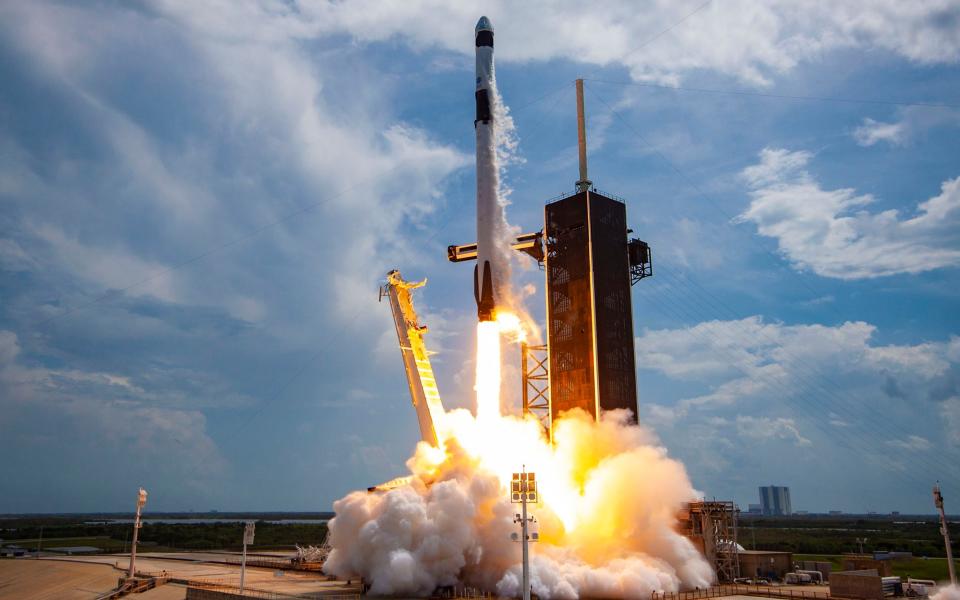
SpaceX’s Falcon 9 rockets have been used extensively for Starlink and Nasa launches - SpaceX via Getty Images

SpaceX’s Falcon 9 rockets have been used to launch hundreds of satellites for Mr Musk’s Starlink constellation, undertaken dozens of missions for Nasa and carried crew to the International Space Station.

The company is racing to develop a new superheavy rocket, Starship, which will carry humans to the Moon with a planned mission in 2025.

However, SpaceX’s latest launch test in April ended with the 400ft rocket spiralling out of control before exploding.

Tom Moline, a former SpaceX engineer who was fired from the company after raising complaints over the company’s culture, said the company’s mission to Mars to “save humanity” had left safety a secondary concern.

He said: “The company justifies casting aside anything that could stand in the way of accomplishing that goal, including worker safety.”

In filings with the US Occupational Safety and Health Administration, SpaceX said it provided staff with extensive safety training, while it also employed “responsible engineers” who had oversight of safety.

Regulators had fined SpaceX a total of just over $50,000 (£41,000) across the safety incidents, according to the report.

SpaceX did not respond to a request for comment.


SpaceX Employees Suffer Broken Bones, Head Injuries Due to Company's Disregard of Safety, Report Claims

Passant Rabie
Fri, November 10, 2023

SpaceX is desperate to see its Starship rocket fly again for a second test flight.

SpaceX has undoubtedly cemented its position as a leader in the emerging space industry, but that may have come at a painful price. A shocking new investigation by Reuters documents 600 workplace injuries and one death at Elon Musk’s rocket company, highlighting a dangerous disregard for safety practices for the sake of SpaceX’s ambitious goals.

In its report, Reuters talked to more than a dozen current and former employees and reviewed medical and worker compensation records. The records included reports of more than 100 workers suffering cuts or lacerations, 29 with broken bones or dislocations, 17 whose hands or fingers were “crushed,” and nine with head injuries, including one skull fracture, four concussions and one traumatic brain injury, according to Reuters. The reports also indicated five burns, five electrocutions, eight accidents that led to amputations, and seven eye injuries.

SpaceX is currently focused on launching its Starship megarocket for a second time after its debut flight didn’t go so well. Starship’s inaugural launch ended in a fiery explosion and the rocket has remained grounded ever since pending a safety review. Despite its botched first flight, Musk continued to push for a second test flight within two months of its April launch.

SpaceX is in a rush to launch Starship as it is under contract to use a modified version of its rocket to land humans on the Moon as part of NASA’s upcoming Artemis missions. From there, Musk’s ultimate vision for his company is to land humans on Mars and build a colony on the Red Planet. The SpaceX CEO recently claimed that an uncrewed Starship could land on Mars within the next three to four years.

Musk speaks of his ambitious Mars plans as a way to save humanity and sustain our species beyond Earth, hence the sense of urgency. As a result, Musk’s execution of his space ambitions have leaned towards an aggressive schedule and unrealistic expectations.

SpaceX, therefore, doesn’t waste its time on safety regulations and instead urges that its workers are responsible for protecting themselves, according to the Reuters report. The report cites an incident from 2014 in which a SpaceX employee by the name of Lonnie LeBlanc died at a SpaceX facility in McGregor, Texas, while transporting foam insulation. LeBlanc had reportedly offered to sit on top of the insulation because there were no straps to hold down the cargo on the truck while on its way to the hangar.

Another incident took place in January 2022 when a part flew off during pressure testing of a Raptor V2 rocket engine, fracturing the skull of SpaceX employee Francisco Cabada, which resulted in him being in a coma. Employees familiar with the incident told Reuters that the part was discovered to have a flaw but it was not fixed before the testing.

“SpaceX’s idea of safety is: ‘We’ll let you decide what’s safe for you,’ which really means there was no accountability,” Travis Carson, a former Brownsville welder and production supervisor at SpaceX, told Reuters. “That’s a terrible approach to take in industrial environments.”

The Reuters report also highlighted Musk’s personal disregard to safety, with the CEO documented while waving around a flame thrower at the company’s site in Hawthorne and his request to paint over the safety yellow color of machinery to change it to black or blue due to his aversion to bright colors.

SpaceX did not immediately respond to our request for comment.

Gizmodo


Elon Musk told SpaceX workers not to wear safety clothes because he doesn't like bright colors: report


Natalie Musumeci,Grace Kay
Fri, November 10, 2023 

SpaceX workers told Reuters that Elon Musk discouraged employees from wearing yellow-colored safety clothes.


The employees said that Musk, the rocket company's founder, doesn't like bright colors.


An investigation by Reuters found that SpaceX has had at least 600 worker injuries since 2014.

SpaceX employees have accused Elon Musk, the rocket company's founder, of being fast and loose when it comes to safety measures.

Four SpaceX workers told Reuters that Musk discouraged employees from wearing yellow-colored clothes for safety purposes because he does not like bright colors.

The employees also told the news outlet that Musk would play around with a novelty flamethrower during visits that the billionaire made to SpaceX sites.

Three former SpaceX supervisors told Reuters that Musk would have machinery painted in industrial safety yellow repainted to black or blue because of he didn't like how it looked. The ex-supervisors also said that some workers were told not to wear yellow safety vests when Musk was on site.

The investigation by Reuters found that SpaceX has had at least 600 previously unreported worker injuries since 2014, including eight accidents that led to amputations.

SpaceX did not immediately respond to a request for comment by Insider on Friday.

Reuters' report comes after some SpaceX employees wrote an open letter last year criticizing Musk's behavior as a "source of distraction and embarrassment."

Musk has been known to run his companies with a high level of intensity, sometimes calling for work sprints and even sleeping on the factory floor at Tesla.
Safety, not speed, should be the priority in launch mishap probes, FAA advisory group says

Elizabeth Howell
Fri, November 10, 2023 

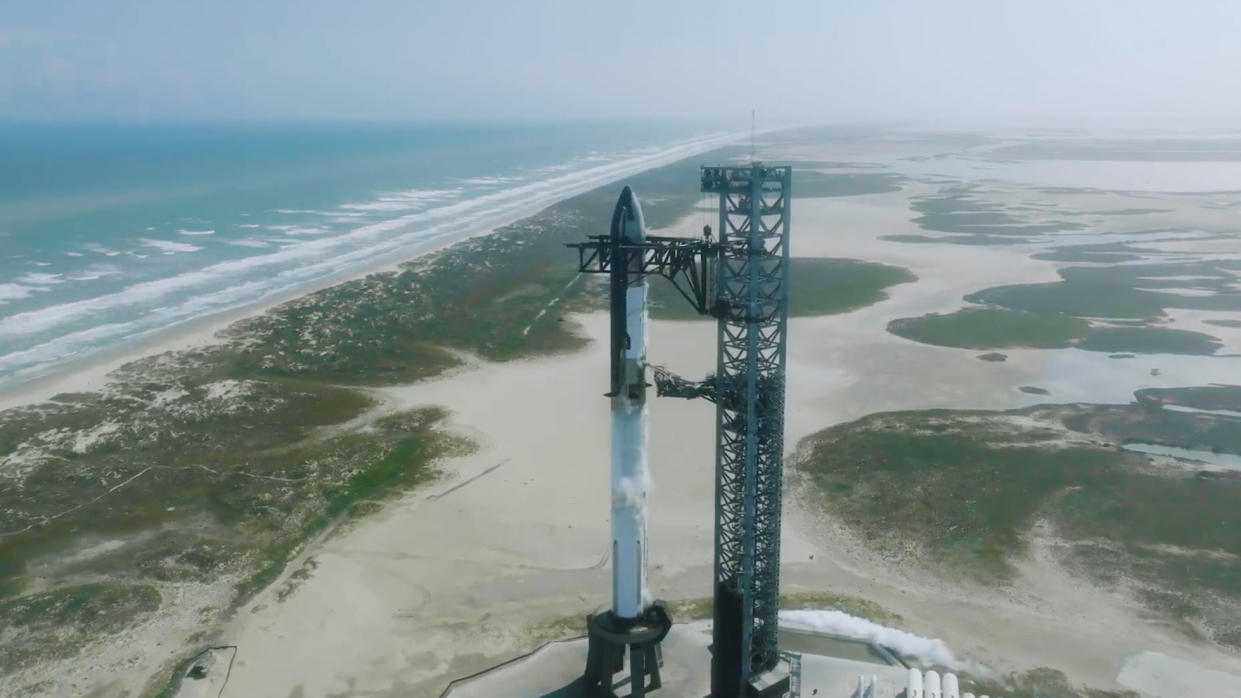
SpaceX's latest Starship prototype is rimmed with frost during a fueling test on Oct. 24, 2023.


Safety, not speed, should be the priority when conducting launch mishap investigations, members of a U.S Federal Aviation Administration (FAA) advisory committee say.

Amid reports of pressure from companies like SpaceX to add licensing staff to speed up approvals for new launches, FAA committee members instead urged caution Wednesday (Nov. 8) during a livestreamed meeting of the agency's Commercial Space Transportation Advisory Committee (COMSTAC).

"We've got to put safety first," Polly Trottenberg, deputy secretary at the U.S. Department of Transportation, emphasized. Paraphrasing Facebook founder Mark Zuckerberg, she said the FAA is often told "to move at exactly the speed of Silicon Valley. I know there's the 'move fast and break things' motto. I'm kind of the 'move fast and fix things' motto."


Still, Trottenberg acknowledged there can be a "conservatism" in the public sector, where "failure is swiftly punished" among politicians. She emphasized that safety cannot be compromised. But, she added, "we recognize that we need to find ways to ensure that, if we're not moving at the speed of industry, that we're moving faster where we can."

Related: FAA wraps up safety review of SpaceX's huge Starship rocket

COMSTAC was established in 1984 to report "on critical matters concerning the U.S. commercial space transportation industry" to the FAA administrator, according to the committee's documentation.

The membership includes not only senior executives from commercial space transportation, but also representatives from fields such as academia, the satellite industry, local and state government and companies that provide services such as insurance and legal matters.

As an advisory group to the FAA, COMSTAC plays no active role in evaluating "mishaps" that arise from failed commercial spaceflight launches. Committee members were also careful during Wednesday's meeting not to discuss ongoing investigations, including that of SpaceX. The company's debut Starship space launch in April saw the spacecraft spin out of control high over coastal Texas. SpaceX deliberately detonated the spacecraft, scattering debris over an environmentally sensitive area.

The FAA announced Oct. 31 that it had wrapped up the safety review of Starship, which examined the risks the launch poses to public health and safety. An environmental review with the U.S. Fish and Wildlife Service is still ongoing, however. Meanwhile, Starship has performed several static fires, and SpaceX has emphasized that the system could launch as soon as mid-November if the regulators approve.

SpaceX has had mixed feelings about the FAA approval process over the years. For example, SpaceX founder Elon Musk said in 2021 on Twitter — now rebranded after Musk's 2022 takeover as X — that the FAA's space division has "a fundamentally broken regulatory structure," as the rules are based on "a handful of expendable launches per year from a few government facilities."

However, on Sept. 8 of this year, in discussing the 2023 relicensing of Starship, Musk posted hat it is "rare" for the FAA "to cause significant delays in launch [as] overwhelmingly, the responsibility is ours." But, on Sept. 5, he noted that Starship was "ready to launch" and is only "awaiting FAA license approval." SpaceX senior officials also told Ars Technica in October, speaking on background, that they want the FAA to double agency licensing staff.

Related: SpaceX's giant Starship vehicle towers above turquoise waters in gorgeous photo


SpaceX's Starship explodes minutes after launch

The FAA leads the investigation of all mishaps that did not, or plausibly could not, result in "a fatality or serious injury to any person;" in cases where such injuries or deaths would be possible, responsibility is led by the U.S. National Transportation Safety Board. Licensing for systems like Starship also can involve multiple government agencies or groups, as the ongoing environmental investigation shows.

Committee members acknowledged that there are more space systems than ever and that launch rates are accelerating. While companies would like the FAA to move faster, however, safety must remain the primary consideration, said the agency's Michael O'Donnell at the same meeting.

"It's really about applying the regulations reasonably so that you can innovate and you can do things differently," said O'Donnell, the FAA's deputy associate administrator for commercial space transportation. "One thing I've learned is the difference between aviation and space is the tolerance for mishaps. On the space side, it's a very different world."

He explained that the aviation industry tends to fly "very similar types of vehicle," while in spaceflight, there's customization: "every single vehicle is unique." The custom builds are part of what makes the licensing process so complex, he emphasized.

O'Donnell acknowledged, however, that the FAA's flat budget for spaceflight investigation needs to accommodate a burgeoning launch industry "an order of magnitude greater than it was five years ago." (To cite just one example, SpaceX has launched 80 orbital missions already in 2023, quadruple its 2018 rate.)

One solution may be for the companies to share safety data along with their "risk acceptance" for certain systems, ranked perhaps between low, medium and high. O'Donnell said this may allow industry and the FAA alike to "then make the determination what the severity is, the likelihood of it (a mishap) happening, and then working from that and trying to build consensus about what the severity is, what the likelihood is, and then work together."

Related: Do space tourists really understand the risk they're taking?


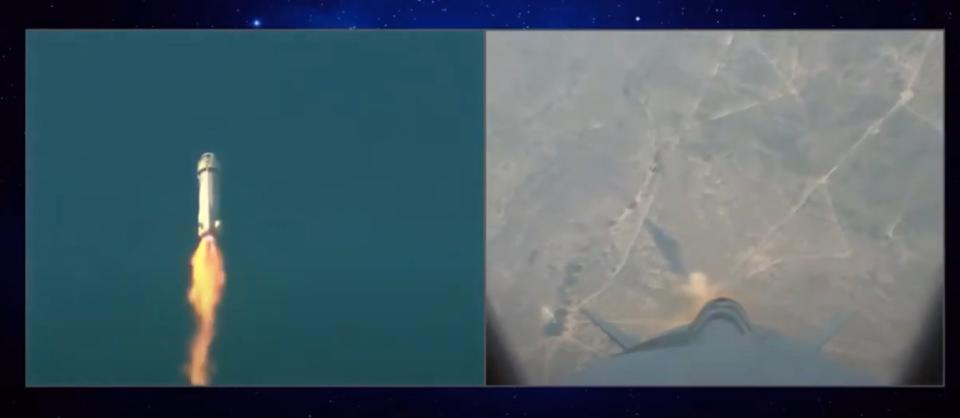
Blue Origin's New Shepard vehicle suffered an anomaly during an uncrewed launch on Sept. 12, 2022. This screengrab shows New Shepard just before the vehicle's capsule successfully engaged its emergency escape system.

O'Donnell noted that the FAA and industry would need to agree on what constitutes "safety data," which has been a sticking point. Industry reticence to such sharing has been brought up repeatedly: given each vehicle is so unique, it is difficult to anonymize information, representatives heard at meetings of COMSTAC in October 2018 and again in May 2023.


A Rocket Lab Electron rocket launches a Capella Space satellite on Sept. 19, 2023. The rocket suffered an anomaly, resulting in the loss of the satellite.

RELATED STORIES:

FAA wraps up safety review of SpaceX's huge Starship rocket

FAA proposes rule to reduce space junk in Earth orbit

FAA closes investigation of Blue Origin launch failure

While SpaceX has been getting most of the attention from the media concerning mishaps, it's not the only one the agency addressed in 2023. The FAA closed five space mishap investigations this year — such as SpaceX's Starship, and a 2022 incident with an uncrewed Blue Origin New Shepard flight — and still has three that are open, O'Donnell said.

One example of an active investigation is that of Rocket Lab, which had a failure on Sept. 19 with its Electron rocket that caused the loss of a commercial Earth observation satellite. An electrical arc within a key power supply system was likely at fault, and the company hopes to fly in late November. (The mishap inquiry continues, but the FAA did tell Rocket Lab its launch license is still active, company representatives recently said.)

Incredible New Videos Show NASA Smashing Into Asteroid

Noor Al-Sibai
Sat, November 11, 2023 


Super Smash Bros

An amateur astronomer has compiled new footage from NASA's groundbreaking asteroid-smashing mission to show just how incredible the collision really was.

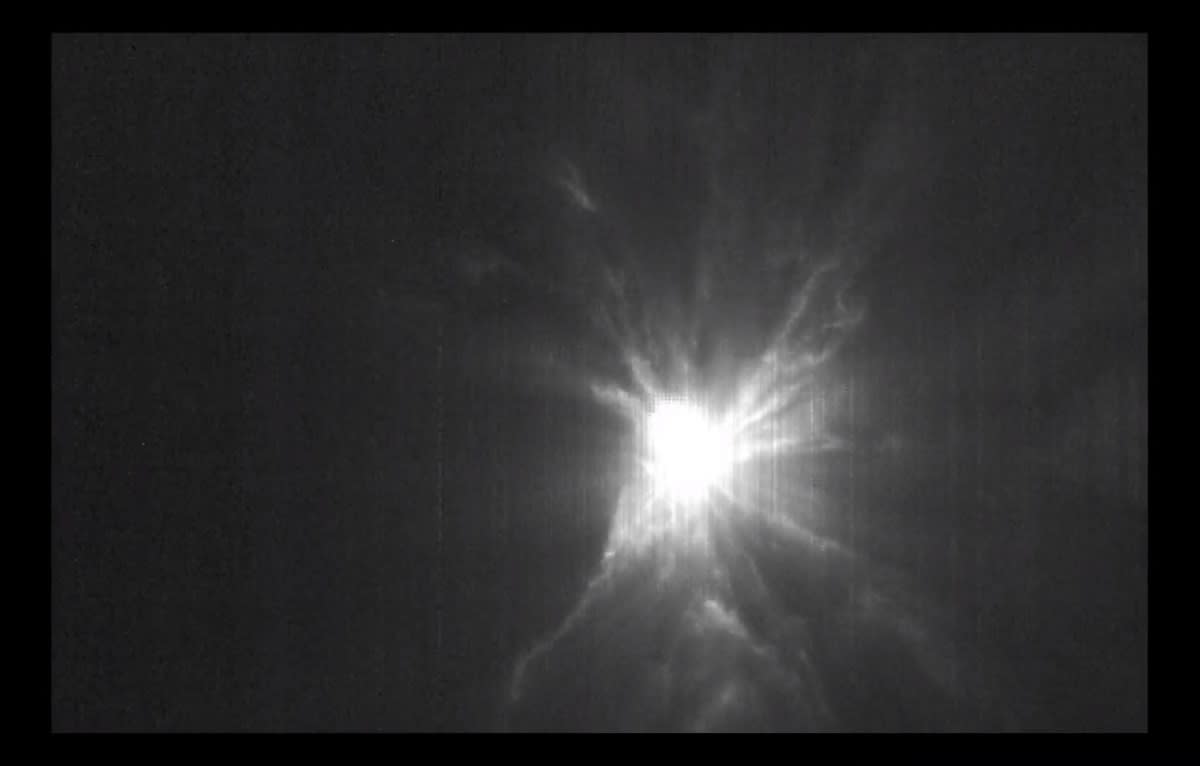
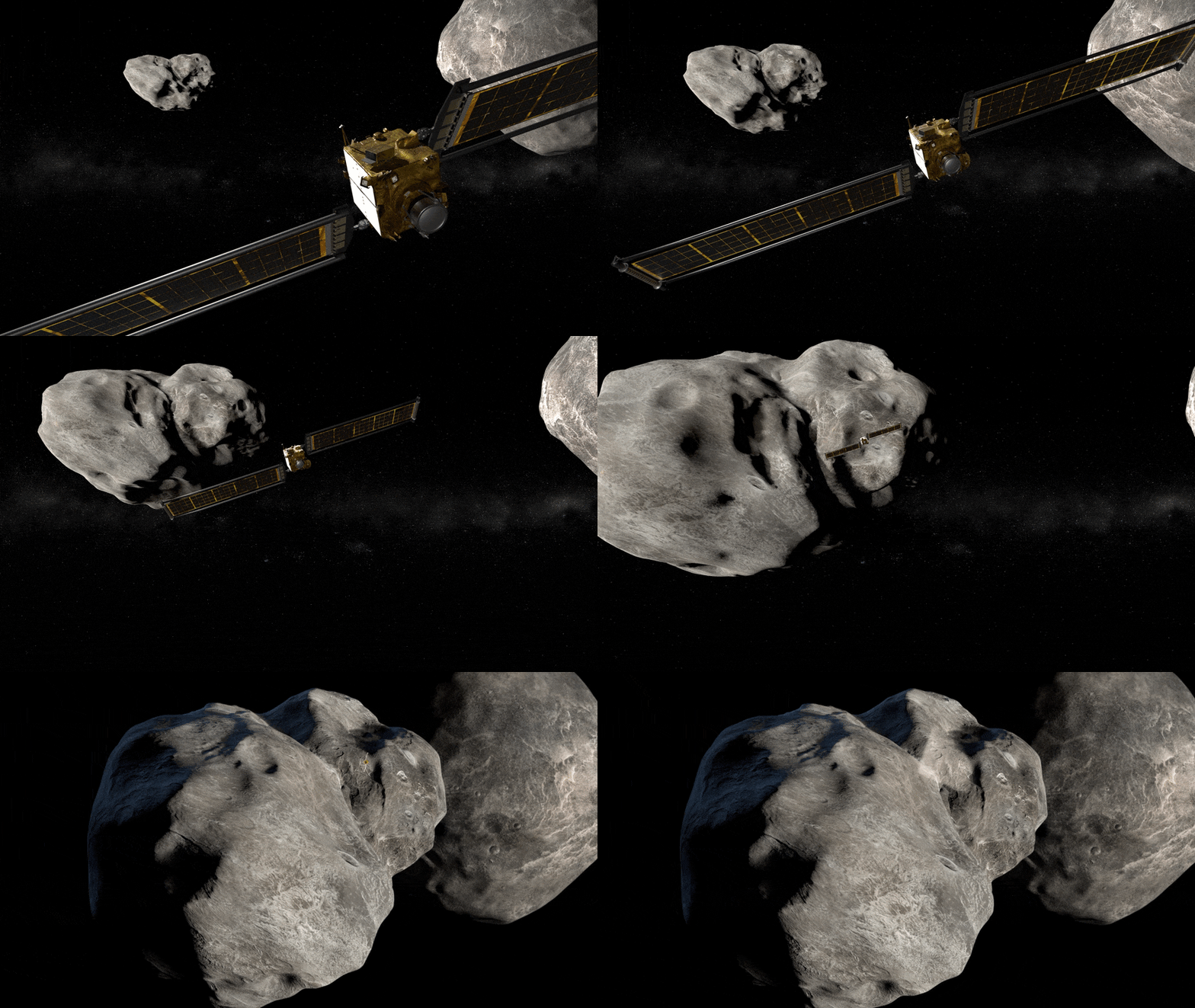
As ScienceAlert reports, Barcelona-based citizen scientist Jacint Roger Perez processed the videos, which he posted on Twitter in GIF form, from newly-released raw images from the Double Asteroid Redirection Test (DART) mission that successfully deflected an asteroid called Dimorphos last September.

Alongside the NASA spaceship used to ram into Dimorphos, the Italian Space Agency sent a tiny cubesat called LICIAcube — and it was new footage from LICIAcube's two cameras that Perez used to compile his stunning views of what happened just before, during, and after the DART craft slammed into the asteroid.

https://twitter.com/landru79/status/1720528631779266852

The DART impact, ScienceAlert explains, ended up having a way larger, more visible, and longer-lasting effect than scientists were expecting.

As NASA reported last December, more than two million pounds of material ejected from the itty bitty Dimorphos asteroid, which was only 525 feet across and orbited its larger brother Didymos every 11 hours and 55 minutes.

https://twitter.com/landru79/status/1720828117038534676

Dead on Impact


After the impact, a whopping 6,214-mile tail of debris trailed the asteroid for months on end — and although scientists were looking to only alter the orbit of the "moonlet" asteroid by about seven minutes, the impact of NASA's refrigeration-sized spacecraft was diminished by a whopping 33 minutes.

Interestingly enough, multiple teams of scientists hypothesized earlier this year that Dimorphos was displaced from its orbit so significantly not just because of the DART impact, but also because of the massive debris tail the collision caused.

As ScienceAlert reported back in March, the journal Nature published a series of articles about the Dimorphos debris, with three of them finding that the asteroid's long post-smashing tail seemed to increase its momentum more than anyone could have expected.

This mission's purpose wasn't just for the love of the game, but rather to see whether we could divert any killer asteroids screaming towards Earth to avert the kind of world-shattering disaster that made dinosaurs extinct.

Obviously, it was way more successful than scientists anticipated — and it made for some pretty stunning and badass imagery of a space-age wrecking rally, just as a bonus.

More on DART: Something Weird is Going on With the Asteroid NASA Smashed

NASA probe to observe near-Earth asteroid's 2029 close encounter

Steve Gorman
Fri, November 10, 2023 


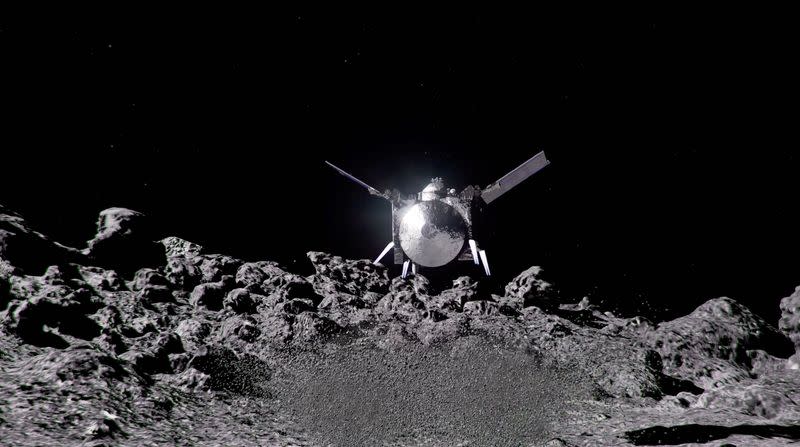
The NASA spacecraft OSIRIS-APEX hovers over the surface of the near-Earth asteroid Apophis

By Steve Gorman

(Reuters) - About 5-1/2 years from now, astronomers predict, an asteroid about as wide as the Empire State Building is tall will streak through space within 20,000 miles (32,200 km) of Earth, the closest any celestial object of that size will have come to our planet in modern history.

When it does, a spacecraft launched by NASA in 2016 is expected to be in position to provide a detailed examination of this rare close encounter.

The mission, directed by University of Arizona scientists, is expected to yield insights into planetary formation and knowledge that could inform efforts to build a defense system against possible doomsday asteroid collisions with Earth.

At the time of its 2004 discovery, the asteroid Apophis, named for a demon serpent embodying evil and chaos in ancient Egyptian mythology, appeared to pose a dire impact threat to Earth, with scientists forecasting a potential collision in 2029. Refined observations have since ruled out any impact risk for at least another century.

Still, its next approach in 2029 will bring the asteroid within a cosmic cat's whisker of Earth - less than one-tenth the moon's distance from us and well within the orbits of some geosynchronous Earth satellites.

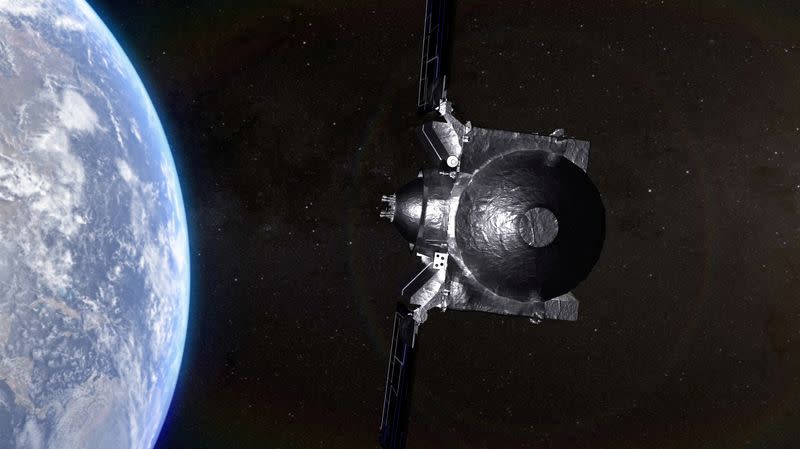
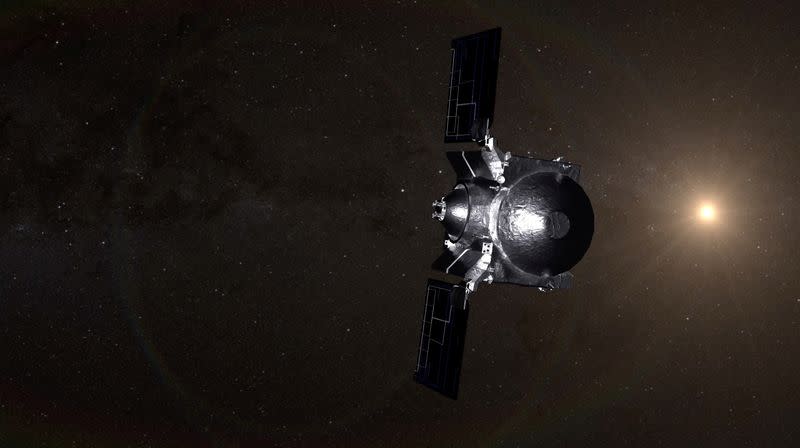
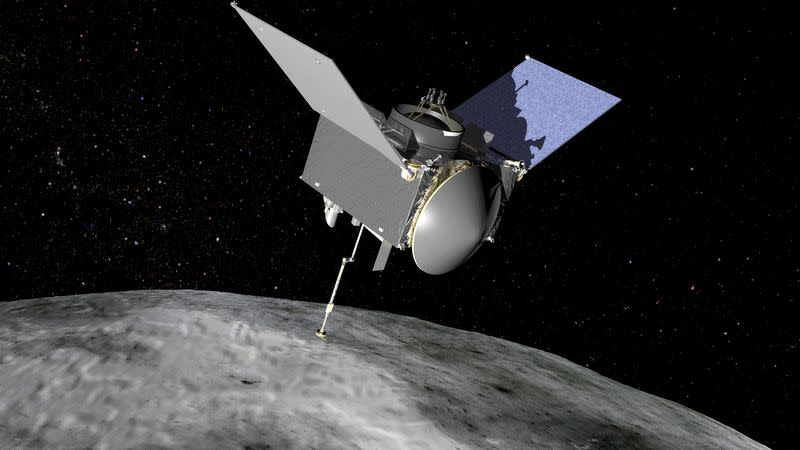
The spacecraft now headed for a rendezvous with Apophis is OSIRIS-REx, which made headlines plucking a soil sample from a different asteroid three years ago and sending it back to Earth in a capsule that made a parachute landing in Utah in September.

SPACECRAFT'S SECOND ACT

Rather than retire the spacecraft, NASA has rebranded it as OSIRIS-APEX - short for APophis EXplorer - and fired its thrusters to put it on course for its next target.

The Apophis expedition was detailed in a mission overview published in the Planetary Science Journal.

Apophis, oblong and somewhat peanut-shaped, is a stony asteroid believed to consist mostly of silicate materials along with iron and nickel. Measuring about 1,110 feet (340 meters) across, it is due to pass within about 19,800 miles (31,860 km) of Earth's surface on April 13, 2029, becoming visible to the naked eye for a few hours, said Michael Nolan, deputy principal investigator for the mission at the University of Arizona.

"It's not going to be this glorious show," Nolan said, but it will appear as a point of reflected sunlight in the night sky over Africa and Europe.

An asteroid that large passing so near to Earth is estimated to occur roughly once every 7,500 years. The Apophis flyby is the first such encounter predicted in advance.

The tidal pull of Earth's gravity likely will cause measurable disturbances to the asteroid's surface and motion, changing its orbital path and rotational spin. Tidal forces could trigger landslides on Apophis and dislodge rocks and dust particles to create a comet-like tail.

The spacecraft is set to observe the asteroid's Earth flyby as it nears and ultimately catches up with Apophis. These images and data would be combined with ground-based telescope measurements to detect and quantify how Apophis was altered as it passed by Earth.

OSIRIS-APEX is scheduled to remain near Apophis for 18 months - orbiting, maneuvering around it and even hovering just over its surface, using rocket thrusters to kick up loose material and reveal what lies beneath.

PLANETARY SCIENCE AND DEFENSE


Like other asteroids, Apophis is a relic of the early solar system. Its mineralogy and chemistry are largely unchanged in more than 4.5 billion years, offering clues to the origin and development of rocky planets like Earth.

Close examination of Apophis could give planetary defense experts valuable information about the structure and other properties of asteroids. The more scientists know about the composition, density and orbital behavior of such celestial "rubble piles," the greater the chances of devising effective asteroid-deflection strategies to mitigate impact threats.

NASA deliberately crashed a spacecraft into a small asteroid last year in a planetary-defense test that nudged the rocky object from its normal path, marking the first time humankind altered the natural motion of a celestial body.

Apophis is substantially larger than that asteroid but tiny compared with the one that struck Earth 66 million years ago, wiping out the dinosaurs.

While not big enough to pose an existential threat to life on Earth, an Apophis-sized asteroid striking the planet at hypersonic speed still could devastate a major city or region, Nolan said, with ocean impact unleashing tsunamis.

"It wouldn't be globally catastrophic in the sense of mass extinctions," but an impact "would definitely come under the category of bad," Nolan said.

"This thing is coming in at many miles per second if it hits. And at that speed, it kind of doesn't whether if it's made of gravel or ice or rocks or whatever. It's just a big, heavy thing moving fast," Nolan added.

(Reporting by Steve Gorman in Los Angeles; Editing by Will Dunham)

Could scientists stop a 'planet killer' asteroid from hitting Earth?

Brandon Specktor
Sat, November 11, 2023 

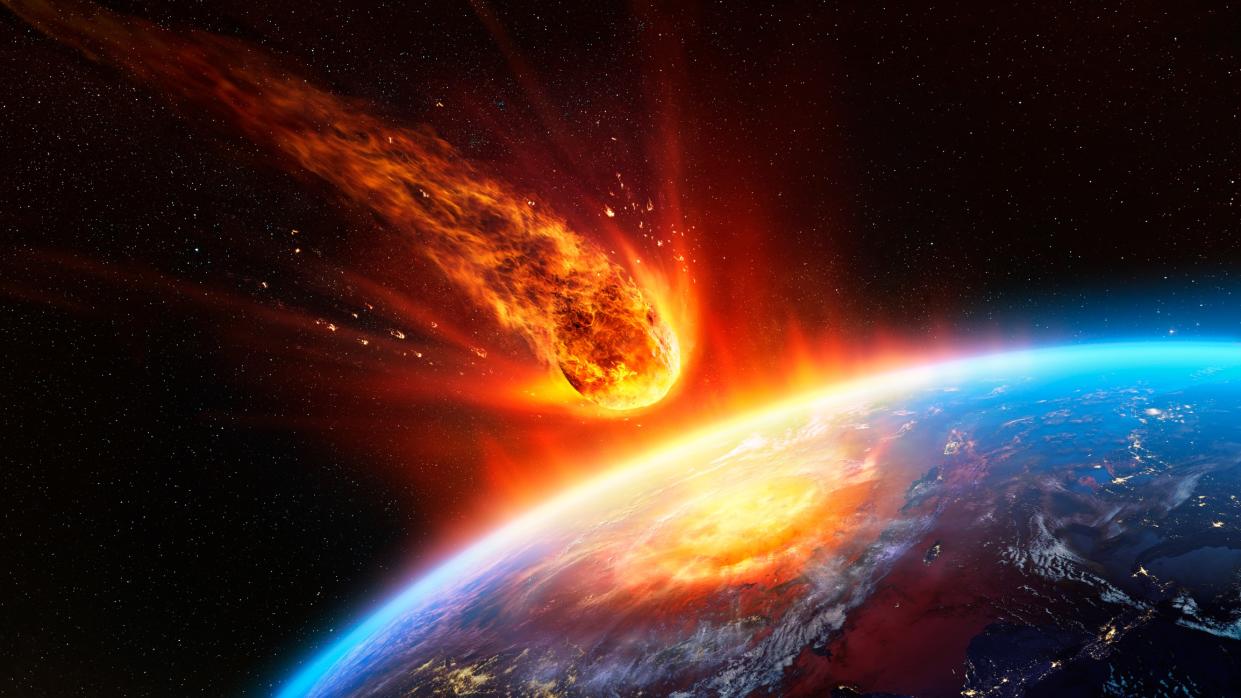
We see an enormous, fiery asteroid falling through Earth's atmosphere and very nearly hitting our blue planet.


It's a classic science fiction scenario: An enormous asteroid is discovered hurtling toward Earth that is sure to trigger a cataclysmic extinction upon impact. Intrepid scientists have only a year to launch a preemptive strike against the space rock — to knock it off course or blow it to bits — with the fate of humankind at stake. Can they stop it?

This doomsday scenario is, in all likelihood, one humans alive today will never have to face. Astronomers have mapped the trajectories of more than 33,000 asteroids that make occasional close approaches to Earth, and none pose any risk of impact for at least the next 100 years.

Still, scientists understand that disaster can descend with little warning; thousands of asteroids move hidden in the sun's glare, including many rocks large enough to obliterate entire cities, and the European Space Agency (ESA) warns that dozens of "planet killer" asteroids — those measuring wider than 0.6 mile (1 kilometer) and capable of triggering a global extinction event — still lurk undiscovered in our solar system.

For this reason, space agencies take the doomsday scenario "very seriously," Brent Barbee, an aerospace engineer at NASA's Goddard Spaceflight Center and a professor of aerospace engineering at the University of Maryland, told Live Science. And after years of research — including the world's first mission to deflect an actual asteroid in space — the international community's efforts have yielded two viable ways of changing a potentially deadly asteroid's course: hitting it with a high-speed impactor, or pummeling it with nuclear explosives.

Related: NASA's most wanted: The 5 most dangerous asteroids in the solar system
The kinetic impactor method


An animation visualizes DART's approach to its asteroid target.

Currently, the only proven way to deflect an asteroid is the kinetic impactor method — essentially, a very, very high-stakes game of cosmic pool.

"The kinetic impactor is a spacecraft that basically just rams into the asteroid at high speed and transfers its momentum to the asteroid, much like playing billiards," Barbee said. "But then the ejected material that comes off the asteroid from the impact point can provide additional momentum change for the asteroid and push it a little bit harder."

NASA tested the kinetic impactor method with the recent Double Asteroid Redirection Test (DART) — a $325 million mission that intentionally crashed a speeding spaceship into the 580-foot-wide (177 meters) asteroid Dimorphos in Sept. 2022.

Dimorphos posed no threat to Earth but made a prime target due to its size and orbit around a larger companion asteroid, Didymos. Following the successful impact on Sept. 26, Dimorphos' orbit around Didymos slowed by a whopping 33 minutes — a result of both the impact and the massive plume of dust ejected from the asteroid's surface. The mission — humanity's first and so far only attempt to alter the course of an asteroid — was a smashing success.

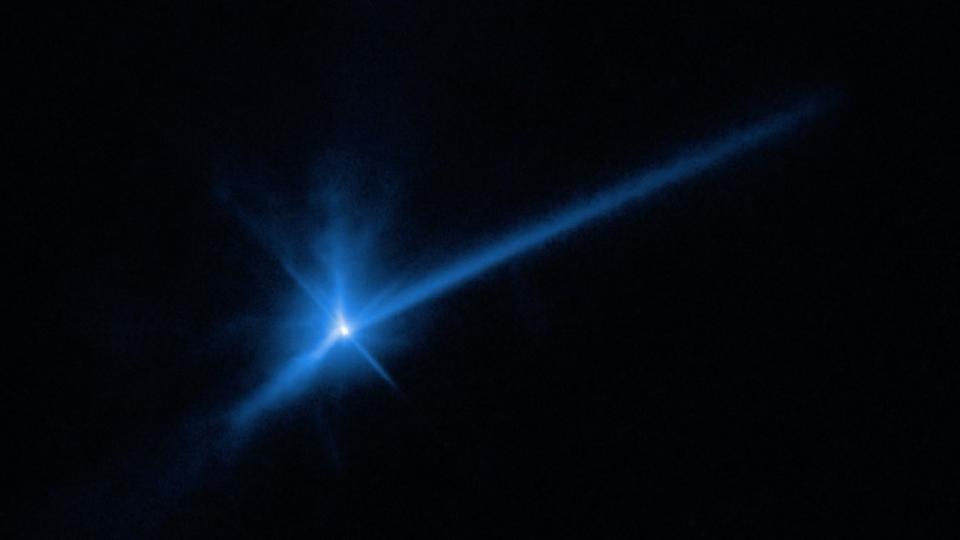
In September 2022, NASA’s DART probe smashed into the Dimorphos asteroid. The Hubble Space Telescope managed to capture an image of the giant dust plume that was generated.

However, the kinetic impactor method has its drawbacks, Barbee said. Particularly, the bigger the target asteroid is, the more kinetic impactors are required to deflect it.

For example, to deflect an asteroid measuring roughly 2,000 feet (610 m) wide — or about three times the size of Dimorphos — scientists would need to simultaneously launch between 39 and 85 Falcon Heavy rockets carrying kinetic impactors, Barbee said, citing the results of a mock asteroid deflection exercise conducted at the International Academy of Astronautics Planetary Defense Conference this year. To deflect an asteroid measuring 4,900 feet (1.5 km) wide — a true "planet killer" — we'd need to simultaneously launch anywhere from 565 to 1,266 kinetic impactors, depending on which part of Earth the asteroid was poised to strike. (A glancing blow takes less mass to deflect than a dead-center hit).

"Either way, those numbers are completely impractical," Barbee said.
The nuclear option

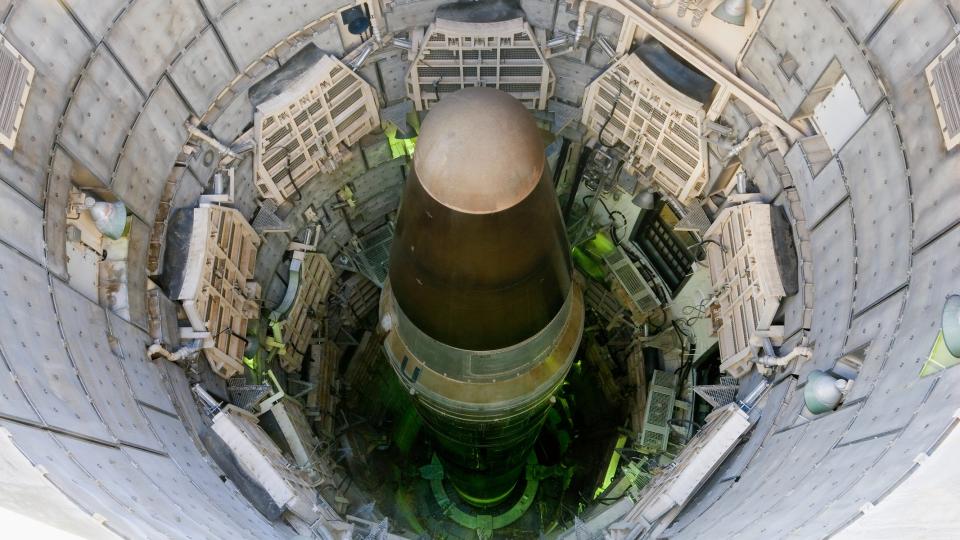
We see the top of a Titan II nuclear missile in its silo in Arizona

The current "best option" for deflecting a large asteroid is to launch a nuke at it, Barbee said.

"A single appropriately sized nuclear explosive device was, in our analysis, found to be capable of deflecting even the 1.5 kilometer size asteroid," he added.

Logistically, the process would begin like a routine interplanetary mission, with a nuclear weapon mounted securely atop a standard launch vehicle, then delivered to the asteroid on a small spacecraft. From there, the weapon could be detonated near the asteroid during a high-speed flyby — or, ideally, the nuke-carrying spacecraft could rendezvous with the target asteroid, orbiting it for months or even years to find the perfect angle of approach, much like NASA's OSIRIS-REx spacecraft did with asteroid Bennu from Dec. 2018 to Oct. 2020. The ideal spot for a nuclear detonation would be within a few hundred feet of the asteroid, Barbee said.

Then, the explosion — a blast that would look nothing like any nuclear bomb ever detonated on Earth.

"Space, of course, is a vacuum… so you don't get a big pressure wave, or any of the thermal effects of a terrestrial detonation," Barbee said. "You get a whole lot of radiation all at once."

This torrent of radiation would penetrate and vaporize a thin outer layer of the asteroid's surface. Then, like a kinetic impactor on steroids, the vaporized material would shoot off the asteroid, giving the rock a powerful shove away from the explosion. If positioned correctly, the explosion would knock the planet-killer off its collision course with Earth.

This method could be equally effective at disrupting smaller "city killer" asteroids, too — those measuring at least 165 feet (50 m) in diameter, which is generally considered the minimum size for an asteroid to reach Earth's surface, Barbee said. While a kinetic impact against such a rock runs the risk of fragmenting it, forming chunks of unknown sizes moving in unpredictable ways, a well-placed nuke could simply "blow the asteroid to smithereens," solving the problem at once, Barbee added.

However, for now the "nuke it" method exists only in simulations based on data from terrestrial explosions. Many factors, including the size and composition of the asteroid, and the timeframe and trajectory of its approach to Earth, would ultimately impact such a mission's success.

Timing is everything


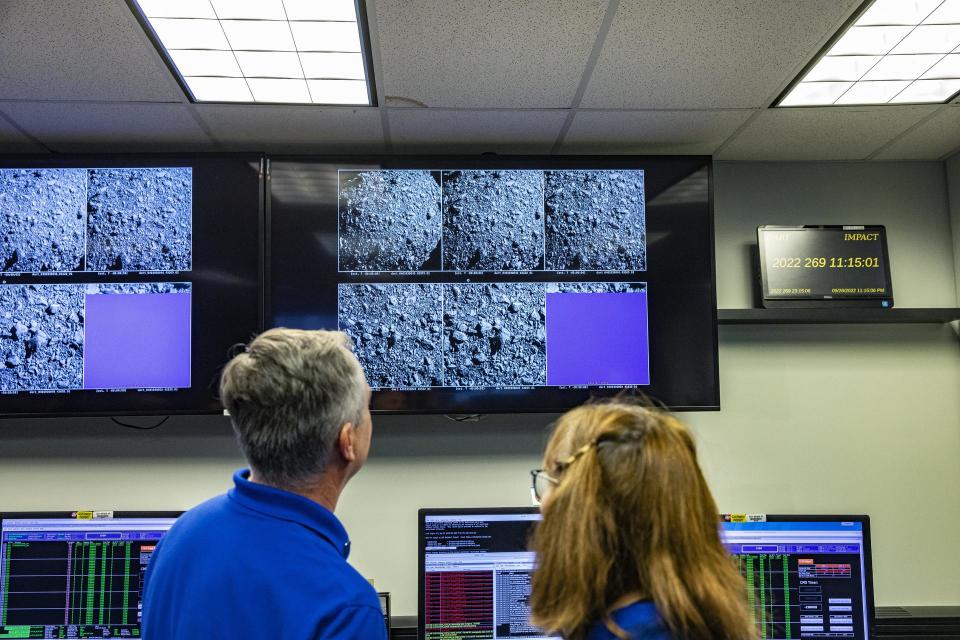
Two NASA researchers watch a wall of screens showing the rocky surface of the asteroid Dimorphos, moments before the DART spacecraft smashes into it

The biggest challenge with both methods is timing. In their Planetary Defense Conference exercises, astronomers were given 15 years' warning before the hypothetical asteroid's impact with Earth. This gave them ample time to plan, launch and rendezvous a spacecraft with the asteroid.

If a real planet-killer was discovered just a year or two before impact, things would get dicey.

"The typical interplanetary mission development timeline is about five years," Barbee said. "The way things stand right now, getting something off the ground in a year would be very difficult. I don't want to say outright that it would be impossible, but it would certainly be a big challenge."

That's why the best planetary defense is detecting asteroids early — charting them, monitoring them, and developing a contingency plan of attack. Many ground-based observatories are already on the case, with several space-based missions — including NASA's NEO Surveyor and ESA's NEOMIR satellites — in the works to join them. Hopefully, together, these eyes on the skies will keep scientists well informed about any killers lurking in the cosmic fog.

"Asteroid impacts are one of the few natural disasters that we actually have the means to both foresee and prevent," Barbee said. "And so we're taking advantage of that fact and trying to become as prepared as possible."

Dark matter may have it's own 'invisible' periodic table of elements

Paul Sutter
Fri, November 10, 2023

A composite image showing the distribution of dark matter, galaxies, and hot gas in the core of the merging galaxy cluster Abell 52. The blue areas show regions with the most mass; dark matter makes up most of this mass.


The universe may have produced dark matter in the first few minutes of the Big Bang, according to new research. Those particles then got trapped into ultradense pockets. Some of those pockets splintered off to become black holes, which then dissolved into a shower of multiple dark matter particle "species," creating a "dark matter periodic table" of invisible elements, the study authors suggest.

Physicists still struggle to explain dark matter — the mysterious, invisible form of matter that makes up the vast majority of the universe's mass. While cosmologists and astronomers have identified circumstantial evidence for the existence of dark matter, from the rotation rates of stars within galaxies to the largest structures visible in the cosmos, they have not identified exactly what the dark matter is.

Previous work assumed that dark matter was simple: a single kind of extremely lightweight particle, flooding the universe, that hardly ever interacted with normal matter. But intense searches for new such particles have come up empty. That led cosmologists to wonder if the dark matter particles might be much rarer, but also much heavier. However, theoretical physicists have struggled to find models that would seed the early universe with the right number of such heavy particles.


In the new study, published in October in the preprint database arXiv, a team of cosmologists found a way to generate massive dark matter particles soon after the Big Bang. The trick was to sprinkle in black holes.

The paper noted that the early universe underwent severe phase transitions as the forces of nature split off from each other, going from a single unified force into the four fundamental forces of today. At each transition, the underlying physics changed. This isn't as wild as it sounds, as scientists can reproduce the last of these transitions in particle accelerators: At high enough energies, recreating the first few seconds of the Big Bang, we can observe the electromagnetic and weak nuclear forces merging into one.

The researchers found that ultraheavy dark matter could get trapped during one of these early-universe phase transitions. If the transition was messy, it would trigger the formation of bubbles, where some pockets of the universe had transitioned to the new physics while the rest had not yet made the change (like water boiling, with the gas phase of water trapped in bubbles surrounded by liquid).

In their model, the earliest dark matter was light but dark matter from later periods was heavy. In this scenario, dark matter gets trapped inside the bubbles, where the densities skyrocket to the point where all the dark matter collapses and forms black holes. Those black holes soon evaporate via Hawking radiation — in which radiation slowly "leaks" out of black holes in the form of thermal energy — well before the appearance of normal matter.

But as the black holes evaporate, dark matter makes a comeback, as the black holes spit out new dark matter particles before they die, the team's model showed. This clever mechanism limits the total amount of massive dark matter in the universe, because only so much can escape the black holes before they evaporate completely.

This evaporation process also generates a slew of dark matter particle species. While all of the dark matter particles share many characteristics (such as likely near-total invisibility), they would differ in their masses, speeds, and ways of interacting with normal matter. In this model, dark matter is a vast collection of different kinds of particles, much like normal matter is composed of the entire periodic table of the elements.

RELATED STORIES

Our entire galaxy is warping, and a gigantic blob of dark matter could be to blame

'Ghost' particles from the sun could lead us straight to an invisible trove of dark matter

1st images from the Euclid 'dark universe' telescope are here — and they're jaw-dropping

Experimental evidence for this idea is still a long ways away, as it is right now a deeply hypothetical concept. Direct detection of one or more dark matter particle species would certainly bolster the idea. And astronomers are currently developing ways to observe gravitational waves from the big bang, which would give us direct observational access to this critical epoch in the history of the universe.

There could be all sorts of new interactions among these dark matter species, leading to a complex web of physics acting invisibly throughout the universe.

Powerful new thrusters for NASA's moon-orbiting Gateway space station get a test (photo)
Andrew Jones
Thu, November 9, 2023 

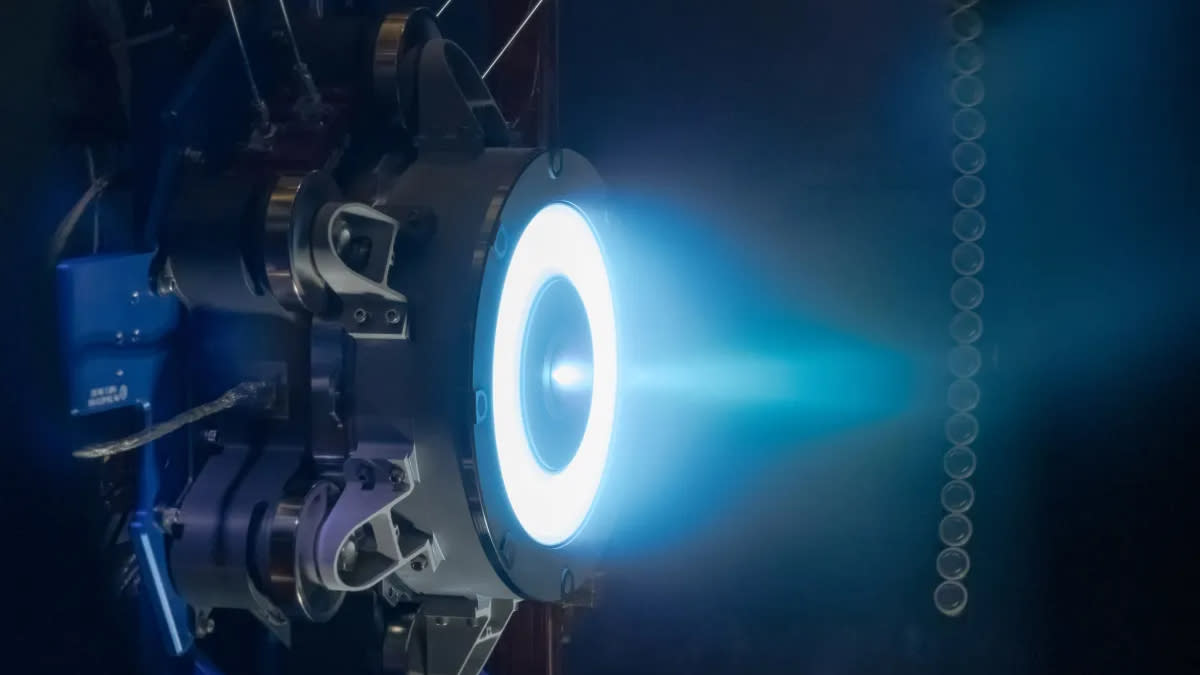
A solar electric propulsion thruster emits the blue hue of Xenon gas during testing. Vibrant blue light emanates in a circular shape from the dark grey thruster, which is mounted inside a vacuum chamber. The blue light then narrows into a plume as it moves farther away from the thruster, illuminating the otherwise darkened chamber.

NASA and Aerojet Rocketdyne are taking a big step in testing a new ion propulsion engine that will help power lunar exploration.

The Advanced Electric Propulsion System (AEPS) has been undergoing qualification testing at NASA's Glenn Research Center in Cleveland, according to a statement from the agency.

AEPS is a Hall effect thruster, which accelerates ions to generate thrust. The AEPS uses electricity generated by solar arrays to create a steady stream of ionized xenon gas, producing low but highly efficient thrust.

Related: NASA's Gateway moon-orbiting space station explained in pictures

The 12-kilowatt Hall thruster is the most powerful electric propulsion thruster in production, according to NASA, being over two times more powerful than the current state-of-the-art in-space electric propulsion. The agency says the new thruster will be critical to future science and exploration missions at the moon and beyond.

"AEPS is truly a next-generation technology," Clayton Kachele, the AEPS project manager at NASA's Glenn Research Center in Cleveland, said in a statement in July, during an earlier testing run.

"Current electric propulsion systems use around four and a half kilowatts of power, whereas here we're significantly increasing power in a single thruster," Kachele added. "That capability opens a world of opportunity for future space exploration, and AEPS will get us there farther and faster."

The thrusters will be used on the Power and Propulsion Element (PPE) of Gateway; NASA's planned lunar space station that will support Artemis missions and more. Xenon gas for the engines will be among the supplies needed to be replenished by cargo missions to the Gateway to keep the small lunar station operating smoothly. A dedicated Xenon Transfer System (XTS) is being developed by OHB in Bremen, Germany for this purpose.

RELATED STORIES:

Artemis 4 astronauts will be 1st crew to use NASA's moon-orbiting Gateway in 2028

Watch NASA's next-generation lunar Gateway space station build up in concept video

NASA's moon-orbiting space station will be claustrophobic, architect says

NASA will test a second thruster qualification article in 2024. That test will simulate conditions that AEPS will likely experience during Gateway's initial orbit raising and transition to lunar orbit. NASA plans to operate the thrusters for 23,000 hours in total during a nearly four-year test campaign inside NASA Glenn's vacuum chambers.

PPE is currently scheduled to launch on a SpaceX Falcon Heavy rocket in November 2025.


The oldest continents in the Milky Way may be 5 billion years older than Earth's

Briley Lewis
Thu, November 9, 2023 

This artist's rendition shows one possible appearance for the planet HD 219134b, the nearest confirmed rocky exoplanet found to date outside our solar system. The planet is 1.6 times the size of Earth, and whips around its star in just three days. Scientists predict that the scorching-hot planet -- known to be rocky through measurements of its mass and size -- would have a rocky, partially molten surface with geological activity, including possibly volcanoes.


The oldest continents in our galaxy may have arisen 5 billion years before Earth’s, new research suggests — and that means there may be multiple worlds in the Milky Way harboring alien life even more advanced than our own.

Astrobiologists think a planet needs to have certain features to support life: oxygen in its atmosphere, something to shield organisms from dangerous radiation and liquid water, for a start. Although big land masses aren't strictly necessary for living things to emerge, Earth's history shows that they're important for life to thrive and exist for long periods of time. So, if an exoplanet had continents before Earth, it follows that there might be older, more advanced life on that world.

This line of thought led Jane Greaves, an astronomer at Cardiff University astronomer in the U.K., to answer the question: When did the first continents appear on a planet in our galaxy? Turns out, two exoplanets' continents — and perhaps life — may have arisen four to five billion years before Earth's.


If life on another planet had a five-billion-year head start, it "could potentially host life more evolved than us," Greaves wrote in a study, published in the September issue of the journal Research Notes of the American Astronomical Society.

Continents form due to plate tectonics, the movement of plates of rock that float atop the molten innards of a planet. Heat from a planet's core keeps that magma from hardening and halting continents' movement. That heat comes from radioactive elements — like uranium-238, thorium-232, and potassium-40 — in the planet's core, which give off energy as they decay.

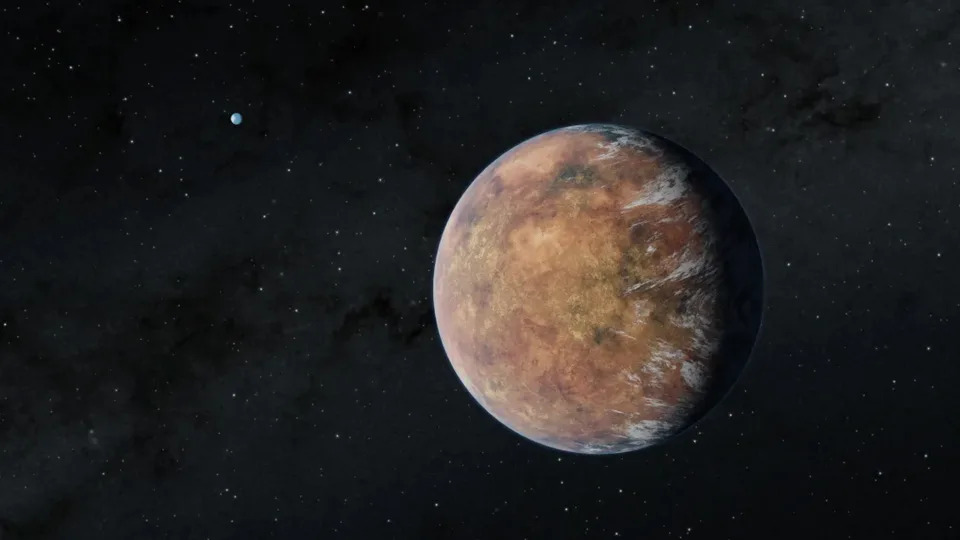
Newly discovered Earth-size planet TOI 700 e orbits within the habitable zone of its star in this illustration. Its Earth-size sibling, TOI 700 d, can be seen in the distance.

Most of those radioactive elements came from catastrophic cosmic events, like supernova explosions and collisions between the dead husks of giant stars, known as neutron stars. Traces of those elements can be detected in the wavelengths of light that stars emit. In her new work, Greaves used levels of uranium-238 and potassium present in nearby stars, plus the ages of stars as measured by the Gaia satellite, to estimate when a hypothetical rocky planet around each of these stars became hot enough for plate tectonics to emerge.

She found that the first continents formed around nearby sun-like stars up to 2 billion years earlier than Earth's plate tectonics began. The oldest continents of a nearby star are around HD 4614, about 20 light-years from Earth. Earth's starting time, however, is average for our cosmic neighborhood.

Two stars stand out from the pack, though: The planets of two stars a bit smaller than our sun (HD 76932 and HD 201891), located 70 to 110 light-years away from us respectively in a region known as the "thick disk", could have formed continents up to 5 billion years earlier than us. Based on her sample of just 29 stars and astronomers' current best estimates for how likely a planet is to be habitable, Greaves wrote, "there could be two systems in this sample alone with biospheres more advanced than here on Earth."

Determining potentially interesting and habitable planets, like these identified by Greaves, is crucial preparation for NASA's future Habitable Worlds Observatory, which astronomers will use to observe Earth-like planets — and hopefully signs of life — in the 2040s. Greaves hopes future work will analyze more stars to determine if they could have planets with plate tectonics, which, she wrote, "could help to uncover more old systems where life on land could pre-date that on Earth."

These small galaxies were shredded by their larger siblings — but they survived

Sharmila Kuthunur
Fri, November 10, 2023

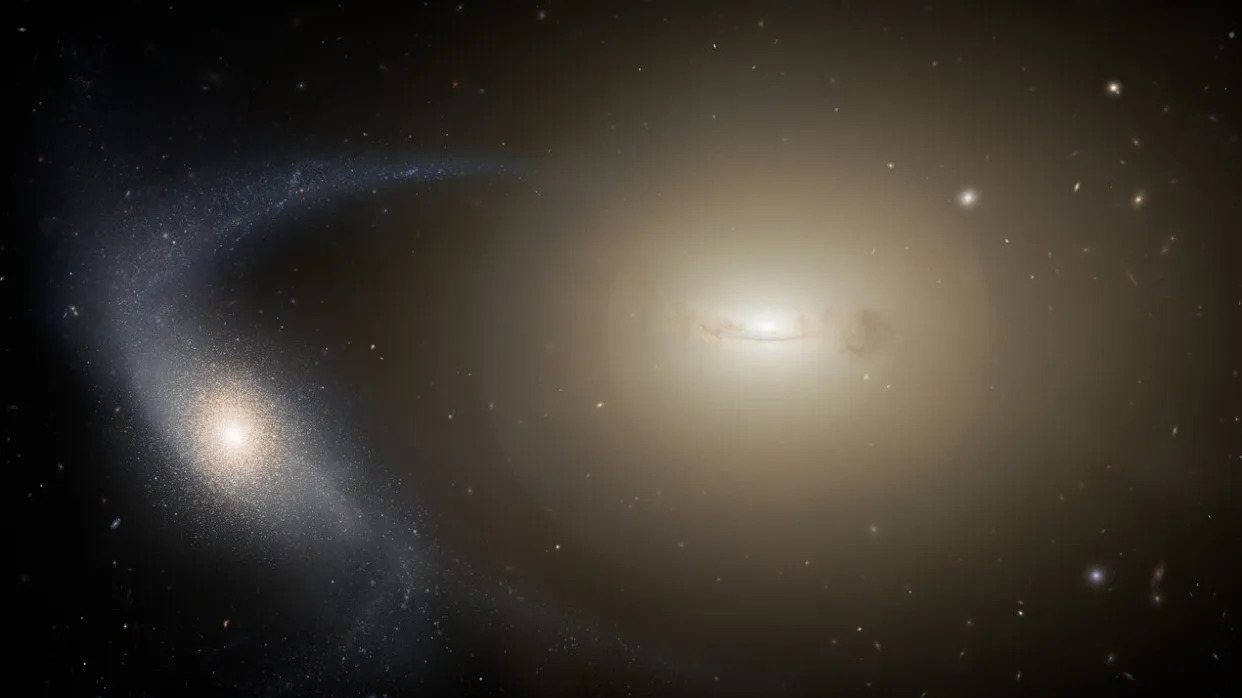
Artist’s impression of a dwarf galaxy undergoing tidal stripping.


While galaxies appear to be lonely wanderers in the vast universe, many in fact huddle closely in clusters, held together by their collective gravity. And sometimes, it would appear, they also munch on one another.

In other words, larger galaxies in these pockets merge with and gobble smaller ones to grow even bigger — our own Milky Way galaxy actually cannibalized a small neighbor galaxy and gained supremacy about 10 billion years ago.

As for what happens to the smaller galaxies getting shredded by their massive counterparts? Well, while few disappear without a trace,, new research shows that some tiny galaxies are dense enough to power through. Those mighty realms are able to hold onto their cores and become what astronomers call Ultra Compact Dwarfs, or UCDs.

Related: Dark energy camera reveals galaxies caught in a cosmic 'tug of war' (photo)

Using the Gemini North Telescope located near the Mauna Kea mountain in Hawaii, the team behind the research spotted galactic cannibalism in action near the Virgo Cluster, a large grouping of thousands of galaxies relatively nearby to Earth. And in a first, the researchers found small galaxy victims transitioning into UCDs. As many as 106 galaxies exhibited far-reaching envelopes of stars, suggesting their outer layers were being ripped apart by nearby large galaxies. Meanwhile, however, tight groupings of stars in their centers reveal their gravitational grip is strong enough to survive the merger, astronomers say.

After stars and gas in the galaxies' outer layers are pried out in full, astronomers expect the tiny galaxies will come to represent late-stage UCDs.

"It's exciting that we can finally see this transformation in action," Eric Peng, an astronomer at National Optical-Infrared Astronomy Research Laboratory, said in a statement. "It tells us that many of these UCDs are visible fossil remnants of ancient dwarf galaxies in galaxy clusters, and our results suggest that there are likely many more low-mass remnants to be found."

Peng and his colleagues first spotted these candidate UCD progenitors in images taken by the Canada–France–Hawaii Telescope, also located near the summit of Hawaii's Mauna Kea mountain. However, in those images, it was very difficult to clearly distinguish the target galaxies from other faraway galaxies beyond the Virgo Cluster, according to the new study.

So, the team used Gemini North to perform follow up observations to accurately measure galaxy distances, then removed all background galaxies such that only the candidate UCDs within the Virgo Cluster could be seen.

The results showed these UCDs resided "almost exclusively near the largest galaxies," Kaixiang Wang, the study's lead author and a scientist at Peking University in China, said in the statement. "We immediately knew that environmental transformation had to be important."

This research is described in a paper published Wednesday (Nov. 8) in the journal Nature.


Scientists Say There May Have Been a Second Big Bang

Victor Tangermann
Sat, November 11, 2023 


Instead of a single Big Bang that brought the universe into existence billions of years ago, cosmologists are starting to suspect there may have been a second transformative event that could explain the vast abundance of dark matter in the universe.

As New Scientist reports, our recent glimpses into early moments of the universe, just millions of years after the Big Bang, could allow us to gain new insights into this "dark" Big Bang, which could solve a conundrum that's been plaguing astronomers for almost half a century.

Dark matter is the hypothetical form of matter that doesn't interact with light or electromagnetic fields in any way, yet appears to make up roughly 27 percent of the known universe.

Astronomers have long attempted to explain why clusters of galaxies move in ways that our existing Standard Model of physics can't account for. To make the math work, the dominant explanation is that there's a bunch of stuff out there that we can't see.

Despite our best efforts, however, we're still unable to observe this matter directly.  Now, some researchers are wondering whether a second big bang might have brought the exotic substance into existence after the regular matter we're accustomed to dealing with.

"People always assume everything is created at the same time in a single big bang, but who really knows?" Katherine Freese, physics professor at the University of Texas at Austin, told New Scientist.

In a yet-to-be-peer-reviewed paper, Freese and her colleagues suggest that a "Dark Big Bang" may have "occurred when the universe was less than one month old."

They suggest the event could've formed several different kinds of dark matter, including "darkzillas" — yes, that's a "Godzilla" reference — which are monstrously sized particles 10 trillion times the mass of a single proton.

However, if the event was more gradual instead of forceful and abrupt, the Dark Big Bang would've produced lighter "dark cannibal" particles that would absorb each other with each collision.

These particles aren't unlike one of the leading dark matter candidates, called "weakly interacting massive particles" (WIMPs), which astronomers have posited for decades to explain the mysterious forces falling outside of the Standard Model of physics.

Freese is now hoping that studying gravitational waves emerging from the universe's gravitational wave background could shed more light on her Dark Big Bang theory.

Her work is part of a greater shift in the astronomy community. Instead of one big event that created the universe, cosmologists are now wondering whether the universe may have gone through several phase transitions, slowly bringing everything from matter to dark matter into being.

By measuring disturbances in signals sent out by highly magnetized neutron stars called pulsars, scientists have been trying to pinpoint the origin of these gravitational waves or ripples in space-time, with the hopes of gaining insights into the earliest days of the universe.

Perhaps then we can get one step closer to unraveling the mystery surrounding the existence of dark matter — or whether "darkzillas" or "dark cannibals" might account for a good portion of the stuff that surrounds us.

More on the Big Bang: Amazing Video Soars Through James Webb's Dazzling 3D View of Universe