Thursday, November 21, 2024


In 1649…


This is an extract from the author’s new book Power Play: The Future of Food.

In the annals of agrarian history, one particular movement has left a profound impact on the collective imagination of food sovereignty advocates. The Diggers in 17th century England were led by the visionary Gerrard Winstanley. This radical group emerged during a period of intense social and political upheaval, offering a revolutionary perspective on land ownership and food production that continues to resonate with modern struggles for (food) justice.

The Diggers, also known as the True Levellers, arose in 1649, a time when England was reeling from the aftermath of civil war. Winstanley and his followers dared to imagine a different world. The group challenged the very foundations of the emerging capitalist system and the enclosure movement that was rapidly privatising previously common lands. But Winstanley’s vision was not merely theoretical.

On 1 April 1649, the Diggers began their most famous action, occupying St. George’s Hill in Surrey, where they established a commune, cultivating the land collectively and distributing food freely to all who needed it. This act of direct action was a powerful demonstration of their philosophy in practice.

As Winstanley declared:

“The earth was made to be a common treasury for all, not a private treasury for some.”

The Diggers, true to their name, began their movement by literally digging up unused common lands and planting crops. According to Professor Justin Champion, they planted “peas and carrots and pulses” and let their cows graze on the fields.

While the Diggers saw their actions as relatively harmless (Champion compares it to having an allotment), local property owners viewed it as a serious threat, likening it to “village terrorism”, according to Champion.

The local landowners called in troops to suppress these actions. Despite their relatively small numbers and short-lived experiments, which spread across parts of England, Champion suggests that the Diggers posed a significant ideological threat to the existing social order, challenging notions of private property and social hierarchy.

Winstanley declared:

“Those that Buy and Sell Land, and are landlords, have got it either by Oppression, or Murther, or Theft”.

He added:

The Work we are going about is this, To dig up Georges-Hill and the waste Ground thereabouts, and to Sow Corn, and to eat our bread together by the sweat of our brows. And the First Reason is this, That we may work in righteousness, and lay the Foundation of making the Earth a Common Treasury for All, both Rich and Poor, That every one that is born in the land, may be fed by the Earth his Mother that brought him forth, according to the Reason that rules in the Creation.

The backlash from local landlords was systematic. The Diggers faced beatings and arson, forcing them to move from St George’s Hill to a second site in Cobham, until they were finally driven off the land entirely.

Writing in 1972 in his book The World Turned Upside Down, Christopher Hill, a prominent historian of the English Civil War period, suggested that the Diggers’ influence was more widespread than just their most famous colony at St. George’s Hill. He argued that from Nottinghamshire and Northamptonshire to Gloucestershire and Kent, Digger influence spread all over southern and central England.

While the actual number of people involved in Digger experiments was relatively small (estimated at 100-200 people across England) and ended in 1651, their ideas spread more widely through pamphlets and word of mouth.

This widespread influence, as described by Hill, suggests that the Diggers’ ideas resonated with people across a significant portion of England, even if actual Digger colonies were few in number.

The Diggers were a radical, biblically inspired movement that practically implemented their beliefs about common ownership of land, provoking strong opposition from the established landowners despite their generally peaceful methods.

The St. George’s Hill experiment represented a radical alternative to the prevailing economic and social order. It was an early example of what we might today call a food sovereignty project, emphasising local control over food production and distribution.

In today’s era of industrial agriculture and corporate food systems, the Diggers’ ideas remain highly significant. Their resistance to the enclosure of common lands in the 17th century mirrors today’s struggles against corporate land grabs — and the colonising actions that underpin the likes of Bayer’s corporate jargon about the unlocking of ‘business growth’, ‘driving change management’, ‘driving market share’ and ‘creating business value’ — as well as the privatisation of seeds and genetic resources.

The consolidation of the global agri-food chain in the hands of a few powerful corporations represents a modern form of enclosure, concentrating control over food production and distribution in ways that would have been all too familiar to Winstanley and his followers.

The Diggers’ emphasis on local, community-controlled food production offers a stark alternative to the industrial agriculture model promoted by agribusiness giants and their allies in institutions like the World Bank and the WTO. Where the dominant paradigm prioritises large-scale monocultures, global supply chains and market-driven food security, the Diggers’ vision aligns more closely with concepts of food sovereignty and agroecology.

Food sovereignty, a concept developed by the international peasant movement La Via Campesina, shares much with the Diggers’ philosophy. Both emphasise the right of communities to define their own food and agriculture systems.

The Diggers’ legacy can be seen in various contemporary movements challenging the corporate food regime. From La Via Campesina’s global struggle for peasant rights to local community garden initiatives and the work of the Agrarian Trust in the US (which provides good insight into the Diggers and their continued relevance in The Diggers Today: Enclosure, Manure and Resistance), we see echoes of the Diggers’ vision.

Modern projects to create community-owned farms, seed banks and food cooperatives can be seen as spiritual descendants of the Diggers’ movement, aiming to reclaim food production from corporate control and put it back in the hands of communities.

However, realising the Diggers’ vision in the current context faces significant obstacles.

The influence of agribusiness conglomerates over key institutions and policymaking bodies presents a formidable challenge. From the World Bank to national agriculture ministries, corporate interests often shape policies that prioritise industrial agriculture and global markets over local food systems. International trade agreements and memoranda of understanding, often negotiated with minimal public scrutiny, frequently benefit large agribusiness at the expense of small farmers and local food sovereignty.

Moreover, proponents of industrial agriculture often argue that it is the only way to feed the world. This narrative, however, ignores the environmental and social costs of this model, as well as the proven productivity of small-scale, agroecological farming methods.

The Diggers didn’t just theorise about an alternative society; they attempted to build it by taking direct action, occupying land and implementing their vision of communal agriculture.

The Diggers also understood that changing the food system required challenging broader power structures. Today’s food sovereignty movements similarly recognise the need for systemic change, addressing issues of land rights, trade policies and economic justice alongside agricultural practices.

In this era of corporate-dominated agriculture, the Diggers’ vision of a “common treasury for all” remains as radical and necessary as ever.

By reclaiming the commons, promoting agroecological practices and building food sovereignty, ordinary people can work towards a world where food is truly a common treasury for all.

The Diggers recognised that true freedom and equality could not be achieved without addressing the fundamental question of who controls the land and the means of production. This understanding is crucial in the current context, where corporate control over the food system extends from land, seeds and inputs to distribution and retail.

This vision also challenges us to rethink our relationship with the land and with each other. In a world increasingly dominated by individualism and market relations, the emphasis on communal ownership and collective labour offers a radical alternative.

The Diggers’ legacy challenges us to think beyond the confines of the prevailing food regime, to envision and create a world where food and land are not commodities to be bought and sold but common resources to be shared and stewarded for the benefit of all.

Their vision of a world where “the earth becomes a common treasury again” is not a quaint historical curiosity, but a vital and necessary alternative to the destructive practices of those who dominate the current food system.

Colin Todhunter is an independent writer. Power Play: The Future of Food is the third book in a series of open-access ebooks on the global food system by the author (Global Research, 2024). Read it on Global Research (or here). Read other articles by Colin.


This Is How It Begins: The Deep State Wants to Terminate the Constitution


That was when they suspended the Constitution. They said it would be temporary.

—Margaret Atwood, The Handmaid’s Tale

This is how it begins.

This is how it always begins, justified in the name of national security.

Mass roundups. Raids. Indefinite detentions in concentration camps. Martial law. The erosion of habeas corpus protections. The suspension of the Constitution, at least for select segments of the population. A hierarchy of rights, contingent on whether you belong to a favored political class.

This is what you can expect in the not-so-distant future.

Once you allow the government to overreach the restraints imposed  by the Constitution, no matter what that threat might be, it will be that much harder to restrain it again, no matter which party is at the helm.

We’ve seen this played out time and again.

Some years ago, for instance, at the height of the COVID-19 pandemic, the Salt Lake Tribune Editorial Board suggested that government officials should mandate mass vaccinations and deploy the National Guard “to ensure that people without proof of vaccination would not be allowed, well, anywhere.”[1]

In other words, they wanted the government to use the military to round up and lock up the unvaccinated in concentration camps.

That didn’t happen, but it so easily could have.

Now the script has been flipped, and it’s the soon-to-be Trump Administration promising to use the military to round up and lock up undesirables in concentration camps.

At this moment in time, those so-called “undesirables” are illegal immigrants, but given what we know about the government and its expansive definition of what constitutes a threat to its power, any one of us could be next up in the police state’s crosshairs.

Once you give the government a taste of that kind of power—to disregard the Constitution, even for a day; to use the military for domestic policing; to rely on mass deportations and concentration camps in order to sidestep due process procedures—it won’t be so easy to rein it in when it runs amok.

And it will run amok.

You don’t have to be an illegal immigrant or a conspiracy theorist or even anti-government to be worried about what lies ahead. You just have to recognize the truth in the warning: power corrupts, and absolute power corrupts absolutely.

This is why significant numbers of people are worried: because this is the slippery slope that starts with supposedly well-meaning intentions for the greater good and ends with tyrannical abuses no one should tolerate.

We’ve already allowed the government to significantly undermine our constitutional republic.

We’ve allowed ourselves to be seduced by the false siren song of politicians promising safety in exchange for relinquished freedom. We placed our trust in political saviors and failed to ask questions to hold our representatives accountable to abiding by the Constitution. We looked the other way and made excuses while the government amassed an amazing amount of power over us, and backed up that power-grab with a terrifying amount of military might and weaponry, and got the courts to sanction their actions every step of the way. We chose to let partisan politics divide us and turn us into easy targets for the government’s oppression.

Consider for yourself.

We are in the grip of martial law. We have what the founders feared most: a “standing” or permanent army on American soil. This de facto standing army is made up of weaponized, militarized domestic police forces which look like, dress like, and act like the military; are armed with guns, ammunition and military-style equipment; are authorized to make arrests; and are trained in military tactics.

We are in the government’s crosshairs. The U.S. government continues to act as judge, jury and executioner over a populace that have been pre-judged and found guilty, stripped of their rights, and left to suffer at the hands of government agents trained to respond with the utmost degree of violence. Consequently, we are at the mercy of law enforcement officers who have almost absolute discretion to decide who is a threat, what constitutes resistance, and how harshly they can deal with the citizens they were appointed to “serve and protect.” With alarming regularity, unarmed men, women, children and even pets are being gunned down by the government’s standing army of militarized police who shoot first and ask questions later.

We are no longer safe in our homes. This present menace comes from the government’s army of bureaucratized, corporatized, militarized SWAT teams who are waging war on the last stronghold left to us as a free people: the sanctity of our homes.

We have no real freedom of speech. We are moving fast down a slippery slope to an authoritarian society in which the only opinions, ideas and speech expressed are the ones permitted by the government and its corporate cohorts. In more and more cases, the government is declaring war on what should be protected political speech whenever it challenges the government’s power, reveals the government’s corruption, exposes the government’s lies, and encourages the citizenry to push back against the government’s many injustices. The ramifications are so far-reaching as to render almost every American who criticizes the government an extremist in word, deed, thought or by association.

We have no real privacy. We’re being spied on by a domestic army of government snitches, spies and techno-warriors. This government of Peeping Toms is watching everything we do, reading everything we write, listening to everything we say, and monitoring everything we spend. Beware of what you say, what you read, what you write, where you go, and with whom you communicate, because it is all being recorded, stored, and catalogued, and will be used against you eventually, at a time and place of the government’s choosing.

We are losing our right to bodily privacy and integrity. The debate over bodily integrity covers broad territory, ranging from forced vaccinations, forced cavity searches, forced colonoscopies, forced blood draws and forced breath-alcohol tests to forced DNA extractions, forced eye scans, and forced inclusion in biometric databases: these are just a few ways in which Americans continue to be reminded that we have no real privacy, no real presumption of innocence, and no real control over what happens to our bodies during an encounter with government officials. The groundwork being laid is a prologue to what will become the police state’s conquest of a new, relatively uncharted, frontier: inner space, specifically, the inner workings (genetic, biological, biometric, mental, emotional) of the human race.

We no longer have a right to private property. If government agents can invade your home, break down your doors, kill your dog, damage your furnishings and terrorize your family, your property is no longer private and secure—it belongs to the government. Hard-working Americans are having their bank accounts, homes, cars electronics and cash seized by police under the assumption that they have allegedly been associated with some criminal scheme.

 We have no due process. The groundwork has been laid for a new kind of government where it won’t matter if you’re innocent or guilty, whether you’re a threat to the nation, or even if you’re a citizen. What will matter is what the government—or whoever happens to be calling the shots at the time—thinks. And if the powers-that-be think you’re a threat to the nation and should be locked up, then you’ll be locked up with no access to the protections our Constitution provides.

We are no longer presumed innocent. The burden of proof has been reversed. Now we’re presumed guilty unless we can prove our innocence beyond a reasonable doubt in a court of law. Rarely, are we even given the opportunity to do so. The government has embarked on a diabolical campaign to create a nation of suspects predicated on a massive national DNA database. Having already used surveillance technology to render the entire American populace potential suspects, DNA technology in the hands of government coupled with artificial intelligence will complete our transition to a suspect society in which we are all merely waiting to be matched up with a crime.

We have lost the right to be anonymous and move about freely.  At every turn, we’re hemmed in by laws, fines and penalties that regulate and restrict our autonomy, and surveillance cameras that monitor our movements. Likewise, digital currency provides the government and its corporate partners with a mode of commerce that can easily be monitored, tracked, tabulated, mined for data, hacked, hijacked and confiscated when convenient.

We no longer have a government of the people, by the people and for the people. In fact, a study conducted by Princeton and Northwestern University concluded that the U.S. government does not represent the majority of American citizens. Instead, the study found that the government is ruled by the rich and powerful, or the so-called “economic elite.” Moreover, the researchers concluded that policies enacted by this governmental elite nearly always favor special interests and lobbying groups. In other words, we are being ruled by an oligarchy disguised as a democracy, and arguably on our way towards fascism—a form of government where private corporate interests rule, money calls the shots, and the people are seen as mere subjects to be controlled.

We have no guardians of justice. The courts were established to intervene and protect the people against the government and its agents when they overstep their bounds. Yet through their deference to police power, preference for security over freedom, and evisceration of our most basic rights for the sake of order and expediency, the courts have become the guardians of the American police state in which we now live. As a result, sound judgment and justice have largely taken a back seat to legalism, statism and elitism, while preserving the rights of the people has been deprioritized and made to play second fiddle to both governmental and corporate interests.

We have been saddled with a dictator for life. Secret, unchecked presidential powers—acquired through the use of executive orders, decrees, memorandums, proclamations, national security directives and legislative signing statements and which can be activated by any sitting president—now enable past, president and future presidents to operate above the law and beyond the reach of the Constitution.

We are one crisis or state of emergency away from having the Constitution terminated.

Mind you, the powers-that-be want the Constitution terminated.

They want us to be censored, silenced, muzzled, gagged, zoned out, caged in and shut down.

They want our speech and activities monitored for any sign of “extremist” activity.

They want us to be estranged from each other and kept at a distance from those who are supposed to represent us. They want taxation without representation. They want a government without the consent of the governed.

Connect the dots.

This was never about politics, populist movements, or making America great again.

This is what happens when good, generally decent people—distracted by manufactured crises, polarizing politics, and fighting that divides the populace into warring “us vs. them” camps—fail to take note of the looming danger that threatens to wipe freedom from the map and place us all in chains.

It’s what happens when any government is empowered to adopt a comply-or-suffer-the-consequences mindset that is enforced through mandates, lockdowns, penalties, detention centers, martial law, and a disregard for the rights of the individual.

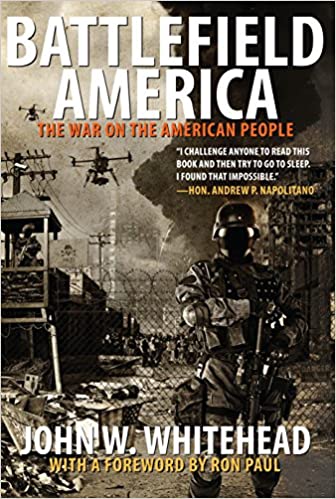
As I make clear in my book Battlefield America: The War on the American People and in its fictional counterpart The Erik Blair Diaries, the slippery slope begins in just this way, with propaganda campaigns about the public good being more important than individual liberty, and it ends with lockdowns and concentration camps.

The danger signs are everywhere.

ENDNOTE:

[1] Jenni Fink, “Utah Newspaper Pushes for National Guard to Block Unvaccinated From Socializing,” Newsweek (Jan. 17, 2022).
RedditEmail

John W. Whitehead, constitutional attorney and author, is founder and president of The Rutherford Institute. He wrote the book Battlefield America: The War on the American People (SelectBooks, 2015). He can be contacted at johnw@rutherford.orgNisha Whitehead is the Executive Director of The Rutherford Institute. Read other articles by John W. Whitehead and Nisha Whitehead.

THE GREATER EVIL WON

Some Thoughts on THE ELECTION


In the wake of the election — THE ELECTION, in capital letters and with strong emphasis — I have read many insightful and thoughtful assessments of how we have arrived at the point where Donald Trump was re-elected. I highly recommend the recent scathing essay by my colleague at Marxism-Leninism Today, Chris Townsend, on the crying need for an alternative to the two-party charade and the bankruptcy of the Democratic Party as a representative for working people.

But for every good analysis, there are a dozen awful commentaries that ultimately blame the voters’ judgment or endorse their worst fears.

However, if pressed for a simple explanation of the election results, one might consider the following:

Once again, offered the odious, devil’s choice between two candidates who are rich, elitist, and completely detached from “ordinary” people, the US voter chose a candidate who was rich, elitist, and completely detached from the lives and interests of most people. 

Of course, people want to know why the voters chose this particular rich elitist at this particular time. That question calls forth both a specific, practical response and a far deeper, concerning answer.

Polls and disregarded economic data show that most voters have a profoundly negative and often painful relationship with their economic status– they are not doing well. They typically punish incumbents when under economic distress. This should come as no surprise. But the highly paid consultants of both parties– with approaching two billion dollars to spend– chose to press many other issues as well and deal with the economy only superficially.

But in the end, exit polls show that economic distress played a decisive role in shaping voters’ choices. Apparently, the pundits forgot how persistent, value-sucking inflation led to the election of Ronald Reagan forty-four years ago.

Again, like today, the 1970s were a period of realignment. The Democrats had lost the South to the Republicans over desegregation and the Civil Rights legislation. After the Nixonian scandals associated with the Watergate burglaries and other dirty tricks, the Democrats won over suburbanites disgusted with Republican chicaneries– a demographic thought by many functionaries to be the needed replacement for the lost South.

In 1976, the Democrats swept in with a squeaky-clean, untarnished candidate, James Carter. With the decade-long stagflation coming to a climax, the Carter regime was short-lived; despite a rightward turn on his part, Carter was beaten by an ultra-right movie star turned politician, Ronald Reagan. Reagan was the default choice for voters wanting change after a lost decade.

For those who like their history repeating from tragedy to farce, consider the transition from the self-righteous old red-baiter, Ronald Reagan, to the pompous, supercilious windbag, Donald Trump. History has a wicked sense of humor.

Few pundits acknowledge that Democratic Party strategists decided in the 1980s that the future of the party would be determined by the interests and concerns of metropolitan voters, especially those in the suburban upper-middle stratum who were “super voters,” economically secure, and attuned to lifestyle and identity liberalism. While they represented the legacy of “white flight,” the suburbanites contradictorily espoused the urbanity of tolerance and personal choice.

Coincident with the embrace of the suburban vote, Democratic Party strategists saw no need to attend to past central components of their coalition: the working class and multi-class Blacks. Loyal union leaders would corral the working-class vote and ascendant Black leaders would rally African Americans of all classes.

Besides, it was believed that neither had any other place to go besides the Democratic Party.

Senate majority leader, Chuck Schumer, revealed this thinking in 2016, when he said: “For every blue-collar Democrat we lose in western Pennsylvania, we will pick up two moderate Republicans in the suburbs in Philadelphia, and you can repeat that in Ohio and Illinois and Wisconsin.” Even before that careless remark, both Hilary Clinton and Barack Obama– in moments of candor– revealed their contempt for working people outside of the metropolis.

This election stamped “paid” on this program, with nearly all the assumed components of the Democratic coalition drifting towards the Republicans.

The always insightful Adam Tooze, writing in The London Review of Books, concludes that the Democratic Party failings demonstrate “the high-achieving, insincere, vacuous incoherence that thrives at the top of the American political class.”

There is, however, a far deeper explanation of the Trump phenomenon seldom mentioned by mainstream commentators. Those who cite the specific issues of abortion rights, immigration, trans rights, crime, racism, etc.– issues that indeed played a role in the November election– neglect the fact that Trumpism is part of an international trend that infects the politics of such far-flung countries as India, Japan, and Argentina, as well as many European countries for often vastly different reasons. The rise of right populism in virtually all European countries– Orban’s Hungary, Meloni’s Italy, RN in France, AfD in Germany, Vox in Spain, Chega in Portugal, and similar parties in virtually every other European country– share one defining feature with the politics of India’s Modi and Argentina’s Milei: a rejection of centrist, traditional parties. 

Right populism rises as a response to the ineffectiveness of the politics of normality. It reflects the dissatisfaction with business as usual.

For hundreds of millions throughout the world, the twenty-first century has brought a series of crises eroding, even destroying their quality of life. Ruling classes have stubbornly refused to address these crises through the indifference of traditional bourgeois political parties. Voters have punished these parties by turning to opportunist right-populist formations that promise to give voice to their anger. Of course, this often takes the form of ugly, reprehensible claims and slogans– appealing to the basest of motives.

But it is not enough to denounce these backward policies without addressing the desperation that unfortunately popularizes those policies. It is not helpful to righteously raise the alarm of “fascism” if we fail to offer an alternative that will answer the hopelessness and misery that serves as the fertile soil for reaction.

From the tragedy of the Reagan election to the farce of the Trump re-election, we have suffered from two sham parties taking turns representing the “people,” while neither did. Isn’t it time for an independent people’s party– a party of the working class majority– that addresses the twenty-first century economic crises and their aftermath, the acute environmental crisis, the broken public health and health care systems, the insidious impoverishment of inflation, the crumbling infrastructure, and a host of other urgent demands, a party dedicated to serving the working people of the US and not its wealthy and powerful?

Greg Godels writes on current events, political economy, and the Communist movement from a Marxist-Leninist perspective. Read other articles by Greg, or visit Greg's website.


Kiribati Has Benefitted from Abolishing Its Military


David Swanson asked me to write about Kiribati after I wrote to him to point out Costa Rica is not the only “full-fledged and totally independent country to be entirely demilitarised.” Kiribati, and other small countries I suspect, have no military. In Kiribati’s case this was a deliberate decision taken by the first President and Government of Kiribati as it was becoming Independent in 1979. Like Costa Rica it has almost certainly benefitted from that foundational decision. Many other newly independent ex British colonies suffered from coups and military rule as a result of the British policy of promoting nationhood on the British model: Westminster type parliament, independent judiciary, and a military force. It was interesting interviewing Sir Ieremia Tabai, the first President and a leading campaigner at the time when it was an issue, stating that the motivation was heavily economic – we are a small country with very little money so we can’t go wasting it on buying guns. If only more leaders would adhere to such basic commonsense!

But first of all a bit of an introduction to Kiribati, as most people have never heard of us and even fewer know much about us. Kiribati sits right in the middle of the Pacific Ocean but tending to the Western side. It is the only country in the world with a claim to be in all four hemispheres, north, south, east and west, spanning as it does the Equator and the 180 meridian, the International Date Line. There are 33 islands spread over 3000kms from west to east along the Equator. The population is currently 130,000 and rising fast, with more than half living in the capital Tarawa. The population is over 90% ethnically homogenous Micronesian, I-Kiribati, with its own language and unique culture. Kiribati dance is a unique cultural form and is central in the culture, an integral part of every occasion from the opening of Parliament to weddings, birthdays, and public holidays. It is one of the main ways in which the culture preserves itself, the Kiribati diaspora using it as an excuse to come together wherever they are and teach it to the children.

Current revenue is predominantly from fishing licences for the right to fish in Kiribati’s vast Exclusive Economic Zone, mainly tuna. The country is very democratic with 45 MPs elected from all the islands who then choose Presidential candidates from amongst their number and these then go up for election by the whole country. The President, who sits for 4 years, barring a vote of no confidence, then chooses a Cabinet from amongst their supporters. The country is now on its fifth President in 45 years. Presidents can have a maximum of three terms. Despite being classified by the UN as a Least Developed State Kiribati has free universal education and health provision, a form of Universal Basic Income, state provision for disabled people, and a non-contributary pension scheme for all those over 60. While some of these benefits are well below the standards provided in more wealthy countries they all represeent advances on previous times. Kiribati has a sovereign wealth fund of $1.5 billion and receives foreign aid from countries such as Australia, New Zealand, China, Japan, Korea, the USA, Cuba, the UN, and the EU. The logistics of Kiribati ensure that it is never likely to become a developed state: the isolation and distances involved, and the consequent difficulties of providing services to tiny communities of only a few hundred people separated by thousands of kilometres ensuring that it continues to be underdeveloped, by world standards.

Isolation has not prevented Kiribati from suffering the depradations of colonialism, militarism, and capitalism. The islands were initially settled by various waves of settlement over the past few thousand years resulting in a homogenous culture and language developed over that timescale. Western Europeans started to arrive in the 19th century, particularly whalers operating out of America and elsewhere which started the first great exploitation, decimating the whale population which has not recovered to this day. This was followed at the turn of the 20th century by the beginning of phosphate mining on Banaba, or Ocean Island as it was called by the British. Banaba was mined to such an extent that its inhabitants were forced to resettle on another island which had been bought for them with their own money. It has been suggested that Banaba’s phosphate was used to subsidise the exponential growth of agriculture in Australia and New Zealand, Britain’s partners in exploiting Kiribati, to the tune of $800 million until the phosphate ran out in 1979, the year of Kiribati independence from Britain. Banaban phosphate royalties also covered the cost of Britain’s colonial administration of the Kiribati.

During WWII, the Japanese invaded Kiribati and fortified one island heavily which then became the site of one of the first major battles of the Pacific war when it was retaken by the Americans at the Battle of Tarawa. In the post WWII decades the British used Kiribati as a nuclear testing ground, doing atmospheric tests on Kiritimati Island in the late 1950s and early 1960s. The U.S. tested its bombs on Bikini and Eniwetok in the Marshall Islands immediately north of Kiribati, while the French tested theirs in Muroroa to the south, inflicting on Kiribati and its Pacific island neighbours what Western nations’ own populations refused to accept.

Whilst fishing revenues are now the basis of the Kiribati economy, it is also true that this is the main way in which the country is exploited as its fishing licence revenues are only a small percentage of the profits gained by foreign fishing companies fishing in its EEZ. Kiribati has had to work hard, along with other Pacific countries, Parties to the Nauru Agreement (PNU), to get even the comparatively small amount it gets in licences, gradually building on its success in forcing American fishing fleets to pay in the mid-1980s. Faced by the complete refusal of U.S. fishing companies to pay for fishing in Kiribati waters Kiribati sold the fishing rights to the Russians, exploiting their superpower rivalry so effectively that the following year the U.S. started to pay as prescribed by the UN Convention on the Law of the Sea(UNCLOS) – a great example of a microstate manipulating two superpowers to achieve its own ends!

Although to date Kiribati has suffered little from climate change it is quite possible that this could provide an existential threat in the future if ocean acidification and temperature increases, sea level rise and weather pattern change combine to make life impossible and cause dispersal of Kiribati’s people, despite Kiribati having made minuscule contributions to the causes.

Kiribati has hosted visits from foreign warships from the U.S., China, Taiwan, Australia, France and others but these are courtesy visits often bringing medical and other teams to share their expertise. Kiribati benefits from the assistance of an Australian patrol boat to police its EEZ and has occasionally held fishing boats illegally fishing in Kiribati waters. It also benefits from New Zealand Air Force search and rescue teams assisting searches for missing fishermen.

Pacific countries generally, and Kiribati particularly, are seen by the United States and its allies as being stategically important in their geo-political rivalry with China – or their need to have an enemy in order to justify their military spending and safeguard the profits of the military industrial complex. Whenever Kiribati is mentioned in articles and programmes in the Western media it is usually accompanied by references to its strategic significance and the threat of it being taken over by China, particularly over recent years since 2019 when Kiribati returned its diplomatic recognition to China following recognition of Taiwan in 2003. The fear seems to be that Kiribati will allow China to build ports and airbases from which China would be able to attack the United States and disrupt trade, although neither Kiribati nor China has shown any inclination to do this, a case it seems of the pot calling the kettle black. The United States has multiple military bases in the Pacific, and indeed throughout the world, and seems to think that everyone else wants to waste money and resources in the same way. Following the switch from Taiwan to China in 2019 the U.S. has been keen to make connections in Kiribati but has been thwarted by the lack of a military it can entice with hardware and a shortage of land in the capital Tarawa where it could build an Embassy. Kiribati sees itself as a Christian country and is naturally culturally connected to the U.S. – its first missionaries were American. U.S. churches have a strong presence in the country. It was liberated by U.S. forces defeating the Japanese in World War II. It has benefitted in the past from Peace Corps volunteers. And its official language is English which makes it part of the Anglophone world. There is a Kiribati diaspora including communities in the U.S. At the same time, the people of Kiribati have no wish to be controlled by any foreign power, and resent any country that interferes with Kiribati’s independence. Experience has also taught Kiribati that it can exploit rivalry for its own benefit. The dangers for Kiribati in this are that should the rivalry escalate to war it is likely that rival powers would prefer to fight in somewhere like Kiribati rather than in their own countries.

Whilst thinking about writing this article it occurred to me that a major benefit of Kiribati’s lack of a military is the lack of guns in the country. I can’t remember anyone ever having been shot, and on asking around I found that no one else could either – hardly surprising as there are no guns to shoot with! This was not always the case. Early contact with Europeans, mainly whalers and traders, was characterised by a trade in tobacco, alcohol, guns, and metal — knives, pots and pans, nails etc. Various chiefs and factions acquired guns to gain an advantage over local rivals, which led to a number of conflicts on and between different islands in the latter half of the 19th century. This came to an end however with the declaration of a Protectorate by the British in 1892 when HMS Royalist raised the Union Jack on all the different islands and rounded up all the guns at the same time.

It feels to me that Kiribati has much to teach the world. Its culture is very communal with an expectation that we should help each other, most strongly within the extended family but also on a wider level. Strangers and visitors are welcomed and treated very well. There are hundreds, probably thousands, of maneabas, communal meeting houses where everybody is welcome, often offering accomodation to anyone who needs it. The expectation is that decisions should be reached by consensus. Most houses are not locked and many are indeed open sided without walls. Kiribati clearly demonstrates the benefits of any people having their own space over which they have control and which they can call their own, without being dominated or subjugated by other ethnicities — a principle which if applied worldwide would lead to the break up of bullying superpowers and other countries that have usually been created through conquest. We could see hundreds, or indeed thousands, of states offering all peoples their own autonomy within a cooperative world framework. Many conflicts in the world are caused by the domination of one group by another within the confines of a larger state, whether that be the Palestinians in Israel, the indigenous peoples of the Americas within their colonised lands, the Rohingya in Myanmar/Bangladesh, the Uyghers in China, the Basques and Catalans in Spain, the Kurds within Iran, Iraq, and Turkey, the West Papuans in Indonesia, or innumerable ethnicities within the colonial imposed boundaries of Africa.

In conclusion, it is worth reiterating the main benefits of Kiribati’s lack of a military. Ieremia insisted that the rationale was wholly economic – we cannot afford to spend money financing a military as that will deprive far more essential services such as education and health of much needed resources. And who is going to attack us anyway out here in the middle of the ocean? The other benefits, which are difficult to be so sure about, include the political stability that has allowed peaceful development and the unchallenged primacy of the democratic electoral system without interference from unelected military officers enforced by soldiers. Then there is the lack of a gun culture leading to completely unnecessary deaths. It is difficult to imagine any advantages that would be gained by having a military!

Richard Westra is Designated Associate Professor, Graduate School of Law, Nagoya University, Nagoya, Japan. His work has been published in numerous international refereed journals. He is author and editor of 10 books including Confronting Global Neoliberalism: Third World Resistance and Development Strategies, Clarity Press 2010. Read other articles by Richard.

FUCK THE ROYALS 

Intimidation and Abuses Fuel Fears of Prince Harry Charity Investigation “Whitewash”


Baka men stand in front of house in resettlement areaTwo Baka men from a community who were evicted to make way for Odzala-Kokoua National Park. Many people in the village have been beaten or abused by park rangers. “We are afraid that if park rangers see us in the forest they will beat us.” © Survival

Campaigners have voiced concerns that an investigation into African Parks, the charity whose figurehead is Prince Harry, may result in a whitewash.

The investigation by Omnia Strategy, a law firm established by Cherie Blair KC, was launched in 2023 following Survival’s complaints to African Parks, its board member Prince Harry and its funders about horrific abuses in Congo’s Odzala-Kokoua National Park. Survival first raised abuses with African Parks staff ten years ago and the organization has publicly acknowledged recent incidents.

The abuses, including beatings, torture and rape, have been committed by rangers employed by African Parks, against the Indigenous Baka people whose ancestral forest has been taken over by the park. They triggered a global media outcry.

Prince Harry speaks at African Parks event with Katie Couric

Prince Harry speaks at an African Parks event in New York City in 2024. He has continued to promote African Parks even while the investigation is ongoing. © Sussex.com

In recent months:

  • Survival has received reports of intimidation of Baka people by African Parks guards just before the investigation began on the ground. At least two Baka people, who have given information about abuses at the hands of guards, describe being confronted by park rangers who questioned their motives for reporting the abuses, and threatened them.
  • The investigators arrived to interview Baka victims of abuse in an African Parks car, and were accompanied by a Congolese government official. This risks a chilling effect on the Baka’s willingness to speak openly.
  • Survival has received shocking reports of further beatings of a group of Baka women and children by African Parks rangers, which resulted in one Baka woman losing her unborn child. This took place as the investigation was ongoing, suggesting that the guards still believe they can act with impunity.

Despite Survival’s requests, African Parks has still made no commitment to publish the results of Omnia’s investigation, or to implement its recommendations.

New details have also emerged, as the investigation is ongoing, into how African Parks stands to make millions of dollars from its management of Odzala-Kokoua and other Protected Areas, by selling biodiversity credits, which it calls “Verifiable Nature Units, (VNUs)” and carbon credits. African Parks says its pilot projects, including Odzala, “aim to issue VNUs for 2024 and 2025.”

A recent book by investigative journalist Olivier van Beemen has also raised concerns about African Parks’s willingness to deal with “independent investigations”. Van Beemen quotes a source, describing previous evaluation experiences: “There is so much fear of AP that some people I know as very professional experts write wishy-washy reports in which they gloss over the reality… You don’t bite the hand that feeds you.”

Survival International’s Director Caroline Pearce said today: “Survival shared our concerns with Omnia regarding the scope and methodology of their investigation, and invited the investigation team to look more broadly at the racist and colonial fortress conservation model underpinning African Parks’ management of Odzala.

“Our concerns have not been resolved, and as the whole basis through which African Parks has come to control so much Indigenous land is allowed to go unchallenged, it means that, whatever the result of the investigation, it won’t help the Baka get their land back – and that is absolutely vital for their livelihoods, wellbeing and very existence as a people.

“Previous investigations paid for by conservation organizations such as WWF have shown that the conservation industry is more than ready to ignore the results, or whitewash the findings, with total impunity in the absence of clear rules or a commitment to fundamental change.

“Not only that, but while this investigation drags on, the abuses are apparently continuing unabated. Survival will continue to fight alongside the victims of African Parks and the conservation industry to ensure they get justice.”

Survival International, founded in 1969 after an article by Norman Lewis in the UK's Sunday Times highlighted the massacres, land thefts and genocide taking place in Brazilian Amazonia, is the only international organization supporting tribal peoples worldwide. Contact Survival International at: info@survival-international.orgRead other articles by Survival International, or visit Survival International's website.


Existence and Isolation

Dr. Samantha Bailey – The Truth About Contagion

A Farewell to Virology
Dr. Mark Bailey’s comprehensive essay, “A Farewell to Virology,” is a scathing critique of the virus model and virology as a whole. The expert edition, published in July 2024, presents a compelling case against the scientific community’s claims about viruses causing disease. According to Bailey, the evidence supporting this notion is lacking, and virology has consistently failed to meet its own requirements.

Key Points
Virology’s virus model is flawed and lacks scientific backing for its claims about viruses causing disease.

Bailey’s essay is a 67-page refutation of the virus model, which has been condensed into a 19-page Word document for easier consumption.

The essay has been praised for its thoroughness and has been described as a “stellar gem” and a “masterpiece” by experts in the field.

Mark Bailey’s work has been adapted into a 3-part documentary series by Steve Falconer, providing a captivating visual representation of the essay’s findings.

Impact
Bailey’s critique has sparked significant discussion and debate within the scientific community, with some experts labeling it the “medical establishment’s worst nightmare.”

The essay has been shared and discussed on online platforms, including Reddit’s r/Whatsyourtheory, where it has been praised for its thoroughness and critical thinking.

Overall, Mark Bailey’s “A Farewell to Virology” is a groundbreaking work that challenges the conventional wisdom on viruses and disease. Its impact has been significant, sparking important conversations and debates within the scientific community.

Allen Forrest is a writer, painter, graphic artist and activist. He has created covers and illustrations for literary publications and books, is the winner of the Leslie Jacoby Honor for Art at San Jose State University's Reed Magazine for 2015, and his Bel Red landscape paintings are part of the Bellevue College Foundation's permanent art collection in Bellevue, WA. He lives in Vancouver, BC, Canada. Read other articles by Allen, or visit Allen's website.


On the Maryhouse Stage, Power Politics and War


Living theater poses crucial questions about consequences of war and potential to abolish it


Art work by Robert Shetterly, taken from the playbill for “Reap What You Sow”

In mid-November, New York’s Catholic Worker community, located in lower Manhattan, opened their sizable auditorium to host “Reap What You Sow: Don’t Lose Heart!” a two act play with two actors which debuted, for two nights, on the Maryhouse stage.

Prior to the performance, preparations included selecting the sturdiest wooden chairs for audience seating, carefully cleaning furniture and floors, and rearranging the space so the next issue of the Catholic Worker newspaper, stacked and ready to mail, wouldn’t interfere with access to the theater. Producers created a set which included curtains made of sheets, an assemblage of donated lights, and a small coffeemaker complete with loud gurgles.

Above were the exposed beams of a building which once functioned as a music school in turn-of-the-century New York City before Dorothy Day and Peter Maurin, founders of the Catholic Worker, appropriated it for works of mercy, feeding hungry people and, as much as possible, housing people in the building’s former musical practice rooms.

It was a fitting spot for the play’s debut. Jack Gilroy, the main author, had created earlier versions. Now the play, authored by Gilroy, zool Zulkowitz, and Olivia Gilroy incorporates the dynamics of “living theater” as actors and activists have fed Gilroy their edits.

The audience were mainly elders who knew one another. Catholic Workers welcomed  Maryknoll Mission sisters, Veterans For Peace, Raging Grannies, and people from Peace Action, World BEYOND War, Code Pink and FOR.

A sprinkling of students from Columbia U. and Fordham, along with a prof from Manhattan College, accompanied by his small son, were also in attendance.

Before the play began, producer zool Zulkowitz played the Beatles’ iconic song, Imagine. Following this came Olivia Rodrigo’s song, Brutal.

Ellie (played by Grazia Saporito) then broke into athletic, riveting dance moves to open the play.

She and her mother, Major Mom, (played by Pat Russell), were winning characters. Tears glistened on Major Mom’s cheeks when she spoke of her experiences as a mother, a widow, and a woman warrior who deeply regretted having killed civilians during missions in which she piloted weaponized drones. The audience learns she was married to Lieutenant Colonel Sean Golden, a marine who died during combat in Iraq. The Major eagerly awaits a promotion to full “Bird Colonel.”

Showing remarkable patience, Major Mom listens to Ellie divulge childhood disappointments, teenage angst, and her current rage over the roles her parents played in “service” to the U.S. military. At one point, Major Mom says “Whoa,” and accuses Ellie of going too far in her accusations.

But Ellie, a debate team champ, doesn’t back down. She has evidence to show that her mom’s “arsenal of democracy” rhetoric and revitalization of World War II themes don’t stand up to actual events in the recent past.

In a way, the play’s two characters are each proxies for fully developed viewpoints. Major Mom represents the Merchants of Death who develop, store, sell and use vast arsenals of weaponry. Ellie champions viewpoints laid out in Howard Zinn’s comprehensive historical outlay, “A People’s History of the United States.”

With Ellie rebelling against revival of World War II rhetoric, the play becomes quite timely. She insists that the good Germans who supported Nazis have counterparts in the U.S. militarists who “take out” women and children in multiple war zones. The claim, “I was only following orders,” eerily enters the script.

Many of the people in the audience have, in the past, supported activists who were recently imprisoned in U.S. federal lockups for having trespassed at a U.S. base harboring nuclear weapons. One of the activists, Carmen Trotta, came to both performances. Plowshares activists literally beat swords into plowshares, damaging nuclear weapons and pouring their own blood over the decommissioned weapons. They believe in making sacrifices, themselves, on behalf of nonviolence, a theme which recurs in Gilroy’s play.

During a dynamic talk back session, actors, producers, and audience members grappled with questions about conscience and pragmatic steps forward. Ellie, still acting in character, urged people to use their imagination and practice empathy. Art, she said, will be the force that carries us through to a new, safe time. Major Mom, (Pat Russell) pointed to the damage caused by structural and systemic violence. Audience members repeatedly voiced outrage over U.S. support for Israel’s genocidal attacks against Palestinians, noting that democrats dared to warn of fascist encroachment while at the same time enabling and provisioning Israel’s mass killing spree, across the Middle East. Israel’s usage of weaponized drones prolongs and exacerbates a war waged by a racist, far-right, nuclear armed, apartheid regime, one to which the U.S. continues to pledge unwavering support.

It seemed all could agree that, as Adam Tooze, writing for the London Review of Books observes:

We should be under no illusion: there has been nothing like this level of threat since the dangerous final phase of the Cold War in the early 1980s. With China committed to a rapid buildup of its nuclear arsenal, we are well on the way to an unprecedented 3-way nuclear standoff.

The characters in Reap What You Sow recognized pivots in their relationships and their interactions, and they assiduously preserved caring relationships. Powerful elites in our world have comprehensively failed to find means for collaboration, opting instead to demonize enemies for their own political gain, pouring energy and resources into the coffers of people whose “top crop” is weaponry. President Biden refuses to negotiate with Putin, and Ukraine has already fired long range missiles, supplied by the U.S., into Russia, sowing ominous seeks which Putin has stated could yield a nuclear exchange.

I hope the play will awaken numerous people, in audiences across this country and beyond, to the crucial question: how can we learn to live together without killing one another? And the follow-up: how can we abolish war?

Reap What You Sow, Don’t Lose Heart is the first production of the Rising Together Talkback Theater Company. The production is available, for FREE, to churches, schools, peace and justice organizations, and other community groups. The company is booking dates for a Summer 2025 “Reap!” Tour. For more information, contact Zool (moc.liamtoh@scitiloPdnAtrAehT) or text 718-964-7643.FacebookTwitterRedditEmail

Kathy Kelly (kathy.vcnv@gmail.com) is the board president of World BEYOND War (worldbeyondwar.org) and a co-coordinator of the Merchants of Death War Crimes Tribunal. (merchantsofdeath.org). Read other articles by Kathy.