Tuesday, June 02, 2026

After The Fanfare: Beijing’s Reading Of The Trump-Xi Summit – Analysis

President Donald J. Trump participates in a bilateral tea with President Xi Jinping of the People’s Republic of China, Thursday, Friday, May 15, 2026, at Zhongnanhai in Beijing, China. (Official White House Photo by Daniel Torok)

June 2, 2026 
Observer Research Foundation
By Kalpit A. Mankikar

With the pomp and pageantry surrounding United States President Donald Trump’s meeting with his Chinese counterpart now receding in the public imagination, the brass tacks of their bilateral relationship are coming into sharper focus.

The two nations have resolved to pursue a “constructive relationship of strategic stability.” A Xinhua commentary deciphers the construct as “cooperation being the mainstay,” with competition kept in check, differences moderated, and lasting stability with peace charting the new direction of the Sino-American relationship. While Trump has billed his summit in Beijing with Chinese President Xi Jinping as “historic,” the tenor of the language in Chinese reportage suggests that Beijing sees it as a work in progress, noting that both sides are “consulting” on the details.

The Trump administration grounds the “historic” nature of the summit with China in Beijing’s commitment to purchase 200 Boeing aircraft — the first such deal since 2017 — which is expected to generate skilled jobs in American manufacturing, along with China’s resumption of poultry imports, pledges to purchase farm products worth $17 billion annually over the next two years, and the honouring of previous soybean purchase commitments made in October 2025. On agricultural purchases, China stated that an agreement was reached to promote the “expansion” of two-way trade across sectors, including agricultural products, through the “mutual reduction of tariffs” on a range of goods, and to actively “push to resolve” US concerns regarding Chinese poultry imports.


On official bilateral mechanisms for managing economic engagement, the White House envisages a US-China Board of Trade to manage trade across non-sensitive products, and a US-China Board of Investment as a government-to-government platform for capital flows. Beijing envisions the trade body as a framework for reciprocal tariff reductions, with goods worth US$30 billion identified for trading at relatively lower tariff rates. The mechanism is also being framed as a platform for addressing mutual concerns in trade and investment, shifting bilateral dynamics from “crisis response” to “institutionalised management,” and providing effective institutional safeguards for economic cooperation. Huang Jing of Shanghai International Studies University argues that such institutional mechanisms effectively lay to rest the campaign to minimise China’s participation in international supply chains — an effort initiated during the Trump 1.0 and Biden administrations — with the US tacitly conceding that this approach is unsustainable. In the pivot from decoupling to renewed economic engagement, the Chinese sense a victory.

On the issue of rare earths, China unveiled sweeping rules in October 2025 that tightened controls on components integral to technology supply chains — including artificial diamonds with industrial uses — and placed rare earths such as holmium, erbium, thulium, europium, and ytterbium on an export-control list, along with equipment used in the production and processing of these materials and in the manufacture of magnets. At Xi’s meeting with Trump in South Korea in October 2025, the White House announced that China had committed to eliminating both “current” and “proposed” export controls on rare earth elements and other critical minerals. Following that summit, Beijing pledged to suspend for one year the export restrictions instituted in October 2025. Following the Beijing summit, while the White House stated that China would “address US concerns” regarding both supply chain shortages related to rare earths — specifically yttrium, scandium, neodymium, and indium — and curbs on the sale of rare earth production and processing equipment, China’s Ministry of Commerce has committed only to working with the US to ensure the security and stability of global supply chains.


Meanwhile, Beijing’s strategists have been assessing the factors behind the rapprochement and the evolving nature of Sino-American relations. Huang Jing notes that the current period has been the most challenging for Trump: his military strike against Venezuela has eroded America’s moral standing in international affairs, and his war against Iran has lacked international legitimacy and support even from US allies, deepening America’s isolation. Huang thus concludes that Washington has “acknowledged” power parity with Beijing — a development that marks a turning point in the dynamics between the two nations — giving rise to the notion of competitive coexistence under the framework of constructive strategic stability.

Ding Yifan from Renmin University’s Institute of Global Governance and Development argues that the US has beenhumbled” by a comparatively weaker power in Iran, and that Trump has been unable to resolve the stalemate of the Strait of Hormuz blockade — which has led him to “swallow his pride” and engage with China to “boost his ratings ahead of the US midterm elections”. Incidentally, the minutes of the Trump-Xi summit released by the White House highlight agreement on keeping the Strait of Hormuz open for energy trade, China’s opposition to the militarisation of the Strait and to attempts to charge a toll for passage, and opposition to Iran acquiring a nuclear weapon. However, the Chinese readout of the summit merely notes that the two leaders “exchanged views” on issues including the Middle East situation, the Ukraine crisis, and the Korean Peninsula.

A common sentiment among Chinese strategic thinkers is that the diplomatic history of the US and China can be divided into two phases: from 1972 to 2017, marked by a mix of cooperation and competition, and from 2018 onwards, characterised by “comprehensive strategic competition.” Towards the end of 2017, the first Trump administration released its National Security Strategy, which categorised Beijing as challenging Washington’s power and interests and undermining its security — developments that necessitated a revision of US engagement policy towards its rival. The Chinese establishment later complained that relations had deteriorated since the US had begun hyping the “China threat theory“, imposing technology curbs, and allegedly interfering in China’s internal affairs. There is a belief that the US sought to exploitissues related to Xinjiang, Tibet, Taiwan, and Hong Kong, in addition to forging blocs such as AUKUS with Australia and the UK, and the Quadrilateral Security Dialogue with Australia, India, and Japan.


Professor Jin Canrong from Renmin University — a seasoned scholar of US-China relations — posits that the current construct of a “constructive relationship of strategic stability” is the foundation of equalitybetween the two nations, and has ushered in a phase of relative equilibrium. Jin argues that China has pushed back against the US across the spheres of tariffs, industry, technology, and the military on the basis of its intrinsic strength, yielding tangible results in 2026 — an allusion to the Trump-Xi Beijing summit. He notes that the US tariff war against China led to shortages of goods in America that hurt consumers; that technology curbs spurred a campaign for self-reliance and home-grown innovation in China, exemplified by DeepSeek, developed at a fraction of the cost of US alternatives; and that China’s “success” in military modernisation was showcased at the People’s Liberation Army parade in September 2025. These “accomplishments” are seen by Beijing as the factors that compelled Trump to “respect” China.

To conclude, it is becoming increasingly clear that despite sustained negotiations, Beijing’s export-control regime remains firmly in its arsenal, and that it can weaponise economic resources at will to achieve its geopolitical aims. Second, Beijing’s strategists perceive Trump as bogged down by myriad conflicts in Europe and West Asia and enfeebled by a rupture in his alliance system; China, by contrast, has withstood tariffs, technology curbs, and sustained geopolitical pressure. This buoyant outlook in Beijing has led Xi to underline that Taiwan is the “most important issue” in the bilateral relationship. Xi has cautioned Trump that any mishandling of Taiwan carries the risk of conflict, with the potential to jeopardise the broader bilateral relationship. Whether China’s confident self-image will unsettle the Asian security architecture is a question that will only be answered in time.

About the author: Kalpit A. Mankikar is a Fellow with the Strategic Studies Programme at the Observer Research Foundation.

Source: This article was published by the Observer Research Foundation.
Navigating The Maritime Gray Zone – Analysis


File photo of China's Yuan Wang 2 ship, used for tracking and support of satellite and intercontinental ballistic missiles.

 Photo Credit: Gadfium, Wikipedia Commons


June 2, 2026
By Indo-Pacific Defense Forum

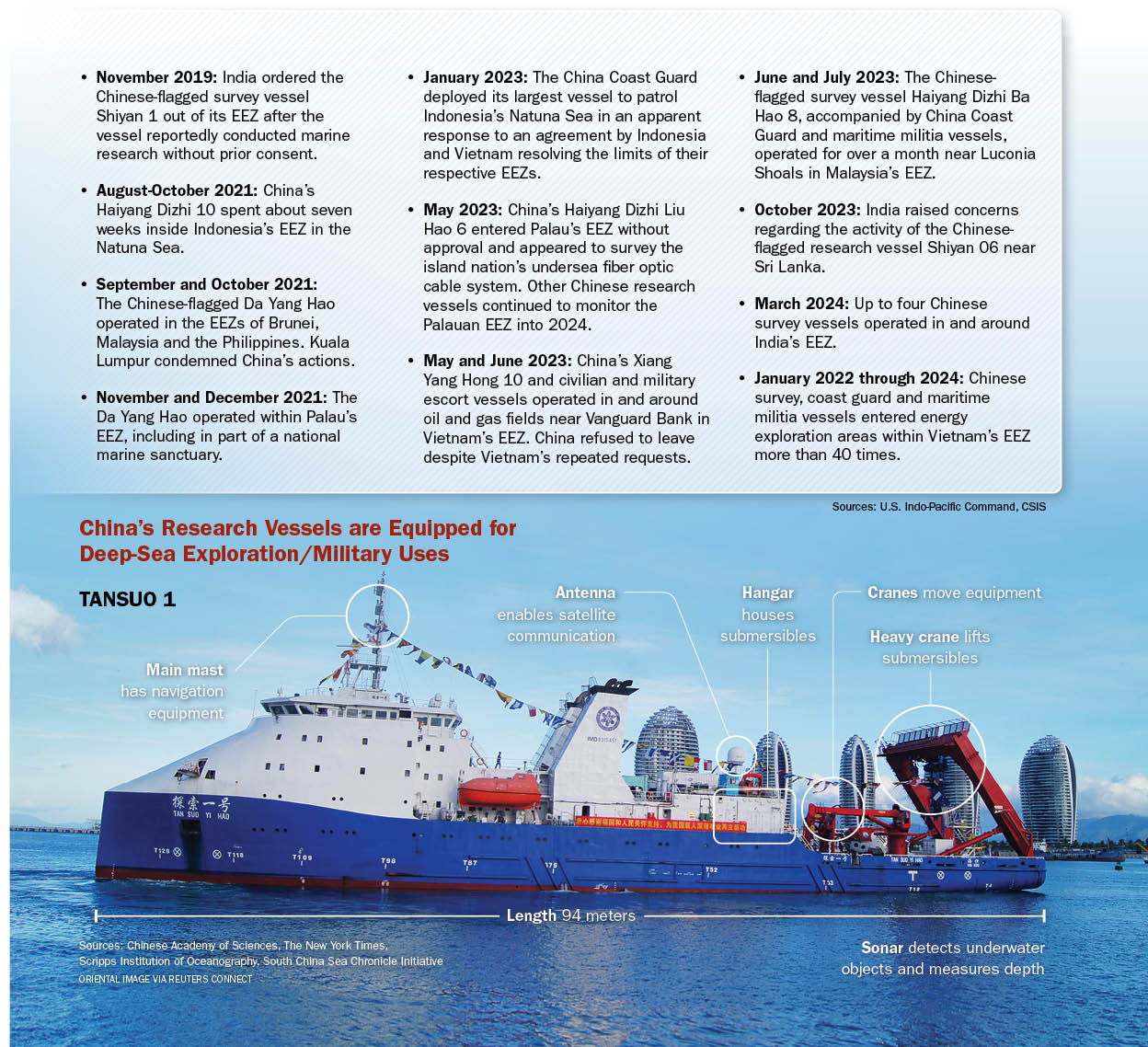
China’s posture in the Indo-Pacific includes the deployment of research vessels under civilian guise but designed for military exploitation. Increasingly, these vessels collect marine data in the region’s disputed waters. Although Beijing calls the survey trips scientific research, the excursions often mask intelligence gathering of military value — particularly near the United States territory of Guam, the Philippines and self-governed Taiwan.

Understanding this dual-use phenomenon is crucial for anticipating operational challenges, advising policy, and supporting deterrence and resilience for the U.S. and its Allies and Partners. This is true especially for those along the so-called first island chain, a string of major Pacific archipelagos that runs from Japan south through Taiwan, the Philippines and on to Borneo, forming a strategic barrier off China’s mainland. China, however, also increasingly collects extensive data farther from its shores, stretching from the Indian Ocean to the South Pacific.

“In truth, all maritime data collection is dual use — it could have useful oceanographic, climate, scientific uses; but it can also have military uses. I’m overall suspicious about China’s intent in the region,” Bruce Jones, a senior fellow at the Washington, D.C.-based Brookings Institution, told FORUM. He is studying China’s ocean research effort.

China operates one of the world’s largest fleets of civilian oceanographic research vessels, analysts say. The Center for Strategic and International Studies (CSIS) reported in 2024 that “of the 64 active vessels, over 80% have demonstrated suspect behavior or possess organizational links suggesting their involvement in advancing Beijing’s geopolitical agenda,” indicating dual-use capabilities at scale.


The strategic opaqueness of China’s research ship operations challenges monitoring, complicates defensive postures and advances excessive maritime claims, analysts say. The vessels frequently operate in contested waters, gathering data on bathymetry (water depth), seafloor structure and oceanographic conditions — information that the People’s Liberation Army (PLA) can leverage for submarine operations, amphibious planning, and mine and antisurface warfare.

In November 2025, for instance, China deployed three dual-use research vessels in the Indian Ocean. India’s maritime surveillance agencies monitored the ships, which included the Shi Yan 6, Shen Hai Yi Hao and Lan Hai 201. “Such deployments typically prompt diplomatic caution and potential denial of port calls at Indian facilities, as seen in earlier instances involving similar Chinese missions,” Indian Defence News reported. The Indian Coast Guard and Navy reported the constant presence of Chinese research vessels in recent years near India’s waters.

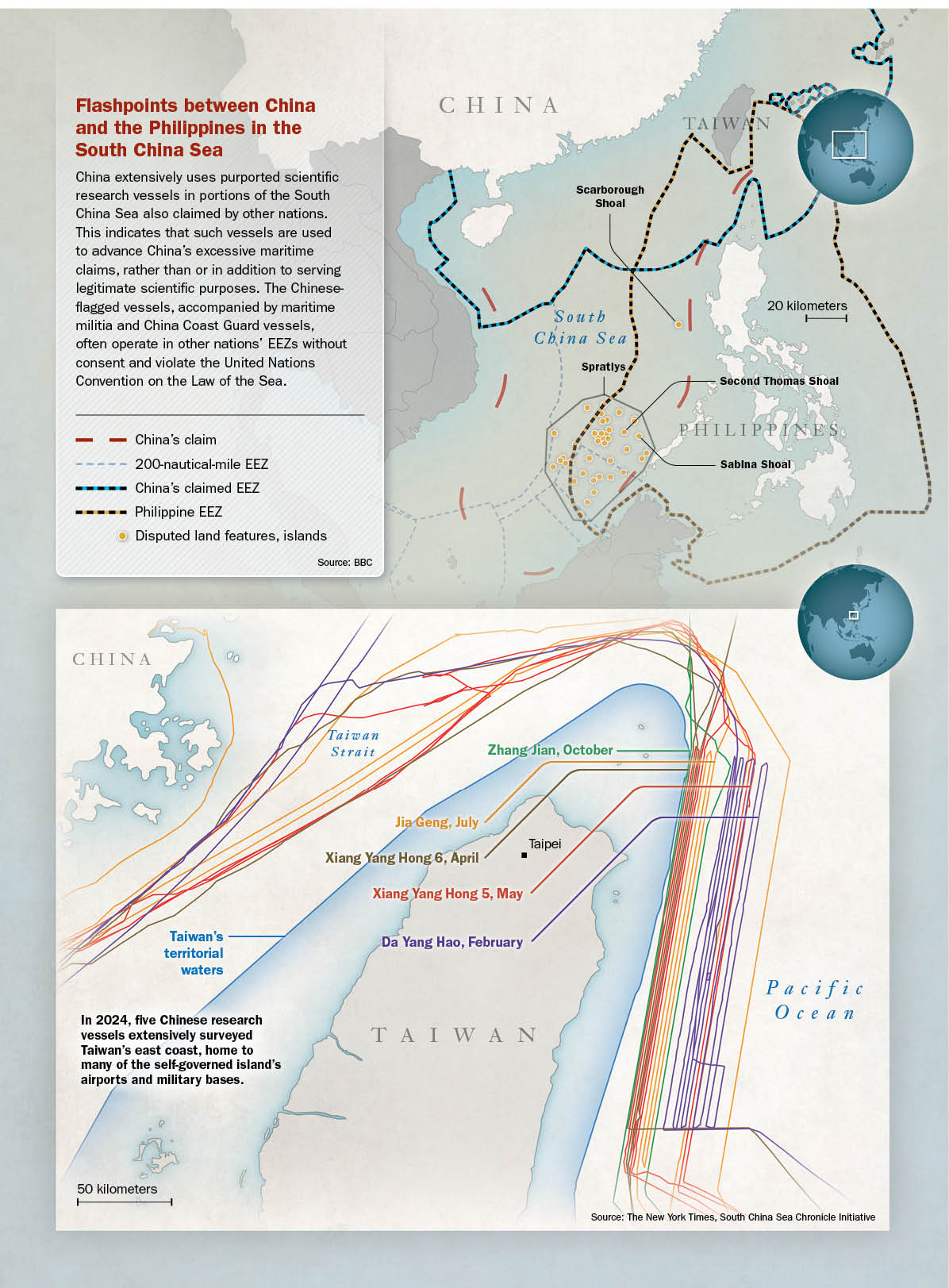
The Haiyang Dizhi 8, as another example, conducted oil and gas surveys off Vietnam’s coast for four months without authorization, highlighting how the vessels can penetrate contested maritime zones under the cover of scientific legitimacy, according to the CSIS’s Asia Maritime Transparency Initiative. The Xiang Yang Hong 6 also exemplifies China’s dual purposes. The vessel and five others made 25 passes in parallel lines off Taiwan’s east coast in 2024, conducting systematic seabed surveys, according to Starboard Maritime Intelligence data cited by The New York Times newspaper in July 2025.


“It’s hard for us to view this situation as normal,” Kuan Bi-ling, the minister of Taiwan’s Ocean Affairs Council, told The New York Times.

The same ships have been active around Guam — home to vital U.S. military installations — collecting data relevant to submarine operations. “It appears that China is trying to collect bathymetric data on that part of the ocean without appearing like it is conducting a bathymetric survey,” Ryan D. Martinson, an assistant professor and expert on Chinese research ships at the U.S. Naval War College, told the newspaper.

Such activities are emblematic of China’s gray-zone tactics, coercive state actions that fall short of open warfare. China views such activity as “a natural extension of how countries exercise power [to] pressure countries to act according to Beijing’s interests [and] without triggering backlash or conflict,” according to a 2022 Rand Corp. report, “A New Framework for Understanding and Countering China’s Gray Zone Tactics.”

Similarly, a June 2023 article published by the SeaLight research initiative noted that “China’s deployment of research and survey vessels in contested waters is a key component of its maritime gray-zone strategy. These vessels, often presented as civilian or scientific, are frequently state-owned or operated by entities with close military ties.” For example, the Chinese Academy of Sciences and China’s Natural Resources Ministry operate research vessels and have PLA cooperation agreements, CSIS reported. The U.S.-based SeaLight uses commercially available technology to expose maritime gray-zone activities.

China has increased marine data collection throughout key Indo-Pacific waters, sometimes disregarding international law that requires coastal state consent for research inside that nation’s exclusive economic zone (EEZ), the U.S. Indo-Pacific Command (USINDOPACOM) reported in July 2025. This pattern reflects a wider lawfare campaign designed to normalize excessive maritime claims while undermining the sovereign rights of coastal states, the report said.

“There are both legal and illegal and aggressive/nonaggressive ways to enter other countries’ EEZs. China is doing a lot of all of the above,” Jones said. “Their behavior is aggressive because it’s aggressive, not because it is/isn’t a violation of the law of the sea.”


South China Sea Surveillance

China’s survey vessels, operating within the EEZs of nations such as the Philippines, obtain maritime domain awareness in contested areas. They reinforce Beijing’s ability to map and exploit the seabed, with implications for mining, anti-submarine warfare and undersea infrastructure monitoring, among other ventures.

Moreover, these activities are part of a convergence of maritime coercion. China’s gray-zone campaigns often establish localized “advantages [for China] that can be sustained over time without precipitating acute crisis,” Isaac Kardon, a senior fellow at the Carnegie Endowment’s Asia Program, testified in June 2024 before the U.S. Congress.

This sustained presence in waters near the Philippines, Taiwan and other areas seeks to normalize China’s maritime coercion and erode the strategic threshold for escalation. “If you look at China’s coast guard and its maritime militia over the last three years — you would see a dramatic increase in the number of ships and the depth of the penetration,” SeaLight Director Ray Powell told The Wall Street Journal newspaper in March 2025. “It’s taken on the character of a maritime occupation.”

For example, China’s ships have made multiple incursions at the contested Sabina Shoal within Manila’s EEZ. In April 2024, the Philippines raised its flag at the shoal to assert sovereignty, prompting China’s deployment of a massive 12,000-ton Coast Guard vessel. Such events typify the pattern: China’s civilian or paramilitary-type vessels enter other nations’ claimed waters to consolidate their presence, gather environmental or hydrographic data, or prepare a pretext for sustained operations.

In May 2025, the Philippines deployed a Coast Guard vessel and aircraft to track a Chinese research ship operating illegally in its EEZ. Manila declared China’s activity a sovereignty violation. The incident reflects China’s strategy of ignoring its obligations as a signatory to the United Nations Convention on the Law of the Sea while pressing its arbitrary and excessive claims.


By pairing scientific vessels with China Coast Guard and maritime militia escorts, Beijing multiplies the coercive effect. The actions show the PLA’s growing use of undersea terrain data to support operations that threaten a free, secure and prosperous Indo-Pacific, analysts say.

China’s alarming gray-zone maritime strategy leverages civilian, paramilitary and military assets, including research and fishing vessels, to exert control over contested zones. This multilayered coercion erodes norms and reinforces China’s maritime claims incrementally. Such operations allow the Chinese Communist Party (CCP) to coerce “while avoiding a conventional military response from the United States and its allies,” notes the November 2024 Rand Corp. report “Understanding and Countering China’s Maritime Gray Zone Operations.” The report recommends enhanced presence, transparency initiatives and allied coordination as deterrent measures.


Masked Intent Near Taiwan

The Taiwan Strait and its eastern approaches are at the heart of China’s coercion campaign. China’s parallel survey patterns east of Taiwan suggest mapping for submarine deployment or interdiction zones. Equally concerning are China’s surveys near Guam — a hub for U.S. power projection in the Western Pacific. Chinese research vessels resumed operations east of Guam as recently as June 2025, according to data cited by The New York Times.

Taiwan’s military intelligence noted a dramatic uptick in China’s maritime and aerial activity across the Indo-Pacific in 2024: nearly 12,000 flights and more than 86,000 missions at sea — military exercises that totaled an estimated $21 billion in operational costs and a nearly 40% increase over 2023 spending, the Reuters news service reported.

Such overt actions distract from less-visible activities such as marine data collection, which accumulates military advantage without risking immediate escalation. The extent of the drills underscores the potential scale and normalization of PLA maritime activities — an environment in which research ships can mix, gather environmental and electromagnetic data, and facilitate PLA submarine or amphibious operations near Taiwan under technical pretexts. “They are trying to normalize their military power projection and intimidation around the first island chain,” a Taiwan military official told Reuters.

Legal Double Standards

China’s marine data collection is a tool for “preparing the battlespace,” particularly when survey tracks are along likely submarine routes or amphibious approach corridors, according to USINDOPACOM. China is moving toward a more conventional approach, indicating a rising threshold of risk tolerance, including in the Pacific, The Heritage Foundation reported in September 2024. Further, PLA modernization is sharpening strategic pressures, making encounters — including those involving ostensibly benign vessels — more fraught and dangerous, according to a May 2024 report by the U.S.-based National Bureau of Asian Research.

China’s rapid expansion and deployment of its research and survey fleet, and the systematic surveys it conducts near Guam, the Philippines and Taiwan, are not merely to advance science. They signal and enable coercion and are part of a strategy to collect data of military utility, normalize excessive claims and undermine the sovereign rights of Indo-Pacific states. Vessels such as the Xiang Yang Hong 6 embody this duality — flying the flag of science but sailing as military scouts. Their data collection should be understood for what it is, analysts say: a gray-zone operation, reinforced by lawfare, to ready the battlespace for potential conflict.
Strengthening Countermeasures

To ensure a free, secure and prosperous Indo-Pacific, the U.S. and its Allies and Partners must remain vigilant about China’s maritime activities — exposing Beijing’s duplicity and countering its attempts to redraw the physical and legal maps that define the maritime domain.

Regional resilience requires recognition of this threat and promotion of cooperative mechanisms to challenge China’s opaqueness and normalization of dual-use maritime activity, defense experts say.

“The U.S. is the most important oceanographic power in the world — but China is catching up and several of our Allies and Partners have very important capacity, skills, local knowledge and geography,” said Jones, the Brookings senior fellow. Countermeasures should integrate intelligence, law enforcement and economic tracking mechanisms, according to Benjamin Jensen, director of CSIS’s Futures Lab, and his colleagues. In commentary published on the CSIS website, they recommended interagency campaigns to counter China’s gray-zone incursions. A joint interagency task force or similar entity could integrate mechanisms to identify CCP influence channels in real time, they wrote.

“The goal isn’t just to shut down documented incursions — it’s to shape the environment so that China loses its ability to leverage migration, illicit finance, and cyber operations as tools of competition,” the CSIS team wrote. That means “deploying targeted counterintelligence and economic measures across the Pacific. It means leveraging the [U.S.] Department of the Treasury’s tools to disrupt illicit Chinese financial networks. It means expanding the use of contracted intelligence, surveillance, and reconnaissance assets to avoid straining existing military collection capabilities. And it means crafting an influence campaign to expose and undermine CCP operations in the information space before they gain traction.”

They cited Jade Spear, an interagency initiative that targeted illegal, unreported and unregulated fishing by China’s fleet. The operation coordinated 15 U.S. agencies to target labor violations and human trafficking, impose sanctions, revoke visas and licenses, inspect vessels, and investigate fishing companies. “Jade Spear [reimagined] the spectrum of engagement with the CCP — it’s not just about use of kinetic action, but the entire arsenal of U.S. bureaucracy can be called to action,” they wrote.


“The private sector plays a critical role —
financial institutions, tech companies and media platforms must be mobilized to prevent CCP actors from exploiting digital spaces and economic systems.”

The U.S. and its Allies and Partners require a sustained, proactive approach to prevent China from exploiting gaps in governance, security and perception management, they concluded. “The real shift must come from embracing competition as a continuous condition, not a crisis-driven response. … It’s not just about blocking Chinese influence — it’s about making the Indo-Pacific a space where U.S. alliances, institutions, and economic frameworks make CCP subversion infeasible.”
China is Mapping the Region’s Seabed for Geopolitical, Military Advantage

Chinese-flagged survey vessels are collecting marine data on an unprecedented scale. Between 2020 and 2024, 64 vessels engaged in hundreds of thousands of hours of operations worldwide, with more than 80% exhibiting dual-use behavior or ties to China’s geopolitical agenda, according to the Center for Strategic and International Studies (CSIS), a U.S.-based think tank.

China also has deployed research vessels to strengthen its presence in geopolitical hotspots. Commercial and scientific research ships, such as those operated by the state-owned China Oilfield Services Ltd., have helped the Chinese Communist Party assert its illegal claims of sovereignty over large swaths of the South China Sea and obstruct coastal states from finding and extracting natural resources, a study by CSIS found.

Chinese ships have conducted survey operations within the exclusive economic zones (EEZ) of other countries without prior approval, which is prohibited under international law. This also constitutes a double standard given China heavily restricts foreign activities in its EEZ.

China appears to use marine data to bolster its excessive claims and prevent other states from exercising their sovereign rights.


Concealed Mission

China’s dual-use research fleet offers strategic advantages for potential military operations:Environmental intelligence: Hydrographic and oceanographic data supports planning for submarine routing, mine deployment, undersea sensor placement and amphibious landing.
Sensor development: Data on sound propagation and currents aid in passive acoustic detection and sensor optimization.
Access creep: Regular presence of civilian vessels normalizes operations inside a nation’s exclusive economic zone (EEZ), making detection and interdiction politically complex.
Infrastructure placement: Data can support undersea infrastructure such as communication cables, sensors and uncrewed vehicles.

Deterrence Measures

To counter China’s maritime gray-zone activities, Allies and Partners should focus on:Transparency: Enhance intelligence sharing and public transparency on research ship movements, flagging dual-use indicators.
Policy coordination: Support interagency initiatives that combine maritime enforcement, sanctions, licensing and public-private cooperation.
Capacity building: Strengthen regional domain awareness via cooperative deployments, hydrographic surveys and shared sensor networks.
Legal frameworks: Clarify norms regarding scientific vessel activity in nations’ EEZs and clearly define boundaries for data collection.
Strategic messaging: Identify China’s dual-use research vessel surveys as part of its coercive strategy.


Sources: Center for Strategic and International Studies, Daniel K. Inouye Asia-Pacific Center for Security Studies, Heritage Foundation, Rand Corp.

This article was published by Indo-Pacific Defense FORUM
Illicit Fentanyl And China’s Role – Analysis


Image: Grok

 Congressional Research Service (CRS)
By Ricardo Barrios and Shelby B. Senger

For over a decade, the synthetic opioid fentanyl and fentanyl-related substances have been key drivers of the U.S. opioid crisis. Countering the illicit trafficking of fentanyl and the precursor chemicals (“precursors”) used to make it has been a U.S. priority. In 2017, the U.S. Department of State first identified the People’s Republic of China (PRC, or China) as the main source of U.S.-bound fentanyl and fentanyl precursors. Since the PRC imposed domestic controls on fentanyl-related substances in 2019, which curtailed almost all direct shipments of fentanyl from China to the United States, many U.S. policymakers have shifted focus. A chief concern of U.S. policymakers today is the role of China—the global leader in chemical sales—as the primary source of precursors used by transnational criminal organizations (TCOs) to synthesize fentanyl and its analogues in third countries (chiefly Mexico). Congress has sought to address China’s shifting role in the illicit drug trade, including through provisions in the BUST Fentanyl Act in the National Defense Authorization Act for FY2026.

Background

Fentanyl is a potent synthetic opioid that has been used medically as a painkiller and an anesthetic since it was first synthesized in 1959. Due to fentanyl’s potential for abuse and addiction, the United Nations (UN) placed it under international control in 1964. Domestically, fentanyl is regulated by the U.S. Drug Enforcement Administration (DEA), pursuant to the Comprehensive Drug Abuse Prevention and Control Act of 1970, as amended (21 U.S.C. §§801 et seq.). The U.S. Centers for Disease Control and Prevention estimate that synthetic opioids (primarily fentanyl-related substances) resulted in about 37,393 U.S. overdose deaths in 2025—a decrease of 52% from the peak of 77,695 deaths from July 2022-June 2023.

As of April 2026, the International Narcotics Control Board (INCB)—an independent expert body that monitors governments’ compliance with UN drug control conventions—reported the existence of 183 fentanyl-related substances with no known legitimate use. The UN Office on Drugs and Crime estimates that laboratories could potentially synthesize thousands of fentanyl-related substances. More than 30 fentanyl-related substances, including precursors, are controlled (“scheduled”) internationally pursuant to the UN Single Convention on Narcotic Drugs of 1961, as amended, and the UN Convention Against Illicit Traffic in Narcotic Drugs and Psychotropic Substances of 1988. UN member states began scheduling fentanyl precursors for international control in 2017. As of May 2026, the INCB had scheduled seven fentanyl precursors for international control.

Sources and Trafficking Pathways


According to the DEA, fentanyl sourced from China accounted for 97% of high-purity fentanyl seized from shipments to the United States in 2016 and 2017. In 2019, in response to U.S. concerns expressed by the first Trump Administration, the PRC government controlled fentanyl substances as a class, leading to a major change in trafficking patterns. According to the Department of State’s March 2025 International Narcotics Control Strategy Report (INCSR), “almost no fentanyl or fentanyl analogues have been detected directly entering the United States from [China] since the PRC implemented controls over fentanyl-related substances as a class in 2019.” (The report notes that production of U.S.-bound illicit fentanyl and analogues is now concentrated in Mexico.)

China and India are “the primary source countries for illicit fentanyl precursor chemicals and pill pressing equipment,” according to the U.S. intelligence community’s March 2026 Annual Threat Assessment. China’s massive chemical and pharmaceutical industries make the PRC a primary supplier not only of precursors for fentanyl, but also for illicit drugs including methamphetamine, ketamine, and nitazenes. Because of the PRC’s role as a supplier of precursors, the President has designated China a major illicit drug producing or drug transit country since 2023, following Congress’ 2022 amendment (P.L. 117-263) of the definition to include synthetic drugs and their precursors.

U.S. Executive Branch Actions

Successive administrations have acted to address China’s role in the trafficking of fentanyl and its precursors. The United States has sanctioned PRC citizens and PRC-based companies. Over the past decade, the executive branch also has indicted dozens of PRC citizens and PRC-based companies for their alleged involvement in the trafficking of synthetic drugs, precursor chemicals, and pill making equipment, and related money laundering. In December 2025, the second Trump Administration, through Executive Order (E.O.) 14367, designated “illicit fentanyl and its core precursor chemicals” as Weapons of Mass Destruction.

The second Trump Administration has sought to address China’s role in the U.S. opioid epidemic in part through trade-related actions. On February 1, 2025, the White House issued E.O. 14195, which expanded the national emergency the President declared in January 2025 (Proclamation 10886) to cover the PRC government’s alleged failures to interdict suppliers of precursors, money launderers, and other actors related to TCOs. The order subsequently imposed an additional 10% tariff on PRC products pursuant to authorities including those under the International Emergency Economic Powers Act (IEEPA). In February 2026, after various changes to tariff rates by the Administration in 2025, the Supreme Court invalidated tariffs imposed under IEEPA authorities, including those on PRC products. In 2025, the President also directed duty-free de minimis treatment to be suspended for low-value imports from China (premised on the alleged use of such shipments as an avenue for the trafficking of illicit substances; the suspension was later expanded globally).

In September 2025, a federal grand jury indicted “dozens” of defendants, including 22 PRC nationals and four PRC-based pharmaceutical companies, on narcotics and money laundering charges for trafficking fentanyl cutting agents. In a similar case, six PRC nationals and two PRC-based pharmaceutical companies were indicted on the same charges as well as attempting to provide material support to a foreign terrorist organization (the Mexican TCO, Cártel del Golfo) in March 2026. In May 2025, the Department of Justice unsealed a 21-count indictment against a PRC-based company and three PRC nationals for their alleged role in the illegal importation of pill-making equipment. Also in May 2025, two PRC nationals pleaded guilty to money laundering charges involving drug trafficking proceeds.

PRC Counternarcotics Efforts


The PRC government has taken actions to counter the trafficking of precursor chemicals and illicit substances, including fentanyl. The PRC stepped up counternarcotics efforts following the 2023 San Francisco Summit between then-President Joe Biden and PRC leader Xi Jinping. The PRC government has argued that the core problem is not supply, but U.S. demand and that punitive U.S. tariffs “dealt a heavy blow” to U.S.-China counternarcotics cooperation. PRC efforts have included:

Scheduling Actions. In June 2025, the PRC completed scheduling all fentanyl precursors scheduled by the INCB, putting the country in line with its international obligations under the 1988 UN Convention. One month later, the PRC government designated nitazene-class substances, another category of synthetic opioids, for domestic control. According to the DEA, some China-based chemical companies may be reluctant to supply controlled precursors overseas due to the government’s scheduling actions. Consequently, many fentanyl cooks in Mexico may be struggling to obtain some key precursors.

Export Controls. Following an October 2025 summit between President Trump and Xi, the White House reported that China agreed to “stop the shipment of certain designated chemicals to North America and strictly control exports of certain other chemicals to all destinations in the world.” In November 2025, PRC agencies, led by the Ministry of Commerce, placed controls on the export to North America of 13 precursor chemicals used to manufacture fentanyl. PRC authorities placed export controls on three more chemicals following President Trump’s May 2026 visit to Beijing.

Investigations. In 2024, “coordinated action” by the PRC, United States, and Mexico “resulted in the arrest of one individual and in Mexico arresting an additional person indicted by the United States for their roles in a money-laundering scheme on behalf” of the Sinaloa cartel, per the Department of State. In December 2025, the PRC Ministry of Public Security, which oversees counternarcotics efforts, said the United States and PRC “have jointly investigated multiple cases” without elaborating.

Enforcement Campaigns. In a March 2025 white paper, the PRC stated it had taken down 140,000 “illegal advertisements” and ordered 14 online platforms to “take corrective action or shut down” as of June 2024. It also reported that it had “urged online platforms in the chemical industry to implement measures like real-name registration for users” and “online information inspection.” Following the May 2026 Beijing Summit, PRC authorities issued a circular calling on chemical companies to keep eight unscheduled chemicals from “being diverted into illegal channels for drug production.”

Issues Facing Congress

Illicit trafficking in fentanyl precursors from China remains an issue in the U.S.-China relationship. The State Department’s 2025 International Narcotics Control Strategy Report (INCSR) asserts that “the PRC’s enforcement of its counternarcotics regulations remains uneven and opaque” and the PRC “has in many instances not acted against companies selling non-scheduled fentanyl and other precursor chemicals used … to illicitly manufacture narcotics.” The report also notes that “there remains significant room for further U.S.-PRC counterdrug cooperation, especially as regards precursor chemical production.” In addressing China’s role in the illicit drug trade, Congress may consider:

Counternarcotics Appropriations.
 Congress may consider whether current funding levels are sufficient to address synthetic drugs. In the 119th Congress, the Consolidated Appropriations Act, 2026 (P.L. 119-75, §7036) directs at least $150 million for countering the trafficking of fentanyl, its precursors, and other synthetic drugs, and specifically countering flows from China and Mexico. The previous full-year appropriations bill (P.L. 118-47) directed $125 million for FY2024, an amount carried forward in FY2025 through continuing resolutions.


Oversight.
 The BUST Fentanyl Act, Title LXXXIII of the National Defense Authorization Act for Fiscal Year 2026 (P.L. 119-60), requires the Secretary of State and Attorney General to submit a report to Congress on U.S. efforts to address synthetic opioid trafficking from China and other countries. Congress may conduct further oversight on topics included in that requirement, including on DEA’s closure of offices in Shanghai and Guangzhou in 2024. The agency did not publicly explain the move, reportedly described internally by then-DEA Administrator Anne Milgram as part of an effort to “harness” the agency’s “limited and strained resources.” DEA maintains offices in Beijing and Hong Kong. Congress also could conduct oversight of executive branch efforts to address money laundering linked to fentanyl and precursor trafficking.

Weapon of Mass Destruction (WMD) 
Designation. Congress may consider whether to assess the implications of the Trump Administration’s designation of “illicit fentanyl and its core precursor chemicals” as WMD for bilateral counternarcotics cooperation with China, as well as other foreign countries including Mexico.

About the authors:Ricardo Barrios, Analyst in Asian Affairs
Shelby B. Senger, Analyst in Foreign Affairs

Source: This article was published by the Congressional Research Service (CRS)
Penpa Tsering sworn in for a second term to lead Tibet’s government-in-exile

DHARAMSHALA, India (AP) — Tsering's swearing-in ceremony took place in the presence of the Dalai Lama, who was escorted to the venue by red-robed monks among the sounds of beating drums and chanted prayers.


Ashwini Bhatia
May 28, 2026

DHARAMSHALA, India (AP) — Penpa Tsering was sworn in Wednesday for a second consecutive term as the president of Tibet’s government-in-exile following his reelection earlier this year.

Tsering, 58, has led the exile government based in Dharamshala, India, since 2021. He secured another five-year term in elections held in February among Tibetans living in India and overseas. Tsering was first elected to the Tibetan Parliament-in-Exile in 1996 and served as speaker from 2008 until he rose to the top executive post.

Formed in 1959, Tibet’s government-in-exile, now called the Central Tibetan Administration, has executive, judicial and legislative branches.

Tsering said Wednesday that the Central Tibetan Administration “remains firmly committed to the ‘Middle Way Policy’ envisioned by His Holiness the Dalai Lama,” adding that the policy seeks resolution through nonviolence, dialogue and lasting mutual benefit.

“Until a resolution is achieved, we will continue the back-channel communications with caution and steadiness with the Chinese government,” he said.

Tsering’s swearing-in ceremony took place in the presence of the Dalai Lama, who was escorted to the venue by red-robed monks among the sounds of beating drums and chanted prayers. The audience included hundreds of monks and Tibetans who looked on as the Chief Justice Commissioner Yeshi Wangmo of the Tibetan Supreme Justice Commission administered the oath of office.

The February vote marked the fourth direct election of the Tibetan exile leadership since the Dalai Lama, the Tibetan spiritual leader, formally ended his role in the administration’s governance in 2011.

China says Tibet has been part of its territory since the mid-13th century and its Communist Party has governed the Himalayan region since 1951. But many Tibetans say they were effectively independent for most of their history and the Chinese government wants to exploit the resource-rich region while crushing its cultural identity.

China does not recognize the Central Tibetan Administration and hasn’t held dialogue with the Dalai Lama’s representatives since 2010. India considers Tibet as part of China, but hosts the Tibetan exile government.

Beijing accuses the Dalai Lama of seeking to separate Tibet from China, which he denies. Some Tibetan groups advocate independence for Tibet, since little progress has been made in talks with China.

Yu Jing, a spokesperson for the Chinese Embassy in India, on Sunday dismissed the legitimacy of the exile administration, saying it was “not recognized by any sovereign country” and had no authority to represent Tibetans or oversee the reincarnation process of the Dalai Lama.

On his 90th birthday last year, the Dalai Lama insisted Chinese authorities would have no role in identifying his successor and the institution of the Dalai Lama would continue after his death.
Associated Press religion coverage receives support through the AP’s collaboration with The Conversation US, with funding from Lilly Endowment Inc. The AP is solely responsible for this content.
Eli Lilly sues church leaders for alleged $200 million 'sham' drug program

(RNS) — A lawsuit filed by the pharmaceutical giant alleges that Bishop Jerry Maynard Sr. and Elder Readus C. Smith III, a national COGIC leader, worked with wholesalers to submit fraudulent drug reimbursement claims.


Bishop Jerry Maynard Sr. speaks at Cathedral of Praise Church of God in Christ Wednesday, May 20, 2026, in Nashville, Tenn. (Video screen grab)


Bob Smietana
May 22, 2026 
RNS


(RNS) — A group of leaders in the Church of God in Christ have been accused in a lawsuit of defrauding a major pharmaceutical company out of more than $200 million in rebates for diabetes drugs.

In a complaint filed Tuesday (May 19) in the U.S. District Court for the Southern District of Florida, lawyers for Eli Lilly and Company alleged that a cost-sharing program covering millions of members of COGIC, a Pentecostal denomination, was a “sham.”

Instead of helping church members get access to Trulicity and other diabetes medications manufactured by Lilly, the program’s leaders worked with wholesalers to resell the drugs while collecting millions in rebates, the lawsuit claims.

The complaint names COGIC Bishop Jerry Maynard Sr. of Nashville, along with his son and daughter, both COGIC pastors, as well as Elder Readus C. Smith III, the general secretary of health and business for the denomination, and several wholesalers.

Most of the alleged fraud involved reimbursements submitted by DrugPlace, Inc., a pharmacy that shared office space with Community Health, a program run by the Maynards and Smith. Community Health is also known as COGIC’s Department of Health.

The lawsuit says DrugPlace purchased “enormous quantities” of Trulicity, allegedly for church members.

“After purchasing the medication, Defendants seek rebates from Lilly for purported utilization of the medication, filtering the rebate claims through a series of intermediaries,” according to the complaint. “In doing so, Defendants represent that the medication has been dispensed to patients — a necessary condition to qualify for rebates.” But the medications never made it to church members, the suit argues. Instead, they were allegedly sent to wholesalers who resold them.


Eli Lilly and Company’s corporate center in Indianapolis. (Photo courtesy of Wikimedia/Creative Commons)

“Defendants then falsely represent to Lilly, through intermediaries, that the resold Trulicity has been dispensed to patients in order to fraudulently cause Lilly to pay rebates,” the complaint alleges.

The church leaders and the wholesalers they worked with “supervised, participated in, conspired to participate in, and benefited from the fraudulent scheme,” according to the complaint.

Neither Smith nor the Maynards responded immediately to requests for comment.

Lilly’s concerns about DrugPlace go back more than a decade. In 2015, the pharmaceutical company cut ties with DrugPlace after finding irregularities with rebates submitted for two diabetes drugs, according to the complaint. At that time, DrugPlace received about $6 million a year in rebates.

In 2015, Lilly audited DrugPlace’s rebate program and, after the audit, decided to not renew its agreement with the pharmacy.

“Ultimately, Lilly’s audit of DrugPlace was unable to confirm that any of DrugPlace’s rebate claims were valid,” according the complaint.

But DrugPlace continued to receive millions in rebates, Lilly’s attorneys allege. From 2020 to 2025, the pharmacy submitted more than $250 million in fraudulent rebates, according to the complaint. The pharmacy did so by allegedly buying Trulicity from wholesalers, then reselling the drug and using third parties to apply for rebates.

“Defendants’ ‘cost share program’ is a sham,” the complaint alleges. “Defendants — who claim to provide prescription drug coverage for a Church with more than a million members — actually operate out of a nondescript two-room office.”

The complaint also names wholesalers in Florida and Texas, as well as the owner of Galaxy Pharmacy, a cost-sharing program with ties to the Texas chapter of a Hispanic Christian leadership group.

“In the course of investigating DrugPlace’s rebate claims, Lilly identified a Texas-based pharmacy, Defendant Galaxy, that became associated with suspicious rebate claims for Trulicity in July 2024,” the complaint alleges.

The complaint outlines Lilly’s investigation of DrugPlace’s rebates, which included auditing data of third parties as well as surveilling the offices of DrugPlace Nashville. Surveillance images were included in the lawsuit.

“There were neither customers coming to retrieve medications nor any indication of product being mailed to individual customers, such as FedEx or UPS trucks,” according to the complaint. “Rather, DrugPlace appeared to be distributing medication or other products to other pharmacies and medical practices throughout the Nashville area.”

Along with seeking damages from the defendants, attorneys for Lilly also filed a motion for a temporary restraining order and a preliminary injunction to bar the defendants from “submitting fraudulent rebate claims.”

(Editor’s note: RNS receives support from Lilly Endowment, Inc., which is a separate and distinct entity from Eli Lilly and Company.)
Abortion, Israel and homosexuality top clergy’s political topics, survey finds

(RNS) — What clergypersons say about such topics varies depending on their viewpoint and, sometimes, their religious affiliation, the Pew Research Center found.


(Photo by Maiko Valentino Báez Brito/Pexels/Creative Commons)


Adelle M. Banks
May 27, 2026
RNS


(RNS) — Two-thirds of U.S. adults who regularly attend religious services say their clergy have spoken about at least one key political issue — most prominently, abortion, Israel or homosexuality — in recent months.

But what clergypersons say about such topics varies depending on their viewpoint and, sometimes, their religious affiliation, the Pew Research Center found in a survey published Wednesday (May 27). Researchers asked about a total of seven political or social topics — including immigration, U.S. military action in Iran, the environment and people who are transgender.

“When people do hear the clergy speak about these topics, they report that they tend to hear more about opposing abortion than supporting abortion rights, opposing homosexuality than encouraging acceptance of people who are gay or lesbian, supporting Israel than criticizing it,” Becka Alper, a senior researcher at Pew, told Religion News Service.


The findings are based on a survey conducted in April of 1,391 U.S. adults who say they attend religious services at least once or twice a month.

Certain topics figured more prominently in religious services attended by people with particular affiliations. For example:

Catholics (49%) and white evangelical Protestants (43%) who attend worship services at least monthly are most likely to say their religious leaders have recently addressed abortion.


“Half of Catholic Mass attenders say their clergy recently spoke about abortion” (Graphic courtesy of Pew Research Center)

RELATED: Most congregations avoid discussing politics, new study shows

White evangelicals also are likely to report hearing pulpit messages about homosexuality (42%). Catholics, on the other hand, were most likely to have heard discussion about immigration (41%) in their churches.

Black Protestants attending at least monthly are mostly likely to hear clergy speak about Israel (32%), immigration (31%) and homosexuality (30%).

White Protestants who are not evangelical were most likely to hear about the environment (27%) and immigration (23%).

White evangelical Protestants (24%) and Black Protestants (16%) are more likely to say they have heard supportive messages about Israel from their clergy rather than criticism.


“66% of Americans who regularly attend religious services hear about at least one political or social issues from their clergy” (Graphic courtesy of Pew Research Center)

Overall, on the topics of immigration, people who are transgender and the environment, clergypersons were heard speaking far more from one stance over the other. For example:

Americans who regularly attended religious services heard more about the need to support and welcome immigrants (15%) than a call for stricter immigration enforcement (3%).

They heard more about opposing transgender identity (15%) than accepting those who are transgender (3%).

They reported more pulpit messages about protecting the environment (15%) than offering a critique of environmental regulations (3%).

In most of the nation’s largest religious groups analyzed in the survey, regular attenders are more likely to say their religious leaders spoke in opposition to abortion, homosexuality and transgender identity than favored abortion rights or acceptance of lesbian, gay or transgender people.

But white Protestants who were not evangelical were as likely to report that their clergy encouraged acceptance of lesbian, gay and transgender people as they were to hear pulpit messages condemning transgender identity or homosexuality.

The survey reflected what seems to be a mixed response about U.S. military action in Iran, a topic heard from clergy by 30% of Catholics, 28% of Black Protestants and about 20% each of white evangelical Protestants and white nonevangelical Protestants.

Almost 1 in 10 regular attendees (8%) overall say they have heard religious leaders speak of opposing the war, while 4% said they heard messages supporting it. In addition, 9% said their clergy spoke of the conflict without voicing opposition or support for it.

Though the bulk of the religious survey takers reported hearing at least one of the seven survey topics addressed from the pulpit at worship services they attended, some 44% of respondents said they were uncertain about the political party with which their clergy affiliated. Another 27% said their clergy are a mix of Democrats and Republicans.

That sense of political affiliation has not changed much since 2019, when 44% of respondents said they were unsure of the political affiliation of their clergy and 26% said they were a mix of both major parties.

But, in the recent survey, 36% of white evangelical Protestants describe their clergy as mostly Republican, with 3% saying their religious leaders are mostly Democrats. Among Black Protestants, 21% state their clergy are Democrats, with 8% describing them as mostly Republican.

The survey, conducted April 6-12, 2026, has an overall margin of error of plus or minus 3.5 percentage points.

Although the survey was open to people of all faiths, it did not have sufficient respondents from some religious groups — for instance, Jews, Buddhists, Muslims or Hindus — who were regular attenders of services to allow for separate analysis of their responses.
Opinion

The anti-Muslim rhetoric that inspired teen gunmen has been increasing for years

(RNS) — Islamophobia rose sharply from 2022 to 2025, according to the Institute of Social Policy and Understanding’s Islamophobia Index, which has tracked anti-Muslim rhetoric since 2016.


This aerial image shows the Islamic Center of San Diego, May 19, 2026, in San Diego. 
(AP Photo/Jae C. Hong)


Dilshad Ali
May 26, 2026
RNS


(RNS) — That the teenage gunmen in the shooting deaths of three Muslim Americans at the Islamic Center of San Diego shared white supremacy ties and anti-Muslim hate is no surprise to Muslims across the United States. It was the first thing that came to my mind as I looked for more information and worked sources to corroborate the obvious.

And it didn’t take long.

First came San Diego Police Chief Scott Wahl’s press conference hours after the murders of security guard Amin Abdullah, mosque shopkeeper and caretaker Mansour Kaziha and Nadir Awad, a neighbor of the mosque whose wife was a kindergarten teacher there. Wahl said that because the killings occurred at a house of worship, San Diego police were treating the case as a hate crime until more information on motive could be found.


RELATED: A look at the Hajj pilgrimage and Eid al-Adha and their significance to Muslims around the world

Within 72 hours, motive became more clear with the discovery of a 75-page manifesto titled “The New Crusade: Sons of Tarrant,” filled with Islamophobic and anti-Muslim rhetoric, antisemitic statements and the promotion of hate and violence, as law enforcement shared with the Los Angeles Times. Tarrant refers to Brenton Tarrant, who murdered 51 Muslim worshippers and injured 89 at two mosques in Christchurch, New Zealand, in March 2019.

In a review of the manifesto along with social media accounts believed to be used by one of the shooters, the Times found hatred toward not only Muslims but also Jews, Black people, Latinos and the LGBTQ+ community, as well as praise and idolization for school shootings, neo-Nazism, far-right extremism and the white nationalist movement.

But the targeted community was Muslims at an Islamic center, which included dozens of children in school and preschool. It happened on the first day of the Islamic month of Dhul Hijjah, a period considered to be among the holiest days for Muslims around the world and those in preparation for the Hajj pilgrimage. And that is also no surprise to many Muslim Americans.


Attendees react during a vigil the day after a shooting, outside of the Islamic Center of San Diego, May 19, 2026, in San Diego. (AP Photo/Jae C. Hong)

Consider the recent hate-filled social media posts from elected officials such as Republicans Rep. Randy Fine of Florida and Sen. Tommy Tuberville of Alabama. Or Texas Gov. Greg Abbott’s relentless attacks on Muslim communities and his campaign to have the Council on American-Islamic Relations be declared a terrorist organization.
RELATED: San Diego mosque shooting reflects how online rhetoric, media depictions and political discourse contribute to increased Islamophobia

Then there is the far-right political activist (and adviser to President Donald J. Trump) Laura Loomer, who said that the answer to shootings at mosques is to deport all Muslims. All this following a contentious recent hearing of a House Judiciary subcommittee titled “Shariah-Free America: Why Political Islam and Shariah Law are Incompatible with the U.S. Constitution.”

With all this, headlines like this one from Time magazine — “San Diego mosque attack highlights growing anti-Muslim threats nationwide” — feel like an insult.

As NBC News and MS Now commentator and journalist Ayman Mohyeldin said in an Instagram post: “What did we think was going to happen? … Let’s stop pretending here that rhetoric doesn’t matter. This is what dehumanization [of Muslims] does. It creates a permission structure where hate is learned and fear is taught. And the end result is a culture in America where Muslims are seen as less worthy. Less worthy of empathy, of innocence, less worthy of being American.”

But it goes beyond being seen as less worthy. Islamophobia rose sharply from 2022 to 2025, according to the Institute of Social Policy and Understanding’s Islamophobia Index, which has tracked anti-Muslim rhetoric since 2016 when Trump was first elected. The index has measured public endorsements of “five false, negative stereotypes associated with Muslims in America.” The research links the stereotypes with greater tolerance for anti-Muslim policies.

The problem is not just the persistent and consistent dehumanization of Muslims in the United States, but the parameters placed upon them to prove their worth and Americanness and defend their right to exist and worship not just on an everyday basis, but more painstakingly so when they and their communities are subjected to violence and hate.

Take the example of the execution-style killing of three college students — Deah Shaddy Barakat, 23; his wife, Yusor Mohammed Abu-Salha, 21; and her sister Razan Mohammad Abu-Salha, 19 — by their neighbor Craig Stephen Hicks in their Chapel Hill, North Carolina, condominium in February 2015. Chapel Hill police stated through their preliminary investigation that the motive for the shootings was a parking dispute with no connection to the victims’ religion.

The victims’ families argued for months that the murders constituted a hate crime, that Hicks targeted the students because of their faith and visibly Muslim appearances. Hicks’ social media history was rife with anti-religious posts against Muslims and many other faiths. In interview after interview, to the detriment of their own mental health and amplification of their grief, the families sought to highlight their loved one’s lives to humanize them.

I spoke with Nancy Khalil, an assistant professor of Arab and Muslim American studies at the University of Michigan and co-chair of the Islamophobia Working Group. She said the pipeline from Islamophobia to hate, bigotry, discrimination and ultimately tragic violence is inevitable given the explosive rhetoric being peddled. And Muslims who lose their loved ones to violence become victims of “a soft violence of dehumanization.”

“They’re not allowed to just deal with the grief of such a horrible tragedy in their lives,” Khalil said. “Instead, they’re denied that, and they have to face the public and give press conferences in just the right tone and using just the right words so they can convince the world they did not deserve for their loved ones to be killed. That they are just like everyone else, and they hurt too, and they too want to live in peace.”

In 2019 after the Christchurch mass shooting, I spent a week painstakingly reporting on each of the 51 victims, putting together a story that shared details about each one. Each Muslim who lost their life that day was a human and not a caricature of some evil Muslim trope. Seven years later, three Muslim men in San Diego lost their lives — and in doing so saved the lives of about 140 children — at the hands of two teenage gunmen who seemingly wanted to continue the work of the Christchurch killer.

Tributes are pouring out for Abdullah, Kaziha and Awad. This country should know who these amazing men were and the gaping hole of grief that their murders have left behind. One could argue that the trauma endured by the Barakat and Abu-Salha families 11 years ago in pressing for their loved ones’ murders to be considered hate crimes was a large part of the painful groundwork borne by Muslim and other faith communities that led to the San Diego police treating the shootings as a hate crime at the beginning of their investigation.

But at what cost? On this day of Arafat, which is considered to be the heart of the Hajj and the holiest of days, when Muslims around the world engage in deep worship and prayer, so many Muslim Americans are left wondering what the next act of violence against them will be. And will anybody care?

(Dilshad D. Ali is a freelance journalist. The views expressed in this commentary do not necessarily reflect those of RNS.)
Opinion

Congress must choose accountability and human dignity over more ICE funding

(RNS) — Instead of demanding accountability before approving more funding, Congress is poised to deepen its investment in the very systems generating widespread alarm.


Federal immigration officers deploy tear gas after the fatal shooting of a U.S. Immigration and Customs Enforcement observer on Jan. 24, 2026, in Minneapolis. 
(AP Photo/Abbie Parr)


Bridget Moix
May 29, 2026
RNS


(RNS) — There’s a crisis of accountability in Washington — one in which the administration pushes the boundaries of executive power while Congress increasingly declines to exercise its constitutional responsibilities. This comes as Congress prepares to advance another massive reconciliation bill in early June that would lock in billions more for immigration enforcement while bypassing the kind of bipartisan negotiation and public accountability our democracy is supposed to require.

The bulk of the $72 billion measure would go toward funding for Immigration and Customs Enforcement and Customs and Border Protection through 2029. Rather than using the appropriations process to negotiate reforms, safeguards or oversight, congressional leadership is once again turning to a partisan fast-track process that requires only majority-party votes.

Last year was one of the deadliest in ICE custody, and the U.S. is already on track to break that record in 2026. It begs the question why most members of Congress endorse a payday for unchecked immigration enforcement riddled with aggressive force, abuse, civil rights violations, denial of medical care, restrictions on spiritual care for detainees, and child imprisonment — all without passing one legislative accountability measure.


Bipartisan lawmakers have echoed the clear and immediate need for reform since the start of the year. House leadership for Department of Homeland Security funding recently admitted that we’ve all “learned something” from the administration’s use of the massive funding windfall in last year’s “One Big Beautiful Bill,” and that Congress needs oversight provisions for immigration enforcement. Still, instead of demanding accountability before approving more funding, Congress is poised to deepen its investment in the very systems generating widespread alarm.

Although the bill is egregious, this moment is bigger than a single budget bill. It’s about accountability — one of the fundamentals of democracy — or a growing lack thereof. History has repeatedly shown that power without accountability inevitably erodes human dignity, weakens institutions and invites abuse. Courts have occasionally intervened to place limits on executive overreach, and some lawmakers have raised concerns about unchecked authority. Yet across issue after issue, from war powers to immigration enforcement to spending priorities, Congress has too often acquiesced rather than governed.

This is happening at a time when families across the country are struggling under rising costs of living and a fraying social safety net. Americans are paying dramatically more for housing, groceries, healthcare, childcare and gas. In some states, families are spending thousands more each year just to maintain the same standard of living. Yet instead of responding to these urgent realities, Congress has set its sights on expanding immigration enforcement and, potentially, a $1.5 trillion budget on illegal, ineffective and costly wars like the conflict in Iran.
Storm clouds gather above the U.S. Capitol.
 (Photo by Harun Tan/Pexels/Creative Commons)

These challenges do not exist in isolation. Last year’s “One Big Beautiful Bill Act” included nearly $1 trillion in cuts to federal healthcare programs like Medicaid and Medicare, alongside major reductions to nutrition assistance programs like SNAP — the effects of which are already deeply felt. In Arizona, SNAP participation has plummeted. In Nebraska, new Medicaid work requirements have created widespread fear of losing healthcare coverage. Refugees and many immigrant families have also been stripped of eligibility for basic supports that help keep families housed, fed and healthy.

At every turn, lawmakers are making choices about what — and whom — we value. And Congress is at it again, using this partisan budget process for the second time in two years to advance the rogue violence and fear plaguing citizens and noncitizens while sidestepping broader debate and compromise. Last year’s legislation allocated $170 billion to expand arrests, detention capacity and enforcement operations across the country. Communities are still grappling with the consequences.

In cities like Minneapolis and Los Angeles, aggressive and sometimes deadly ICE and Border Patrol actions have sparked widespread public concern and growing support for reform over indiscriminate enforcement. Since January 20, 2025, more than 145,000 U.S. citizen children have had at least one parent apprehended and placed in immigration detention, with more than 22,000 experiencing the detention of both of their co-resident parents. Not only are these actions punishing individuals who were following the law, they are also disrupting the U.S. labor force and communities. People of all statuses are avoiding attending worship and school and avoiding gaining medical attention at sensitive locations because of interferences and apprehensions in violations of civil liberties.

I can’t think of a less appropriate time to pour another $72 billion into ICE and CBP — especially without requiring meaningful reforms or accountability measures. Yes, this nation has laws to enforce and public interests to protect. However, respecting those needs does not mean disregarding the Light in each of God’s children.

As Quakers, we reject the false choice between security and human dignity. True safety cannot be built through fear, cruelty or unchecked power. Lasting security comes from thriving communities, functioning institutions, economic opportunity and respect for human rights.

And we are not alone in these beliefs. This month, my organization, the Friends Committee on National Legislation, joined 150 other faith organizations in urging Congress to reject this legislation. Organized through the Interfaith Immigration Coalition, the letter represents millions of people of faith across the country who believe our immigration policies should reflect compassion, justice and accountability — not political expediency.

This message is rooted in the shared concept of welcoming the stranger and a moral conviction that governments have an obligation to care for human beings, especially the vulnerable. Scripture teaches us that love does no harm to a neighbor. If that principle means anything in public life, it must mean our government cannot continue funding harm while refusing accountability for its consequences.

The reconciliation bill now before Congress is therefore a defining test — one not only of policy, but of conscience — because budgets truly are moral documents. They reveal what we fear, what we protect, what we value and what kind of neighbors we choose to be to one another.

When lawmakers return in June, my hope is that they choose a path that reflects the best of our values: compassion over cruelty, accountability over unchecked power, and human dignity over political expediency. In this moment, love of neighbor requires more than rhetoric. It requires action.


(Bridget Moix is the general secretary of the Friends Committee on National Legislation and leads two other Quaker organizations, Friends Place on Capitol Hill and the FCNL Education Fund. The views expressed in this commentary do not necessarily reflect those of Religion News Service.)
Opinion

As Stephen Colbert signs off, America loses a prophet

(RNS) — Comedians are doing some of the most serious moral work in America right now.


Host Stephen Colbert on the set of “The Late Show” at the Ed Sullivan Theater in Manhattan. (Scott Kowalchyk/CBS Broadcasting Inc.)
Liz Bucar
May 21, 2026 
RNS

(RNS) — I’ve never been a regular viewer of “The Late Show” because I’m usually in bed by 9 o’clock. But I’ve been feeling a growing sense of loss that Stephen Colbert’s last episode airs Thursday (May 21), not for late night television, but for something more serious: We are losing a great American prophet.

I mean that in a technical sense. The prophet figure appears across religious traditions, and not as someone who primarily predicts the future. The prophet Amos wasn’t predicting anything when he said, “Let justice roll down like waters.” He was looking at what was actually happening — the exploitation of the poor, the corruption of the courts, the performative piety of the powerful — and refusing to look away.

Prophets are intermediaries who stand between us and a truth we cannot yet see. They name what is real when institutions that are supposed to protect people are instead protecting power. In this time of political, environmental and tech-driven crisis, we need all the prophets we can find.

Prophets aren’t usually rewarded for what they do. They speak out anyway because the truth had to be said and no one else was saying it. Colbert knows this all too well. When CBS canceled “The Late Show” last summer — just days after Colbert called Paramount’s $16 million settlement with President Donald Trump a “big fat bribe” on air — he looked straight into the camera and said, “They made one mistake: They left me alive. And now the gloves are off.” Colbert used his remaining months to speak, in his own words, “unvarnished truth to power.”

But now that time is up, and we are losing a prophet.

You might be thinking, isn’t this a bit much? Colbert’s a talk show host, not Jeremiah. But after 25 years studying religious ethics, I think comedians are doing some of the most serious moral work in America right now.


Stephen Colbert on Monday, May 18, 2026. (Scott Kowalchyk/CBS Broadcasting Inc.)

There are a couple of reasons why this works. We experience comedians as outside the institutions that have failed us. They aren’t politicians or even clergy. And their platforms mean they can reach millions of people who would never sit through a sermon or watch a Senate hearing on C-SPAN.

But humor also does something other forms of truth-telling can’t. It gets us to see what’s been right in front of our face. Our laughter is the moment of our moral clarity.

Religious thinkers have understood this for a long time. The religious ethicist Reinhold Niebuhr wrote in “Discerning the Signs of the Times” that “humor is a prelude to faith, and laughter is the beginning of prayer” because it can hold the irrational, complex messiness of life. Sociologist Peter Berger argued in “Redeeming Laughter” that comedy is a signal of transcendence insofar as it is a crack through which something larger can be seen. And the theologian Harvey Cox, in “The Feast of Fools,” suggested that the capacity for irreverence is an essential part of a serious moral life. The religious studies scholars all understood that the joke is not the opposite of the truth. Sometimes, it is the only way to get others to see it.

Colbert, who has spoken often about being Catholic, is not alone in this prophetic comedic work. Jon Stewart, whom one critic described as “a TV preacher, and shame is his drama,” called Immigration and Customs Enforcement a “well-funded paramilitary group” when politicians wouldn’t. Trevor Noah, a South African who see America’s contradictions with the clarity of an outsider, stood on the Grammy stage and said, “I’m going to enjoy tonight because this may be the last time I get to host anything in this country,” a joke highlighting our harsh immigration policy. And comedian Pete Holmes, who calls himself a “Christ-leaning spiritual seeker,” hosts the podcast, “You Made it Weird,” built around the question: 

What is the meaning of life?

When Colbert goes off air Thursday, we won’t just lose a late-night host. We’ll lose access to a public figure grounded in a serious moral tradition and willing to tell the truth at real cost to himself. There’s a word for that; we just stopped using it.

So, what does Colbert leave us with? When Dua Lipa asked him on air whether his faith and comedy ever overlap, he said comedy is “funny and sad and funny about being sad,” which is rooted for him in the Catholic conviction that death is not defeat. Fear, he said, is what drives people toward darkness. And so, “No matter what happens, you are never defeated. You must find some way to love and laugh with each other.”

(Liz Bucar is a religious ethicist and professor at Northeastern University and the author of “Beyond Wellness.” She writes the Substack Religion, Reimagined. The views expressed in this commentary do not necessarily reflect those of Religion News Service.)
Building on the pope's great AI encyclical: What comes next

(RNS) — ‘Magnifica Humanitas’ gives us the tools to extend the church’s social teaching into the places the encyclical itself did not go. Three areas in particular call out for exactly this kind of constructive extension.


Pope Leo XIV speaks during the presentation of his first encyclical, "Magnifica humanitas: On Safeguarding the Human Person in the Time of Artificial Intelligence," at the Vatican, Monday, May 25, 2026. 
(AP Photo/Alessandra Tarantino)


Charles C. Camosy
May 27, 2026 
RNS

(RNS) — Pope Leo XIV’s first encyclical, “Magnifica Humanitas,” is an extraordinary document. Its integration of artificial intelligence within the church’s prior commitments to human dignity, its prophetic call for collective structural responses to systematic problems, and its use of Catholic social teaching to draw attention to labor are essential and timely contributions to one of the most consequential debates of our time. I am so grateful for it and have been writing about it with something close to (for the Seinfeld fans out there) unbridled enthusiasm.

But this is Purple Catholicism. Which means forthright engagement across political and ideological differences. And, in this context, it includes naming what remains to be done.


But before naming some unfinished business, it is worth recalling how central integration of a fully Catholic moral vision across ideologies is to the church’s social tradition. In #51 of “Caritas in Veritate,” Pope Benedict XVI taught us that “the overall moral tenor of society” cannot be compartmentalized. When a society loses respect for human life at its most vulnerable (through things like artificial conception, the sacrifice of embryos, the denial of natural death), it simultaneously loses what Benedict called “human ecology.” He wrote, “The book of nature is one and indivisible.” It encompasses not only the environment but “life, sexuality, marriage, the family, social relations: in a word, integral human development.” To uphold one set of duties while trampling the other, said Pope Benedict plainly, is “a grave contradiction.”

Pope Francis used exactly this integrative model. Even in “Laudato Si’,” his ecological encyclical, he found room to address abortion. And when it came to gender ideology, Francis was even more clear and direct: On multiple occasions, he called it “the ugliest danger of our time” and an example of “ideological colonization.” This was not Francis caving to the right or becoming obsessed with “pelvic issues.” It was Francis insisting on the full, nonideological, integrated vision of Catholic teaching.

“Magnifica Humanitas” gives us the tools to do the same. The question is whether theologians, pastors and others will pick them up and use them in the places the encyclical itself did not go. Three areas in particular call out for exactly this kind of constructive extension.

First, the encyclical’s treatment of transhumanism and posthumanism is rich: It critiques the logic of unlimited enhancement, the desire to eliminate human weakness and the reduction of people to the greatest efficiency or convenience. Leo insists that a human being is never “a project to be optimized” and human dignity is unconditional.


Copies of Pope Leo XIV’s first encyclical, “Magnifica Humanitas: On Safeguarding the Human Person in the Time of Artificial Intelligence,” are distributed at the Vatican, Monday, May 25, 2026. (AP Photo/Alessandra Tarantino)

Those critiques apply directly to the most concrete transhumanist project currently underway: AI-assisted embryo creation, selection and discarding. Companies like Orchid and Nucleus Genomics are already offering polygenic screening of embryos created through in vitro fertilization. Proof of concept for in vitro gametogenesis (the creation of eggs and sperm from ordinary cells) raises the prospect of a future in which AI analyzes thousands of embryos for preferred traits and discards the rest as medical waste. The encyclical’s anthropology is exactly what is needed to address this. That application now falls to us.

Second, the transhumanism section critiques the desire to transcend the limits of the human body. It strongly critiques thinking of human beings in disembodied ways, as merely projects of self-construction rather than as given and embodied persons called to relationship. John Paul II’s “Theology of the Body” is the tradition’s richest positive resource here: the body as a genuine sign of the person, as the locus of love and gift, as irreducibly normative.

“Magnifica Humanitas” invites exactly this kind of application when it insists on embodiment and relationality as constitutive of genuine humanity. The connection to gender ideology — through its claim that biological sex can be a limit to be overcome through using technology at the service of a dualistic anthropology which imagines that the real person could be born in a wrong body — is direct and theologically and culturally important. Leo has given us the framework. It is now ours to apply.

Third, the encyclical is deeply attentive to the ways AI can simulate a false human connection and hollow out genuine communion. It warns against mistaking AI intimacy for real relationship. It is concerned with automation and what caving to robots is doing (and may do) to human work and human dignity.

A natural extension of this argument, one the encyclical’s own theology of embodiment and relationality makes readily available, would be to AI-powered sex robots. This rapidly developing technology extends the logic of both pornography’s vicious objectification and the false intimacy of AI chatbots. Here, too, Leo has given us the tools. The application is ours to make.

What these three areas have in common is that they involve the sexual and reproductive dimensions of the AI and transhumanist threats the encyclical addresses so well. The encyclical, it seems, took on the challenges that were most likely to resonate with a broad secular audience — labor, governance, objective truth, global cooperation — and I am so glad it did. The challenges that push more directly against progressive assumptions about sex and reproduction were left for another day, another document, or perhaps another set of voices.

This, actually, is the kind of integrated ethical work that this Purple Catholicism column is all about doing. And Leo XIV has given us better tools for it than we had before. Time to get cracking.