Thursday, June 04, 2026

CUTHULU STUDIES

Study shows octopuses' impressive ability to navigate space


Researchers demonstrate invertebrates can solve a spatial problem using a mirror.


Dartmouth College

California two-spot octopus in front of a mirror 

image: 

California two-spot octopus in front of a mirror in the Octopus Lab at Dartmouth.

view more 

Credit: Photo by Mary Kieseler.


Octopuses are remarkably intelligent creatures, as was demonstrated by Inky the Octopus's famous escape from the National Aquarium of New Zealand through a drainpipe back to sea in 2016.

A new Dartmouth study shows octopuses can use mirrors to find food out of sight, demonstrating spatial cognitive abilities. The results are published in Current Biology.

"Our findings are the first to demonstrate that invertebrates can use mirrors to understand their environment to find prey," says lead author Mary Kieseler, Guarini '25, who conducted the research as a PhD student in the Department of Psychological and Brain Sciences at Dartmouth and is now a postdoc at Switzerland’s University of Fribourg. "It's a skill that previously has only been documented in vertebrates, such as in some mammals and some birds."

The researchers trained three California two-spot octopuses (Octopus bimaculoides) in the Octopus Lab at Dartmouth to not attack a crab image that they see in a mirror but instead to infer and move to where the hidden stimulus was displayed behind them.

First, the octopuses were acclimated to the mirror in their habitat. Then, they were trained to understand how a mirror works using a live food reward—crab—which was placed in a glass jar that they could see in the mirror. To obtain the crab, the octopus had to make a 90-degree turn around a corner.

"We don't enter the world knowing how to use a mirror but learn how to use a mirror," says senior author and cognitive neuroscientist Peter Tse, a professor of psychological and brain sciences at Dartmouth. Just as new drivers learn to use a rearview mirror to track other vehicles, "Octopuses can also learn how to use a mirror to infer where things are in the world."

Octopuses have chemoreceptors that enable them to smell and taste by touch. So, for the experiment, the team used a virtual crab stimulus rather than a live crab. 

The octopus was placed in a start box open to the top and front and shown the virtual crab image in a mirror directly in front of the animal. The virtual crab image was projected from behind the octopus on the left or right side. Instead of the octopus going to the mirror to try and obtain the virtual crab, it went to the projection site, requiring a 180-degree turn, where it then received a live crab reward. In some cases, the octopus would climb up and over the box to the side where the crab was projected rather than exiting the box and swimming around to the side.

The results show that octopuses travelled to the correct side approximately 73% of the time.

During the trials, the team manually tracked a spot between the eyes on the mantle, which is like the head of the octopus, from overhead. The researchers also calculated the length of the paths the octopuses used to seek the reward. While they did not always choose the shortest way of travel, they became faster at going to where the stimulus was based.

"Octopuses are among the most evolutionarily distant animals from humans, as our last common ancestor was a worm that lived 350 to 500 million years ago," says Kieseler.  "Given that such a remote organism has independently evolved the means to use a mirror as a tool to process spatial cognition suggests that the underlying cognitive processes might be subject to convergent evolution, where different species evolve similar neural solutions to the same challenge."

The world in which octopuses live, mainly coral reefs and the ocean seafloor, are complex environments.

"Octopuses are like cats: they will sneak up on their prey and pounce, and they want to do so as fast as possible, so that they don't become preyed upon," Tse says.

"Hunters are very effective when they have a mental map of their territory, so that they know where they are in relation to their environments," says Tse. "Our work suggests that octopuses might also have internal maps, an internal representation of space." 

However, according to the co-authors, additional research is needed to prove this.

Kieseler is available for comment at: Marie-luise.Kieseler@dartmouth.edu.

###

Experiment setup 

Experiment setup for testing the octopuses’ ability to utilize the mirror.

Credit

Graphic by Mary Kieseler and Marvin Maechler.

Mexican designer blends soccer and pre-Hispanic culture ahead of the World Cup

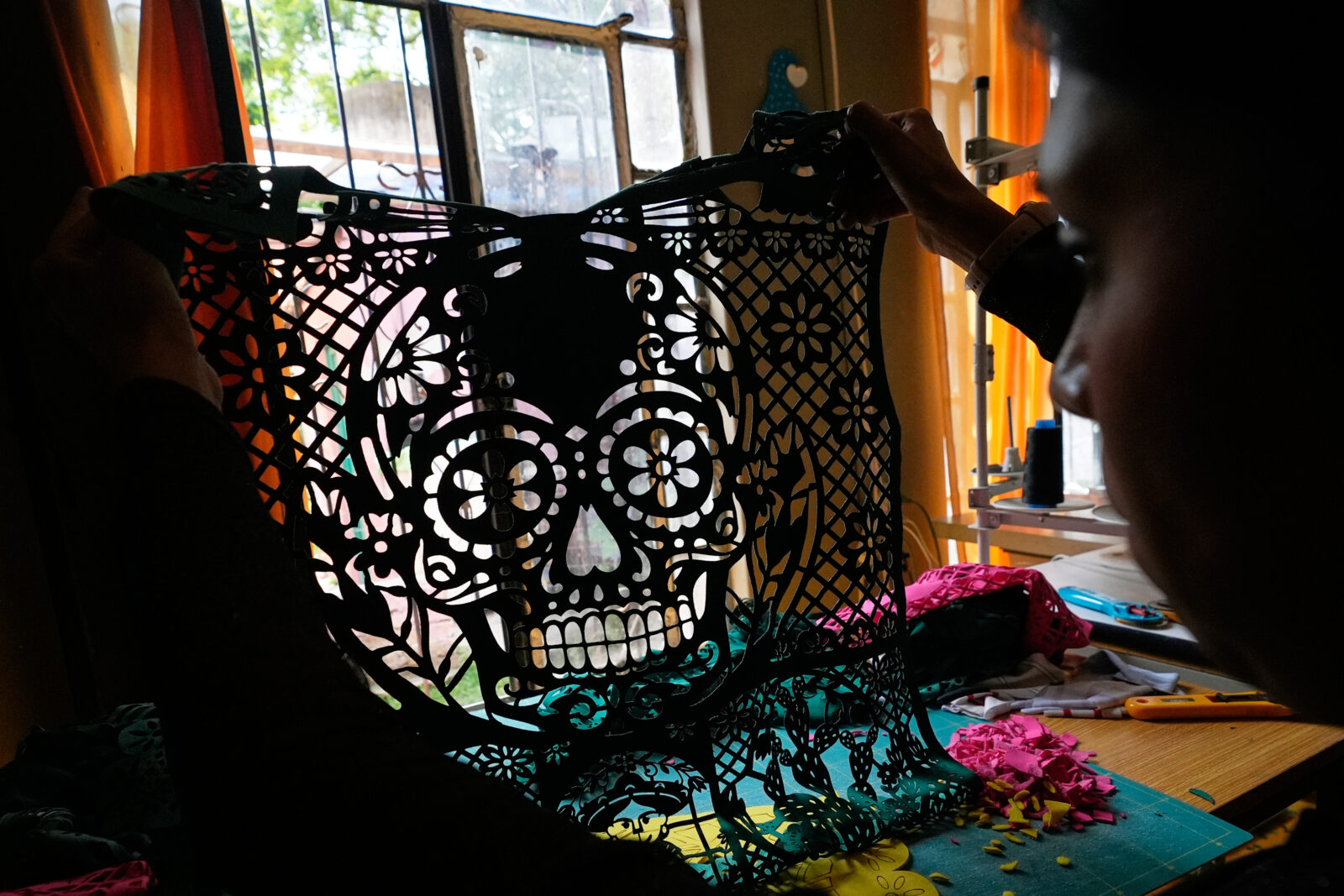
MEXICO CITY (AP) — The collection is called “Calados del Alma” or “Cutouts of the Soul.” It draws inspiration from ancient Mexican beliefs and papel picado, the delicate cut-paper ornaments commonly used during local celebrations and holidays.


Maria Teresa Hernandez
June 2, 2026 

MEXICO CITY (AP) — It’s no coincidence that Hugo Rosas’ jersey designs ahead of the World Cup resemble some of Mexico’s most iconic decorations. His work fuses soccer and Mexican identity to showcase his country’s culture beyond its borders.

His latest collection is called “Calados del Alma” or “Cutouts of the Soul.” It draws inspiration from ancient Mexican beliefs and papel picado, the delicate cut-paper ornaments commonly used during local celebrations and holidays.

“We try to create concepts that resonate with us and convey traditions that make Mexicans feel proud,” said Rosas, who has run a workshop with his brother Andrés near Mexico City since 2022. “The country’s best is reflected in papel picado, colors and town celebrations.”

The first jersey sketched by the brothers portrayed Quetzalcoatl, the feathered serpent deity revered by several pre-Hispanic civilizations. That garment remains Andrés’ favorite to date.

“Quetzalcoatl represents a balance that sees the world as a system, not as something extractive that human beings can simply benefit from,” said Andrés, who oversees the brand’s marketing. “I connect with that pre-Hispanic worldview, which is why most of our products are deeply rooted in that vision.”

Ancient beliefs, modern jerseys

Hugo’s World Cup collection builds on an earlier set of designs he called “Ofrenda Viva,” or “Live Offering.”

Its aesthetics and concept are rooted in Mexico’s Day the Dead — that the living remember and honor their dearly departed with celebration instead of sorrow.

“It’s a garment resembling papel picado so that a person can offer their actions, thoughts and passions as an homage to those who are already gone,” Rosas said.

The jerseys are made of polyester so the fabric can be cut like papel picado without becoming vulnerable to tears or rips. Rosas and his team once experimented with natural fibers, but the material could not withstand the weight and structure required after production.

Designing each jersey can take up to three weeks, while sewing and cutting requires between eight and 10 hours of work.

Rosas’ first step is deciding the symbols he wishes to depict. He then determines the size and shape of each figure so the stitching aligns with his vision. Once a design is ready, the team’s seamstresses patiently cut and sew each piece of clothing.

A modern armor

The Rosas brothers operate on a modest scale and are proud of that approach. They value the care and time devoted to each jersey, keeping the process as artisanal as possible.

Since the World Cup garments went on sale in April, their Mexclart brand has crafted about 30 jerseys. Hugo Rosas expects demand to increase as the opening ceremony approaches.

Among his other collections is one devoted to pre-Hispanic gods. His favorite portrays Mictlantecuhtli, the Aztec ruler of the underworld, who is often depicted in skeletal form.

“Putting on a garment like this is like wearing a modern armor through which we can carry that pride and passion for our roots and show it to the world,” Rosas said.

He sometimes turns to books about Mexico’s history while developing his designs. However, the source of inspiration he enjoys the most is traveling to Indigenous communities where ancient ceremonies and customs remain alive.

“If it were up to me, I’d use gold or another material that could accurately represent our gods the way our ancestors did,” he said. “All the garments we create are meant to give Mexicans the chance to bring those deities into the present.”

___

Associated Press religion coverage receives support through the AP’s collaboration with The Conversation US, with funding from Lilly Endowment Inc. The AP is solely responsible for this content.


For 2 centuries, Latter-day Saints have revered religious freedom – but their definition is evolving

(The Conversation) — Latter-day Saints have long valued the US Constitution’s promise of religious freedom – but the church has also tested its boundaries.


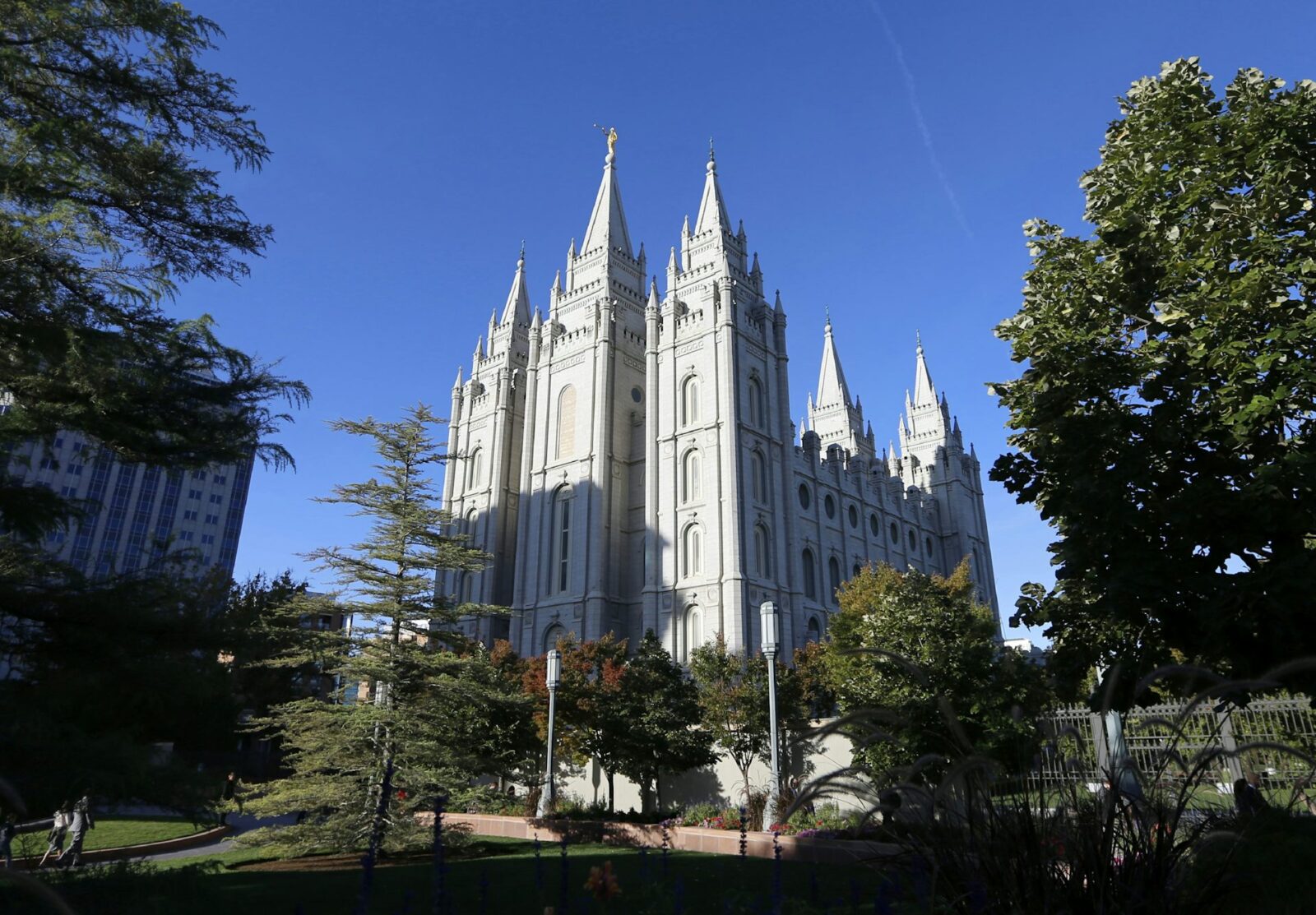
Leaders of the Church of Jesus Christ of Latter-day Saints have called for a fast on July 5, 2026, to give thanks for religious liberty. (AP Photo/Rick Bowmer)

Nicholas Shrum and Benjamin Park
June 2, 2026 at 1:48 p.m. ET


(The Conversation) — On July 5, 2026, the Church of Jesus Christ of Latter-day Saints is encouraging its American members to participate in a special fast: a day to “express gratitude for religious liberty and to pray that it be strengthened throughout the world,” in the words of its top three leaders.

The fast will coincide with the United States’ semiquincentennial celebrations. For Latter-day Saints, the 250th anniversary commemorations are not merely a historic milestone for the country, but an opportunity to reflect on their faith’s relationship to the American experiment. In the church’s early decades, that relationship often tested the boundaries of religious liberty – and the church’s own understanding of that principle has been evolving ever since.
Divine plan

From the faith’s beginnings in the 1830s, founder Joseph Smith frequently emphasized the significance of religious liberty. In one 1843 sermon, for example, Smith explained that “civil and religious liberty … were diffused into my soul by my grandfathers,” both of whom had fought in the war of independence.


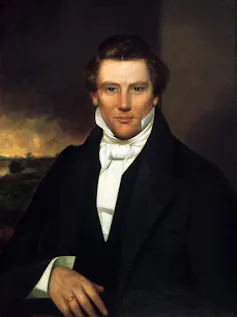
Joseph Smith published the Book of Mormon in 1830.
Wikimedia Commons

Smith’s personal connection to the Revolution and the nation’s founding documents were central to the faith’s developing theology. Latter-day Saints believe that their church is a restoration of Jesus’ “only true and living church,” and that America’s founding helped make that possible. In other words, Mormonism exists because of the United States, specifically its tradition of religious freedom enshrined in the Constitution’s First Amendment.

According to this logic, America’s founding was a crucial part of God’s divine plan, accomplished by chosen servants. Its founding documents are treated with reverence, especially the Constitution.

One of Smith’s own revelations declared that God “established the Constitution of this land, by the hands of wise men whom I raised up unto this very purpose,” suggesting divine intervention.

‘Kingdom of God’

However, Latter-day Saints soon came to doubt whether the United States was truly a land of religious freedom.

Early on, the small Mormon church faced persecution – especially in Missouri and Illinois, where state-sanctioned mobs forced members to flee. After Smith was killed by a mob in 1844, his successor, Brigham Young, decided to lead Latter-day Saints outside the country’s borders into present-day Utah, which was then northern Mexico.

Yet on their path to the Great Basin region, the federal government enlisted a group of church members to serve in the Mexican-American War. Known as the Mormon Battalion, they marched into Mexican territory under an American flag with only 13 stars. It was a symbolic protest: the U.S. they hoped to represent was the one that existed during the American Revolution, not the one with 28 states that had chased them out. They saw their own church, not the current government, as the revolutionaries’ true inheritor.


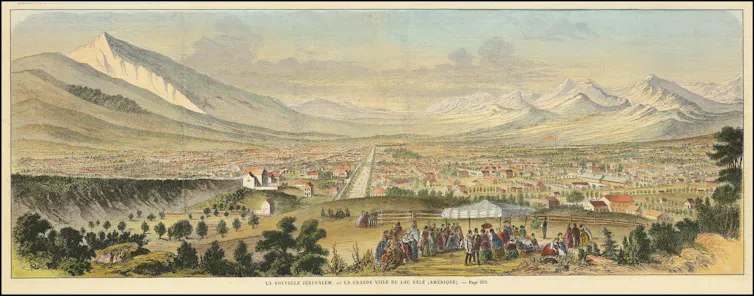
An 1863 depiction of Salt Lake City, which had been founded about 15 years earlier.
Wikimedia Commons

Once the war was over, the U.S. annexed much of Mexico’s land, including the Utah region. For about two decades the church had latitude to establish what it called its “Kingdom of God” in the West, in line with church doctrine. But the federal government soon cracked down, particularly on the church’s commitment at the time to polygamy and theocracy: beliefs that Mormons insisted were protected by the First Amendment.

The ensuing legal and political battles lasted for four decades, testing the boundaries of American religious liberty. Only after the Supreme Court ruled against a church member with two wives in 1879, and Congress passed legislation to further enforce anti-polygamy laws, did the church publicly forfeit the practice in 1890.

Yet even amid these struggles, Latter-day Saint devotion to the founding generation continued. In 1877, for example, Wilford Woodruff, who later became president of the church, declared that he had received a vision of the signers of the Declaration of Independence. The signers “gathered around me, wanting to know why we did not redeem them” by offering them Latter-day Saint ordinances for the deceased.


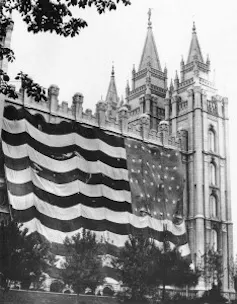
An American flag draped over the Salt Lake Temple in 1896, the year Utah became a state.
Charles Ellis Johnson/Wikimedia Commons

Though Woodruff’s vision has become the subject of Mormon folklore, it represents how deeply a certain strain of Americanism became woven into church culture in the 19th century. Just as Smith’s revelations had done a generation before, this vision and the sentiments behind it elevated the Declaration of Independence and the U.S. Constitution to quasi-scripture.

Shifting focus

During the 20th century the church continued to “Americanize,” such as by embracing U.S. capitalism and participating in the two-party system. Talk about religious freedom shifted away from primarily seeking protection for religious minorities toward protection for their own theological commitments as part of a Christian mainstream.


Ezra Taft Benson, then president of the church, delivered an address in 1987 on the Constitution’s sacred significance.

By the mid-1900s, church leaders had embraced a conservative view of politics and law that championed limited government. Paralleling broader American attitudes during the Cold War, which pitted “godless” Soviet communism against American democracy and freedom of religion, Latter-day Saints used the language of religious freedom to advocate for their own interpretations of religion’s role in the public square.

Latter-day Saint leaders’ list of perceived threats evolved from New Deal legislation and civil rights protections to abortion, the Equal Rights Amendment and, finally, homosexuality – similar to other conservative Christian groups’ concerns. The church got involved in a number of legal cases and campaigns opposing same-sex unions.

Since the 2015 Supreme Court decision in Obergefell v. Hodges, which legalized same-sex marriage across the United States, the church’s public policy stance has focused on compromise, balancing protection of religious liberties with protection against discrimination for LGBTQ+ people in housing and employment.


Dallin Oaks, a former Utah Supreme Court justice who is now president of the church, delivered a landmark speech on religious liberty at the University of Virginia in 2021.


A global church

What becomes clear across the past two centuries is that definitions of religious freedom have substantially changed, including for Latter-day Saints. In the 19th century, church members focused on protecting all minority religious groups like themselves against the Protestant majority. Today, the church’s messaging on religious freedom, at least in the United States, usually concerns protecting beliefs that clash with secular progressivism and LGBTQ+ protections. Overall, its approach has largely aligned with the religious right.

Equally significant, a majority of the church’s members now live outside the United States, and it is eager to present an image that is less American and more universal. Instead of elevating the Declaration of Independence and the Constitution as quasi-scripture, leaders tend to highlight principles of religious freedom that are applicable across the globe.


The July fast will highlight “the importance of the Declaration of Independence and the Constitution and how these documents support religious freedom,” but it will also call for expanding liberty around the world. The day will be an opportunity for Latter-day Saints to reflect on their own place in the American story – a place that is still being defined.

This article has been updated to clarify how Joseph Smith was killed.


(Benjamin Park, Associate Professor of History, Sam Houston State University. Nicholas Shrum, Doctoral Student in Religious Studies, University of Virginia. The views expressed in this commentary do not necessarily reflect those of Religion News Service.)
Opinion

At Union seminary, I saw the power of religious pluralism. It offers the US a better path.

(RNS) — As I prepare to step down from the presidency, I see a blueprint for a flourishing, interreligious America. But when I turn to the headlines, I see our nation barreling toward a far more destructive vision.


People attend Rededicate 250 on the National Mall in Washington. (RNS photo/Jack Jenkins)

Serene Jones
June 2, 2026 
RNS


(RNS) — Nearly every day, dozens of religiously diverse students — Christian, Jewish, Buddhist, spiritual, agnostic, atheist and beyond — walk the halls of Union Theological Seminary, the Manhattan school I’ve been proud to lead for almost two decades. They share dorms, take classes and enjoy meals together. They engage in lively discussions about theology. They organize peaceful demonstrations to advance a more just world. And they host events to celebrate their different religious traditions.

As I prepare to step down from the presidency next month, I look at this community and see a blueprint for a flourishing, interreligious America. But when I turn to the headlines, I see our nation barreling toward a far more destructive vision.
RELATED: As seminaries shuttered, Union grew. For Serene Jones, controversy was the price of survival.

President Donald Trump and his far-right allies are taking a wrecking ball to the foundations of our pluralistic society and purposely sowing discord between people of different religious traditions. Ultimately, they aim to impose a narrow, exclusionary version of Christianity on the entire nation — one that views difference as a threat rather than a strength.

Case in point: The Trump administration and other far-right leaders have consistently expressed a desire to make America a conservative Christian nation — and have pushed policies that reflect those beliefs. They’ve spewed rhetoric that frames Muslims and other marginalized religious communities as enemies rather than neighbors. And now, as we mark the 250th anniversary of the signing of the Declaration of Independence, the administration is holding events steeped in far-right Christian symbolism.

I’ve got news for Trump — this isn’t how you make a nation strong. On the contrary, when you create spaces for diverse religious communities to come together and collaborate, true strength emerges. I’ve witnessed this at Union Theological Seminary time and time again.

One of my most poignant memories happened in 2024, during the height of pro-Palestine protests. Police officers at Columbia University across the street stormed that campus and arrested student demonstrators.


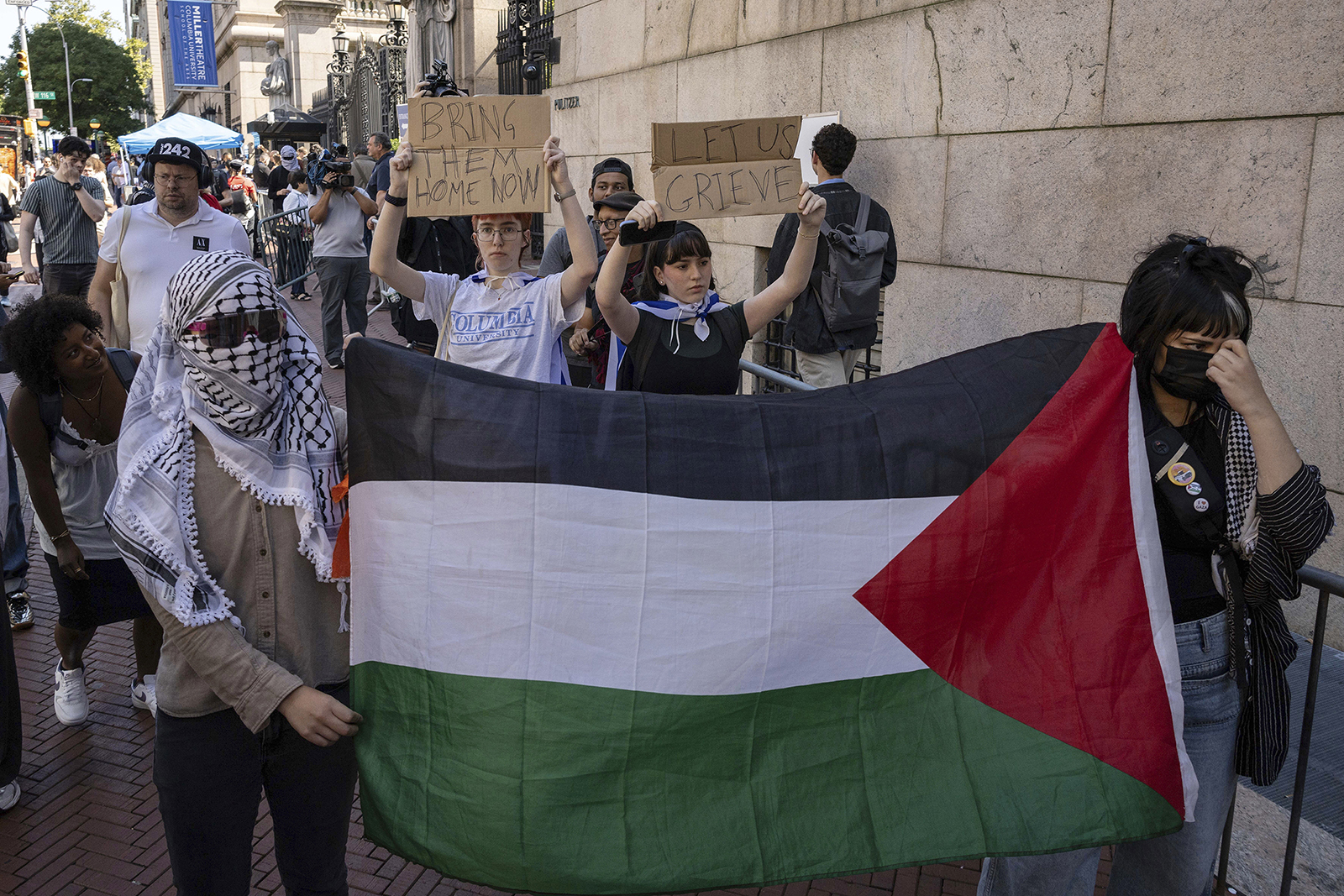
Pro-Israel demonstrators, center, raise signs while pro-Palestinian supporters protest outside Columbia University, Sept. 3, 2024, in New York. (AP Photo/Yuki Iwamura)

Instead of ostracizing these students, we welcomed them to campus for a seder. The service, led by Columbia’s Jewish students, brought together students of diverse religious traditions to share a meal — a meal full of laughter, prayer and deep thought. It was a beautiful display of how different religious communities could come together for a shared moment of understanding and peace.

In my time at Union, a historically Christian seminary, we’ve also expanded programs devoted to multiple religious traditions. We now have classes in Buddhism, Islam and more. We also continue to partner with our long-standing neighbor, Jewish Theological Seminary. Additionally, we instituted requirements for students to learn about religious traditions other than their own. When our graduates enter the world, they don’t “tolerate” the imam or the Buddhist priest — they work alongside them. Indeed, they often are them.

And we’ve ensured that campus spaces encourage interreligious dialogue. We transformed a former finance office into a multifaith prayer and meditation hall. The wood grain of the floor points toward Mecca, ensuring every student knows they have a place to turn. Meanwhile, our campus hosts an array of events from different religious communities.

All of these moments and initiatives may seem small in the grand scheme of our world. But when people have the skills and desire to engage with different religious communities, they can make a difference. Throughout our nation’s history, interfaith communities have come together to advance humanitarian aid, sanctuary for immigrants, criminal justice reform and more.

As an example, every Monday, members of the Union community gather with other faith groups at Columbus Circle in New York City for Multifaith Mondays — an anti-fascist public witness that proves faith is a tool for love and peace, not a weapon of division. The gatherings started small but have continued to grow. These demonstrations have offered space for reflection, boosted community connections and inspired people to take action.

Meanwhile, during immigration enforcement raids in Minnesota, we saw a breathtaking surge of interreligious solidarity. With this collaboration, religious communities — including Union graduates — were able to stall Immigration and Customs Enforcement agents and save immigrants from their clutches.

Make no mistake: Navigating religious differences involves friction. But when met with respect, those disagreements make us more understanding, inclusive and effective.

I can’t help but see a grand irony in this political moment. As we at Union have strengthened our campus infrastructure and built a more inclusive community, Trump is taking a sledgehammer to the so-called People’s House. He is attempting to dismantle the basic structures of our democracy to build a home layered in gold and exclusion.

We are proof that there is an alternative house being built in America — a multireligious and deeply diverse community that is growing rapidly and refuses to be silenced.

As I step down from Union at the end of this school year, my hope is that our seminary serves as a powerful example of the power of interreligious engagement. President Trump believes our strength lies in a single, narrow religious perspective. But after nearly two decades at Union, I know the truth: Religious diversity and, indeed, all of our beautiful differences are not threats. They are the only thing capable of holding the roof up.

(The Rev. Serene Jones is president and the Johnston Family Professor for Religion & Democracy at Union Theological Seminary, a globally recognized seminary and graduate school of theology in Manhattan where faith, spirituality and scholarship meet to reimagine the work of justice. The views expressed in this commentary do not necessarily reflect those of Religion News Service.)
Why Mary, as the Immaculate Conception, became the patron saint of the US in the 1840s

(The Conversation) — Mary, as the Immaculate Conception, became patroness of the United States before the Vatican officially defined that belief as dogma.


Bridget Retzloff and Stephanie Shreffler
June 3, 2026 


(The Conversation) — Every year in March, tens of thousands of Americans take to the streets – and bars – to celebrate St. Patrick, the patron saint of Ireland. Similarly, Mexican Americans celebrate the Feast of Our Lady of Guadalupe, Mexico’s patron saint, in December.

But did you know that the U.S. has its own patron saint? Nearly 200 years ago, in May 1846, Catholic priests and bishops named the Virgin Mary patroness of the United States of America – specifically, under her title as the Immaculate Conception, referring to the belief she was conceived without sin.

According to the Catechism of the Catholic Church, which summarizes doctrine, a saint is a holy person who “leads a life in union with God through the grace of Christ and receives the reward of eternal life.” Catholics may venerate saints and ask them to intercede with God on their behalf. Some are recognized, whether formally or informally, as “patrons” of particular situations, conditions, identities or places, often inspired by their life on Earth.


We are librarians at the University of Dayton who work in the Marian Library and the U.S. Catholic Special Collection. We recently created a digital exhibit with objects pointing to the history of this devotion to Mary as the Immaculate Conception in the United States – objects that reflect both patriotism and faith.

The Immaculate Conception


‘The Immaculate Conception,’ by 16th-century painter Juan de Juanes.
Fundacion Banco Santander/Google Art Project via Wikimedia Commons

Mary is known by many names and titles, including the Virgin Mary, Mary of Nazareth, Our Lady of Lourdes, Holy Mother of God, Queen of Heaven, Seat of Wisdom and Mystical Rose.

One important title is Immaculate Conception, referring to the Catholic belief that Mary was free of “original sin” and therefore suitable to be the mother of Jesus Christ. The Catholic Church teaches that all other people are conceived with original sin as a result of Adam and Eve’s disobedience to God in the Garden of Eden.

Originally, the idea that Mary was free of original sin was widely debated within the Catholic Church. But the teaching was defined as dogma on Dec. 8, 1854, by Pope Pius IX. The feast day of the Immaculate Conception is now celebrated by Catholics on Dec. 8 each year. Even before its official acceptance, devotion to the Immaculate Conception influenced the art and teachings of the Catholic Church.


Patroness of the United States


How did Mary, as the Immaculate Conception, become patroness of the United States?

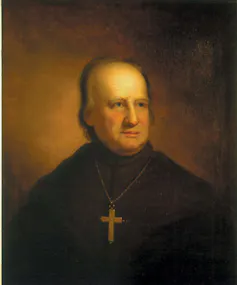
John Carroll, who became the first American bishop in 1790, was devoted to Mary throughout his life. In 1791, he and other American Catholic clergy consecrated the Diocese of Baltimore to Mary, asking her to “[preserve] from all evil” the people of the diocese.


Rembrandt Peale’s portrait of John Carroll, the first Catholic bishop from the United States.
Wikimedia Commons

Half a century later, in 1846, a council of priests and bishops from across the country officially named Mary, under her title as the Immaculate Conception, the patroness of the entire United States, asking her for “the aid of her prayers.”

Devotion to the Immaculate Conception has remained an important part of the faith lives of many American Catholics, even if they are unaware of her patronage of the United States. This devotion is demonstrated by the many churches that are named for the Immaculate Conception, jewelry depicting the Immaculate Conception and the inclusion of the Feast of the Immaculate Conception as a holy day of obligation in the U.S. – a day when Catholics are expected to attend Mass.

On Feb. 7, 1847, the Vatican approved the request to make Mary, as the Immaculate Conception, the patroness of the United States. This was seven years before the dogma was defined by the pope, pointing to the popularity of this devotion even before official recognition.


Bicentennial holy card


Many items in the Marian Library’s collection, such as holy cards, also demonstrate American Catholics’ devotion to Mary as the Immaculate Conception. A holy card is a small portable devotional tool, often including an image of Jesus or a saint on the front. Typically, a prayer, devotion, scripture passage or commemoration of an important event is printed on the reverse side.

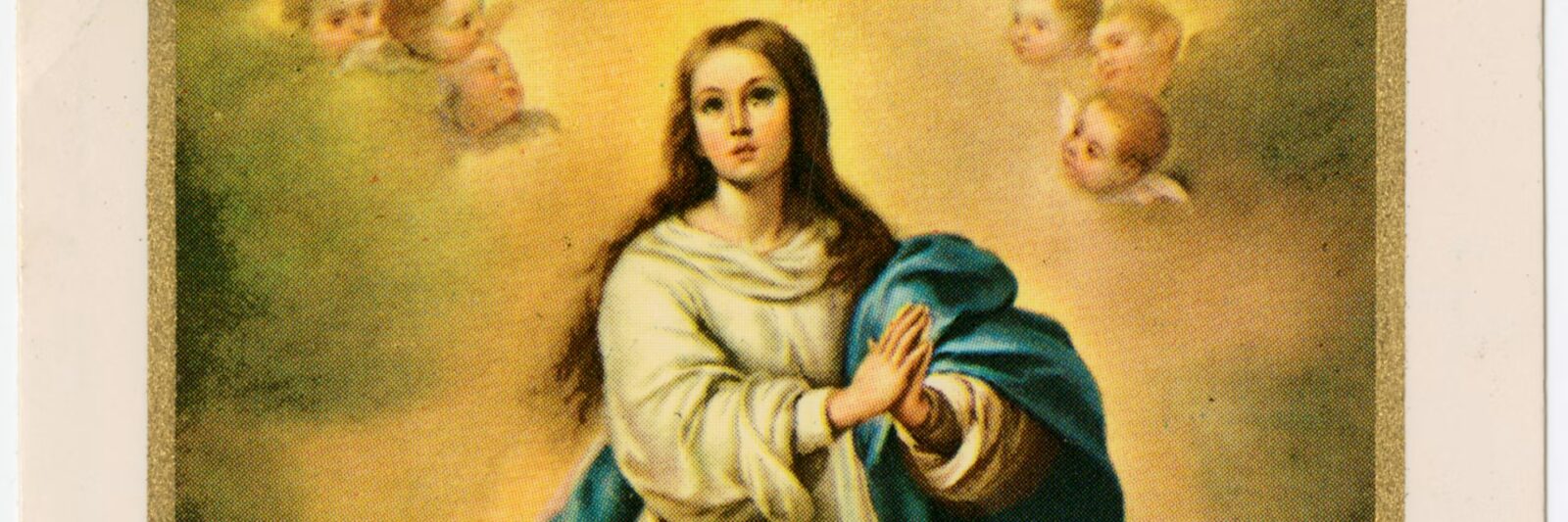
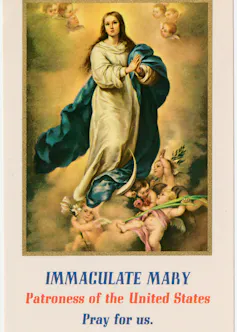
One of our cards features an image of Mary as the Immaculate Conception above the words: “Immaculate Mary, Patroness of the United States, Pray for Us.” The reverse commemorates the bicentennial of the United States in 1976, followed by the motto of the United States, “In God We Trust.”

The image of Mary is a reproduction of “The Immaculate Conception of El Escorial,” a painting by 17th-century Spanish painter Bartolomé Esteban Murillo in the collection of Madrid’s Museo del Prado. The painting reflects artistic traditions that symbolize the theology behind the Immaculate Conception.


This holy card draws on symbols from the Book of Revelation.
The Marian Library, University of Dayton

Mary is shown with a blue garment: a color associated with faith, humility, the heavens and the sea. Since blue pigments were very expensive during the Renaissance, the color was reserved for important figures, particularly paintings of Mary.

Other symbols, though, are specific to Mary as the Immaculate Conception. She stands with a moon beneath her feet, inspired by the “apocalyptic woman” from the Bible’s Book of Revelation: “a woman clothed with the sun, with the moon under her feet, and on her head a crown of twelve stars.” Catholic theologians interpret this figure as a reference to Mary, establishing her as mother of all Christians.

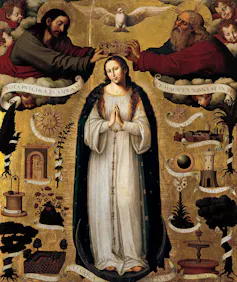
In other artwork of the Immaculate Conception, Mary is depicted with a snake beneath her feet, a crown of 12 stars or a dragon – also inspired by Revelation, Chapter 12.


American rosary

Another important object of Catholic devotion, the rosary, encourages reflection on the lives of Jesus and Mary. The word can refer to a physical object – a set of 50 beads or knots on a string – or certain sets of prayers, including Hail Mary and Our Father. Touching the beads as they pray helps Catholics keep track as they recite the prayers.


This rosary mixes religious devotion with patriotic colors.
The Marian Library, University of Dayton

The “American Rosary” in our collection was designed by Marie George of New York in 1956, though archivists do not know exactly who she was. It uses beads in the patriotic colors of red, white and blue, and it includes a Miraculous Medal, which depicts Our Lady of the Immaculate Conception. A card included with the rosary encourages Catholics to offer prayers “for World Peace, with Justice and Charity.”
Across centuries

For much of U.S. history, Catholics in the United States often faced prejudice and discrimination. In the mid-19th century, when Mary as the Immaculate Conception was named patroness, the Protestant majority of the U.S. was deeply suspicious of Catholics’ loyalty to the pope.

The bicentennial holy card and the American rosary from the following century, both dedicated to the Immaculate Conception, reveal how American Catholics still sought to demonstrate that their faith and their patriotism did not conflict with each other.

In 2026 – the 250th anniversary of the United States, and the 180th anniversary of Mary’s patronage – some of that history may feel distant. The Catholic Church elected the first American-born pope, Leo XIV, in 2025, and the United States has seen a surge in Catholic conversions in 2026. But Catholics still ask Mary, as patroness of the U.S., for her intercession: not only in their lives, but for their country.


(Stephanie Shreffler, Religious Collections Librarian/Archivist and Associate Professor, University Libraries, University of Dayton. Bridget Retzloff, Assistant Professor and Coordinator of Art Collections and Exhibits, University of Dayton. The views expressed in this commentary do not necessarily reflect those of Religion News Service.)


The Conversation religion coverage receives support through the AP’s collaboration with The Conversation US, with funding from Lilly Endowment Inc. The Conversation is solely responsible for this content.
AP exclusive: Under Notre Dame cathedral, a 'dig of the century' unearths 1,700 years of history

PARIS (AP) — For archaeologists, the cathedral dig is a rare treat. In France, like elsewhere, they work only where building work is about to begin — a bit like how industrial quarry workers end up unearthing dinosaur remains.


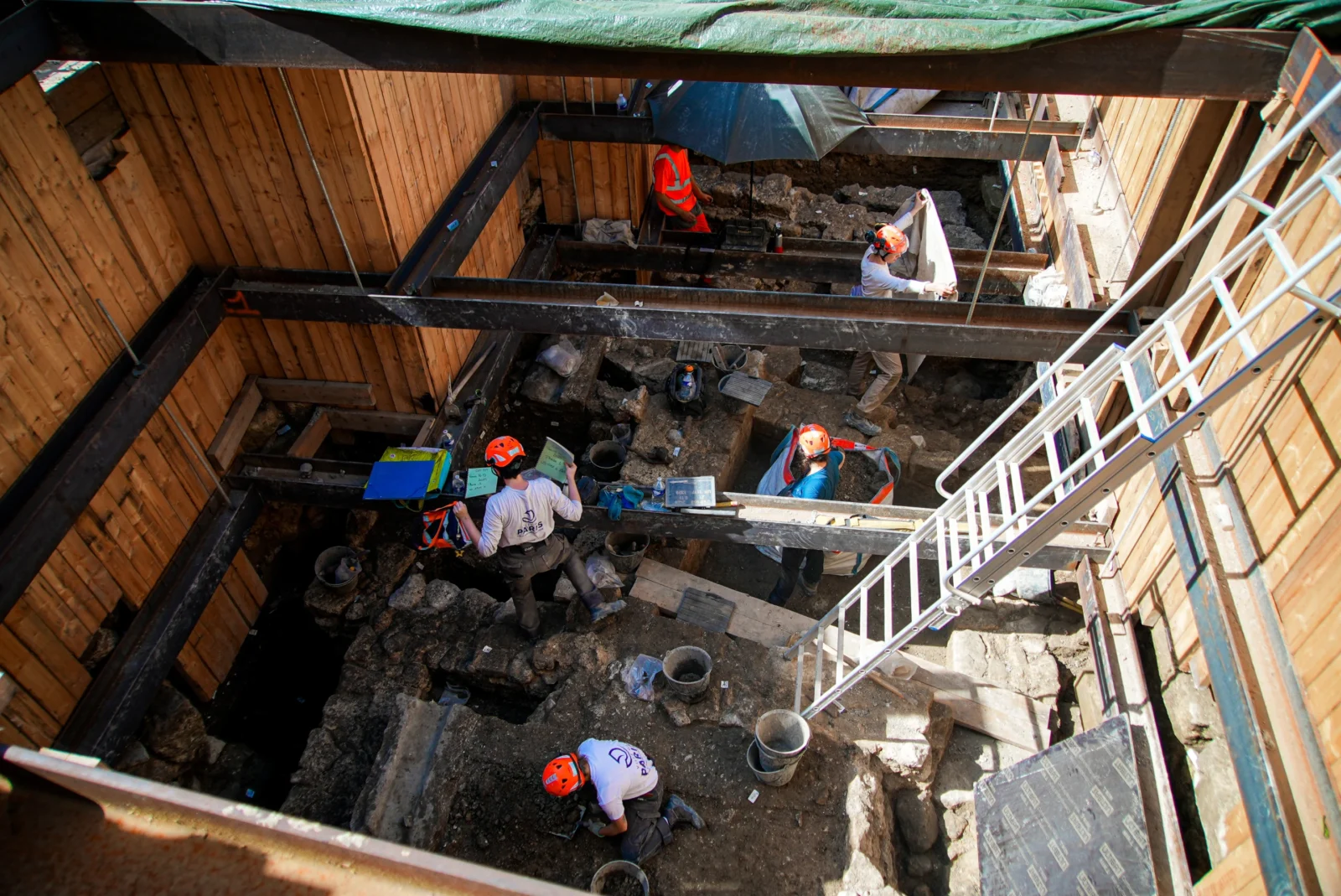
Archaeological workers wearing hard hats dig 4 meters (13 feet) underground during excavations outside Notre-Dame Cathedral in Paris, Monday, June 1, 2026. 
(AP Photo/Nicolas Garriga)

Jeffrey Schaeffer and Thomas Adamson
June 3, 2026 


PARIS (AP) — Wilting in the summer sun, a line of tourists waits to climb Notre Dame cathedral and meet its gargoyles.

Four meters (13 feet) beneath them, a team of archaeologists is digging the other way — straight down and back in time, to Roman Paris 2,000 years ago.

In 2019, fire brought Notre Dame’s spire crashing down as the world watched. The cathedral was rebuilt and reopened in late 2024, and now Paris wants to soften the hot, bare square in front of it with trees and shade.

But in a city this old, the soil cannot be turned until what lies beneath it is excavated, in case it is damaged during works.

So a slice of Notre Dame’s forecourt has become an excavation site — an open pit ringed by barriers and crossed by a wooden walkway, a few steps from the line-up.

A modern Da Vinci Code

French media have dubbed it the “dig of the century.”

“It’s a rare opportunity for us to work on something that’s tangibly going to make a difference to the history of Paris,” Lucie Altenburg, a conservator with the Paris archaeology unit, told The Associated Press.

Among the hundreds of objects already found: a fourth-century coin stamped with the face of the Emperor Constantine, and shards of medieval pottery painted on the inside with marks no expert has yet deciphered — like a modern Da Vinci Code.

“It makes Notre Dame feel alive again,” said Emily Carter, 34, a tourist from Manchester waiting in line with her two children. “You come to see the cathedral, then realize there’s another city under your feet. That’s almost more moving.”

The first traces appear 50 centimeters (20 inches) down; 4 meters (13 feet) lower, the team is still pulling up the past. Some days they fill 15 crates — from ground that has lain untouched for decades.

Ancient cities have archaeologists monitoring digs

This is the bargain in every old city: The past is not in a museum down the street — it is under the street.

Cities rise. Each age builds on the rubble of the last, and the ground climbs with it; in Rome, it has risen about 9 meters (30 feet) since the empire fell in the fifth century AD.

When Athens built its metro for the 2004 Olympics, it set off the largest excavation in Greek history and turned up tens of thousands of objects, now shown in the stations themselves. Paris is no different.

It all comes from the island in the Seine, the Ile de la Cite, where Paris began.

Centuries later, Notre Dame rose on the same ground.

At the cathedral’s birth in 1163, the entire square was packed with medieval houses, split by a single street, said Camille Colonna, the archaeologist leading the dig.

Digging down, her team has reached their cellars — and therefore also the time in history they represent.

Below them lie Merovingian and Carolingian grain pits, from the sixth to the 10th centuries; below those, darker and deeper still, a dense Roman quarter from the fourth and fifth centuries.

Twenty centuries are stacked in 4 meters (13 feet) of earth — or about the height of two-and-a-half Napoleon Bonapartes standing on top of one another.

“Here you can see the layers — medieval Paris, Roman Paris, maybe even before that,” said Yasmine Benali, 22, an archaeology student watching from behind the barriers. “It makes the city feel less like a postcard and more like something still being discovered.”

Coins, ceramics and mysterious markings

The richest finds here come from the foulest place: the deep pits beneath the medieval houses, old latrines that doubled as rubbish dumps.

Out of them the team keeps lifting whole jugs and cups — thrown away centuries ago, yet still intact — among the broken plates and animal bones.

It’s “rare to find complete ceramics,” said Valentine Breloux, an archaeologist with the unit.

Here the soft waste cushioned them, and centuries later they miraculously came up whole.

Then some other objects came that confounded experts. As conservators cleaned what looked like ordinary medieval pottery, they found faint reddish writing painted on the inside — the same mysterious markings on shard after shard.

What they mean has yet to be deciphered.

Of everything she has cleaned from Notre Dame, Breloux said, these are the most “astonishing.”

Coins can help date the layers

The coins came up as black discs, eaten by rust. But under an X-ray, a face returned: it was Constantine, the Roman emperor who ruled in the early 300s AD.

Such objects also “can be invaluable in giving us the date of the (underground) layer,” Altenburg said.

The Roman finds are the ones the archaeologists value most — the deepest, oldest and least understood. In Roman times, the town was called Lutetia, and its center lay across the river, on the Left Bank.

As the Roman empire collapsed, people pulled back to the Ile de la Cite, where Notre Dame would later rise, and fortified the island with walls of stone taken from earlier buildings.

Colonna’s team found some proof: a Roman doorstep found in the dig, taken from a much bigger building, carried over, turned upside down, and laid in a road as paving.

Paris houses thousands of finds in an archaeology center

Every find leaves the pit and travels north, to the city’s archaeology center — what Colonna calls “a huge archaeological store,” a treasure house of Paris.

For archaeologists, the cathedral dig is a rare treat. In France, like elsewhere, they work only where building work is about to begin — a bit like how industrial quarry workers end up unearthing dinosaur remains.

“This only happens because the city of Paris decided it wanted to beautify the area,” Altenburg said.

The new square should be mostly finished by 2028: a kind of woodland clearing, with 160 new trees and a thin film of water sliding over the stone to cool it in summer — part of how Paris is bracing for ever hotter summers induced by global warming.

The tourists who now wait in the bare sun beneath the gargoyles will, in a few summers, line up in the shade.

The old underground parking lot will reopen as a visitor center looking onto the Seine.

Until then, the Notre Dame team wants to go deeper still — past the Romans, toward whoever came before them, the Gauls who gave the city its first name.

“The hope is that we are able to go back in time even further than we’ve ever been before,” Altenburg said.

___

Nicolas Garriga in Paris contributed.

‘Surprise’ election result poses new challenges for Colombia’s left


De La Espriella

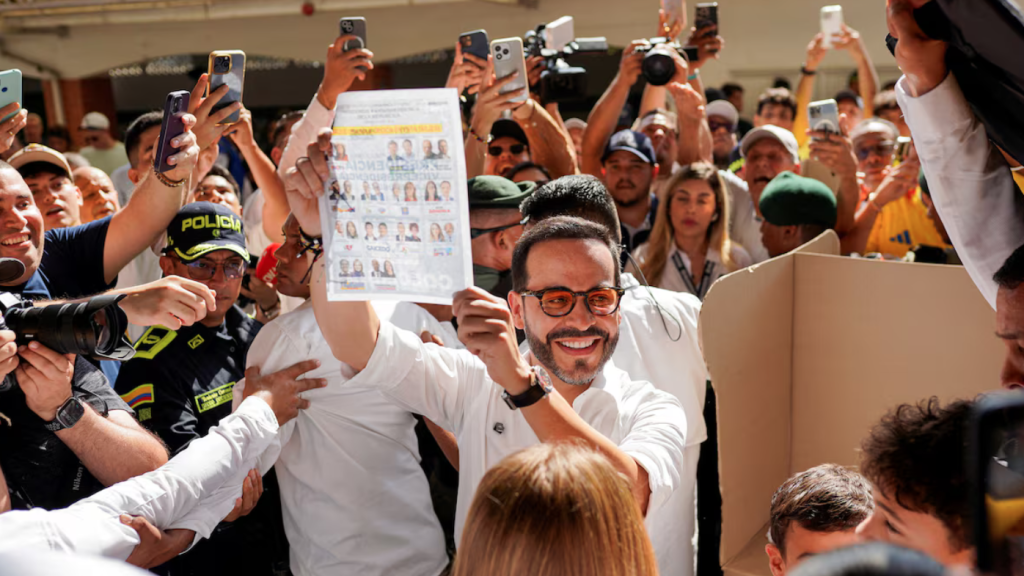
Having supported Ivan Cepeda as the candidate to succeed Colombian President Gustavo Petro, most left-wing and democratic Latin Americans were not surprised by the meteoric rise of a Javier Milei-style far-right candidate in the final weeks of the presidential campaign. Libertarian lawyer Abelardo de la Espriella not only managed to rapidly rise in the polls, but got through to the second round just ahead of Cepeda, a reserved university philosophy lecturer and human rights defender. Cepeda was preselected by Petro’s Pacto Histórico (Historic Pact) to preside over a second term of centre-left progressive government.1

De la Espriella, nicknamed El Tigre (the Tiger), secured 43.72% of the vote against Cepeda’s 40.92% (a difference of 600,000 votes). Paloma Valencia — an aristocrat, a former president’s granddaughter and former right-wing president Álvaro Uribe supporter — secured 6.9% as the Centro Democrático (CD, Democratic Centre) candidate, well below the 15% polls predicted. In the end, El Tigre’s tank steamrolled the CD.

The reality is that neither Colombia nor any of the other 35 Latin American and Caribbean countries are immune to the global neo-fascist far right wave. The country’s history attests to a longstanding right-wing presence in politics, which until May 31 had been occupied by Uribe’s CD (never centre-right to begin with). But de la Espriella’s vote is also reflects the current regional and global climate.

His support came from bourgeois-oligarchic factions (agribusiness, the financial markets, big business and social media platforms), with de la Espriella swiftly overtaking Valencia as their darling. The Colombian Milei was also backed by US President Donald Trump and far-right parties in government across the region.

Moreover, in a country where social media regulation is virtually non-existent, de la Espriella benefitted from a deluge of fake news — largely originating from the US and Spanish state2 — that spread blatant lies about Petro and Cepeda’s supposed links to guerrillas and organised crime. Rounding off de la Espriella’s perfect storm was his hiring of a political marketing firm — the same one that worked on social influencer Pablo Marçal’s almost successful 2024 São Paulo mayoral campaign — and manipulation of Colombia’s, at best, fragile electoral system.

To understand the impact of the fake news, one must remember that Colombia endured six decades of civil war,3 which left 450,000 dead, 121,000 missing and 7.7 million internally displaced, and saw countless bomb attacks against authorities and civilians and the kidnapping and murder of politicians. An agreement was signed in 2016 between the government and the Fuerzas Armadas Revolucionarias de Colombia (FARC, Revolutionary Armed Forces of Colombia) to disarm and reintegrate guerrilla fighters into civilian life.

Petro’s government and the Pacto advocate a policy of “Total Peace,” which seeks dialogue with the remaining guerrilla group, the Ejército de Liberación Nacional (ELN, National Liberation Army), and even criminal armed groups willing to lay down their guns. This policy is vehemently opposed by the CD, agricultural sectors and the urban middle class. De la Espriella skillfully manipulated these sectors, accusing Petro and Cepeda of being bloodthirsty guerrillas and friends of drug traffickers.

A semi-privatised electoral system

Colombia’s electoral system rests on three-prongs. The first is not an electoral court, but rather the National Electoral Council (CNE), which is composed of nine members appointed by parliament, with quotas filled through complex mathematical calculations that give a majority to whoever holds a majority in parliament. The second is the Registrar’s Office, which functions as a large civil and electoral registry office. Only those who are registered can vote.

The third, and most questionable, leg of the tripod is the semi-privatised vote counting system. Counting of the about 120,000 ballot boxes is done manually, with party observers present. However, once ballot box results are processed at the district, department (state) and national level, a tally is carried out by a private Colombian security firm, Thomas Greg & Sons, which does not disclose the source code for the count, meaning there is no way to verify their tally.

It is therefore not surprising that Petro questioned the May 31 results, and has said he will press ahead with his allegations of irregularities. This comes amid reports that de la Espriella co-opted company employees and Electoral Registry staff (as well as members of the police and Armed Forces). According to the president’s social media posts, 800,000 votes for the neo-fascist candidate cannot be verified.

For there part, Cepeda and his campaign team decided on June 1 to endorse the result. According to Pacto leaders this was to allow the election process to continue. The contradiction between Petro and Cepeda’s position could reflect a rift between the two or a deliberate division of labour. Either way, the outlook for the second round remains in limbo.

A young progressive movement with a grassroots base

Despite not achieving Cepeda’s aim of winning the first round, the Pacto and its allies in the Alianza por la Vida (Alliance for Life) obtained the best ever election result for Colombia’s left, surpassing Petro’s 2022 vote.

The strength of this coalition of left-wing and centre-left groups and individuals, along with social movements, can be explained by the momentum and unity forged as a result of the 2019 and 2021 social uprisings. At the time — and in parallel with Chile's anti-neoliberal uprising — the country rebelled against then-president Ivan Duque (CD) for his fiscal austerity policies and mishandling of peace agreements with the FARC and ELN, as well as murder of social leaders and repression of protesters that occurred under his watch. 

The movement managed to weather the pandemic, with political figures and organisations identified with the protests coming out stronger. Petro — who leads Colombia Humana (Humane Colombia), a force within the Pacto — won the 2022 presidential elections on the back of that wave. 

His government, like all progressive centre-left movements, has been characterised by its strictly constitutional action — it has operated exclusively within the framework of the existing bourgeois-democratic regime. At the same time, it has distinguished itself from similar governments, such as those of Lula da Silva (Brazil), Gabriel Boric (Chile) and Uruguay’s Frente Amplio (Broad Front), by calling popular mobilisation in support of key policies, such as with the 23% minimum wage rise at the end of 2025.

Petro has governed with a parliamentary minority, but has managed to largely circumvented this by channelling significant portions of the national budget to projects submitted by juntas vecinales (neighbourhood associations) and their regional federations.4 Cepeda’s campaign, for its part, decided to capitalise on this tradition of neighbourhood organisation by focusing on a proactive policy-based campaign (rather than attacking opponents), grassroots mobilisation, and the idea of a first-round victory (a debatable choice).

The impression shared by international left party observers is that the campaign did not give enough importance to social media and did not prepare enough for the very high likelihood that the far right would wage an aggressive and widespread campaign of fake news and disinformation, all within the continental context of a renewed Monroe Doctrine5 and Trump’s “Shield of the Americas”.6 The campaign lacked a media command centre dedicated to defending Cepeda and the alliance’s program against de la Espriella’s lies — something that would have been perfectly feasible, with the support of intellectuals and digital activists from across the region. 

There were also many complaints within the Pacto, including from leaders, about the absence of lawyers and observers at all 120,000 polling stations.

Pacto Histórico becomes a party

The Pacto decided to register as a political party in December 2024 and obtained legal recognition in mid-2025. This involved unifying the legal entities of the Polo Democrático Alternativo (Alternative Democratic Pole, Cepeda’s former party), the Unión Patriótica (Patriotic Union, which is backed by the Partido Comunista Colombiano/Colombian Communist Party) and Colombia Humana (led by Petro and Senator Gloria Flores).

Also part of the Pacto are a political faction that emerged from the Organización Nacional Indígena de Colombia (ONIC, National Organization of Indigenous Peoples of Colombia) and formerly known as the Movimiento Alternativo Indígena y Social (MAIS, Alternative Indigenous and Social Movement); Unidad Democrática (Democratic Unity, eco-socialist), the Partido del Trabajo de Colombia (Colombian Labour Party, Maoist) and Todos Somos Colombia (We Are All Colombia, affiliated to the Progressive International); and feminism and environmentalist forces — which have broad backing on the local left — as well as the significant Palanquero Black movement (the Colombian name for rural communities made up of former Black slaves and Afrocolombian people).

Colombia’s progressive centre-left movement is a young political force, with just one presidential term under its belt and still in the process of consolidating a unified party for its political project. Given its youth — less experienced than even Mexico’s Morena party, not to mention Partido dos Trabalhadores (Workers Party), Uruguay’s Frente Amplio and Argentina’s Peronist movement — the Pacto has maintained a certain reluctance towards direct confrontation. Cepeda appears to be seeking to overcome this, challenging de la Espriella to a debate the day after the first round. 

Its youthfulness is also reflected in an apparent overconfidence in the institutions of the 1993 Constitution, as evidenced by the lack of questioning of the electoral system prior to the results.

The second round

Cepeda’s alliance involved forces beyond the Pacto, including the indigenous movement, represented by vice-presidential candidate Aída Cilcuyé (of the Nasca people); the Green Alliance (a kind of Green Party); En Marcha (On The March, a party formed in 2018 by dissident liberals); former Bogotá mayor Claudia López; independent dissident liberals; and even, according to the reactionary media, CD conservatives unhappy with Valencia. All share a commitment to peace after decades of armed conflict.

A left-wing victory in the second round will be no easy feat, although the more experienced Pacto members and leaders believe Cepeda can win, provided that: (1) problems with vote monitoring are rectified, and communication and legal work on social networks and online platforms is strengthened; (2) as Cepeda said on the night of the first-round vote, even more young people are mobilise to reduce abstention; and (3) if new key endorsements can be secured.

Cepeda will have to secure new votes from supporters of centrist former Medellín mayor Sergio Fajardo, who received 1 million votes in the 2025 primaries; officially negotiate with the Partido Liberal; and develop a strategy to win over CD sectors. Indeed, Valencia’s running mate, Juan Daniel Oviedo, has already declared he will not support or vote for de la Espriella.

The battle is not over. Young people have already begun to take to the streets in Bogotá. An exciting second half is still to come. Rather than making doomsday predictions that the Pacto has lost before the fight even started, the regional and international left would do well to offer assistance, whether through their physical presence in Colombia or online, to help ensure the tide turns in the left’s favour.

  • 1

    Colombian law prohibits re-election.

  • 2

    According to research by the Pacto Histórico campaign

  • 3

    These figures are from the Truth Commission and refer to the armed conflict between the state and the FARC that began in 1964. There have been numerous other civil wars in Colombia’s history including 19 conflicts between liberals and conservatives between 1812–86, and the famous La Violencia (The Violence) between 1948–58, immortalised in the pages of Gabriel García Márquez’s One Hundred Years of Solitude.

  • 4

    For more information on Colombia's neighbourhood associations movement, see articles by Brazilian historian Tamis Parron in Rosa Magazine www.revistarosa.com.

  • 5

    As exemplified in the Trump administration's National Security Strategy, which states: "the United States will reassert and enforce the Monroe Doctrine to restore American preeminence in the Western Hemisphere, and to protect our homeland and our access to key geographies throughout the region." 

  • 6

    A military and political coalition of right-wing and far-right governments in Latin America, organised by the Trump administration under the guise of fighting drug cartels

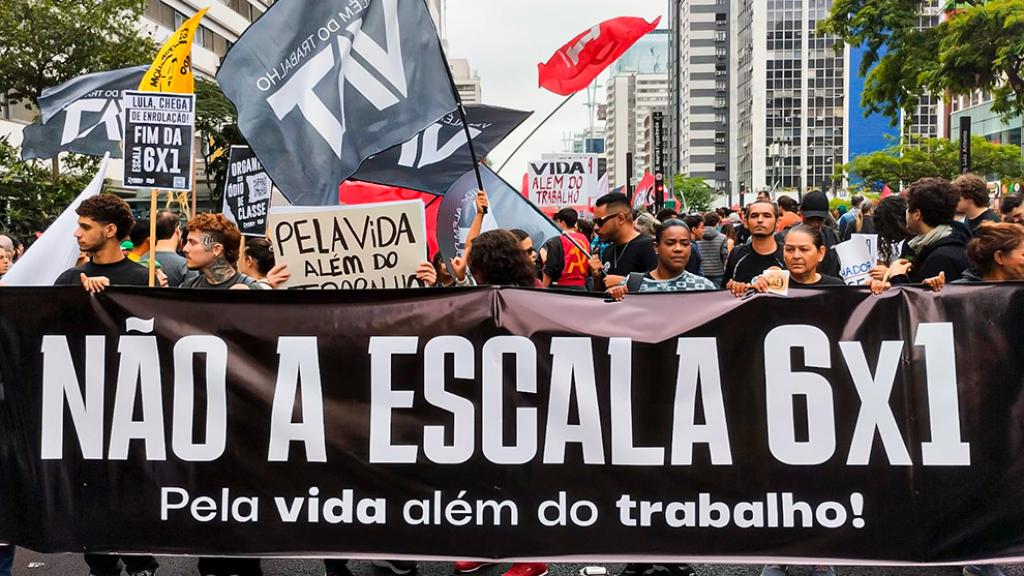
The end of the 6x1 work week: A working-class victory in Brazil

No 6x1 protest

First published in Portuguese at Revista Movimento. Translation by Federico Fuentes for LINKS International Journal of Socialist Renewal.

What seemed impossible a few years ago is becoming inevitable. Reflecting broad social opinion, the lower house of Brazil’s parliament has voted to end the odious “6x1” work week (six day/44-hours of work). Starting 60 days after the Senate passed it, the work week will be reduced by one day to five, and to 40 hours. This is undoubtedly an historic victory for the Brazilian working class, one that will have a political impact on the upcoming national election.

The parliamentary vote was overwhelming, with 472 in favour in the first round and only 22 against — mostly MPs from far-right parties such as Novo (New Party), Partido Liberal (Liberal Party), and Missão (Mission Party). The second round vote was 461–19.

The far-right tried all kinds of manoeuvres to obstruct the reform, even proposing a 10-year transition period. The coup plotters’ attempts to generate confusion was defeated, and the bill is now in the Senate. Vigilance and mobilisation are needed, as the bosses remain unhappy with the bill. We must also take advantage of the politicising effect this has had in the streets and on social media.

Popular support

A broad popular majority, expressed in the streets and on social media, celebrated this victory. The much-talked-about WhatsApp family groups this time were not filled with messages of support for conservatism. The proposed work week reduction resonated deeply with tens of millions of Brazilians — an impressive 70% plus of the population supporting it, an unusually high figure in such a politically fractured society.

The persistence of the VAT movement (Movimento Vida Além do Trabalho or Life Beyond Work Movement) succeeded in pushing its progressive agenda amid capitalism’s crisis, which currently offers few or no reforms. The movement helped sway Congress, which is usually aligned with the bosses’ interests and dominated by the Centrão (Big Centre, a centre-right parliamentary bloc). Up against the wall, and with about 120 days until the election, very few parliamentarians wanted to risk being listed as an enemy of the working class.

The government successfully tapped into popular sentiment, knowing this would be a crucial battle as part of its electoral strategy, where every vote matters. It ran advertising campaigns highlighting the importance of free time for all workers. President Lula da Silva spoke publicly about this too. Society became immersed in a discussion around a central issue for workers: the struggle for free time and the work week.

Despite this energy, there were no significant demonstrations in support of the proposal. Why? Leaving aside the paralysis of the main trade union leadership and the Workers Party government’s policy of avoiding actions that generate “street heat”, the new working class, mostly young and concentrated in certain sectors, instead expressed themselves via an unstoppable torrent on social networks. They did not express themselves that much in the streets, due to the lack of a tradition of struggle and a coherent strategy — there was not even a call for a united May Day event. Nevertheless, we have seen an important shift in the political pendulum, if not to the left at least towards a greater sense of class consciousness and class demands. An opening has been created.

This was a struggle with a “national political character,” which also set the agenda for the upcoming election, even if there are also important local struggles. There have been strikes by municipal teachers in state capitals such as São Paulo, and there is an ongoing strike in Belo Horizonte. There was also the strike at São Paulo state universities, which mobilised about 12–15,000 people in opposition to Governor Tarcísio Freitas.

Far-right on backfoot

As the dispute was more political than anything else, it has influenced — and, at the same time, been influenced by — the election campaign. The election campaign is coming to the end of a first period, which will likely last until the “mini-recess” for the World Cup, according to analysts such as Vinicius Torres Freire writing in Folha de São Paulo. The defeat of the 6x1 work week is part of this first period.

The Bolsomaster scandal, which links the Bolsonaro family to the Banco Master financial scandal, has also changed the dynamics of the election campaign. Directly damaging Flávio Bolsonaro, the scandal halted his upward trajectory and has left the far right at an impasse. Confidence among Flávio allies in him has plummeted, as has his voting intentions.

What seemed like the start of a favourable trend has stalled and is now going backwards. Some are even questioning the viability of his candidacy. Amid the unpredictability of our times, nothing is certain, but Flávio is clearly struggling to regain momentum.

Flávio managed to take a photo with Trump, which means a lot for him amid the crisis. He wanted Trump’s blessing to run with the same priorities as his father, Jair, did before. But the right-wing opposition is suspicious of him. Brazilian entrepreneur and Missão party presidential pre-candidate Renan Santos wants to channel the youth vote, while Partido Social Democrático (PSD, Social Democratic Party) pre-candidate Ronaldo Caiado and Novo pre-candidate Romeu Zema are trying to forge a possible alternative in case Flávio’s campaign falters.

Trump’s designation of Primeiro Comando da Capital (PCC, Capital's First Command) and Comando Vermelho (CV, Red Command) as terrorist organisations represents a very serious threat, and raises the spectre of more direct US interference in Brazil’s election.

There is logic behind taking a photo with Trump, as foreign policy will be a key issue in this campaign, and will only gain in importance as time goes on. US imperialism’s quagmire in Iran, its attacks on Cuba, and the popular rebellion in Bolivia are vying for people’s imagination just months out from the election. The far right is gambling its future on the Brazilian and Colombian elections, along with Trump's strategic bid to win the November US midterm elections.

Support for radical left

In all this, we cannot ignore the strong support shown for Partido Socialismo e Liberdade (PSOL, Socialism and Liberty Party) and its leaders on social media as a result of the 6x1 issue. This support will no doubt also express itself politically and electorally. But it is up to PSOL’s left wing to organise this support into a militant social force.

The support on social media has been incredible, especially for PSOL MPs Sâmia Bomfim and Fernanda Melchionna, but also for PSOL MP Erika Hilton and PSOL Rio city councillor Rick Azevedo, who founded the VAT Movement. Sâmia’s ironic takedown of far-right MP Nikolas Ferreira went viral. It takes a lot of nerve to deal with the sheer audacity of such far-right leaders.

We need to mobilise if the Senate threatens to weaken the bill. Trade unions, the UNE (National Union of Students) and the UBES (Brazilian Union of Secondary Students) would need to call for a plan of action and strikes.

Although the working class is not yet mobilised enough to organise a general strike in the immediate term, this option should not be ruled out if the Senate seeks to undo the victory. In that scenario, the social majority that supports ending the 6x1 work week could generate the conditions for a more decisive national action, with large marches and demonstrations. The idea of ​​paralysing the country could serve as a demonstration of the need to go all the way in order to achieve victory, as proposed by STILASP, the trade union who led the successful Pepsico strike.

But we cannot stop there. The millions who have been discussing options for the country and workers in schools, neighbourhoods, shopping centres, universities, factories and workplaces, could become a fundamental asset for building a real instrument of the new working class, one that would vote for Lula as a containment tactic against the far right, but go much further in terms of agenda and methods of struggle.

Trump’s action the day after the significant victory indicates that the polarisation will continue, including in the election campaign. We must throw ourselves into it, taking advantage of the enormous support PSOL has received, to build a movement that guarantees Lula’s victory and the election of a parliamentary bloc committed to present and future struggles.

The Bolivian rebellion teaches us that the far right and capitalists must be defeated through the strength of the working class and the people as a whole, and its program.

Israel Dutra is a sociologist, PSOL Secretary of Social Movements, a member of the party's National Committee, and a Socialist Left Movement (MES/PSOL) leader.