Friday, June 12, 2026

AMERIKAN PROTESTANTISM
Inside Trump Cabinet official’s ties to shadowy evangelical group

June 09, 2026
ALTERNET

President Donald Trump continues to draw a great deal of criticism on both the left and the right for picking Federal Housing Finance Agency (FHFA) Director Bill Pulte for acting national intelligence director despite his lack of national security experience. But Trump considers Pulte a true MAGA loyalist. And according to Salon, he has another credential that makes him appealing to MAGA: his family's connection to The Family, a secretive Christian group that has been active in Washington, DC for 91 years.

Journalist Jonathan Larsen, in Salon, reports that Pulte's family "has had extensive ties over two generations to leaders and financial backers" of the Fellowship Foundation, AKA The Family — which "conducts shadow diplomacy around the world, according to public records and documents I obtained."

"Pulte's grandfather, at one point one of the wealthiest men in the world, built a Fortune 500 company and gave tens if not hundreds of millions of dollars to charity before his 2018 death," Larsen reports. "He was also friends with Doug Coe, died in 2017 after decades leading the secretive, controversial Fellowship Foundation that built and sustained a global right-wing network including dictators, lobbyists, and corrupt millionaires largely united against labor, LGBTQ+ and reproductive rights. Better known as The Family, The Fellowship runs the National Prayer Breakfast and the congressional residence on Capitol Hill called C Street."


The Family was formed in 1935 during the Great Depression by Abraham Vereide, a native of Norway. Democratic President Franklin Delano Roosevelt was serving his first term at the time, and The Family was decidedly opposed to FDR's New Deal. Although Vereide was a Methodist/Mainline Protestant minister, evangelicals have become increasingly prominent in The Family over the years.

Larsen notes that he "found no public indication that Pulte has direct, personal ties to The Fellowship," but members of his family clearly do.


"If Pulte is personally connected to The Fellowship," Larsen explains, "he'd hardly be alone in the administration's upper ranks. Secretary of State Marco Rubio used to live at the C Street townhouse, as did Senate Majority Leader John Thune (R-S.D.). President Donald Trump's special envoy to the United Kingdom, former 'Apprentice' producer Mark Burnett, is a regular at The Fellowship's National Prayer Breakfast….

It's not surprising that the Pulte family, based in Michigan, has ties to Fellowship insiders and funders. The Fellowship has had a strong presence among Michigan's wealthy for decades…. But, especially in Pulte's new position, The Fellowship could be just a phone call away, given its intense focus on relationships with global leaders, and given Pulte’s ostensible closeness to his grandfather. The Fellowship already has a history of working with and inside the State Department."


Southern Baptists oppose amnesty, political violence, women pastors at annual meeting

(RNS) — In a departure from resolutions dating to 2006, the SBC’s new statement does not mention a path to legal status for immigrants.


Thousands of people attend the Southern Baptist Convention annual meeting, Tuesday, June 9, 2026, at the Orange County Convention Center in Orlando, Fla. (RNS photo/Marty Jean-Louis)

Adelle M. Banks
June 11, 2026 
RNS


(RNS) — Southern Baptists adopted a resolution on immigration at their annual meeting, affirming “love of neighbor” but also legal immigration enforcement.

The resolution, one of 11 nonbinding statements adopted that gave a sense of viewpoints of those gathered at the Southern Baptist Convention’s meeting in Orlando, Florida, was adopted after the denomination’s public policy arm broke ties with an evangelical immigration advocacy group last September.

“We reject amnesty, understood as forgiveness of legal violations without accountability,” read the denomination’s Wednesday (June 10) statement, which also disavowed “all ideologies or rhetoric that deny the equal worth and dignity of any people group regardless of immigration status.” It also affirmed “that Christian compassion and hospitality do not negate lawful order or excuse indifference to public justice and social peace.”

Before a vote, the statement prompted questions on the floor of the Orange County Convention Center, including from Kyle Stachewicz, lead pastor of a Reedsburg, Wisconsin, church. He said some of its language would convey to young adults carried across the border at a young age and later baptized in a Southern Baptist church “that we see no distinction between them and someone who willfully broke the law as an adult.”

He added: “I fear that not recognizing this will close doors to gospel ministry in immigrant communities at the exact moment that we are asking Southern Baptist churches to strengthen such ministry as this resolution calls us to do.”

In a departure from past resolutions dating back to 2006, the new statement, which was presented by the SBC resolutions committee, does not mention a path to legal status for immigrants

RELATED: Willy Rice, Florida pastor and abuse crisis skeptic, elected SBC president


“One of the tremendous problems is that the system’s been overwhelmed by just the sheer number of people who have come over,” Hunter Baker, chair of the committee, said at a news conference after the resolutions were considered. “You don’t have an adequate judicial apparatus or regulatory apparatus to give everybody due process.”

As a result, he said, immigrants are left not knowing where they stand.

The slate of resolutions, most of which were adopted on Wednesday, the second day of the two-day meeting, included one that adds to their yearslong discussion of women pastors.

Earlier in the day, messengers, or church delegates to the conference, adopted a measure called the Truth and Unity Amendment in a first step to have the SBC constitution bar churches that have women pastors or permit women to preach on Sunday mornings. The amendment was proposed by Al Mohler, president of the flagship Southern Baptist Theological Seminary in Louisville, Kentucky.

The related resolution, titled “On the Office and Function of Pastor/Elder/Overseer,” states that the Southern Baptist messengers “reaffirm that the office of pastor/elder/overseer is limited to men as qualified by Scripture” and “affirm that the New Testament presents the pastoral office and the function of pastoral oversight of the church as inseparably connected.”
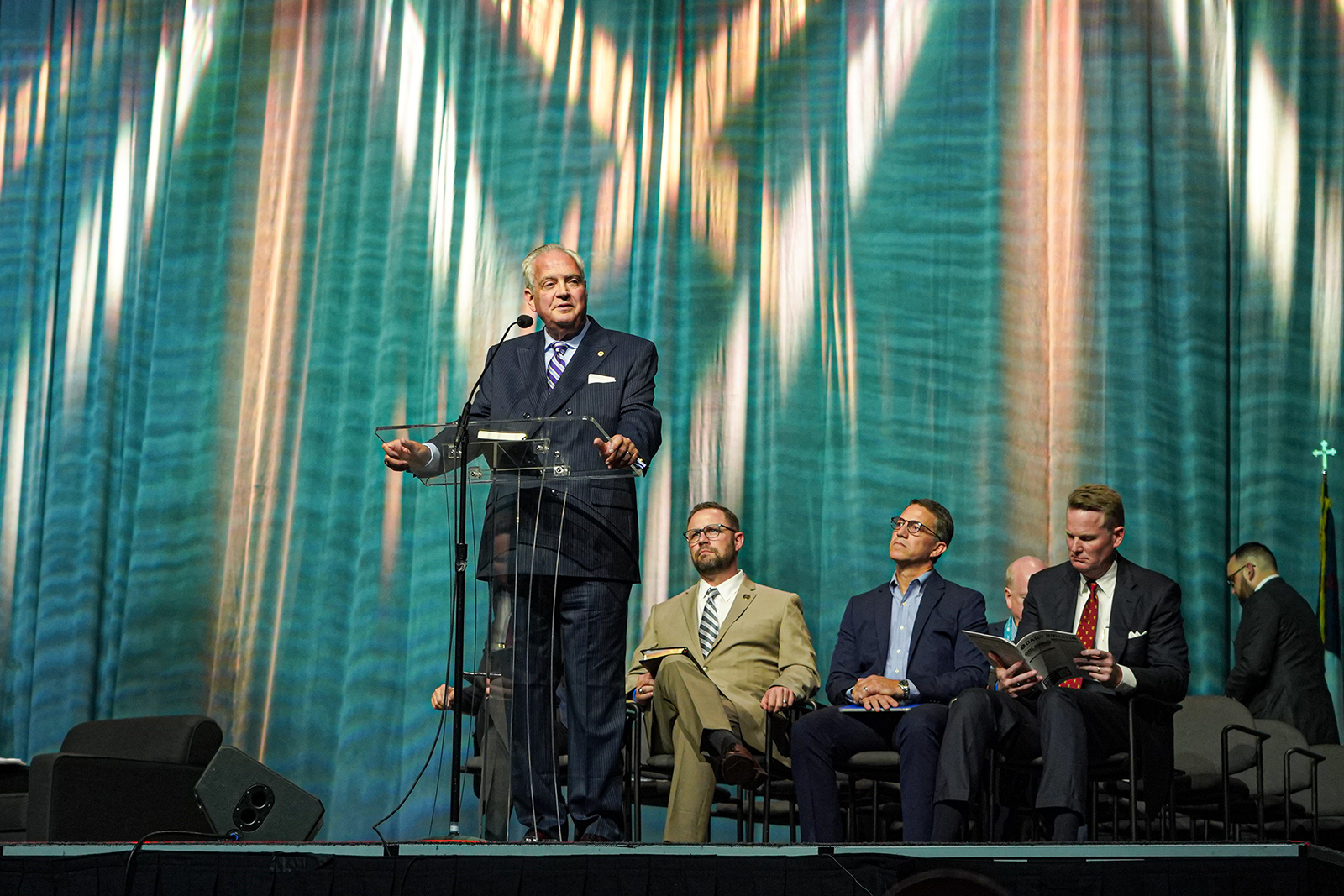
Al Mohler addresses the Southern Baptist Convention annual meeting, Tuesday, June 9, 2026, in Orlando, Fla. (RNS photo/Marty Jean-Louis)

Citing confusion in some SBC congregations, it urged churches to not use the titles “pastor,” “overseer” and “elder” for nonpastoral offices and to “continue affirming and deploying women in biblically faithful ways.” The statement expressed gratitude for the “indispensable service” of women across Southern Baptist life, such as in missions work and evangelism.

The Baptists also condemned political violence, citing recent “assassinations and attempted assassinations of public figures, the harassment and even murder of fellow citizens in houses of worship, vandalism of crisis pregnancy centers, and public mayhem that sows chaos and destruction.”

William Wolfe, a messenger from a Fort Mill, South Carolina, church and executive director of the Center for Baptist Leadership, unsuccessfully sought to add wording to the resolution about Charlie Kirk, the evangelical Christian activist and co-founder of Turning Point USA who was assassinated last September.

“In 2018, the SBC passed a resolution specifically mentioning the assassination of MLK Jr., and if we can name MLK Jr., we can name Charlie Kirk,” said Wolfe, a former Trump administration official, in a reference to the Rev. Martin Luther King Jr.

But the resolutions committee opposed Wolfe’s proposed amendment. During a press conference, committee member Ryan Helfenbein, who said he was a close friend of Kirk’s, said that the whole committee felt the loss of Kirk but wanted to address the bigger issue of political violence.
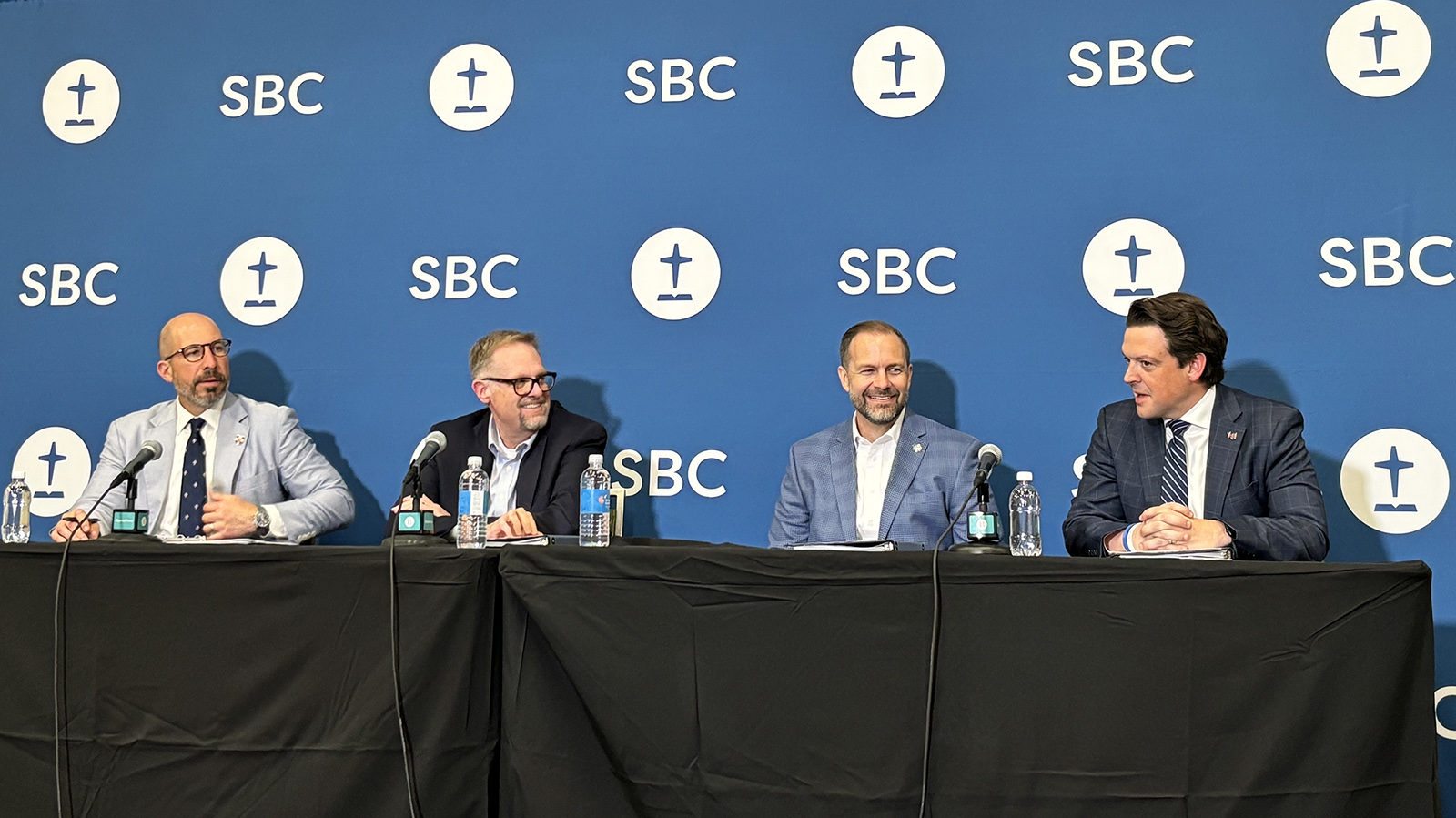
Members of the 2026 SBC Committee on Resolutions, including Jeremy Pierre, from left, Hunter Baker, Evan Lenow and Ryan Helfenbein, hold a press conference June 10, 2026, in Orlando, Fla. (RNS photo/Bob Smietana)

Baker echoed that sentiment, citing the assassination attempts that targeted President Donald Trump as well as the fatal ambush last year of Melissa Hortman, a Democratic state representative in Minnesota, along with the death of Kirk. “We wanted to capture the broader phenomenon,” he said.

The resolution called on Southern Baptists to analyze their public speech and online content, treat others as neighbors rather than enemies and reject the idea that their foremost identity is their political affiliation rather than their Christian commitment.

“We reject any claim that righteous ends justify unrighteous means,” it stated.

In a separate resolution, Southern Baptists reiterated that they “unequivocally condemn this new surge of antisemitism in all its forms, including violence, cultural hatred, and conspiracy theories of Jewish controlled cabals, as sinful, unchristian, and an assault on both biblical truth and basic human dignity.”

Pastor Stephen Feinstein of a Southern Baptist church in Hesperia, California, urged passage of the resolution on antisemitism.

“If you do not believe that antisemitism is rising in our society, you aren’t paying attention,” said Feinstein, whose church website describes him as a Christian convert who is the son of a Jewish father and a Roman Catholic mother. “My youngest daughter asked me if we could change her last name. My name is Feinstein. You shouldn’t have to have your daughter ask that kind of question.”
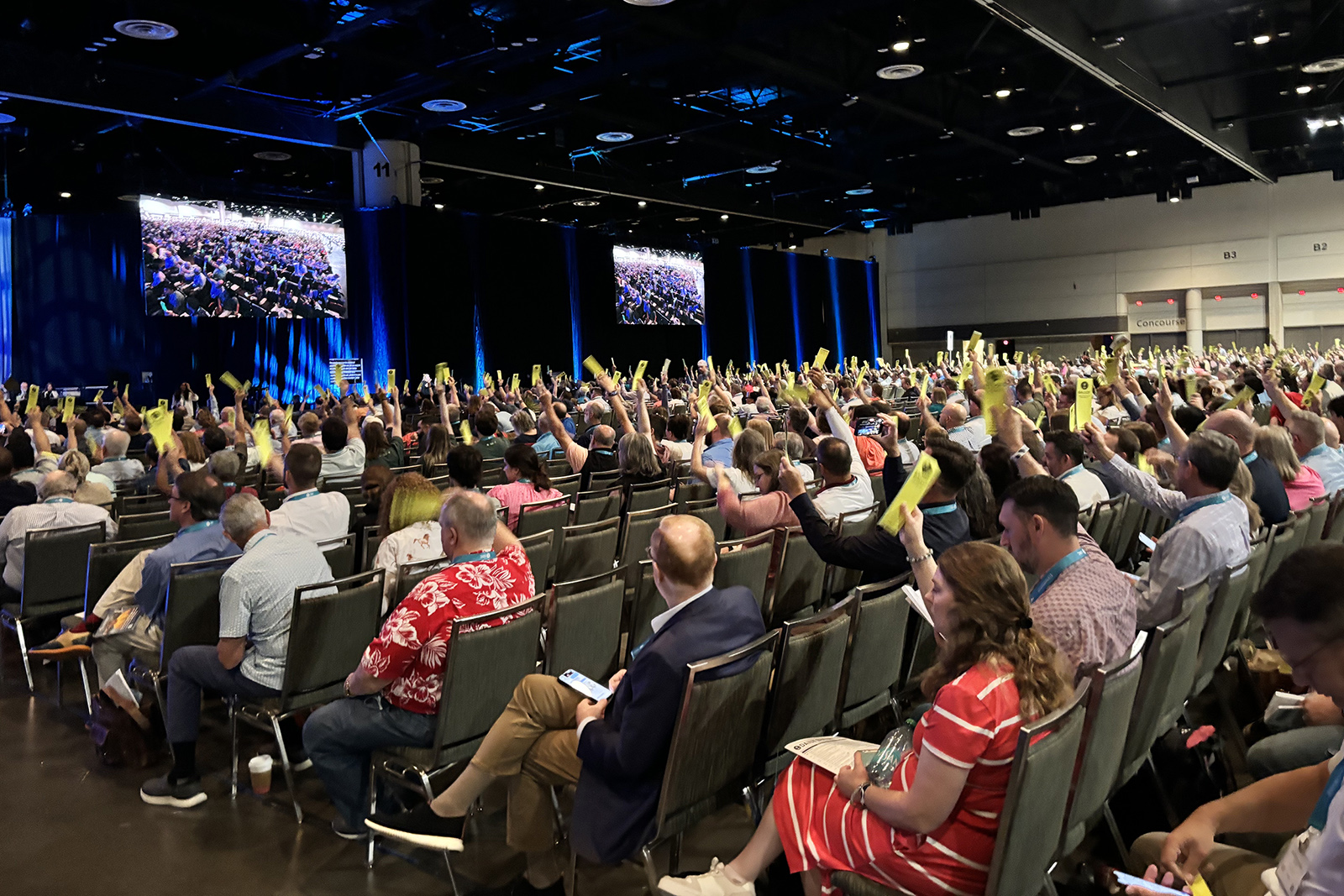
Messengers vote during the Southern Baptist Convention annual meeting, Wednesday, June 10, 2026, at the Orange County Convention Center in Orlando, Fla. (RNS photo/Bob Smietana)

Another resolution said that using digital technology for worship should not take the place of in-person services for all who are able. The statement, titled “On the Nature and Importance of the Physically Gathered Church in a Digital Age,” also affirmed in-person baptism and Communion rather than “virtual or digitally mediated substitutes.”

On Tuesday, the Southern Baptists approved a resolution about the 250th anniversary of the country and religious liberty, acknowledging “sins such as slavery, racism, abortion, injustice, and sexual immorality” in the country’s history. It noted that despite failings the country had ended slavery within its borders and defended freedom from threats of communism abroad.

They added: “we call upon Southern Baptists to pursue national renewal through biblically informed civic engagement, including advocating for just laws that are rooted in God’s natural law and consistent with the witness of holy Scripture, and electing public officials who will do the same.”

Another adopted resolution expressed appreciation for bivocational and volunteer pastors who work in other jobs while serving local congregations. Yet another encouraged all Southern Baptist congregations to expand their inclusion of children and adults with disabilities, including identifying barriers to physical access to enable families to participate in church.

One measure reaffirmed their opposition to assisted suicide, as more states have legalized the practice, and urged policymakers and medical practitioners to prioritize care such as hospice, palliative support and effective pain management.

And a resolution, passed in light of attention given to pastors and other ministry leaders embroiled in scandal, expressed gratitude for those who “labored faithfully over many years and finished well, keeping the faith and maintaining a testimony above reproach to the end.”

RNS national reporter Bob Smietana contributed to this report.


France

Macron’s G-Zero

Wednesday 10 June 2026, by Jean Batou


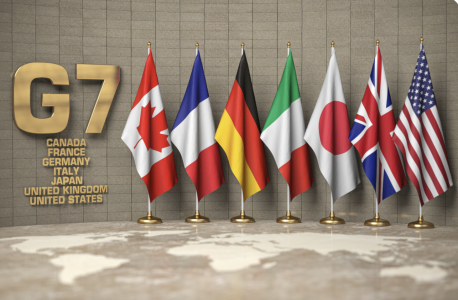
The G7 summit will be held in Évian from June 15 to 17. The heads of government and central banks from North America, the major European powers, and Japan will meet there to try to resolve their differences and consider common responses to the problems they face. South Korea has been invited, as well as India, Brazil, and Kenya.

Why in Evian rather than Paris?

– For security reasons: between the Alps and the lake, the area around this small town is relatively easy to control. Furthermore, the street demonstrations that such a summit is bound to provoke will have to be managed primarily by the Swiss police.

– For symbolic reasons: Évian is the perfect setting for a “diplomatic bubble,” isolated from the social tensions of the real world. The Hôtel Royal was, in fact, built in 1909 as a luxury hotel for the elite. Its name refers to King Edward VII. For over a century, it has welcomed sovereigns, heads of state, diplomats, industrialists, and the very wealthy.

– Due to Geneva’s proximity, its international organizations, and its globalized economic and financial position. Giant companies such as ADM, Alcon, Bunge, Cargill, Caterpillar, DuPont, Gunvor, L’Oréal, Logitech, Mercuria Energy Group, Merk Serono, MSC, Richemont, Trafigura and Vitol have their European or global headquarters in Geneva.

Growing rivalries

This G7 has little to do with the summits of the era of "happy globalization." We have entered fully into an era of rising inter-imperialist conflicts.

Signs of disagreement are multiplying between the United States, the European Union, and Japan. To name just a few: industrial, trade, and customs policy; the regulation of major digital platforms; the strategic and technological autonomy of European defence; the future of NATO; relations with China, Russia, and Iran; the status of Greenland; and the role of major international institutions (UN, ILO, WHO, WTO, etc.). On all these points, the divergences between the United States and the major European powers, and to a lesser extent with Japan, have only grown.

This is why there is little chance that the G7 will be able to agree on a common response to the crisis factors that are disrupting international relations: the rise of US protectionism, the loss of competitiveness of EU countries, the continued rise of the Chinese trade surplus ($1 trillion); the issue of energy security; the shortage of certain critical resources, particularly rare earths; the challenges of AI; the reshaping of development aid (more funding COMING from countries of the South, more private funding); the wars in Ukraine and the Middle East.

“Macron’s term is drawing to a close. His popularity at home is low. France is a ‘middle-ranking power’ with little chance of securing concrete commitments from the United States and China, let alone Germany. Moreover, China isn’t even a member of the G7. In 2026, we can expect a plethora of academic papers, scenarios, and speeches on global imbalances, which will only underline what we already know. But the United States and China, along with many European countries, are unlikely to change the policies that have created these excessive global imbalances, any more than they have in the past two decades.” (Mark Sobel, senior US Treasury official for 40 years, OMFIF, March 3, 2026)

Towards a G-Zero

In reality, the various organs of "global governance" are increasingly malfunctioning: the UN is considerably weakened, the WTO has been marginalized by the unilateral tariff policy of the United States, the G20 struggles to agree, even on a final declaration, the BRICS represent contradictory interests… It is in this sense that the very influential American political scientist, Ian Bremmer, author of US vs Them: The Failure of Geobalism ( 2018) , predicts a G-Zero .

"Geopolitical expert Ian Bremmer stated that the American operation that led to the capture of the Venezuelan leader reflected a deeper shift toward what he calls a ’G-Zero world,’ where no country is willing or able to assume global leadership. He argued that the United States was turning away from the international order it once established, based on collective security, the rule of law, and democratic norms, and replacing it with unilateral action guided by brute force." (India Today , January 7, 2026)

To plug the leaky hull of the "global governance" ship, various options are being debated. Some advocate expanding the G7 to include Australia, South Korea, and Spain, suggest inviting more middle-ranking powers, and strengthen its collaboration with international institutions to counterbalance the unilateral policies of the United States—the US would not necessarily participate in all discussions. Others advocate cooperation among the willing, with the EU, Canada, and the UK potentially taking the lead, aimed at creating leverage for negotiations with China.

The only points of agreement: intensifying the class war

On at least six objectives, the G7 members will agree without difficulty:
1. Continue to favour the enrichment of the richest; 2. Continue to dismantle our public services and social insurance; 3. Further reduce our freedoms and democratic rights; 4. Intensify the hunt for migrants ; 5. Turn a blind eye to climate change; 6. Accelerate the arms race.

But precisely, they hardly need to debate that in Évian. The matter is settled!

1. Continuing to enrich the wealthiest: the number of dollar billionaires grew from 1,810 in 2016 to 3,028 in 2025. Together, they hold $15 trillion, equivalent to the combined assets of the 5.5 to 6 billion poorest people (70% of the world’s population). But this staggering imbalance doesn’t interest the world’s elite, and for good reason.

2. Continue the dismantling of our public services and social safety nets. Whether they wield a chainsaw or a plane, businesses and governments are committed to a systematic reduction of social spending. Emmanuel Macron explicitly acknowledged this before the 80th session of the United Nations General Assembly on September 23rd, feigning regret, of course:

“Everywhere, we are reducing and undermining our shared ambitions to finance major global challenges. Collective funding for healthcare is collapsing, as is funding for food security and education.”

3. Further curtailing the freedoms and democratic rights we have acquired through more than 150 years of struggle in order to establish more authoritarian regimes. Indeed, the governments of the G7 countries are now looking enviously towards Russia and China, where authorities and businesses do not have to take into account trade unions, political parties, or associations independent of the regime in power. Imperialism on its last legs has never been compatible with democratic rights…

4. Intensify the hunt for migrants : Over the past ten years, 30,000 people have died trying to enter Fortress Europe illegally — Frontex relies on several thousand agents (10,000 planned for 2027) — not counting the much larger forces of national police forces — a budget of one billion euros, dozens of physical barriers, sophisticated weaponry, and several hundred detention camps. In the United States, 7,000 people have died attempting to cross the border; ICE has more than 20,000 agents and a budget of 11.3 billion dollars.

5. Turning a blind eye to climate change. A leader in this area, the United States actively promotes fossil fuels, reduces federal regulations on greenhouse gas (GHG) emissions, and lowers its international commitments. The other G7 countries also play a key role in reducing the COP climate targets.

6. Accelerating the arms race. The United States currently spends $1 trillion annually on armaments, and Donald Trump has announced plans to increase this colossal budget to $1.5 trillion. The EU and the UK allocate approximately $500 billion to their military spending, and these amounts are expected to approach $800 billion by 2030.

It is against these six objectives shared by the Swiss government and the Geneva financial centre that we must mobilize in Geneva and in France, from June 13 to 17.

Servility towards the United States

Despite growing disagreements, the subservience of G7 members to the United States and the bluster of its president is impressive…

During the preparation period for the Summit, the six other G7 countries made numerous conciliatory gestures so as not to irritate Donald Trump.

First, South Africa, a regular guest at G7 summits, was not invited this year under pressure from the United States. To ensure Africa wasn’t completely excluded from the festivities, France had to call upon Kenya…

Why didn’t Trump want South Africa?

– Because of its complaint against Israel before the International Court of Justice for violation of the Genocide Convention in Gaza.

– Because of its land reform allowing the expropriation of certain lands without compensation to correct the inequalities inherited from apartheid.

– Because of the alleged persecution of white farmers, presented by Washington as a premeditated “white genocide”.

Then, regarding Iran, on January 14, the G7 foreign ministers, unflinchingly echoing Donald Trump’s rhetoric, published a joint statement outlining the following undertaking:

No opposition to the war in Iran…

"The G7 members remain ready to impose further restrictive measures if Iran continues to repress protests and dissent in violation of international human rights."

Yet, on February 28, the US and Israeli aggression against Iran made no further mention of "international human rights." It was now solely about uranium and missiles. Furthermore, it strengthened the powers of the petro-theocracy of the Revolutionary Guards and massively intensified domestic repression, while exposing the civilian population to the direct and indirect effects of massive bombings, also causing significant shortages.

Silence in the face of increased repression by the Revolutionary Guards

Repression has intensified in Iran since the beginning of the American-Israeli aggression.

From November 1, 2025 to February 28, 2026: 121 death sentences were carried out

From March 1 to May 31, 2026: 321.

(Source: Iran Human Rights )

This did not prevent the G7 foreign ministers from using doublespeak on March 1st, jointly declaring that they "would continue to closely coordinate their actions in the face of the various challenges facing the international community."

However, despite repeated calls from Donald Trump, this time his allies did not lift a finger to help him get out of the impasse he has plunged headlong into in Iran.

The German chancellor went even further, recalling American failures in Iraq and Afghanistan, referring to a quagmire, and even adding that Iran had
"humiliated" the United States. This was more than the champion of " Make America Great Again " could bear, and he announced the withdrawal of 5,000 American troops from Germany.

Trump’s latest whim

As if all that weren’t enough, "President Trump, in order to organize a boxing match under a tent erected in the White House gardens on his own birthday, imposed the postponement of the G7 summit in Évian. Trump’s circus thus forces the postponement of the ceremony honouring Marc Bloch, the historian, author of *Strange Defeat*, resistance fighter, and hero who died for France" (Pierre Ouzoulias, Communist senator). Indeed, the interment of Marc Bloch in the Panthéon, initially scheduled for June 16, exactly 82 years to the day after his assassination by the Nazis, had to be postponed to June 23.

4 June 2026

Translated by International Viewpoint from marx21.ch.

P.S.

If you like this article or have found it useful, please consider donating towards the work of International Viewpoint. Simply follow this link: Donate then enter an amount of your choice. One-off donations are very welcome. But regular donations by standing order are also vital to our continuing functioning. See the last paragraph of this article for our bank account details and take out a standing order. Thanks.

The general strike in Portugal scored points, but the future is uncertain

Thursday 11 June 2026, by Antonio Louçã


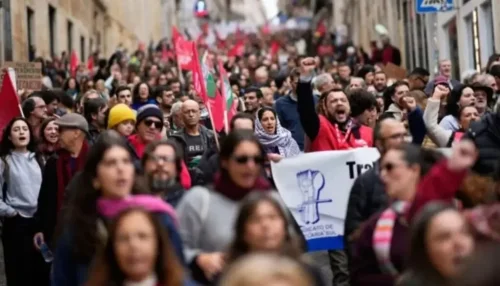
The general strike of June 3rd paralysed a significant number of businesses and services. There is a widespread awareness among the working class that the package of dozens of labour laws represents a mortal threat to their future.

The tourism industry was severely affected by the cancellation of numerous flights at Lisbon, Porto and Faro airports; public transport was paralysed in the major cities, with the exception of minimal bus services and some rail connections between the centre and the outskirts of Lisbon; schools were paralysed in the middle of exam season and public hospitals only operated for emergencies. The big news was the significant participation from the private sector, clearly higher than that seen in the general strike in December, with stoppage rates that the CGTP (Confederação Geral dos Trabalhadores Portugueses or General Confederation of Portuguese Workers, the largest trade union federation) estimated at 100% for companies like Sovena and Cimpor, 95% for Bosch and 88% for Glavidro. [1]

The working class was not swayed by the siren songs that guaranteed the rejection of the "package" in the parliamentary vote. The previous strike, in December, had been strong enough to force the neo-fascist Chega party to change its voting position and announce its opposition to the approval of the bill promoted by the (minority) conservative right-wing government. But Chega’s about-face was, and remains, one of its many opportunistic manoeuvres, and no one can trust it to stick to its position. The struggle had to continue, and the call for a new general strike, despite all the postponements and vacillations by the CGTP, offered the working class the opportunity to make its position clear. And that opportunity was seized decisively.

In addition to rejecting illusions about the uncertain outcome of the parliamentary vote, the working class resisted the highly demobilising effect of the five-month interval between the general strike in December and this one in June. During that time, employers and the Government negotiated in the forum known as "Social Concertation" with the social democratic trade union federation UGT (União Geral de Trabalhadores or General Union of Workers), excluding the CGTP, in its majority tied to the communist party. Excluded from negotiations, they did not use that time to mobilise within companies, warning about the danger posed by the government project, but instead went around in circles until calling for a new general strike on June 3.

When the Government’s intransigence forced the UGT itself to refuse to agree to the package, the CGTP had a golden opportunity to promote assemblies in the companies that would eventually drag the UGT into joining the strike. In fact, even without that pressure from below, several UGT unions gave their members the green light to join the strike called by the rival union. However, the CGTP preferred to issue a top-down call, emphasising the UGT’s "yellow" nature and avoiding opening the Pandora’s box of a widespread workplace assembly process that could potentially sustain the struggle in the coming weeks and months.

The absence of assemblies resulted in a very uneven distribution of picket lines. In many workplaces, the union bureaucracy left the mornings free for strikers to stay home or go to the beach and simply called for afternoon demonstrations in each city. Thus, workplaces with a long tradition of assemblies and pickets were now deprived of both. The strike’s coincidence—anything but accidental—with a public holiday the following day, and with a Friday that invited long weekends, exponentially worsened the demobilisation. In Lisbon, the afternoon demonstration was less attended than the one in December 2025.

On June 3, 2026, the working class made its mark with a powerful strike. But there is no strategy or leadership that can guarantee the defeat of the labour package. We are still far from defining that strategy and building that leadership.

5 June 2026

Translated by David Fagan for International Viewpoint from Huella del Sur.

Footnotes

[1] Sovena Group is one of the largest Portuguese agribusiness holding companies, with its own farmyards in Portugal and several other countries. Cimpor - Cimentos de Portugal is the largest Portuguese cement group. Glavidro manufactures glass for industrial and construction purposes.