Thursday, July 02, 2026


As Super El Niño Looms, New Study Finds American Churches Unprepared to Help Congregants Cope with Climate Grief
Associate Director (Acting Executive Director), The BTS Center

Research reveals a “spiritual infrastructure gap” and a surprising disconnect between preachers and their congregations on climate emotions

PORTLAND, Maine — With a Super El Niño poised to amplify an expected record-breaking wildfire season, coastal flood risk, and extreme heat events across the United States this summer, a new study warns that American faith communities – among the most trusted institutions in civic life – are largely unprepared to help their members cope emotionally with the accelerating climate crisis.

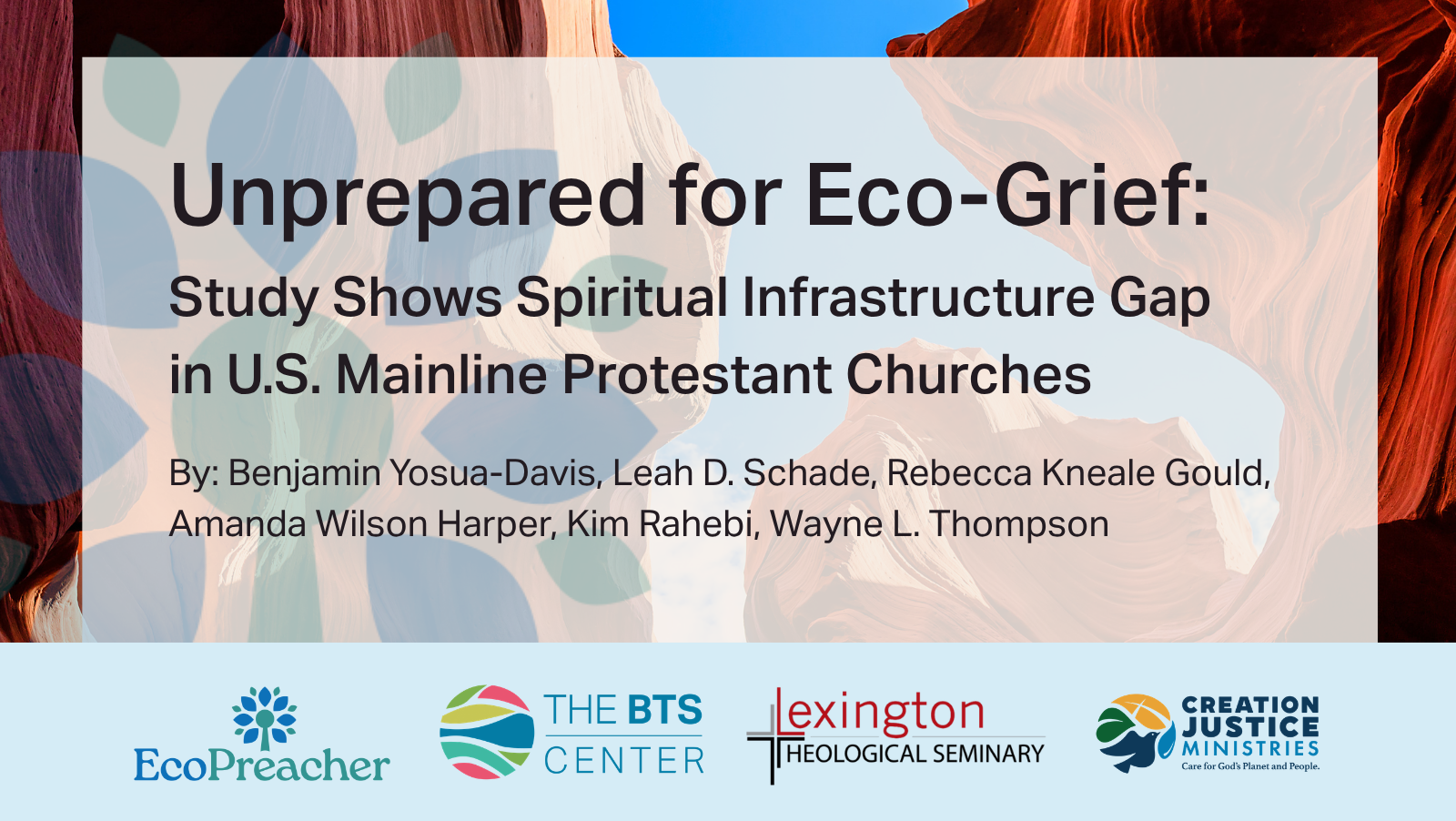
The paper, “Unprepared for Eco-Grief: Study Shows Spiritual Infrastructure Gap in U.S. Mainline Protestant Churches,” is a publication from the EcoPreacher Initiative, a multi-institutional research initiative funded by Lilly Endowment Inc.’s Compelling Preaching Initiative and conducted through Lexington Theological Seminary in partnership with The BTS Center and Creation Justice Ministries. The findings, drawn from surveys of nearly 300 clergy and lay church leaders in Fall 2025, document a widespread and largely unaddressed emotional crisis in the pews.

Eco-Grief Common Among Congregants

Nearly half of active church members surveyed report feeling anxiety or dread about climate change (47%), while 45% describe anger or frustration, and 37% express alarm about the future of humanity. Researchers call this cluster of responses “eco-grief”: the mourning of lost species, disappearing ecosystems, and climate-devastated communities.

Yet the study finds that most congregations lack the biblical, theological, and liturgical frameworks to hold these emotions — what researchers term a “spiritual infrastructure gap.” This gap is both pastoral and strategic: a congregation’s willingness to explore eco-grief is a strong statistical predictor (r = .50) of whether climate action becomes a high priority for that community.

The Pulpit–Pew Divide

One of the study’s most significant findings is a notable perception gap between clergy and their congregations. While 80% of church lay leaders cite concern for future generations as a major motivator for climate action, only 64% of their ministers perceived this to be the case for their congregants. Even more striking: 75% of congregants said that connection to specific local places (e.g., forests, beaches, rivers) is a powerful motivator, yet only 27% of preachers recognized this.

Preachers also significantly overestimate the risk of backlash to climate preaching. Nearly a quarter of clergy cited fear of political resistance as a major barrier to addressing climate from the pulpit, yet only 8% report having actually received hostile responses to environmental sermons. In contrast, 95% report that congregants respond with curiosity, openness, or enthusiasm.

Why This Matters Now

With the convergence of long-term climate change and a nascent Super El Niño, federal forecasters have projected a severe 2026 hurricane season, elevated wildfire risk across the West and in southern Canada, and historically abnormal heat across much of the country. For the millions of Americans who turn to their faith communities in times of crisis, the question of whether churches can respond to climate-driven trauma has become increasingly urgent.

The research team argues that faith leaders are uniquely equipped to fill the spiritual infrastructure gap — if they choose to. Preachers already function as meaning-makers, using scripture, music, ritual, and communal practice to help people navigate loss. The study points to specific approaches: creating liturgical space for lament (drawing on the Hebrew Psalms as a model), preaching with personal vulnerability about ecological loss, incorporating trauma-informed care frameworks, and forming what the researchers call “sermon feedback circles” where congregants can connect local environmental realities to their faith lives.

Prior research from the project found that when congregations do engage climate emotions, the results are measurably positive: 70% of congregants report increased gratitude and 60% increased compassion — outcomes that strengthen the very community bonds needed for collective resilience.

About the Research

The study, authored by Benjamin Yosua-Davis, Leah D. Schade, Rebecca Kneale Gould, Amanda Wilson Harper, Kim Rahebi, and Wayne L. Thompson, draws on intake surveys administered in September 2025 to 97 EcoPreacher participants and 186 congregational leaders across 22 U.S. states and 12 countries. Methodology included descriptive statistics, correlation rankings, multiple regression modeling, and qualitative thematic coding of open-ended responses.

The EcoPreacher Cohort is a rigorous learning community that equips clergy and faith leaders with theological frameworks and practical resources to address climate and environmental justice from the pulpit. The EcoPreacher Initiative is a partnership of Lexington Theological Seminary, The BTS Center, and Creation Justice Ministries, funded by Lilly Endowment Inc.’s Compelling Preaching Initiative.


Disclaimer: The views and opinions expressed in this article are those of the authors and do not necessarily reflect the official policy or position of RNS or Religion News Foundation.

 Purple Catholicism


Pope Leo, come to Silicon Valley


(RNS) — Twice in the last 135 years, the actions of a pope sparked massive global changes that met the cultural moment. The AI race is another such moment to meet.
Pope Leo XIV attends the presentation of his first encyclical, “Magnifica Humanitas: On Safeguarding the Human Person in the Time of Artificial Intelligence,” at the Vatican, May 25, 2026. (AP Photo/Alessandra Tarantino)

(RNS) — I wish I could better recall every person I met at Our Lady of Peace Church and Shrine this past June 6. It’s a vibrant and growing parish (packed Sunday Masses, every two hours, from 6:30 a.m. through 8 p.m.) in the heart of Silicon Valley, and Bishop Oscar Cantu of San Jose decided it would be an ideal place to have an event on Pope Leo XIV’s encyclical, “Magnifica Humanitas,” just days after its release.

I met people from Anthropic, Google DeepMind, Meta, PayPal and Microsoft, among other places. Well over 300 folks showed up for two public panels on a papal encyclical at 9 a.m. on a Saturday. Several who identified as religious felt deep apprehension about what was happening within their companies. Others were secular but expressed gratitude that the pope was stepping up at this key moment in our history. Both the numbers of the people who came, and the kinds of stories they told, demonstrated the profound need for the leadership of Pope Leo and an interest in “Magnifica Humanitas.”

I’m a Catholic moral theologian, but prominent secular outlets like NPR, The New York Times, the BBC, The Atlantic and The Washington Post all reached out to me to help cover the encyclical. I recently helped the U.S. Conference of Catholic Bishops brief congressional staffers on the encyclical. The House dining room we reserved was packed, and the exchange, robust. 

We engaged topics such as lethal autonomous weapons, the geopolitical pressure put into the system by China and the differences between using brain-implanted devices for therapies versus using them for enhancement. And, of course, in the back of everyone’s mind was the race that artificial intelligence and tech companies are having in the U.S. and around the world.

Many of these companies find themselves in something akin to a prisoner’s dilemma, where they believe that if they don’t “win,” then other companies (including those working for foreign adversaries) will do things like ignore safety standards and expose the steps for making chemical or biological weapons — or even risk the “escape” of autonomous large-language models that could wreak havoc and perhaps put human civilization itself up for grabs. 

From my own formal and informal conversations with folks working in frontier AI labs, it is clear not everyone agrees about the nature of these risks or how far into the future they might become existential concerns. Some believe we have about 18 months to act before the exponentially increasing power of AI becomes unstoppable, while others think that there is almost no chance of this happening. Others take something like a middle position. Unfortunately, more than one person from these labs has said there is basically no neutral forum available where these competing claims are welcomed and publicly tested.

Copies of Pope Leo XIV’s first encyclical, “Magnifica Humanitas: On Safeguarding the Human Person in the Time of Artificial Intelligence,” are distributed at the Vatican, May 25, 2026. (AP Photo/Alessandra Tarantino)

The U.S. government, paralyzed by a combination of fear and massive amounts of tech bro money, seems unlikely to step in with solutions. This despite the fact that Anthropic, OpenAI and the CEO of Google DeepMind have called for a pause in the breakneck pace of frontier AI development.


Of this situation, the Center for Strategic and International Studies said, “It takes a profound failure of political imagination for the United States government to be outflanked on the most pressing technological issue of the twenty-first century by a two-millennia-old religious institution.” The Catholic Church, they claim, “has accomplished exactly what U.S. politicians have failed to do.”

Brian Green, director of technology ethics at the Markkula Center for Applied Ethics at Santa Clara University, wrote, “The Church might be the only institution in the world that can actually lead this moral discussion on AI.”

Vice President JD Vance agrees. “The American government is not equipped to provide moral leadership, at least full-scale moral leadership, in the wake of all the changes that are going to come along with AI,” he said. “I think the Church is. This is the sort of thing the Church is very good at.”

Choosing this topic for his first encyclical, and being the first pope to appear at the press conference for its release, reveals Leo’s sense of urgency — as do his actual words in “Magnifica Humanitas.” He notes the need to move quickly, “given the frequent imbalance between the speed of technological growth and the slower development of awareness, norms, safeguards and institutions capable of governing its effects.” He calls for “more active political involvement that is capable of slowing things down when everything is accelerating,” and especially the need to “disarm” AI.  

With all this in mind, Pope Leo should make a special and urgent visit to Silicon Valley.

I predict such a visit would mirror the dramatic results of St. John Paul II’s visit to Poland in 1979: an earthquake with aftershocks that led to the Solidarity movement. One could draw a historical line from this to the fall of communism in Poland to the fall of the Iron Curtain itself.

Pope Leo XIV took his name as a way of signaling his intention to respond to our current moment in ways that mirror what Leo XIII did in promulgating “Rerum Novarum” in 1891. Many different kinds of responses to the Industrial Revolution — including the labor union movement, minimum wage laws, child labor protections, the 40-hour workweek, worker safety protections and more — can be traced back to the influence of Leo XIII and the development of Catholic social teaching.

Today, despite taking controversial positions on everything from immigration to abortion, Pope Leo XIV remains incredibly popular. Christianity more broadly in the United States is experiencing a recovery and, with certain significant pockets of young people, something akin to a revival. Evidence of this came through loud and clear in a deeply reported article by The San Francisco Standard titled “Silicon Valley Found AI and Started Looking for God.” Apparently, our experience at Our Lady of Peace was not unique. A “shift” is being described by younger people in the area where religion has a “fading stigma” and questions coming from today’s tech revolution lend themselves to theological answers.

These are the people Leo would find if he came to Silicon Valley.


He would also find many leaders working in frontier AI labs, desperate for solutions, who would join events at his invitation. These would include local folks but also, crucially, international players — including those working for DeepSeek and other Chinese companies. (For many different reasons, the Vatican diplomatic corps has lots of experience working with the Chinese.)

Modeling some of what we did in Santa Clara, the Holy Father could hold listening sessions, discuss his proposals in “Magnifica Humanitas,” invite other religious leaders to lend their wisdom and draw global attention to the AI issues like no other event has in human history. Like we did, the Holy Father will find people who are thirsting, not only for his humble leadership, but for someone with the convening power to name the moment we are in and spur the major players to discussion and action.

He could also use the visit as a way of calling the formidable global resources of the Catholic Church — ecclesial, educational, healthcare and more — to address this particular moment. In the past, religious orders such as the Jesuits, Dominicans, Franciscans and Benedictines have moved at the direction of the pope to use their particular gifts to meet the signs of their times. The Augustinians, who count Leo himself as a member, have a particular role to play, especially with their charism focused on what sorts of ideas and practices can address the “restless hearts” so many have today.

I also hope the Holy Father’s visit would kick off plans to start something like a “Magnifica Humanitas Institute for Technology and Catholic Social Teaching.” The already substantial institutional resources of the church could be organized for both continuing the dialogue and debate in a forum not influenced by profit margins or campus politics, and also for organizing and activating to help affect consensus changes. 

Happily, the issues surrounding AI have not yet been politically or ideologically coded in ways that lead to deadlocked polarization. Everyone from Sen. Bernie Sanders to Vance is floating dramatic responses to meet the needs of this moment. There is a perhaps unique amount of ideological room for big, creative, evidence-based proposals

Here’s what’s missing: the urgent energy, breakthrough levels of attention and global institutions necessary to help bring such proposals to the fore and get them implemented. Twice in the last 135 years, the actions of a pope sparked massive global changes that met the cultural moment. 

Pope Leo XIV, the world needs you to help pull this off again. 


Vatican excommunicates Lefebvrists over unauthorised ordinations

Pope Leo after the Mass celebrated in St Peter's Basilica
Copyright AP Photo

By Stefania De Michele
Published on

It comes after the controversial ordination of four new bishops carried out without papal approval.

The Vatican has declared the automatic excommunication of leading figures of the Priestly Society of Saint Pius X, the Lefebvrists, following the controversial ordination of four new bishops carried out without papal approval.

The decree, issued by the Dicastery for the Doctrine of the Faith and signed by Prefect Víctor M. Fernández, describes the act as “of a schismatic nature” and refers to the sanctions provided under canon law for the crime of schism.

The decree states that Bishop Alfonso de Galarreta, together with the newly ordained bishops Pascal Schreiber, Michael Goldade, Michel Poinsinet de Sivry and Marc Hanappier, are considered excommunicated "latae sententiae".

A further sanction also applies to Bishop Bernard Fellay, named as a co-consecrator and therefore directly involved in what the Holy See judges an illicit act.

The decree also warns the faithful and clergy against aligning themselves with the position of the Society, stating that even simple participation in the schism would entail the same canonical penalty.

The consecration and the break with Rome

The decision comes after the episcopal consecration was held in Écône, Switzerland, presided over by de Galarreta, despite a direct appeal from the Pope to suspend the initiative.

The ordinations were carried out without papal mandate, which under canon law constitutes one of the most serious violations in the Church.

During the ceremony, the Superior General of the Society, Father Davide Pagliarani, defended the move, arguing that the community does not intend to separate itself from the Church but to “serve it in tradition,” reiterating the legitimacy of its doctrinal stance.

However, the official position of the Priestly Society of Saint Pius X remains in clear conflict with that of the Holy See, which regards ordination without a papal mandate as an act that breaks ecclesial communion.

In the days leading up to the ceremony, the Pope had sent a direct appeal to the Society, asking it to halt the initiative and warning of the risk of an irreversible rupture. In his message, the Pontiff reaffirmed his willingness to continue dialogue, urging those responsible to “turn back” to avoid canonical and pastoral consequences.

According to the Vatican, a formal break would deprive the faithful of licit access to the sacraments and open a new phase of ecclesial tension.

A long-running conflict

The developments forms part of a long history of complex relations between the Society and Rome.

The traditionalist movement, founded by Marcel Lefebvre in 1970, emerged in opposition to several reforms of the Second Vatican Council, particularly the liturgical reform and the use of vernacular languages in Mass.

The most serious rupture occurred in 1988, when Lefebvre himself ordained four bishops without papal approval, prompting a declaration of excommunication that was later partially reconsidered.

An attempt at reconciliation was pursued by Pope Benedict XVI and marked the high point of the Holy See’s efforts to heal the rift with the Priestly Society of Saint Pius X.

Between 2007 and 2009, Joseph Ratzinger pursued a twofold strategy.

On the one hand, the motu proprio Summorum Pontificum of 7 July 2007 liberalised the celebration of Mass according to the pre-conciliar rite, establishing the coexistence of two forms of the one Roman rite, with Paul VI’s Missal as the ordinary form and John XXIII’s 1962 Missal as the extraordinary form. It also clarified that the latter had never been legally abrogated and allowed any Latin-rite priest to celebrate it without the need for specific authorisation.

On the other hand, on 21 January 2009, the latae sententiae excommunication imposed on the four bishops ordained in 1988 by Monsignor Lefebvre was lifted, a gesture of détente aimed at fostering theological dialogue and removing one of the main canonical obstacles. It did not, however, automatically bring about full restoration of ecclesial communion, since the Lefebvrist bishops still lacked effective canonical recognition pending any full adherence to the teaching authority of the Second Vatican Council.

Nevertheless, despite these steps, subsequent attempts at dialogue did not lead to full institutional regularisation of the Society, hampered by persistent doctrinal disagreements over the conciliar texts. In the following years, the situation changed further with a gradual tightening on the liturgical front, culminating in the restrictions introduced by Pope Francis on the use of the old rite in the name of safeguarding ecclesial unity.

According to the Vatican, the current case reopens a wound that had never been completely healed. Church authorities stress that the act represents a serious breach of the unity of the Catholic Church, while the Society continues to describe its actions as an attempt to “stitch tradition back together” rather than a break with Rome.

It remains to be seen whether this rift will lead to a new phase of canonical isolation or whether channels of mediation between the parties will be reopened, in what is shaping up to be one of the most sensitive crises of recent years for the Catholic Church.


Vatican excommunicates six


ultraconservative bishops over ordination

Issued on: 02/07/2026 - FRANCE24

The Vatican excommunicated six bishops from the ultraconservative Society of St Pius X on Thursday, while warning that any lay believers who "formally adhere" to the fraternity would suffer the same fate. Reporting from Rome, FRANCE 24's Seema Gupta explains that the breakaway group deny key tenets of the Catholic Church, specifically its modernisation, interreligious dialogue and repairing ties with other Christian denominations.


Video by: Seema GUPTA


Pope promotes Italian nun to top migrant role in his first major appointment of a woman to Holy See


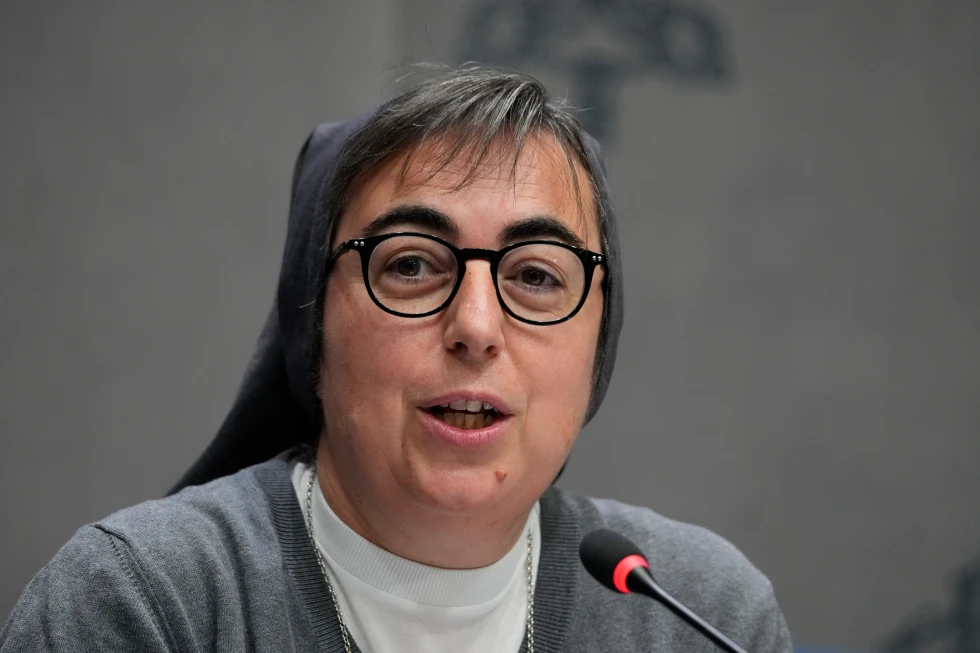
ROME (AP) — With the appointment of Italian Sister Alessandra Smerilli, Leo appears to be following suit of his predecessor, Pope Francis, who made a point of promoting women to top-level management positions within the Holy See as part of his response to calls by women for greater decision-making roles in the church.
Sister Alessandra Smerilli, secretary general of the Vatican Dicastery for Promoting Integral Human Development, attends a press conference at the Vatican, Tuesday, Sept. 30, 2025. (AP Photo/Gregorio Borgia, File)

ROME (AP) — Pope Leo XIV on Tuesday made his first major appointment of a woman to the Holy See hierarchy, promoting Italian Sister Alessandra Smerilli to head the Vatican office responsible for migrants, the environment and development.

Smerilli, an economist, is currently the No. 2 in the Dicastery for Promoting Integral Human Development. As prefect, she replaces the retiring Canadian Cardinal Michael Czerny, who turns 80 this month.

With the appointment of Smerilli, Leo appears to be following suit of his predecessor, Pope Francis, who made a point of promoting women to top-level management positions within the Holy See as part of his response to calls by women for greater decision-making roles in the church.

But Leo too is following Francis’ lead by simultaneously naming Cardinal Fabio Baggio as a “pro-prefect” of the office, where he is currently undersecretary.

The dual nominations recognize that sometimes the role of a Vatican department head requires being an ordained priest and cardinal.

Baggio was also given the mandate to head up the Vatican’s Borgo Laudato Si environmental educational center, at Castel Gandolfo, near Rome.

The Catholic Church reserves the priesthood for men, and women have long complained of a second-class status despite carrying out the lion’s share of the church’s work running schools, hospitals and passing the faith onto younger generations.

___

Associated Press religion coverage receives support through the AP’s collaboration with The Conversation US, with funding from Lilly Endowment Inc. The AP is solely responsible for this content.