Thursday, July 02, 2026


Two of "Putin's Yachts" Leave Russia, Bound for Turkey

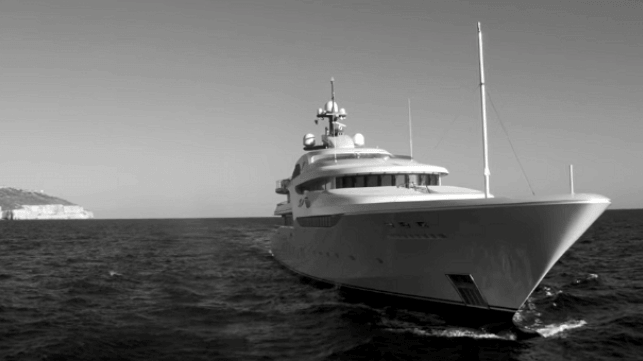
Graceful (file image courtesy Blohm+Voss)

Published Jul 1, 2026 11:53 PM by The Maritime Executive

Two of the many superyachts linked to Russian President Vladimir Putin have departed their home country and gotten under way, signaling on AIS that they are headed for Turkey. 

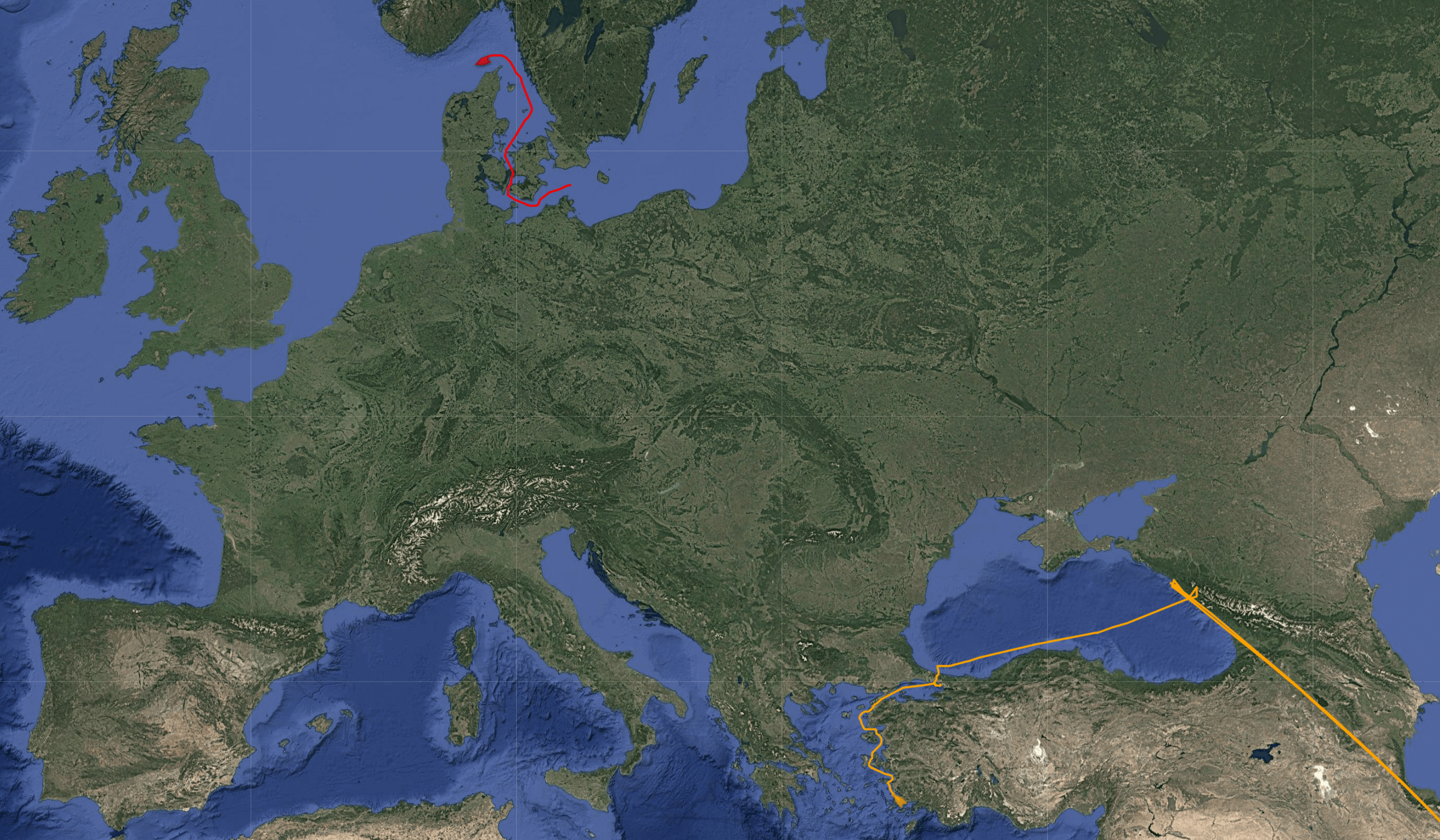
The 270-foot superyacht Graceful (also known as Kosatka) made a timely exit from Germany shortly before the invasion of Ukraine in February 2022. She returned to Kaliningrad, later relocating to St. Petersburg, and remained in the Baltic with AIS turned off for four years - until June 28, when she reappeared on tracking at a position just south of Copenhagen.

Graceful was noticed by ship-spotters in the Baltic Sea, outbound through the Kattegat under heavy escort. She was accompanied by the Voevoda, a yacht-like government "rescue vessel" - which is also suspected of filling a presidential transport role - and by the Udaloy-class destroyer Severomorsk. While the Russian Navy routinely escorts Russia-linked tankers in the Baltic, the assignment of a destroyer to guard a yacht is out of the ordinary.

Upon exiting the Skaggerak, Graceful turned off her AIS once more and disappeared from public tracking. 

Graceful is a 270-foot superyacht delivered by Blohm+Voss in 2014. She is valued at about $100 million, and is the second-largest yacht linked to Putin. 

Another Putin-linked yacht, the Victoria (IMO 1009663), turned on her AIS in the Black Sea on June 16. She got under way last week, also headed for Turkey, and is now anchored off the small resort town of Torba in the Adriatic Sea. 

The Victoria has been linked to rhythmic gymnast Alina Kabaeva, who many Russia analysts believe to be Putin's mistress. Like several vessels suspected of belonging to the Russian leader, Victoria is officially owned by a Russian businessman who has personal ties to Putin; the businessman appears to lack the financial means to sustain so many yachts on his own. Unusually, Victoria was built by Sevmash, the sole shipyard in Russia that builds nuclear submarines - and not ordinarily a builder of superyachts.

The largest yacht linked to Putin, Scheherazade, has been in shipyard in Italy since the beginning of the war in 2022. It was seized by Italian authorities early on in the Ukraine conflict.


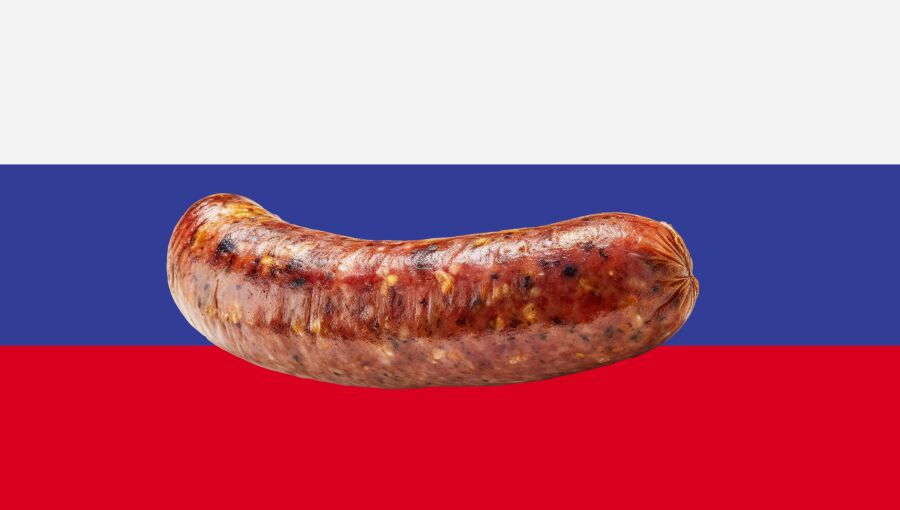
Sausage sales are falling in Russia

Sausage sales are falling in Russia
Sausage sales are dropping in Russia. But why? / bne IntelliNewsFacebook
By bne IntelliNews July 1, 2026

Sales of sausage products in Russia fell across most categories in the first quarter of 2026, as consumers increasingly turned to cheaper protein sources and ready meals, Rossiyskaya Gazeta reported on July 1.

The decline points to a deeper shift in Russian consumer habits rather than simple belt-tightening, with producers restructuring ranges towards cleaner ingredients and convenience formats as meat products lose ground to eggs, dairy and prepared food.

Sales of frankfurters and small sausages fell 1.9% by volume in January-March, cooked-smoked and semi-smoked sausages declined 1.4%, and raw-smoked and cured varieties dropped 10.8%, according to analytics firm NTech.

Exceptions included cooked sausages and ham, up a symbolic 0.2%, smoked products up 6.1% and sliced cold cuts up 13.6%. Most categories continued to grow in value terms, driven mainly by price rises.

The rise in sliced product sales fits a steady trend towards quick snacking, said NTech analytics director Leonid Ardalionov, who saw the increase in smoked products as a temporary fluctuation rather than a market reversal.

The industry pointed to several challenges facing sausage products at once. The first was stronger competition from more affordable protein, said Yulia Panferova, chair of the National Union of Meat Processors, with eggs, dairy and chilled poultry often cheaper for shoppers. The share of meat products in the protein segment fell 0.5 percentage points in the first quarter, with the volume shifting to eggs, according to monitoring of 13 federal retail chains.

A second factor was changing lifestyles, with rising real incomes making time as valuable as money, and more shoppers willing to pay for products that speed up cooking. Panferova said the meat industry had also lost the battle for consumer trust, with buyers viewing sausage as less healthy than alternatives.

Talk of the entire market falling was inaccurate, said Dmitry Vostrikov, executive director of the Rusprodsoyuz association, describing a period of deep transformation instead. Falling demand for traditional formats was being offset by growth in sliced products, ready meals, semi-finished products and canned meat.

"It is impossible to endlessly sell a product that is cheaper than the raw material it should theoretically be made from," said Vostrikov, adding that processors needed to move away from competing on price alone.

Ready meals grew 18% by volume in the first quarter, the fastest-growing part of the protein segment, with margins around 10% higher than traditional sausage products, Panferova said.


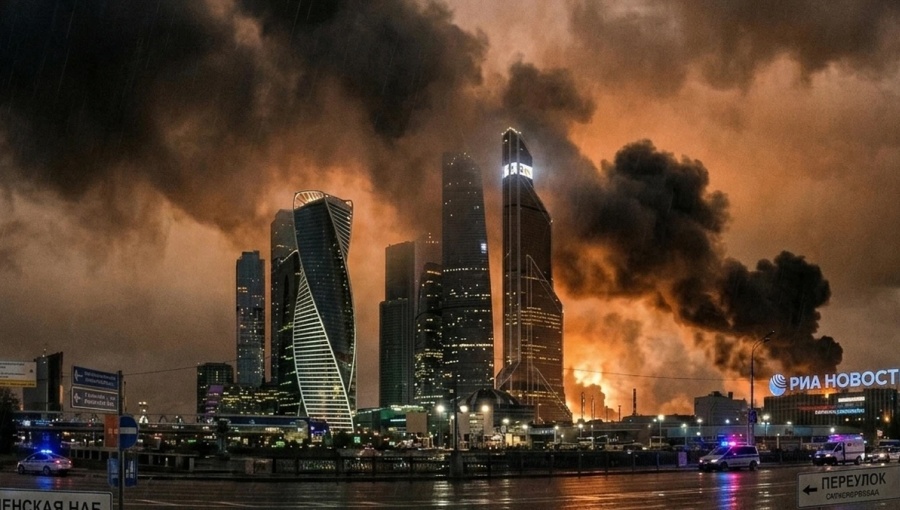
Russian economic confidence falls to lowest level in two decades as war fatigue deepens

Russian economic confidence falls to lowest level in two decades as war fatigue deepens
After the initial patriotic boost following the invasion of the Ukraine, after four years the growing pain of the war has caused Russian confidence to collapse. / bne IntelliNewsFacebook
By Ben Aris in Berlin July 2, 2026

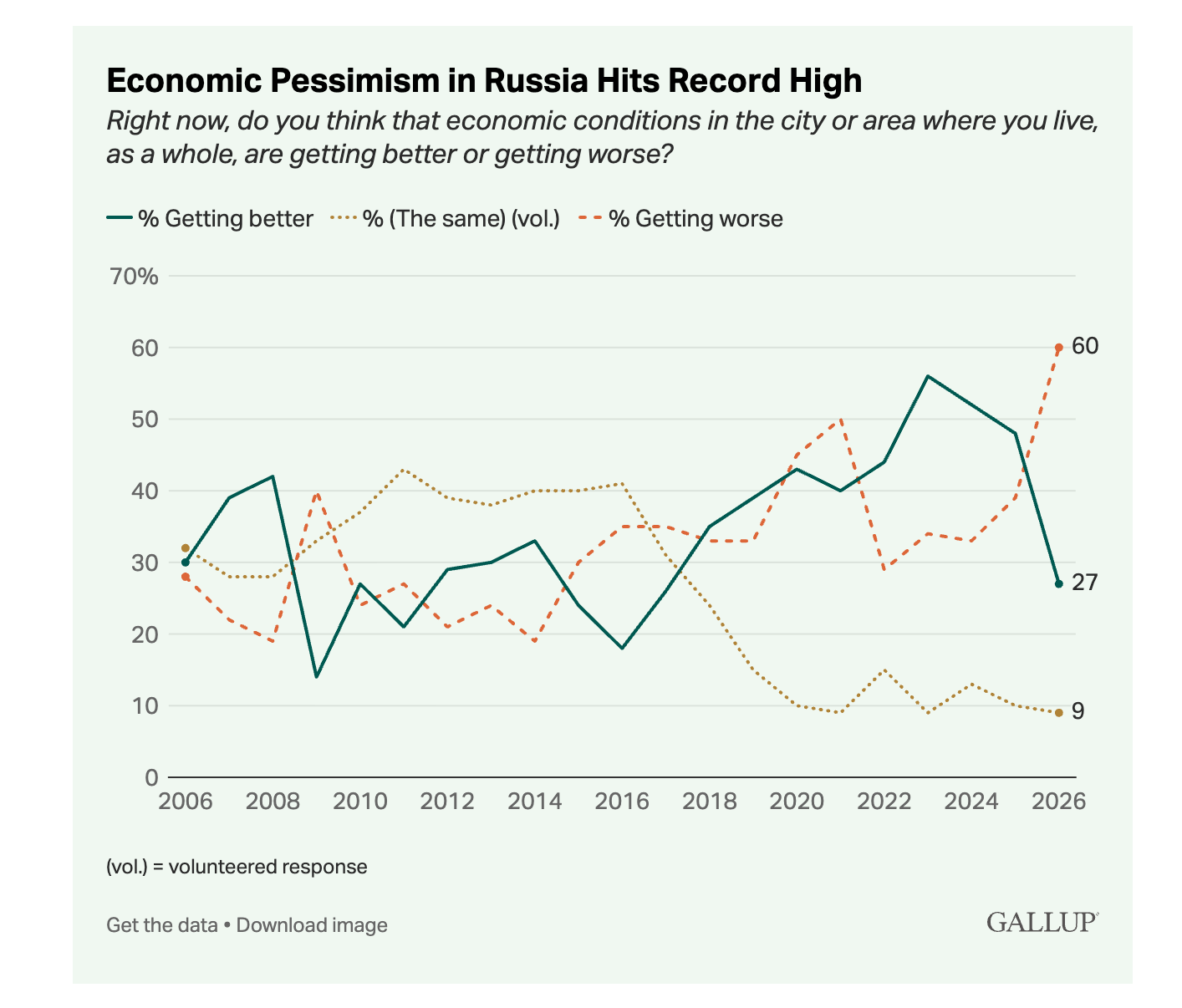
Russian public confidence in the economy has collapsed to its lowest level in at least two decades, according to a new Gallup survey, suggesting the economic resilience that underpinned the Kremlin's wartime strategy may be beginning to fray as the conflict in Ukraine enters its fifth year.

The poll found that 60% of Russians now believe economic conditions in their local area are deteriorating, the highest proportion since Gallup began tracking the measure in 2006. Only 27% believe conditions are improving, marking a dramatic reversal from the early years of the war when buoyant government spending and record labour shortages fuelled optimism despite sweeping Western sanctions.

The findings adds to pressure on Russian President Vladimir Putin, who is facing a muted rebellion in the ranks of the elite between the doves and the hawks, both of which want to end the hostilities, but have very different proposals of how to do that. The collapse of confidence is also a function of the deteriorating state of the economy, which has been split in half: the military industrial complex is flourishing, while the civil sector is stagnating. The official growth outlook for this year has been cut from 1.3% to a mere 0.4% as strong inflation, sky high interest rates and falling oil prices weigh on budget revenues and spending.

While unemployment remains close to record lows and defence factories continue operating at full capacity, civilian sectors are increasingly struggling under the weight of labour shortages and the poor health of the economy. Nevertheless, the economy soldiers: S&P Global reported on July 2 that Russia’s manufacturing PMI moved back above the no-change 50 points benchmark in June and expanded for the first time this year on the back of a mild recovery in demand.

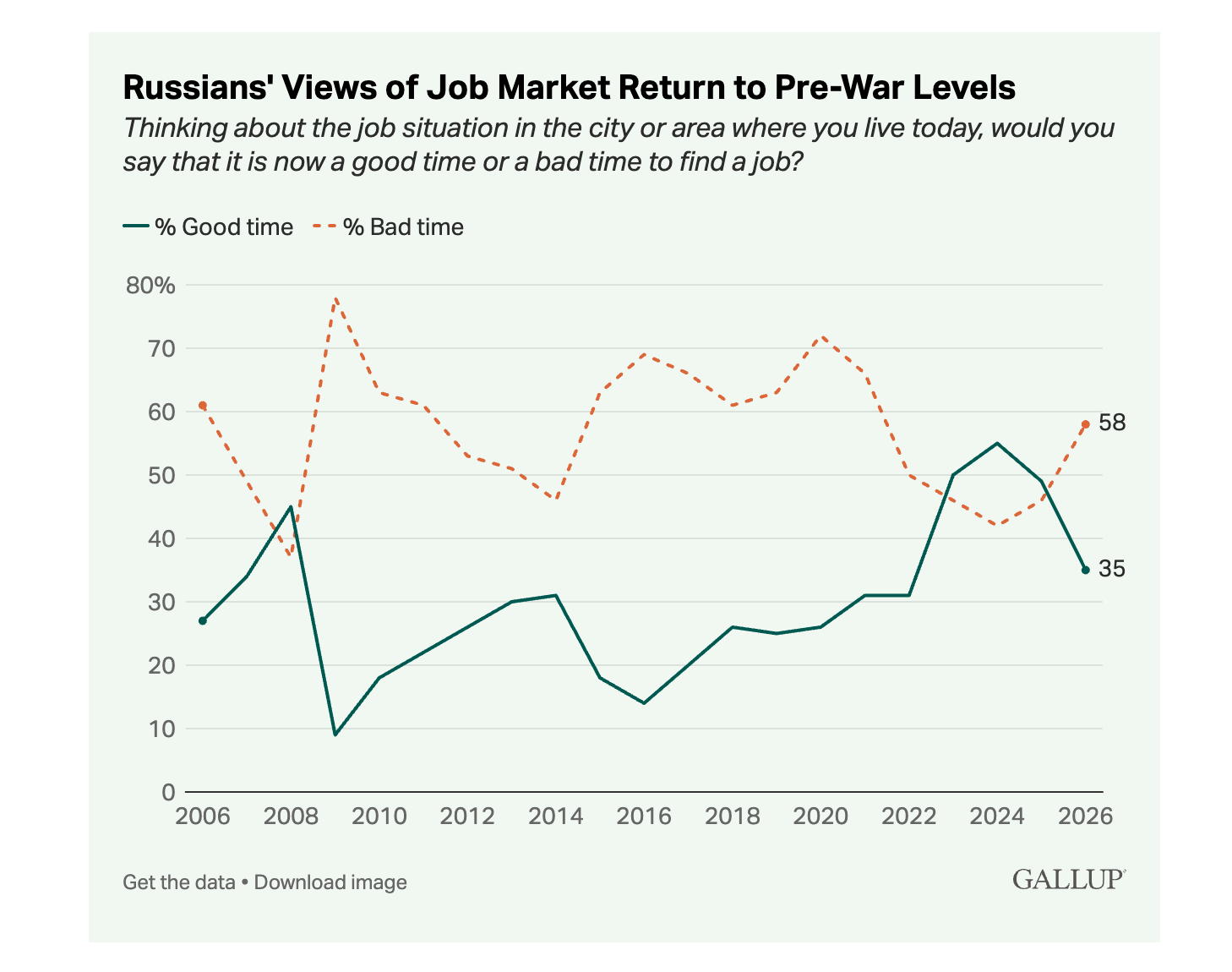
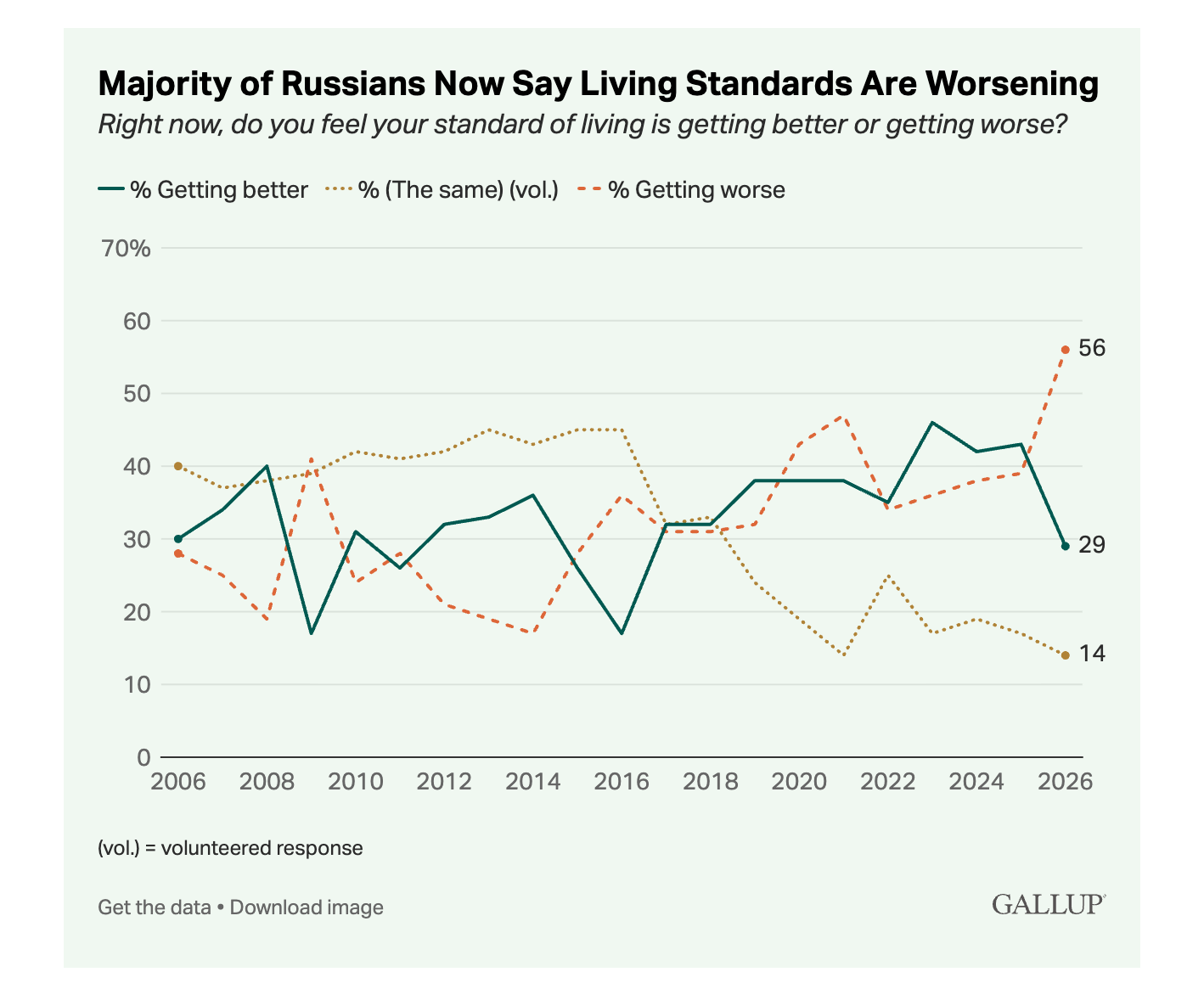
Gallup also found that 56% of Russians believe their own standard of living is worsening, the first time in two decades that a majority has expressed such pessimism. At the same time, perceptions of the labour market have deteriorated sharply. Just 35% now say it is a good time to find a job where they live, down from an average of 51% during the previous two years, while 58% now describe the job market as poor.

The survey suggests that Russians increasingly recognise the difference between an economy sustained by unprecedented military expenditure and one generating genuine improvements in household prosperity.

"The longer the war grinds on, the more it may test people's patience with the conflict and the sacrifices it demands," Gallup concluded.

The deterioration comes as Russia's macroeconomic outlook has become noticeably weaker.

Weak economy

Earlier this year the government cut its 2026 growth forecast from 1.3% to just 0.4%, acknowledging that the rapid expansion fuelled by defence spending is beginning to fade. Russia’s small- and medium-sized enterprises (SMEs) have been particularly exposed and are deteriorating rapidly.

Even the temporary boost from higher oil prices following the conflict between Israel and Iran has done little to change the broader trajectory, while the Central Bank of Russia has repeatedly warned that the economy is overheating after years of exceptionally tight labour markets. The windfall effects of oil prices over $100 caused by the war have already worn off as oil prices fall back to pre-war levels of around $75 per barrel so that the impact on the Russian budget will be small and short lived.

The country's labour shortage has become one of the defining characteristics of the wartime economy, with military recruitment and defence production competing directly with civilian employers for workers. The result has been rapid wage growth in strategic sectors but mounting difficulties for manufacturers, retailers and service industries trying to recruit staff.

Gallup's findings suggest that Russians increasingly view these shortages as a symptom of economic strain rather than strength.

The survey also recorded the sharpest annual decline in confidence in key state institutions since the series began.

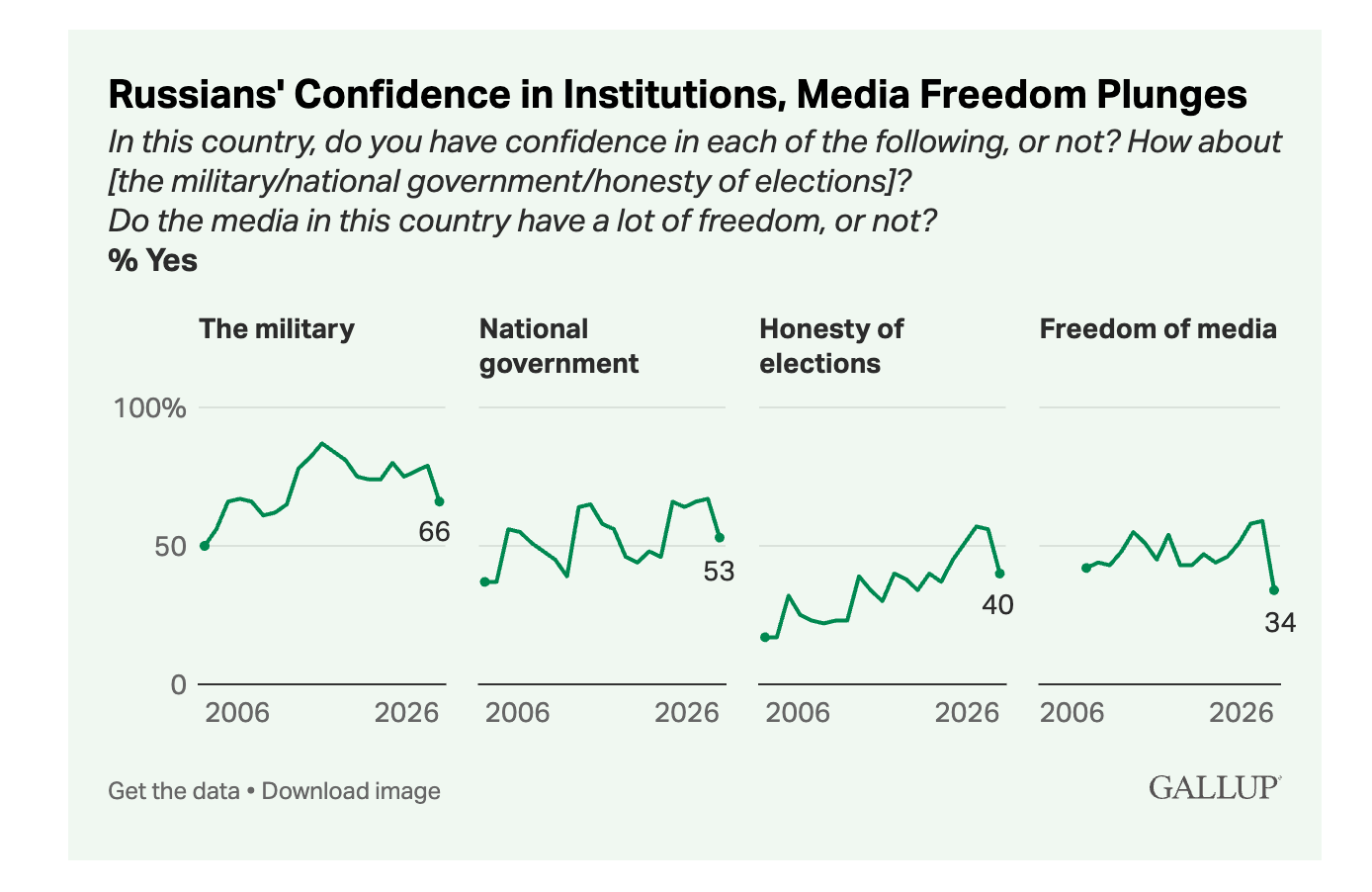
Confidence in the military fell 13 percentage points to 66%, confidence in the national government dropped 14 points to 53%, while confidence in the honesty of elections declined 16 points to 40%. Perceptions of media freedom suffered an even steeper fall, dropping 25 percentage points from 59% to a record low of 34%.

The poll was conducted between March and May, before Ukraine intensified its campaign against Russia's domestic fuel infrastructure. Ukrainian long-range drone attacks have increasingly targeted refineries, storage depots and logistics hubs across Russia, contributing to fuel shortages in several regions, particularly in occupied Crimea.

Timothy Ash, the senior sovereign strategist at BlueBay Asset Management in London, argues that the deterioration in public sentiment may therefore only be beginning.

"After 4.5 years of a war, or 'special military operation' which was meant to be over in weeks, the war seems to be finally coming home to Russians," he wrote in a recent commentary.

Ash argues that several factors are likely to reinforce the negative trend.

The temporary rise in oil prices triggered by the conflict in the Gulf has already begun to unwind, while US sanctions relief briefly granted to allow Russian producers to continue exports has expired. As benchmark oil prices retreat towards the $70 per barrel range, he expects Russia's Urals crude to resume trading at discounts of around 30%, potentially pushing realised prices back into the $50 per barrel range or lower.

Longer term, Ash sees even greater pressure building. He argues that higher production from countries such as the United Arab Emirates, combined with weaker global demand following the Iran conflict, could leave Brent crude closer to $60 per barrel over the next year, implying Urals prices could fall below $46, levels already associated with recessionary conditions in Russia earlier this year.

Perhaps more importantly, Ash believes the recent resilience of global oil markets has altered the sanctions calculus.

"The Iran war has shown that the West has much more leverage over Russia than it has perhaps dared to assume," he wrote.

"If the West, and even China, wants to bring this war to an end they should cut off Russian energy exports."

According to Ash, eliminating Russia's remaining oil exports would deprive the Kremlin of around €500mn per day in revenue, potentially triggering a much deeper recession, accelerating capital flight, placing severe pressure on the banking system and forcing a sharp depreciation of the ruble.

"The wheels would literally come off Putin's war machine," he argued.

Ash also points to the growing asymmetry between Russia's economy and that of Europe. With the European Union having approved a €90bn financial package for Ukraine and additional pre-accession funding under discussion, he argues Kyiv now has the financial resources to continue expanding drone production and deep-strike capabilities for years.

"Russia's $2.5 trillion, and declining economy, just cannot compete with Europe's $25 trillion economy," Ash wrote. "Putin started an arms race with Europe that Russia simply cannot win now."

While the asymmetries between the EU economy and Russia’s are large, Russia has repeatedly surprised with the resilience of its economy to the extreme sanctions regime, which has caused as much, or more, damage to the increasingly dysfunctional European economy than to the Russian economy. At the same time the Kremlin continues to fund its war with cash, while Europe is increasingly funding its support for Ukraine with debt.

Nevertheless, Russians are becoming increasingly sceptical about the economic trajectory of the country. The patriotic rallying effect – patriotism was at an all-time high in 2022 – has evaporated, replaced by growing concerns over living standards, employment prospects and the longer-term costs of sustaining a war that the Kremlin initially expected to conclude within weeks.
 

Flamingo Revolution poses biggest challenge to Albanian PM in years

Flamingo Revolution poses biggest challenge to Albanian PM in years
/ Lëvizja BASHKË via FacebookFacebook
By IntelliNews July 1, 2026

Weeks of anti-government protests in Albania, initially sparked by opposition to a luxury tourism development near protected wetlands, have evolved into the most significant grassroots challenge to Prime Minister Edi Rama in years, exposing broader anger over corruption, environmental degradation and economic inequality, according to a comment from Warsaw-based think tank the Centre for Eastern Studies (OSW).

The demonstrations, dubbed the “Flamingo Revolution”, began on May 30 near the village of Zvërnec, where activists sought to halt construction linked to a luxury resort project near the Vjosa wetlands, an ecologically sensitive area that is home to hundreds of bird species, including flamingos.

What started as a local environmental protest quickly spread to Tirana and other Albanian cities including Vlorë, Durrës and Korçë, while members of Albania’s large diaspora staged parallel demonstrations abroad.

According to the OSW, the movement signals “a break with the stagnation that has characterised Albania’s civil society in recent years”, with protesters increasingly targeting the political establishment as a whole rather than a single policy dispute.

Demonstrators are now calling for Rama’s resignation, corruption investigations and what they describe as a fundamental overhaul of an economic model dominated by oligarchic interests and organised crime.

The project at the centre of the unrest has attracted international attention due to links to investors associated with the family of US President Donald Trump. Though investment vehicles linked to the president’s daughter Ivanka Trump and her husband Jared Kushner have reportedly stepped back formally, the couple is believed to remain involved privately.

The resort, estimated to cost at least $1.4bn, has become symbolic of what critics call Albania’s increasingly tourism-dependent growth model. Protesters argue large-scale luxury developments enrich elites while offering limited benefits to ordinary citizens and doing little to reverse emigration among young professionals.

“The protesters have also criticised the government’s emphasis on developing tourism,” the report said, arguing its “large scale and increasingly luxury-oriented character” has accelerated environmental harm.

Albania, with a population of roughly 2.8mn, receives more than 12mn visitors annually, making tourism a major pillar of economic growth.

Investigations by Albania’s anti-corruption prosecutor, SPAK, have added to the controversy. Although authorities reportedly unfroze investor funds after determining their origins were legitimate, investigators are now examining land transactions surrounding the project amid allegations of speculative purchases and possible money laundering.

The protests also reflect deeper frustrations over governance. OSW pointed to “mass emigration of young and educated people, pervasive corruption, vote-buying in elections and persistent rule-of-law concerns” as major drivers of public anger.

Rama’s government initially dismissed the demonstrations, but as international scrutiny intensified, the prime minister responded with accusations of foreign interference.

OSW said Rama “continued to reject the protesters’ demands and to look for those responsible beyond Albania’s borders”. According to the report, he first accused Greece of fomenting unrest to weaken Albanian tourism, before later suggesting Iran was behind the protests in retaliation for Tirana’s support for US-Israeli military actions and its hosting of Iranian dissidents. The report noted Rama “has not presented any evidence to support these claims.”

European institutions are also paying closer attention. The protests have received support from members of the European People's Party and the European Democratic Party, while the European Commission has reportedly warned the development could complicate Albania’s EU accession path. Environmental compliance is particularly sensitive because Chapter 27 of accession talks covers climate and environmental standards.

Opposition leader Sali Berisha has backed the protests rhetorically but remains absent from demonstrations. Protest organisers have deliberately kept traditional opposition parties at arm’s length, seeking to maintain the movement’s anti-establishment credibility. OSW said the opposition is “not welcome at the demonstrations, as they are directed against the political establishment as a whole.”

Despite continued control over state institutions, signs of strain are emerging within Rama’s governing Socialist Party. One lawmaker has left the party, in a second internal split in recent months.

For now, OSW analysts do not expect Rama to yield quickly, especially given the geopolitical implications of abandoning a project involving high-profile foreign investors. Still, the think-tank warned the protests have already weakened his political standing.

Whether the movement can translate street anger into lasting political change remains unclear. But for the first time in years, Albania’s ruling establishment faces a broad-based civic uprising capable of reshaping the country’s political landscape.


Albanian police fire water cannon as protests against Trump-linked luxury resort continue

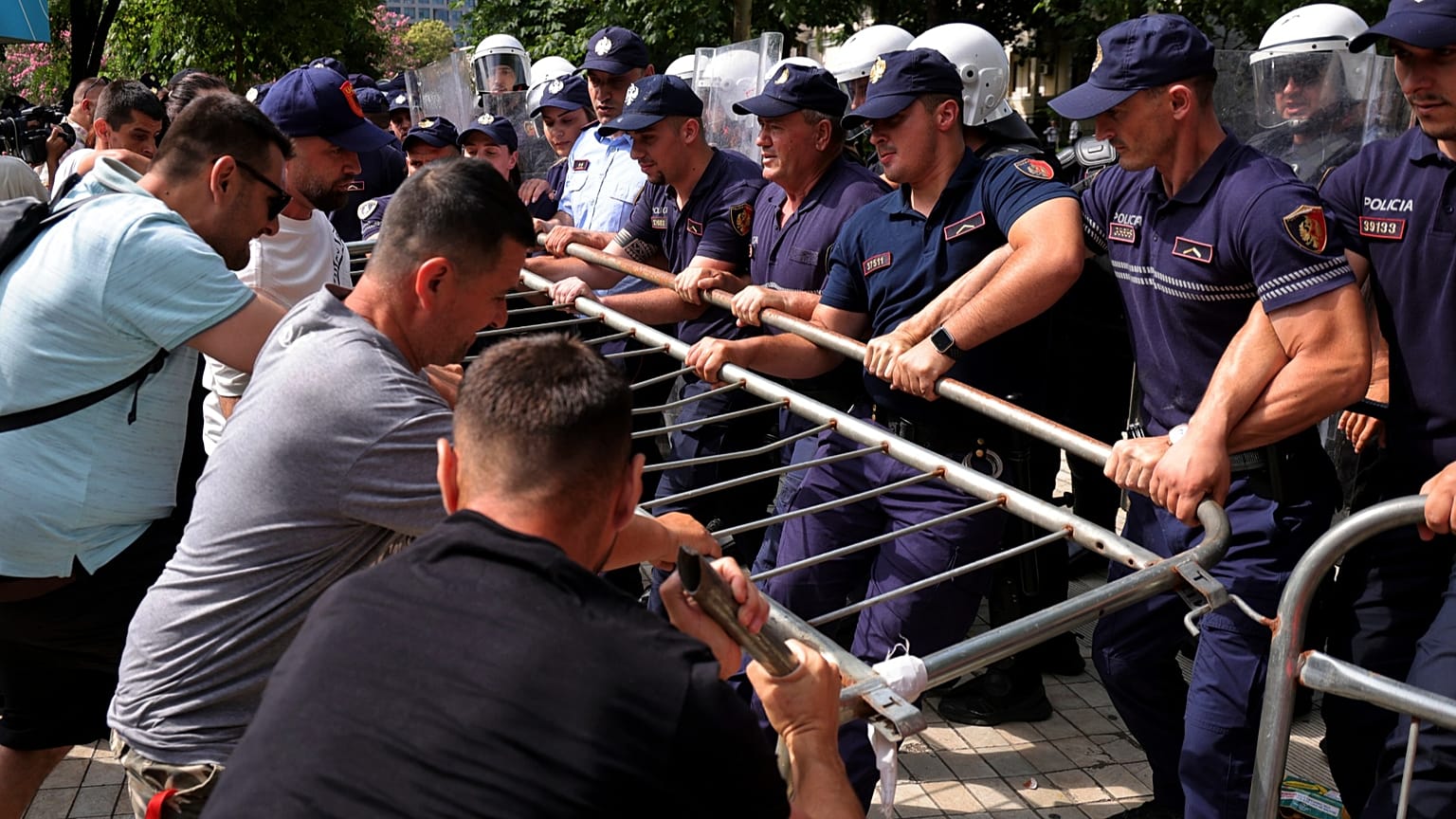
Protesters try to remove a barricade as police hold it during clashes at an anti-government rally in Tirana, 2 July, 2026
Copyright AP Photo

By Gavin Blackburn
Published on

The government says the development on the Adriatic coast would be transformational for the former communist nation as it seeks to enter the high-end tourism market and pushes for European Union membership.

Violent clashes erupted between police and demonstrators outside Albania's parliament on Thursday, as protests against a controversial resort development linked to US President Donald Trump's family continue.

Since late May, protests have been held against the construction of a luxury hotel linked to Trump's daughter Ivanka and her husband Jared Kushner in a nature reserve in Zvernec, on Albania's southwestern coast.

For the second time this week, large groups of protesters had gathered outside the country's parliament in an attempt to confront lawmakers and block entry to the building.

Hundreds of demonstrators were met with lines of riot police who pushed them back from the building, leading to clashes and several arrests, according to journalists at the scene.

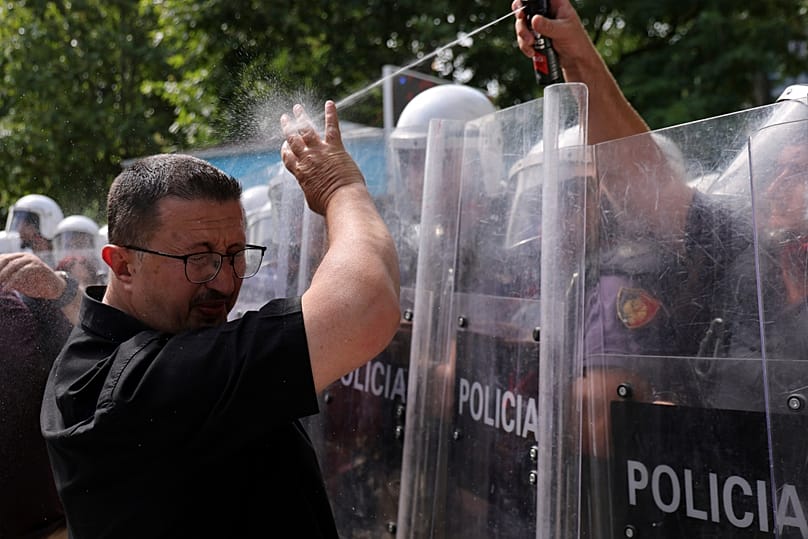
Police used pepper spray and a water cannon in an attempt to break up the crowd as some protesters attempted push through lines of officers.

Nine officers were injured by projectiles thrown by protesters, police said, but did not confirm arrest numbers.

A riot police officer uses pepper spray against a protester during clashes at an anti-government rally in Tirana, 2 July, 2026 AP Photo

People were also seen smashing the windows of an empty police car in a nearby street as the crowd was pushed away from area.

It comes after six protesters were arrested on Tuesday when demonstrators threw eggs at lawmakers' cars.

The violence is a marked contrast to the overwhelmingly peaceful daily gatherings that have drawn thousands to the streets since the movement began.

The planned resort was first unveiled in 2024, but the latest wave of protests began after barbed-wire fencing and bulldozers appeared on beaches in late May.

The government says the development on the Adriatic coast would be transformational for the former communist nation as it seeks to enter the high-end tourism market and pushes for European Union membership.

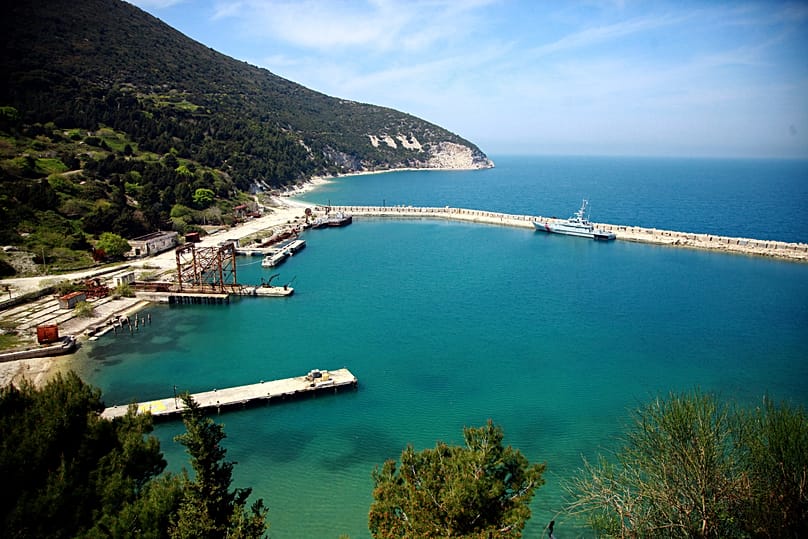
The small harbour on Sazan Island southwest of Albania's capital Tirana, 14 April, 2015 AP Photo


But the venture, spanning a protected island and a nearby stretch of seafront on Albania’s southern coast, has drawn opposition from environmental campaigners and critics of long-time Socialist Prime Minister Edi Rama.

The luxury project has two components: a coastal development in the Narta Lagoon area, which is a wildlife reserve, and a smaller resort on the nearby uninhabited island of Sazan, a communist-era military base.

Opposition to the project has become a flashpoint for anger over perceived corruption, with protesters calling for Prime Minister Edi Rama to step down over what they describe as a lack of transparency.

Hybrid war

Last month, Rama told Euronews that a “hybrid war” was responsible for stoking anger among protesters, blaming bots, antisemitic narratives and hostile external forces.

"It's a lot of bots, it's a lot of fake profiles, it's a lot of attacks coming from all over," Rama said. "I have seen it this week on social media. The way it has happened in other countries, I am now seeing it in my own country.

Asked whether protesters' concerns were legitimate, Rama argued that their "well-meaning" worries were being "weaponised" by hostile actors employing a coordinated online strategy to exploit public sentiment around environmental protection and Albania's relationship with Israel.

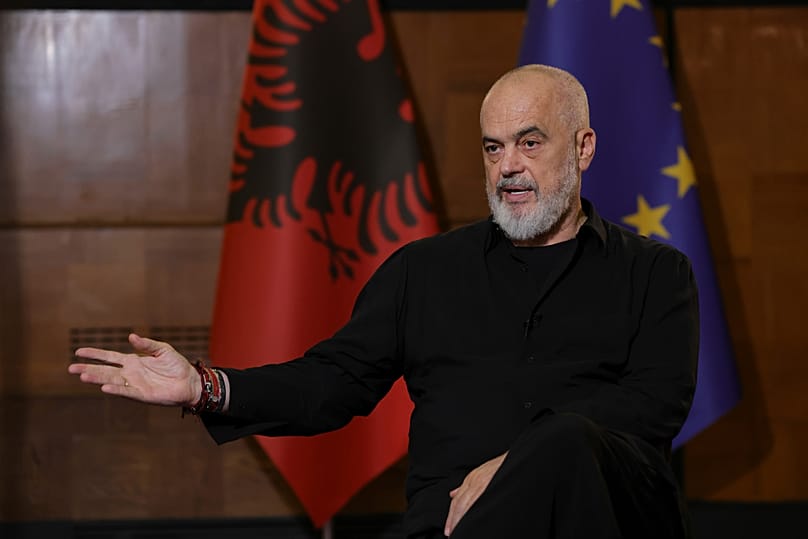
Albanian Prime Minister Edi Rama speaks during an interview in Tirana, 9 June, 2026 AP Photo

Also in June, the European Commission issued a veiled warning to the Albanian government over the planned project, urging authorities to “act without delay” in order to avoid jeopardising the country’s bid to join the EU, which will require it to align with the bloc’s environmental rules.

“Albania should refrain from actions that could undermine the fulfilment of the closing benchmark, in this case Chapter 27, and so we expect the Albanian authorities to act without any delay,” spokesperson Guillaume Mercier said, referring to the chapter of EU accession talks which requires a candidate country to align with environmental rules.


PANNIER: Countries line up to access Central Asia’s critical minerals

PANNIER: Countries line up to access Central Asia’s critical minerals
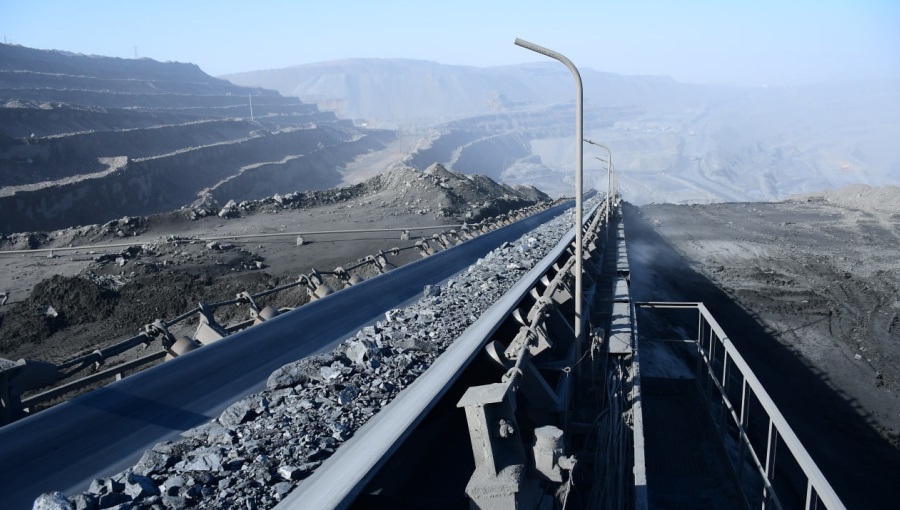
Uzbekistan's NMMC has invested into high-productivity conveyor infrastructure. / NMMCFacebook
By Bruce Pannier in Prague July 2, 2026

Countries are lining up to reach agreements with Central Asian states for access to the region’s abundant critical minerals. The minerals are there, and continued surveying turns up new deposits all the time. 

One of the problems for the Central Asian countries most often cited is that they do not have the facilities to process these minerals at home, and it could be years before such facilities are constructed.

Certainly, the planned scale of production requires construction of possibly a dozen or more new processing plants, but some Central Asian countries already do have such facilities.

Already exporting

The Ulba Metallurgical Plant is located in Oskemen (formerly Ust-Kamenogorsk), in the East Kazakhstan Province. The plant is connected to uranium. It opened in 1949, just a few weeks after the Soviet Union tested its first atomic bomb in the Semei (formerly Semipalatinsk) region, a little more than 200 kilometres from Oskemen. 

The Ulba plant is now operated by state company Kazatomprom and the China General Nuclear Power Corporation. In 2024, the plant reached capacity for producing low-enriched uranium fuel assemblies, 200 tonnes, enough for six reactors.

Ulba produces more nuclear fuel than just the fuel assemblies that went to China. Kazakhstan has been the leading producer of uranium in the world since 2009, and now ships uranium to countries in Europe, Asia, and to the United States. 

But the Ulba plant produces more than uranium. The Kazatomprom website says Ulba also turns out “products containing beryllium, tantalum and niobium…”

Uzbekistan’s Navoi Mining & Metallurgical Combine (NMMC) has mainly focused on gold production since opening in 1958. The plant also produced uranium.

As part of a reorganisation at NMMC, Navoiyuran was established and started an operation to extract rare earths from uranium deposits in January 2022. Those rare earths include vanadium, rhenium, and copper, as well as uranium.

Uzbekistan is the sixth largest producer of uranium. Navoiyuran’s sales in 2025 amounted to some $1.1bn, largely due to a 35% increase in uranium.

Coming soon?

In Kyrgyzstan, the Kadamzhai Antimony Plant in the south of the country launched in 1936 and was a leading producer of antimony during the Soviet era. 

Since Kyrgyzstan became independent in late 1991, operations at the Kadamzhai plant have limped along. Recent increased global interest in securing supplies of critical minerals have led several countries to take a closer look at the Kadamzhai plant. 

In 2022, Turkish investors said they could invest up to $50mn in the Kadamzhai plant and nearby Khaidarkan Mercury Plant, but later faced problems and abandoned the project. 

Russian company Voyager has 30 years of involvement in Kadamzhai and in August 2025 expressed interest in leasing the facility. Voyager is currently upgrading the plant and plans to relaunch operations.

China already accounts for 60-70% of the global mining and processing of antimony. That has not stopped Chinese investors from inquiring about Kadamzhai. 

In neighbouring Tajikistan, where the world’s second largest reserves of antimony are located, Chinese investors are already involved in at least two large-scale mining operations (Zeravshan-Hissar and Sughd).

Almost all the antimony mined in Tajikistan is sent to China for processing, something Kyrgyzstan hopes to avoid. 

The Kara-Balta Ore Mining Combine, some 60 kilometres from the capital Bishkek, was built in 1955 to process uranium. 

Since independence, Kyrgyz authorities have generally welcomed gold mining, but Kyrgyzstan is still trying to clean up the Soviet-era uranium tailings in the area near the town of Maily-Suu and was extremely reluctant to sign deals for mining uranium and other minerals.

In 2016, the plant stopped uranium operations, the Times of Central Asia reported. In 2019, Kyrgyz authorities placed moratoria on development of uranium and thorium deposits, and by 2022, the Kara-Balta plant was declared bankrupt .

With increasing global interest in critical minerals, Kyrgyz President Sadyr Japarov signed legislation in June 2024 that lifted the moratorium and work has already restarted at the Kyzyl-Ompol uranium and thorium deposits in northeast Kyrgyzstan.

Not long after, state gold company Kyrgyzaltyn acquired all the assets of the Kara-Balta plant, naming its new subsidiary Karabalta Mining Company LLC.

The company’s website says a modernisation of the plant is coming with the expectation it will process “uranium, non-ferrous, rare-earth metals, and other valuable minerals.” 

Not enough, but a start

Kazakhstan and Uzbekistan have opened their countries to investment in critical minerals mining but both countries want to sell processed materials, not raw ore.

Kazakh and Uzbek authorities have made clear that foreign investors should be prepared to help build the facilities needed to process the minerals in Kazakhstan or Uzbekistan.

Germany’s HMG Bergbau, for example, is investing up to $700mn to build a lithium mining and processing plant at a site in Ulan, East Kazakhstan Province . 

However, if the need for critical minerals is urgent, there are Soviet-era options that are already operating, or simply in need of modernisation and upgrades.

The Ulba Metallurgical plant is proof that investment in refurbishment can result in production of materials suited for modern use. Uzbekistan’s NMMC subsidiary Navoiyuran is another example.

Countries seeking large amounts of critical minerals from Central Asia will have to wait for a while, but deliveries is small quantities are already being made and, in Kyrgyzstan’s case, these deliveries could easily be increased.


Turkey to launch 'climate bridge' at COP31 to unlock green investment

Turkey to launch 'climate bridge' at COP31 to unlock green investment
IntelliNews copyright / bne IntelliNewsFacebook
By bne IntelliNews July 2, 2026

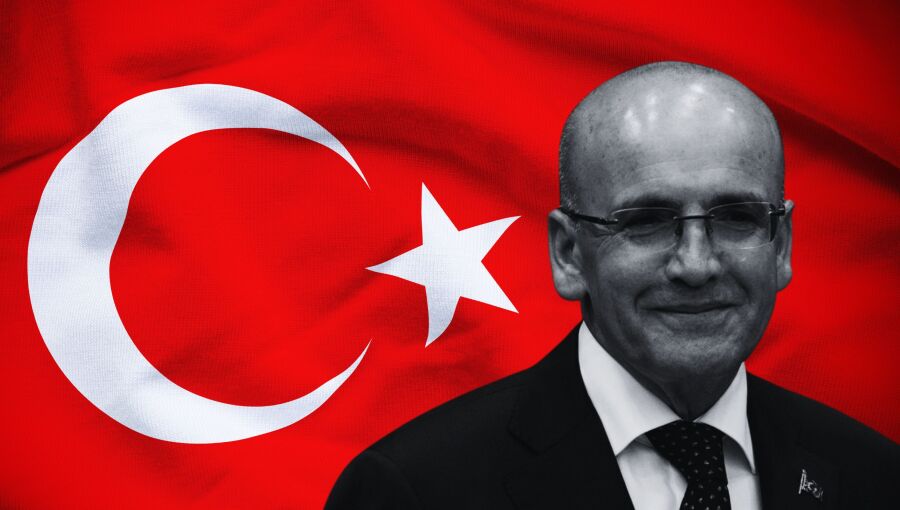
Turkey’s government is planning to launch a major climate initiative at the COP31 summit later this year, aiming to close the gap between global capital and underdeveloped green projects, finance minister Mehmet Simsek said on June 25 during a speech at the Climate Resilience Finance Summit during London Climate Action Week.

The minister also unveiled Turkey’s plans for the "COP31 Climate Implementation Bridge," a framework designed to help governments translate raw climate strategies into "bankable," investment-ready project pipelines that can attract private capital and commercial banks.

"Our priority at COP31 is clear. We now need to speed up the implementation of these plans," Simsek told attendees, adding: "The key is financing. We must mobilise sufficient capital in time and direct it toward investments that deliver tangible results for people."

The initiative arrives amid a severe shortfall in funding for adaptation and resilience. According to data cited by Simsek, meeting global climate targets will require an annual investment of $6.3 trillion to $6.7 trillion by 2030, a stark contrast to current global climate finance flows of roughly $2 trillion.

The deficit is most acute across developing countries. Excluding China, developing countries face an annual climate financing requirement of approximately $2.4 trillion, yet receive only about one-tenth of that amount today.

Crucially, Ankara does not intend for the initiative to act as a standalone entity.

"Our goal is not to establish a new platform or institution. We want to strengthen cooperation within the existing ecosystem and ensure that financing reaches the areas where it is needed most," Simsek said.

Instead, the minister argued that the core bottleneck is programmatic rather than a lack of liquidity.

"The problem is not a shortage of capital," he remarked, noting that significant pools of private capital remain in active search of attractive returns while prospective climate projects frequently struggle to secure backing due to inadequate preparation.

For Turkey, which is set to host the UN climate summit later this year, the economic toll of climate volatility is already bleeding into macroeconomic indicators. Simsek pointed to a severe agricultural frost followed by a drought in Turkey last year, which disrupted millions of livelihoods and left a direct mark on the country's monetary targets.

"I'm not offering this as an excuse but inflation came in slightly higher than we had projected, largely because of these shocks," Simsek said, adding that climate resilience is now a matter of economic competitiveness rather than purely environmental policy.

"Economies that are better prepared for shocks are more productive, more competitive and more attractive for investment," he added.

Globally, the financial buffer against these events remains thin. Only one-quarter of climate-related financial losses are currently covered by insurance, forcing state balance sheets, corporations and households to absorb the residual costs.

To counter this vulnerability, Simsek called for targeted investment pipelines in water management, climate-smart agriculture, sustainable land use, resilient infrastructure and healthy ecosystems.

Unlocking the necessary long-term capital will require a broader institutional push beyond multilateral development banks. The minister called on regulators, export credit agencies, credit rating agencies, and local financial institutions to align to mobilise deep pools of investment.

Ankara stated that it is prepared to collaborate with international partners through its upcoming COP31 presidency to scale up these resilience structures and accelerate the deployment of capital into active project pipelines.