It’s possible that I shall make an ass of myself. But in that case one can always get out of it with a little dialectic. I have, of course, so worded my proposition as to be right either way (K.Marx, Letter to F.Engels on the Indian Mutiny)
Thursday, July 02, 2026
Heat mortality surges in Europe – Statista
The death toll from extreme summer temperatures has doubled. Deadly heatwaves have killed 5.5 people per 100,000 population between 2012 and 2021. / bne IntelliNews
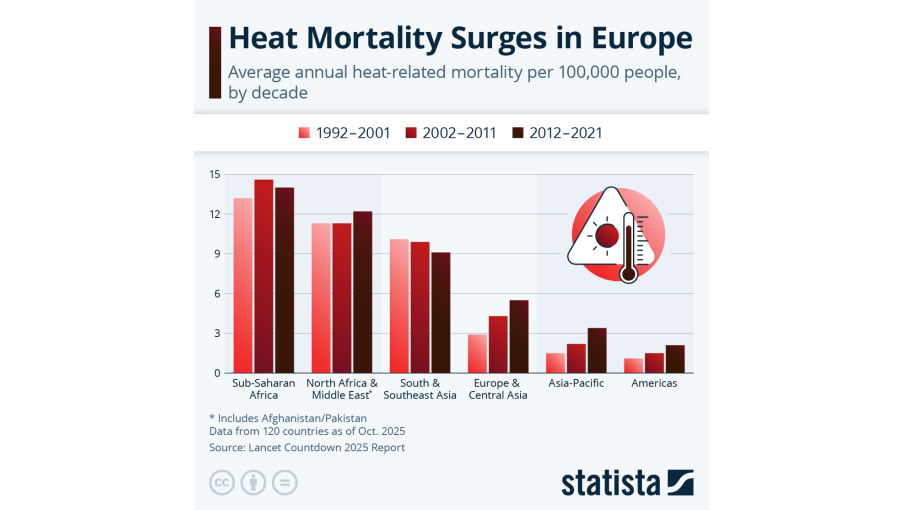
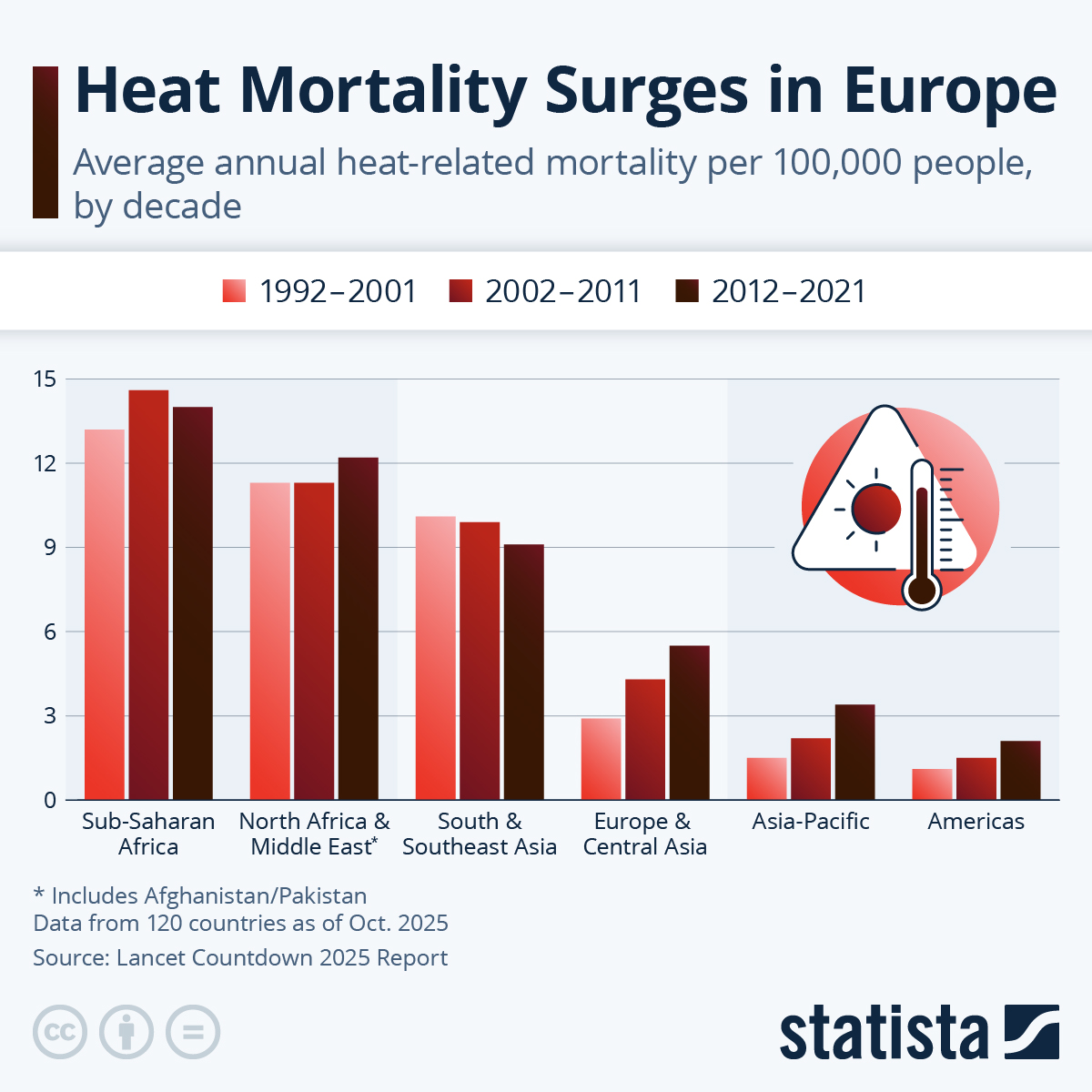
Heat-related mortality in Europe has surged over the last couple of decades. This is according to the latest available data published by the Lancet Countdown 2025 Report, Statista reports.
Between 2012 and 2021, 5.5 people per 100,000 population died of heat-related causes per year on the continent. This is almost double the annual rate observed between 1992 and 2021.
Similarly rapid surges were observed over the same time period in Asia-Pacific as well as in the Americas. However, heat deaths stayed on a lower level in these regions and reached only an annual 3.4 and 2.1 in 100,000, respectively, during the last decade.
All three continents in question have an aging population, making heatwaves more deadly as it is older people who predominantly succumb to heat-related causes. But Europe is also less prepared than other continents for a changing climate as its many temperate regions have not built for the heat and have traditionally neither been equipped for it, may that be in terms of air conditioner ownership or knowledge of ways to stay cool.
Hotter (and younger) regions of the globe have not seen the same developments in heat-related mortality, even though they do experience consistently higher levels of it. In Sub-Saharan Africa, North Africa and the Middle East as well as South and Southeast Asia, brutal heatwaves claim the lives between nine and 14 people per 100,000 every year. In all three regions, this figure has changes by at most 10% since the 1990s.
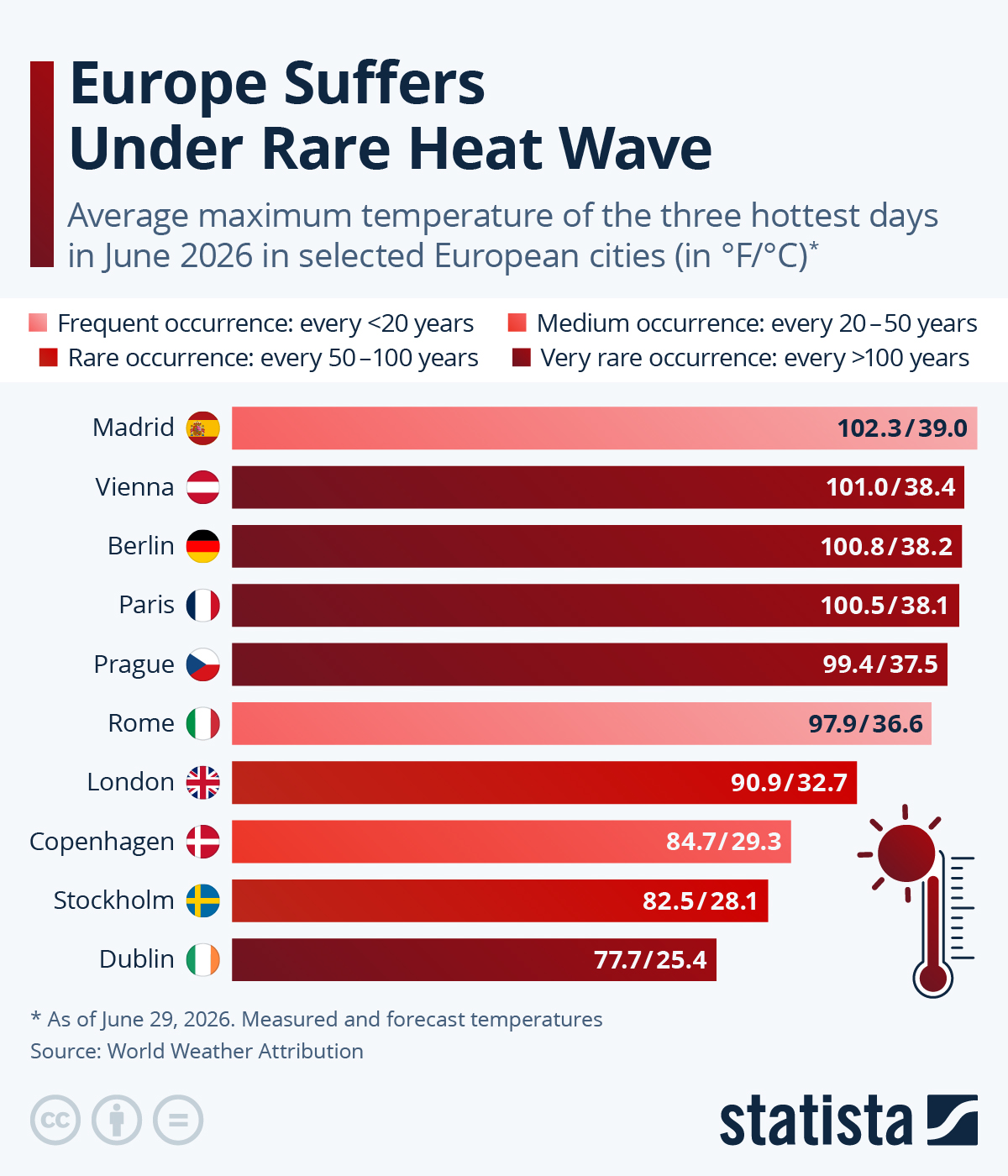
According to World Weather Attribution, an initiative studying the impact of climate change on extreme weather events, the temperatures observed over the past 10 days would have been extreme at any time of the year, but for June they are even more unusual. As our chart shows, the three hottest days in numerous European capitals were so extraordinary for June, that the estimated return period of a similar heat wave exceeds 100 years. The same was true for nighttime temperatures, which made this heat wave so dangerous. “Nighttime is when the body is supposed to recover. When we sleep, our core temperature drops, our cardiovascular system rests, and the cumulative stress of a hot day begins to ease. When nights stay warm, that recovery does not happen. The body remains under strain around the clock,” Armel Castellan, Extreme Heat Services Technical Advisor of the WHO-WMO Climate and Health Joint Office explained.
According to WHO Director-General Tedros A. Ghebreyesus, more than 1,300 excess deaths linked to extreme heat have been recorded in Europe since June 21 – a grim reminder of the lack of preparedness for extreme heat in large parts of Europe. “Heatwaves like this are what we expect to see in a changing climate,” John Kennedy, head of climate information at WMO, said in a statement. “In the 50 years since the historic heatwave in 1976, Europe as a whole has warmed by around two degrees. It’s the fastest warming continents and extremes of temperature have increased too,” he said. To address the growing threat posed by extreme heat, Dr. Tedros encouraged policymakers across Europe to implement heat health action plans to protect health against the future effects of climate change.
Imagine an anteater with a long, thick tail, huge, curling claws, and an armored body covered by overlapping, pinecone-like scales. What you get is a pangolin, a mid-sized mammal found only in Africa and Asia. The pangolins’ scales make them unique, but these scales have become their undoing. Pangolins are poached for their scales, making them the most highly-trafficked mammals in the world and consequently, at high risk of extinction.
A new study in the journal Communications Biology reveals that an unrecognized species of Asian pangolin, Manis aurita, has been hiding in plain sight among the trees of Nepal and Northern India. It is a vital distinction that expands biologists’ understanding of where each species is found and how they differ from each other. And it might be the key to helping prevent illegal poaching before it happens.
“We can’t protect what we do not know, and now that we have confirmed that this other species of pangolin exists, we can use that information to help protect these endangered animals,” says Anderson Feijó, the Negaunee Assistant Curator of Mammals at the Field Museum and co-corresponding author of the study.
“This finding marks the culmination of more than five years of research that began in Nepal, where we first documented evidence suggesting that Himalayan pangolins represented a distinct evolutionary lineage,” says Narayan Koju, a researcher at the Nepal Engineering College at Pokhara University and the study’s first author. “The confirmation of Manis aurita as a valid species demonstrates the importance of long-term research, international collaboration, and museum collections. Most importantly, it provides a strong scientific basis for conservation planning, wildlife forensics, and efforts to protect one of the world’s most trafficked mammals from extinction.”
In 2025, another group of scientists correctly declared that Chinese pangolins weren’t all the same, and that what had long been considered one species was actually two: one that lives primarily in China, and another found in the foothills of the Himalayas, spreading across parts of Nepal, India, Bhutan, and Myanmar. The scientists gave the mountain species a new name: Manis indoburmanica, the Indo-Burmese pangolin.
However, when animals are given scientific names, the first name assigned to a species is the one that counts. Feijó and his colleagues were already in the midst of a decade-long analysis of the pangolin family tree, using both physical traits and DNA to back up their arguments of how many species of pangolin there are and how they’re related to each other. They read about another pangolin species, Manis aurita, that had been described in 1836, and had been since downgraded to a subspecies of Chinese pangolin.
“This left us with a core taxonomic riddle: what is the relationship between indoburmanica and aurita? Are they the same species or different species?” says Kai He, another of the paper’s co-corresponding authors and a researcher at the South China Biodiversity Research Center at Guangzhou University. “The ultimate, most thrilling piece of the puzzle came from the Natural History Museum in London. Thanks to their incredible expertise and assistance, the NHM team successfully sequenced the DNA directly from the historical type specimen of the Nepalese subspecies (aurita). This specimen dates back to 1836, making it nearly 190 years old.”
The historic DNA from the museum collections provided the definitive proof: the modern specimens from the Himalayas matched aurita. That means that the species that had been described in 2025 as M. indoburmanica should actually be called M. aurita.
“This taxonomic clarification provides a crucial scientific basis for combating illegal poaching and lays the groundwork for protecting this cryptic endangered species,” says Yan Hua, a co-corresponding author of the study and researcher at the Guangdong Academy of Forestry.
The differences between Himalayan pangolin M. aurita (briefly formerly known as M. indoburmanica) and the Chinese pangolin are subtle, but noteworthy.
“Compared to the Chinese pangolin, the Himalayan pangolin has a bigger body, a longer tail, and smaller ears,” says Feijó. The newly resurrected species name, aurita, even refers to its distinct ears.
In addition to their physical differences, the two species also inhabit different geographical regions that do not overlap. For critically endangered animals, particularly ones targeted by poachers, a clear and detailed account of species varieties and their geographic distribution is vital to their protection.
In traditional Chinese medicine practices, pangolin scales are believed to be a powerful aphrodisiac. As a result, illegal poaching poses an enormous threat to these animals. But putting a stop to poaching is no small task.
“In the marketplaces you basically only find pangolin scales, not the whole animals, which makes it hard to know which species are being hunted and where they are coming from,” says Feijó. But the new DNA analyses from this study can help conservation scientists pinpoint the precise species of pangolins being poached. This means that conservationists can now work backwards using poached samples in illegal marketplaces to identify which species are being hunted and locate the geographical regions at high risk for poaching.
This information could be used to stop poachers in different regions, and also make sure that efforts to re-introduce pangolins to their previous ranges are focusing on the correct species. “Before, you might have introduced Chinese pangolins into Nepal, because you didn’t know the difference,” says Feijó. “By defining the differences between the species and the limits of where each species is found, we can make better conservation decisions.”
According to the researchers, these real-world conservation applications could not have happened without museum collections, which contain pangolin specimens dating back more than a century.
“Using museum collections allows us to have access to more individuals across the species’ range,” says Feijó. “If you only rely on fresh material, since the animals are so rare to find in the wild, this greatly limits the information that you can gather. We used collections to have a more complete sampling of the species. It’s a big advantage to have this resource available as a repository of material that we can look back and keep learning from.”
Germany Charges Ukrainian Officer With "War Crimes" for Nord Stream Attack
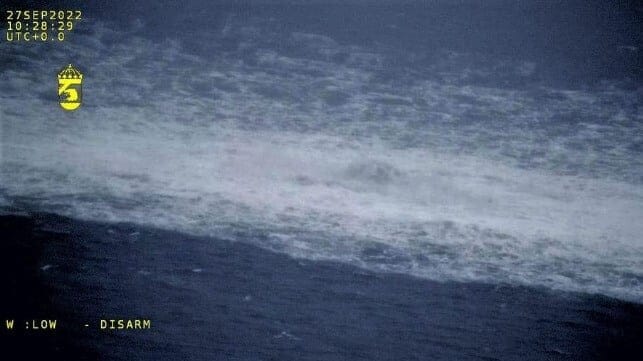
Gas roils the surface of the Baltic after one of the three Nord Stream pipeline blasts (Swedish Coast Guard)
Prosecutors in Germany have formally charged a Ukrainian officer who they suspect of involvement in the 2022 attack on the Nord Stream pipeline system, which breached three out of four lines and caused the largest manmade methane release in history.
The suspicions have been public for some time. In August 2025, at the request of German officials, Italian police detained Ukrainian military veteran Serhii Kuznietsov in the resort town of Rimini. Germany accused him of contributing to the complex attack on Nord Stream 1 and Nord Stream 2 in 2022 and sought his extradition. Italian courts approved the request, despite Kuznietsov's appeals and his attempt to stage a hunger strike.
Kuznietsov now faces charges of causing an explosion, disrupting public service, damaging property, and an additional "accomplice to war crimes" charge for an attack on civilian infrastructure. According to German authorities, he and his colleagues chartered a small yacht in Rostock using forged identities and covert methods, then sailed out into the Baltic and emplaced explosive charges on the seabed pipelines.
German prosecutors have had less luck in securing the extradition of a second Ukrainian suspect who resides in Poland. A Polish court ruled against a German request for the suspect's transfer and released the man from custody. The Polish government - which long opposed the construction of the subsea Nord Stream system, viewing it as a strategic enabler for Russian aggression against neighboring states - has declined to intervene in the case. "It is certainly not in Poland's interest to charge or hand over this citizen to another state," Polish Prime Minister Donald Tusk told Polsat News last year. "The problem of Europe, Ukraine, Lithuania, and Poland is not that Nord Stream 2 was blown up, but that it was built."
The damage to the pipelines created a physical impediment to any effort to restart the Russian-controlled gas export system. For Ukraine, this outcome was advantageous, inflicting material damage on Russia's future prospects for resuming EU gas sales. The attack did not change the immediate status quo, as all Nord Stream deliveries had already shut down due to political positioning in both Germany and Russia - but even if a future German government wanted to resume subsea deliveries of cheap Russian energy, the damage to the lines would make it difficult to do so.
KYIV BLOG: Russia, Ukraine political assassinations and the backpack bomb in Monaco
Seven people were injured in Monaco's first terrorist attack. / Image by Alexandra_Koch from PixabayFacebook
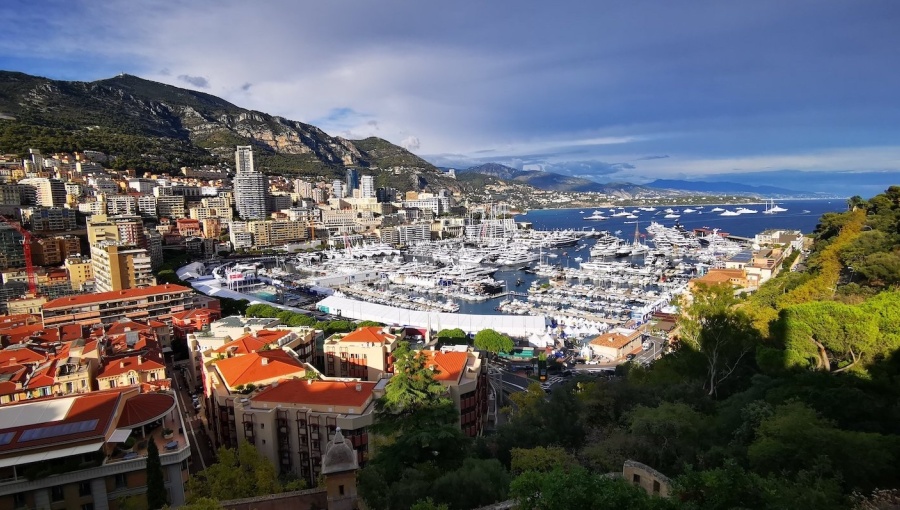
A backpack bomber targeted Ukrainian real estate mogul and online scammer Vadym Yermolaiev in Monaco yesterday in the principality’s first ever terrorist attack.
No one was killed, but seven people were injured and Yermolaiev’s wife had both her legs amputated as a result of the blast. CCTV footage showed a black clad man running from the scene who was tracked until he disappeared into France.
Speculation is roiling as to the motive of the attack. Yermolaiev made his money in Dnipro real estate before leaving the country a decade ago and giving up his Ukrainian citizenship for a Cypriot passport. His personal fortune is reportedly worth $220mn. Various Ukrainian business interests and funding of Ukrainian President Volodymyr Zelenskiy’s political opponents have been suggested as a motive, but there is no evidence as yet of who was behind this attack.
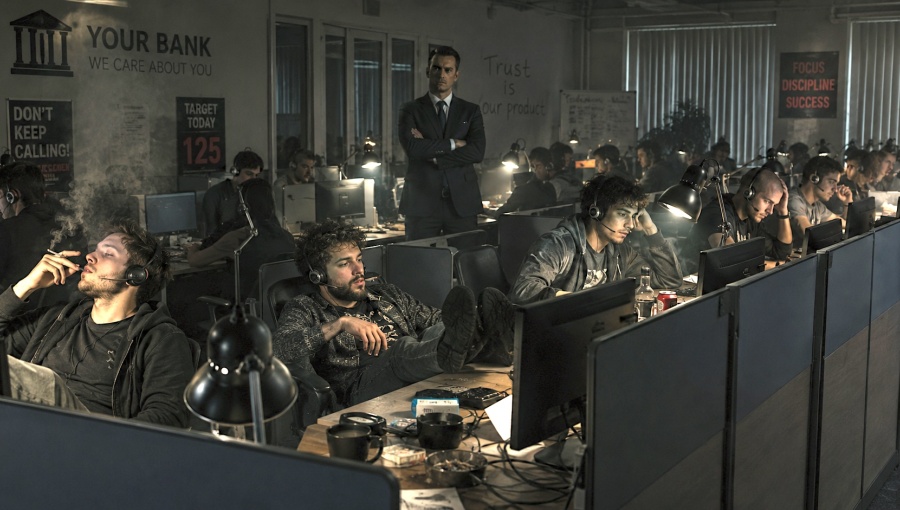
Another possibility is the attack was related to the number of call centres Yermolaiev runs in Dnipro that target EU pensioners and other vulnerable groups with online scams to rob them of their money. These criminal conmen attempt to fraudulently coerce payments or steal bank and credit card data from unsuspecting punters in what is reportedly a multi-million-dollar business out of the reach of EU police and courts.
Some reports have linked the Ukrainian Security Service (SBU) to the attack, and the security agency, which is under the direct control of the president, has a record of assassinating its enemies on foreign soil. Darya, the daughter of “Putin’s brain”, philosopher Alexander Dugin, was killed by a car bomb in Russia in August 2022. It is widely assumed the bomb was intended for her father, the car’s owner, in an attack widely blamed on the SBU and publicly condemned by the US as it smacked too much of terrorism.
Prominent Russian military blogger Vladlen Tatarsky was killed by a bomb blast in a St Petersburg cafe in April 2023 in the second assassination on Russian soil of a prominent pro-Russia media figure. Located in the heart of the city, the explosion shocked Russians as the war suddenly arrived in the homeland that has largely been insulated from the conflict until then.
In another incident of increased attacks on military figures, Lieutenant General Igor Kirillov, head of Russia’s Nuclear, Biological and Chemical Defence Forces (NBC) was killed in an explosion outside his apartment building in southeastern Moscow in December 2024 In that case the SBU publicly acknowledged being responsible. A scooter packed with explosives was detonated remotely near the building’s entrance at around 4am as Kirillov came out and suggested careful planning and monitoring of Kirillov’s movements. Several more Russian generals were killed by bombs or shot around the Moscow region during 2025.
The list goes on. There have been a total of at least a dozen high profile assassinations or attempted assassinations of Russian figures that have been linked to Ukrainian special operations outside of Ukraine, according to IntelliNews estimates.
If you include killings of Russian officials in Ukrainian territories under Russian control then some studies and media databases have catalogued 30–50 targeted attacks in occupied territories alone during 2022–24, many carried out by Ukrainian special services or partisan groups, although concrete attribution is almost always uncertain. As a rule, neither the SBU nor Bankova comment on assassinations.
Russia is not above assassinating its enemies. The most famous case is the death by polonium of Alexander Litvinenko in London. A former FSB operative who was working for oligarch Boris Berezovsky in London. According to one version of the story, a hard core clique of FSB generals saw Litvinenko as a traitor and decided to take him out. The use of polonium, which can only be sourced from Russia military institutions, was deliberate and intended as a message to other “traitors.”
More recently, Maxim Kuzminov, a Russian helicopter pilot who deserted and handed his Mi-8 AMTSh machine over to the Russians in exchange for a half a million-dollar reward, was assassinated at a luxury villa near Alicante on Spain's Costa Blanca this February. He was shot multiple times before reportedly his attackers drove over his body before fleeing in a car that was later found burned out. Spanish investigators have never publicly identified the perpetrators, but it widely assumed it was the GRU (Main Directorate of the General Staff of the Russian Armed Forces military intelligence). Other famous cases include the ex-spy Sergei Skripal who defected to the UK and opposition figure Alexei Navalny, who died in prison last year in suspicious circumstances.
Political assassinations is still a thing in both countries. Numerous senior Russian oil industry figures have died in strange circumstances in the last years. In Ukraine there was a wave of suicides among former Yanukovych allies in 2015, including Stanislav Melnyk and Oleksandr Peklushenko, who were both found shot dead. Oleksandr Muzychko, a Ukrainian nationalist and Right Sector figure close to Yanukovych, who died during a police operation near Rivne in March 2014, shortly after Yanukovych was ousted. According to the official version he died by accidently shooting himself twice during a showdown with police.
The public evidence varies considerably from case to case. Some operations have been openly acknowledged by Ukraine, others have been widely attributed by Western intelligence or media, while others remain allegations by Russia without independent verification. Mysterious murders or defenestrations are often blamed not on Ukraine, but the Kremlin itself further muddying the waters.
This article originally appeared in Editor’s Picks, a free daily email digest of bne IntelliNews’ best stories from the last 24 hours. Sign up for free here.
Monaco bombing reveals Ukraine as European scam call centre hub
Scam call centres are doubling their turnover and Ukraine has emerged as a key hub, using the war as protection to run a business worth billions of dollars a year. / bne IntelliNewsFacebook
Ukraine has become a European hub for multimillion dollar online scamming call centres. The attempted murder of Ukrainian businessman Vadym Iermolaiev in Monaco on June 28 is likely to be connected to his illegal call centre operations based in his home town of Dnipro in Ukraine, say experts, beyond the reach of EU police or courts. The call centres target consumers in the EU and Russia and generate hundreds of millions of dollars a year.
The bombing is the first of its kind in Monaco’s history, but the chief prosecutor quickly ruled out a terrorist attack. "This attack cannot be classified as terrorism," adding that a single suspect was the focus of the investigation. The suspect was tracked on surveillance cameras leaving the device at the entrance to a residential complex before crossing into neighbouring France. As of July 1, midday, there had been no arrest.
The attack injured seven people including Iermolaiev, his wife and his 13-year-old son. His partner is in life-threatening condition, having sustained serious injuries to her lower body, with Ukrainska Pravda reporting she has lost both her legs. Monaco's investigators have not officially named Iermolaiev as the target, identified a motive, or linked the attack to organised crime. Multiple competing theories have been advanced publicly, none accompanied by supporting evidence.
Iermolaiev’s business interests
Iermolaiev built his fortune through the Alef industrial and commercial group, becoming one of Dnipro's largest property developers, but since then he has additionally set up a string of large call centres where operators try to trick innocent punters into making payments or fraudulently steal their bank and credit card data.
Forbes Ukraine estimated his net worth at around $220mn in 2021. He renounced his Ukrainian citizenship in 2019, explaining to Forbes in 2024: "The Ukrainian judicial system, to put it mildly, is not ideal, and the tax system is not objective." But the dysfunctional rule of law is ideal for running call centres attempting to scam people out of their savings. While no investigation appears to have ever been launched into Iermolaiev's business, it has reportedly been flourishing.
In late 2023, Iermolaiev was personally sanctioned by the Ukrainian government for involvement with the Russian government and maintaining an alcoholic beverage company in Russian-annexed Crimea.
President Volodymyr Zelensky said at the time that the sanctions had been directed against “those who aid Russia's aggression, those who assist it, and those who have chosen the disgraceful path of collaborating with the terrorist state.”
The oligarch denies these claims and has since transferred many of his assets to his daughter, Sofia Kononenko, according to an investigation by Glavcom, a Ukrainian news site.
Iermolaiev was formerly chairman of the supervisory board of Versobank, a small Estonian lender whose licence was revoked by the European Central Bank in 2018 for violating anti-money laundering rules. His elder son Artur was also a board member during the same period, an Eesti Ekspress investigation established.
Ukrainska Pravda, citing law enforcement sources, reported that French investigators believe the Monaco attack followed a breakdown in a territory-sharing arrangement and unpaid debts between Iermolaiev and organised crime figures in Dnipro. Monaco's investigators have confirmed none of this.
Son arrest for call centre scams
The most likely motive for the bombing is connected to Iermolaiev’s son Arthur. In a rare success for law enforcement cracking down on cybercrime, Artur was arrested in Cyprus by Interpol on December 4, 2025, attempting to board a plane headed for Dubai.
He was extradited to Estonia where he was found guilty of heading a scam centre which had swindled over €100mn from its victims, confirming the Iermolaiev family’s control over numerous illegal scam call centres.
However, in a surprise decision, he was granted a plea bargain in April 2026, receiving only €8.5mn as a fine, a suspended five-year sentence and a 10-year Schengen ban.
Experts speculate that as part of Arthur’s deal, he agreed to turn informant and give up names of other people working in the scam call centre business, which has provoked a gangland style retribution.
"It's much more likely that it was connected to the scam call centres, and most likely to his son. Artur appears to have struck a deal with the investigators and likely gave up his accomplices and the other beneficiaries of the call centre network involved in criminal activity. In the end, this appears to have been retaliation,” political analyst Volodymyr Fesenko told the Kyiv Independent.
Fast growth of the scamming industry
Scam activity across Europe is escalating dramatically, nearly doubling over the past year, according to Europol. The owners of call centres are constantly developing new strategies that are becoming increasingly sophisticated, seeking vulnerabilities and playing on the egos of con victims.
Romance scams, which play on the idea of online dating, have been doubling annually since 2023. The advent of AI has taken things to a new level with voice scams where AI mimics the voice of someone the victim knows are also doubling. Alternatively, the fraudsters impersonate police or bank staff in their efforts to steal financial data, according to an investigation by the Organized Crime and Corruption Reporting Project (OCCRP).
One consumer survey estimated that Europeans lost $57bn to scams in the last year alone, with only about 3% of victims reporting the crime to authorities. Losses in the banking system are clearer: payment fraud across the European Economic Area reached €4.2bn in 2024, up from €3.5bn in 2023. Credit-transfer fraud alone was €2.2bn, up 16% y/y, with payment users bearing about 85% of those losses, largely because of scams that trick people into authorising transfers. In the UK, authorised push payment fraud losses rose 12% in 2025, reversing a recent downward trend.
Specifically, call centres are only one channel within the broader online fraud business. Europol estimates scam calls cause around €850mn in losses worldwide each year, which would make Arthur Iermolaiev a significant player if the Estonian claim that he swindled victims out of €100mn. But call centres remain a fraction of the total since much fraud now runs through online platforms and fake investment sites rather than phone calls, says OCCRP.
War-torn Ukraine has nonetheless become a significant hub for call-centre fraud targeting Europeans and Russians who have also lost an estimated $2bn last year, according to German Gref, Chairman of Sberbank, Russia’s largest bank.
In December 2025, a Eurojust-coordinated operation dismantled a network running professional call centres in Kyiv, Dnipro and Ivano-Frankivsk that defrauded hundreds of victims of more than $11.7mn. An action day on December 9 produced 72 searches across the three cities, 12 arrests and 45 identified suspects; police seized forged police and bank IDs, cash, 21 vehicles, weapons and even a polygraph machine, Ukrainska Pravda reported. Around 100 people worked in the operation, recruited from the Czech Republic, Latvia, Lithuania and elsewhere, earning up to 7% commission on what they extorted, with promised bonuses of cash, cars or a Kyiv apartment for top earners. Tactics included posing as police to withdraw money using victims' card details, or claiming accounts had been hacked and persuading victims to move funds to safe accounts, sometimes via remote-access software.
Ironically, the war in Ukraine has provided cover for these call centres. Dnipro, in the eastern half of the country, has come under direct fire from Russian forces. Czech detectives say it has become more common to move call centres closer to the frontline, where they are less likely to be targeted by law-enforcement operations, The Record reported. A separate December bust in Kyiv, run in coordination with Ukraine's Security Service, the SBU, hit a fake-investment operation led by a 31-year-old from the Donetsk region, causing nearly $2mn in losses to at least 138 known victims.
The violence the industry generates is not confined to Monaco. In February 2026, Igor Komarov, a 28-year-old Ukrainian national identified by Ukrainian media as an admitted operator of Dnipro-based call-centre networks since 2021, was kidnapped on the Indonesian island of Bali. His dismembered body was found on a beach in Gianyar on February 26. Bali police confirmed identification through DNA testing on March 4 and named seven foreign suspects, four of whom had already left Indonesia. In video footage that circulated before his death, Komarov described a dispute over criminal proceeds as the trigger for his abduction.
Ukraine’s crackdown
Ukrainian authorities started to target domestic call-centre networks defrauding EU citizens in 2022 at the start of the war with Russia. The scale of what they were dealing with became clearer in March 2025, when OCCRP and more than 30 media partners, including Le Monde, Der Spiegel and The Guardian, published Scam Empire, an investigation based on a leak of nearly two terabytes of internal data from two major scam operations, including more than 20,000 hours of recorded calls, screen recordings and internal spreadsheets.
The investigation found that those two networks alone took in around $275mn from at least 32,000 people over roughly four years. The report described Dnipro in particular as a centre of the trade, with a Wolf of Wall Street-style office culture and young recruits hired openly through job sites. Former Interpol secretary general Jürgen Stock told OCCRP that "the laptop, so to speak, is now the sharpest sword in the arsenal of criminal groups." Nino Goldbeck, senior cybercrime prosecutor in Bavaria, told the investigation that "these call centres are extremely professionally structured and organized and are managed accordingly."
Up to 1,500 fraudulent call centres were operating in Ukraine as recently as 2024, according to the UN Office on Drugs and Crime, many of them concentrated in Dnipro and its surroundings.
As part of Ukraine's EU accession bid it is required to crack down on corruption, and the authorities have been working to curb cybercrime operations in the country. Negotiations on the first cluster have just been opened, which deal with the “Fundamental” package of reforms that include the judiciary, law enforcement and anti-corruption measures, where Ukraine is lagging behind.
Scamming has also become an unofficial weapon and another front in Ukraine’s economic war with Russia. In December 2024, Vladimir Putin told his annual press conference that Ukrainian phone scammers had stolen more than RUB250bn ($2.5bn) from Russian citizens that year alone, and accused Kyiv of making phone fraud "state policy," the Moscow Times reported.
What is separately documented is the way the war has reshaped the operating environment. The Geneva-based Global Initiative Against Transnational Organised Crime found that some call-centre operators frame their work explicitly as economic warfare against Russia, with job advertisements asking recruits whether they want to help undermine the Russian economy. Proceeds, the same report found, rarely re-enter the Ukrainian economy, moving instead into offshore accounts or cryptocurrency.
This creates an uncomfortable calculation for Ukrainian authorities. Eurojust operations demonstrate that Ukrainian law enforcement is capable of acting and has done so. But in a country fighting for survival, with law enforcement resources stretched and its economy contracting, the political appetite to shut down an industry generating billions, even a criminal one, has limits that investigators and policymakers have not publicly discussed.
What is not in dispute is the outline the Monaco bomb has made visible: a sanctioned oligarch from Dnipro, a son convicted of running a €100mn fraud network who served four months before paying his way to freedom, and a city that functions as the acknowledged capital of European telephone fraud, shielded in part by a war that has made it harder to police and easier to justify.
Who is Ukrainian oligarch Vadym Yermolaiev, the suspected target of the Monaco bombing?
The explosion that wounded three people in Monaco Monday night is being treated as an “attempted murder”. So who was the target? While Monegasque authorities remain tight-lipped about the victims’ identities, media reports point to Vadym Yermolaiev, a Ukrainian-born oligarch sanctioned by Kyiv for his business dealings in Russian-annexed Crimea.
“To my knowledge, it’s the first time in history that such a thing has happened in the principality,” he said in a press conference Tuesday, the morning after an explosion rocked the heart of the wealthy, ultra-safe micro-state in France’s south.
Just before 9pm, a powerful explosion ripped through the ground floor of a block of flats, wounding three people including a 13-year-old child. For now, local authorities are treating the incident as an “attempted murder”, Thibault said, stressing that no suspect had yet been found.
The construction king of Dnipro
Monegasque authorities have refused to identify the victims of the attack, revealing only that they lived on the building’s ground floor and had arrived in the micro-state in 2021.
But information obtained by French news station BFMTV and confirmed to AFP by a source close to the investigation suggests that one of the three people was Vadym Yermolaiev, a wealthy oligarch from Ukraine.
Manhunt launched after Monaco blast targets Ukrainian-born oligarch
Ryhor Nizhnikau, a specialist in Ukraine and the broader post-Soviet world at the Finnish Institute of International Affairs, said that Yermolaiev had been an influential figure in the country’s industrial east during the 1990s before falling into disgrace.
“He is a very typical oligarch from the 1990s,” he said. “He was probably in the top five oligarchs in the Dnipro region – which is one of the richest regions.”
Yermolaiev was targeted with Ukrainian sanctions in 2023 for having continued his business dealings in Crimea – annexed by Russia in 2014 – even after Moscow launched its full-scale invasion of Ukraine in 2022.
The multi-millionaire first made a name for himself as “Mr Shopping Mall” in the thriving city of Dnipro in Ukraine’s south-east, inaugurating what was at the time the country’s largest shopping complex – Most-City – in 2006.
Not content to build malls, Yermolaiev threw himself into a slew of ambitious infrastructure projects in Dnipro, which now finds itself on the front line of the grinding war. He remade an entire neighbourhood in the city’s historic centre, earning him a reputation in local media as “the man who changed the face of Dnipro”.
Yermolaiev has since diversified his businesses. The Alef Group, the parent company of his business empire, controls companies in 19 industries, as reported in the mid-2010s by UBR, a Ukrainian business magazine no longer in circulation.
The grapes of wrath
With interests ranging from commercial real estate to the manufacture of dental implants, agro-food production to river transport, Yermolaiev steadily built up a vast portfolio that allowed him to build a fortune estimated at more that $300 million by the mid-2010s – and enter the closed-off club of Ukraine’s 100 richest people.
In the end, it was drink that led to his ruin.
Yermolaiev has been accused of continuing to profit from his wine-making business in Crimea following the peninsula’s annexation by Russia, and even two years after Moscow's full-scale invasion.
Worse, a portion of his Crimea-based companies’ revenue allegedly went to Moscow in taxes, leading to accusations that the oligarch was directly financing the Russian war effort.
Even before he found himself on a list of sanctioned businessmen, Yermolaiev had left the country. In 2019, he renounced his Ukrainian nationality in favour of Cypriot citizenship.
Nizhnikau said that Yermolaiev's trajectory was typical of many oligarchs who had made their fortunes in the chaotic years following the collapse of the Soviet Union, only to lose influence with President Volodymyr Zelensky’s abrupt rise to power and the outbreak of the war with Russia.
He said that Yermolaiev was far from the only oligarch in the country who had continued to earn money from ongoing business activity in Crimea.
“You're not allowed – it’s illegal, obviously,” he said. “But the point is that it's like a conditional secret – you had a business before in Crimea, so what are you going to do? You register or create a fictional company, and you basically give your Crimean or Russian assets to this company.”
Nizhnikau suggested that the oligarch’s inclusion on Kyiv’s sanction lists in 2023 was likely influenced by other factors – potentially a lobbying campaign by a young, ambitious rival.
For now, the investigation is generating more questions than answers. Authorities in France and Monaco on Tuesday were searching for a man in a black bucket hat who was seen in surveillance footage leaving a backpack at the foot of the building shortly before the explosion.
If authorities do manage to lay hands on a suspect, Nizhnikau said, it would be interesting to see if he had his own links to Dnipro or Crimea.
Monaco bombing suspect flees to France as police probe attempted murder Police in Monaco and France launched a manhunt for a suspected bomber on Tuesday after three people were wounded by an explosion in the wealthy principality, including Ukrainian-born oligarch Vadym Yermolaiev. The attack was being investigated as attempted murder, but not being considered terrorism act.
Police on Tuesday were searching for the suspect behind a parcel bomb that wounded a businessman of Ukrainian origin and two others in Monaco, after the unprecedented attack rocked the super-safe principality.
Dozens of officers were deployed in Monaco, while two helicopters and some 30 gendarmes scoured neighbouring France for a man who left a package in a residential building near the border, according to the police and gendarmerie.
The device exploded at around 9:00pm (1900 GMT) on Monday, leaving a man and a woman seriously wounded and a teenager with lighter injuries, according to the Monegasque authorities.
Monaco public prosecutor Stephane Thibault said as of Tuesday the man had been stabilised, but the woman's condition remained "life-threatening".
He said the blast was being investigated as "attempted murder" but was not being considered as a "terrorist" act.
He declined to say who was the presumed target of the blast, but several sources have said it was Ukrainian-born businessman Vadym Yermolaiev, who is a permanent resident of Monaco and has acquired Cypriot nationality.
Monaco's Minister of State Christophe Mirmand said he was not aware of any specific threats against Yermolaiev.
"The family's behaviour before entering their block of flats did not appear to show any signs of concern on their part," he told broadcaster BFMTV.
"They were dressed for summer, relaxed and did not appear to be taking any particular precautions," he added.
He earlier said the teenager was "very likely related" to the couple.
The wounded had been taken to hospital in the southern French city of Nice. A source close to the case had said the man had suffered severe burns and the woman was in critical condition.
John Bulanadi, a 19-year-old student living near the site of the incident, told AFPTV he had heard a loud explosion.
"I quickly went out onto my terrace to see what was happening. There was screaming, crying and two people on the ground," he said.
Monaco's Prince Albert II described the incident as a "heinous crime" and "a shock to the entire Monegasque community". Bolts, buckshot
Thibault said a suspect had left a bag or package in the building's lobby before leaving.
The Monaco government said the "strong explosion" was caused by a "parcel bomb".
"A suspect was seen on video surveillance fleeing towards the municipality of Beausoleil in France," it wrote on X.
Mirmand earlier said witnesses had provided information to identify the suspect.
The explosive device apparently contained bolts and buckshot, he added.
Emergency services treated four other people for shock and cuts from windows shattered in the blast, he said.
"This is the first time in history, to my knowledge, that such an act has taken place in the principality," he added.
Yermolaiev, a multi-millionaire Monaco resident, has been subject to sanctions from Kyiv since December 2023, which Ukrainian security services reportedly said stemmed from his alcohol business activity in Russian-occupied Crimea.
Mirmand told a news conference late Monday that intelligences services were working to understand the victims' background and "determine if others might be facing specific threats".
The scandal over alumina sales to Russia continues to dog Ireland as it takes over the rotating presidency of the EU Council, but Dublin says it will not commit to sanctions until an internal investigation is concluded.
Ireland is under mounting pressure to end its alumina sales to Russia, as the risk of propping up Moscow's war machine becomes an explosive liability.
The government in Dublin is weighing whether to allow EU sanctions on the raw material, which is sold as a white powder and is essential to the manufacture of aluminium, which is commonly found in weapons on the battlefield in Ukraine.
However, no decision will be taken until an internal probe to determine the final destination of alumina exports is completed. The probe is in its final stages.
"We will discuss (the findings) with the European Commission, but the Commission has never put alumina on a sanctions list, so that's an important point, nor have we had to lobby, in any shape or form, in respect of this issue," Irish Prime Minister Micheál Martin said on Thursday during a briefing attended by Euronews.
The deliberations, Martin noted, should take into account the potential disruption to local jobs, the environment and Europe's alumina supply chain. Once these "various factors" are considered, the premier said, Dublin will "develop an approach" with the Commission to deal with the "core issue" – a promise that stops short of committing to sanctions.
"We don't want material to be supportive of the Russian war effort," he said. "Europe has to be ever vigilant that we continue to support Ukraine in very practical terms."
Meanwhile, Deputy Prime Minister Simon Harris said that "the best way" to tighten the screws on Moscow's high-intensity war machine was through economic sanctions. Harris described his country as an "enthusiastic" supporter of the policy.
"Ireland will never cherry-pick when it comes to sanctions. It will never cherry-pick the criteria. The criteria are clear. The criteria must be applied. That's important," Harris said in Dublin. "But it's important that we establish the facts."
Harris said the issue of Irish-made alumina had been examined "many times in the past" and the information provided had "led to the satisfaction" of both EU and US authorities.
The two men's comments come on the heels of a headline-making visit by Ukrainian President Volodymyr Zelenskyy to attend the opening ceremony of the Irish presidency of the EU Council, which began on 1 July.
Zelenskyy made it clear he wants the alumina trade with Russia to stop.
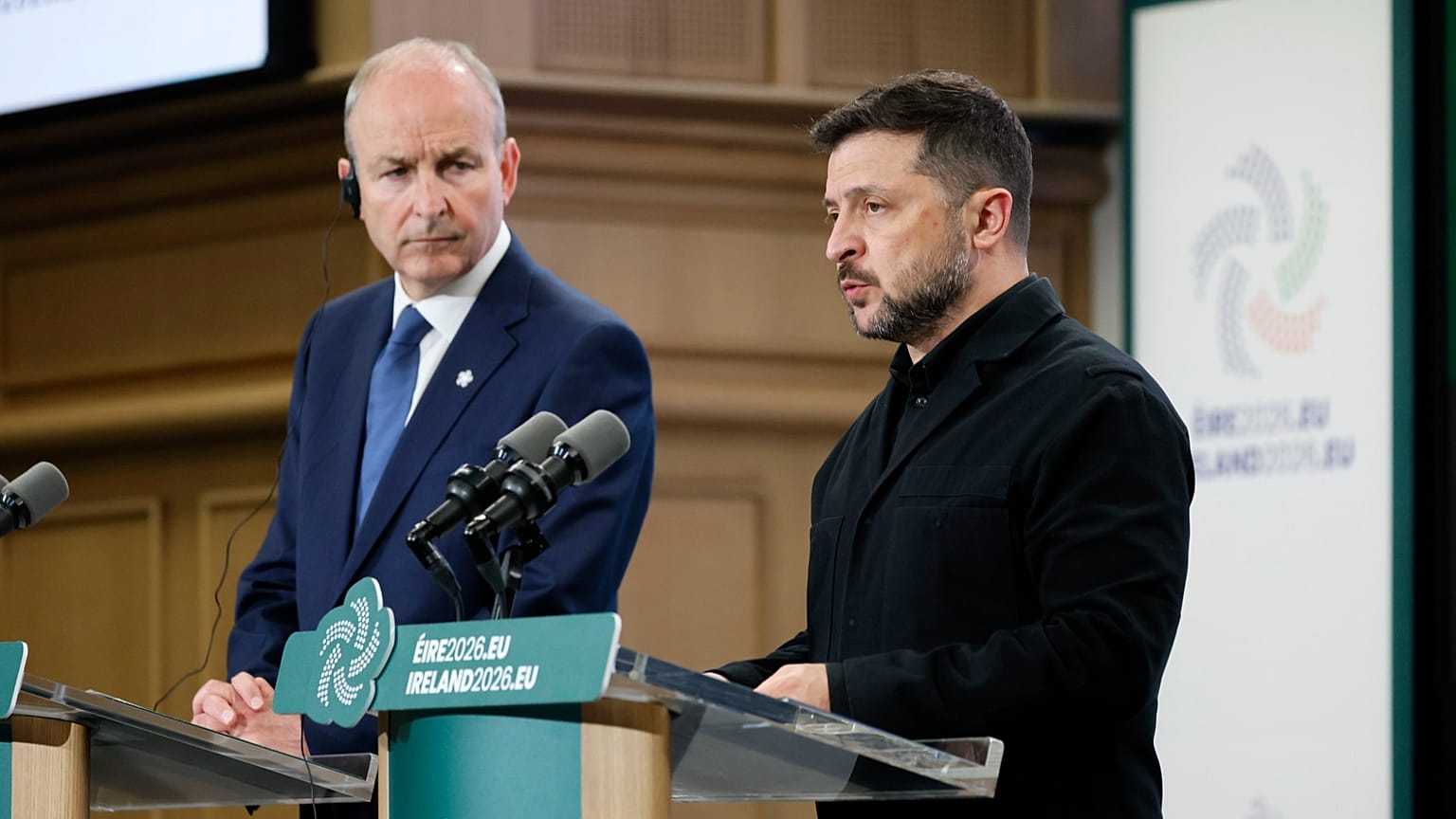
"Every tonne of raw materials that ends up in Russia is used against us in this war. This is what we understand. This is how we see it," Zelenskyy said on Tuesday, speaking next to Martin at a joint press conference.
"When the economy is shrinking, we can see that immediately, just as it shrinks Russia's capability to perform massive attacks. All of that is reflected in the quantity of casualties in Ukraine, to be honest."
Zelenskyy's visit to Dublin was followed by a wave of Russian strikes against Kyiv that killed at least 21 people.
A damaging scandal
Ireland has been in damage control since a media consortium published a bombshell investigation in late March exposing the business ties between Aughinish Alumina, Europe's largest alumina refinery, and the Russian economy.
According to the findings, the sprawling plant, based in western Ireland, sells alumina to Russian smelters owned by its parent company, United Company Rusal, which in turn sells the metal to a trader that supplies aluminium to sanctioned defence manufacturers.
The weapons made by these manufacturers have been deployed to kill Ukrainian civilians and bombard civilian infrastructure, the investigation found. (The journalists traced Irish alumina to the Russian trader, but not to a specific product.)
Separately, Swedish authorities have concluded that Rusal, the parent company of Aughinish, remains under the effective control of Oleg Deripaska, a Russian oligarch with close ties to the Kremlin who is under EU sanctions
Aughinish insists its activities are entirely legal because alumina has been spared from any trade restrictions. The company says alumina exports to Russia represented about 45 percent of all sales in 2025 and expects the share to be similar at the end of 2026.
Virtually all EU-made alumina sent to Russia originates in Ireland.
Aughinish has reportedly told the Irish government that EU sanctions on alumina would be so disruptive for its operations that it would require the government to take over the plant to salvage hundreds of jobs and guarantee a critical supply chain.
On Thursday, both Micheál Martin and Simon Harris pushed back against the company's claims, even though they echoed some of its concerns.
"We're not accepting threats from any quarter," Martin said.
Harris, who also serves as finance minister, rejected what he called a "binary" choice between state rescue and bankruptcy. He noted that he had not been involved in any discussions involving a potential nationalisation.
"There have to be ways to address the issue that enable crucial supply chains to continue into the European Union and enable absolute clarity that there are (no links) in any manner or means to Putin's regime in relation to the war," Harris said
"I don't think these issues are binary at all because Europe has shown, time and time again, how it has managed to put in place ways to protect our economy, our own supply chains," he added.