Wednesday, August 05, 2026


Source: League Against Imperialism

In February 1927, 175 delegates from across the globe convened in Brussels for the founding Congress of the League Against Imperialism and Colonial Oppression (LAI). They aimed to create a global mass anti-imperialist movement, and for several years, the LAI inspired and supported anti-colonial and anti-imperialist struggles worldwide. It was an early part of a growing tapestry of internationalist formations that came to reshape the political terrain of the 20th century.

One hundred years later, the world has undergone major changes, but the mission of anti-colonial and anti-imperialist unity is no less urgent. Formal colonial rule — the direct territorial administration of one people by another — has largely receded. Imperialism has not. It remains the structuring relation of the world economy, where a core of capitalist countries controls the flow of capital, goods, and labor for its benefit. For the world’s oppressed — particularly the workers and peasants of the Global South — imperialism is a catastrophe. It arrives as job insecurity, deflated wages, austerity, and underdevelopment. Most people are given no say in the policies that most affect their lives. Indeed, imperialism often imposes its diktats at the barrel of a gun.

Since the end of World War II, imperialism consolidated its forces and established its core in the United States. With the collapse of the Soviet Union and the socialist Eastern Bloc, U.S.-led imperialism has largely been uncontested — a status quo that it has sought to preserve at all costs. In strategic documents adopted in the early 1990s, the U.S. set out its aims clearly: to deny states in the Global South the possibility of development through “mechanisms for deterring potential competitors from even aspiring to a larger regional or global role”.[1]

But, in many ways, the U.S. strategy has failed. The global order is undergoing a tectonic transformation, and new centers of power are emerging — a trend that accelerated notably after the 2008 financial crisis.

In the economic sphere, U.S. dominance is being contested by the rise of China. China’s ascent has also enabled other former colonies to forge new partnerships outside the straitjacket of the imperialist system. This movement is shifting the world away from Western hegemony toward a fragmented, polycentric reality — an increasing dispersal of accumulation and political weight that creates room for maneuver for the countries of the South.

This process is not linear, nor does it automatically guarantee progressive outcomes. Imperialism is mobilizing against these transformations, often with extreme violence. And not every state leading these processes is socialist in its orientation. Nonetheless, the struggle for sovereignty advances. It will take the conscious and determined organization of the world’s workers and oppressed peoples to give progressive substance to the changes that are unfolding today.

Imperialism Today

Imperialism is not one injustice among many. It is the primary contradiction of our system — the relation that organizes the world economy and distorts the class struggle on every continent.

War, indebtedness, underdevelopment, and ecological collapse are all expressions of this contradiction. It follows that they cannot be resolved piecemeal, within the framework of the system that produces them, but only by severing the arteries of imperial accumulation. This task falls to the peoples of the periphery, through whom the system reproduces itself, and to the workers of the core, in whose name it claims to act. 

In fits and starts, that process is now underway. The global economic center of gravity is shifting toward Asia, particularly China. Nations and peoples are resisting imperialist diktats, and new systems of cooperation and exchange are emerging to circumvent systems dominated by the countries of the Global North. 

Imperialism is responding with increasing belligerence. Its attempts to secure and extend control over markets, finance, technology, strategic infrastructure, energy and critical resources are intensifying. In the process, it has launched a systemic war against the world’s workers and oppressed peoples. That war is fought with neoliberal restructuring, sanctions and debt — instruments that impose wage and resource price deflation and de-development on nations and peoples across the South, and which are backstopped by the threat or application of military force.

Vladimir Lenin described imperialism as “moribund capitalism” — the final stage of the system. On one hand, it represents capitalism developed to its highest form: production dominated by huge international monopolies, the control of industry by finance capital, the export of capital from imperial centers to the periphery, and the economic and territorial division of the world.

On the other hand, Lenin argued that it is the final stage because the system had reached its boundaries. This did not mean that the system faced imminent collapse. One hundred years after the founding of the League Against Imperialism, the world’s economy remains structured by imperialism. But this is an imperialism that has outlived its day — a system that has hit its limits and is no longer capable of resolving its internal contradictions.

More than ever, the world economy is under the control of huge monopolies. Through the concentration and centralization of capital, almost every sector is dominated by just a few concerns. These entities use their market power to hold the economy hostage in order to extract super-profits. As soon as competitors show signs of weakness, they are ready to eliminate or absorb them, further consolidating their dominance and rendering references to a “free market” hollow. 

Within the imperialist countries, this process manifests itself as an assault on the hard-won gains of social democracy — a set of temporary concessions eked out from capitalism during a time of great turmoil. Within the global periphery, it manifests itself as an attack on the very architecture of the state, which is systematically dismantled to facilitate accumulation by international concerns. Across the world, states find themselves unable to recycle national income into development. Instead, their national wealth is systematically siphoned to Wall Street or the City of London.

Capital continues to flow globally to generate the highest possible profit for its owners, most of whom reside in the imperial core. The outcome is a deep North-South divide, where wealth accumulation by a Northern minority contrasts with the enduring poverty and underdevelopment sustained by neo-colonial arrangements and imperialist rule in the South. 

For workers, imperialism is experienced not only through the extraction of minerals and wealth but through the restructuring of work itself. Public sector wage restraint, privatization, outsourcing and public-private partnerships have become familiar prescriptions attached to debt restructuring and fiscal consolidation programs promoted by international financial institutions and supported by imperialist states.

The percentage of people engaged in precarious and informal work is rising precipitously. Displaced by land grabs, climate change, conflict, and other factors, masses of people are abandoning the countryside and moving into increasingly-congested cities. This process puts billions of people outside the reach of the feeble social protection mechanisms available to the employed. This is a recipe for a social catastrophe of genocidal proportions.

As these contradictions deepen, ruling elites continue to search for new avenues of accumulation and exploitation while shifting the social, economic and environmental costs onto workers and communities. One such avenue is the advent of artificial intelligence. AI and digital technologies are fueled by critical minerals in the Global South, thus motivating a renewed scramble for resource extraction and territorial control from Greenland to the DR Congo.

Imperialist Aggression and Resistance

Samir Amin observed that imperialism walks on two legs: an economic leg — globalized neoliberalism imposed as the only permissible economic policy — and a political and military leg — the wars, coups, and interventions visited upon those who refuse it.[2]

While the maintenance of a system that reproduces inequality has always required extreme violence, the decline of U.S.-led hegemony has produced an imperialism on overdrive across both its economic and military dimensions.

The U.S. siege of Cuba, which culminated in the recent near-total fuel blockade that deprived the island of all oil imports, represents the economic war at its most extreme. The 2026 abduction of Venezuelan President Nicolás Maduro from his palace represents the military leg at its most brazen. Indeed, Washington’s renewed belligerence in Latin America seeks to reactivate and reinvigorate the Monroe Doctrine, as outlined in the U.S. National Security Strategy of late 2025. This doctrine seeks to re-establish the Western Hemisphere as an exclusive U.S. “hunting ground,” targeting any nation that seeks to diversify its trade with China or Russia.  

But U.S. designs are not limited to the Western Hemisphere. The U.S. is now spending over $1.3 trillion a year on its military. With the Western-backed war on Gaza, genocide is once again on imperialism’s political agenda. And as U.S. Secretary of State Marco Rubio said at the 2026 Munich Security Conference, the West is determined to reassert imperial rule on a global scale — a posture that threatens to engulf the world in war.

While the U.S. continues to exercise enormous military and financial power, European governments, financial institutions and multinational corporations remain committed to the imperialist project. They advance military alliances, trade agreements, investment regimes and the continued promotion of market reforms that favor private capital over public good or interest. And they do not hesitate to use military force themselves. Recognizing these ways in which these centers of imperialist power intersect is a pre-condition for establishing the kind of international working-class solidarity that is necessary to confront the imperialist order.

Although the military might of U.S. imperialism and NATO may seem overwhelming, there are also signs of weakness. The preservation of a unipolar world order is no longer possible. Faced with this reality, the U.S.-led imperialist system has responded through increasingly brazen acts of aggression that are no longer even justified by reference to the language of democracy, security, or humanitarian intervention. While imperialism never disappeared, its contemporary form has become more naked and unapologetic, exposing its true character and objectives for all to see. In doing so, it is helping to generate a growing consciousness of the need to confront, resist, and ultimately overcome this aggressive assertion of global dominance.

The endurance of the Cuban people, the steadfastness — sumud — of the Palestinian resistance, the persistence of Chavismo in Venezuela, the humiliating defeat of U.S.-Israeli forces in Iran, and the advances against colonial domination in the Sahel all demonstrate that resistance to this global order is not only possible, but already underway.

Likewise, the continuing struggles against austerity in Kenya, the mobilization of hundreds of millions of workers in India, and waves of strikes across Portugal and France reveal both the necessity and the potential of collective struggle. Together, these movements affirm a fundamental truth: even in the face of immense power, peoples and nations retain the capacity to resist, organize, and chart an alternative path.

Reclaiming the Mission of Internationalism

Against this backdrop, the current anti-imperialist sentiment arising from imperialism’s brazen use of force can benefit from the lessons learned in the anti-imperialist movement that emerged after the League Against Imperialism’s 1927 Brussels conference.

1927 was a world in transition. World War I had shattered the old order — exposing the imperial “civilization” as one of industrial slaughter and colonial domination. Socialist revolution swept Russia, and the ideas that it generated spread throughout the colonized world, inspiring movements from Cairo to Canton. Lenin’s recognition that the struggles of the colonized were not a sideshow to the workers’ movement but central to the defeat of imperialism gave theoretical shape to struggles that were stirring around the globe. When delegates gathered in Brussels, they were part of a rising, global current, carried by the conviction that the colonized peoples, far from being passive objects of history, were the motor force of our collective liberation.

Are we living through another historic turning point? The answer is not yet clear. What is clear, however, is that the contradictions of the present order are deepening. The growing instability of Western imperialism, its increasing reliance on military force, sanctions, political coercion, and open aggression, reflects not confidence but a system struggling to preserve a position of dominance that is becoming increasingly difficult to sustain.

Yet history offers no guarantees. Periods of imperial decline have produced both liberation and catastrophe. The possibility of transformation exists, but it must be consciously organized. The same conditions that create opportunities for emancipation can also lead to wider wars, intensified exploitation, and environmental collapse. The stakes of the present moment could not be higher.

At the same time, humanity possesses unprecedented capacities. Never before have the productive forces of society been so advanced. Never before has human labor been so interconnected across borders. The global economy rests upon vast production chains that link workers from every continent, creating the material basis for a common struggle against a system that concentrates wealth, power, and resources in the hands of an increasingly small global elite.

Imperialism remains the central contradiction of our era. It is imperialism that fuels war, deepens inequality, obstructs development, and accelerates climate and ecological destruction. Its consequences are felt not only in the Global South but by working people everywhere. For this reason, confronting imperialism is not the task of any single nation or region; it is a shared responsibility that demands the broadest possible unity between the peoples of the South and the working classes of the North.

We are not the first generation to face this challenge. The Anti-Imperialist Conference of 1927 brought together revolutionary, nationalist, and workers’ movements from across the world in recognition of a simple truth: the struggle against colonialism, exploitation, and war required international unity.

Decades later, the Bandung Conference in Indonesia marked these forces’ presence on the world stage. It brought together the anti-colonial movement — both nationalist and communist — to affirm principles of sovereignty, equality, peace, and self-determination. This was a decisive break from the imperialist and colonial system, which for centuries had resolved political questions through brute force and genocide. The ‘Bandung Spirit’ remains relevant not as an object of nostalgia, but as a reminder of the transformative role that struggles for socialism and national liberation can play when they unite against a shared enemy.

Today, the need to recover that ‘Bandung Spirit’ — and the struggles that were its material basis — is greater than ever. The danger of escalating global conflict, including the possibility of wider wars between major powers, is real. So too is the threat posed by climate change and environmental degradation, whose consequences fall most heavily on the world’s working and oppressed peoples. Neither danger can be addressed within the framework of imperial accumulation and domination. A just transition requires a paradigm shift — away from imperialism and towards democratic public planning, social dialogue, strong public institutions, decent green jobs, protection for affected workers and communities, and fair access to climate finance and technology.

The call, therefore, is to develop clarity about the historical moment we are living through, to identify the forces responsible for humanity’s crises, and to build the unity necessary to overcome them. The future remains unwritten. Whether this period becomes one of liberation or one of catastrophe will depend on the ability of peoples across the world to organize, unite, and act with the urgency that this moment demands.

For the world’s workers and oppressed, commemorating the centenary of the LAI27 must be more than an act of remembrance. It is an opportunity to rekindle the unfinished struggle against colonialism and imperialism — a precondition for the advancement of our aspirations towards decent work, democratic governance, economic sovereignty, living wages, universal social protection, quality public services, gender equality and a just transition. It should renew a practical program of international solidarity linking workers in the Global North with those struggling for sovereignty in the South. These struggles are rooted in different national realities, yet they confront common structures of exploitation. Their shared experience provides the strongest foundation for rebuilding an international anti-imperialist movement grounded in the daily lives and collective power of working people. It is a call we want to heed in 2027 to commemorate and celebrate one hundred years of struggle against imperialism.

[1]U.S. Department of Defense’sDefense Planning Guidance (DPG), February 18, 1992.

[2] Samir Amin, Contemporary Imperialism, Monthly Review, Vol. 67, No. 03 (July-August 2015), https://monthlyreview.org/articles/contemporary-imperialism/


This article was originally published by League Against Imperialism; please consider supporting the original publication, and read the original version at the link above.

The Flamingo Revolution Continues Despite Arrests And Intimidation

Source: Pressenza

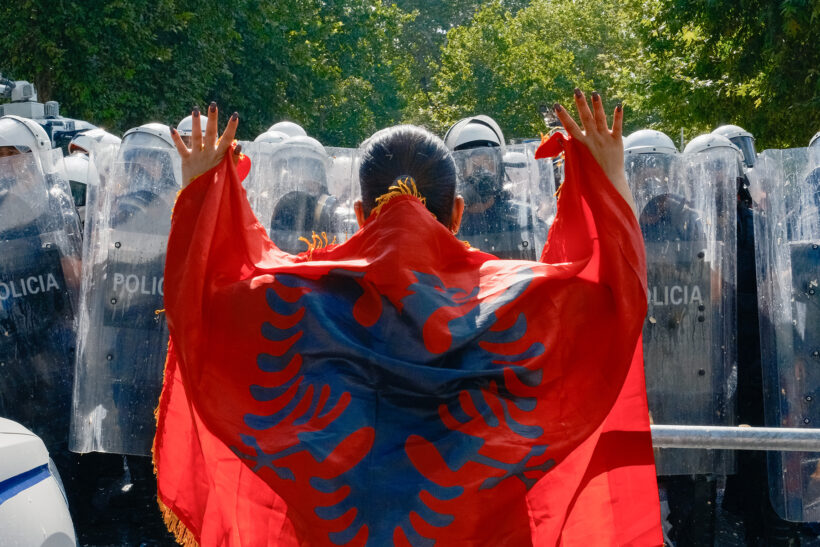
On July 23—now the 54th day of the protest—demonstrations took place not only at the usual afternoon time but also in the morning, starting at 8:00 AM, in front of Parliament. Several hundred people gathered around the building while a plenary session was underway inside to decide on the issue of foreign ownership of agricultural land. Rather than congregating in a single spot, protesters spread out across the various entrances to Parliament, which was already ringed by metal barriers and a heavy police presence. The police officers—who were legally required to display identification badges on their uniforms—were not wearing them that day. It was a sign of what was to come.

By now, you know that the main demonstrations have been taking place in the late afternoon every day for over fifty days: a procession starts at Skanderbeg Square and heads to the Prime Minister’s office for a sit-in lasting several hours, followed by a march that continues along an indefinite route for an undetermined amount of time. These regular events, which have become a fixture of daily life in the capital, Tirana, are supplemented by special actions held in the mornings or on weekends.

Such actions are organized, for instance, when Parliament is in session—like the protests on July 2 and July 20—or outside other institutions; an example is the July 9 protest at the Ministry of Culture against the allocation of four million euros in public funds for a concert by Ye (better known to most as Kanye). Meanwhile, on weekends, the mobilization shifts to fenced-off areas that have been closed to the public, including Zvërnec (May 13, June 30, June 6), Rrjoll (June 13), and Kakome (June 21).

Returning to the bills under discussion in Parliament, one of the contested measures is a draft law published for consultation by the Ministry of Agriculture and Rural Development, titled “On the transfer of ownership of agricultural land to foreign natural and legal persons.” The text paves the way for the purchase of agricultural land by foreign citizens and companies, stipulating that the new provisions would take effect seven years after Albania’s potential accession to the European Union. Currently, foreign investors can lease agricultural land for up to 99 years but cannot purchase it. The new text, however, would allow the sale and purchase of both private and state-owned land, including land belonging to the pool of public lands classified as “available” or not yet allocated—all within an Albanian context where many families have yet to legalize their property holdings and numerous properties and land plots remain subject to ownership disputes.

The bill was debated just days after Deputy Minister of Agriculture Fatmir Guri and the Director General of the Israeli Ministry of Agriculture and Food Security, Oren Lavi, signed a memorandum during a visit covering “agricultural technologies, sustainable production, food security, and joint research” between Albania and Israel. That was June 2nd—the third day of the “Flamingo Revolution.”

Around 10:00 a.m., tensions at the protest—which had begun peacefully—escalated sharply when police attempted to move barricades to prevent eggs and tomatoes from being thrown at lawmakers’ vehicles. After failing to push back the demonstrators, law enforcement used pepper spray and two water cannons to disperse the crowd. For several minutes, the entrance to Parliament turned into a scene of confrontation, with tomatoes and eggs flying through the air.

From the square—unusually uncongested despite the peak hour—chants rang out such as “Rama, resign,” “Rama to jail, Berisha to jail,” “Parliament of crime,” and “Your end has come,” as well as Italian-language slogans like “Edi Rama, son of a b****” and “Edi Rama, f*** off.” Slogans directed at the police included “Police of crime” as well as “Hiqni kapelet” and “Bashkohuni me ne”—calls for them to remove their caps and join the protest for the future of Albania.

The protests continued until around 4:00 PM, when the State Police detained 32 people and took them to Tirana’s police stations No. 1 and No. 3; two of them remain in custody. In its monitoring report, the Albanian Helsinki Committee confirmed—and stated in a press release—that among those detained were two women who did not understand the reason for the restriction of their liberty. One of them reported being taken away while simply filming.

Elsa Paja—an activist, artist, and designer who, together with her sisters in the artistic trio Trivet, produced the photos for this article—stated:

“They think they can scare us, but the behavior of the police forces only strengthens our resolve, as it demonstrates that the Flamingo Revolt is on the right side; every Albanian should join the protests.

Carrie Ann Morgan, an American sociolinguistic anthropologist who has lived in Albania for years, was detained while on her way home, without being informed of her rights or the charges against her. Edison Lika—an activist with *Mesdhe* and a volunteer for *Drejtesi Sociale*—was dragged away while away from the protest itself; he had been broadcasting live online with News24, reporting on the police pursuit of citizens.

Mirela Ruko—an activist and Tirana city councilor for *Lëvizja Bashkë* (Together Movement)—was detained simply for being present at the protest, without facing any specific charges of violence, as reported by *Citizens*. Emiljando Kitaj, a member of the same party, also reported—as did activist Arnen Sula of the *Tek Bunkeri* association—the degrading and abusive treatment they received from the police while being taken to the station.

Also present at the police station was a protester with injuries to his head and arm, who had been transferred there after being taken from the military hospital. This mirrors the experience of other protesters who were removed from emergency rooms—where they were being treated for injuries caused by police-deployed agents—only to end up in police custody. Accounts also describe individuals being dragged along the ground and the use of tear gas in the presence of children, the elderly, the sick, and people with disabilities. Protester Skerdi Topalli specifically denounced the treatment of women and mothers who were dragged away by officers.

Among those taken to the police station was Vjolanda Peca, a journalist for Citizens.al, who was detained while documenting the protest. Zylyftar Bregu, a representative of the Albanian Helsinki Committee, condemned both her detention and interrogation; he argued that—even though she was not displaying her press badge at the time, despite having identified herself as a journalist—she should have been treated differently by the police and not subjected to a restriction of her liberty, a stance also voiced by the Association of Albanian Journalists (AGSh) in its statement.

However, the crackdown did not disperse the mobilization; protesters remained outside the entrances and exits of Parliament until well after 5:00 PM. At the conclusion of the protest, organizers called on citizens to march toward police stations No. 1 and No. 2, where those who had been detained were being held.

The Flamingo Revolution is neither dead nor backing down. The response on July 23rd demonstrates—and indeed reinforces—the Albanian people’s determination to resist. The flamingos continue to occupy public space despite intimidation, smear campaigns, barricades, water cannons, tear gas, and police detentions. The strength of the flamingos lies precisely in their persistence. The strength of the Albanian flamingos lies not in meeting violence with violence, but in continuing to occupy public space despite intimidation, delegitimization  campaigns, barricades, water cannons, tear gas, and police detentions. Being peaceful does not mean accepting injustice, nor does it mean stopping or backing down.

Today is the 56th day, and the protest set to draw the diaspora is scheduled for August 14, 15, and 16.


This article was originally published by Pressenza; please consider supporting the original publication, and read the original version at the link above.


Sovereign Rot

Source: Africa is a Country

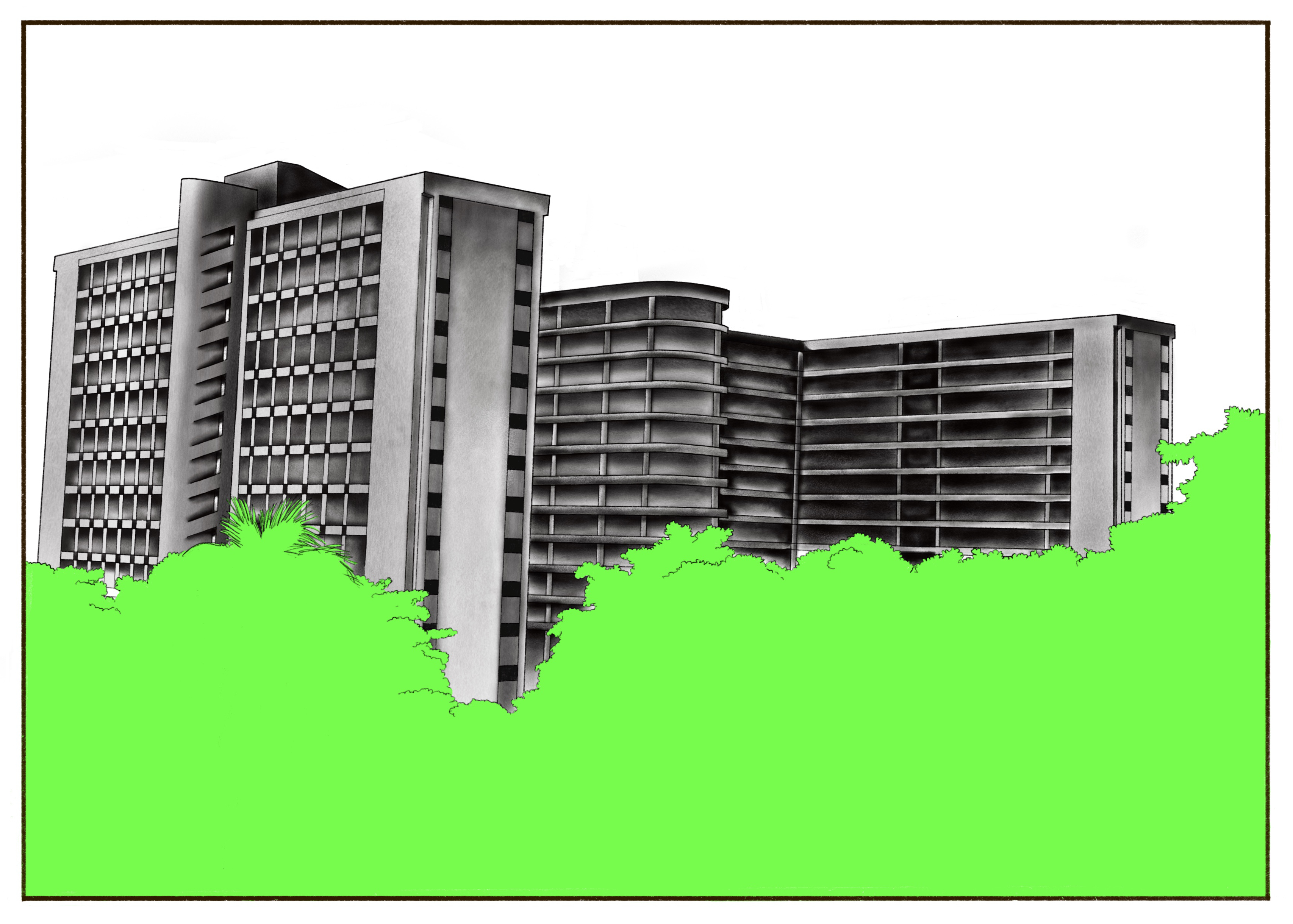
In the heart of Ikoyi, Lagos, a fifteen-story concrete ghost haunts the skyline. The Old Federal Secretariat was once a nerve center of Nigerian power, functioning as the heart of Nigeria’s civil service. Since the federal capital was moved to Abuja in 1991, this complex has been left to rot. In a city defined by fervent construction and the relentless pursuit of newness, its stillness, frozen in time, is a provocation.

Illustration of the abandoned Ikoyi Federal Secretariat in Lagos, a modernist high-rise complex rising above a dense foreground of bright green tree canopies.
The abandoned Ikoyi Federal Secretariat.

Nigeria’s independence in 1960 arrived with serious ambition. Gifted by the British to mark the young nation’s sovereignty, the 25-story Independence Building served as the Republic’s first federal secretariat, anchoring the administrative machinery of the new state. As the civil service swelled during the oil boom years, the government erected the Ikoyi Secretariat in 1976. This new structure was designed to monumentalize the nation’s soaring aspirations—an architectural declaration that a young republic had outgrown its colonial infancy and entered a new era of industrial sophistication.

The Independence Building was eventually appropriated by the military and renamed Defence House. Today, it stands as a shadow of its former glory. Following a devastating fire in 1993, the military command abandoned the charred remains, relocating to the new capital of Abuja. Left behind in Lagos, the old tower’s narrow apertures now watch over the public square below like hollow eyes, stripped of its utility and its national significance.

Down the road, this architecture of abandonment reaches its literal peak at NECOM House. Built as the tallest skyscraper in the country, this telecommunications tower was conceived to be the crown jewel of the Lagos financial district; today, it suffers the same slow rot that plagues the civic landscape. This pattern of neglect repeats across the city center. Lagos is now a museum of deferred promises, littered with monumental structures left underused, suspended in time, or surrendered to decay.

The vacuum left by the government’s silent withdrawal from these sites has inevitably invited squatting and illicit activity. When the state refuses to occupy and maintain its landmarks while failing to provide housing, resources, and safety, it creates the conditions it then criminalizes. What appears as squalor is state neglect made visible. These buildings become shelter for those the state has rendered invisible. In a twist of irony, these administrative monuments have been involuntarily democratized.

While state-owned monoliths sit idle for decades, the government exhibits a violent agility elsewhere, bulldozing lives and properties in informal settlements with little to no prior notice.

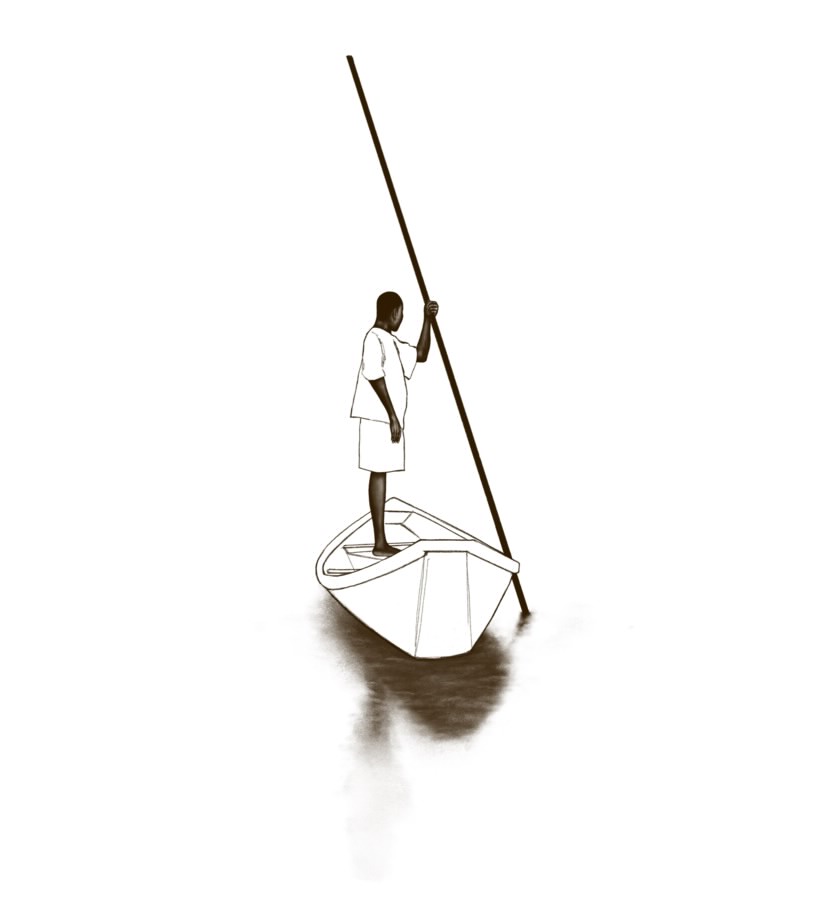
Makoko, a historic community of roughly 100,000 residents, is one of Lagos’s most storied waterfront settlements. Established on the lagoon by the Egun fishing people, it has evolved over generations into a complex urban ecosystem built entirely on stilts. In December 2025, armed demolition teams backed by state authorities entered this settlement under the pretext of enforcing a safety corridor beneath a high-tension power line. Demolitions started two days before Christmas.

Over 3,000 homes, schools, and clinics were bulldozed and burned, displacing about 10,000 people. Protesters and civil society organizations have alleged that the demolitions resulted in deaths, including infants and elderly residents.

Minimalist illustration of a lone figure standing in a small boat, using a long pole to propel it across still water against an otherwise empty white background.
Thousands were displaced just days before Christmas.

The official justification followed a familiar script: environmental concerns, urban renewal, the language of progress. But beneath the bureaucratic vocabulary, what it produced was displacement, lives dissolved into the water. In this context, the long-term abandonment of these spaces reads as an intentional pattern of uneven urgency. The government grants itself unlimited leniency regarding its own monumental dereliction, while displaying a ruthless impatience for the expedient improvisations of the people it has abandoned.

Deracination has shaped Lagos’s socio-economic fabric for generations, and the map of the city can serve as a historical record of state-led displacement. Take Obalende, whose name translates to “the [British] king chased us here”—an etymology the historian K. Dike traced, in a 1997 Guardian essay, to the colonial army’s expansion into the area. Today, it is a bustling hub bordering Lagos Island, but its origins trace back to the colonial era, when the British crown displaced the local population in favor of expanding an army base. This is a foundational precedent of spatial injustice that outlived the empire. Instead of dismantling this colonial architecture of exclusion, the modern Nigerian state has embraced and optimized it, expressing its sovereign authority through the violence of forcible land clearance rather than the duty of housing its most vulnerable communities.

The message to the average Lagosian is clear: Space is scarce when it belongs to the poor, expendable when it belongs to the state, and available to those with enough clout to bend the city to their will. When there is corporate capital to secure or elite enclaves to engineer, the state magically rediscovers its capacity for urban planning. Ultimately, the rotting high-rises of the Marina and the demolished stilt-houses of Makoko are symptoms of the same institutional disease. They represent a state that has fundamentally abdicated its social contract, leaving behind a city that is simultaneously starved for public life and choked by avarice.

For those tasked with shaping the built environment, this landscape of sovereign rot poses a sharp ethical challenge. We are trained to obsess over the new, chasing the next “smart city.” But what does it mean to design for the future in a city where the most basic act of care—maintenance—has been undervalued by those meant to uphold it the most?

To answer this is to confront a notoriously wicked problem, an entangled crisis in which the professional domains of the architect, the policymaker, and the developer are all implicated. In Braiding Sweetgrass, Robin Wall Kimmerer notes a sobering truth: “As the land becomes impoverished, so too does the scope of [our] vision.” Lagos, and indeed much of Nigeria, suffers acutely from this exact starvation of perspective. On paper, the mechanics of urban revitalization are not rocket science. However, the unchecked greed permitted to fester across the country has corroded the foundations of every civic institution and shriveled the imagination of our city-makers.

When presented with decades of water-adapted vernacular literacy in Makoko, or the complex maritime history of Tarkwa Bay, the developer’s only legible response is demolition—flattening centuries of ecological resilience to install a yacht club or a generic “luxury” tower. This impoverished vision can only copy; it cannot synthesize. It views indigenous knowledge as a blight to be cleared and abandoned structures as dead weight, all while funding exclusive archipelagos reclaimed from the sea. Eko Atlantic stands as the ultimate expression of this hubris: a private enclave engineered for the few, rising from the ocean while the waterfront communities of the many are erased to make room for the supply chain of exclusivity.

By chasing the illusion of the “blank slate,” the architect becomes the aesthetic enforcement arm of this system, providing the glossy renders that legitimize spatial violence long before the bulldozers arrive. The policymaker completes the triangle. It is the state that issues the demolition orders, absorbs the legal challenges, and quietly steps aside for the developer. The FBT Coral Estate agreement, in which the Lagos State Government negotiated a 25 percent stake in the “luxury” development designed to replace Makoko, exemplifies this arrangement explicitly. Everything is transactional.

By trading the social contract for a real estate ledger, the state has rendered its own history meaningless and its people invisible. Lagos continues to rise, but it rises against itself.

The abandoned Secretariat and the state-sanctioned displacement are evidence of a system functioning exactly as those who benefit from it intend. “Smart city” rhetoric and urban renewal frameworks create the assumption of a state that has lost its way, merely requiring the right policy intervention to find its footing again. But a government that can mobilize armed demolition teams against impoverished communities two days before Christmas, while its own civic infrastructure crumbles unremarked across the city, has not lost its way. It has chosen one.


This article was originally published by Africa is a Country; please consider supporting the original publication, and read the original version at the link above.l

Ninu Sonuga is a London-based designer and writer from Lagos, currently part of the New Architecture Writers cohort 8, sponsored by the Architecture Foundation and the Architectural Review.

Tuesday, August 04, 2026

The Most Shocking Climate News of 2026


 August 4, 2026

Image by Casey Horner.

The UK Green Party’s former leader Caroline Lucas recently nailed the Labor Party for “burying the most explosive report” of the year by UK military and intelligence sources. The concealed report warns “that the global collapse of ecosystems poses grave threats to the UK’s security and food supply within as little as five years.” (Source: As Europe Burns, a Climate Cover-Up Continues, The Nation, July 30, 2026)

“The UK ‘has no future’ if it cannot ‘restore the natural world on which we rely for our food, water, and clean air,’ said Chris Hinchliff, who is among the members of Parliament pressing the government to release the full report, rather than a shorter, redacted version. Even that version, which was obtained by The Guardian’s Fiona Harvey, ‘paints a devastating picture of severe food shortages, price rises, migration, political destabilization, and possible war, resulting from the collapse of ecosystems, fueled by the human-induced climate crisis and over-exploitation,” Ibid.

Global collapse of ecosystems, if realized, if in fact it truly happens within five years, is certain to create havoc throughout the world, but no governments, other than this leak of a high-ranking report, has suggested to the public the risks of collapse of ecosystems leading to food shortages with panic and fighting. Why not?

After all, it was only a few months ago that an esteemed panel of UK scientists held a public forum, i.e., UK National Emergency Briefing d/d November 27, 2025, that essentially spelled out the same problem with powerful evidence of near-term collapse of some ecosystems. Why don’t the nations of the world confront the causes and inform the public as soon as possible? In five years, it’ll be too late to inform anybody. The only way to get the public onside to help fight this scourge is to explain the issue to the public and requests they embrace efforts to mitigate.

Spain’s PM recently declared a “climate emergency,” with scorching fires consuming much of the countryside for the second year in a row. PM Pedro Sanchez called on political parties “across the ideological spectrum ‘to reach an agreement, a State pact, (and) to address the climate emergency,” Ibid.

Throughout the EU extreme heat is sucking soils dry and destroying agricultural crops. In America, nearly 50% of the Lower States are in some level of drought. The Rocky Mountain “water towers for the Southwest” experienced dreadfully scattered snowfall and the entire Colorado River Complex that feeds water to 40 million people is broken, Lakes Mead and Powell, the two largest reservoirs in the United States, are at dangerously low levels. The emergency recognized by PM Sanchez is “everywhere as an emergency.” Spain is not alone.

But governments throughout the world are too timid to be effective and thus seduce their constituencies by greenwashing or ignoring reality often in concert with media. They can’t face the truth because they don’t have any good answers or they’re paid off to ignore the truth, to hide it from the public. Sadly, politics are for sale to the highest bidders that could care less about public welfare. If they truly cared, problems like this would already be addressed.

Which is good reason for people to rise up against incompetent leaders. The world is infested with them. For example, “Aides to former Labour prime minister Keir Starmer twice quashed plans to release the UK report… allegedly for fear that the climate-denying Reform UK Party would attack Labour for putting climate concerns ahead of the cost of living,” Ibid. How bloody stupid is that?

“Climate denial persists in the UK media as well: Even as wildfires scorched Europe, the front page of the Rupert Murdoch–owned The Times of London featured a rant against the net-zero emissions goal that scientists say is essential to preserving a livable planet,” Ibid. Oh please, this is beyond stupidity. It’s something worse than stupidity.

This kind of behavi0r by weak-kneed leaders is sickening. It’s insulting to the public. It’s a crime against humanity to fail to tell the truth accompanied by outrageously blatant failure to search for answers, mitigation measures, exploring whatever can be done to protect citizens but alas, at the end of the day, failing to protect them.

This failure of leadership in the world started in earnest for all to see when 195 nations agreed at Paris 2015 that CO2 emissions from burning fossil fuels, oil, gas, and coal cause global warming, and they all agreed to cut these harmful emissions. Today, less than a handful of those original 195 nations will even come close to meeting their obligations. They have failed. The public deserves to know the truth about their failure, and why it unintentionally but ridiculously promotes excessive global heat throughout the planet today.

It’s even worse than that, according to The Nation, most news outlets across Europe are not reporting the “influence of climate change driving the massive fires.” But they are providing images of people having fun on the beach with massive fires raging in the distant background. Oh please!

The Most Shocking Aspect: The Public Knows

“Covering Climate Now’s 89 Percent Project spotlights the reality that 80 to 89 percent of the world’s people want their governments to take stronger climate action. In this summer of smoke and fire, the public is waiting for their politicians and their press to respond. ‘Voters are much more tuned into this than most of our [elected] representatives are,’ author George Monbiot said on the UK’s Channel 4. ‘And indeed than most of the media is,” Ibid.

That’s 80-89% of the world’s people want their governments to take stronger climate action. But ever since WWII, the United States has been the world leader in many respects, especially militarily. It is the only country with military in 80 countries with 750 individual bases. No nation is in such a favorable position to assist the world in fighting battles. Yet, the U.S. is promoting fossil fuels that assist excessive heat whilst ignoring fierce battles against climate-induced wildfires throughout the world. Hmm.

Robert Hunziker lives in Los Angeles and can be reached at rlhunziker@gmail.com.