On Slow Violence in Cuba
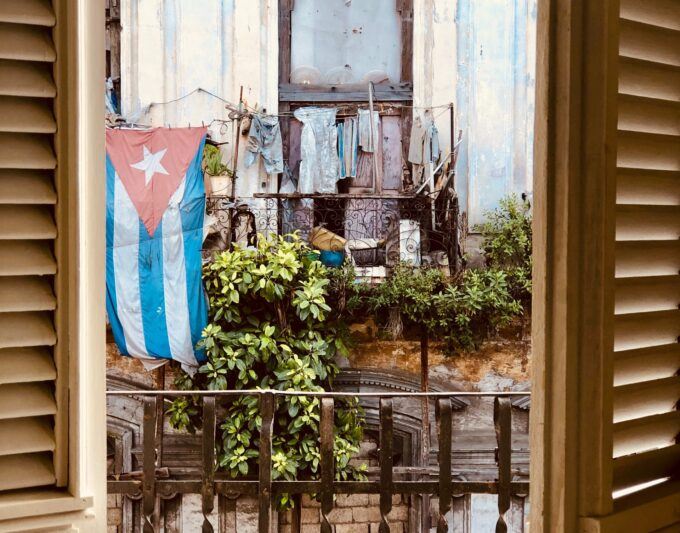
Photograph Source: Jason Gamble – Unsplash
The rooftop of Azotea de la India in Centro Habana offers respite. At this elevation, just peaking over the rival buildings, the sea breeze races across the island struggling to combat the heat that blankets the streets below. This place is a Cuban archive, an unmatched collection of vinyl records from a bygone era of cultural production, curated alongside a Cuban cocktail class. Dayle and Pancho are a Cuban-Italian couple skilled as artists, craftspeople and historians. When they are not hosting listening sessions, this space is a haven for artists and other creatives that resist succumbing to the despair of the country below. Instead, they have created a space for joy to exist and propagate, to cultivate community, to take care of their neighbors and to embody the resilience of the Cuban identity. A 1960’s Irakere jazz record ricochets off neighboring walls and spills down the unseen alleyways below. Everything in this space is recycled and re-purposed by hand. The bar, the DJ booth, the dining table and the generator articulate more than a gritty DIY event space – this is a passion project of preservation that simply could not be accomplished without care and love for Cuba.
In many ways, a short research-focused trip to Havana in mid-May of 2026 is wildly incapable of capturing Cuba in its entirety; certainly not the amplified precarity of our contemporary moment. My profession and political proximity to violence, however, lends itself well to discuss the unique cadence of war that Cuba is embattled in. In contrast to the pure carnage the world has witnessed in Gaza, in Sudan, in Ukraine, in Kashmir and in the DR, Americans are co-authoring a slow violence that violates the international human rights of the Cuban people (Nixon 2013). This slow violence is responsible for crimes against humanity and for violating multiple United Nations Charters for Human Rights. I will not make broad sweeping generalizations about the Cuban government here, though it should be of note that the Cuban citizens who held space for me will not excuse their government’s role in their decades-long suffering. This, however, is a key feature of this silent military strategy. In economic warfare, sanctions and embargoes are offensive volleys aimed at starving out international commerce, stagnating value, production, prosperity and daily life for citizens in the public sector.
These are not poorly calculated decisions but rather precise attacks on communist rule. Communism, or rather the goal thereof is, “the creation of a state where every person can contribute according to their ability, and in return receive what is necessary to live equally with everyone else, Furthermore, “the government of persons is replaced by the administration of things, and by the conduct of processes of production. The state is not ‘abolished’. It withers away,” (Engels 1932). Since communism is seen as a direct threat to the global dominance of US empire and capitalism, coercing a government into paralysis and shaming it publicly as a failed state requiring intervention are important components of a much larger campaign of manufactured ruin. US Secretary of State Marco Rubio has peddled this propaganda and seemingly awaits ascendance to the Republican party throne, gambling on the fall of Cuba’s regime as his crown achievement as a politician. His Cuban-American heritage serves as a credential to validate his approval of human suffering, all without acknowledging the critical role that American policy has served in crushing any attempts for the communist state to thrive, starting in 1960.
Rubio wants to usher in a new era for Cubans, one that is (allegedly) prosperous for all. But he noticeably ignores advice from revolutionary Ernesto “Che” Guevara who warned in 1960: “the first thing we will have to do is not to go to the people to offer them our wisdom. We must go, rather, to demonstrate that we are going to learn with the people, that together we are going to carry out that great and beautiful common experiment: the construction of a new Cuba,” (On Revolutionary Medicine 1960). Modern day American foreign policy blatantly ignores collaboration with Cuban citizens. Instead, it forges a path forward with its most central insight from land developers and expatriates of the Cuban regime, hawkish to re-make the island fit for their capitalist dreams.
Although Havana lacks the more traditional, physical features of war that we have consented to as Americans, the suffering is equally visceral, an unabashed display of collective punishment. In a socialized economy under duress, struggle is ubiquitous, and these woes are on the minds and tongues of everyone you may encounter. Strains of exhaustion haunt the faces of caregivers who fought for sleep during frequent blackouts during scorching night; bodies ghastly from inadequate food rations. Families sprawl onto the streets in the late afternoon to escape damning heat that suffocates an overcrowded electrical grid and makeshift housing arrangements. At local, state-run bodegas, bread stores and produce markets, supplies are sparse – if available at all – they are low quality and hardly answer the beckoning hunger in the bellies of the elderly and children. Pensions and salaries (sometimes less than the equivalent of $20 US dollars a month) are simply insufficient. During a thorough tour through Old Havana a brilliant sociologist named Yoly told me that these state allowances were not always so dismal. There was a time in the country when agricultural production was abundant and fuel was widely available to transport goods and services across the island. There was a time when guarantees of free education, health care, housing and food were more than empty ambitions for a young nation who dreamt of a future beyond the inherent exploitations of Western capitalism.
Cubans are not unfamiliar with the requirements of revolution: the sacrifice, the risk and the costs of freedom. Unfortunately, a country whose low birthrate and rapidly aging population is at a costly moment in history where these values and identity may very well be forgotten. There is a very stark, generational gap in understanding Cuba’s history. This too, is a direct outcome of decades long unilateral policy of sanctions, embargoes and blockades. After the Special Period of the 1990s, the collapse of the Soviet Union and their subsidies caused the contraction of the Cuban GDP by more than 30% between 1989 and 1993. It also caused a severance of memory within a class of citizens who lack both a historical analysis of material conditions and lived experience under another reality. The only Cuba that young people know is of a government that has been chronically shorthanded, struggling to provide in the public sector. While there was an era of considerable improvement in the private sector under President Obama, the windfalls of this moment were not concretized or advanced into lasting foreign policy. The present reveals a generation who has slowly gained access to other, more individualistic ways of life. Private investment, content filtered through (illegal) VPNs and increased access to public Wi-Fi have offered alternatives to a national identity rooted in communal survival. “The internal blockade” is a common phrase that was repeated to me in various conversations with locals discussing their current living conditions and refers to a lack of transparency, active suppression and censorship efforts perpetuated by the Cuban government. While this may very well be an effort to preserve revolutionary Cuban ideals, it has undoubtedly fomented anger and frustration.
This erosion of trust in governance simultaneously creates a loosening attachment to national pride and identity. An entire class of people now exist who don’t care if foreign invasion or takeover happens because perhaps tomorrow will bring change and hope for the future. Anything is better than the status quo. Slow violence via embargoes and sanctions create political apathy and sows the seeds of discontent without firing weapons or threatening military action. It intentionally destabilizes the government while promoting and enabling human suffering amongst the masses. It pits those with access to foreign investment in the private sector against those without, historically the most vulnerable. It creates new social divisions that feed on inequality and unrest. This is a man-made crisis, full stop. No better crystallization of policy-driven inequity exists than the words written in a memorandum from the Deputy Assistant Secretary of State for Inter-American Affairs in 1960,” …If the above are accepted or cannot be successfully countered, it follows that every possible means should be undertaken promptly to weaken the economic life of Cuba. If such a policy is adopted, it should be the result of a positive decision which would call forth a line of action which, while as adroit and inconspicuous as possible, makes the greatest inroads in denying money and supplies to Cuba, to decrease monetary and real wages, to bring about hunger, desperation and overthrow of government,” (Mallory Memorandum 1960).
Cuba is a country who has long provided the highest level of medical education and gifted this knowledge back to the world’s most underserved and is now without the capacity to save lives within its own borders. Cuban patients are suffering at an accelerated rate without power for ventilators, in intensive care units, without adequate medical interventions. This is further exacerbated by deferred procedures, sub-optimal antibiotic provisions and an inability to transport sick patients to facilities across the island. Human decisions have decided that this level of suffering is not only acceptable, but gainful for scavenging capitalists looking to prop up their ventures without the regulations and tax code of their homelands. Every day that the United States unilaterally allows these conditions to persist, every day that these sanctions force the termination of business relationships, including global, with punitive legal restrictions, Cuban people die. The US government is in an ideological war of ideas, using this to justify avoidable casualties without claiming them as victims of war.
“People speak sometimes about the ‘bestial’ cruelty of man, but that is terribly unjust and offensive to beasts. No animal could ever be so cruel as man, so artfully, artistically cruel.” – Fyodor Dostoevsky, Crime & Punishment 2006
On the night of May 13th, 2026 I descended the steps of Azotea de la India filled with a sense of hope of what resilience is, and reminders of what place joy has in liberation. On the street, I am met with a contradicting reality. Without the generator-powered luxuries of the rooftop, Havana is enduring yet another hours-long blackout. The urban density is all but invisible in the darkness and yet, life persists. The absence of power creates a kind of deafening silence only punctuated by battery powered radios, speakers, and flashlights. In the darkness, children stay up past conventional bedtimes, playing in the streets, laughing through disaster, at last avoiding the stagnant heat that builds mercilessly in the absence of airflow. I navigate the silence, about thirty minutes walking distance from my hostel, buoyed by their resilience. The stars are on full display, typically a view observed only from the countryside. Roads are nearly absent of vehicles, save for the few electric transports, bikes and horse drawn carriages. It’s hard to put into words how jarring this experience is. In some contexts, this kind of suffering might incite panic, interpersonal and community violence, or uprising. Instead, the Cuban people have not faltered.
Perhaps we can learn from this, if we are careful and intentional in our dreams of collective liberation. It is one thing to name injustice from my privileged position in the United States. It is another bear witness to the suffering our political institutions have caused. From a country that glorifies individual achievement, the rest of the world remains on fire around us, at our expense.
“Isolated individual endeavor, for all its purity of ideals, is of no use, and the desire to sacrifice an entire lifetime to the noblest of ideals serves no purpose if one works alone, solitarily, in some corner of America, fighting against adverse governments and social conditions which prevent progress.” Ernesto “Che” Guevara, On Revolutionary Medicine 1960.
Despite an onslaught of mandates aimed at destroying the political will of the people and creating opportunity to revolt and uproot the communist regime, Cubans wait in perpetuity. Wait for change that may yet come, wait for relief that is barred from its shores, wait for a dignified response to the slow violence that all but erases hope for the future. And still, Cuba has demonstrated that continued survival may be the most powerful iteration of defense and liberation on display. Long. Live. Cuba.
References:
Collective Punishment | The Practical Guide to Humanitarian Law. (2026, May 10). Guide-Humanitarian-Law.Org. https://guide-humanitarian-law.org/collective-punishment
Dostoyevsky, F. (2000). Crime and Punishment (R. Pevear & L. Volokhonsky, Trans.). David Campbell Publishers. (Original work published 1866)
Engels, F. (1932). Socialism : utopian and scientific. Allen & Unwin.
Foreign Relations of the United States, 1958–1960, Cuba, Volume VI – Office of the Historian. (n.d.). In history.state.gov. Retrieved July 31, 2026, from https://history.state.gov/historicaldocuments/frus1958-60v06/d499
Irakere. (1985). Bailando Asi. In Spotify. Arieto. https://open.spotify.com/album/24BqqFHNww0T4dwlx5aMYq
Nixon, R. (2011). Slow Violence and the Environmentalism of the Poor. Harvard University Press. https://doi.org/10.2307/j.ctt2jbsgw
On Revolutionary Medicine. (2026). Marxists.Org. https://www.marxists.org/archive/guevara/1960/08/19.htm
Slow violence (concept) | Research Starters | EBSCO Research. (2021). In EBSCO. https://www.ebsco.com/research-starters/environmental-sciences/slow-violence-concept
Studio ATAO | Understanding Socialism in the U.S. (2019). Studio ATAO. https://www.studioatao.org/socialism?gad_source=1&gad_campaignid=14173103193&gclid=Cj0KCQjwjb3SBhDgARIsAMKiWzjqLI-sTxnYgm6VcDZkw5g2YWstAhmHVtqhB05KN9-DzYy5asxIWtUaAploEALw_wcB

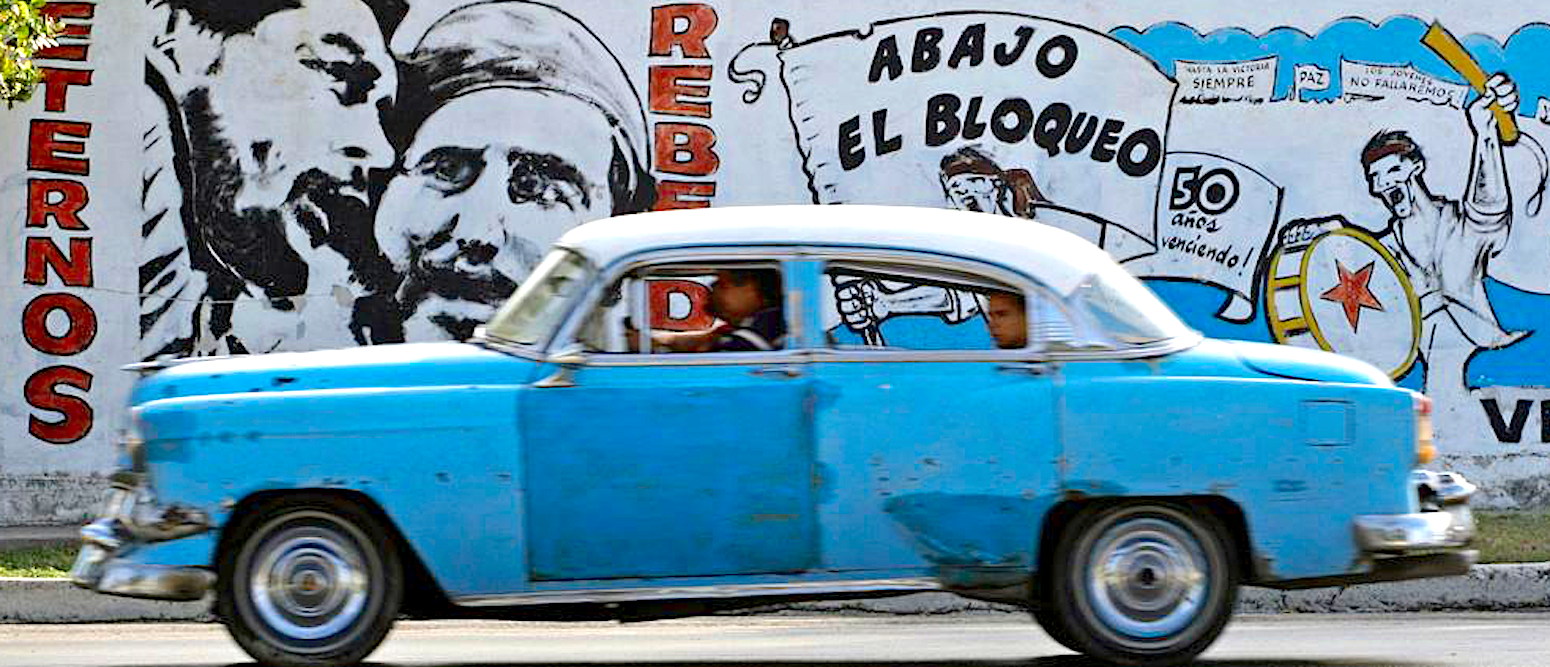
The Trump Administration’s indictment of former Cuban President Raúl Castro, the deployment of the USS Nimitz aircraft carrier and warships, and recent measures pressuring countries not to supply oil to Cuba are all intended to force regime change on the island. These policies are part of the United States’ long-standing campaign against the Cuban government, codified in 1962 with the U.S. embargo on Cuba, and have created what could be described as Cuba’s “New Special Period,” comparable to the original “Special Period” in the 1990s after the loss of support from the Soviet Union. The Cuban revolution against the U.S.-backed Batista dictatorship has survived 64 of its 67 years under what U.S. officials call an “embargo.” Cubans call it “el bloqueo” (the blockade), arguing that its impact has been just as physically isolating as a military blockade. Suffering aside, the amount of money that the United States has spent on enforcing this policy of economic isolation—the longest blockade in history—could instead have been used to address pressing social needs throughout the United States. This raises the question: Was the blockade worth the cost? And if so, for whom?
According to Doctors Without Borders’ “The Practical Guide to Humanitarian Law,” a blockade is an act of war that seeks to isolate an adversary, disrupt economic activity, and prevent the movement of vital supplies. Under an embargo, a country prohibits its own companies or subsidiaries from engaging in business with another country, rather than interfering with third parties. Through what is essentially a broader economic blockade, the United States has intermittently prevented Cuba from commerce with other nations. As President Donald Trump has become even more strident, the United Nations has criticized his administration’s policy of imposing tariffs on any country that sends oil to Cuba as a serious violation of international law. Earlier this year, a military blockade was evident as “the U.S. Coast Guard intercepted a tanker full of Colombian fuel oil en route to Cuba within 70 miles of the island,” according to the New York Times. The U.S. government knows that a blockade is an act of war, according to Connecticut Congressperson Joe Courtney, who said in a recent press release, “The international law, actually, in terms of blockades, was established in 1909 at the London Naval Conference, which the U.S. participated in and the U.S. Senate actually voted to endorse, and it defined blockades as an act of war.”
That is why, until now, U.S. administrations have been so adamant about calling such sanctions an “embargo.” Understanding how this economic campaign against Cuba began, along with its impacts on Cuba and beyond, will help us better understand the current situation between the United States and Cuba.
The Origins of the “Embargo”
The original justification for the embargo in the early 1960s was Cuba’s expropriation of “some $1.8 billion worth of U.S.-owned property,” according to the U.S. Foreign Claims Settlement Commission. In turn, Cubans argue that earlier in the century the United States had seized control of 70% of Cuban land and three-quarters of its primary industry—sugar—which Carollee Bengelsdorf, in The Problem of Democracy in Cuba, describes as the “virtual ‘confiscation’ of [Cuba’s] economy by the United States.” By the 1950s, as a result of U.S. wealth-extraction and the legacy of Spanish colonial rule, five out of six Cubans lived in shacks or were homeless, 80% of Havana’s residents suffered from hunger and unemployment, and two-thirds of Cuban children didn’t attend school. Cuban census data for those years reveal that only 3% of rural Cubans had habitable housing, only 10% enjoyed running water or electricity, and more than half of the Cuban population lived in housing that lacked cement walls or floors. Cubans say such conditions left them no recourse in 1959 but to expel the “Yanquis” and reclaim their own territories and businesses, just as the Yankees had expelled the British in 1776. The result was an exodus of around a quarter of a million of mostly wealthy Batista loyalists, now the anti-Castro Cuban-American lobby.
If we are to hold Cuba accountable for roughly $4.5 billion in U.S. claims stemming from the 5,911 cases certified by the U.S. Foreign Claims Settlement Commission against the Cuban government for the expropriations it carried out primarily from 1960–1961, one can hardly comprehend what the United States would owe to British Loyalists and the Crown after 250 years.
Pressured by the Cuban-American lobby, this parallel has escaped both Republican and Democratic U.S. administrations. To exact revenge, in 1962 President John F. Kennedy invoked the Trading with the Enemy Act of 1917, the legal basis for the trade embargo, which allowed the United States to freeze Cuban assets and prohibit financial transactions. Then, in 1966, the Helms-Burton Act tightened the economic blockade by punishing foreign companies doing business in Cuba. In 1992, worsening the impact of the Soviet collapse, President George H. W. Bush signed the Torricelli Act, banning foreign U.S. subsidiaries from trading with Cuba.
From 2017 to 2021, invoking dormant portions of the Helms-Burton Act, Trump relisted Cuba as a state sponsor of terrorism, restricted travel and remittances, and encouraged lawsuits against companies “trafficking” or engaging in business with property nationalized by the 1959 Cuban Revolution. This paved the way for the 2026 Supreme Court ruling allowing the U.S.-based Havana Docks Corporation to sue four cruise lines for docking in Havana ports that were nationalized by the Cuban government before 1960.
Trump’s attacks on Cuba have more recently come to mirror his broader “maximum pressure” strategy, which combines severe economic sanctions and international isolation in an effort to topple adversarial governments in Latin America and the Middle East, particularly targeting Iran, Cuba, and Venezuela.
Trump’s January 29, 2026, Executive Order expanded his maximum pressure campaign by imposing tariffs on countries sending fuel to Cuba, and his May 1, 2026, Executive Order authorized the United States to seize assets belonging to foreign individuals found to be “trafficking” in blacklisted or nationalized properties.
The Costs to the United States of Maximum Pressure
Most countries have consistently supported U.N. resolutions opposing U.S. actions against Cuba. U.N. experts call the blockade an “extreme form of unilateral economic coercion” that violates international law. They say it obstructs the “Cuban people’s right to development while undermining their rights to food, education, health, and water and sanitation.” For 34 consecutive years, since 1992, the U.N. General Assembly has overwhelmingly passed resolutions demanding an end to the U.S. economic blockade of Cuba, citing the violation of international law. Annual votes consistently see over 180 countries opposing the U.S. stance, with only the United States and Israel typically voting against.
The U.S. public has been skeptical of the blockade for decades. A 2016 Pew Research Center poll revealed that 73% of Americans favored ending the blockade. More recently, a February 25, 2026 poll by YouGov shows that not even a third of people in the United States approve of the blockade, and only 13% support attacking Cuba. Just 5% of Americans view Cuba as a serious threat. To put this in perspective, 4% of Americans view Canada as a threat, too. A 2024 Data for Progress poll shows that only roughly a quarter of Americans oppose lifting travel restrictions to the island.
These percentages might be higher were the public aware that the blockade is costing us more than Cuba. The Cuba Policy Foundation estimates that the United States is losing up to $4.84 billion annually in sales and exports. “If the embargo were lifted, the average American farmer would feel a difference in his or her life within two to three years,” the study’s author wrote. At $4.84 billion a year, over the lifespan of 64 years, the United States has missed out on $310 billion—nearly enough to provide a home for every unhoused person in the country. (According to the U.S. Department of Housing and Urban Development (HUD), the number of people experiencing homelessness in 2024 peaked at 771,480 people. This is about $402,000 per unhoused individual, just shy of the Median Home Listing Price of $425,000.) While this won’t fix the structural causes of homelessness, it would represent a transformative solution. The housing comparison is just one way of understanding the scale of that figure. A total of $310 billion could also put $1,890 in the pocket of each of the nation’s 164 million taxpayers.
In turn, as Helen Yaffe notes in a Jacobin article from earlier this year, “In 2025, Cuba’s annual report to the United Nations put the cumulative cost of the U.S. blockade at over $170 billion. Costs are rising year after year, reaching $7.6 billion from March 2024 to February 2025 alone.” This would put the cost for Cuba to date at about $178 billion, a little over half of the $310 billion the United States has spent so far.
The blockade has also deprived the U.S. public of Cuba’s medical breakthroughs. In 2008 Cuba released Cimavax, the first lung cancer vaccine which extended life in lung cancer patients while also easing breathing and restoring appetite. In 2022, Cuba released NeuroEPO, which reverses cognitive decline in patients with Alzheimer’s. U.S. consumers have also been denied access to the world’s first meningitis B vaccine; Cuba’s potent Covid vaccines; Heberprot-P, a treatment for severe diabetic foot wounds that also significantly reduces the risk of lower-limb amputations; technologies for hearing impairment; treatments for retinitis pigmentosa (a group of rare eye diseases that affect the retina); and PPG, a popular cholesterol-reducing drug with the side effect of increased sexual potency.
Until maximum pressure, the socialist island managed to provide all its inhabitants with what the most affluent country in the world could not: free top-notch health care, free university and graduate school education, subsidized food and utilities, and overall, very low violent crime and gun ownership rates.
In the United States, as of 2024, nearly 14% or 47.9 million people were food insecure and 26.7 million lacked health care coverage, according to sources including the U.S. Census Bureau. In contrast, prior to 2018, Cuba’s food insecurity hovered around 2.5%, according to the USDA’s Economic Research Service. After the pandemic and Trump’s maximum pressure campaign, by 2023, the USDA Economic Research Service estimated that nearly 12.8% of Cuba’s population were food insecure. Today, as a result of Trump’s accelerated campaign against Cuba, independent groups like the Cuban Observatory for Human Rights have reported that up to 78% of Cubans are skipping meals.
A recent report by the Center for Economic and Policy Research based on World Bank data also found that the strengthening of U.S. sanctions against Cuba beginning in 2017 were likely the main cause of a huge spike in Cuba’s infant mortality rates. For decades Cuba had a lower infant mortality rate (four per 1,000 live births) than the United States (six per 1,000 live births). Since 2018, however, the report found the rate has increased, reaching 9.9 in 2025, resulting in a total of 1,800 infant deaths over a seven-year period.
While Cuba may have universal health care, with fuel reserves depleted, hospitals lack electricity for incubators and operations, and pharmacies lack medicine. Nonetheless, Cuba still compares favorably to the United States in other areas:
Housing: There are virtually no unhoused people in Cuba. The 1960 Urban Reform Law turned renters into homeowners so 85% of Cubans own their own homes and pay no property taxes or interest on their payments. After 1985, payments toward buying a home couldn’t exceed 10% of the combined household income. U.S. mortgages often exceed 38% of salaries.
Literacy: The adult literacy rate in Cuba (99.8%) is higher than the United States’ rate (97%), per the United Nations Development Programme (UNDP).
Employment: Cuba’s unemployment rate is only 1.8% according to CIA data, compared with 4.3% in the United States.
Harms to Cubans
While the United States’ $310 billion price tag is higher, Cuba has obviously suffered a far greater blow relative to its size and resources.
Many unnamed Cuban and U.S. sources for this article mentioned a variety of hardships—the garbage piles attracting pests (one mentioned seeing a person sifting through them for food), the 20–22-hour blackouts halting water pumps, people skipping showers and meals. Ellen Rosenzweig, who lived in Cuba for 20 years and was married to a musician in the legendary Cuban band Los Van Van, noted, “So if your electricity is on at 3 a.m., you have to be up then to fill bathtubs and cook for the day.” One result of Trump’s maximum pressure campaign has been a massive exodus from Cuba of 10% of its population, mostly young professional economic refugees, with emigration continuing to rise.
Before Trump’s first presidential term, Cuban ingenuity was able to outsmart el bloqueo. The country withstood the previous oil crisis during the 1990s post-Soviet Special Period, the loss of its tourist industry during the pandemic, and the need to improvise replacement parts for aging U.S.-made transportation systems and electric grids. Yet each of these crises further exposed Cuba’s Achilles’ heel, one that Secretary of State Marco Rubio was more than happy to attack.
“All of the pieces aligned to make this obsessive desire to finally take over Cuba seem possible,” observes Medea Benjamin, author and co-founder of the anti-war organization Code Pink, in a telephone interview. In a recent article on Common Dreams responding to Castro’s indictment over the deaths of four Brothers to the Rescue operatives who were killed in 1996 when their plane was shot down over Cuba, Benjamin describes how anti-Cuban extremist groups have killed over 74 Cuban civilians and how Brothers to the Rescue specifically received warnings for “25 serious and systematic violations of Cuban airspace” prior to the downing of the plane. (Brothers to the Rescue was a Miami-based Cuban exile organization that began as a search-and-rescue group for Cuban migrants but became politically controversial due to anti-Castro activities and flights near Cuban airspace.)
“That same anti-communism has been around for decades and Miami Cubans like Marco Rubio feel they can finally accomplish their dream. This bold-faced support for the modern-day Monroe Doctrine—the ‘Donroe Doctrine’—is coming directly from Rubio,” she explains. The term is a play on Donald Trump’s name and the 1823 policy established by President James Monroe that has evolved to justify military interventions in Latin America.
Rubio is a primary driver of the Trump administration’s maximum pressure campaigns. He is supported by influential anti-Castro Cuban-American political networks, including the Cuban-American lobby, the Fanjul family (a prominent Cuban-American family known for building a multi-billion-dollar sugar and real estate empire), and the late Las Vegas Sands owner Sheldon Adelson, a conservative donor whose primary cause was maintaining U.S. support for Israel.
Given our own economic woes here in the United States, a growing chorus of voices is calling for an end to this costly, immoral vendetta. After meeting with Cuban President Miguel Díaz-Canel and Foreign Minister Bruno Rodríguez Parrilla this spring, House Representatives Pramila Jayapal and Jonathan Jackson released a statement. “This is cruel collective punishment—effectively an economic bombing of the infrastructure of the country—that has produced permanent damage. It must stop immediately,” they wrote.
Earlier this year, House Representative James McGovern introduced H.R. 7521, the United States-Cuba Trade Act of 2026, which would lift the blockade entirely. Unfortunately, the legislation has not yet been scheduled for a vote.
“That’s a failed blockade because it hasn’t worked in 64 years,” says Zoila Benitez, the retired head of a Cuban news department. “The oil sanctions have created a humanitarian crisis and nobody should have to go through that.” Benitez emigrated to the United States in 2021 after an accident in an unlit stairwell and the sudden unavailability of medical joint replacements due to Trump’s sanctions. She misses loved ones and her beautiful apartment with marble floors that she helped build. Like many Cuban émigrés she believes Cuba needs change—including, possibly, more political parties—but rejects U.S. involvement.
Seventy-five percent of Cuban-Americans in South Florida—mostly Rubio’s and Trump’s base—also say that the blockade has not worked, a recent poll by the Cuban Research Institute found.
Florida Uber driver Ryan Stone told me, “I’m 100% for America staying in its lane instead of wasting our money. I think we should vote on it each year and it should be democratic.”
Jean, a former Colombian who is in Florida on asylum, lost his commercial trucking license thanks to an executive order Trump issued in March. “Es una tonteria—It’s a joke,” he said about the blockade dismissively. On the other hand, when I asked hotel hostess Yanet about whether or not she supported a U.S. invasion, she said in Spanish, “Invasion? I call it an intervention.”
While lifting the blockade would boost Cubans’ living standard and lay bare the Cuban government’s true mistakes, Cuba’s economy would still be saddled with its colonial legacy as a producer first of sugar and later of tourism. Unequal trade terms historically maintain formerly colonized countries as purveyors of raw materials and services, subsidizing the high standard of living in industrialized countries. It is useful to remember this uneven playing field whenever making comparisons with Cuba.
The Cuban president implied that copycat Iran assassinations and Venezuela kidnappings won’t work in Cuba, nor would an occupation. “The fact is that we have a collective leadership …there are hundreds of people who are capable of assuming that responsibility and making decisions collectively,” Díaz-Canel explained on NBC, “…a doctrine known as the War of the Entire People … every Cuban woman and every Cuban man has a mission, a purpose, a goal to defend, a place and a position to occupy in the defense.”
Cuba’s Future
Despite the hardships, more than half of the Cuban population (5.2 million out of 9.7 million) came out to celebrate the legacy of the Cuban Revolution and International Workers’ Day on May 1. Later that month, 6,230,973 people—or 80% of the country’s population over age 16—signed a petition denouncing the energy blockade and committing to defend Cuba’s sovereignty.
Recently, Mexico, China, and Russia pledged to continue trading with Cuba. The BBC reports that “the Chinese foreign ministry called on the United States to stop using ‘coercion’ and ‘threats’ against its ally, while the Kremlin said the pressure being exerted on Havana ‘borders on violence.’” China has been working with Cuba to build up its solar infrastructure. This does not look like a war that Trump and Rubio will win quickly.
Prior to 1959 Cuba was dominated by casinos, prostitution, and organized crime. Judging from his former investments, political maneuverings, and close friendships, one could assume Trump has a soft spot for casinos, ballrooms, and islands. Will the exorbitant cost of the blockade be worth returning to the same unequal status quo Cuba had under Bastita, but under the Trump brand instead?
Prior to Trump’s maximum pressure campaign, the fact that a poor, formerly colonized country could meet its citizens’ basic needs, while outperforming the United States on key measures, underscored how inexpensively the United States could follow suit. And herein may lie the real motivation of the blockade, and its most significant cost: it keeps people from making such comparisons first-hand. In other words, why is the U.S. government willing to spend $310 billion, plus the incalculable cost of a potential invasion, just to keep the U.S. public from making its own comparisons?
Margot Pepper’s memoir about her year based in Cuba during the Special Period, Through the Wall: A Year in Havana, was nominated for the 2006 American Book Award. Her work has appeared in Dollars & Sense, Common Dreams, the Utne Reader, Monthly Review, Z-net, Counterpunch, City Lights, and elsewhere and can be found at margotpepper.com.
Sources: Medea Benjamin, “The Indictment of Raul Catro: A New Low in Cuba Policy,” Common Dreams, May 21, 2026 (commondreams.org); Kim Hjelmgaard, “Trump ramps up Cuba pressure as Nimitz carrier enters Caribbean Sea,” USA Today, May 21, 2026 (usatoday.com); Françoise Bouchet-Saulnier, “The Practical Guide to Humanitarian Law,” Medecins Sans Frontieres/Doctors Without Borders, 1998 (guide-humanitarian-law.org); David Mericle, Jacob Kitzman, Wong Gim Teck, and Shu Jian, “Embargo or Blockade?” The Cuban Experience,1998; Jack Nicas and Christiaan Triebert, “A New U.S. Blockade Is Strangling Cuba,” New York Times, February 20, 2026 (nytimes.com); Joe Courtney Press Release, “Of Course A Blockade is an Act of War,” May 19, 2026 (courtney.house.gov); Eduardo Galeano, Open Veins of Latin America (Monthly Review Press, 1971); Carollee Bengelsdorf, The Problem of Democracy in Cuba (Oxford University Press, 1994); Eduardo Humberto del Río García, Cuba para principiantes/ Cuba for Beginners (Editorial Grijalbo S.A., 1983); José Luis Rodríguez and George Carriazo Moreno, Eradication of Poverty in Cuba/ Erradicación de la Pobreza en Cuba (Editorial De Ciencias Sociales,1987); Tom Phillips, “Cuba Has Run Out Of Diesel And Fuel Oil, Energy Minister Says, As Us Blockade Pushes Island To Brink,” The Guardian, May 13, 2026 (theguardian.com); Vibhu Mishra “General Assembly renews long-standing call for end to US embargo against Cuba,” UN News, October 30, 2024 (news.un.org); United Nations General Assembly, “Necessity of ending the economic, commercial and financial embargo imposed by the United States of America against Cuba,” October 11, 2023 (docs.un.org); Michelle Nichols, “Us Fails To Make Big Dent In Un Vote Calling For End To Cuba Embargo,” Reuters, October 29, 2025 (reuters.com); The Editors of ProCon. “Cuba Embargo,” Encyclopedia Britannica, February 10, 2026 (britannica.com); Steven Goldstein, “America’s Farmers Bearing Heavy Burden for U.S. Embargo Against Cuba: New Report,” AfroCubaWeb, January 28, 2002 (afrocubaweb.com); Anna Diamond, “Why We Don’t Know How Many People Are Homeless,” New York Times, February 18, 2026 (nytimes.com); Macrotrends, “U.S. Median Home Listing Price (2016-2026)” (macrotrends.net); Zillow, “Housing Data” (zillow.com/research/data); Helen Yaffe, “Defend Cuba From US Efforts to Crush It,” Jacobin, March 13, 2026 (jacobin.com); Bureau of Diplomatic Security, “Cuba 2012 Crime and Safety Report,” U.S. Department of State, March 21, 2012 (state.gov); Steven Zahniser, Lila Cardell, Yacob Abrehe Zereyesus, and Constanza Valdes, “Cuba’s deteriorating food security and its implications for US agricultural exports,” U.S. Department of Agriculture, Economic Research Service, October 2024 (usda.gov); Nicholas Kristof, “Why Infants May Be More Likely to Die in American Than Cuba, New York Times, January 18, 2019 (nytimes.com); Ed Augustin and Jack Nicas, “Cuban Patients Are Dying Because of US Blockade, Doctors Say,” New York Times, March 26, 2026 (nytimes.com); Economist Sinan Koont; Leni Villagomez Reeves, “Marco Rubio’s Powerful Secret Backers,” Community Alliance, April 2, 2025 (fresnoalliance.com); Dan Berman, “Sheldon Adelson-owned Las Vegas Review-Journal endorses Marco Rubio,” CNN, February 5, 2016 (cnn.com); Jonathan Jackson, “Press Release: Jayapal, Jackson Statement on Delegation to Cuba,” April 5, 2026 (jonathanjackson.house.gov); Kristen Welker Interview with Cuban President and First Secretary of the Central Committee of the Communist Party of Cuba Miguel Mario Díaz-Canel Bermúdez, “Surrender is Not Part of the Revolutionaries’ Mindset,” Meet the Press, NBC News, April 9, 2026 (nbc.com); Belly of the Beast, “Cuba’s Population Shrinks by 1.4 Million in Five Years,” May 30, 2025 (bellyofthebeastcuba.com); Frances Robles, “On May Day Cuba’s Communist Leaders Deliver a Defiant Tone to the U.S.,” New York Times, May 1, 2026 (nytimes.com).