It’s possible that I shall make an ass of myself. But in that case one can always get out of it with a little dialectic. I have, of course, so worded my proposition as to be right either way (K.Marx, Letter to F.Engels on the Indian Mutiny)
Thursday, August 13, 2026
LME Aluminum Stockpiles Sink to Lowest Level Since 1990
Norsk Hydro cut output at its Alunorte alumina refinery in Brazil by 50% after a natural gas disruption, pushing aluminum to a seven-week high in London.
LME aluminum inventories have dropped to 250,000 tons, the lowest since November 1990, while Hydro warns the global deficit could top 900,000 tons.
Copper is trading above $14,000 a ton in London as US stockpiling ahead of Trump's expected tariff tightens global supply alongside aluminum.
Norwegian aluminum producer Norsk Hydro's Alunorte plant in Brazil, one of the world's largest alumina refineries, reduced output by 50% following disruptions to natural gas availability.
Bloomberg reports that disruptions to NatGas availability at Alunorte forced a 50% reduction in output and sent aluminum prices in London to a seven-week high. Hydro said production would return to full capacity once gas supplies normalize.
Aluminum rose nearly 2% in London and traded at $3,373 a metric ton. Alumina futures gained 1% in Shanghai.
NatGas is critical to Alunorte because alumina refining requires high-temperature heat and steam. The gas powers the Bayer process, which refines bauxite:
Digestion: Bauxite is mixed with caustic soda and heated under pressure to dissolve the aluminum-bearing minerals.
Evaporation and steam generation: Large boilers provide steam throughout the refinery.
Calcination: Aluminum hydroxide is heated to around 1,832F to remove water and produce smelter-grade alumina.
The disruption means that Alunorte cannot maintain enough steam and furnace heat to operate its production lines, forcing the refinery to reduce throughput. For context, Alunorte is the world's largest single-site alumina refinery and the largest outside China. It is located in Barcarena, Pará, and has an annual capacity of 6.3 million metric tons.
Inventories in London Metal Exchange warehouses have fallen to 250,000 tons, the lowest level since November 1990. Norsk Hydro recently warned that the annual global aluminum deficit could top 900,000 tons if trade through the Strait of Hormuz remained disrupted.
Also in the industrial metals space, copper futures in London are trading above $14,000 per ton as metal inflows into the US continue ahead of President Trump's expected tariff, effectively tightening global supplies.
Surging prices for both industrial metals will only make electrification and decarbonization even more expensive.
"Copper and aluminum are important beneficiaries of electrification and decarbonization," said UniCredit SpA strategist Thomas Strobel. "While copper's investment case is driven by structural supply constraints, aluminum benefits from lightweighting, grid expansion and recycling. Together, they offer complementary exposure to some of the strongest long-term trends in the global economy."
By Zerohedge
FOSSIL FOOL ECOCIDE
Trump Puts 81 Million Gulf Acres Up for Oil and Gas Auction
The Trump administration will put oil and gas leases covering more than 81 million acres in the Gulf of Mexico up for auction on Wednesday, August 12, in the third of 30 Gulf lease sales mandated under President Donald Trump’s 2025 tax and spending law.
Wednesday’s auction is also the second Gulf lease sale since the U.S.-Israeli war with Iran began in February, disrupting Middle East crude supplies and sending oil prices to four-year highs. Brent crude was trading above $89 per barrel on Wednesday.
The Interior Department will offer 15,100 unleased blocks across the U.S. Outer Continental Shelf, located between three and 231 miles offshore in water ranging from nine feet to more than 11,100 feet deep.
Despite the enormous area available, companies are bidding on only a small portion of it. Twelve companies submitted 69 bids covering roughly 330,000 acres, equivalent to about 0.4% of the 81 million acres offered, according to pre-sale documents released Tuesday.
The previous Gulf auction in March generated $46.98 million in high bids for 25 blocks covering roughly 141,000 acres. That was a fraction of the $300.4 million in high bids submitted in the first sale mandated under the 2025 law, held in December.
The Gulf currently accounts for roughly 15% of U.S. oil production, but offshore development has lost ground to shale in recent years because projects require substantially more upfront capital and take much longer to bring into production. That means Wednesday’s auction will do little to alleviate the immediate supply disruption caused by the Iran war, even if higher crude prices improve the economics of future Gulf projects.
The administration’s 30-sale program establishes regular Gulf auctions through 2039, giving producers a predictable schedule for acquiring new federal offshore acreage.
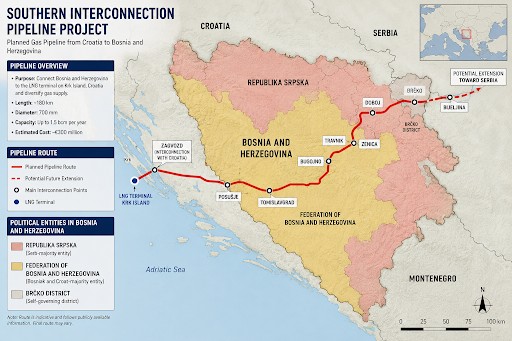
Trump has made Bosnia’s energy sector a geopolitical priority, backing the Southern Interconnection pipeline to bring U.S. LNG into Bosnia while supporting a private company linked to Trump allies.
The deal has raised major transparency and conflict-of-interest concerns, as AAFS was inserted into the pipeline project without a competitive tender.
Washington’s strategy could backfire, with sanctions relief strengthening Milorad Dodik, who has resumed secessionist rhetoric and deepened ties with Russia, while the U.S. and Europe remain divided over Bosnia’s High Representative.
Bosnia is next on U.S. President Donald Trump’s disruption agenda, and an opaque energy deal riddled with conflicts of interest is at the heart of yet another of Washington’s transactional gambles based on insufficient knowledge.
Since the second half of 2025, the Trump administration has been dismantling key elements of long-running U.S. policy toward Bosnia and Herzegovina, all because it wants a pipeline from Croatia to supply U.S. LNG, with deals brokered by an unknown company run by Trump loyalists collecting on owed favors.
The Trump administration has already infiltrated this last bastion of fragile stability–a stability that has lasted since 1995. The administration will find enough officials and businessmen willing to act against the national interest, and Trump loyalists are adept at identifying them. They are also unafraid of a rather complacent population that doesn’t often rock the boat.
In order to achieve that pipeline deal, the Trump administration is gambling that it can unleash and then control the country’s number one destabilizing individual: Milorad Dodik, the Bosnian Serb strongman who has spent years challenging the authority of the Bosnian state and threatening the constitutional order established by the 1995 Dayton peace agreement.
The Step-By-Step Dismantling of Bosnia
The playbook was laid out in a lobbying contract Republika Srpska signed with RRB Strategies, headed by former Illinois governor and Trump ally Rod Blagojevich. Michael Flynn was working the same Washington terrain through a separate organization, the Gold Institute for International Strategy, where his duties included connecting Dodik with “decision-makers and influential figures in Washington”. Flynn, Trump’s former national security adviser, is a retired lieutenant general who pleaded guilty in 2017 to lying to the FBI about contacts with Russia before Trump pardoned him in 2020. Later, he would become a prominent election-denial activist and political ally whose brother now fronts the company that is slated to develop the pipeline to Croatia.
Step 1: Rehabilitate Milorad Dodik
Dodik has dominated Republika Srpska, Bosnia’s Serb-majority entity, while repeatedly threatening secession and attempting to strip Bosnia’s central institutions of their authority.
The U.S. first sanctioned him in 2017 for obstructing the Dayton agreement. The Treasury sanctioned him again in January 2022 for attacks on Bosnian state institutions and corruption, accusing him of using patronage, bribery and government contracts to enrich himself and his associates.
Washington later extended sanctions to Dodik’s children, Igor and Gorica, and companies tied to the family. The Treasury said in 2023 that Dodik had used his official position to direct government contracts and monopolies to private companies overseen by members of his family and associates. A further round in 2024 targeted companies forming part of Igor Dodik’s financial network, including Prointer ITSS, Infinity International Group, Kaldera, Sirius 2010, Elpring and Nimbus Innovations.
The media coverage has been dismal from a local standpoint, and on the Western media front, one can rely solely on The Guardian and a smattering of disconnected Reuters newswires.
The groundwork began months before Washington formally rehabilitated Dodik.
In March 2025, Republika Srpska hired RRB Strategies, headed by former Illinois governor and Trump ally Rod Blagojevich, to lobby the Trump administration. The stated mandate included lifting U.S. sanctions on Republika Srpska officials, opposing High Representative Christian Schmidt, pushing for the eventual elimination of the Office of the High Representative and establishing “intensive and personal contacts” with senior State Department officials.
By the fall of last year, Washington was negotiating with Dodik’s government.
Republika Srpska subsequently reversed several measures challenging Bosnia’s state institutions and accepted Dodik’s departure from the entity presidency. The State Department welcomed the reversals as the result of U.S.-led efforts to defuse the political crisis that Dodik himself had caused.
The payoff came quickly for Dodik. The U.S. Treasury removed four Dodik allies from the sanctions list on October 17. Twelve days later, OFAC removed Dodik himself along with his children, senior Republika Srpska officials and dozens of associated people and companies. The Treasury offered no detailed public explanation for the mass delisting.
Step 2: The Overnight Emergence of a Pipeline Deal
The pipeline itself, the Southern Interconnection, is not under much scrutiny. Its purpose, long supported and facilitated by the EU (including Schmidt), is to bring American LNG into Bosnia and reduce reliance on Russian gas, a reliance that Europe wholeheartedly embraced for decades.
With this in mind, the pipeline itself isn’t a problem for the EU. It would love nothing more than to facilitate this, but not at the expense of the destruction of the state, and not with an opaque company created overnight by figures close to the U.S. president, with no state tender process.
The best way to understand the nature of the unknown company that stands to benefit from the pipeline is through the chronology.
Just 22 days after removing sanctions from Dodik and family, and before the elusive American company AAFS existed, U.S. officials and their civilian loyalists were making their move to secure the pipeline development for themselves.
On November 20, 2025, U.S. Chargé d’Affaires John Ginkel met the leaders of the five main political parties in Bosnia’s Federation entity and proposed a new model for the Southern Interconnection: an American private company would develop, build and manage the pipeline. The Federation leaders agreed in principle. The U.S. Embassy said American investment would speed up construction and provide Bosnia with “affordable and reliable” U.S. LNG. At the time, the American company was not identified.
AAFS was not entirely new. Sarajevo businessman Amer Bekan had registered a Bosnian company under the same name in 2021. Bekan is a lobbyist and a fixer working behind the scenes for the highest bidder, according to an international consultant based in the U.S. and Sarajevo.
A 2019 industry biography described him as CEO of Karimpol Group for Bosnia, Serbia and Croatia, calling him “one of the largest lobbyists for foreign investments in Bosnia and Herzegovina”. He also ran his own political party, Prva Stranka, founded in Sarajevo in 2014, and stood for mayor of Sarajevo’s Centar municipality in 2016, finishing last. The party’s financial records listed its headquarters at Splitska 12 in Sarajevo–the same address later used by the original Bosnian AAFS.
Bekan was also accused of selling votes to Dodik. During the 2020 local elections, former Srebrenica mayor Camil Durakovic publicly accused Bekan of selling Prva Stranka’s positions on Srebrenica polling boards to Dodik’s SNSD party. Durakovic said he had evidence supporting the allegation and cited a message he said came from an SNSD member indicating that the positions had been paid for. Bekan denied the accusation and threatened legal action. There are no subsequent court rulings on this.
The new AAFS was the result of Bekan being brought into the new American venture by Trump’s personal lawyer, Jesse Binnall, and Michael Flynn’s brother, Joe Flynn. They did not bring Bekan on for his experience in constructing or operating energy infrastructure, of which he has none. He was brought in because of his connections, his lobbying abilities, and his government contract influence.
That was all in November 2025. By January, Washington was openly backing AAFS.
Binnall and Flynn arrived in Sarajevo and began meeting the country’s political leadership with Ginkel at their side. On January 12, they met Foreign Minister Elmedin Konakovic. The following day they met Dragan Covic, leader of the largest Bosnian Croat party and deputy speaker of the House of Peoples. The U.S. Embassy said the meetings would explore how “American capital and resources” could develop and operate the Southern Interconnection.
AAFS has no infrastructure development experience or resources of its own. It is essentially a middleman: it proposes to secure the concession and financing, then rely on other companies to provide the engineering, construction and operating expertise needed to deliver the project.
AAFS has not identified who would engineer and build the Southern Interconnection, who would operate it, or which investment funds would provide the capital. It has not even disclosed all of its own shareholders. Binnall and Flynn are acknowledged owners, while Bekan has confirmed that there are others without naming them.
That raises the more obvious question of why Bosnia allowed this to happen at all, and without a tender.
Southern Interconnection had already been under development for years by BH Gas and Croatia’s Plinacro, the established gas-transmission operators on either side of the border. The two companies signed a cooperation agreement covering the route in 2017 and continued working jointly on its development, including the interconnection point between the Croatian and Bosnian transmission systems. Under the original plan, BH Gas would develop and operate the Bosnian section while Plinacro handled the Croatian side.
Nor was there any shortage of established American companies capable of taking part if Washington wanted U.S. private investment. Bechtel representatives arrived in Sarajevo in January to discuss Southern Interconnection. Bechtel has decades of experience delivering major pipelines and other energy infrastructure.
There was no tender to determine whether Bechtel, another international pipeline developer, the existing transmission operators or any other qualified consortium could offer Bosnia better terms.
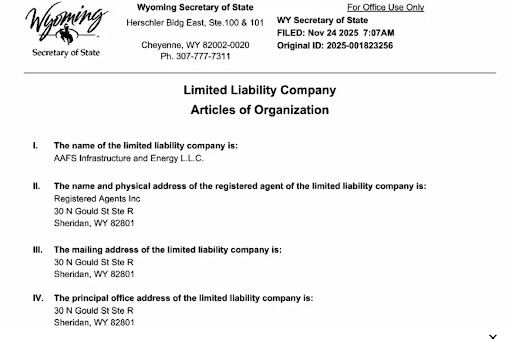
By April, parliament had amended the Southern Interconnection law to remove BH Gas from its previous role and put AAFS at the center of the project. A company incorporated in Wyoming less than five months earlier, with no comparable project history and no disclosed engineering, construction or operating partners, was now positioned between Bosnia and the companies that would actually have to build and operate its strategic new gas corridor.
It could very well end up being Bechtel that builds the pipeline, while AAFS controls the deal. In January, Bechtel emerged as a potential construction partner and was still being discussed alongside AAFS in March, but no final construction contract with Bechtel has been publicly announced.
If Bechtel (or similar) ultimately builds the pipeline, the obvious commercial structure could have been for Bosnia/BH Gas or another project company to contract directly with an experienced EPC company such as Bechtel. Alternatively, Bosnia could have tendered a concession to qualified international infrastructure developers and required bidders to disclose their financing, EPC contractors and operators.
But that would have cut out a very lucrative middleman position for Bekan, Flynn and Binnel.
AAFS does not need the technical capacity to build or operate the pipeline. Once it controls the concession, it can contract the engineering, construction and operations to companies that do.
But because there was no competitive tender, Bosnia never required AAFS to compete openly on the qualifications that would ordinarily determine who receives such a project: technical experience, financing, proposed contractors, operating expertise, price and terms.
The opacity therefore goes well beyond AAFS’s ownership. Bosnia does not publicly know all of the people behind the company, where all of the money is coming from, which companies will perform the work, or how much of the project’s value AAFS and its shareholders will retain for arranging it.
Bosnia’s recently ex-High Representative, Schmidt, then ended up resigning over this deal process, not the idea of the pipeline itself.
The total proposed investment across the Bosnian projects has reached roughly €1.5 billion.
But AAFS isn’t just looking for a pipeline deal here. Its plans expanded to include three gas-fired power plants, and all along, they have been trying to take control of Bosnia’s key international airports.
The result is an extraordinary expansion for a company whose American incarnation did not exist when Trump returned to office.
In a matter of months, AAFS went from a newly incorporated Wyoming company to the preferred investor in a strategic international gas pipeline, the prospective developer of three power plants and a bidder for decades of control over two international airports.
Its owners include the president’s personal lawyer and the brother of Michael Flynn. Its other shareholders remain undisclosed. Its financing remains undisclosed. Its principal technical and operating partners remain undisclosed.
And throughout that expansion, the U.S. Embassy has been at its side.
Binnall himself has called the Southern Interconnection a “priority” of the Trump administration. That statement carries considerably more weight when Binnall’s two roles are put next to each other: he is Donald Trump’s personal lawyer, and he is a shareholder in the private company positioned to profit from the administration’s Bosnia policy.
The pipeline was already moving forward when Washington turned its attention to the next obstacle: Christian Schmidt and the Office of the High Representative.
Step 3: Dismantle the Office of the High Representative in Bosnia
The Southern Interconnection pipeline crosses an international border and requires decisions at the level of the Bosnian state. It also runs straight into one of the country’s most explosive unresolved postwar disputes: state property. Roughly one-third of the proposed pipeline would cross land classified as state property, ownership of which Bosnia has never resolved.
Dodik had spent years fighting that battle from the other direction. His position is that public property located inside Republika Srpska belongs to the entity, while Bosnia’s Constitutional Court has repeatedly rejected attempts by Republika Srpska to take ownership of state property. For Dodik, control over state property is central to his effort to transfer power and assets away from Bosnia’s central institutions and into Republika Srpska.
Washington therefore needed cooperation from the same politician it had spent years sanctioning for attacking the Bosnian state.
And Dodik gave it.
In April, Dodik announced that the Republika Srpska government had approved Southern Interconnection, calling it primarily a Federation project. But his support came with a demand of his own: Republika Srpska’s projects should no longer be blocked.
One of those projects is particularly important. Republika Srpska has been pursuing its own €500-million Eastern New Interconnection, connecting the entity directly with Serbia and preserving access to the Russian gas system. As recently as June, Dodik was in St Petersburg for talks involving Gazprom while Republika Srpska continued preparations for that pipeline.
The result is a remarkable arrangement. Washington is promoting Southern Interconnection as the project that will break Bosnia’s dependence on Russian gas, while the country’s most powerful pro-Russian politician has agreed to support it while demanding that Republika Srpska be allowed to pursue its own projects (for Russian gas).
But Dodik was only one obstacle.
The unresolved state-property question remained, and there was one international official in Bosnia with extraordinary powers to intervene in precisely that kind of dispute: the High Representative.
Schmidt had the power to break the deadlock. As High Representative, he could use the Bonn powers to impose legislation without waiting for Bosnia’s political institutions to reach agreement. But Schmidt would not impose a permanent division of state property.
That refusal was particularly inconvenient because a settlement could solve two problems for Washington at once. It could clear the property needed for the AAFS pipeline while giving Dodik something he had demanded for years: control by Republika Srpska over state property located inside the entity.
Schmidt had previously used his powers to stop Dodik from doing exactly that. In 2022, he suspended a Republika Srpska law claiming state property for the entity, maintaining that Bosnia, not Republika Srpska, had authority over its disposal.
Washington therefore needed a High Representative willing to do what Schmidt would not.
Either removing the OHR entirely, or hindering it by leaving it without a High Representative, creates a direct path between Dodik and American officials to act unilaterally against the interests of the state.
It worked.
In May 2026, Schmidt announced his resignation after coming under intense U.S. pressure.
Washington then backed veteran Italian diplomat Antonio Zanardi Landi to replace him, with Trump-aligned officials stating in no uncertain terms that the pipeline would be resolved as soon as Landi took over, with no clear explanation as to why they assumed that.
An AAFS representative told senior Bosnian parliamentarians that the state-property problem would be resolved once Landi became High Representative. Landi’s own platform did not explain how he would deal with state property.
But the EU isn’t playing along–yet.
France, Germany and Britain have resisted Landi’s appointment, instead backing French diplomat René Troccaz.
So, Washington and the AAFS pipeline deal still have a lingering problem. Washington can’t install Bosnia’s High Representative on its own. The High Representative is chosen through the Steering Board of the Peace Implementation Council, where the U.S. campaign has run into opposition from its European allies.
France put forward its Western Balkans envoy, René Troccaz, with Germany and Britain lining up behind him. The United States backed Landi, joined by Italy, Turkey and Japan. The first attempt to choose Schmidt’s successor on June 4 ended without agreement after hours of negotiations in Sarajevo. American officials had pressed for Landi to be appointed that day.
Washington then increased the pressure. The Americans demanded Schmidt’s immediate departure rather than allowing him to remain through Bosnia’s October elections, as an earlier compromise with Germany had envisioned.
At the next PIC meeting on June 30, Washington got that much: Schmidt was forced out immediately. But it still could not get Landi installed. The meeting again ended without agreement on a successor, leaving Schmidt’s American deputy, Louis Crishock, temporarily in charge, while the U.S. and European governments continued fighting over who would take the office permanently. The PIC failed again on July 14, leaving Crishock in charge indefinitely while Washington and its European allies continue to fight over a permanent successor. No date has been announced for another attempt.
This fight isn’t just over who replaces Schmidt; it’s over who controls an office with the power to settle the state-property dispute standing in the way of the AAFS pipeline.
As of now, Europe has stopped Washington from completing that part of the plan. But this is just a waiting game. And that also makes Chrishock the pipeline kingmaker, though statements from him so far, combined with the fact that he is a career diplomat at the OHR since 2024, do not suggest he is actively seeking to work with Trump with respect to using his Bonn Powers to resolve the state property issue and pave the way for AAFS’ pipeline plans.
Unleashing Dodik
Since Trump let Dodik off his leash, things haven’t gone as smoothly as Trump had anticipated, and Dodik is an animal he cannot necessarily control. Washington’s gamble on Dodik was already coming apart within weeks of the sanctions relief. By January, he was again openly advocating secession and defying Bosnia’s Constitutional Court. By February, he was using a U.S. visit to call Sarajevo the “enemy of Republika Srpska” and demand the expulsion of the High Representative. By March, a bipartisan group of U.S. lawmakers was asking the Trump administration to put the sanctions back, warning that the delisting had emboldened him. By May, Dodik was back in Moscow with Putin. By June, Republika Srpska was deepening talks with Gazprom and pursuing the €500-million pipeline that would preserve the Russian gas relationship Washington says it is trying to dismantle.
TO BE CONTINUED … By Charles Kennedy for Oilprice.com