It’s possible that I shall make an ass of myself. But in that case one can always get out of it with a little dialectic. I have, of course, so worded my proposition as to be right either way (K.Marx, Letter to F.Engels on the Indian Mutiny)
Thursday, August 13, 2026
Greenpeace “Marks” Abandoned Leaking Tanker Launching Black Sea Campaign
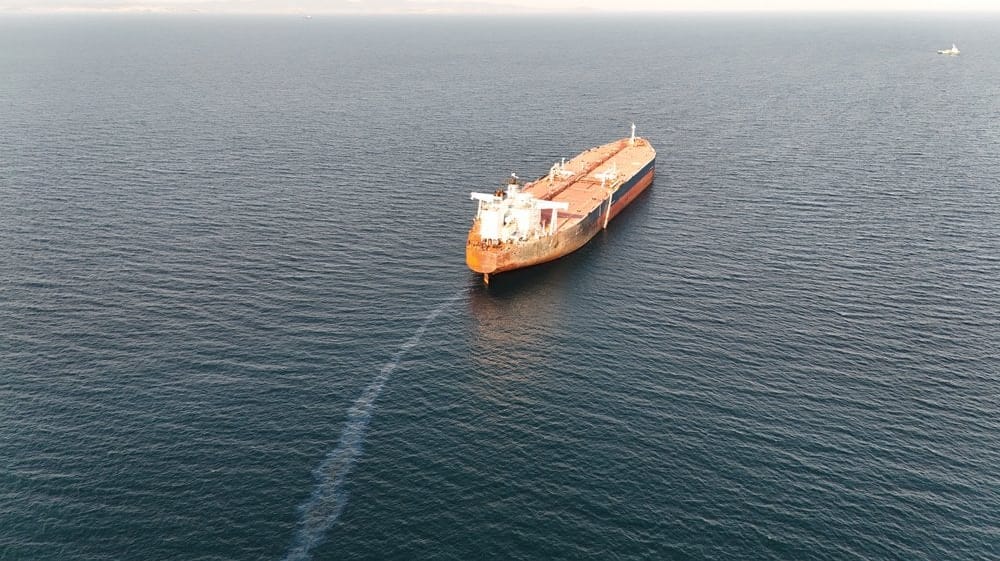
Image from early August showing the oil slick from the abandoned tanker (Greenpeace Bulgaria)
Activists with the group Greenpeace “marked” the hull of the abandoned tanker Kairos anchored off Bulgaria as they launched a new campaign to protect the Black Sea. The group has been asserting for weeks that the tanker, which was damaged in November 2025 in a Ukrainian attack, is leaking residual oil off the port of Burgas.
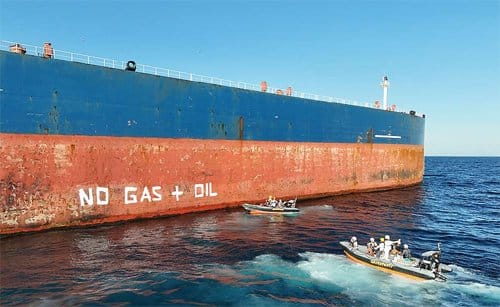
Organized by the Bulgarian chapter of the group, activists from Bulgaria, Ukraine, Spain, the United States, and the Philippines took part in the demonstration. Using small boats launched from the group’s flagship Arctic Sunrise, they went alongside the tanker, which has been anchored off Burgas for months. They painted a message, “No Gas + Oil,” on the hull of the abandoned ship.
The group released pictures in late July, reporting that it had documented oil slicks around the tanker. They used images from the Sentinel-1, Sentinel-2, and PlanetScope platforms and reported they had identified oil slicks on April 26, May 14, 15, 17, and 19, and again on July 21. They also reported that three days ago, the Arctic Sunrise had also documented a leak from the Kairos.
Activists marked the hull to draw attention to their calls for an investigation into the oil slicks and to launch their new campaign for the Black Sea (Greenpeace Bulgaria)
The tanker has been off Burgas since it was attacked in the Black Sea by a Ukrainian drone. The sanctioned tanker was bound for Novorossiysk, Russia, to load a cargo when it was struck. A large fire engulfed the aft section of the vessel, and with the assistance of the Turkish authorities, the crew was evacuated. However, days later, it was being towed and then suddenly washed ashore in Bulgaria with assertions that a Turkish tug had abandoned the ship. The Bulgarian Navy assisted the skeleton crew aboard the tanker, and it was later towed to a safer anchorage off Burgas.
The Bulgarian maritime authorities said in July that they had surveyed the ship and denied the reports of an oil leak. They said they were in contact with the owners of the vessel.
Greenpeace, however, continues to assert that the Kairos is “the most likely source” for the oil slicks. It continues to call for further surveys to establish the origin of the oil, as well as chemical analysis of the fuel stains.
Last month, Bulgaria’s Transportation Ministry reported it was informed the hulk had been sold to a cash buyer for dismantling in Turkey.
The Arctic Sunrise, which has been operating with the organization since 1995, arrived in Bulgaria for the new campaign. The vessel has been used for expeditions and campaigns around the world, including the Arctic, Antarctic, Amazon, and Africa. The vessel was opened for public inspection in Varna, Bulgaria, and a press event was held last week for the new campaign “A Living Black Sea Without Oil and Gas.” They are launching an initiative called “Cities Without Gas” to encourage investments in new energy-efficient and renewable sources of energy instead of new gas infrastructure.
Suspicious Subsea Cable Breaks Prompt Calls for Investigation in Australia
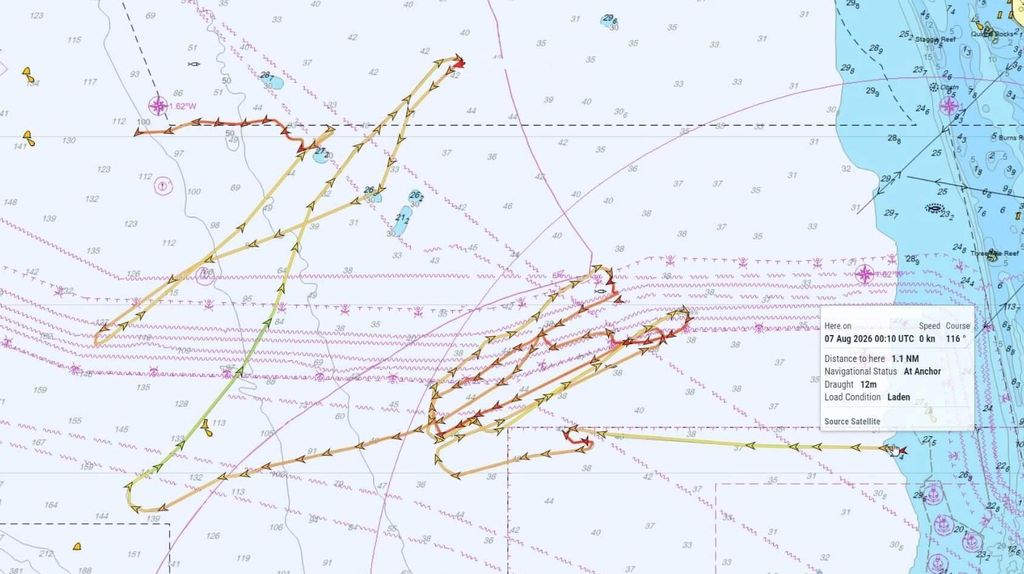
The track of the vessel in question off Perth, WA (edited to remove identifying information / MarineTraffic / Subco)
A new awareness of the vulnerability of subsea infrastructure is leading to enhanced scrutiny with every break, particularly when there might be a ship involved. Over the weekend, a UAE-managed product tanker opted to navigate in an unusual racetrack pattern over a charted subsea cable zone off Perth, Australia; at about the same time, a fiber optic cable operator reported an outage in two cables in the same area - and raised the possibility of a security incident.d
The cables breaks happened back-to-back within a government-designated cable protection zone, and the ship was moving back and forth in the same area. Security consultancy Windward independently validated the vessel's presence and identity.
The CEO of the operator, Subco, noted that the activity of the vessel could be a coincidence - but encouraged the authorities to investigate.
"This is a concerning development. Partially because submarine cables are the digital lifeblood of our nation, but also because this this could very well turn out to be the second such incidence in a Federally declared cable protection zone," said Bevan Slattery, founder and CEO of Subco.
The cables did not have automatic diagnostic systems installed, so Subco will not know the root cause of the casualty (and whether it was an anchor-drag incident) until it arranges a physical inspection. Anchor-dragging accounts for about one third of all cable breaks globally, according to the International Cable Protection Committee. Surface conditions at the time were benign, and the vessel made multiple crossings of the same cable area.
"This maybe a coincidence, but it’s important for the Australian Federal Police to investigate the issue urgently," said Slattery.
Australia has a keen awareness of its reliance on subsea cables. Just 16 of them connect the Australian market to the rest of the world, and losing two is a substantial security event. Both Russia and China are suspected of experimenting with cable-cutting as a way to cause disruption while maintaining deniability.
"We've seen numerous incidents in Europe and around Taiwan over the last, say, three or four years of cables being cut," said ASPI researcher David Brewster, speaking to ABC. "It's difficult to be absolutely certain of the reasons in some of these cases, but in a great number of cases, it's fairly obvious that they were done by state actors, Russia and China."
A newly-prepared review from the National Security College at the Australian National University (ANU) - released just this week - warns that these subsea capabilities are being actively tested and developed.
"The more recent incidents in the Baltic Sea and around Taiwan suggest that state actors are now actively probing and testing cable infrastructure in peacetime as part of broader hybrid warfare strategies, with the intention of being able to rapidly degrade connectivity at the outset of a conflict," the authors of the report concludd.
US, EU bodies report on nuclear fuel market situation
Canada, closely followed by Kazakhstan, remained the largest source of uranium delivered to utilities in both the USA and Europe in 2025, according to recently published annual market reports from the Euratom Supply Agency and the US Energy Information Administration.
(Image: Cameco)
Owners and operators of US civilian nuclear power reactors purchased a total of 46.9 million pounds U3O8e (18,040 tU) of deliveries from US and foreign suppliers during 2025, 16% less than the 55.9 million pounds purchased in 2024, according to the latest edition of the US Energy Information Administration's Uranium Marketing Annual Report. (The unit used in the report, U3O8e, stands for U3O8 equivalent, representing uranium concentrate (U3O8) and the equivalent uranium component of uranium hexafluoride and enriched uranium).
Canada remained the top source of US deliveries (32%), followed closely by Kazakhstan (28%) and Australia (15%), with material from Uzbekistan accounting for 7% of total deliveries, and Namibia 4% of total deliveries. Uranium was also imported from Malawi and Niger. US material accounted for 7% of total deliveries in 2025, down from 8% in 2024. Although Russian-origin material accounted for 2,301 million pounds U3O8 of 2024 deliveries, data on any deliveries of Russian-origin material in 2025 has been withheld to avoid disclosure of individual company data. Several other countries are also marked as "withheld" in the publication.
The year saw 32 million pounds U3O8e of natural uranium feed delivered on behalf of US nuclear power plant owners and operators to uranium enrichers at home and overseas, of which 37% went to domestic enrichers with the remaining 63% going to enrichment suppliers in France (5.5 million pounds U3O8e) and Russia (2.4 million pounds U3O8e).
The Energy Information Administration is a statistical and analytical agency within the US Department of Energy.
EU continues to diversify supply
Canada and Kazakhstan were also the top suppliers to the EU in 2025, according to the Euratom Supply Agency's 2025 annual report which was released in early July. Four countries provided over 83% of all deliveries to the EU and six countries provided over 98% of all-natural uranium supplied to the bloc. Unlike the US report, however, Russian deliveries played a significant part, with 2,346 tU of Russian-origin deliveries accounting for 15.98% of the total.
All of the EU's demand for fresh uranium is covered by imports from countries outside the bloc, and is therefore subject to geopolitical developments and related trade policy implications, the report notes. The Agency has a central role in ensuring the supply of nuclear materials for all EU users.
"One key area of attention is diversification," the Agency's Director General Michael Hübel said in his foreword to the report. "Addressing the remaining dependencies from Russia - in line with the Commission's Roadmap towards ending Russian energy imports - is a key priority in this respect. But the task is more challenging - as nuclear demand grows in Europe there needs to be emphasis on a safe and secure supply chain, enabling nuclear energy to play its role as homegrown energy to the full."
In May 2025 the European Commission published the REPowerEU roadmap to end EU dependency on Russian energy by stopping the import of Russian gas and oil and phasing out Russian nuclear energy. This includes diversifying the source of supply of nuclear fuel for Russian-designed VVER reactors, which operate in several EU countries.
According to the Agency, "significant progress" was made during the year in this respect. "By the end of 2025, all EU operators of VVER reactors had secured alternative fuel supply contracts from non-Russian suppliers, strengthening long-term security of supply," the report says.
Australian reactor marks 20 years of operations
Australia's nuclear science and technology organisation ANSTO is marking 20 years of operations for its multi-purpose nuclear reactor at Lucas Heights in southern Sydney.
The OPAL reactor building (Image: ANSTO)
OPAL - for Open Pool Australian Lightwater reactor - reached first criticality on 12 August 2006. Since then, it has supported the production of more than 10 million lifesaving nuclear medicine doses, irradiated over 900 tonnes of silicon ingots and created neutrons essential for enabling 8,000 cutting-edge scientific experiments, ANSTO said.
The 20 MW reactor officially opened in 2007 - here's how WNN reported it at the time. It replaced the HIFAR research reactor which operated from 1958 to 2007. Construction began in 2002, taking just four years to complete. The reactor was designed, constructed and commissioned by Argentinian nuclear technology company INVAP, alongside Australian alliance partners John Holland Construction and Engineering and Evans Deakin Industries Limited. More than 500 people were employed on site at the peak of construction, making it one of the most complex construction projects ever undertaken at the Lucas Heights campus.
Flashback: OPAL's pool is craned in during the construction phase (2002-2004) (Image: ANSTO)
OPAL does not generate electricity: nuclear power reactors are currently prohibited in Australia under federal and state-level legislation. The unit is a research reactor which produces neutrons for scientific, medical and industrial uses. Beams of neutrons produced by the reactor are guided to a suite of sophisticated scientific instruments at the Australian Centre for Neutron Scattering for research in a vast array of scientific disciplines and industry applications including medicine, food, engineering and construction, mining, advanced technologies, energy materials, palaeontology, cultural heritage items, planetary and space studies.
The reactor is also used for irradiation activities, including the production of radioisotopes - including molybdenum-99, the precursor of technetium 99m, one of the most commonly used medical diagnostic radioisotopes. It also carries out the irradiation of silicon to produce specialised material for use in semiconductors.
A view of OPAL's pool from the bridge: targets for irradiation can be lowered from the bridge into the pool (Image: ANSTO)
ANSTO CEO Shaun Jenkinson said for twenty years, OPAL has arguably been Australia's most significant piece of scientific infrastructure.
"OPAL underpins Australia's enduring nuclear capability, sustaining the expertise, infrastructure and international confidence needed in a changing strategic environment," he said. "It is one of the clearest examples of how nuclear science directly improves lives."
"Every Australian will, on average, require two nuclear medicine procedures in their lifetime. If you or a loved one has undergone a diagnostic imaging scan such as a SPECT scan, it is highly likely the nuclear medicine administered came from Lucas Heights," he added.
"Similarly, if you drive an electric or hybrid vehicle, or have caught a high-speed train overseas, there is a very good chance that a small component of that technology is able to function because of OPAL."
As well as being a major employer in the southern Sydney area, OPAL remains a nationally important asset, supporting sovereign expertise, training the next generation of nuclear specialists, and demonstrating the value of sustained investment in nuclear science and technology, he said. It also has a "crucial role in the training and development of Australia's growing nuclear workforce, including for future national priorities such as AUKUS." AUKUS is the 2021 trilateral partnership between Australia, the UK and the USA under which Australia is set to acquire nuclear-powered submarines.
Construction of Bailong 2 conventional island begins
The first concrete pour has been completed for the basemat of the conventional island of unit 2 at the Bailong nuclear power plant in the Guangxi Zhuang Autonomous Region of southern China, State Power Investment Corporation announced.
(Image: CNNC)
The basement slab of the conventional island - also called the turbine island - of unit 2 adopts an integral raft foundation, which is divided into nine construction zones and constructed using the 'skip-pour' method. Concrete pouring in the area known as Zone 1 started on the evening of 7 August and was completed on the morning of 9 August. A total of 1,732 cubic metres of concrete was poured during the process, which involved 38 hours and 46 minutes of continuous work.
"During the pouring operations, the project team closely monitored process standards, continuously strengthened supervision and control throughout the entire process, and built a solid safety and quality defence line to ensure the safe and high-quality implementation of the conventional island first concrete pouring," SPIC said.
(Image: CNNC)
"The completion of the conventional island first concrete pouring of unit 2 is a crucial engineering milestone in the construction of the Bailong Nuclear Power Project," the company added. "It lays a solid foundation for the subsequent construction of the turbine foundation and basement sidewalls, and provides strong support for the overall efficient progress of the project."
The construction of Phase I (units 1 and 2) of the Bailong plant was among approvals for 11 new reactors granted by China's State Council in August 2024. SPIC plans to build two CAP1000 pressurised water reactors - the Chinese version of the Westinghouse AP1000 - as the first phase of the plant. An investment of about CNY40 billion (USD5.6 billion) is planned for the two units, which are expected to take 56 months to construct.
(Image: SPIC)
Excavation work for the foundation pit of the nuclear island for unit 1 began in late December 2024. SPIC subsidiary Shanghai Nuclear Engineering Research & Design Institute (SNERDI) - joint general contractor for the project - announced it poured the first concrete on 22 December 2025. The company said a total of 6,662 cubic metres of concrete was poured in a process lasting just over 64 hours.
Located on Jiangshan Peninsula in Fangchenggang City, Guangxi Province, the Bailong plant is planned to have six units, with a total installed capacity of 8.62 GWe and a total investment of approximately CNY120 billion. The first phase of the project adopts the CAP1000 design, with each unit having a capacity of 1.25 GW. Four larger CAP1400 reactors are also proposed to be built at the site - located about 24 kilometres from the border with Vietnam and about 30 kilometres southwest of China General Nuclear's Fangchenggang nuclear power plant - in later phases.
After the first phase of the project is completed and put into operation, it is expected to generate about 20 billion kilowatt-hours of electricity per year, which is equivalent to reducing standard coal consumption by about 6 million tonnes and carbon dioxide emissions by about 16 million tonnes per year.
First fuel loaded into Tianwan unit 7
The initial loading of fuel assemblies into the core of unit 7 of the Tianwan nuclear power plant has begun. It is the first of two Russian-designed VVER-1200 reactors under construction at the site in China's Jiangsu province.
Tianwan units 7 and 8 (Image: CNNC)
The first of 163 nuclear fuel assemblies was loaded into the reactor on 12 August, China National Nuclear Corporation (CNNC) announced.
Russian state nuclear corporation Rosatom supplied fuel for the initial loading for Tianwan unit 7 in January. The fuel was manufactured at the Novosibirsk Chemical Concentrates Plant and is part of the contract for units 7 and 8 at the plant.
CNNC said the start of fuel loading "lays a solid foundation for the subsequent reactor criticality and commercial operation".
The background
In June 2018, Russia and China signed agreements for the construction of two VVER-1200 reactors as units 7 and 8 of the Tianwan plant. Construction of unit 7 began in May 2021, with that of unit 8 starting in February 2022. The units are scheduled to be put into commercial operation in 2026 and 2027, respectively.
The Tianwan nuclear power plant is owned and operated by Jiangsu Nuclear Power Company, a joint venture between CNNC (50%), China Power Investment Corporation (30%) and Jiangsu Guoxin Group (20%).
The first four units at the Tianwan site - which began commercial operation between June 2007 and December 2018 - are Gidropress VVER units supplied by Russia. Units 5 and 6 both feature Chinese ACPR1000 reactors.
In January, CNNC announced that hot tests - which simulate the temperatures and pressures the reactor systems will be subjected to during normal operation - had been completed at unit 7 on 30 December. Cold tests - which verify the leak-tightness of the primary circuit and components - were completed at unit 8 earlier this month.
According to the project construction plan, Tianwan units 7 and 8 are scheduled to be put into commercial operation in 2026 and 2027, respectively.
Once all units at the Tianwan plant are operational, the total installed capacity will exceed 9 GWe, with an annual power generation of over 70 TWh, reducing carbon dioxide emissions by 57.4 million tonnes annually.
Upgrading of Loviisa turbine island begins
Finnish utility Fortum has begun a major modernisation of the turbine island at its Loviisa nuclear power plant, a project that will increase the electricity output of the plant and ensure its continued operation until 2050.
(Image: Fortum)
Loviisa - comprising two VVER-440 type pressurised water reactors - was the first nuclear power plant in Finland and currently provides more than 10% of the country's electricity. Loviisa unit 1 began commercial operation in 1977, with unit 2 following in 1981. In February 2023, the Finnish government granted Fortum an extension to the operating licence for the two units, allowing the plant to continue generating power until the end of 2050.
The modernisation of the low-pressure turbines is the largest single project in the modernisation of Loviisa's turbine island. It involves renewing the housings and internal parts of the plant's eight low-pressure turbines. The goal of the renewal is to significantly improve the efficiency of the turbine plant, which will enable higher electricity production without increasing the thermal power of the reactor. The project is being delivered by the Czech company Doosan Škoda Power under a contract signed in May 2024.
A turbine automation upgrade will replace the turbine protection and control systems and related actuators of both plant units. Turbine automation plays a key role in the safe, reliable and efficient operation of the turbine plant, as it controls and monitors the operation of the turbines in all operating situations. The upgrade will update the systems to meet current technical requirements, which will improve their reliability, maintainability and availability of spare parts. In addition to the turbine automation, the generator auxiliary systems will be modernised, which will enhance the real-time monitoring and control of the systems from the control room. The turbine automation will be supplied by Finnish company Valmet.
The main seawater pumps are also being modernised as part of the turbine plant's cooling process. The main seawater pumps are responsible for circulating seawater to the condensers, where the steam leaving the turbines is cooled back to water and returned to the power plant process. Both plant units have four main seawater pumps in use. The current pumps and their motors are approaching the end of their technical service life, which is why they are being replaced as part of the power plant's long-term investment programme. The project is being delivered by Andritz from Austria.
Loviisa (Image: Fortum)
The modernisation programme - to be implemented in stages up to 2028 in connection with annual maintenance outages - will result in an increase in the total capacity of about 38 MWe from the plant's current capacity of 1,014 MWe and will raise the expected generation from plant over the course of the new licence period from 170 TWh to 177 TWh.
"The upgrades will ensure the turbines will operate reliably until the end of their service life," Fortum said. "Some of the current components are approaching the end of their technical service life, which will make their maintenance and spare parts availability more difficult in the coming years. At the same time, the operating environment has changed, and geopolitical factors have increased uncertainty regarding the support provided by some original equipment and system suppliers and the availability of spare parts. The modernisation will ensure that the power plant can safely and reliably utilise modern, long-term supported technologies."
Fortum invested about EUR70 million (USD81 million) last year in refurbishing the Loviisa plant. The company estimates that investments related to the continuation of operations and the lifetime extension will amount to about EUR1 billion by 2050.
Containment of first Egyptian unit takes shape
Concreting work on the fourth tier of the reactor building's inner containment at unit 1 of Egypt's El Dabaa nuclear power plant has been completed, the Nuclear Power Plants Authority announced.
(Image: NPPA)
The Authority said concreting work continued non-stop for 30 hours, using five concrete pump trucks with boom distributors. About 80 specialists participated in the work during the day shift, another 80 during the night shift, and 20 people continued working around the clock to ensure the smooth operation of construction equipment and machinery.
The total volume of concrete poured was 1,608 cubic metres, and this work contributed to increasing the height of the reactor building from a level of 24.4 metres above ground to a level of 34.0 metres.
"The successful completion of the concreting work for the fourth tier of unit 1 is a new strategic step, reflecting the ongoing progress of the project, said Sherif Helmy, chairman of the NPPA board of directors. "This achievement is the result of fruitful cooperation and full coordination between all work teams of the Nuclear Power Plants Authority, the project's customer and operator, and Atomstroyexport JSC, the project's general contractor."
Alexey Zhukov, First Vice President of ASE JSC and President for NPP Construction, added: "The completion of the installation of the fourth tier of the El Dabaa NPP reactor building's internal containment vessel marks a new, important milestone in the construction of unit 1 and reflects the high level of professionalism and dedication of the entire project team. By mid-August, we plan to begin work on installing the fifth tier, which will subsequently serve as a support for the polar crane."
Background
El Dabaa will be Egypt's first nuclear power plant, and the first in Africa since South Africa's Koeberg was built nearly 40 years ago. The Rosatom-led project, about 320 kilometres north-west of Cairo, will comprise four VVER-1200 units, like those already in operation at the Leningrad and Novovoronezh nuclear power plants in Russia, and the Ostrovets plant in Belarus.
VVER-1200 reactors have two containment buildings - an inner one and an outer one - which provide extra safety and protection from external impacts.
Under the 2017 contracts, Rosatom will not only build the plant, but will also supply Russian nuclear fuel for its entire life cycle, including building a storage facility and supplying containers for storing used nuclear fuel. It will also assist Egyptian partners in training personnel and plant maintenance for the first 10 years of its operation. Rosatom has said it is aiming for a future service life of up to 100 years for nuclear power plants.
The four units are being built almost concurrently, with first concrete at unit 1 in July 2022, followed in turn by the others, concluding with first concrete at unit 4 in January 2024. Egypt's aim is for 9% of electricity to be generated by nuclear by 2030, which would be achieved by the commercial operation of the first two units by that time, directly displacing oil and gas.
MIT's New Framework Aims to Tackle Nuclear Fusion's Money Problem
MIT's new framework weighs the physical inputs and plant construction costs fusion needs to actually compete in energy markets, not just achieve ignition in a lab.
The system works across any fusion approach, tokamak, laser confinement, or z-pinch, which could help settle which technology wins commercially.
Researchers argue the physics of fusion is proven; the real hurdle now is money, and getting honest about the economics before scaling up.
For decades, the joke was that nuclear fusion was and would always be 30 years away. But a rapid string of breakthroughs over the last five years, catalyzed by privatization and the pressure as well as the support of the AI boom, has changed the calculus and suddenly brought the technology onto a real and achievable timeline.
Nuclear fusion is treated as a ‘holy grail’ of clean energy because, if harnessed in a commercially viable and scalable way, it could provide limitless energy production with zero greenhouse gas emissions and negligible environmental externalities. In short, it’s a silver-bullet solution for the world’s energy trilemma.
“To power one person’s lifetime, it’s a bathtub of seawater and a laptop battery’s size of lithium,” nuclear physicist Annie Kritcher recently told Fortune. “It’s not a lot of materials, and there’s no [long-term] radioactive waste like we have with fission.”
The first major breakthrough took place at California’s Lawrence Livermore National Laboratory in late 2022, when a team of scientists led by Kritcher made a breakthrough that many doubted would ever happen. The lab achieved ‘first ignition’ when it achieved a man-made fusion reaction that produced more energy than it consumed for the first time in human history. Since then, this amazing feat has been recreated, and other breakthroughs have started piling up in fusion experiments around the globe.
Breakthroughs have been achieved in a wide variety of fusion experiments. The breakthrough at the Lawrence Livermore National Laboratory was achieved using high-powered lasers, but other extremely promising options use a device called a tokamak that uses ultrapowerful magnets to contain plasma. China’s tokamak-based EAST ‘artificial sun’ is currently on track to achieve ignition by next year, at which point it would become the first fusion reactor to sustain plasma without external heating. Another promising approach is offered by z-pinch systems, which use electrical currents.
We now have a wealth of proof that nuclear fusion is possible and replicable through a number of different technologies – but are any of them scalable? As it stands, nuclear fusion is nowhere close to being commercially viable. The resources required to create a relatively miniscule amount of energy are enormous and completely untenable for any practical application.
A new framework from the Massachusetts Institute of Technology (MIT) seeks to puzzle out how to keep the momentum moving forward to bring fusion from a lab environment to an industrial and economic reality. The framework weighs “the physical inputs needed to sustain controlled fusion energy production, as well as the cost of building power plants that can compete in energy markets” according to a recent press release from MIT. The scientists argue that the age of throwing methods and materials at the wall to see what sticks is now over. We now know that fusion is possible scientifically, and how to achieve it. Now it’s time to crunch the numbers.
“It’s all the things that come along with finding, allocating, and spending money at this scale,” says Dennis Whyte, a professor of nuclear science and engineering at MIT and co-author of the study, published last month in the Journal of Fusion Energy. “This is critical to what we do. We should look at the economics. If we want this technology to actually be meaningful in the world economy, we have to start getting straight with ourselves about these topics.”
Critically, the framework is applicable to any and all of the fusion energy approaches that are currently under development. At this early stage of fusion research, it’s still not clear whether tokamakaks, laser-controlled internal confinement, or z-pinch systems will hold the key for commercial viability. But MIT’s system could help us figure that out.
Whyte says that the framework is “completely agnostic to whatever fusion concept you use, because the physical reality of fusion is that you expend money to build the capability to produce fusion power.” Moreover, Whyte’s co-author Andrew W. Lo emphasizes, “It doesn’t matter whether the fusion power plant is small or large, the bottom line is: In both cases you better have money coming out that exceeds the money going in, otherwise it’s not going to be around for very long.”
A study by Massachusetts Institute of Technology researchers proposes a framework for understanding what is needed to make fusion energy commercially viable in the marketplace. The method considers the physical inputs needed to sustain controlled fusion energy production, as well as the cost of building power plants that can compete in energy markets.
(Image: MIT)
The goal of the paper, according to co-author and MIT professor of nuclear science and engineering Dennis Whyte, is to create "this framework, where are all the economics are clear, and then we understand what it would mean” for any fusion energy power plant. He added: "If we want this technology to actually be meaningful in the world economy, we have to start getting straight with ourselves about these topics."
The study - titled Criteria for the economic viability of fusion power plants and published in the Journal of Fusion Energy - proposes ten parameters for evaluating the economic viability of a fusion energy power plant. Some of these are scientific and physical, dealing with the energy consumed and produced in a given plant. Most of the parameters are in the realm of engineering and economics, such as the costs of plant construction.
The parameters in the framework describe engineering features of the fusion power plant such as power density, the efficiency of converting fusion power into an economic product, and the durability of components used in the energy conversion, in addition to costing and market parameters that assess the expenses and returns from invested capital.
"This framework and its associated model are able to provide new insights into the design space of future fusion power plants (FPPs) independent of specific knowledge of their technologies," the paper says. "It confirms that low-cost financing will be necessary to the economic success of any new FPP, it highlights the importance of the replacement cost and frequency of the control surface of the fusion reaction, and it overturns the idea that a very low power density will allow a FPP to become economically viable. We hope that the simplicity, flexibility, and transparency of this model will make it a staple in the fusion development space."
Co-author Andrew Lo, a professor of finance at the MIT Sloan School of Management, said: "It's challenging to reduce complex scientific and engineering requirements to economic consequences. But if we don't do that, we're not going to get the funding we need to achieve the impact we want."
Researchers have tried a variety of methods for generating and containing fusion energy. The paper's framework, Whyte says, is "completely agnostic to whatever fusion concept you use, because the physical reality of fusion is that you expend money to build the capability to produce fusion power." The parameters do not depend on the size of any reactor being built; the framework is set up so that any inputs can be scaled to a given project or power output.
"It doesn't matter whether the fusion power plant is small or large, the bottom line is: In both cases you better have money coming out that exceeds the money going in, otherwise it's not going to be around for very long," Lo said. "It's pretty clear that economic viability is something we can start assessing now."
Whyte added: "When you've got a framework to evaluate it in a quantitative way, it tells you about the literal worth of making a particular design decision. That seems to me at this moment of fusion development absolutely critical, and what we've been missing."
Whyte is a former head of MIT's Department of Nuclear Science and Engineering and a former director of MIT's Plasma Science and Fusion Center. He co-founded Commonwealth Fusion Systems, an MIT spinoff firm. Whyte and Lo also co-founded Rutherford Energy Ventures, a consultancy and investment advisory firm, which is working with the US Department of Energy's Oak Ridge National Laboratory to build a consortium for new fusion research.
Key appointment
Whyte has been appointed CEO of the United Kingdom Atomic Energy Authority (UKAEA) following an open international recruitment process, taking up the role later this year. With UKAEA’s Culham Campus continuing to grow as a world-leading hub for fusion research and innovation, Whyte will lead a workforce of more than 2,600 people across four sites and will provide leadership to UKAEA which includes the national laboratory and UK Fusion Energy Ltd. He will oversee the organisation’s high-impact scientific and engineering work in fusion research and development, advance commercial pathways, strengthen international and industry partnerships and translate scientific innovation into practical outcomes.
"I am excited to be joining the exceptional team at UKAEA, which has a compelling plan for delivering commercial fusion energy, developing key technologies for fusion energy extraction, and the largest workforce in the world committed to advancing the development of fusion science and engineering in its widest forms," Whyte said. "My goal at MIT has been to develop bold innovators, not just scientists. Innovation happens when technical rigour meets entrepreneurial ambition. That mindset has helped launch breakthrough technologies, such as high-temperature superconducting magnets, from laboratory concepts into compelling efforts in the commercial space. This shows how education can accelerate the transition from fundamental science to real-world impact, all while inspiring the next generation of leaders who treat energy security with urgency."
SOCIALISM
Norway $2.3 Trillion Wealth Fund Posts Record-High Profit in H1
The world’s biggest sovereign wealth fund, Norway’s $2.3-trillion Government Pension Fund Global, posted a record-high profit of $185 billion for the first half of 2026, as Asian technology stocks boosted its returns and profit on the portfolio.
Norway’s Government Pension Fund Global (GPFG), which is commonly referred to as 'Norway's oil fund' because it was created with oil and gas revenues, is a shareholder in many large companies in the world, with more than half of the value of its equity investments in the U.S. market. The Norwegian fund was created in the 1990s, and today it holds, on average, 1.5% of all listed companies in the world.
For the first half of the year, the fund posted a record profit on the portfolio before foreign exchange adjustments at 1.753 billion Norwegian crowns, or $185 billion, the fund’s manager, Norges Bank Investment Management (NBIM), said on Wednesday.
This is more than double compared to the profit for the first half of last year, amid a rally in technology stocks.
“The result is driven by good returns in the equity market, particularly from Asian technology stocks,” said Nicolai Tangen, CEO of Norges Bank Investment Management.
The investments in the Government Pension Fund Global returned a record-high 9.4% in Norwegian crowns in the first half of 2026, up by 0.22 percentage points compared to the return on the benchmark index. The fund’s value was 22.683 trillion crowns, or $2.39 trillion, as of June 30, up by 1.416 trillion crowns, or $149 billion, from the same time a year earlier.
Equity investments accounted for 72.1% of the fund’s value at the end of the first half of 2026, and fixed-income investments for 25.8%. Nvidia, Apple, and Microsoft are the most valuable investments of the Norwegian wealth fund.
The fund’s equity investments returned 13.0% in the first half of 2026, with telecommunications, technology, and energy delivering the strongest returns, NBIM said.
Earlier this month, NBIM told the U.S. Securities and Exchange Commission (SEC) that it doesn’t support its proposal to scrap outright current requirements for climate-related risks and disclosures.

_13350.jpg)
_83572.jpg)
_59e0d738.jpg)
_a99aec8d.jpg)
_74242.jpg)
_81c7fe80.jpg)
_a52443fb.png)
_d99eb848_25133.jpg)
_29005.jpg)
_1_2fbe0100.jpg)
_56890.png)