Tuesday, August 18, 2026

Myanmar's banks buckle under junta rule as the kyat loses three-quarters of its value

Myanmar's banks buckle under junta rule as the kyat loses three-quarters of its value
/ Alexander Schimmeck - UnsplashFacebook
By Ben Aris in Berlin August 17, 2026

Cash-strapped depositors, a collapsing currency and lenders shut out of the global financial system – Myanmar's banks are being ground down by more than five years of military rule.

The economy shrank 2% in the fiscal year to March and consumer prices rose 24.6% year on year in April, the World Bank said in June, warning that a fresh fuel shock had piled new pressure on an already fragile system.

“While there are signs that economic conditions have stabilised, Myanmar's economy remains under significant strain,” said Melinda Good, the bank's division director for the region.

Behind the figures sits a slow-motion banking crisis. Since the generals seized power in February 2021, deposits have drained from private lenders, the kyat has lost roughly three-quarters of its dollar value and the sector has been cut adrift from Western finance by sanctions and a global money-laundering blacklist.

A currency in free fall

The kyat changed hands below MMK1,500 to the dollar before the coup. By mid-2024 the black-market rate had blown past MMK6,000 and briefly touched a record above MMK7,000, even as the central bank sold dollars to importers at a pegged rate thousands of kyat lower.

The Central Bank of Myanmar still holds an official reference rate near MMK2,100 to the dollar, but almost no one trades there. The bank keeps drip-feeding hard currency into favoured sectors – $2.9mn to edible-oil importers on a single day in June, for instance – yet the sums are too small to shift the street rate, and traders complain they cannot see where the dollars end up.

Deposits people cannot reach

Public trust never recovered from the bank runs that followed the takeover. As savers queued to pull out their money, lenders including KBZ Bank, the largest private institution, shut branches, and the authorities imposed withdrawal limits that forced customers to give notice before taking out large sums.

Private banks must still report cash withdrawals above MMK100mn ($47,600) to the financial-intelligence unit, and outsized withdrawals can trigger an investigation. To coax deposits back, banks later pushed one-year fixed rates as high as 12.5%, following a central-bank rate rise meant to tame inflation.

KBZ towers over a shrunken sector

KBZ Bank (Kanbawza Bank), founded in 1994 and genuinely private rather than military-owned, dominates what is left. It accounts for nearly 40% of retail and commercial banking, with 5.2mn customers and around 500 branches. Its KBZPay wallet, claiming some 10mn users, has become the workaround of choice in a cash-scarce economy, alongside rival Wave Money.

Below KBZ sit private majors such as AYA Bank, CB Bank and Yoma Bank – the last controlled by First Myanmar Investment, the first company to list on the Yangon Stock Exchange. The insurance market, led by Grand Guardian Insurance, is similarly thin and locally owned.

The state banks are another matter. Myanma Economic Bank and Myanma Foreign Trade Bank (MFTB) sit at the heart of the junta's finances, and it was defaults on MFTB loans that saw 23 companies and their directors blacklisted in August.

Cut off from the world

Washington has tightened the screws. In June 2023 the US sanctioned MFTB and a second state lender, Myanma Investment and Commercial Bank, accusing them of channelling foreign currency to buy arms for the military. Myanmar has also sat on the FATF blacklist of high-risk money-laundering jurisdictions since 2022, and was kept there again in June.

Foreign banks are backing away. Singapore's UOB moved to sever ties with Myanmar counterparts, Nikkei Asia reported, and a UN human-rights expert has accused international lenders of helping the regime move money. The borderlands, meanwhile, host sprawling cyber-scam compounds whose fraud proceeds run into the billions of dollars, CNN has reported, washing through the region's financial plumbing.

With Western markets closed off, the central bank has turned east, deepening banking and fintech ties with Russia and studying Sberbank's payment technology.

Symptom, not cure

For ordinary people the effect is corrosive: savings that lose value by the month, banks that ration cash and a currency that buys less with every fresh shock. For the generals, a hobbled but captive financial system still helps fund the war.

Little of it is transparent. The central bank publishes sparingly, and much of what is known comes from exile media and money-changers rather than audited accounts. What is clear is that nearly six years after the tanks rolled out, Myanmar's banks remain a symptom of the country's wider unravelling, not a way out of it.


 

Hungary in race against clock to stabilise Danube water levels as Paks nuclear plant faces critical days

Hungary in race against clock to stabilise Danube water levels as Paks nuclear plant faces critical days
/ Facebook/Zsolt HarfasFacebook
By IntelliNews August 18, 2026


UNCCD COP17 addresses scourge of desertification

UNCCD COP17 addresses scourge of desertification
The organisers of UNCCD COP17 say it's now or never for "action not words". / unccdcop17.org


By bne IntelliNews August 17, 2026

Delegates from around the world have gathered in Ulaanbaatar, Mongolia, to address the scourge of desertification.

The 17th Conference of the Parties to the United Nations Convention to Combat Desertification (UNCCD COP17) is taking place from August 17 to 28.

Up to 40% of the world’s land is currently degraded, official United Nations estimates show. The figure for Mongolia is 77%.

“Land is our most vital infrastructure — underpinning food security, water, livelihoods and stability,” UNCCD executive secretary Yasmine Fouad said ahead of the conference. She has called for COP17 to advance practical and investable solutions that restore degraded land and soils while strengthening the relationship between land and water management.

Mongolian Prime Minister Uchral Nyam-Osor was reported by official news agency Montsame as urging delegates at the opening of COP17 to deliver a shift “from talk to action, from goals to implementation, and from commitments to measurable results.”

COP17 is being held under the theme ‘Restoring Land. Restoring Hope’. It is expected to bring together delegates from the UNCCD’s 197 Parties, alongside representatives of governments, businesses and civil society, scientists, young people, indigenous peoples, pastoralists and smallholder farmers.

The consequences of land degradation extend far beyond the environment, says UNCCD, observing that degraded land “can reduce food production and water availability, undermine livelihoods and increase economic and social vulnerability”.

It added: “Human activities have significantly altered 75% of the Earth’s land surface, reducing productivity across 23% of the global terrestrial area, according to landmark findings by IPBES (the Intergovernmental Science-Policy Platform on Biodiversity and Ecosystem Services).”

Discussions at COP17 will focus on land restoration, drought resilience, water, rangelands and food systems, with particular attention to turning political commitments into practical action and mobilising the financing needed to implement solutions at scale.

COP17 is also on the calendar during the United Nations International Year of Rangelands and Pastoralists 2026, an observance championed by Mongolia.

Rangelands (see IntelliNews May 2024 article, “Silent demise” of world’s vast rangelands threatens food supply of billions, warns UNCCD report) cover more than half of the Earth’s land surface and directly support the livelihoods of around 500mn people, while contributing substantially to global food systems. “Yet these ecosystems are increasingly under pressure from degradation and drought,” said the UNCCD.


Jordan's king courts Beijing for investment as war strains economy, US ties fray

Jordan's king courts Beijing for investment as war strains economy, US ties fray
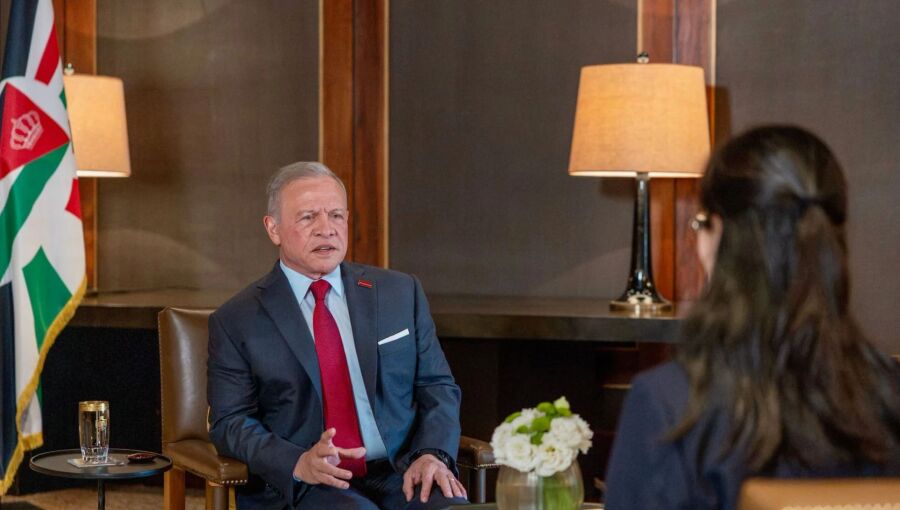
King Abdullah II of Jordan in interview with Xinhua Chinese television. / CC: Jordan News Agency (Petra)Facebook
By bna Cairo bureau August 17, 2026

Jordan's King Abdullah II arrived in China on August 18 for his first visit in more than a decade, pressing for Chinese investment in energy, aviation and technology as the Iran war batters the kingdom's economy and its aid relationship with Washington comes under strain.

The trip, Abdullah's ninth to China but his first since 2015, is less a pivot than a hedge, an attempt by one of Washington's closest Arab allies to widen its economic options at a moment when the certainties underpinning its finances are slipping.

Jordan has been hit economically since the regional conflict began in February, targeted by Iranian attacks over the presence of several thousand US troops on its soil under a defence pact. China, a major buyer of Iranian oil that casts itself as neutral in the conflict, has not condemned those attacks, a silence that sits awkwardly against the security guarantees Amman relies on from the United States.

At the same time Jordan's aid relationship with Washington has grown less certain. US President Donald Trump has floated cutting American funding, worth more than $1.5bn a year, to press Jordan and Egypt into accepting large numbers of Palestinians displaced from Gaza under his plan to depopulate and redevelop the territory, a proposal Abdullah has repeatedly rejected as against the unified Arab position.

In an interview with Xinhua before the visit, Abdullah set out where he wanted Chinese money to go, pointing to his Economic Modernisation Vision, a reform roadmap to 2033. Renewable energy had grown from under 1% of Jordan's electricity generation a decade ago to about 27% now, he said, with a target of 40% by 2035 and a pipeline of nearly 1 GW of new generation and storage worth more than $1bn in investment. He said integrating AI into public administration was a further priority.

Abdullah also pressed the trade case directly, calling for stronger air connectivity with China to build inbound and outbound tourism, and pitching Jordan as a filming destination for the Chinese film industry. He said the kingdom was positioned as a regional manufacturing and export hub that Chinese investors could use to reach its trade-agreement network.

The king travelled with an economic ministerial delegation, with cooperation agreements expected to be signed. He is scheduled to meet President Xi Jinping, Premier Li Qiang and Zhao Leji, chairman of the National People's Congress standing committee, and to visit Shanghai and Shenzhen.

Bilateral trade has grown to $6.7bn, with China becoming Jordan's top trading partner last year. Past cooperation has spanned the Belt and Road Initiative, a $2.3bn memorandum on a national railway, a roughly $700mn Chinese industrial city in Aqaba, and energy deals covering solar, wind and oil shale.

Abdullah said he wanted China to use its weight as a UN Security Council member to push for a two-state solution, calling the Palestinian issue the core problem in the region. Jordan backs an independent Palestinian state on the 1967 lines with East Jerusalem as its capital.


Ancient Egyptian tomb shows how burial trends changed over hundreds of years


Placement of mummies in a Theban tomb – from individual placement to stacking of bodies – shows how burial practices and their symbolic implications changed over time


Frontiers

Mummified individuals from TT 209 

image: 

Figure 3 — Mummified individuals from Side Chamber 3 of Theban Tomb 209, showing variation in body orientation and arm position.

view more 

Credit: Proyecto dos cero nueve, Universidad de La Laguna / Jared Carballo-Pérez.


The Theban Necropolis, opposite Luxor, is comprised of more than 400 tombs. In a new Frontiers in Environmental Archaeology study, researchers in Spain examined a part of one of these tombs – chamber three in tomb TT 209 – more closely to reconstruct how this burial space was used and reused between its construction during the Twenty-fifth Dynasty (754-656 BCE) and the Ptolemaic period (305–30 BCE), when it was abandoned.

“We found a total of 16 mummified human individuals, a mummified dog, and a disturbed deposit containing the remains of at least four individuals,” said first author Dr Jared Carballo-Pérez, a researcher at the University of La Laguna. “The detailed study of the bodies indicates neither chaotic accumulation nor a loss of the original ritual over time. Rather, there was a spatial logic in which each new deposition was adapted to the presence of previous bodies – a kind of funerary memory in the processes of reuse.”

Senior author Dr Miguel Ángel Molinero Polo, a professor of Egyptology at the University of La Laguna, added: “We have few details regarding how the people who entered tombs behaved, what their motivations were in each historical period, and how they conceptually reconfigured the pre-existing space.”

Tomb through time

To deepen the understanding of the deposition of bodies and the transformation of funerary space, the team excavated the chamber, photographed the mummies, and produced sketches and descriptions of their position, orientation, and relationship with the tomb’s structures. The chamber contains nine funerary deposits, comprising individual and multiple burials, as well as associated funerary objects.

For the earliest deposits, the team observed relatively separated burials where bodies were placed in coffins.

“The earliest individuals buried here appear to have been of high social standing, as they were interred in coffins, with funerary nets and amulets, and with an assemblage containing costly items, such as the contents held in Phoenician amphorae, a large number of which were found alongside them,” said Molinero Polo.

Later, towards the end of the 25th dynasty and the Persian period (around 680-404 BCE), bodies started being inserted into any space still available. This resulted in denser use of space. In some cases, a change could be seen in the positioning of limbs, for example a folded-in arm whereas in earlier burials arms were typically stretched out. Also in the Persian period, the team observed a shift from individual deposits to a vertical way of arranging bodies. Superposition of bodies was found in two thirds of the burials in the chamber.

Reconstructing funerary practices

In the southeastern section of the chamber, four mummies and one mummified dog are buried on top of one another in the Ptolemaic Period.

“The bodies buried in vertical superposition did not have coffins but were carefully mummified. They also can be associated with upright jars that point to a specific ritual not found in the earlier phases of the tomb’s use,” said Molinero Polo.

“One detail I find quite beautiful is the presence of a mummified dog placed directly on top of the mummies of a man and a woman,” said Carballo-Pérez. “This could indicate a close relationship between these human individuals and the animal, an idea that I think is quite easy to empathize with.”

“It could also reflect a further change in ritual practice, with an animal taking on the role of a psychopomp, a symbolic helper in the journey to the afterlife,” added Molinero Polo.

This, alongside certain changes in the arrangement of bodies – for example, in later deposits individuals were buried with both arms folded over their chests in what Egyptologists call the Osirian position – suggests that the tomb did not become disordered or without structure, or that cultural rites were lost. Instead, the chamber should be considered a repeatedly reactivated space, reconfigured by new burials that transformed the organization and meaning of space itself without erasing the past.

In some funerary deposits, it is difficult to identify the exact sequence of depositions and reconstruct the precise intentionality behind them, the team noted. This is due to century-long use during which the chamber flooded multiple times as well as fires and human re-entry that transported debris within the tomb.

“Nevertheless, what we present means that deposits that were previously considered ‘disordered’ can be reinterpreted,” concluded Carballo-Pérez. “This helps us develop a better understanding of the social behaviors behind funerary practices.”