Is this the civil rights moment of our day?
(RNS) — The hard-won gains of the civil rights era are steadily being eroded by political pandering to white anxiety in the midst of growing diversity.

The U.S. Supreme Court photographed April 13, 2026, in Washington.
(RNS) — On April 29, in a 6-3 decision, the Supreme Court ruled that a Louisiana congressional map that included two majority Black districts constituted an unconstitutional racial gerrymander. This decision will likely go far in resegregating the U.S. Congress. It was yet another court ruling undercutting the 1965 Voting Rights Act, rendering it virtually meaningless. In fact, columnist Jamelle Bouie wrote in The New York Times that this decision might facilitate “the largest reduction in Black representation at the federal and state levels since the end of Reconstruction.”
Indeed, historian Jemar Tisby responded by saying, “We are living through the Civil Rights movement of our day.” He cautions Christians not to miss the historical moment in which we live.
(RNS) — The hard-won gains of the civil rights era are steadily being eroded by political pandering to white anxiety in the midst of growing diversity.
The U.S. Supreme Court photographed April 13, 2026, in Washington.
(AP Photo/Mariam Zuhaib)
Lovett H. Weems Jr.
June 18, 2026
June 18, 2026
RNS
(RNS) — On April 29, in a 6-3 decision, the Supreme Court ruled that a Louisiana congressional map that included two majority Black districts constituted an unconstitutional racial gerrymander. This decision will likely go far in resegregating the U.S. Congress. It was yet another court ruling undercutting the 1965 Voting Rights Act, rendering it virtually meaningless. In fact, columnist Jamelle Bouie wrote in The New York Times that this decision might facilitate “the largest reduction in Black representation at the federal and state levels since the end of Reconstruction.”
Indeed, historian Jemar Tisby responded by saying, “We are living through the Civil Rights movement of our day.” He cautions Christians not to miss the historical moment in which we live.
The era between Reconstruction and Jim Crow
After the Civil War (1861-1865), the Reconstruction period (1865-1877) provided protections for the rights of Black people never seen before in the country. But in 1877, those rights crumbled and would not be regained for nearly a century, in the mid-1960s when civil rights and voting rights were finally guaranteed nationwide. The dark period of Jim Crow segregation laws is sometimes referred to as American apartheid.
However, I think we need a term for the period in between Reconstruction ending and the onslaught of Jim Crow implementation by the Southern states — a period facilitated by Supreme Court decisions. During this era, the Supreme Court issued several decisions that adopted a narrow interpretation of the 14th Amendment (1868) and the 15th Amendment (1870), which had been added to protect Black persons after slavery. The effect of the court’s decisions was to limit federal efforts to enforce those protections while ceding control to white Southerners to dismantle Black political participation and civil rights.
What followed Reconstruction was a white backlash that virtually wiped out the gains from the Civil War. A political compromise permitted states to limit Black rights to the point of virtually no political rights.
We need to name the backlash era because it is occurring again today. Slowly but steadily, the hard-won gains of the civil rights era are being eroded by political pandering to white anxiety in the midst of growing diversity. And that movement is aided by a Supreme Court apparently so out of touch with the racial dynamics of this nation’s history that they fail to see what looks obvious to many others. Otherwise, why would a series of Southern states move immediately after the decision to redo their congressional district lines, with the result of eliminating people of color from their congressional delegations?
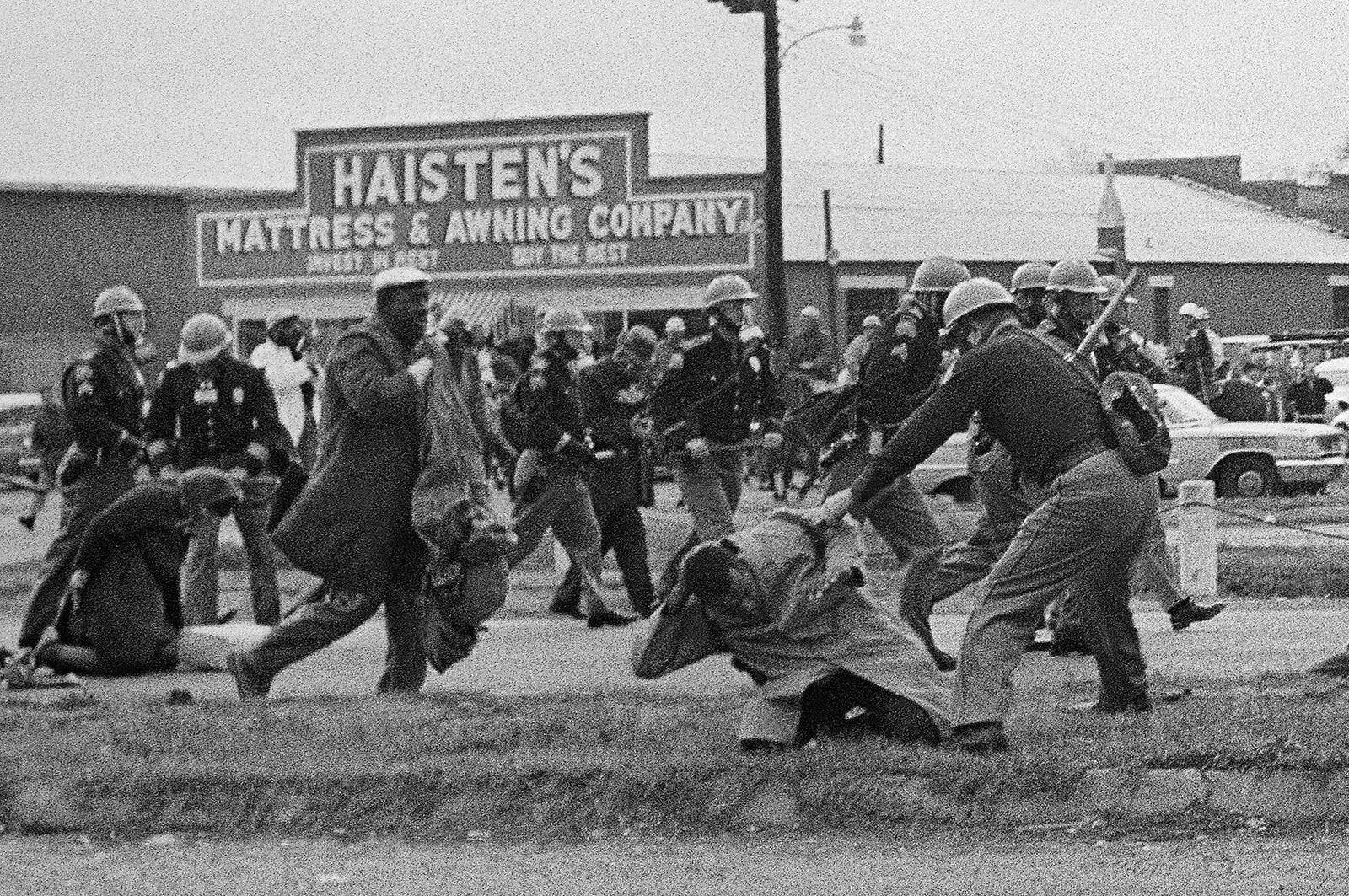
State troopers swing billy clubs to break up a civil rights voting march in Selma, Ala., March 7, 1965, on what became known as Bloody Sunday. (AP Photo, File)
Religious leaders and the Voting Rights Act
Religious leaders were intimately involved in the passage of the Civil Rights Bill of 1964 and the Voting Rights Bill of 1965. Most observers credit their efforts with some of the critical influence in securing the votes necessary for passage. As it turned out, Republican votes were essential for passage. Those working for passage came to realize that it was religious groups that had connections with Republicans that other groups, such as labor groups, did not. This became the high point for religious influence on national legislation in recent eras.
These commitments to civil rights continue today and are reflected in some immediate actions after the Supreme Court issued its opinion. In my denomination, the United Methodist Church, two agencies, the General Board of Church and Society and the General Commission on Religion and Race, issued a joint statement:
“After decades of historically protected equitable political representation,” they said, “the Court’s decision exposes Black, Brown, and Indigenous communities to renewed disenfranchisement. The potential loss of districts and voices from people of color that have been meaningfully represented, is a direct threat to a fair and equitable Democracy.”
They went on to say that “the Voting Rights Act is a testament to the courage of those who marched, prayed, and organized for a more just democracy.”
The GOP was for the minority districts they now are disbanding
The Voting Rights Act of 1965 was signed into law on Aug. 6, 1965. In 1982, Congress passed an amendment prohibiting the drawing of electoral boundaries or the use of other electoral devices that result in a denial or abridgment of the right to vote on account of race or color. In 1986, the Supreme Court in Thornburg v. Gingles concluded that “unlawful dilution of the voting strength of racial minorities may be caused by the dispersal of blacks into districts in which they constitute an ineffective minority of voters or from the concentration of blacks into districts where they constitute an excessive majority.” This led the Reagan Department of Justice to mandate the drawing of minority-majority districts in a state whenever voter dilution was in question.
Instead of seeing this as a threat, Republican Congressman Newt Gingrich saw that if people of color could be “packed” into a few districts, then the other districts in the South were more likely to elect Republicans since Southern whites were increasingly voting Republican. The result was an increase in both people of color representatives and Republican representatives. This was one factor in Republicans winning the House majority in 1994 for the first time in almost 40 years.
So in 1992, 12 new Black members of Congress from the South were elected, bringing the Black House membership to 38 from 26. For most of the 12, they were the first Black representatives from their states since Reconstruction. Now the GOP is rushing to undo a system that served it well in the 1990s. The results could be risky, but the intent is clear.
There continues to be a concentration of Blacks in the South, where over 50% of the Black population lives. This is precisely where state legislatures are already meeting to restructure congressional districts to eliminate Black representation. They claim that the action is strictly political with no reference to race, but that is not credible. In 1967, after passage of the Voting Rights Act of 1965, Robert Clark Jr. became the first Black lawmaker elected to the Mississippi Legislature since Reconstruction. He served until 2004. His son, and successor in the Legislature, said that claiming actions are political and not racial in Mississippi makes no sense when most Black voters are Democrats and most white voters are Republicans. “The two are often indistinguishable,” he said.
A Christian challenge
Christians are called to approach public issues from a different perspective than many advocacy groups. We seek not special treatment or advantage but rather the common good. Methodists seek to follow John Wesley’s example. He offered spiritual and religious reasons for Methodist behavior, but when he approached public officials, he cited the public interest at stake in any actions sought. He strived for what was best for all the people.
Ethicist Walter Muelder once said that “the message of Christianity should throw a searchlight on the actual facts of the existing situation and reveal the concrete consequences of political behavior.” This is a time when public officials need to see this big picture and how their actions will impact the lives of so many others. Christians are called today to point the searchlight.
(Lovett H. Weems Jr. is the Distinguished Professor of Church Leadership emeritus at Wesley Theological Seminary in Washington, D.C., and the author, most recently, of “An Aura of Hope: United Methodism’s Next Chapter in the United States.” A version of this article first appeared on his Substack newsletter, United Methodist Focus. The views expressed in this commentary do not necessarily reflect those of RNS.)
Opinion
161 years after Juneteenth, there is unfinished work of freedom
(RNS) — The forces that threaten freedom continually take new forms.
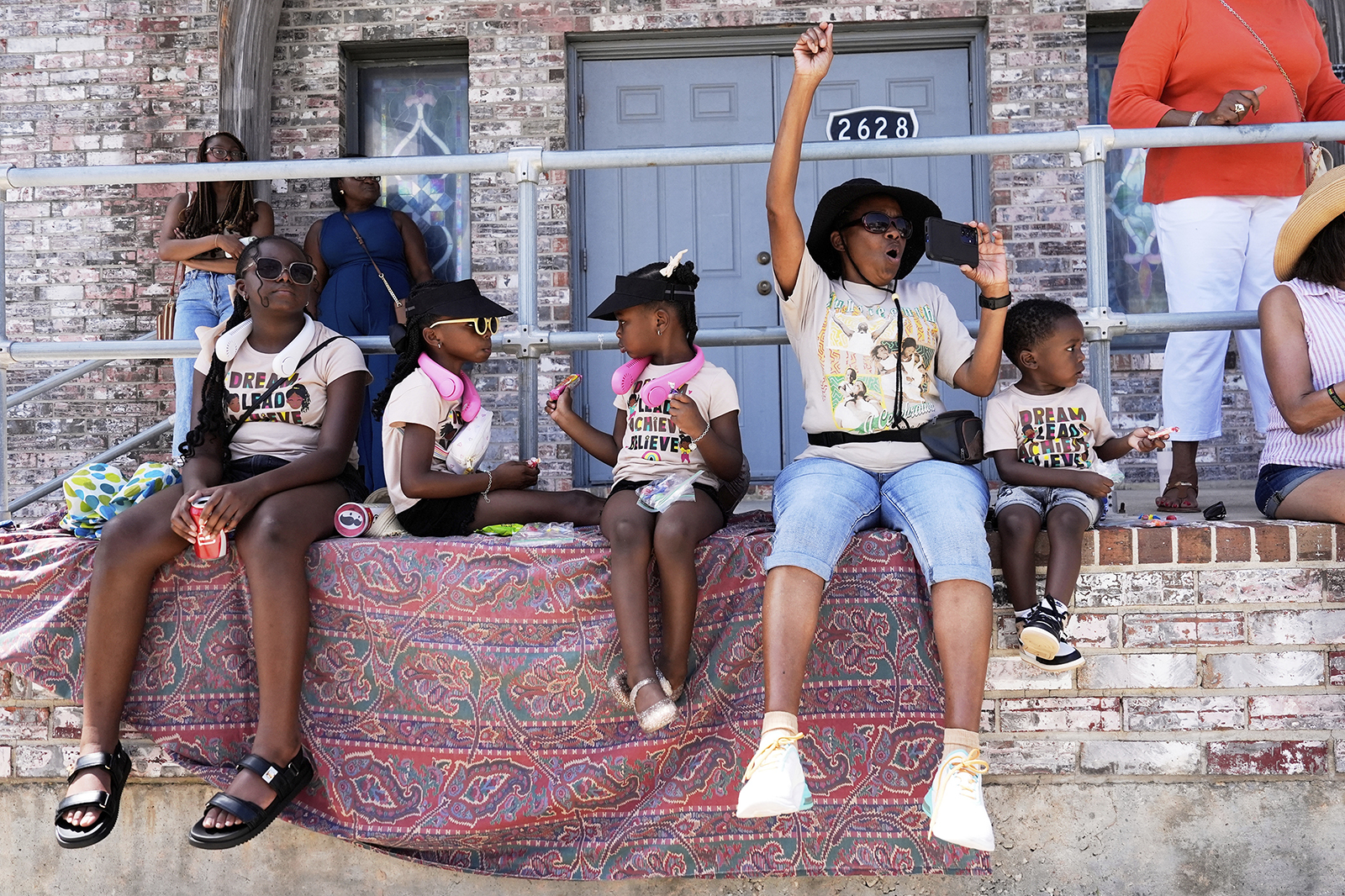
People cheer during a Juneteenth parade, June 19, 2025, in Galveston, Texas.
Kelly Brown Douglas, Stephanie Spellers and Winnie Varghese
June 18, 2026
161 years after Juneteenth, there is unfinished work of freedom
(RNS) — The forces that threaten freedom continually take new forms.
People cheer during a Juneteenth parade, June 19, 2025, in Galveston, Texas.
(AP Photo/David J. Phillip)
Kelly Brown Douglas, Stephanie Spellers and Winnie Varghese
June 18, 2026
RNS
(RNS) — Not every proclamation is true. Some we must struggle and keep the faith to make true.
On June 19, 1865, U.S. Army Maj. Gen. Gordon Granger arrived in Galveston, Texas, and issued General Order No. 3, announcing that “all slaves are free.” He was conveying news of the Emancipation Proclamation, which President Abraham Lincoln had issued two years earlier on Jan. 1, 1863.
Granger’s declaration of freedom was aspirational. While the enslaved were legally emancipated, they remained bound by entrenched systems of white supremacy and enduring prejudices that denied their humanity and reduced them to property. In the years that followed, African Americans continued to live in the “afterlife” of slavery, as new and more insidious shackles emerged.
Vagrancy laws, convict-leasing schemes, debt bondage and the expanding architecture of Jim Crow segregation all served to reproduce many of the conditions of the old slave order under new legal and social guises.
Neither the Emancipation Proclamation nor General Order No. 3 was yet true. Both ushered in a new reality of “unfreedom.” Both expressed the enduring tension within the American freedom experiment itself: the gap between our proclaimed ideals and our lived realities.
This paradox lies at the heart of the American story. It is the story of a nation whose Declaration of Independence announced that “all men are created equal,” even as it restricted the promise of freedom to propertied white men, enslaved more than a fifth of its population, and pursued the genocide of Native peoples.
The story of freedom is unfinished in a nation that pledges “liberty and justice for all,” while it systematically advances policies, practices and ideologies that diminish human dignity.
We know these gaps and indignities too well, as women of color in this nation, and especially as ordained women of color in the Episcopal Church. Our tradition has often mirrored and blessed American systems of white supremacy, elitism and patriarchy. But our tradition also proclaims a commitment to Jesus and to God’s beloved community, where all human beings are sacred.
We are compelled by this faith to name the gap between what our nation promises and what our nation does, to recognize the same gaps and untruths in our own churches and to join in shared struggle to make freedom real.
Here is what we know: Freedom is not an achievement to be declared and celebrated once and for all. The work of freedom is perpetually unfinished because the forces that threaten it continually take new forms, as we see today in restrictions on voting rights, challenges to citizenship and the denial of due process to immigrants.
We know the work of freedom dies when we believe that we are powerless, that we are alone, that certain lives matter less than others, that my gain is your loss, that despair and defeat are inevitable, that not everyone deserves to be free.
But we also know this: No matter what political, social or even religious institutions may proclaim, we are all human beings created in the image of a God who is free. True freedom — God-given freedom — liberates us from illusions of superiority and entitlements of privilege. It calls us beyond the domination and exclusion of any people. Our freedoms are bound up in one another.
Faith does not permit us to be passive observers of history, remaining silent and on the sidelines while others proclaim and enact untruths in the name of God. Indeed, faith compels us to participate in God’s liberating work in the world. Faith calls us to lead the struggle for freedom. Faith propels us to refuse to be divided against one another.
Faith urges us to attend to our well-being, to nourish our capacity to risk together, and to shield our joy so we can stay in the struggle. Faith demands that we proclaim freedom in word and in deed.
As our nation marks 161 years since the proclamation of emancipation to enslaved peoples — and as the 250th anniversary of the Declaration of Independence approaches — we can never forget that freedom remains unfinished business. We have soul work to do and truths to proclaim and make real.
The truth is, we must be honest about our history as a nation and church — we cannot heal what we have not named.
The truth is, all institutions — political, social and religious — must work for the freedom of all people.
The truth is, every form of oppression is a desecration of the image of God.
The truth is, we are endowed by our Creator with freedom, love and power that the world cannot take away.
The truth is, until all God’s children can live with dignity, justice and genuine freedom, the 1865 Juneteenth proclamation is not yet true.
This Juneteenth, we recommit with you to the work of making it true.
(The Rev. Kelly Brown-Douglas, the former dean and interim president of the Episcopal Divinity School, is a visiting professor of theology at Harvard Divinity School. The Rev. Canon Stephanie Spellers is an author and Episcopal priest. She was canon to former Presiding Bishop Michael Curry and will become priest-in-charge of St. Gregory of Nyssa in San Francisco this summer. The Very Rev. Winnie Varghese is dean of the Episcopal Cathedral of St. John the Divine in New York. The opinions expressed in this commentary do not necessarily reflect those of Religion News Service.)
(RNS) — Not every proclamation is true. Some we must struggle and keep the faith to make true.
On June 19, 1865, U.S. Army Maj. Gen. Gordon Granger arrived in Galveston, Texas, and issued General Order No. 3, announcing that “all slaves are free.” He was conveying news of the Emancipation Proclamation, which President Abraham Lincoln had issued two years earlier on Jan. 1, 1863.
Granger’s declaration of freedom was aspirational. While the enslaved were legally emancipated, they remained bound by entrenched systems of white supremacy and enduring prejudices that denied their humanity and reduced them to property. In the years that followed, African Americans continued to live in the “afterlife” of slavery, as new and more insidious shackles emerged.
Vagrancy laws, convict-leasing schemes, debt bondage and the expanding architecture of Jim Crow segregation all served to reproduce many of the conditions of the old slave order under new legal and social guises.
Neither the Emancipation Proclamation nor General Order No. 3 was yet true. Both ushered in a new reality of “unfreedom.” Both expressed the enduring tension within the American freedom experiment itself: the gap between our proclaimed ideals and our lived realities.
This paradox lies at the heart of the American story. It is the story of a nation whose Declaration of Independence announced that “all men are created equal,” even as it restricted the promise of freedom to propertied white men, enslaved more than a fifth of its population, and pursued the genocide of Native peoples.
The story of freedom is unfinished in a nation that pledges “liberty and justice for all,” while it systematically advances policies, practices and ideologies that diminish human dignity.
We know these gaps and indignities too well, as women of color in this nation, and especially as ordained women of color in the Episcopal Church. Our tradition has often mirrored and blessed American systems of white supremacy, elitism and patriarchy. But our tradition also proclaims a commitment to Jesus and to God’s beloved community, where all human beings are sacred.
We are compelled by this faith to name the gap between what our nation promises and what our nation does, to recognize the same gaps and untruths in our own churches and to join in shared struggle to make freedom real.
Here is what we know: Freedom is not an achievement to be declared and celebrated once and for all. The work of freedom is perpetually unfinished because the forces that threaten it continually take new forms, as we see today in restrictions on voting rights, challenges to citizenship and the denial of due process to immigrants.
We know the work of freedom dies when we believe that we are powerless, that we are alone, that certain lives matter less than others, that my gain is your loss, that despair and defeat are inevitable, that not everyone deserves to be free.
But we also know this: No matter what political, social or even religious institutions may proclaim, we are all human beings created in the image of a God who is free. True freedom — God-given freedom — liberates us from illusions of superiority and entitlements of privilege. It calls us beyond the domination and exclusion of any people. Our freedoms are bound up in one another.
Faith does not permit us to be passive observers of history, remaining silent and on the sidelines while others proclaim and enact untruths in the name of God. Indeed, faith compels us to participate in God’s liberating work in the world. Faith calls us to lead the struggle for freedom. Faith propels us to refuse to be divided against one another.
Faith urges us to attend to our well-being, to nourish our capacity to risk together, and to shield our joy so we can stay in the struggle. Faith demands that we proclaim freedom in word and in deed.
As our nation marks 161 years since the proclamation of emancipation to enslaved peoples — and as the 250th anniversary of the Declaration of Independence approaches — we can never forget that freedom remains unfinished business. We have soul work to do and truths to proclaim and make real.
The truth is, we must be honest about our history as a nation and church — we cannot heal what we have not named.
The truth is, all institutions — political, social and religious — must work for the freedom of all people.
The truth is, every form of oppression is a desecration of the image of God.
The truth is, we are endowed by our Creator with freedom, love and power that the world cannot take away.
The truth is, until all God’s children can live with dignity, justice and genuine freedom, the 1865 Juneteenth proclamation is not yet true.
This Juneteenth, we recommit with you to the work of making it true.
(The Rev. Kelly Brown-Douglas, the former dean and interim president of the Episcopal Divinity School, is a visiting professor of theology at Harvard Divinity School. The Rev. Canon Stephanie Spellers is an author and Episcopal priest. She was canon to former Presiding Bishop Michael Curry and will become priest-in-charge of St. Gregory of Nyssa in San Francisco this summer. The Very Rev. Winnie Varghese is dean of the Episcopal Cathedral of St. John the Divine in New York. The opinions expressed in this commentary do not necessarily reflect those of Religion News Service.)

No comments:
Post a Comment