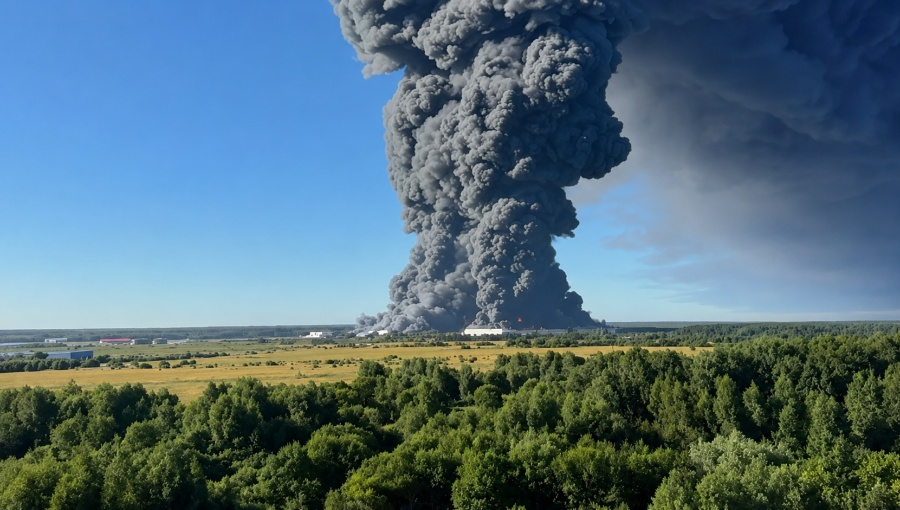
Ukrainian drone strikes on two of Wildberries’ largest warehouses could leave Russia’s biggest online marketplace and its merchants facing losses of more than RUB100bn ($1.28bn), with independent sellers expected to bear the greater part of the damage, The Bell reported on July 20.
The attacks overnight at the weekend struck logistics centres in Elektrostal, east of Moscow, and Kotovsk in the Tambov region. Seven night-shift workers were killed in Kotovsk and another person later died after the Elektrostal attack, while more than 80 people were injured, according to Russian officials. Fires continued at the Elektrostal complex for more than a day.
The two centres formed an important part of Wildberries’ distribution system as well as providing a platform for the businesses of thousands of entrepreneurs. The Elektrostal facility was a principal hub serving Moscow and its surrounding region, while Kotovsk was a recently opened, highly automated regional centre capable of holding as many as 54mn items.
Using a conservative estimate of 250,000 square metres for Elektrostal and 108,000 square metres for Kotovsk, the facilities represented about 7% of the logistics estate of Wildberries and Russ, the merged group known as RWB, The Bell reported. The company had more than 200 logistics sites covering 5.2mn square metres at the end of 2025. Some estimates put the full Elektrostal complex at more than 360,000 square metres, implying that the affected share could be larger.
The loss will not paralyse Wildberries’ operations, but it is likely to put severe pressure on deliveries around Moscow, its most important market, and force the company to reroute millions of items through more distant warehouses.
The Bell estimated that rebuilding the two facilities alone could cost between RUB21bn and RUB35bn ($268mn-$447mn), based on construction costs of RUB60,000-RUB100,000 ($766-$1,277) per square metre. That calculation excludes the value of equipment, destroyed merchandise, lost revenue, logistics disruption and any compensation paid to merchants.
The direct cost should be manageable for RWB, which reported RUB175bn ($2.23bn) in net profit and gross merchandise value of RUB6.1tn ($77.9bn) in 2025. The group invested more than RUB310bn ($3.96bn) in logistics, IT infrastructure and new businesses during the year.
Merchants hit hardest
The larger financial threat falls on Wildberries’ sellers, many of which stored most or all of their inventory at Elektrostal.
“For many, Elektrostal served as their primary warehouse; for some sellers, the loss of goods spells the total collapse of their business and irreparable financial damage,” The Bell said.
Kirill Agapov, managing partner of Umbrella Consulting Group, told The Bell he estimated that combined losses from the two warehouse fires would exceed RUB100bn ($1.28bn), with merchants carrying most of the burden.
The previous large Wildberries warehouse fire provides a guide to the possible bill. A blaze at Shushary near St Petersburg in January 2024 caused an estimated RUB10bn-RUB12bn ($128mn-$153mn) of direct damage. Wildberries subsequently paid sellers RUB34.9bn ($446mn), covering about 95% of the assessed losses on their goods.
Applying a similar ratio to Elektrostal and Kotovsk would produce a compensation bill several times greater than the cost of reconstructing the buildings.
Wildberries has not disclosed the value of inventory destroyed or the extent of its insurance coverage. The Shushary case is not a clear precedent: the warehouse itself was widely reported to lack adequate property insurance, although Tatyana Kim, Russia’s richest woman and Wildberries’ co-founder and chief executive, later said that goods had been insured while in storage and transit.
Insurance coverage among sellers appears to be extremely limited. Insurance industry sources cited by Kommersant estimated that only 5-7% of Wildberries merchants had obtained their own policies, and that only 10-20% of those policies covered sabotage or military-related damage.
New terms and conditions
The uncertainty has been intensified by a change to Wildberries’ standard seller agreement that took effect on July 7, just 11 days before the attacks. The new terms exempt the company from liability for losses caused by “force majeure”, explicitly including artillery fire, drone and missile attacks, military equipment, political protests, strikes and riots.
Wildberries therefore appears to have no contractual obligation to reimburse merchants. However, Kim has said that the company is nevertheless working on compensation.
“Despite the emergency and the absence of an obligation to compensate for lost goods, we are already working out the volume of payments to sellers and other financial-support measures,” she said.
Kim said the company would conduct an “assessment to determine the payout amount for our sellers”, which could take as long as 30 days.
Initial measures fall short of direct compensation. Wildberries has offered temporary discounts on storage charges, free transfers of merchandise to some regional warehouses and accelerated payments of sales revenue.
WB Bank will provide affected small and medium-sized companies with up to six months’ deferral on debt repayments, as well as preferential loans. The bank has also said it will consider requests from affected merchants as a priority.
For sellers whose entire working capital was tied up in stock at Elektrostal, additional borrowing may only postpone insolvency. One electronics merchant said he had lost PlayStation consoles with a retail value of RUB10mn-RUB12mn ($128,000-$153,000) and was selling his car for RUB2.8mn ($36,000) to finance replacement inventory. Another seller said the combined effect of higher commissions and the warehouse losses had made trading through Wildberries commercially unviable.
Politically sensitive
The compensation decision has also become politically sensitive ahead of Russia’s State Duma elections on September 20. Wildberries provides the main route to market for tens of thousands of small manufacturers, importers and retailers, many of which could struggle to survive without assistance.
Even the state television programme Vesti Nedeli described Wildberries as a “people’s” business, claiming that Ukraine had targeted it to “pressure Russians with Western support” and cause “problems, including a psychological reaction among the public”.
Wildberries is unlikely to commit its entire annual profit to compensation. But transferring most of the losses to sellers risks bankruptcies, litigation and an exodus of merchants to rival marketplaces or their own distribution channels.
The attacks have exposed a structural weakness in the marketplace model: Wildberries controls the warehouses and logistics network, but much of the merchandise — and therefore much of the financial risk — belongs to its partners.
The goal of Bankova, Ukraine’s presidential administration, was likely to be exactly this: bring the war in Ukraine into the homes of regular Russians, who Russian President Vladimir Putin has been careful to insulate from his war until now. In a sign of how painful the warehouse strike was, Russia unleashed one of its most intense missile barrages on Kyiv the following day as the tit-for-tat missile war continues to intensify.
Turkish readywear retailer Koton’s stock damaged by Ukrainian bombing of Wildberries warehouses in Russia
Inventory of Turkish fashion retailer Koton (KOTON) held at fulfillment centres belonging to Russian ecommerce giant Wildberries has been damaged by Ukrainian drone attacks, Koton said on July 20.
The apparel group said the damaged stocks at two major Wildberries logistics facilities was equivalent to 0.4% of its total assets as of end-Q1.
The logistics hubs operated by Russia’s leading ecommerce platform, owned by Ozon (Moscow/OZON), were struck during aerial attacks on July 17.
Koton said the incident would not exert a material impact on its financial position, ongoing operations or business continuity.
Wildberries is currently conducting comprehensive damage assessment procedures at the affected sites and it has pledged support measures for impacted vendor partners. Koton noted that it is actively pursuing indemnity claims under its existing property and cargo insurance policies, working in close coordination with local and regional insurance brokers to recover losses.
Exodus of Western brands
Following the exodus of Western retailers from Russia in the wake of the Kremlin's February 2022 full-scale invasion of Ukraine, Turkish apparel chains stepped in aggressively to expand into vacated commercial spaces and digital marketplaces across Russia.
Wildberries serves as the central digital distribution backbone for foreign apparel and consumer goods imported into Russia, making it a critical sales channel for Turkish brands navigating Russian consumer demand.
In April, Koton ended store operations by closing its two locations in Ukraine and decided to continue operations in the country via online channels.
War in the north, war in the south
Koton has also been expanding into the Gulf Cooperation Council (GCC) region, which is imperilled by the continuing Iran War. On July 16, the company said that it launched a third store in Oman in addition to a fourth store in Qatar.
The company also operates stores in Saudi Arabia, the UAE and Bahrain.
So far, the company’s GCC stores remain unaffected by the conflict.
In March, the company launched its seventh franchise store in Azerbaijan. In December, it opened its sixth store in Hungary.
As of end-March, Koton operated 464 stores, including 226 franchise stores. A total of 226 stores were abroad, including 76 franchise stores.
Koton, launched in 1988, opened its first stores in the Middle East, Russia and Balkans in 2002.
The tit-for-tat missile war escalated at the weekend after Ukraine hit the largest distribution centre belonging to Wildberries, the “Amazon of Russia.” The Kremlin hit back the next day with a massive drone and missile barrage.
The war has entered a new and brutally destructive phase with both sides adopting a “punishment strategy” – both are deliberately targeting civilian infrastructure and assets with the intention of just making people’s lives hell.
Zelenskiy was careful to say that Wildberries sells things like drone parts and both Wildberries, and its Ukrainian equivalent Nova Poshta, are used by regular people to send their men at the front care packages and supplies.
Zelenskiy claims the military supply component makes the Wildberries’ warehouse a legitimate military target, but we all know what is going on here: the AFU just wants to bring the war into the homes of regular Russians, who have been largely insulated from the effects until now. Pictures coming out of Moscow over the weekend show a huge black cloud over the city leading people to quip that it looks like Mordor.
But destroying the Wildberries’ warehouse is actually a lot more painful than it first appears. Wildberries became not only the largest e-commerce site in Russia, but the largest retail outlet of any kind in 2019 when it overtook Sportsmaster, the previous leader. The destruction of its stockpile is not just going to make shopping harder, it has also destroyed the livelihoods of thousands of SMEs that have already been struggling due to the sharp economic slowdown this year.
People (and the sanctions) focus on Russia’s oil wealth, but as I detailed in a piece way back in 2004, Russia is a “Soviet Sandwich” – there is a top piece of tasty and nutritious bread that is the oil and gas sector, but there is also a bottom piece equally appealing that is the retail sector. The middle was made up of greasy, grislily, and unhealthy pink processed and unreformed Soviet industrial sausage meat. There is a reason why half of all Russia’s imports over the last three decades has been machinery.
People forget how vast Russia’s consumer market is: 150mn gadget- and fashion-hungry punters. That is half as big again as Germany, the second most populous country in Europe. Pre-war retail turnover was approaching half a trillion dollars – about one third of GDP. This is why companies like Auchan and Raiffeisen Bank International (RBI) refuse to leave the Russian market – when I was at the EIU companies told me that not only was Russia their biggest market in terms of headcount, but also their most profitable, because the barriers to entry were so high, that pushed up the profit margins.
The upshot is amongst my Russian friends from the 1990s, anyone that had any good idea for any product or service, quickly became a millionaire, simply because the market is vast.
Light manufacturing Which brings us to Wildberries and why it is so successful. The second unusual factor that plays into this equation is not only is the consumer market vast, but so is the country. To get your goods to punters you have to send them over huge distances – literally halfway across the planet if a Moscow widget-maker sells something to a customer in Vladivostok.
Companies like Wildberries, and its rival Ozon (see my 2019 interview with the boss here), stepped into the breach here and have set up marketplaces which have become the basis of a flourishing micro-economy. But crucially they also set up the logistics distribution network. As Ozon CEO Alexander Shulgin told me: “Someone that makes nice chairs used to only be able to sell them to people in his town or city. What we do is open up the whole country to these craftsmen.” The way it works is you make your wooden stylish chair and drop it off at the local distribution centre (or they come and pick it up) but once it goes online and is sold, Wildberries or Ozon take over and will send it anywhere in the country, as well as taking care of billing and collection. Suddenly a small shop in Ryazan has access to 150mn people.
This is Germany’s Mittelstand with knobs on. The German version is thousands of small firms that make things like specialist high precision engineering goods or machines that they sell to bigger companies. The Russian version is much broader and is largely B2C rather than Germany’s B2B.
In other words, we are talking about jobs for regular people. The online marketplaces make it even easier to invent yourself as an entrepreneur in Russia than in Germany, and a very successful one at that if you have a good product.
This process has also been fuelled in a fundamental change in the cost of production. A great example and early success story was Obuv Rossii, a Siberian shoe shop, catering to the middle classes. The CEO, Anton Titov, told me that he used to have his shoes made in China, but after a decade of growth, Chinese wages grew at the same time as the ruble devalued to the point where it became cheaper to make things in Russia. China stopped being the world’s factory, as Chinese President Xi Jinping switched from an export-led economic model to a consumption-led one. This led to an explosion of light-weight manufacturing investment that was catalysed by online market places which appeared at exactly the right time to solve the very serious marketing and distribution problems overnight. In many ways Russia’s online sector has leapfrogged western retail which still relies on bricks and mortar chains on the high street.
Russia is physically so big, and the cities so spread out, that the physical distribution and shop networks make a lot less sense as they are so much more expensive. The heart of the online marketplace revolution is that a handful of leading companies have basically concentrated Russia’s entire logistics into a few centrally controlled systems that cover the whole range of products to make it as efficient as possible and have the economies of scale. The same is true to Ukraine’s Nova Poshta, probably the best company in the country.
Russia skipped over the light manufacturing stage in 1991. Usually, emerging markets get their first shot in the arm after the transition by attracting light manufacturing foreign direct investment (FDI) because wages are so low. But in Russia’s case the so-called Dutch disease of a heavily overvalued currency, thanks to oil and gas exports, meant that the cost of labour was too high, adding to the pain of the Yeltsin-era chaos. When I arrived in Moscow in 1993, despite the fact the economy had collapsed about a year earlier, the city was insanely expensive.
Belatedly, the light manufacturing boom finally took off nearly 20 years after the collapse of central planning. The tasty bottom layer of bread in the Soviet sandwich is also part of the reason the Russian economy has been so robust in the last few years as it can’t be sanctioned. VAT is the biggest contributor to budget revues (40%), far more than oil & gas (25%). How do you sanction retail sales that happen entirely inside the Russian economy and rely on no imports? That’s the whole point of local light manufacturing: it only uses Russian inputs to keep things cheap.
And there is the rub. Not only did Ukraine blow up a retail distribution hub so it will be harder to get your groceries this week in Moscow, but it also blew up the stock of thousands of small entrepreneur businesses. This has wrecked not just their jobs, but many of these small businesses have sunk life savings into funding their production in an effort to grow. I have seen reports of one woman that had invested $25,000 into her children’s clothes production and all her capital was tied up in inventory – all stored in the Wildberries’ Elektrostal logistics centre. She will have to go back to scratch and start all over again, carrying some heavy debt.
That is why Zelenskiy’s decision to hit the warehouse is so painful. He has chosen a target that is in many ways more painful for the economy than blowing up the oil terminals at Primorsk and Ust-Luga last month, not because it will hurt the budget, but because it will hurt a big source of employment for regular people. It was a lot more painful than it first appears as it hit a part of economy that was flourishing.
It was only one warehouse, but that is the main feature of the escalating missile war: both sides are now hitting warehouses, supermarket, delivery trucks and transport hubs. For example, Russia has started to systematically target Ukraine’s petrol stations. There are hundreds of these, but Russia is producing millions of drones. It will slowly wear Ukraine’s ability to put fuel in cars in the same way that Ukraine has already caused a fuel crisis by targeting Russian oil refineries. Soon just getting your shopping could become hard too. And currently the plan is to continue the war for two more years.

No comments:
Post a Comment