‘A formidable predator’: Italian scientists relying on octopuses to get blue crab populations in check
The Italian government has previously been urged to declare a state of emergency over the blue crab explosion, fuelled by climate-warmed waters.
Italian scientists have become octopus breeders in the latest battle of a long running war against invasive blue crabs. Known for their sharp, blue-tinted claws the creatures are estimated to have wreaked €200 million worth of damage on the fishing industry.
From a fishing trawler in the Adriatic, the scientists gently release thousands of tiny octopuses in the hope of fighting an invasive crab species that has devastated local fisheries.
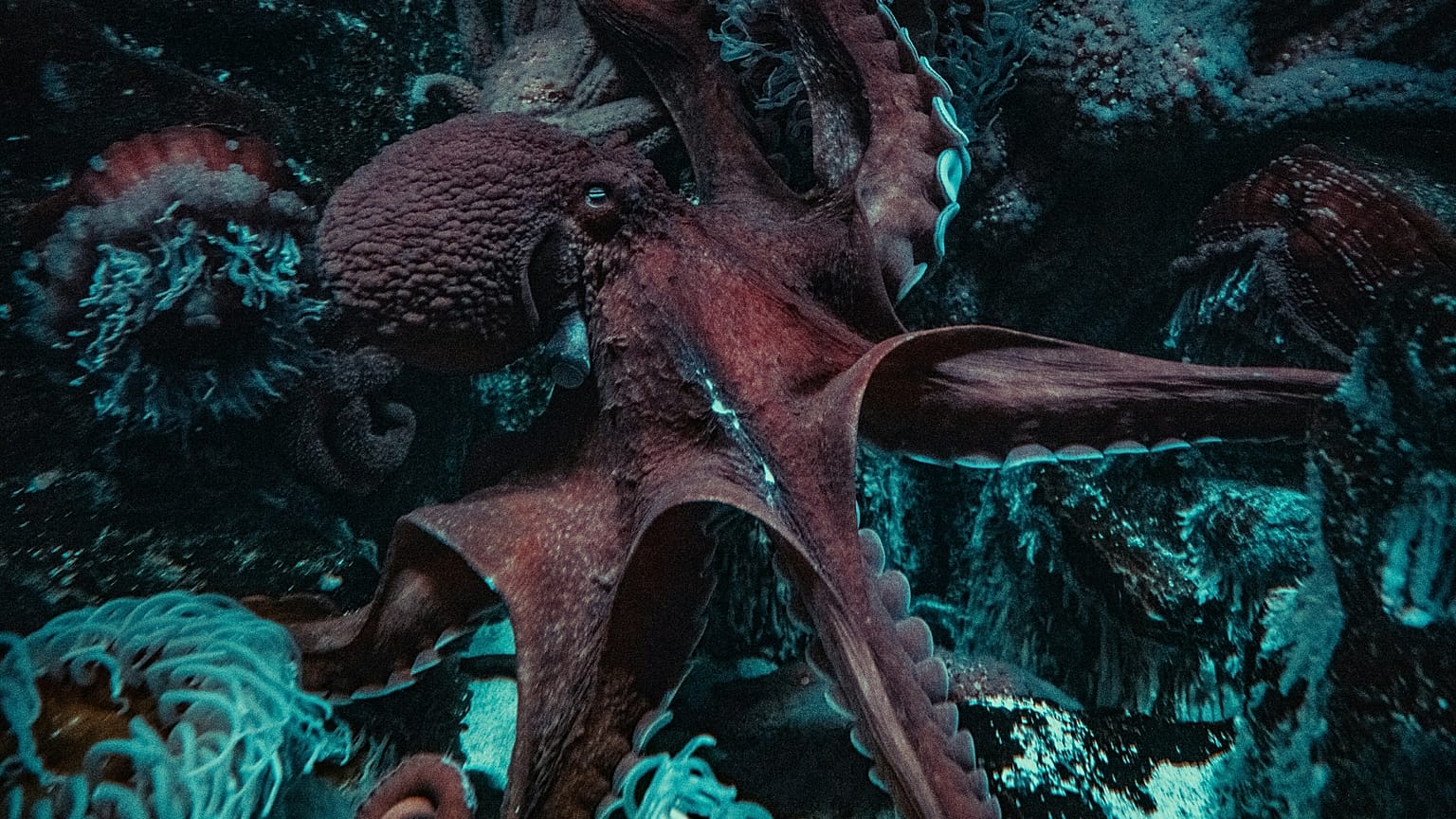
"We chose the octopus because, in the wild, it is a formidable predator of crustaceans," Antonio Casalini, one of the researchers, told the AFP news agency.
Italian scientists have become octopus breeders in the latest battle of a long running war against invasive blue crabs. Known for their sharp, blue-tinted claws the creatures are estimated to have wreaked €200 million worth of damage on the fishing industry.
From a fishing trawler in the Adriatic, the scientists gently release thousands of tiny octopuses in the hope of fighting an invasive crab species that has devastated local fisheries.
"We chose the octopus because, in the wild, it is a formidable predator of crustaceans," Antonio Casalini, one of the researchers, told the AFP news agency.
A single blue crab lays millions of eggs
Native to the North American Atlantic coast, blue crabs arrived in the Mediterranean decades ago, likely transported via ballast water from ships. But in 2023 their numbers exploded, obliterating the seafood Italy’s Po Delta is famous for, like mussels, ‘vongole veraci’ - a species of clam - and pink oysters.
The suspected culprit is climate change. “With warming waters, the crabs have become more active and voracious,” fisherman Bellan told news agency AP in 2023. When the temperature of the water drops, the crabs eat and reproduce less, but recently the opposite has occurred.
“Usually, at certain times of the year, when the water drops below 10°C, this crab does not live well, but now finds the ideal temperature 12 months of the year,” said Enrica Franchi, a marine biologist at the University of Siena.
Since then authorities and fishing lobbies have been looking for ways of using and disposing of the shellfish - including sending container loads to the US where it is considered a delicacy.
Authorities in Bologna's Emilia-Romagna region said last year the species has caused almost €17 million in damages there since 2022.
Farming and fishing group Coldiretti has put the figure at about €200 million for the whole of Italy, with the northern Veneto region also badly affected.
"It eats everything including young clams lying on the seabed," Davide Sanulli, a fisherman and mussels farmer with thick eyebrows and grizzled hair, says of the crab.
Excellent swimmers and weighing up to a kilogram, the crabs have few natural predators - something the researchers are hoping to change.
Native to the North American Atlantic coast, blue crabs arrived in the Mediterranean decades ago, likely transported via ballast water from ships. But in 2023 their numbers exploded, obliterating the seafood Italy’s Po Delta is famous for, like mussels, ‘vongole veraci’ - a species of clam - and pink oysters.
The suspected culprit is climate change. “With warming waters, the crabs have become more active and voracious,” fisherman Bellan told news agency AP in 2023. When the temperature of the water drops, the crabs eat and reproduce less, but recently the opposite has occurred.
“Usually, at certain times of the year, when the water drops below 10°C, this crab does not live well, but now finds the ideal temperature 12 months of the year,” said Enrica Franchi, a marine biologist at the University of Siena.
Since then authorities and fishing lobbies have been looking for ways of using and disposing of the shellfish - including sending container loads to the US where it is considered a delicacy.
Authorities in Bologna's Emilia-Romagna region said last year the species has caused almost €17 million in damages there since 2022.
Farming and fishing group Coldiretti has put the figure at about €200 million for the whole of Italy, with the northern Veneto region also badly affected.
"It eats everything including young clams lying on the seabed," Davide Sanulli, a fisherman and mussels farmer with thick eyebrows and grizzled hair, says of the crab.
Excellent swimmers and weighing up to a kilogram, the crabs have few natural predators - something the researchers are hoping to change.
Octo-Blu: Octopus hatchlings destined for artificial dens underwater
A team from University of Bologna is betting that the common octopus can help contain the burgeoning population of blue crab - a voracious crustacean that has ravaged shellfish production in the Adriatic.
Launched last year and funded by the Emilia-Romagna region, the ‘Octo-Blu’ project seeks to increase octopus numbers as a counterweight to the hard-shelled invaders.
The team breeds octopus hatchlings in white water tanks at a lab in the port town of Cesenatico. When ready, the tiny invertebrates are scooped out by the thousands into a large plastic bag and taken out to sea, sometimes using Sanulli's rugged blue fishing boat.
The hatchlings are then released near underwater reefs where the group has laid cement-and-clay artificial dens to help the octopuses thrive.
Some 80,000 have been let out since June, a figure the research team is seeking to double by the end of August, hoping to see a few grow into fully developed octopuses.
"The idea is to establish a small community close to shore so that it can better combat the spread of the blue crab," says Casalini, an aquaculture technician.
A team from University of Bologna is betting that the common octopus can help contain the burgeoning population of blue crab - a voracious crustacean that has ravaged shellfish production in the Adriatic.
Launched last year and funded by the Emilia-Romagna region, the ‘Octo-Blu’ project seeks to increase octopus numbers as a counterweight to the hard-shelled invaders.
The team breeds octopus hatchlings in white water tanks at a lab in the port town of Cesenatico. When ready, the tiny invertebrates are scooped out by the thousands into a large plastic bag and taken out to sea, sometimes using Sanulli's rugged blue fishing boat.
The hatchlings are then released near underwater reefs where the group has laid cement-and-clay artificial dens to help the octopuses thrive.
Some 80,000 have been let out since June, a figure the research team is seeking to double by the end of August, hoping to see a few grow into fully developed octopuses.
"The idea is to establish a small community close to shore so that it can better combat the spread of the blue crab," says Casalini, an aquaculture technician.
Some argue seabass would be more effective predators
The project has some clear drawbacks.
The common octopus is not prone to live in the sandy, warm waters typical of the lagoon areas where the blue crab is making the most damage, making its potential impact there negligible - something the researchers are well aware of.
Other experts have suggested that seabass could be more effective at crab-fighting and the Bologna University team is also looking at eels, which are avid eaters of crustacean eggs, to complement the octopus's efforts.
Yet, if replicated, the pilot could still help limit blue crab numbers and the related impact on the Adriatic coast's marine environment, Casalini says.
"Blue crabs have an incredible reproductive potential and fertility rate," says Pietro Emmanuele, another University of Bologna researcher, noting a single crab lays millions of eggs, most of which hatch.
Although only some hatchlings reach adulthood, were an octopus to catch even a single female, it would make a difference, he says.
The project has some clear drawbacks.
The common octopus is not prone to live in the sandy, warm waters typical of the lagoon areas where the blue crab is making the most damage, making its potential impact there negligible - something the researchers are well aware of.
Other experts have suggested that seabass could be more effective at crab-fighting and the Bologna University team is also looking at eels, which are avid eaters of crustacean eggs, to complement the octopus's efforts.
Yet, if replicated, the pilot could still help limit blue crab numbers and the related impact on the Adriatic coast's marine environment, Casalini says.
"Blue crabs have an incredible reproductive potential and fertility rate," says Pietro Emmanuele, another University of Bologna researcher, noting a single crab lays millions of eggs, most of which hatch.
Although only some hatchlings reach adulthood, were an octopus to catch even a single female, it would make a difference, he says.

No comments:
Post a Comment