Ambrey Takes On Salvage of Wrecked Tanker off Oman
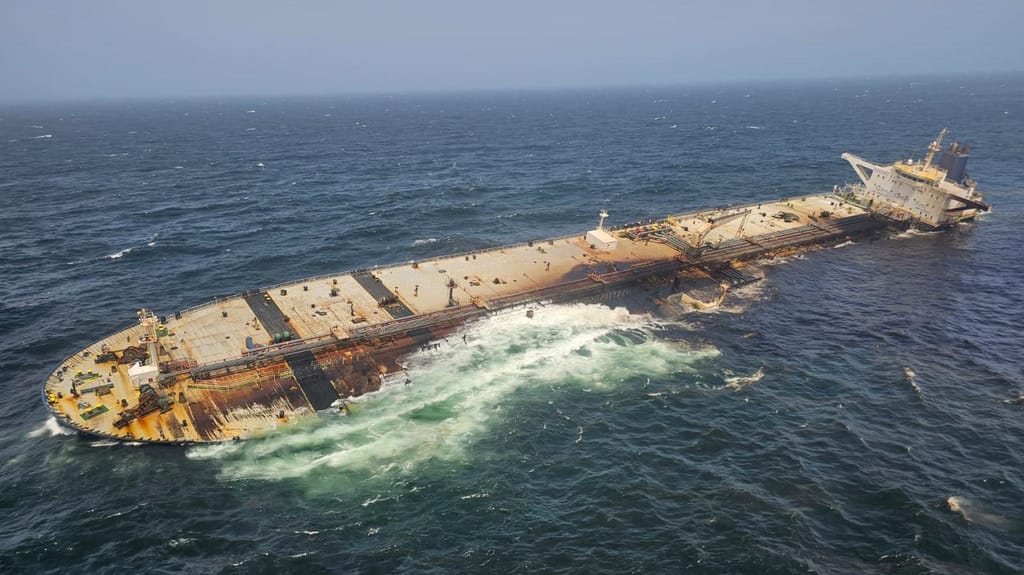
Maritime response company Ambrey has been hired by undisclosed parties for an effort to salvage the wrecked tanker Caroline Bezengi, which drifted aground in June in the Hallaniyat Islands, off the southeastern coast of Oman.
The initiating incident occurred June 8 when an explosion disabled the shadow fleet Suezmax tanker off the coast of Yemen. An effective towing response was not initiated, and the ship drifted northeast with the monsoon winds for several weeks until she grounded on June 30 on Al Qibliyah Island.
The anonymous Chinese owner and (potentially fraudulent) insurer have failed to step forward to pay for a full-scale response - a cost which could ordinarily be expected to run to nine figures.
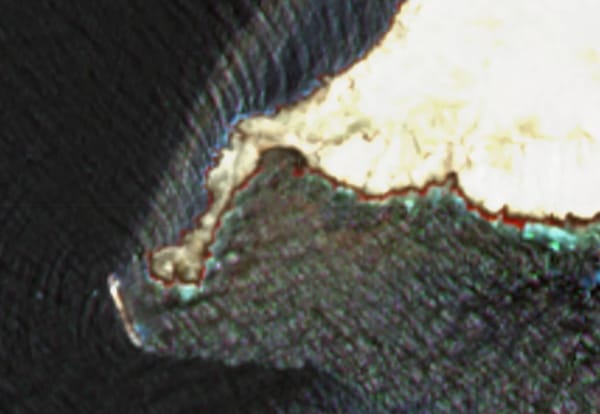
Caroline Bezengi and her spreading oil slick, lower left, August 12 (False color / Copernicus-2)
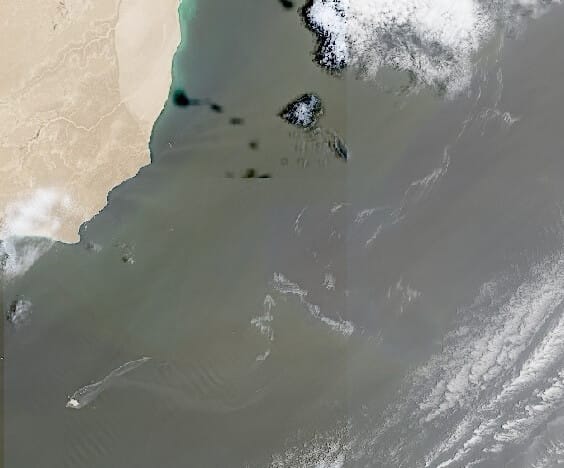
A long, sinuous slick from Caroline Bezengi drifts northeast along Oman's coastline, August 12 (Copernicus-2)
Ambrey has accepted the job and is working with the Sultanate of Oman and subcontracted salvors (not named) to complete the project. Specialists have been on board and assessed the vessel, with logistics assistance from Oman's air force, the consultancy said.
While the ship appears to be grounded on rocks forward, there are outcrops off the port side which could also catch the ship if it shifted. There are also exposed rocks 500 yards off the stern of the ship. TME understands that there has not yet been a catastrophic failure, nor apparently a major breach in the cargo tanks on the ship, all but one of which were full when the ship went aground.
As expected from weather data and satellite imaging, conditions on scene are "extremely challenging" with "extreme adverse weather and sea conditions" from the annual Khareef monsoon season, Ambrey reported. Sea state can be the determining factor in salvage, affecting the responders' basic ability to operate on scene as well as the condition of the wreck. The wave action has an ongoing effect on the Bezengi's stability, the safety of the operation and the access to the site, Ambrey confirmed.
"We have deployed the leading experts in each aspect of the response and have mobilized the appropriate supporting equipment, aircraft and vessels. We are working around the clock to mitigate the environmental impact of the situation. Ambrey is grateful for the support of the Omani state, including the Ministry of Transport, Communications and Information Technology, the Environment Authority and the RAFO, which continues to be outstanding," said director of global response Ed Wollaston.
Ambrey appears to have identified and mobilized the assets it will need to implement its plan, and is likely to establish a forward operating base on the airfield on the largest of the Hallaniyat Islands, from which salvage crews can be flown directly onto the Caroline Bezengi by helicopter every day. Sea states make this the only feasible way of boarding the Caroline Bezengi in current sea states.
It appears likely that the costs of the operation will be offset by selling the cargo, which at prevailing prices after de-watering could command about $50 million.
Although there have been reports of some oil coming ashore, the currents have again shifted to a more easterly direction, taking the bulk of the oil plume directly out into the Arabian Sea. The oil at present is clumping, reflecting both the heavy seas and the as-yet small amounts of oil leaking out of the wreck.
Two More Tankers Attacked in the Strait of Hormuz
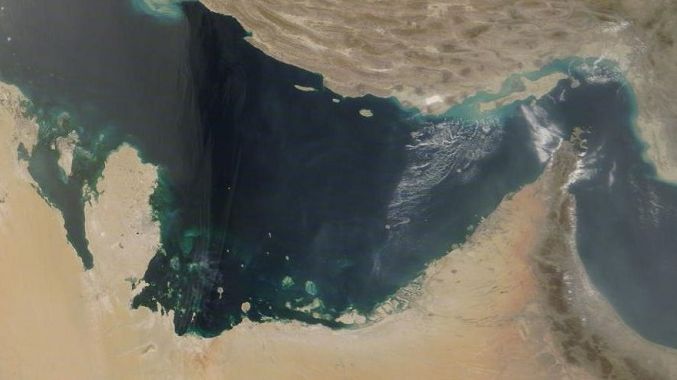
Two tankers were attacked in the Strait of Hormuz overnight Thursday, according to UKMTO and UAE state oil company Adnoc. It was the latest round of strikes instigated by Iran in an attempt to reinforce Iranian control of the strait, and the latest in a long string of attempts to halt Adnoc's shipping operations.
At about 1550 hours UTC, military authorities in the region informed UKMTO that a tanker was hit in the strait during an outbound transit. The vessel sustained only minor damage, and the crewmembers were unharmed.
In a later statement, the UAE foreign ministry said that two vessels - not one - had been attacked during transits of the Strait of Hormuz. The ministry said that the strikes were a "flagrant violation" of a UNSC resolution affirming freedom of navigation, and called Iran's repeated ship attacks "a tool of economic coercion or blackmail" and an "act of piracy." The ministry pointed to the Islamic Revolutionary Guard Corps - the hardline, ascendant military faction with growing influence over Iranian policy - as the responsible party.
The ministry also reiterated its call for full and unconditional reopening of the strait to all navigation.
Maritime security consultancy Vanguard Tech identified the vessels as the Navig8 Messi and the Tarif, and said that they were hit by drones. No injuries were reported, and both vessels continued on their voyages under their own power, Vanguard said.
Adnoc has been at the forefront of efforts to circumvent Iran's "Persian Gulf Strait Authority" system for the control of Hormuz. The IRGC claims that Iran has a sovereign right to control traffic on the waterway, and has repeatedly attacked vessels that attempt to use a neutral, southern route through Omani waters. To get its oil to market without requiring foreign-flag shipping to transit this hazardous waterway, Adnoc has set up a shuttle system with its own tankers to run crude out past the Musandam Peninsula and then transfer it to chartered vessels at an anchorage off Fujairah. Recent reporting confirms that Adnoc has been using this system to move Iraqi crude to market as well, providing a conveyor belt for regional production in addition to its own.
This has put Adnoc's tankers squarely in the sights of the IRGC, and the vessels have been attacked regularly. Thursday's strikes mark the 17th and 18th times that its tonnage has been struck since the start of the conflict.

No comments:
Post a Comment