Why critics oppose India's RSS chief Mohan Bhagwat's US visit
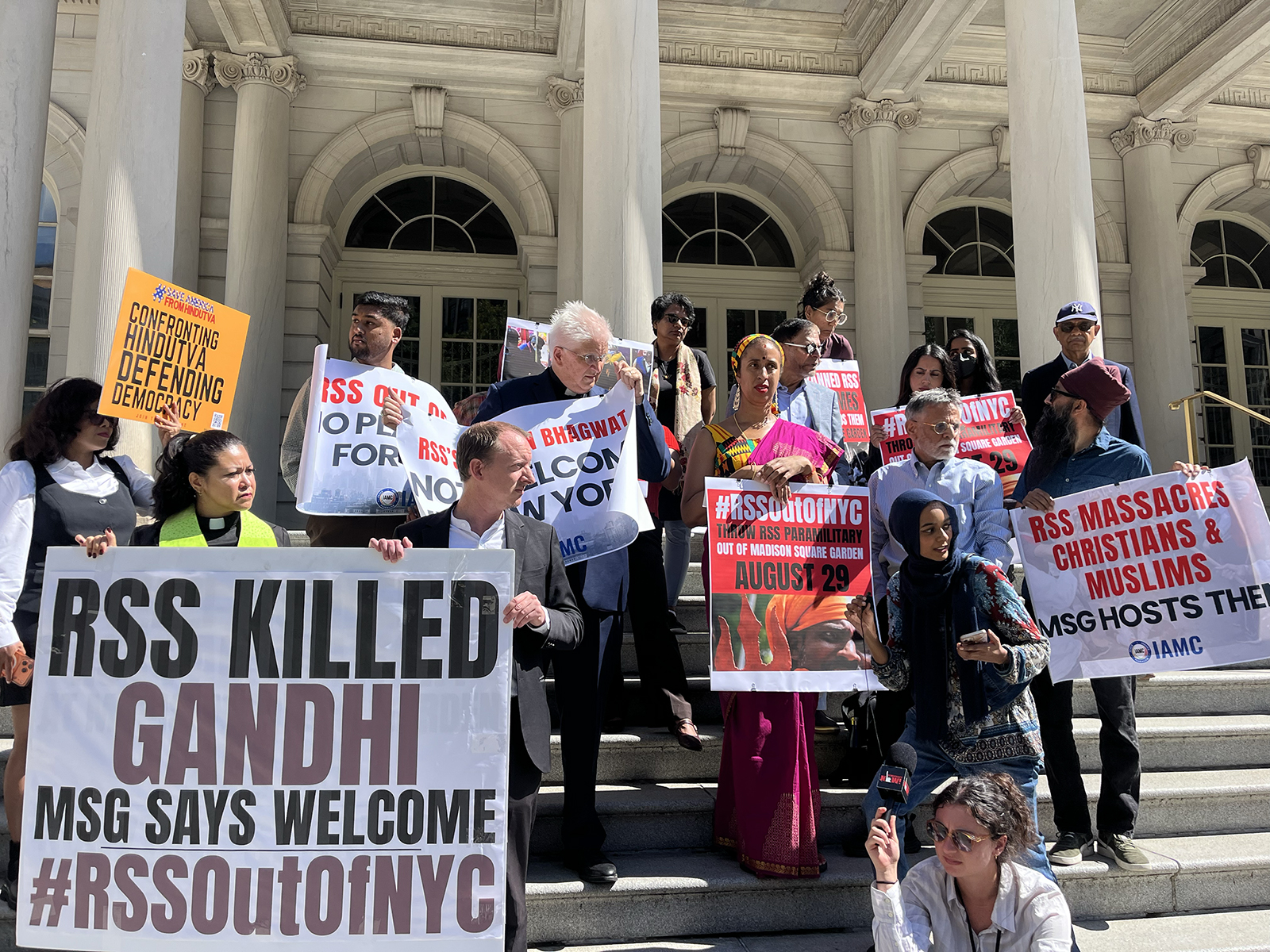
(RNS) — Mohan Bhagwat, head of one of India’s most influential Hindu nationalist organizations, the Rashtriya Swayamsevak Sangh (RSS), is coming to New York City on Saturday (Aug. 29). His visit might have been a diaspora gathering. Instead, it has become a test of how the U.S. will respond to an organization with an opaque network of affiliates that human rights groups accuse of fomenting religious discrimination and violence.
The upcoming “Universal Oneness Celebration” is hosted by American Hindus for Engagement and Dialogue, a nonprofit with links to the U.S. wing of the RSS and founded in 2025. The event is expected to draw 5,000 Hindu Americans along with more than 100 groups, from temple associations to yoga and cultural groups.
Founded in 1925, the RSS is one of India’s most influential social and ideological organizations. Through tens of thousands of local branches and a vast network spanning education, labor, student groups and social services, the RSS has helped spread Hindu nationalist, or Hindutva, ideas across Indian society and has faced criticism for its treatment of Muslims and Christians, often cast as less Indian than Hindus.
The RSS promotes and informs the ruling Bharatiya Janata Party’s most controversial policies and rhetoric, including cow protection that has encouraged vigilante violence against Muslims, anti-conversion laws that have led to mob attacks on churches, a citizenship amendment that favors non-Muslim migration and restrictions on foreign funding to religious organizations, disproportionately choking Christian and Muslim NGOs, which provide essential services to Indians in education and other social sectors.
In 2025, the U.S. Commission on International Religious Freedom (USCIRF), an independent, bipartisan federal commission created by Congress to monitor religious freedom abroad and make recommendations to the U.S. government, has recommended that the government designate India as a “country of particular concern.” USCIRF also recommended targeted sanctions against individuals and entities, including the RSS, including freezing their assets and restricting their entry into the country. Most recently, USCIRF officials warned against extending high-level meetings and diplomatic courtesies to Bhagwat and other RSS leaders. Several human rights and advocacy organizations have also called on Secretary of State Marco Rubio to deny or revoke Bhagwat’s U.S. visa.

2025 USCIRF Recommendations. (Courtesy image)
The Indian government and various Hindutva groups have pushed back hard in defense, claiming that their critics are simply anti-Hindu.
For the first time, in 2002 following the Gujarat riots, when Narendra Modi was the state’s chief minister, USCIRF recommended that India be designated a “Country of Particular Concern” (CPC). It made the same recommendation again in 2004 but did not recommend CPC status for India again until 2020. Since then, it has made the recommendation every year.
Last year, in his Independence Day speech from the Red Fort, Prime Minister Narendra Modi described the organization as the world’s biggest NGO as it marked its centenary year. This characterization has revived an important institutional question: If the RSS is one of the country’s largest voluntary organizations, under what legal framework does it operate in India, and should an organization of such scale be subject to the same standards of registration and transparency as other organizations operating in the public interest?
Further, if the RSS is an organization with such a vast network and global presence, why are programs and events for its members and supporters organized by separate organizations, both in India and abroad? What is the nature of the relationship between the RSS and these organizations, and how transparent is that relationship?
One possible explanation is a desire to avoid greater transparency and potential tax scrutiny. These concerns have been highlighted recently by Karnataka Home Minister Priyank Kharge of the Indian National Congress, who has questioned the RSS’s legal status, sources of funding (particularly voluntary contributions), tax compliance and the scale of its public activities, including the thousands of daily branches operating in the state and even in government buildings. He demands that the RSS register in accordance with the law or face a ban.
His remarks drew a strong response from the RSS and the BJP. Bhagwat called the demand politically motivated, saying the organization has openly functioned as a voluntary cultural body for nearly a century and so does not need formal registration. BJP Member of Parliament Ramesh Jigajinagi questioned why a dalit (low caste) leader like Kharge should be concerned about the RSS, sparking further debate.
To understand the true scale of the RSS’s institutional reach, it is necessary to look beyond the RSS itself. Indian magazine “The Caravan” recently launched “Seeing the Sangh,” an ongoing research project developed over six years in collaboration with researchers. The project attempts to map the vast organizational network surrounding the RSS. Drawing on publicly available sources, including RSS publications, academic research, financial records and government documents, it has so far identified more than 2,500 organizations associated with the wider RSS ecosystem across the globe. While the database is still evolving, the sheer scale of the network offers a revealing picture of how the RSS umbrella has expanded its presence across different areas of public life and raises further questions about the nature, structure and transparency of these institutional relationships.
As of now, the project’s map identifies 113 affiliated organizations operating under different names across the U.S. alone.
While many of the RSS-associated organizations are separately registered, the RSS itself has maintained that it functions as a voluntary cultural movement rather than as an organization requiring formal registration. This limits public transparency regarding its structure, finances and accountability.
In 2025, the RSS quietly hired one of Washington’s major lobbying firms — not directly but through intermediaries, so that on paper, the RSS’s name barely showed up. The stated purpose, per the filings, was to introduce the RSS to the U.S. Senate and House. It took reporters actually digging through the disclosures to figure out who the real client was. That’s not an oversight; it’s the same move the RSS makes at home — stay just outside the frame that would force disclosure.
This raises a straightforward question: If the RSS is, by its own repeated insistence, just an unregistered cultural body confined to India, why exactly does it need $330,000 worth of Capitol Hill access and a team of congressional staffers whispering in Senators’ ears? Purely cultural organizations do not typically require such lobbying.
In the end, the central question remains: Should an organization with such extensive influence be allowed to remain institutionally opaque?
(Mohd Arshid is a senior research scholar at Jawaharlal Nehru University in New Delhi working on the political economy of religion. The views expressed in this commentary do not necessarily reflect those of Religion News Service.)
Mohan Bhagwat’s US visit puts RSS’s vision of Hindu unity in spotlight
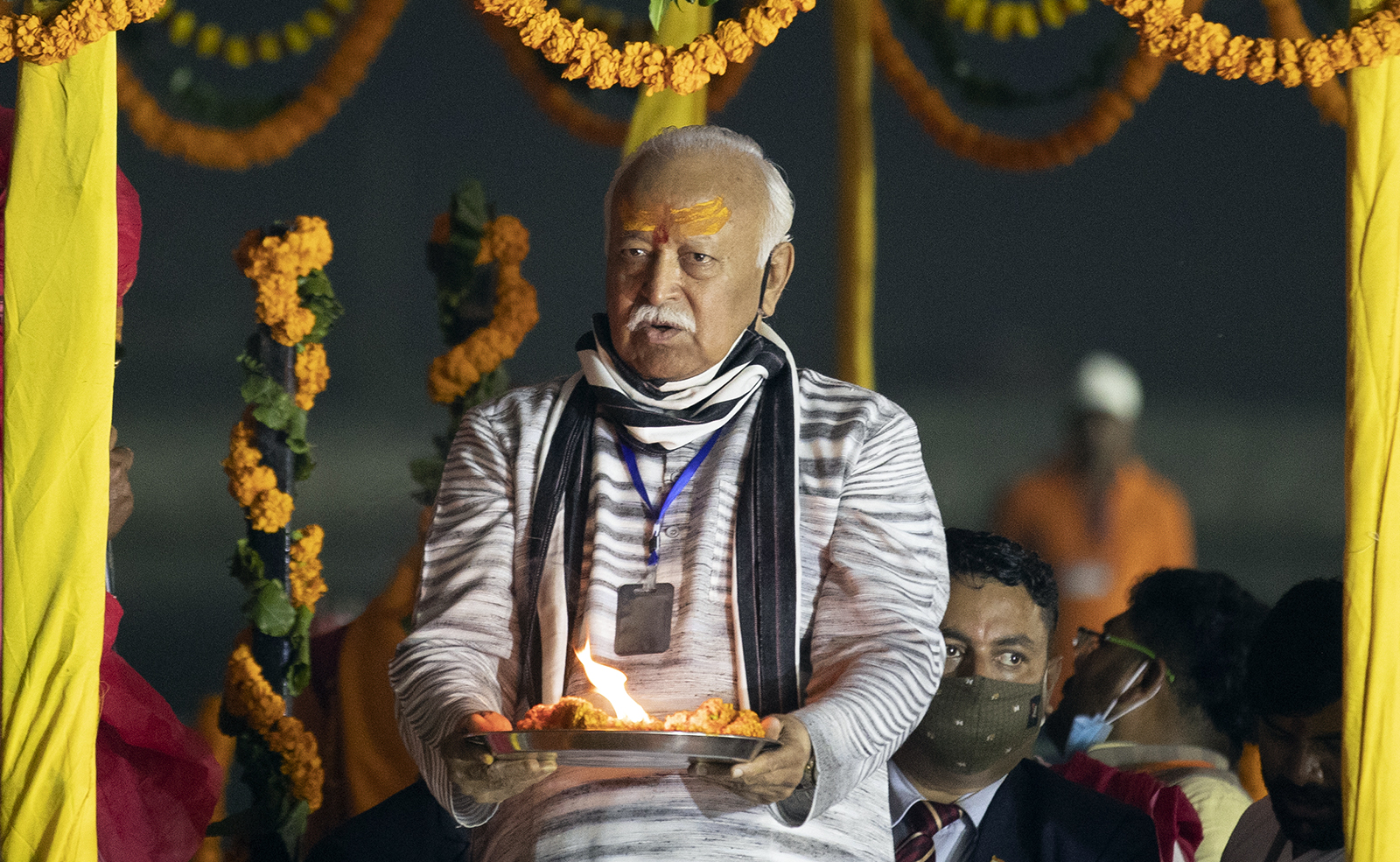
(RNS) — This Saturday (Aug. 29), Mohan Bhagwat, chief of India’s Hindu nationalist organization, Rashtriya Swayamsevak Sangh (RSS), is scheduled to give the keynote address at Madison Square Garden for an event celebrating “universal oneness.”
The event, hosted by the nonprofit American Hindus for Engagement and Dialogue (AHEAD) Forum, will feature musical performances and communal hymns and is expected to draw more than 5,000 spectators and over 100 groups affiliated with Hindu temples, yoga associations and cultural groups.
“Our job is to sit for a dialogue — mutual dialogue — to understand each other for the betterment of global humanity,” said Sudesh Agrawal, director of the AHEAD Forum. “Our earth is one.”
Priya Samant, the spokesperson for the Universal Oneness Celebration, agreed.
“It’s a celebration of our shared goals and our humanity,” she told RNS, adding that Bhagwat will share the stage with faith leaders from different religions, including Islam, Christianity, Judaism and Sikhism. “And oneness does not mean sameness. It means that we can work through our differences, and yet, be one big family.”
And yet, the event has sparked widespread backlash from a coalition of faith-based and secular organizations as well as elected officials. Critics argue that the idea of unity is a thin veneer and that Bhagwat represents an organization built from a vision of a Hindu-first India. They point to a documented rise in discrimination and violence against minorities in India since 2014, when Prime Minister Narendra Modi and the Bharatiya Janata Party (BJP), considered the political muscle of the RSS, gained power.
In the context of the RSS and its representatives, the idea of unity often only refers to Hindu unity, said Thomas Blom Hansen, a professor of South Asian studies and anthropology at Stanford who studies religious and political violence in India. “Anyone who talks about caste, who talks about communities, who talks about minorities — they are inherently divisive,” Hansen said.
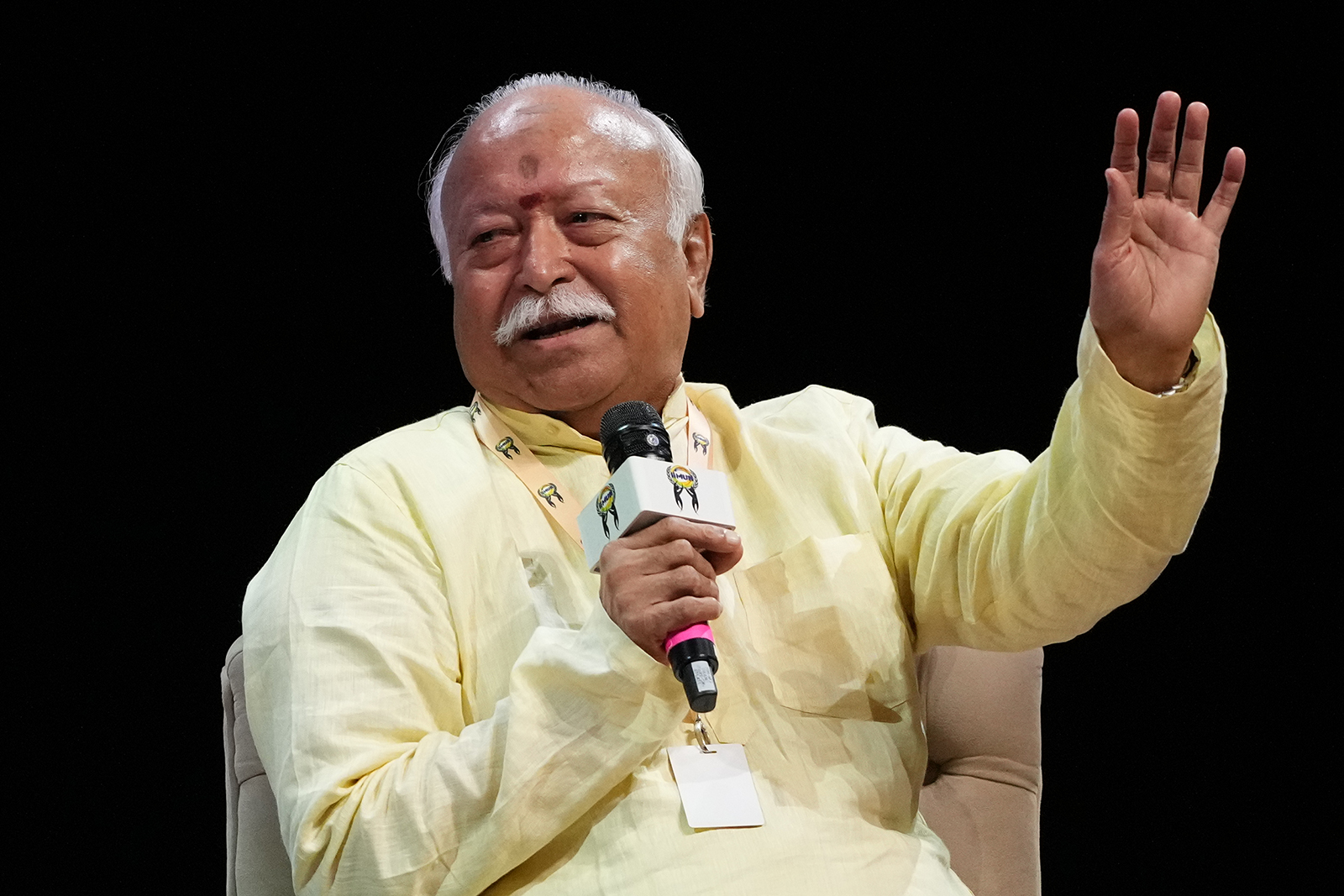
Rashtriya Swayamsevak Sangh (RSS) chief Mohan Bhagwat addresses students during an India International Movement to Unite Nations (IIMUN) event in Mumbai, India, Thursday, Aug. 6, 2026. (AP Photo/Rafiq Maqbool)
Bhagwat’s visit kicks off an international tour to increase global outreach on the centennial of the RSS’s founding. He is scheduled for upcoming events in Canada and the United Kingdom.
The RSS was founded in 1925 as a male-only volunteer organization that held small local gatherings meant to cultivate shared Hindu identity amid British colonial rule and past Muslim conquests. The organization has since become a major force in Indian society, particularly as an ideological guide to the BJP.
“The BJP knows that they cannot win elections without the RSS,” Hansen said.
Bhagwat, 75, was born into a Marathi Brahmin family of RSS activists. He joined the organization full time in his 20s and climbed the ranks to become the organization’s chief in 2009. He now presides over millions of RSS members across the country and serves as a prominent figurehead.
Bhagwat himself has advocated for many controversial BJP policies promoted by the RSS, advising families to protect their Hindu daughters from “love jihad,” defending a citizenship amendment that favors non-Muslim immigration, defending “anti-conversion laws” that have resulted in mob attacks on churches, and labeling India a fundamentally Hindu nation. He has also praised the construction of the Ram Temple in Ayodhya on the site where a Hindu nationalist mob illegally razed a 16th century mosque and ensuing riots killed an estimated 2,000 people, mainly Muslims.

A general view of the audience during the opening of the Ram Mandir, a temple dedicated to Hindu deity Lord Ram, in Ayodhya, India, Jan. 22, 2024. (AP Photo/Rajesh Kumar Singh)
Two of AHEAD Forum’s previous initiatives involved book tours for Sachin Nanda and Ratan Sharda, who wrote about RSS history and principles.
The RSS has been banned three times in India. The first ban came in 1948 after an RSS affiliate assassinated Mahatma Gandhi, the Indian independence leader who advocated for religious harmony and a secular democracy.
The Indian government mandated that the RSS operate with transparency, but instead, “they branched out and created a whole range of different front organizations that are not formally affiliated with the RSS,” said Hansen. “It was a way of creating a sense of deniability.”
Ahead of Bhagwat’s speech, progressive platform Savera published a report alleging that the AHEAD Forum is a front for the U.S. wing of the RSS.
Agrawal responded that the AHEAD Forum is an independent 501(c)3 organization and “not prompted or promoted or guided by any other organization.”
Sunita Viswanath, executive director of the progressive nonprofit Hindus for Human Rights, has been working with a coalition of advocates to campaign for Madison Square Garden to cancel the event, urging individuals to call the venue and voice their opinion.
“As a progressive Hindu organization that’s working night and day to manifest a loving and inclusive interpretation of our faith, it’s very upsetting to see the same words and the same concepts, such as ‘oneness,’ being used by an organization and its leadership who very clearly represent the opposite,” Viswanath said.
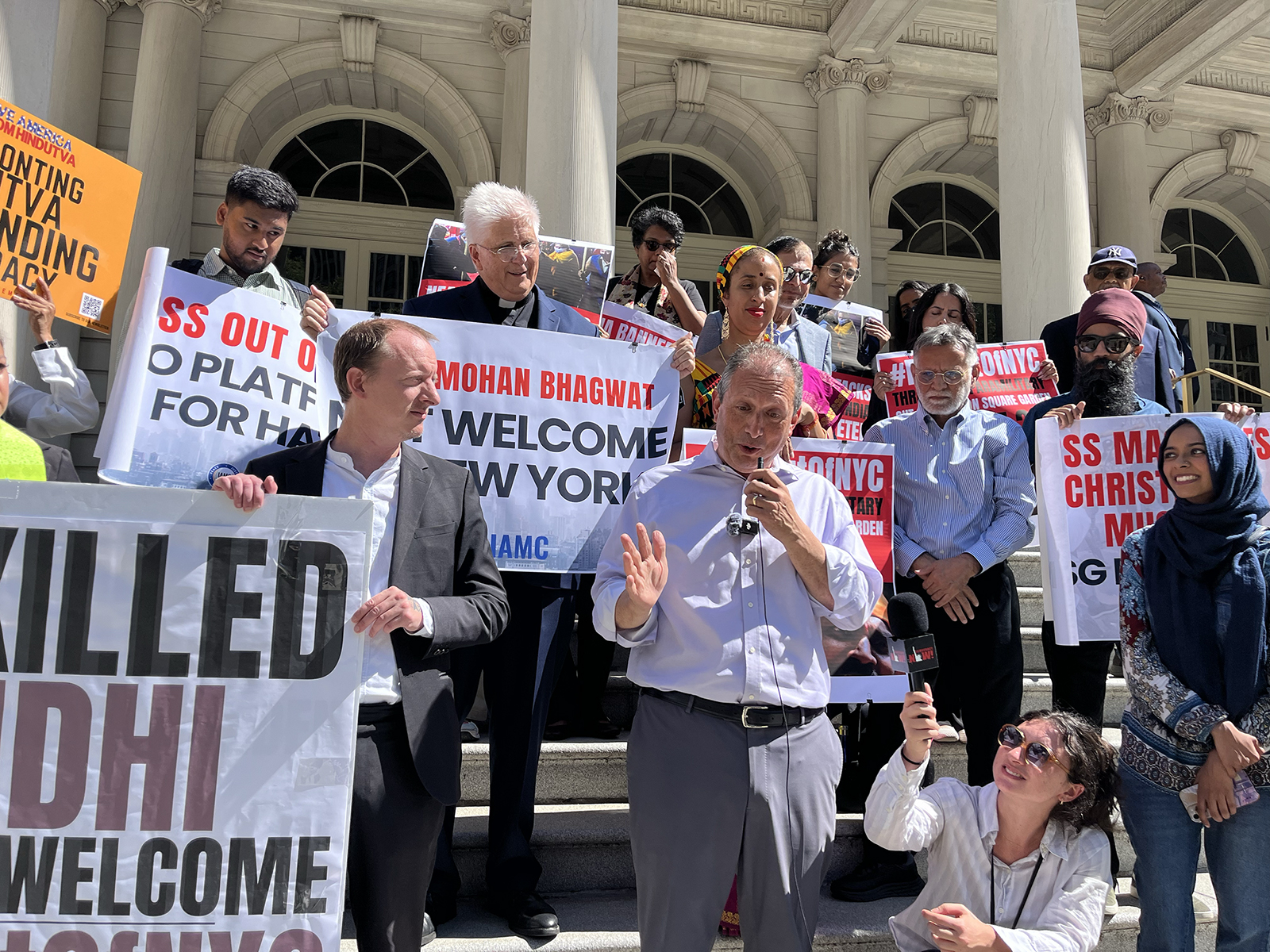
Brad Lander, center, speaks during a demonstration against Mohan Bhagwat’s upcoming visit to New York, at City Hall on Tuesday, Aug. 25, 2026, in New York City. (RNS photo/Fiona André)
Elected officials, including Democratic candidate for Congress Brad Lander and New York City Councilmembers Shahana Hanif and Lincoln Restler, have also spoken out against Bhagwat’s appearance in New York City. Zohran Mamdani, New York City’s first Indian-American mayor and a Muslim, also said he opposed Bhagwat’s appearance but did not have the jurisdiction to cancel the event.
“The vision of India that I was taught by my family and the one that I grew up being very familiar with was of a pluralistic society, of a secular republic,” said Mamdani in a press conference. “It has been incredibly troubling to see the rise of a movement that is predicated on an exclusionary vision.”
Madison Square Garden representatives have told callers that venue management has limited authority to cancel private events.
Still, those opposed to Bhagwat’s visit will protest outside Madison Square Garden on Saturday. Viswanath expects hundreds of protesters will gather and voice their opposition to Bhagwat, the RSS and the Hindutva philosophies they embody.
“If we don’t stand up to religious supremacy and exclusively hateful ideologies,” she said, “we will not be fulfilling our responsibility as citizens of conscience, citizens of the countries that we live in and citizens of the world.”
Samant, on the other hand, said the event fills her with hope, stating that it is an opportunity for a diverse crowd to learn from Bhagwat’s experience leading a century-old organization.
“The RSS has done so much great work,” she said. “It’s like a masterclass.”

No comments:
Post a Comment