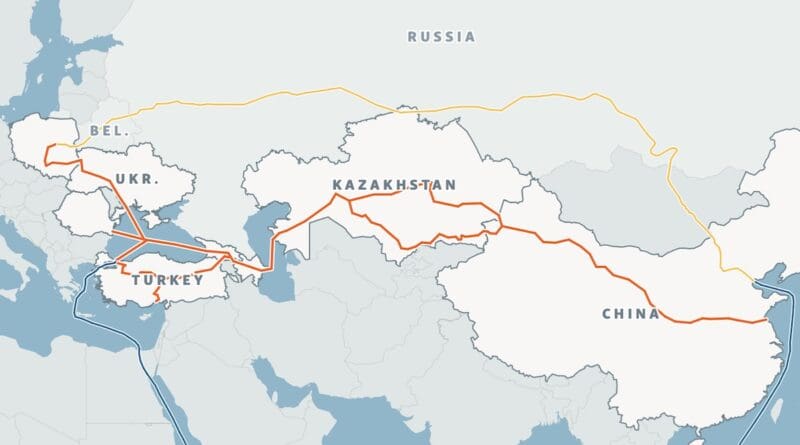
The Middle Corridor -- or the Trans-Caspian International Transport Route -- is a network of roads, railroads, and ports that connect China to Europe. It offers an alternative to a northern route which largely passes through Russia, and to maritime routes. Credit: RFE/RL
August 1, 2026
Arab News
By Luke Coffey
Key Takeaways:
A trans-Caspian gas pipeline from Turkmenistan to Azerbaijan has long been blocked by Russian and Iranian geopolitical objections, even though the engineering challenges are manageable and Turkmenistan holds vast underutilized reserves.
Improving Azerbaijan–Turkmenistan relations, US diplomatic support, and the current distractions facing Russia and Iran create a rare window to advance the project, starting with a smaller interconnector as a proof of concept.
This week, the Iraqi government reportedly came under additional US pressure to abandon its planned purchase of natural gas from Turkmenistan. This has nothing to do with Turkmenistan itself, but rather Iran.
Because there is no pipeline directly connecting Iraq with Turkmenistan, both sides would rely on Iranian pipelines to deliver the gas. With the Trump administration reinstituting its campaign of maximum pressure on Tehran, coupled with the ongoing regional conflict, Washington has been reluctant to grant sanctions waivers for Baghdad to purchase Turkmen gas because the arrangement would also generate revenue for Iran.
This episode illustrates how complex the geopolitical situation in the Middle East has become, especially in the context of the conflict involving Iran.
It is also a reminder of the potential of the Middle Corridor — a transportation network linking Central Asia to global markets through the South Caucasus — and highlights why a trans-Caspian pipeline connecting Turkmenistan’s vast natural gas reserves to the South Caucasus, and onward to international markets, deserves renewed attention.
Looking at a map, many would be surprised that no gas pipeline connects the eastern and western shores of the Caspian Sea. The reason for this has much more to do with geopolitics than any engineering or technical challenges.
Russia and Iran have long argued that the Caspian is a shared body of water and that any subsea pipeline should require their approval. As two of the world’s largest natural gas producers, both countries have a strong interest in maintaining their share of global energy markets. Preventing Turkmenistan from exporting its gas across the Caspian has long suited the strategic interests of both Moscow and Tehran.
Natural gas can be transported long distances in liquefied form. However, the liquefaction process is expensive and only economically viable over long distances. In the case of the Caspian, the distance is too short to justify such an investment. A pipeline therefore remains the only economically viable means of transporting Turkmen gas across the sea.
Turkmenistan possesses some of the world’s largest natural gas reserves and has already constructed the East-West Pipeline, which can carry gas from fields in eastern Turkmenistan to the Caspian coast but remains significantly underutilized.
While Azerbaijan has long been enthusiastic about a trans-Caspian pipeline, Turkmenistan has historically been cautious about such a project for fear of antagonizing Russia, Iran and even its largest customer, China. Nevertheless, there are growing signs that the political mood in Ashgabat might be changing. For several reasons, there has rarely been a better opportunity to place the trans-Caspian pipeline back on the regional agenda.
Firstly, regional politics are becoming more favorable. Last month, the Turkmen president, Serdar Berdimuhamedow, visited Baku to meet his Azerbaijani counterpart, Ilham Aliyev. It was the first visit by a Turkmen president in more than three years. Although the two leaders made no explicit reference to constructing a trans-Caspian pipeline, their discussions placed considerable emphasis on the expansion of energy cooperation.
The visit followed the landmark 2021 agreement between Azerbaijan and Turkmenistan to jointly develop the formerly disputed Dostluk offshore field (“dostluk” means “friendship” in both the Azerbaijani and Turkmen languages), ending a decades-long disagreement that had hindered meaningful energy cooperation. Today, relations between Baku and Ashgabat are arguably stronger than at any point since both countries gained independence.
At the same time, the Turkmen foreign minister, Rashid Meredov, recently visited Washington to meet Secretary of State Marco Rubio. In the official readout of the meeting, Rubio stated that he “expressed strong US support for diversifying Turkmenistan’s natural gas exports through trans-Caspian routes.” This is arguably the clearest public endorsement of a trans-Caspian gas corridor by any US administration in more than two decades.
Secondly, the pipeline’s two principal opponents are increasingly distracted. Russia remains consumed by its war against Ukraine, while Iran continues to face sustained economic and military pressure from the US. A project that once would have attracted intense opposition from both capitals is now unlikely to rank as highly among their strategic priorities.
Thirdly, President Donald Trump has placed greater emphasis on strengthening US relations with the countries of Central Asia and the South Caucasus than any previous administration. His administration has elevated engagement with the five Central Asian republics while also supporting efforts to broker peace between Armenia and Azerbaijan, including initiatives to improve regional transportation links connecting Central Asia with global markets. A trans-Caspian pipeline would fit neatly within this broader strategic vision, as Rubio’s comments suggest.
Finally, there is a clear market for Turkmen gas. China remains Turkmenistan’s largest customer but policymakers in Ashgabat must recognize the risks of becoming overly dependent on a single buyer. Europe, Turkiye and Iraq would all benefit from greater access to Turkmen gas, making export diversification both commercially attractive and strategically prudent.
None of this suggests that a Trans-Caspian pipeline could be built overnight. Even if Russia and Iran are temporarily distracted, both countries will continue to discourage Ashgabat from pursuing such a project.
As a practical first step, Azerbaijan and Turkmenistan should consider constructing a shorter, interconnector pipeline linking their existing offshore infrastructure in the Caspian. Such a project would serve as both a confidence-building measure and proof of concept, demonstrating that the two shores of the Caspian can indeed be connected by a pipeline while minimizing unnecessary political friction with Moscow and Tehran.
Over time, as geopolitical conditions become more favorable, that interconnector could evolve into a fully fledged trans-Caspian pipeline. Such a project would strengthen global energy security during a period of continuing uncertainty, provide new economic opportunities for the countries of the South Caucasus and Central Asia, and even help countries farther away, such as Iraq, diversify their energy imports.
The opportunity is there. The question is whether policymakers will be bold enough to seize it.
By Luke Coffey
Key Takeaways:
US pressure is blocking Iraq’s planned purchase of Turkmen gas because the only delivery route runs through Iranian pipelines, which would generate revenue for Tehran under maximum-pressure sanctions.
A trans-Caspian gas pipeline from Turkmenistan to Azerbaijan has long been blocked by Russian and Iranian geopolitical objections, even though the engineering challenges are manageable and Turkmenistan holds vast underutilized reserves.
Improving Azerbaijan–Turkmenistan relations, US diplomatic support, and the current distractions facing Russia and Iran create a rare window to advance the project, starting with a smaller interconnector as a proof of concept.
This week, the Iraqi government reportedly came under additional US pressure to abandon its planned purchase of natural gas from Turkmenistan. This has nothing to do with Turkmenistan itself, but rather Iran.
Because there is no pipeline directly connecting Iraq with Turkmenistan, both sides would rely on Iranian pipelines to deliver the gas. With the Trump administration reinstituting its campaign of maximum pressure on Tehran, coupled with the ongoing regional conflict, Washington has been reluctant to grant sanctions waivers for Baghdad to purchase Turkmen gas because the arrangement would also generate revenue for Iran.
This episode illustrates how complex the geopolitical situation in the Middle East has become, especially in the context of the conflict involving Iran.
It is also a reminder of the potential of the Middle Corridor — a transportation network linking Central Asia to global markets through the South Caucasus — and highlights why a trans-Caspian pipeline connecting Turkmenistan’s vast natural gas reserves to the South Caucasus, and onward to international markets, deserves renewed attention.
Looking at a map, many would be surprised that no gas pipeline connects the eastern and western shores of the Caspian Sea. The reason for this has much more to do with geopolitics than any engineering or technical challenges.
Russia and Iran have long argued that the Caspian is a shared body of water and that any subsea pipeline should require their approval. As two of the world’s largest natural gas producers, both countries have a strong interest in maintaining their share of global energy markets. Preventing Turkmenistan from exporting its gas across the Caspian has long suited the strategic interests of both Moscow and Tehran.
Natural gas can be transported long distances in liquefied form. However, the liquefaction process is expensive and only economically viable over long distances. In the case of the Caspian, the distance is too short to justify such an investment. A pipeline therefore remains the only economically viable means of transporting Turkmen gas across the sea.
Turkmenistan possesses some of the world’s largest natural gas reserves and has already constructed the East-West Pipeline, which can carry gas from fields in eastern Turkmenistan to the Caspian coast but remains significantly underutilized.
While Azerbaijan has long been enthusiastic about a trans-Caspian pipeline, Turkmenistan has historically been cautious about such a project for fear of antagonizing Russia, Iran and even its largest customer, China. Nevertheless, there are growing signs that the political mood in Ashgabat might be changing. For several reasons, there has rarely been a better opportunity to place the trans-Caspian pipeline back on the regional agenda.
Firstly, regional politics are becoming more favorable. Last month, the Turkmen president, Serdar Berdimuhamedow, visited Baku to meet his Azerbaijani counterpart, Ilham Aliyev. It was the first visit by a Turkmen president in more than three years. Although the two leaders made no explicit reference to constructing a trans-Caspian pipeline, their discussions placed considerable emphasis on the expansion of energy cooperation.
The visit followed the landmark 2021 agreement between Azerbaijan and Turkmenistan to jointly develop the formerly disputed Dostluk offshore field (“dostluk” means “friendship” in both the Azerbaijani and Turkmen languages), ending a decades-long disagreement that had hindered meaningful energy cooperation. Today, relations between Baku and Ashgabat are arguably stronger than at any point since both countries gained independence.
At the same time, the Turkmen foreign minister, Rashid Meredov, recently visited Washington to meet Secretary of State Marco Rubio. In the official readout of the meeting, Rubio stated that he “expressed strong US support for diversifying Turkmenistan’s natural gas exports through trans-Caspian routes.” This is arguably the clearest public endorsement of a trans-Caspian gas corridor by any US administration in more than two decades.
Secondly, the pipeline’s two principal opponents are increasingly distracted. Russia remains consumed by its war against Ukraine, while Iran continues to face sustained economic and military pressure from the US. A project that once would have attracted intense opposition from both capitals is now unlikely to rank as highly among their strategic priorities.
Thirdly, President Donald Trump has placed greater emphasis on strengthening US relations with the countries of Central Asia and the South Caucasus than any previous administration. His administration has elevated engagement with the five Central Asian republics while also supporting efforts to broker peace between Armenia and Azerbaijan, including initiatives to improve regional transportation links connecting Central Asia with global markets. A trans-Caspian pipeline would fit neatly within this broader strategic vision, as Rubio’s comments suggest.
Finally, there is a clear market for Turkmen gas. China remains Turkmenistan’s largest customer but policymakers in Ashgabat must recognize the risks of becoming overly dependent on a single buyer. Europe, Turkiye and Iraq would all benefit from greater access to Turkmen gas, making export diversification both commercially attractive and strategically prudent.
None of this suggests that a Trans-Caspian pipeline could be built overnight. Even if Russia and Iran are temporarily distracted, both countries will continue to discourage Ashgabat from pursuing such a project.
As a practical first step, Azerbaijan and Turkmenistan should consider constructing a shorter, interconnector pipeline linking their existing offshore infrastructure in the Caspian. Such a project would serve as both a confidence-building measure and proof of concept, demonstrating that the two shores of the Caspian can indeed be connected by a pipeline while minimizing unnecessary political friction with Moscow and Tehran.
Over time, as geopolitical conditions become more favorable, that interconnector could evolve into a fully fledged trans-Caspian pipeline. Such a project would strengthen global energy security during a period of continuing uncertainty, provide new economic opportunities for the countries of the South Caucasus and Central Asia, and even help countries farther away, such as Iraq, diversify their energy imports.
The opportunity is there. The question is whether policymakers will be bold enough to seize it.
Luke Coffey is a senior fellow at the Hudson Institute.

No comments:
Post a Comment