Logging Operations Leave Distinct Damage Patterns In Nepal’s Sal Forests
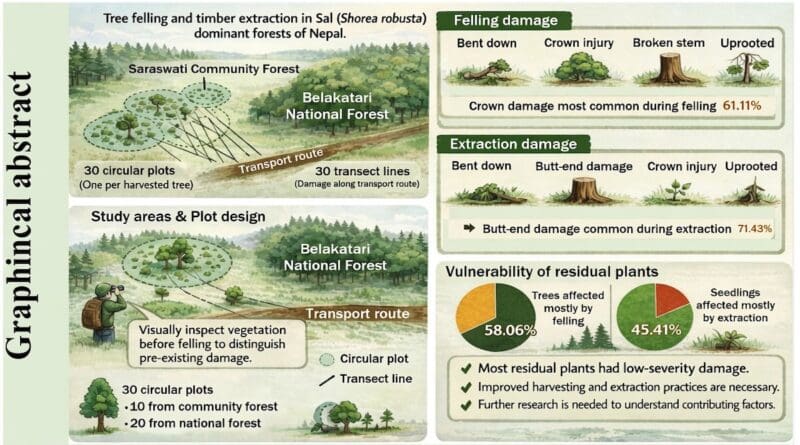
Damage to residual plants during felling and timber extraction on Sal (Shorea robusta Gaertn. f.) dominant forest in Nepal CREDIT: Nisha Dhungel, Rajeev Joshi, Jeetendra Gautam, Aman Prabhakar, Saraswoti Adhikari, Tek Maraseni & Han Zhang
Key Takeaways:
- Timber felling and extraction damage residual plants differently in Nepal’s Sal forests: felling mainly harms mature trees’ crowns, while extraction causes more severe injury to seedlings by bending, crushing, or uprooting them.
- Seedlings are especially vulnerable during log extraction, with over half of damaged seedlings suffering medium- or high-severity injuries that can hinder natural regeneration.
- Practical steps such as directional felling, carefully planned extraction routes that avoid dense seedling areas, and simple post-harvest damage monitoring can substantially reduce ecological harm while supporting sustainable timber harvesting.
Timber harvesting supports local economies and supplies essential forest products, but the process can also harm the plants left behind. A new study in Nepal has revealed that tree felling and timber extraction affect different parts of the forest in different ways, highlighting practical opportunities to reduce ecological damage during logging.
“Our findings show that sustainable harvesting is not only about deciding which trees to cut. It is also about protecting the seedlings and trees that will form the next generation of the forest,” said corresponding author Rajeev Joshi. “Better planning, directional felling, carefully designed extraction routes, and operator training can substantially reduce avoidable damage.”
The study examined Sal forests dominated by Shorea robusta, an ecologically and economically important tree species in Nepal. Sal forests provide timber and other resources, store carbon, support biodiversity, and contribute to the livelihoods of forest-dependent communities.
Researchers conducted field assessments in the Saraswati Community Forest and the Belakatari National Forest in Udayapur district. They established 30 circular plots around trees selected for harvesting and assessed another 30 transects along timber extraction routes. Vegetation was inspected before harvesting so that newly caused damage could be distinguished from existing injuries.
The results showed a clear difference between the effects of felling and extraction. Among damaged seedlings, 45.41% of the damage was associated with timber extraction, compared with 43.35% from felling and 11.24% from other human activities. In contrast, 58.06% of damage to residual trees was caused by felling, while extraction accounted for 22.58%.
Seedlings were especially vulnerable to being bent, crushed, or uprooted. During felling, 44.4% of damaged seedlings were bent down, 38.4% experienced stem damage, and 17.2% were uprooted. During extraction, bending remained the most frequent injury at 47.1%, followed by stem damage at 29.6% and uprooting at 23.3%.
The remaining mature trees displayed a different pattern. During felling, crown damage accounted for 61.1% of recorded tree injuries, probably because falling trunks and branches struck neighboring canopies. During extraction, 71.4% of damaged trees experienced injury around the butt end, or lower trunk, often caused by dragged logs striking standing trees.
Although most damage to residual trees was classified as low severity, the researchers found greater concern among seedlings. During extraction, 53.4% of damaged seedlings experienced either medium or high-severity damage, suggesting that timber movement can interfere with natural forest regeneration even when mature trees appear relatively unaffected.
The authors recommend several measures to reduce these impacts. Before harvesting, forest managers can map areas with dense regeneration and plan extraction trails that avoid them. Workers can use precision directional felling to guide trees toward existing gaps rather than neighboring crowns or seedling patches. Machinery should remain on designated trails, and logs can be winched toward those trails instead of being dragged through larger areas of the forest.
The study also recommends adding simple post-harvest damage records to Nepal’s existing forest management registers. Such monitoring could help community forest user groups and government offices adjust future harvesting plans based on observed ecological impacts.
Protecting residual plants is essential because today’s seedlings and surviving trees determine the structure, productivity, carbon storage, and resilience of tomorrow’s forest. The findings provide a practical basis for reduced-impact logging and more sustainable management of Nepal’s Sal forests.

No comments:
Post a Comment