Saturday, November 11, 2023

China has a sweeping vision to reshape the world — and countries are listening

Simone McCarthy, CNN
Thu, November 9, 2023 

Xi Jinping has a plan for how the world should work, and one year into his norm-shattering third term as Chinese leader, he’s escalating his push to challenge America’s global leadership — and put his vision front and center.

That bid was in the spotlight like never before last month in Beijing, when Xi, flanked by Russian President Vladimir Putin, United Nations Secretary General Antonio Guterres, and some two dozen top dignitaries from around the world, hailed China as the only country capable of navigating the challenges of the 21st century.

“Changes of the world, of our times, and of historical significance are unfolding like never before,” Xi told his audience at the Belt and Road Forum. China, he said, would “make relentless efforts to achieve modernization for all countries” and work to build a “shared future for mankind.”

Xi’s vision — though cloaked in abstract language — encapsulates the Chinese Communist Party’s emerging push to reshape an international system it sees as unfairly stacked in favor of the United States and its allies.

Viewed as a rival by those countries as its grows increasingly assertive and authoritarian, Beijing has come to believe that now is the time to shift that system and the global balance of power to ensure China’s rise — and reject efforts to counter it.

In recent months, Beijing has promoted its alternative model across hefty policy documents and new “global initiatives,” as well as speeches, diplomatic meetings, forums and international gatherings large and small — as it aims to win support across the world.

For many observers, this campaign has raised concern that a world modeled on Beijing’s rules is also one where features of its iron-fisted, autocratic rule — like heavy surveillance, censorship and political repression — could become globally accepted practices.

But China’s push comes as American wars overseas, unstable foreign policy election-to-election, and deep political polarization have intensified questions about US global leadership. Meanwhile pressing issues like climate change, Russia’s war in Ukraine and Israel’s assault on Gaza have sharpened discussion over whether the West is taking the right approach to respond.

All this coincides with longstanding calls from countries across the developing world for an international system where they have more say.

Many of those countries have substantially enhanced their economic ties with Beijing during Xi’s rule, including under a decade of his up to $1 trillion global infrastructure building drive, which leaders gathered to celebrate last month in the Chinese capital.

It remains to be seen how many would welcome a future that hews to China’s worldview — but Xi’s clear push to amplify his message amid a period of unrelenting tensions with the Washington elevates the stakes of the US-China rivalry.

And as the procession of world leaders who have visited Beijing in recent months, including for Xi’s gathering last month, make clear: while many nations may be skeptical of a world order pitched by autocratic China — others are listening.
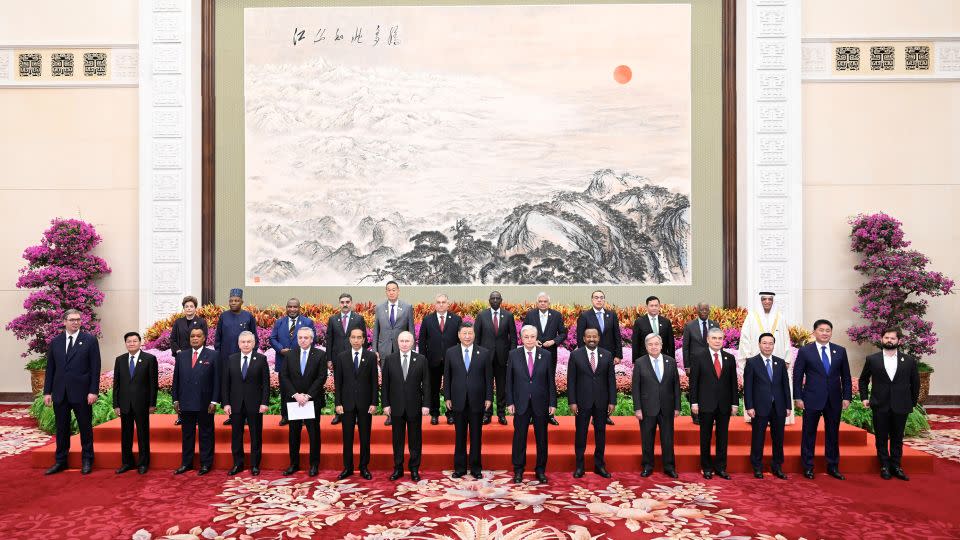
Chinese leader Xi Jinping, Russian President Vladimir Putin and other leaders pose for a group photo during the Belt and Road Forum in Beijing last month. - Shen Hong/Xinhua/Getty Images

‘Shared future’

A more than 13,000-word policy document released by Beijing in September outlines China’s vision for global governance and identifies what it sees as the source of current global challenges: “Some countries’ hegemonic, abusive, and aggressive actions against others … are causing great harm” and putting global security and development at risk, it reads.

Under Xi’s “global community of shared future,” the document says, economic development and stability are prioritized as countries treat each other as equals to work together for “common prosperity.”

In that future, they’d also be free of “bloc politics,” ideological competition and military alliances, and of being held responsible for upholding “‘universal values’ “defined by a handful of Western countries,” the document says.

“What the Chinese are saying … is ‘live and let live,’ you may not like Russian domestic politics, you might not like the Chinese political regime — but if you want security, you will have to give them the space to survive and thrive as well,” said Yun Sun, director of the China program at the Stimson Center think tank in Washington.

This vision is woven through three new “global initiatives” announced by Xi over the past two years focusing on development, security and civilization.

The initiatives echo some of Beijing’s long-standing talking points and are largely short on detail and heavy on rhetoric.

But together, analysts say, they present a case that a US-led system is no longer suited for the current era — and signal a concerted push to reshape the post-World War II order championed by it and other Western democracies.

That current international framework was designed to ensure, in theory at least, that even as governments have sovereignty over their countries, they also share rules and principles to ensure peace and uphold basic political and human rights for their populations.

China has benefited from that order, supercharging its economy off World Bank loans and expanded opportunities under the World Trade Organization, which Washington backed Beijing to join in 2001 in the hope it would help liberalize the Communist country.

Just over two decades later, Beijing is chafing under it.

The US and its allies have watched warily as Beijing has not only grown economically competitive, but increasingly assertive in the South China Sea and beyond and more repressive and authoritarian at home.

This has driven Washington’s efforts to restrict Chinese access to sensitive technology and impose economic sanctions, which Beijing sees as bald-faced actions to suppress and contain it.

The US and other nations have decried Beijing’s intimidation of the self-ruling democracy of Taiwan and tried to hold it to account for alleged human rights violations in Tibet, Hong Kong, and Xinjiang, the latter of which a UN human rights office last year said could amount to “crimes against humanity” — a charge Beijing denies.
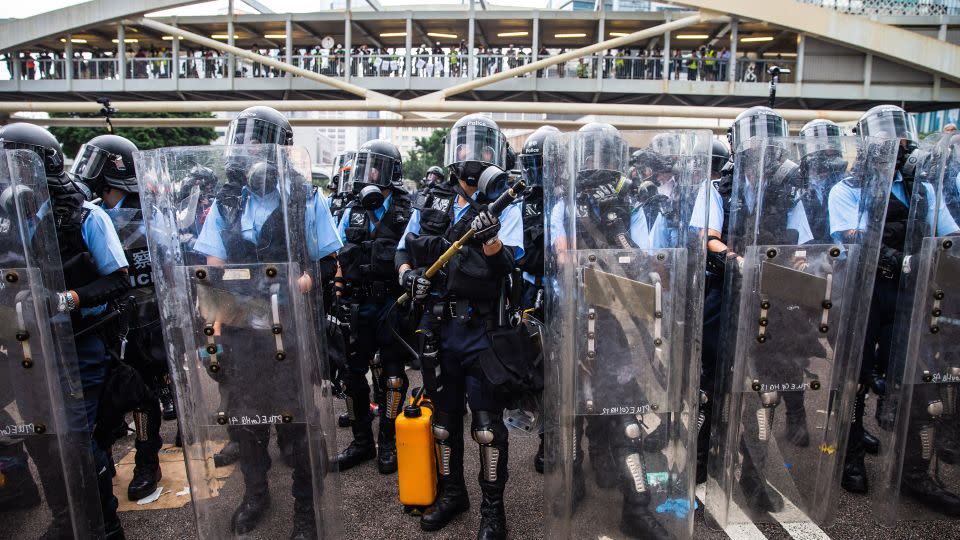
Riot police stand guard during a June 2019 protest in Hong Kong against a proposed extradition law that would have allowed extradition of fugitives to mainland China. - Sanjit Das/Bloomberg/Getty Images

In response, Xi has ramped up longstanding efforts to undercut the concept of universal human rights.

“Different civilizations” had their own perceptions of shared human “values,” Xi told leaders of political parties and organizations from some 150 countries earlier this year as he launched China’s “Global Civilization Initiative.” Countries wouldn’t “impose their own values or models on others” if China were setting the agenda, he implied.

This builds on Beijing’s argument that governments’ efforts to improve their people’s economic status equates to upholding their human rights, even if those people have no freedom to speak out against their rulers.

It also links to what observers say is growing confidence among Chinese leaders in their governance model, which they see as having played a genuinely positive role to foster economic growth globally and reduce poverty — in contrast to a US that has waged wars, sparked a major global financial crisis and faces fraught politics at home.

“All this makes China think America is quickly declining,” said Shanghai-based foreign policy analyst Shen Dingli, who says this feeds Xi’s drive not to overturn the existing world order, but revamp it.

Beijing, he added, sees the US as merely “paying lip service” to the “liberal order” to hurt other countries.

“(China asks) ‘who is more prone to peace and who is less capable of leading the world?’ This has beefed up China’s self-image, (and this idea that) ‘We are great and we should be greater — and we should let the world realize it’s our time,’” he said.
Who’s listening?

For strongmen leaders and autocratic governments, Xi’s vision has obvious appeal.

While Russia’s Putin, accused of war crimes and continuing his brutal invasion of neighboring Ukraine, and Afghanistan’s Taliban leaders are shunned in the West, both were welcomed to Xi’s table of nations in Beijing last month.

Just weeks earlier, Syrian dictator Bashar al-Assad — who has been accused of using chemical weapons against his own people — was feted at the Asian Games in Hangzhou, where he arrived on a Chinese-chartered jet and visited a famous Buddhist temple.

A headline in the state-run Global Times portrayed Assad’s visit as one from the leader of a “war-torn country respected in China amid Western isolation” — providing a glimpse into the through-the-looking glass scenarios that could become the norm if Xi’s world view gains traction.

But Beijing’s broader argument, which implies that a handful of wealthy, Western countries hold too much global power — resonates with a wider set of governments than just those at loggerheads with the West.

Those concerns have come into sharper focus in recent weeks as global attention has focused on Israel’s relentless assault on Gaza following the October 7 attack on its territory by Hamas. The US has been in the minority opposed to broad global backing for an immediate humanitarian truce — and its support of Israel is seen in much of the world as enabling the country to continue its retaliation, despite mounting civilian casualties.

Russian President Vladimir Putin is welcomed by Chinese leader Xi Jinping during a ceremony at the Belt and Road Forum in Beijing last month. - Sergei Savostyanov/Sputnik/Reuters

In recent years, even some countries that have for decades embraced a close partnership with the US have drawn closer to China and its vision.

“Pakistan aligns with Chinese leader Xi Jinping’s view that a new global era is emerging, characterized by multipolarity and a departure from Western dominance,” said Ali Sarwar Naqvi, a former Pakistani ambassador, now executive director of the Center for International Strategic Studies in Islamabad.

But there are also many governments that also remain wary of its politics and ambitions, or of appearing to side with Beijing over the West.

“We’ve kept our relationship with all nations open,” Papua New Guinea Prime Minister James Marape told CNN on the sidelines of the Belt and Road Forum last month, where he delivered a speech calling for more green energy investment in his country under the China-led initiative.

“We relate to the West, we relate to the East … We maintain a straight line, we don’t compromise our friendship with all people,” he said.

And while others may be ready to back China in calling for a more representative international system — there are questions about what that means under Beijing’s leadership.

“China can count on Brazil day and night to say that multilateralism is important, and we have to revisit global governance … however, there’s a very important ‘but,’” according to Rubens Duarte, coordinator of LABMUNDO, a Brazil-based research center for international relations.

He points to questions circulating within some countries, like Brazil, about why China is now championing concepts promoted in the Global South for 70 years — and claiming them as its own.

“Is China really trying to promote multipolarity — or does China just want to (become a) substitute (for) US influence over the world?” he asked.

A passenger gets off a Chinese-funded high-speed train after its commercial operations launched last month in Indonesia. - Li Zhiquan/China News Service/VCG/Reuters
Expanding ambitions

For decades, China has built its international influence around its economic clout, using its own rapid transformation from a deeply impoverished country to the world’s second largest economy as a model it could share with the developing world.

It was in this vein that Xi launched his flagship Belt and Road financing drive in 2013, drawing dozens of borrowing nations closer to Beijing and expanding China’s international footprint a year after he became leader with the pledge to “rejuvenate” the Chinese nation to a place of global power and respect.

“China’s traditional (foreign policy) thinking was very heavily focused on economic capability as the foundation for everything else. When you become an economic power, you also naturally acquire greater political influence and soft power, et cetera — everything else will fall in line,” said Tong Zhao, a senior fellow at the Carnegie Endowment for International Peace think tank in Washington.

But as China’s economic rise has come alongside geopolitical friction with the US and its allies, Beijing has seen the need to expand its vision “and tackle geopolitical issues as well,” Zhao added.

The war in Ukraine has only heightened this dynamic. China’s key economic partners in Europe tightened ties with the US and reassessed their relationships with Beijing after it refused to condemn the Kremlin’s invasion, while at the same time Washington shored up relations with allies in Asia.

This “served as a wake-up call to the Chinese that the great power competition with the United States, ultimately, is about (winning over) the rest of the world,” said Sun from the Stimson Center in Washington.

A Chinese vessels operate near Scarborough Shoal in a disputed area of the South China Sea. - Ted Aljibe/AFP/Getty Images

Then, faced with mounting pressure from the West to condemn Moscow’s invasion of a sovereign country, Beijing instead used the moment to argue its own view for global security.

Two months after Russian troops poured into Ukraine, Xi announced China’s “Global Security Initiative,” declaring at an international conference that “bloc confrontation” and “Cold War mentality” would “wreck the global peace framework.”

It was an apparent reference not to the Russian aggressor, but to NATO, which both Moscow and Beijing have blamed for provoking the war in Ukraine.

Xi’s words were far from new for Beijing, but Chinese diplomats in the following months ramped up their promotion of that rhetoric, for example calling on their counterparts in Europe’s capitals, as well as the US and Russia, to build a “sustainable European security architecture,” to address the “security deficit behind the (Ukraine) crisis.”

The rhetoric appeared to catch on, with Brazilian President Luiz Inácio Lula da Silva days after returning from a state visit to China this spring calling on Washington to “to stop encouraging war.”

This gets to the heart of Beijing’s aims, which experts say are not to build its own alliances or use its military might to guarantee peace in volatile situations, as the US has done.

Rather, it looks to cast doubt on that system, while projecting its own, albeit vague, vision for countries ensuring peace through dialogue and “common interests” — a phrasing that again pushes back against the idea that countries should oppose one another based on political differences.

‘“If a country … is obsessed with suppressing others with different opinions it will surely cause conflicts and wars in the world,” senior military official Gen. Zhang Youxia told delegations from more than 90 countries attending a Beijing-led security forum in the capital last month.

Beijing has said its model is already successful, pointing to its role brokering a restoration of ties between longtime rivals Saudi Arabia and Iran in March. It also dispatched an envoy to the Middle East following the outbreak of the latest conflict, pledging to “make active efforts” to de-escalate the situation — though Beijing’s readouts of his trip made no mention of any stop in Israel or Palestine.

But Xi’s rhetoric falls flat for many countries that see China and its rapidly modernizing military as the leading aggressor in Asia and which question its support for Russia despite Moscow’s flagrant violation of international law as it invaded Ukraine.

Speaking to CNN in September, Philippine Defense Secretary Gilberto Teodoro Jr. accused China of bullying smaller countries as it expanded control of disputed areas of the South China Sea in violation of a ruling from an international tribunal.

“If we don’t (push back), China is going to creep and creep into what is within our sovereign jurisdiction, our sovereign rights and within our territory,” he said.
Alternative architecture

Beijing’s effort to broadcast its vision to reshape the world order is enabled by an extensive network of international organizations, regional dialogues and forums that it has cultivated in recent decades.

Bolstering those groups — and positioning them as alternative international organizations to those of the West — has also emerged as a key part of Xi’s strategy to reshape global power, experts say.

This summer both the China and Russia-founded Shanghai Cooperation Organization (SCO) security grouping and the BRICS group of emerging economies increased their numbers – and acted as a platform for Xi to promote his brand of geopolitics.

Countries should “reform global governance” and stop others from “ganging up to form exclusive groups and packaging their own rules as international norms,” Xi told leaders from Brazil, Russia, India, and South Africa after they invited Argentina, Egypt, Iran, Ethiopia, Saudi Arabia and the United Arab Emirates to join BRICS — the group’s first expansion since 2010.

Weeks later, he appeared to underline his preference for his own alternative architecture — skipping out on the Group of 20 summit hosted by New Delhi, where US President Joe Biden and other Group of Seven leaders were in attendance.

But besides the splashy, high-profile events on China’s diplomatic calendar, officials are also broadcasting China’s vision and pitching its new initiatives throughout ministerial or lower-level regional dialogues with counterparts from Southeast Asia to Latin America and the Caribbean — as well as topical forums on security, culture and development with international scholars and think tanks, official documents show.

So far, China has appeared to have little trouble getting dozens of countries to at least cursorily back aspects of its vision — even if it’s typically not clear who all these supporters are or whether their backing comes with any tangible commitment.
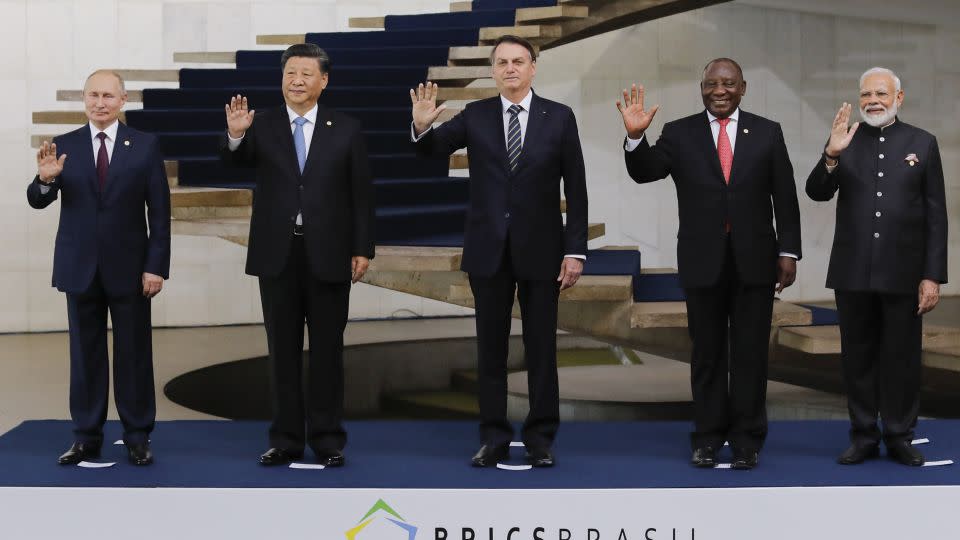
BRICS leaders gather in Brazil in 2019. - Sergio Lima/AFP/Getty Images

China’s Foreign Ministry earlier this year claimed more than 80 countries and organizations had “expressed approval and support” for the Global Security Initiative.

According to Beijing, the economic-focused “Global Development Initiative,” launched in 2021 to support United Nations sustainability goals, boasts some 70 countries in its “Group of Friends” — hosted under the auspices of the UN.

This chimes with China’s long-held strategy to win broad backing for its position against that of Western countries in the UN and other international organizations, where Beijing has also been pushing for a bigger role.

But in addition to how much tangible support Beijing can garner, a key hanging question also remains over whether Xi’s ambitions are limited to efforts to dominate the global narrative and shift the rules in China’s favor or if he wants to truly assume a role as the world’s dominant power.

There is a broad gap between China’s power and military capacity relative to that of the US — and the potential for an ailing economy to slow its rise.

For now, experts say, China appears focused on shifting the rules to undercut American credibility to intervene or hold countries to account for domestic issues — be they civil conflicts or human rights violations.

Success doing that could have implications for how the world responds to any potential future move it could take to gain control of Taiwan — the self-ruled, democratic island the Communist Party claims.

But China’s actions in Asia, where its military has become increasingly assertive, while decrying US military presence, suggest to many observers that Beijing does hope to dominate the region.

They also raise questions about how a more militarily and economically powerful China would behave globally, if left unchecked.

China, however, has denied ambitions of dominance.

“There is no iron law that dictates that a rising power will inevitably seek hegemony,” Beijing said in its policy document in September. “Everything we do is for the purpose of providing a better life for our people, all the while creating more development opportunities for the entire world.”

Then, in an apparent reference to its own belief, or hope, for the trajectory of the US, it added: “China understands the lesson of history — that hegemony preludes decline.”

Detained, missing or under investigation: Business leaders in China face an ‘aggressive’ crackdown

Analysis by Laura He, CNN
Fri, November 10, 2023 at 4:57 PM MST·6 min read

Business leaders in China are under immense pressure, as the country’s leader Xi Jinping intensifies a regulatory crackdown on companies and strengthen s its control of the economy.

This year, more than a dozen top executives from sectors including technology, finance and real estate have gone missing, faced detention or been subjected to corruption probes.

Even international consulting firms have been caught up in the sweep. They face rising risks, including the possibility of police raids and detentions of staff, in the world’s second largest economy.

The crackdown, driven by the Communist Party’s desire for control and its heightened concerns about national security, has continued even though the Chinese economy is on wobbly ground with private investments plunging since June.

Even though Beijing has sought to reassure entrepreneurs and foreign investors that China is open for business, experts say the steady stream of investigations — including cases of detention — are unsettling executives.

“Over the last decade, China has entered a new phase of regulatory control over the private sector and foreign investors,” said Doug Guthrie, a professor and the director of China Initiatives at Arizona State University’s Thunderbird School of Global Management.

“The message was clear: Regardless of global financial status, if you are a Chinese company, you will work with the Chinese government first and foremost; and if you do not, you will suffer significant consequences,” Guthrie added.
A sudden disappearance

Just this week, the Cover News, a state-owned media outlet, reported that the founder and CEO of DouYu, a Chinese live-streaming service backed by Tencent, had been unreachable in recent days, citing unconfirmed reports that he was being investigated.

It didn’t say which authorities were behind the possible investigation.

Another state-owned outlet, the Paper, reported that Chen had been missing since October.

A DouYu spokesperson told CNN that its “business operations remain normal,” adding that it would announce “any significant news or material activities” in a “timely manner.”

Chen’s disappearance came five months after the Cyberspace Administration of China launched an onsite inspection of Douyu to investigate what it called “serious” problems related to the platform, including alleged pornography and “vulgar” content, according to a May statement from the internet watchdog.

Another executive, Zhao Bingxian, a business man dubbed “China’s Warren Buffett” because of his reputation for making lucrative investments, was detained by authorities, his company, Wohua Pharmaceutical, said on Monday.

Zhao was assisting supervisory and anti-corruption agencies in investigations, the Shenzhen-listed company said in an exchange filing, without elaborating. The investigation was not related to the company, it said.

Zhao is chairman of Wohua Pharmaceutical and several other listed companies. A former banker, he has invested in a series of Chinese companies since 2000 and brought their shares to the public markets in mainland China and Hong Kong.

Earlier this year, Chinese officials had signalled that they would wind down their campaigns against tech and financial companies as part of a policy shift intended to focus on economic growth.

But Guthrie said this type of “aggressive corporate governance” was still going on and would continue into the future.

“Beijing will use selective cases to send signals to the market that behaviours and practices that do not fit with the central government’s goals will not be tolerated,” he said. “The cases of DouYu and Shandong Wohua are very clearly part of this continuing trend.”

Other top business leaders have also been facing scrutiny.

In a brief statement on Wednesday, the Central Commission for Discipline Inspection (CCDI) and the National Supervisory Commission said Zhou Zheng, former deputy general manager of COFCO Group, China’s largest state-owned food manufacturer and processor, was being investigated.

Zhou was “suspected of seriously violating rules and laws,” the two anti-corruption watchdogs said, without giving further details.

The probe into Zhou follows a similar investigation into Zhang Hongli, a former senior executive at the Industrial and Commercial Bank of China, one of China’s “Big Four” lenders, according to the CCDI.

Bao Fan, a star investment banker and tech dealmaker, was also caught up in the sweep. In May, Chinese state media reported that Bao had been in the custody of the anti-graft agency since his disappearance in February.

So far this year, the commission has already investigated more than a dozen senior executives at the country’s most important financial institutions, according to a previous CNN analysis of statements posted on the CCDI’s website.
No end in sight

The crackdown this year has spooked the business community in China, but it is not unfamiliar. Xi launched a sweeping regulatory crackdown on the private sector in 2020, which wiped trillions of dollars off the market value of Chinese companies worldwide. Five years earlier, there was a spate of top executives going missing.

The decline in business sentiment is apparent. Recent official data showed that private sector investment had dropped 0.6% in the first nine months of this year, compared to growth of 7.2% growth in the state sector.

In the third quarter, a gauge of foreign direct investment slipped into negative territory for the first time since 1998, underscoring the outflow of capital.

Beijing has rolled out a spate of measures to try to restore confidence, including a 31-point plan in July pledging to improve the business environment, but experts say those may not be enough to undo the damage.
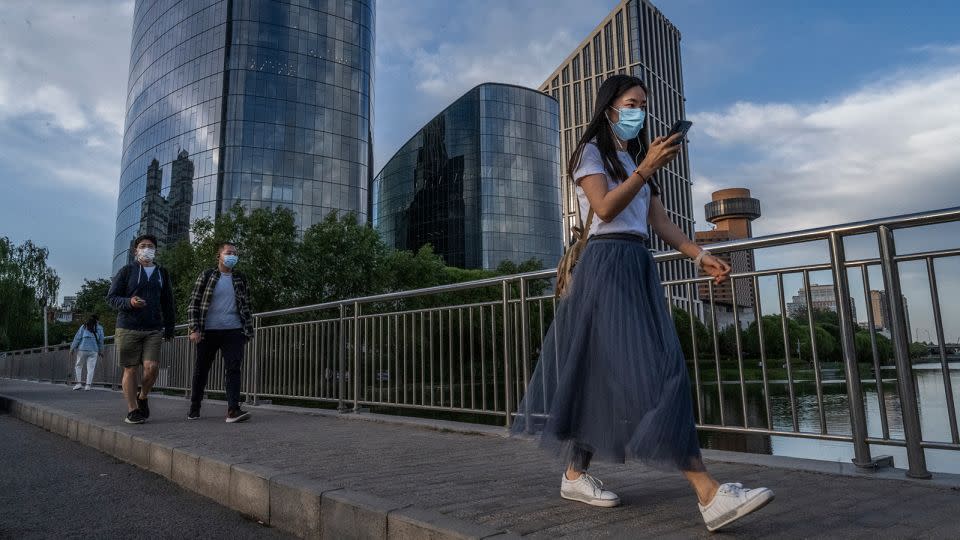

People wear protective masks as they walk across a bridge over the Liangma River on May 24 in Beijing. - Kevin Frayer/Getty Images

The latest cases of missing or detained executives will not boost investors’ sentiment.

“For foreign companies that are largely trying to gain access to China vast consumer markets, and in particular attempting to do so through closely regulated sectors — namely, technology, finance, and education — some will undoubtedly be scared away,” Guthrie said.

Mauro Guillen, a professor of multinational management at the Wharton School of the University of Pennsylvania, said it will further harm China’s investment outlook.

Global investors are already weary about rising tensions between China and the West, as well as the country’s sluggish growth and large corporate debt, he said.

“President Xi is prioritizing geopolitical influence over the economy, not fully realizing that you need a strong economy to have influence in the world,” Guillen said. “[He] should focus on growth for a couple more decades.”

Electric heavy lorries poised to overtake hydrogen truck

Pierre-Henry DESHAYES
Sat, 11 November 2023 

Mercedes Benz Trucks' eActros 600 electric long-distance lorry (Daniel Bockwoldt)

Hydrogen-powered heavy lorries were once seen as the future of emissions-free road transport but they could soon be relegated to niche markets in Europe, overtaken by electric trucks.

On the outskirts of Trondheim in western Norway, food wholesaler Asko has since 2020 been testing four hydrogen fuel cell trucks supplied by Swedish truckmaker Scania.

The experience has been mixed so far.

Integration problems, defective parts and a forced stoppage after the explosion of a charging station near Oslo have meant the vehicles have been available for use only 30 to 40 percent of the time.

"They're not on the road as much as we would have liked. That's the least we can say," admits Asko project head Roger Saether.

"But we're convinced that it will all work out in the end."

When they're running, the trucks, which have a range of up to 500 kilometres (310 miles), supply supermarkets spread across a vast region.

For closer deliveries, the group uses battery-run vehicles, which today have a shorter range.

That distribution of roles -- hydrogen lorries for heavy loads over long distances, electric ones for lighter loads on short distances -- has long been accepted as standard among industry experts due to the advantages and disadvantages of each technology.

But things are changing.

"Now what we're seeing is that contrary to a few years ago, electric trucks and buses are actually playing an increasingly big role and we also see a very important role for them to play in the decarbonisation (process)," said Fedor Unterlohner, freight manager at NGO Transport and Environment.

- Electric Avenue -


Heavy duty vehicles account for six percent of the European Union's greenhouse gas emissions.

Brussels has called for the industry to reduce its emissions by 45 percent compared to 2019 levels by 2030, and by 90 percent by 2040.

According to a study conducted last year by German authorities, truckmakers expect 63 percent of new lorries sold in Europe in 2030 to be "zero emission" vehicles.

Electric trucks are expected to make up the lion's share, with 85 percent.

That's because previous concerns about electric trucks have been eliminated as, unlike hydrogen, the technology for electric trucks has benefitted from advances made in the electric car industry.

Range?

Most heavy trucks in Europe drive fewer than 800 kilometres a day, a distance that could soon be within reach of electric batteries -- especially given drivers' strictly regulated breaks, during which they can recharge their vehicles.

Payload limited by the batteries' weight?

The amount of energy batteries can store continues to improve, to the point where the weight difference compared to a diesel truck is expected to become insignificant.

Infrastructure?


So-called megawatt charging stations are currently being developed and should soon be able to provide 10 times more power than the fastest charging stations currently available.

- Economies of scale -

When it comes to cost -- a crucial factor, given the narrow margins in the transport sector -- electric trucks hold the advantage.

Purchase prices benefit from economies of scale generated by the rapid development of electric car batteries.

Operating costs are also modest, with e-trucks requiring little maintenance and electricity normally much less expensive than green hydrogen.

However, in some cases hydrogen lorries could be the wiser choice.

"For example, if you are driving with two drivers in Europe -- which allows drivers to skip regulated breaks.

"Or when you are in very peripheral regions. Or on islands where you don't have any connection to the grid," said Unterlohner.

"Or if you're transporting an 80-tonne wind turbine through Germany, where you have to block the roads in the night and you have to work all night. Then it may make sense," he said.

But even Scania, which has supplied the four hydrogen trucks to Asko, has chosen to focus on electric heavy trucks "due to their cost advantage in total operation economy and fuel efficiency".

"For some geographies and operations ... we see that the hydrogen-fuelled vehicles might be a viable technology," Scania senior official Peter Forsberg said.

"Therefore we have initiated some activities in order to learn how the hydrogen eco system might play out."

phy/po/gil
An EU plan aimed at fighting climate change will go to final votes, even if watered down

Fri, November 10, 2023


BRUSSELS (AP) — European Union institutions and conservationists on Friday gave a conditional and guarded welcome to a major plan to better protect nature and fight climate change in the 27-nation bloc.

The plan is a key part of the EU’s vaunted European Green Deal that seeks to establish the world’s most ambitious climate and biodiversity targets and make the bloc the global point of reference on all climate issues. Yet it has had an extremely rough ride through the EU's complicated approval process and only a watered-down version will now proceed to final votes.

Late Thursday's breakthrough agreement between parliament and EU member states should have normally been the end of the approval process. But given the controversy the plan had previously stirred, the final votes - normally a rubberstamp process - could still throw up some hurdles.

The plan has lost some of its progressive edge during negotiations over the summer because of fierce opposition in the EU's legislature, particularly from the Christian Democrat EPP, the largest of the political groups.

"The final text on this law has little to do with the original proposal,” said EPP legislator Christine Schneider. The EPP opposition also highlighted the core struggle in Europe over how to deal with climate issues. Despite the succession of droughts, floods and heat waves that have swept through many areas in Europe, the EPP wants to hit the pause button on environmental action and concentrate on economic competitiveness first over the next five years.

Under the plan, member states would have to meet restoration targets for specific habitats and species, with the aim of covering at least 20% of the region’s land and sea areas by 2030. But the negotiations were plagued by quarrels over exemptions and flexibility clauses allowing member states to skirt the rules.

“Negotiators have hollowed out the law to the point that it risks being toothless in practice and prone to abuse,” said Ioannis Agapakis, a lawyer at the ClientEarth conservation group. He said the weakening of provisions “have set a very frightening precedent for EU law-making, rather than cementing the EU at the forefront of biodiversity conservation.”

But the EPP, other conservatives and the far right have insisted the plans would undermine food security, fuel inflation and hurt farmers.

The EU's main agricultural group, COPA-COGECA, said that despite the concessions in the new plan, “the overall final compromise reverts to a totally unrealistic proposal for farmers and forest-owners.”

The group said that with the plan as it stands, “no MEP can now say that the text proposed for ratification will not have major impacts on our production, our competitiveness, the EU trade balance, or the consumption price for millions of Europeans.”

The EPP's Schneider still did not give the plan the wholehearted support of her group for the last votes in parliament, leaving the final adoption of the EU plan in doubt.

“The EPP Group will now seriously check the outcome of today’s negotiations," Schneider said, "keeping in mind that nature restoration and achieving our climate goals go hand-in-hand with agriculture and forestry. Only then we can secure Europe’s food security.”

___

Associated Press climate and environmental coverage receives support from several private foundations. See more about AP’s climate initiative here. The AP is solely responsible for all content.

Raf Casert, The Associated Press
Danica Roem breaks through in Virginia Senate by focusing on road rage and not only anti-trans hate

The Canadian Press
Sat, November 11, 2023 


WASHINGTON (AP) — Lonely, poor and quite lost, Danica Roem thought she had nothing going for her back in 2016 except toned calves from toting kabobs up the stairs of apartments in Arlington, Virginia, in her dead-end food delivery job.

“Picture it," Roem, now a groundbreaking politician who also was a journalist back then, wrote later about that time: "a five-foot- eleven, long-haired brunette metal-head trans lady reporter wearing a rainbow bandana, an A-line skirt, and a black hoodie ... screaming obscenities behind the wheel of her four-door ’92 Dodge Shadow America."

Not the usual gauzy pitch to voters. But in Tuesday's election, the onetime scribe and heavy metal singer scored her fourth election victory, breaking through to the state Senate and overcoming a pitched effort from Republicans and their allies to use her transgender identity as a cudgel.

In one of the latest battles in America's culture wars, Republicans across the country tried in this year's voting to make the embrace of trans rights a powerful, emotional argument against Democratic candidates who they said had violated social norms. Against Roem, it didn't work.

Roem, 39, already had two comfortable reelection victories in her northern Virginia House of Delegates district. Now, Roem has helped Democrats achieve full legislative control in an election that broadly repudiated the far right and promises to stall the social conservative agenda of Republican Gov. Glenn Youngkin.

“The only difference between this campaign and my three campaigns for the House of Delegates is they put a lot more money into promoting a transphobic message that lost as opposed to a moderate amount or a little amount of money into a transphobic message that lost,” Roem told The Associated Press. “They will keep losing by doing this over and over and over again.”

Despite the limited races in the off-year elections, the LGBTQ+ Victory Fund lists 148 openly LGBTQ+ candidates who won across the country Tuesday. The lesson from this “rainbow wave,” said Annise Parker, the fund’s president and a former Houston mayor: “Equality wins elections — not culture war scare tactics.”

Roem “faced an unprecedented deluge of anti-trans hate on the campaign trail, but she was not phased nor distracted." Parker said.

That deluge included some 30 negative mass mailings, several “fake positive” ones and ads accusing of her of wanting to allow “boys to play in girls' sports.” One national organization distributed mass mailers giving out her personal cellphone number and imploring people to use it to “put the heat on Danica Roem."

No flood of hostile callers followed, she said. Only two folks who saw the mailers phoned her and she’s having lunch with one of them to talk things through.

“The other side decided that their closing message was going to be to double, triple and quadruple down on transphobia,” she said.

But she had brought to the campaign her secret sauce for success, learned from days reporting on local politics: “No matter what office you run for, always run like you’re running for mayor. That’s what I did.”

___

‘TORCHING DOUBTS’

By 2016, Roem had slept in more than 60 parking lots across the country from meandering road trips and gigs as a moonlighting metal rocker with day jobs in local journalism.

In that time she carefully ranked the 40 best lots for free overnight parking, choosing a Delaware rest stop off Interstate 95 as tops because of the always open bathrooms, the vending machines and lights that weren't too bright for sleep.

“Nothing about my life screams ‘electable’ (or even ‘hygienic’) on paper,” she observed in her 2022 memoir, “Burn the Page: A True Story of Torching Doubts, Blazing Trails, and Igniting Change.”

Yet she had caught the eye of Democrats and activists in her frequent trips to the Capitol in Richmond to advocate against anti-gay bills from Republicans, and they sounded her out about running.

While engaging a variety of lawmakers in Richmond, she judged the deeply conservative delegate from her own district, Bob Marshall, a lost cause. After all, he had once proudly called himself Virginia’s “chief homophobe.”

Instead of lobbying him, she defeated him. Her victory in a 2017 House of Delegates race made her the first openly transgender candidate to win and take a legislative seat in the United States.

___

HER INNER MAYOR

As a trailblazer for trans politicians, Roem is celebrated in Democratic and cultural circles. But as a legislator with a solid record of writing bills and getting some big ones passed, she is known for her passion for the prosaic, such as traffic congestion.

Perhaps channeling the road rage that once made her unleash swear words from her 24-year-old Dodge, Roem has been in the thick of the debate over roads since she first ran. She calls Route 28, snaking through her area’s suburban sprawl past Dulles Airport, an obsession.

Her slogan for the 2023 campaign was “Fixing roads, feeding kids.” Much of Roem’s social media feed reads like a transportation diary — or the work of a mayor.

“Update,” she says in a typical post, “all three of the southbound lanes are now all open in Centreville from 29 to just before the Bull Run bridge, so if you’re taking Route 28 home to Manassas from I-66, you won’t get stuck in that right turn lane in front of the movie theater.”

This year, pushing initiatives she's already fought for as a delegate, she pitched voters on improving storm water management. On keeping the tech sector’s data centers away from parks and homes. On putting new transmission lines underground. She counts Virginia's expansion of Medicaid under the former Democratic governor as a key accomplishment.

It’s a long way from her kabob-shop days and from her short-lived mobile yoga studio venture, where clients did their moves to a head-banging Swedish metal soundtrack.

___

DIGGING FOR DIRT

Many U.S. campaigns employ an “opposition research” team to poke through an opponent’s past. In her first two campaigns, Roem had her own past investigated, to avoid being blindsided.

Oh that hurt, she writes.

“For those of us who grew up in the age of social media, it can be an exercise in demented self-loathing to figure out just how much of your history the public can truly stomach.”

Sure enough, Marshall's 2017 campaign surfaced a suggestive music video from Roem's metal band, Cab Ride Home. “Lewd,” Marshall told voters.

Insisting on calling his opponent by male pronouns, he also played up Roem's comment in a radio interview when asked if she would support teaching kindergarteners about gender identity. Yes, she said, if the instruction were age-appropriate.

She defeated Marshall with 54% of the vote to his 46% and posted similar margins in the next two elections before taking a narrower victory Tuesday over a former police detective, Bill Woolf III, with 52%.

In a phone interview, Roem rattled off a heavy list of legislative priorities. They include free school meals for all public school students, earmarking 10% of general fund surplus dollars to transportation safety projects, five bills to control data-center sprawl, and an initiative to secure rights for people to be buried in family cemeteries that are located on private property.

She also chronicled her sad history of car ownership. There was the ant-infested Subaru Outback given to her by her mom — “almost killed me twice in one day,” she said of the vehicle. And the “dirty Dodge” she bought from her drummer's dad for $700.

Now life for the senator-elect has improved.

“I'm driving a sweet, sweet 2004 Nissan Sentra,” she said.

Calvin Woodward, The Associated Press
'Support students': Some teachers say they won't follow Saskatchewan's pronoun law

The Canadian Press
Sat, November 11, 2023 


REGINA — Alex Schmidt says she knows she may face consequences for not following the province's pronoun law, but it's a risk she's willing to take.

The Regina public school teacher says she'd rather ensure gender-diverse children who could be put at risk by the law are safe.

"Part of the process has always been: 'No. 1, thank you for sharing this with me, and No. 2, how can I support you?'" Schmidt told The Canadian Press in an interview.

"I think that respects the rights of parents. And if children say, 'I need you to support me and not share this information until I understand how,' then that is the way that I would support students."

Schmidt and dozens of other teachers have signed an online petition calling on school divisions not to follow the law. It says the legislation harms gender-diverse students, as it could force them to come out or have teachers misgender them.

"We will continue to use the practice of letting students have autonomy over their identity and letting students determine who does and doesn’t know about their gender disclosure," the petition says.

The law, passed in October, prevents children under 16 from changing their names or pronouns at school without parental consent.

The rule was part of a provincial policy announced in August. In September, a judge granted an injunction until a court challenge could be heard, saying the protection of gender-diverse youth surpasses the interest of the government.

The Saskatchewan Party government then put the policy into legislation and used the notwithstanding clause to override sections of the Charter of Rights and Freedoms and Saskatchewan's Human Rights Code.

The province has not provided details on what the consequences may be for teachers who don't follow the pronoun law.

It said it expects all divisions and teachers to follow it.

As of Thursday, 98 people had signed the petition. Names are entered online but not listed publicly.

A spokesperson for the petition, another teacher at a Regina public school, said organizers have verified 70 of the signatories are teachers and most of them work in Regina or Saskatoon.

The spokesperson fears losing their job and asked not to be named. They said other teachers are waiting to decide what they will do.

Schmidt said her school's gay-straight alliance club is much smaller than it was before the law passed.

"They're very passionate about what's happening, the ones who are there. But I think that there is a disconnect out of fear that they don't know which teachers at their school are allies."

Schmidt said she hopes school divisions can take on some of the risk.

"We hope different decisions are made by those larger power systems," she said.

The petition, which is also being forwarded to schools divisions and trustees, calls on them to take a stand.

"We implore you to recognize that you always have a choice. You always have the option to prioritize students’ human rights," the petition says.

Education Minister Jeremy Cockrill has said the law has broad support from parents and is meant to ensure they're included in their children's lives.

If it's believed a student would be harmed because of the consent requirement, the law says the school's principal is to direct the student to a counsellor.

School divisions across Saskatchewan are reviewing their guidelines.

Regina Public Schools is reviewing its gender and sexual diversity guideline, which had allowed students to be addressed by a name or pronoun that corresponds to their gender identity.

A spokesperson for the school division said educators will be notified when changes are made.

"While Regina Public Schools administration works towards making required changes as a result of the amendments, Regina Public Schools' commitment to safe, inclusive equitable and welcoming environments for all members of the school community will not change," said Terry Lazarou.

Cockrill has said the guideline of Regina Public Schools, announced in June 2022, was the "impetus" for the province's pronoun legislation. But the school division has said the minister never asked about it.

Jennifer Lyons, a spokesperson for Saskatoon Public Schools, said it has had conversations with teachers and administrators about updated guidelines for names and pronouns.

"Any issues with implementation will be discussed at the school level," Lyons said.

Spokespeople for the catholic school divisions in Regina and Saskatoon said work continues on implementing the law.

The Saskatchewan Professional Teachers Regulatory Board, which deals with teacher complaints, declined to comment on what would happen if a teacher doesn't follow the law.

The Saskatchewan School Boards Association declined to comment, as there is still a court challenge, likely to be heard in December.

The Saskatchewan Teachers' Federation, the union representing educators, also had no comment.

The law has been criticized by the province's Human Rights Commission, which said invoking the notwithstanding clause significantly affects the rights of minors.

Heather Kuttai, a former Saskatchewan human rights commissioner, resigned over the legislation, saying it assaults the rights of gender diverse children.

A report from Saskatchewan's child advocate said it violates rights to gender identity and expression. The report by Lisa Brodaalso raised concerns that teachers may be violating their professional standards of practice if they follow it.

This report by The Canadian Press was first published Nov. 11, 2023.

Jeremy Simes, The Canadian Press


Blinken urges Indian counterparts to co-operate with Canada in probing Nijjar killing

The Canadian Press
Fri, November 10, 2023 


WASHINGTON — The U.S. secretary of state urged India again Friday to assist Canada's investigation into the killing of Hardeep Singh Najjar, something Prime Minister Justin Trudeau says his government has been calling for "from the very beginning."

Antony Blinken wrapped up a whirlwind nine-day, eight-city overseas trip with a final stop in New Delhi, where he sat down with senior Indian government officials, including Prime Minister Narendra Modi.

He said he has raised the issue of Nijjar — a prominent Sikh activist who was gunned down in June outside a gurdwara in Surrey, B.C. — with his Indian counterparts on multiple occasions, including on Friday.

"These are two of our closest friends and partners, and of course we want to see them resolving any differences or disputes that they have as a friend of both," Blinken told a news conference.

"We think it's very important that India work with Canada on its investigation, and that they find a way to resolve this difference in a co-operative way. But that really does go with Canada moving its investigation forward and India working with Canada on it."

Blinken's meeting with External Affairs Minister Subrahmanyam Jaishankar came as part of what's known as the U.S.-India "2+2" ministerial, which included Defense Secretary Lloyd Austin and his Indian counterpart, Rajnath Singh.

Trudeau stunned the House of Commons back in September when he cited "credible allegations" linking Nijjar's killing to agents of the Indian government. Some reports have pointed to Canada's partners in the Five Eyes security alliance as the source of the intelligence.

Nijjar, 45, was at the wheel of his pickup truck when he was gunned down June 18 by a pair of masked gunmen in the parking lot of the gurdwara shortly after evening prayers. At the time, police in B.C. described it as a targeted killing.

Trudeau's allegations pose a vexing diplomatic challenge for the U.S., which has been cultivating closer economic ties with India as part of an effort to build a geopolitical bulwark in the Indo-Pacific against China's growing influence.

A joint statement released by the State Department described Friday's meeting as having made "substantial progress in transforming U.S.-India relations ... based on trust and mutual understanding."

Canada's relationship with India, however, is now on a very different footing.

"From the very beginning ... we reached out to India to ask them to work with us in getting to the bottom of this matter," Trudeau said Friday during a media event in Sault Ste. Marie, Ont.

"We also reached out to our friends and allies, like the United States and others, to work on this really serious violation of international law and of sovereignty of a democracy."

India's high commission in Canada resumed processing some types of visa applications in late October after suspending the services for Canadian citizens around the world for more than a month, citing security concerns.

India also threatened last month to strip Canadian emissaries and their family members of their diplomatic immunity, an escalation that prompted Global Affairs to direct 41 of its diplomats and their dependents to leave the country.

On Friday, Trudeau called that a violation of the Vienna Convention, the 1961 UN agreement that provides diplomatic officers with certain rights and protections in order to safely operate in another country.

"That is of concern to countries around the world," he said. "If a given country can just decide that the diplomats of another country are no longer protected, that makes international relations more dangerous and more serious."

The stakes in the dispute are high, and not only for Canada, Trudeau added.

"If might starts to make right again, if bigger countries can violate international law without consequences, then the whole world gets more dangerous for everyone."

This report by The Canadian Press was first published Nov. 10, 2023.

James McCarten, The Canadian Press
Israel is looking to World War II in its Gaza fight, and it risks taking lessons from the wrong war


Sam Fellman, Sonam Sheth
Updated Sat, November 11, 2023 

Israeli combat vehicles are seen near the Israeli-Gaza border on Oct. 14, 2023.
Ilia Yefimovich/Getty images

Israel faces long odds of ending Hamas, and even if it succeeds it's faced with a difficult dilemma: What comes next?


The US invaded Iraq and Afghanistan but ran into trouble when it tried to rebuild their governments.


"The Israelis have a similar problem here," a military expert with RAND told Insider.

Israel's military is leveling the tiny Gaza enclave with the overwhelming force of a nation that, much like the US in 2001, vows never again to be blindsided by a massive terrorist attack.

Hamas, Israelis feel, must be destroyed.


But beyond the certainty many Israelis feel about ending Hamas, there lies an uncertain future and a political dilemma Israel has avoided addressing — a predicament that hamstrung a superior military power, the United States, in similar conflicts.

"The Achilles heel of the US operation in Iraq and Afghanistan was that we had the game plan for the invasion more or less worked reasonably smoothly," Raphel Cohen, the director of the Strategy and Doctrine Program of RAND Project AIR FORCE, told Insider. "The problem was what came next and that was where we ran into trouble. The Israelis have a similar problem here."

Israel faces long odds of permanently ending Hamas. Even if it succeeds in doing so, its leaders have failed to clearly articulate what will replace it and why that represents a better future for Palestinians in Gaza. It's a critical question that will define whether Israel's war succeeds, experts on military strategy told Insider.

"The more important lessons from 9/11 and the wars that followed are political: Who is going to provide security in Gaza once the fighting ends?" said retired US Army Col. Peter Mansoor, an Iraq veteran and leading counter-insurgency strategist. "Because without security, nothing else will last."

In the month since Hamas carried out its terror attacks in Israel — killing at least 1,200 people, injuring thousands more, and seizing over 200 hostages, including children and seniors — Israel has unleashed an all-out war in Gaza echoing the destructive battles of World War II.

Mosques toppled. Roads ruptured. Refugee centers reduced to rubble. Civilians struggling to find enough water while hospitals go dark.

The Israel Defense Forces are taking out what they say are military targets in these civilian settings, often with overpowering force that has resulted in thousands of civilian casualties. Israel's air force has conducted nonstop bombing runs against the strip as ground forces prepare to clear Gaza's largest city of every Hamas fighter. Israeli military officials are clear that their aim is the total destruction of Hamas. What's less clear is who will lead Gaza afterward.

"I think Israel will, for an indefinite period, will have the overall security responsibility because we've seen what happens when we don't have it," Israeli Prime Minister Benjamin Netanyahu told ABC News on Monday.

Likewise, an Israeli cabinet minister would only tell reporters last weekend that "there's a lot of ideas that are out there" about what comes after Hamas.

Netanyahu advisers suggest that Israeli troops will remain in Gaza at least until it is demilitarized, a process that will likely take months at best and during which they could face an insurgency supported by a radicalized population.

It remains unclear how long Israel will re-occupy the territory or if they would eventually transfer it to, for example, a peacekeeping force or another authority.

The IDF declined to comment on whether it was taking lessons from the US wars in Iraq and Afghanistan into consideration in its Hamas war.

They've "ping-ponged around this question of what happens next," Cohen said. "So this is clearly a problem for Israel in that they haven't been able to articulate what their goals are."

Smoke and flame rise after Israeli air forces targeting a shopping center in Gaza Strip, Gaza on October 07, 2023.
Ashraf Amra/Anadolu Agency via Getty Images


'Mowing the grass'


Since Israel's withdrawal from Gaza in 2005, it has had four major clashes: 2008, 2014, 2021, and now.

Israel's strategy towards Hamas-controlled Gaza has been described as "mowing the grass," which refers to Israel's policy of tolerating Hamas control until its attacks justify short campaigns to kill militants and reduce their capacity to threaten Israel from the impoverished enclave.

This strategy "failed spectacularly" during the October 7 terror attacks, Cohen argued in a recent piece published by RAND, because it showed Israel couldn't contain Hamas and its periodic operations failed to deter them. And critics say that Israeli operations in service of this strategy often result in a disproportionate number of deaths compared to those caused by Hamas attacks.

Cohen described "mowing the grass" as "strategic fatalism" in the RAND piece, adding that it "reflects a large measure of hubris." Cohen argued it has also failed to break the cycle of Palestinian radicalization that fuels the attacks.

Israel's belief that it can hit Hamas just enough to stave off any attacks but not so hard that Gaza descends into chaos is a "hard if not impossible balance to strike year after year, especially as Gaza's internal pressures mount," he wrote.

In the aftermath of the October 7 attacks, Israel has abandoned "mowing the grass" in favor of a much more far-reaching and deadly strategy.


Israeli soldiers sit on a Merkava tank as they man a position at an undisclosed location on the border with Lebanon on October 21, 2023.
Jalaa Marey/Getty Images

Israel's war with Hamas is still in its nascent stages, but modern urban battles already pale in comparison.

The long, nine-month siege of Mosul, Iraq by the Iraqi government coalition, backed by the US, in its fight to uproot the Islamic State left up to 11,000 civilians dead. The US-led effort to clear insurgents from Fallujah, Iraq in 2004 killed roughly 800 civilians in six weeks. By contrast, in a month's time, the war in Gaza has already ended the lives of over 10,800 people, 41% of whom are children, according to the Hamas-led Ministry of Health in Gaza. Although this count does not differentiate between fighters and civilians, it is nonetheless a staggering figure.

The vast majority of those deaths come from Israel's airstrikes, and the death toll will almost certainly keep climbing as Israeli troops move to strike the 30,000 Hamas militants lying in wait in Gaza city, believed to be home to hundreds of thousands of civilians.

The sheer scale of the Israeli effort may trigger a dynamic that's known to US policy makers as the Pottery Barn rule — you break it, you buy it. This was how Secretary of State Colin Powell privately warned President George W. Bush about the consequences of invading Iraq. According to this axiom, Israel must be prepared to bear the costs of rebuilding Gaza and endure its dangers unless it finds another authority to intervene.


A company of US infantry troops moves past the General Post Office building on their way to assault the walled city of Intramuros Feb. 23, 1945, in Manila, Philippines. The month-long battle laid waste to much of Manila.
Ohio Army National Guard Historical Collections

As the war takes shape, the most apt comparison for a major urban battle involving a Western military may require looking much farther back, to the last days of World War II. In 1945, American G.I.s assaulted the capital of the Philippines to root out nearly 20,000 Japanese defenders. They liberated Manila after a month but at a huge cost.

It shattered the city and claimed 100,000 civilian lives.

It's telling that Israeli leaders have directly compared their Hamas fight to World War II, the conflict that the US waged with full-force, viewing it as necessary, even existential. Netanyahu has compared the October 7 terrorist attacks to the 1941 bombing of Pearl Harbor that pulled the US into WWII.

The Israel-Hamas conflict is "not a war of choice for Israel," Cohen said. "The October 7 attacks made it essential that the Israelis take some sort of action to deny Hamas control of Gaza, if only to prevent another 10/7 attack."

Hamas leaders have said the militant group will try to carry out more attacks until Israel is erased. "So Israel was in some ways forced into a policy of regime change in ways that we weren't necessarily forced into with Iraq," Cohen said.

Israel faces geographical challenges with Gaza that the US did not with Iraq and Afghanistan. The US eventually withdrew from Iraq and Afghanistan, though it took years for American officials to make the decision, and about 2,500 US troops remain in Iraq.

"The Israelis can't really withdraw here by reasons of geography," Cohen said. "Gaza will always be next door to them, so they're going to have to remain engaged in Gaza, whether they like it or not, for the foreseeable future."


A Palestinian kid with an assault rifle attends the funeral of Aysar al-Amer, 25, a local commander in the Islamic Jihad militant group, and Jawad Turki, 19, in the West Bank city of Jenin.
Nasser Ishtayeh/Getty Images

Getting 'nowhere'

Peter Mansoor was a newly retired Army colonel when he arrived in Tel Aviv in 2008. He had come to speak to Israeli officers about the success of the American troop plus-up and counter-insurgency effort, known as "the Surge," that reduced the violence roiling Iraq. As executive officer to Gen. David Petraeus, the effort's architect and leader of the Multi-National Force-Iraq, Mansoor brought unique insight to his Israeli counterparts.

"The number one lesson I gave them is you gotta find willing partners among the other side," Mansoor — now a professor of military history at the Ohio State University and author of the book, "Surge: My Journey with General David Petraeus and the Remaking of the Iraq war" — recalled in a phone interview with Insider.

"You don't reconcile with your friends, They're already your friends. You reconcile with people who have blood on their hands. And you've gotta find portions of the opposition that are just willing to put down their arms, at least temporarily, and give the political process a chance."

That is what US leaders sought in Iraq. Americans supported moderate Sunni tribal leaders and helped fund the militias that patrolled their communities in an effort to cut support for al Qaeda in Iraq, which was fueling violence and undermining the US-backed government. For a nation on the brink of a full blown civil war, the strategy worked.

After Mansoor's briefing, some Israeli officers came up to talk to him.

"The Israeli officers who were there back in 2008 told me, 'Well that's not possible with the Palestinians. So what else do you have for us?'" Mansoor recalled.

"And I looked at them and said, 'If you ignore the first and most far-reaching lesson of the Surge, you're going to get nowhere.'"


Israeli Merkava battle tank units regroup near the border of Gaza, in the southern part of Israel, Saturday, Oct. 14, 2023.
Marcus Yam/Getty Images

In this war, Israeli leaders have used heated rhetoric while their forces maintain a deadly bombing campaign. Israel's president has said that the "entire nation" of Gaza is "responsible" for Hamas' terror attacks. One minister even spoke about the possibility of nuking it, though Netanyahu and the defense minister criticized his comments.

Netanyahu has, however, used Western military actions in World War II to justify the killing of civilians if it results from strikes against military targets. In a late October address, he pointed to a British bombing operation near the end of the war in 1945 during which the Royal Air Force missed the intended target and struck a school.

"That is not a war crime," the prime minister said.

The wholesale slaughter of civilian populations in World War II — 45 million by one estimate — led to the creation of a new Geneva convention specifically addressing protections for civilians in war zones.

In the battle for Manila, or the atomic bombings of Hiroshima and Nagasaki, the US used overwhelming force and simply accepted the mass civilian death and suffering that came with it.

Yet destruction on such a scale today, when social media and camera-equipped cell phones can capture war's costs and cruelty, risks a global backlash unlike any Israel has seen in its existence.

And even then it may not succeed in its war against Hamas in the aftermath of the October 7 attacks. A RAND study of campaigns against terror groups over four decades found that only 7% were dismantled by military force.

Should Israel beat those odds and destroy Hamas, that's still not the end of the road. The question persists: What next?

For Mansoor, the counter-insurgency expert, the long-term success of Israel's war will be driven by its willingness to empower Palestinians looking to build a better future peacefully alongside Israel.

"You're going to have to be willing to give the Palestinians what they want. Not the destruction of Israel of course, but a state on the West Bank and in Gaza," Mansoor said. "If the Israelis are not willing to do that then we're looking at something like this happening again in the future."
Once-in-a-century flooding swamps Somalia after historic drought -UN
Reuters
Fri, November 10, 2023 

Heavy rains wreak havoc in East Africa

MOGADISHU (Reuters) - The United Nations has described floods that uprooted hundreds of thousands of people in Somalia and neighbouring countries in East Africa following a historic drought as a once-in-a-century event.

Around 1.6 million people in Somalia could be affected by the heavy seasonal downpours, which have been worsened by the combined impact of two climate phenomenons, El Niño and the Indian Ocean Dipole, the UN Office for the Coordination of Humanitarian Affairs (OCHA) said in a statement late on Thursday.

The floods, which followed heavy rains that started in early October, have already killed at least 29 people and forced more than 300,000 from their homes in Somalia, and inundated towns and villages across northern Kenya.

Camps for people displaced by an Islamist insurgency and the worst drought in four decades have also been flooded, causing people to flee for a second time, aid groups say.

Large-scale displacement, increased humanitarian needs and further destruction of property remain likely, OCHA said, with some 1.5 million hectares (3.70 million acres)of farmland potentially being destroyed.

"Extreme weather linked to the ongoing El Niño risks further driving up humanitarian needs in already-vulnerable communities in Somalia and many other places," said Martin Griffiths, Under-Secretary-General, the UN's Humanitarian Affairs and Emergency Relief Coordinator.

"We know what the risks are, and we need to get ahead of these looming crises," he said.

(Reporting by Abdi Sheikh in Mogadishu and Hereward Holland in Nairobi; Writing by Hereward Holland; Editing by Tomasz Janowski)
View comments (7)


Terms/Privacy Policy
Privacy Dashboard
About Our Ads

NASA warns El Niño could bring ‘extra flooding’ this winter

Travis Schlepp
Thu, November 9, 2023

People stand near a sinkhole caused from storms in San Diego, California on January 7, 2016. (Getty Images)

New analysis from NASA shows that major flooding in cities along the West Coast could become a serious problem if a strong El Niño develops this winter, which is widely expected.

NASA’s sea level change science team analyzed data and determined that an increase in high-tide flooding could swamp roads and spill into low-lying buildings if the periodic climate phenomenon has a prolonged stay in the western U.S.

El Niño happens every few years and is characterized by sea levels that are higher than normal and above average temperatures in the Pacific along the equator.

This year, a particularly strong El Niño could result in “ten-year flood events” in major cities, including Seattle and San Diego, NASA warns. In South America, Ecuador could see up to three of these same flood events.

Even more alarming than the risk of devastating floods this year, scientists caution that these natural disasters could soon become commonplace.

Currently, these historic flood events are unlikely to happen during non-El Niño years, NASA says, but that could change by the 2030s due to rising sea levels and climate change. These cities could experience these 10-year floods annually, with or without El Niño NASA says.

“I’m a little surprised that the analysis found these 10-year events could become commonplace so quickly,” said Phil Thompson, an oceanographer at the University of Hawaii and a member of NASA’s sea level change science team. “I would have thought maybe by the 2040s or 2050s.”

A ten-year flood is an event that has a 1 in 10 chance of occurring in any given year and is a measure of how high local sea levels can rise.

“Ten-year floods can result in what the National Oceanic and Atmospheric Administration classifies as moderate flooding, with some inundation of roads and buildings, and the possible need to evacuate people or move belongings to higher ground,” NASA said.

NASA says the extent of flooding in specific cities depends on multiple factors, including a region’s terrain and the location of homes and infrastructure near the ocean.

More Santa Ana winds increase wildfire risk throughout Southern California

Because water expands as it warms, sea levels tend to be higher in places with warmer water. Sea levels are rising due to the overall warming of the planet due to the heating of the earth’s atmosphere and the melting of ice sheets and shelves.

These rising temperatures have already increased the total number of high-tide flooding days that cities along the coast experience every year. Those flooding risks are compounded by storm surges and weather events like El Niño.


El Nino

“As climate change accelerates, some cities will see flooding five to 10 times more often,” said Nadya Vinogradova Shiffer, of NASA’s Surface Water and Ocean Topography mission. “SWOT will keep watch on these changes to ensure coastal communities are not caught off guard.”

NASA monitors sea levels through various missions and initiatives in hopes of collecting enough data to help legislators and local leaders prepare their communities for rising sea levels, which are almost assured to continue to be a problem in the coming decades.

To read more about NASA’s sea level monitoring studies, click here.

El Niño could unleash several '10-year flood events' this winter in cities such as Seattle and San Diego

Ben Turner
Fri, November 10, 2023 

Giant waves batter Santa Cruz Lighthouse point during the 2018-2019 El Niño event.

A strong El Niño could cause more floods across cities along the western coasts of the Americas this year, swamping roads and inundating buildings, a NASA analysis warns.

This year's El Niño — a warming of surface temperatures from the Central to East Pacific Ocean — could unleash up to five "10-year flood events" this winter in cities such as Seattle and San Diego.

Ten-year floods (those that have a 1-in-10 chance of occurring in any given year) lead to moderate flooding, according to the National Oceanic and Atmospheric Administration, causing exposed roads and buildings to be partially inundated and prompting limited evacuations. There is a 55% chance of El Niño being at least “strong” and a 35% chance of it being "historically strong" this November-to-January season, the U.S. Climate Prediction Center (CPC) said.

Related: Florida waters now 'bona fide bathtub conditions' as heat dome engulfs state

And by the 2030s, climate change and rising sea levels could cause similar floods along the West Coast each year without El Niño, the researchers said.

"I'm a little surprised that the analysis found these 10-year events could become commonplace so quickly," Phil Thompson, an oceanographer at the University of Hawaii at Mānoa and a scientist on NASA's sea-level-change science team, said in a statement.

The El Niño Southern Oscillation occurs every two to seven years and is a natural shift in sea surface temperatures that causes equatorial trade winds, which tend to blow water east to west, to weaken or reverse, causing warm water to flow eastward. This causes global temperatures to increase by about 0.36 degrees Fahrenheit (0.2 degrees Celsius), according to the World Meteorological Organization.

The effects of an El Niño event, which typically last' nine months to two years, are global. The current El Niño, which began in June 2023 and is expected to last until at least April 2024, has already paired with climate change to make 2023 the hottest year on record, causing record droughts across East Africa, Indonesia, Australia and the Americas.

And the biggest effects are likely still to come, given that the strongest effects tend to happen between January and March.

RELATED STORIES

NASA spots sign of El Niño from space: 'If it's a big one, the globe will see record warming'

1,000-year-old wall in Peru was built to protect against El Niño floods, research suggests

The surface of the ocean is now so hot, it's broken every record since satellite measurements began

To investigate how the oscillation is affecting this year's sea levels, NASA used the Surface Water and Ocean Topography (SWOT) and Sentinel-6 Michael Freilich satellites to gauge the height of the ocean before and after this year's El Niño.

The coming flooding is a harbinger of the effects of rising sea levels.

"As climate change accelerates, some cities will see flooding five to 10 times more often," said Nadya Vinogradova Shiffer, a SWOT program scientist and the director of the ocean physics program at NASA.

By monitoring sea surface temperatures, programs like SWOT can help planners prepare ocean defenses and evacuation plans, the researchers said.


El Niño turns strong and still growing as winter fast approaches

Dennis Mersereau
Fri, November 10, 2023 


The Pacific Ocean continues running a fever as the northern hemisphere heads into the winter months, and forecasters see the chance for this El Niño pattern to grow even stronger in the weeks to come.

NOAA’s Climate Prediction Center (CPC) issued an El Niño advisory in its monthly update on Thursday, a formality that makes official what we’ve long known—El Niño is here, it’s strong, and it could affect our winter weather.

MUST SEE: El Niño's impact on Canada's winter: What to expect?
El Niño is officially here and growing stronger

We’re on the lookout for potential shifts in winter weather patterns across North America in the weeks ahead as El Niño strengthens in the eastern half of the Pacific Ocean.

Water temperatures in the equatorial Pacific Ocean west of South America have been consistently warmer than normal since the early spring, with a period of steady warming through the summer.


Global sea surface temperatures November 2023

A spell of abnormally warm waters is considered an El Niño when sea surface temperatures are consistently 0.5°C above normal for about seven consecutive months. Anomalies of 1.0°C represent a moderate El Niño, while a strong event features temperatures at least 1.5°C above normal.

Average sea surface temperatures across a critical section of the Pacific are coming in around 1.7°C above average, the CPC said this week, which meets the criteria for a strong El Niño.

Given that this pattern started in the late spring, October's warmth satisfied the time duration required to graduate from a "likely" El Niño to a full-blown event that's ongoing as we move into winter.

This warmth extends more than a hundred metres below the surface, as well, which reinforces the staying power of this event into the first half of 2024.
Experts see continuing odds of a “historically strong” El Niño this season

Greater temperature anomalies signify a stronger El Niño, which may have greater and farther-reaching impacts on global weather patterns.

RELATED: A ‘historically strong’ El Niño is possible heading into winter

Forecasters with the CPC give a 35 percent chance of this El Niño growing “historically strong,” with average temperature anomalies of 2.0°C or warmer. This change represents a slight uptick in the odds of a high-end El Niño compared to the agency’s update in October.


NOAA El Niño Forecast November 2023

Since 1950, only three winters have seen average temperatures in this part of the Pacific rise more than two degrees above normal: 1982-83; 1997-98; and 2015-16. All three of those seasons saw highly impactful shifts in weather patterns around the world.

What could this mean for folks across Canada?

“Past data indicates that El Niño winters tend to be relatively mild across the country, particularly during strong El Niño events like the one anticipated for this winter,” wrote Dr. Doug Gillham in The Weather Network’s look-ahead to what El Niño could portend for our upcoming winter.

Not all El Niño winters are the same. While many of them follow the same patterns, each one has its own personality of sorts.

Some complicating factors will likely make this winter unique, including a far-reaching warmth across the Pacific, as well as the exceptional warmth that remains present throughout much of the Atlantic Ocean.

Dr. Gillham noted that we’ve still seen impactful winter storms even during those milder El Niño winters: “Even mild winters have a risk for impactful winter weather, as demonstrated by the destructive ice storm that struck southern Quebec and eastern Ontario during the powerful El Niño of 1997-98.”

Stay tuned for The Weather Network’s official winter outlook coming out on Wednesday, November 29, and check back frequently throughout the month as forecasters monitor how these pattern changes will affect conditions in your community.
WATCH: How El Niño could affect Canada's winter weather

Click here to view the video
Century-old buffalofish are still living in their prime

Hannah Seo
Fri, November 10, 2023 

A smallmouth buffalofish that was caught and aged in Lake Apache in Arizona.


From Saskatchewan to Mexico, buffalofish have been swimming under scientists’ radar. They’re a group of non-game fish, relatively difficult to catch, and not considered economically important to the regions they live in. Compared to other freshwater fish, very little is known about different species of buffalofish and their behaviors.

It was once thought that buffalofish only lived up to 26 years in the wild. Then in 2019, a centenarian buffalofish was identified in Minnesota. Now in a new study, scientists caught and analyzed specimens from Apache Lake, Arizona, and confirmed that three of the buffalofish species there can live to be more than 100 years old—and possibly many years more, based on their health. That makes them only the second animal genus, after the marine rockfish Sebastes, known to have three or more species that can live past a century. The discovery could change how we manage buffalofish populations across North America, and lead to more experimental anti-aging research in the future. The findings were published in October in the journal Nature’s Scientific Reports.

[Related: World’s oldest living aquarium fish could be 100 years young]

To pinpoint the ages of these fish, researchers focused on otoliths, the stone-like structures found in the ears of 97 percent of fish species. “What's really interesting about otoliths, and what makes them so valuable for age analysis, is that they put down rings as they go through slow growth periods,” says Alec Lackmann, an ichthyologist at the University of Minnesota Duluth and lead author of the new study. He and his team examined thinly sliced sections of the otoliths to estimate ages. They then cross checked their findings with radiocarbon dating, revealing signs that corresponded to historical events and environmental changes in the area. For example, samples from fish that lived through the 1950s and '60s contained unique radiocarbon signatures from when the US was testing nuclear bombs in the West.

The smallmouth buffalofish the researchers found in the lake ranged from 11 to 101 years old; the black buffalofish were 106 to 108 years old; and the bigmouth buffalofish were 85 to 105 years old. What makes the fishes’ longevity even more remarkable is that they aren’t native to Arizona waters, Lackmann says—the three species were introduced to the state in 1918, likely from Iowa. So, based on the results of the study, it’s likely that some of Arizona’s first buffalofish are still in Lake Apache today.


A bigmouth buffalo from Apache Lake with a unique spotting pattern.

“I found the new study very exciting and novel in that it was the first to look at multiple species of buffalofish,” says Jeff Sereda, a manager of ecological and habitat assessment at the Water Security Agency in Saskatchewan, Canada. Sereda has studied buffalofish and has previously collaborated with Lackmann, but was not involved in the latest research. “We don't know what the fishes’ actual upper limit for age is,” he says, and that has “completely turned up our understanding of these species on its head.”

Before, biologists thought buffalofish populations were relatively stable wherever they existed. But the fact that most of the tested fish were excessively old indicates that they might be more at risk of decline than we thought, Sereda explains. If they’re living for so long, but numbers are stable, it’s a sign they’re barely reproducing. Think of it like the declining birth rate among people in Japan, which is causing the average age of the population to rise and the overall size of the population to shrink each year.

Another aspect of buffalofish that isn’t well understood is their reproductive behavior. Researchers in Saskatchewan haven’t found evidence of new young buffalofish in about 40 years, Sereda says. The fish spawn sometimes but don’t survive to the juvenile stage. Buffalofish remain fertile through old age, even after decades of not spawning any young, Sereda adds. We just need more research to tell whether this is how they survive—living long lives and successfully rearing very few young—or if there’s something amiss.

[Related: A rare fish with ‘hands’ is spotted in a surprising place]

Getting a clearer picture of how buffalofish in different waters live and reproduce can give us a more accurate idea of how they’re faring. They’re classified as “special concern” in Canada, in part because of the lack of data. While a few species have special conservation statuses in the US—bigmouth buffalofish are listed as endangered by Pennsylvania—researchers don’t have a good grasp on the population sizes or trends in most places where buffalofish are found. Without that information, it’s hard to know what the creatures' exact needs are.

“There’s such mystery surrounding buffalofish,” Lackmann says. In the future, he would like to study the otoliths of other buffalofish of the same genus, including one species in Mexico. Getting a better grasp of how their genes contribute to their impressive lifespans could also provide insight into how vertebrates postpone aging, he adds. “It’s incredibly fascinating.”