SPACE/COSMOS
Selfies from space: Aussie nanosatellite completes first phase of mission
Australia’s SpIRIT nanosatellite has successfully completed the initial phase of its mission, marking a milestone achievement for Australia’s place and reputation in the global space industry
University of Melbourne
image:
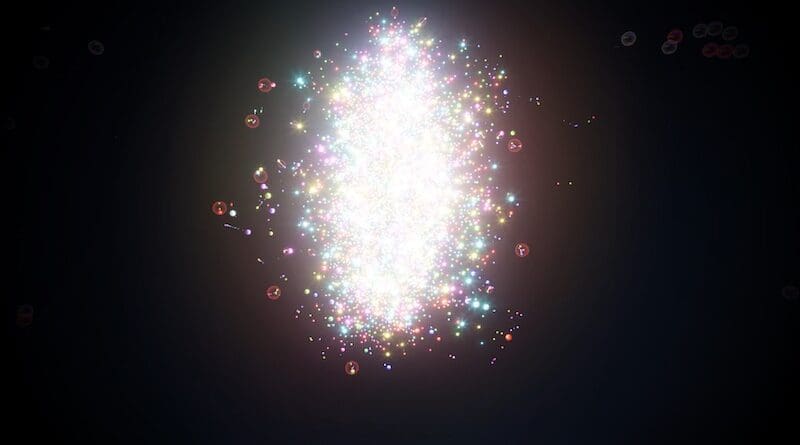
The first image taken by the SpIRIT selfie camera upon completion of the first phase of its mission
view moreCredit: University of Melbourne
Australia’s SpIRIT nanosatellite has successfully completed the initial phase of its mission, marking a milestone achievement for Australia’s place and reputation in the global space industry.
Led by the University of Melbourne, in collaboration with the Italian Space Agency (ASI), the Space Industry Responsive Intelligent Thermal nanosatellite – known as ‘SpIRIT’ – is the first space telescope funded by the Australian Space Agency to carry a foreign space agency’s scientific instrument as its main payload.
Since its launch aboard a SpaceX Falcon 9 rocket from California in December 2023, SpIRIT has circled the Earth more than 9,000 times – travelling a distance comparable to a round trip between Earth and Mars – and has been in orbit for over 600 days.
Principal Investigator, University of Melbourne Professor Michele Trenti said SpIRIT’s successful commissioning period is a true milestone for Australian technological advancements and space capabilities.
“SpIRIT is a complex satellite designed and built in Australia, with many components flying for the first time and hosting a scientific instrument contributed by the Italian Space Agency,” Professor Trenti said.
“Now that SpIRIT has completed rigorous testing in space, we are confident it’s ready to commence the next phase of its mission, which is truly exciting.”
Expected to remain in orbit for more than 1000 days in total, SpIRIT’s core mission will now transition from testing flight capabilities and Australian space technology to scientific observation.
SpIRIT will be scanning large areas of space using its HERMES X-ray detector to spot cosmic explosions called gamma rays bursts, which are created when stars collide or die. These explosions are unpredictable and difficult to spot, like a needle in a haystack.
Acting as an early warning system, SpIRIT will alert astronomers to a gamma ray burst event for further investigation.
The completion of the first phase of SpIRIT’s mission was marked with the deployment of its winged thermal management system and selfie stick, which it used to take a ‘selfie’ in space.
The image, beamed back to Earth, showed the nanosatellite crested in emblems of partners who made its mission possible.
SpIRIT’s unique wings, designed by the University of Melbourne, helps keep the space telescope cool and increase science performance. Now in its final configuration, the spacecraft measures almost a meter in size.
Head of the Australian Space Agency Enrico Palermo welcomed the milestone and transition to the next phase of the mission.
“The SpIRIT mission has demonstrated the capability that exists within the Australian space sector – from building the satellite and testing new technologies in orbit and on ground, to hosting international science payloads and successfully completing its initial phase,” Mr Palermo said.
“I commend the team, and our colleagues at the Italian Space Agency, on their persistent long-duration operations in space. SpIRIT is a great example of the mutual benefit that comes from collaborating in space.”
“The result confirms the excellence of Italian space science, capable of producing technologically advanced equipment, and at the same time reaffirms the strong strategic value of scientific collaboration between the Italian Space Agency and its Australian counterpart,” said Teodoro Valente, President of the Italian Space Agency.
“The SpIRIT satellite carries on board a prototype detector funded by ASI, built entirely in Italy under the guidance of INAF. The nominal operation of this miniaturized instrument, which has successfully completed the commissioning phase, has been demonstrated by pointing at the Crab gamma pulsar, detected with only 700 seconds of observation.”
SpIRIT’s radiators after deployment, flying high over the Indian Ocean
Credit
University of Melbourne
Europlanet Prize for Public Engagement 2025 Awarded to RECA Educación
Europlanet
image:
Laura Ramirez Galeano and Natalia Oliveros receiving the Europlanet Prize for Public Engagement 2025 on behalf of RECA Educación at EPSC-DPS2025 in Helsinki, Finland.
view moreCredit: Europlanet.
The 2025 Europlanet Prize for Public Engagement has been awarded to Red de Estudiantes Colombianos en Astronomía (RECA) Educación, a Colombian non-profit network of volunteers that aims to bring science, astronomy and planetary science to schools and communities across Colombia.
RECA Educación representatives Laura Ramirez Galeano and Natalia Oliveros received the prize, which comes with a cash award of €1000, and gave a lecture during the opening ceremony of the joint meeting of Europlanet Science Congress and the American Astronomical Society’s Division for Planetary Science (EPSC-DPS2025) in Helsinki.
Thibaut Roger, presenting the prize on behalf of Europlanet, said: “RECA is an inspirational organisation that carries out impactful work to engage communities and groups in remote and rural areas where access to science education can be extremely limited. Through the Europlanet Prize for Public Engagement, we are proud to recognise the importance of the volunteer work from RECA and its approach of combining rigorous science with culturally sensitive and inclusive teaching methods. They are a model for what astronomy outreach can achieve when driven by equity, passion and purpose.”
The RECA association, founded in 2012, seeks to create and maintain strong links among Colombian astronomy students in the country and around the world. One of RECA’s main goals is to build a collaborative community of early-career and professional astronomers to strengthen the country’s scientific development and foster long-term academic growth. Since 2021, the educational node, RECA Educación, has spearheaded a public scientific outreach programme that deploys online communications to construct a bridge between professional scientists and school students across the country, including in the most rural communities.
RECA Educación has developed multiple projects such as La Astronomía va a tu colegio (Astronomy Talks in Your School), Remote Observations in partnership with Shadow the Scientists, drawing contests, and BARCO (Bringing Astronomy to Rural Communities). The network currently reaches hundreds of schools in all 32 regions of Colombia, as well as participating in international collaborations to connect schools with scientists around the world.
The RECA team is composed primarily of young scientists and students, who are passionate about making science a right, not a privilege. Despite limited resources, they have developed creative and inclusive formats for delivering astronomy content, including storytelling sessions and hands-on experiments adapted for the home or classroom.
On receiving the prize, Ramirez Galeano said: “We are truly honoured to receive the Europlanet Prize for Public Engagement 2025. It brings us great joy and motivation to know that our efforts to bring astronomy and planetary science to underserved and often overlooked communities are appreciated at such a level.”
As a next step, with the support of the Europlanet prize funding, RECA Educación aims to distribute to schools across Colombia copies of Salomé, a comic-based educational initiative that introduces children to exoplanets and the scientific method in an engaging, narrative-driven format. The team also plans to develop complementary workshops, and train teachers to use the Salomé comic as an accessible entry point to planetary science.
Left to right: President Shu-San Hsiau and Professor Adam Amara
Credit
University of Surrey
UK and Taiwan to forge space partnership, with universities teaming up to give students real-world mission experience
University of Surrey
image:
Left to right: Andie Wang, Professor Wing-Huen Ip, Dr Loren Chang, President Shu-San Hsiau,
Professor Chung-Pai Chang, Adam Amara and Tobias Marchant.
Credit: University of Surrey
The University of Surrey, United Kingdom, and National Central University (NCU), Taiwan, have announced plans to work together on a broad programme of potential collaborations, identifying areas for future work, including the sharing of space radiation data, collaboration on the design of future instruments to measure it, and the development of resilient space infrastructure.
The memorandum of understanding will see the two universities work together to build opportunities for students to work on live missions and space hardware. Providing practical experience for students will strengthen technical expertise and help tackle the global skills shortage affecting the global space industry.
Wing Ip, Professor at National Central University and Chair of the Taiwan Space Union, said:
“The University of Surrey is synonymous with revolutionising small satellites, and it’s renowned for the skilled space engineers it trains. With their creation of the new Surrey Space Institute, they are showing their ambition via international cooperation to further build on this legacy, both in space engineering and the wider disciplines now needed to establish a resilient future for the space industry. It is great news that SSI is joining hands with our researchers in Taiwan.”
Professor Adam Amara, Founding Director of Surrey Space Institute at the University of Surrey, said:
“Through strong collaboration and practical hands-on research, we have a shared strategic vision for addressing space industry skills gaps both for Taiwan and the UK. Our University and the NCU have a history of successful satellite manufacturing, and we have common research interests – for example, in solar radiation – and I’m excited by the prospect of joint working.”
The collaborative plans follow multiple successful engagements between the Universities, from NCU professor Loren Chang joining a Taiwanese delegation to Guildford in March to partnership working between students from each university earlier this summer when Surrey and NCU worked with launch provider Stellar Kinetics at Etlaq Spaceport in Oman. The students worked together to integrate the Jovian-O and SIGHT space payloads that they had developed onto the KEA-1 rocket.
The universities also share research interests. The Surrey Space Centre has built space-based radiation detectors and, as part of the UK’s SWIMMR programme to improve resilience to space weather, developed miniature detectors to measure radiation at different altitudes and created a model for the UK Met Office to predict radiation levels experienced by aircraft.
NCU has developed multiple scientific payloads and small satellite science missions, including the Deep Space Radiation Probe (DSRP), which flew aboard the commercial lunar payload service provider, ispace, Inc.’s Resilience lunar lander, launched in January 2025. DSRP was operational for more than 97% of the five-month mission, providing measurements of the radiation belts, several solar radiation storms and radiation in lunar orbit. It was the first Taiwanese payload to fly and operate beyond Low Earth Orbit.
Established in Taiwan in 1962, the NCU has extensive experience in space science and engineering, with a strong mandate on space science and the geosciences. NCU is also Taiwan’s only university with a Department of Space Science and Engineering with undergraduate and graduate programmes. It is also home to Taiwan’s first interdisciplinary university space centre, the Centre for Astronautical Physics and Engineering (CAPE). NCU currently has robust research and education programs on space weather, satellite communications, small satellite missions, and the space environment.
Surrey has a 45-year legacy of space leadership, particularly through the Surrey Space Centre and its renowned expertise in small satellite technology. This legacy has transformed the economics of space and led to the success of major spinouts, including Surrey Satellite Technology Ltd. (SSTL). The new Surrey Space Institute aims to align the University’s space-related activities across disciplines to address emerging challenges and seize global opportunities in the expanding space economy.
With Taiwan’s rapidly growing Space sector and the Taiwan Space Agency’s ambitious target of growing their space economy to 1 trillion NTD by 2029, the NCU and Surrey are working on ways to support this growth and address potential skills challenges through career professional development and degree programmes.
Shape-Shifting Collisions Probe Secrets Of Early Universe
Artistic rendering of quark–gluon plasma (Image: CERN)
This summer, the Large Hadron Collider (LHC) took a breath of fresh air. Normally filled with beams of protons, the 27-km ring was reconfigured to enable its first oxygen–oxygen and neon–neon collisions.First results from the new data, recorded over a period of six days by the ALICE, ATLAS, CMS and LHCb experiments, were presented during the Initial Stages conference held in Taipei, Taiwan, on 7–12 September.
Smashing atomic nuclei into one another allows physicists to study the quark–gluon plasma (QGP), an extreme state of matter that mimics the conditions of the Universe during its first microseconds, before atoms formed. Until now, exploration of this hot and dense state of free particles at the LHC relied on collisions between heavy ions (like lead or xenon), which maximise the size of the plasma droplet created.
Collisions between lighter ions, such as oxygen, open a new window on the QGP to better understand its characteristics and evolution. Not only are they smaller than lead or xenon, allowing a better investigation of the minimum size of nuclei needed to create the QGP, but they are less regular in shape. A neon nucleus, for example, is predicted to be elongated like a bowling pin – a picture that has now been brought into sharper focus thanks to the new LHC results.
The experiments focused on measurements of subtle patterns in the angles and directions of the particles flying outward as the QGP droplet expands and cools, which are caused by small distortions in the original collision zone. Remarkably, these “flow” patterns can be described using the same fluid-dynamics calculations that are used to model everyday fluids, allowing researchers to probe both the properties of the QGP and the geometry of the colliding nuclei. Accurate model predictions enable a more precise exploration of flow in oxygen–oxygen and neon–neon collisions than in proton–proton and proton–lead collisions.
ALICE, which specialises in the study of the QGP, as well as the general-purpose experiments ATLAS and CMS, have measured sizeable elliptic and triangular flow in oxygen–oxygen and neon–neon collisions, and found that these depend strongly on whether the collisions are glancing or head-on. The level of agreement between theory and data is comparable to that obtained for collisions of heavier xenon and lead ions, despite the much smaller system size. This provides strong evidence that flow in oxygen–oxygen and neon–neon collisions is driven by nuclear geometry, supporting the bowling-pin structure of the neon nucleus and demonstrating that hydrodynamic flow emerges robustly across collision systems at the LHC.
Complementary results presented last week by the LHCb collaboration confirm the bowling-pin shape of the neon nucleus. The results are based on lead–argon and lead–neon collisions in a fixed-target configuration, using data recorded in 2024 with its SMOG apparatus. The LHCb collaboration has also started to analyse the oxygen–oxygen and neon–neon collision data.
“Taken together, these results bring fresh perspectives on nuclear structure and how matter emerged after the Big Bang,” says CERN Director for Research and Computing Joachim Mnich.
Eurasia Review is an independent Journal that provides a venue for analysts and experts to publish content on a wide-range of subjects that are often overlooked or under-represented by Western dominated media.
Collision between two bodies of similar mass may explain the formation of Mercury
A study published in the journal Nature Astronomy challenges traditional explanations about the origin of the innermost planet in the Solar System and proposes a more likely scenario.
Fundação de Amparo à Pesquisa do Estado de São Paulo
The formation of Mercury remains an unsolved mystery. The planet closest to the Sun has a disproportionately large metallic core – accounting for about 70% of its mass – and a relatively small rocky mantle. Until now, the most widely accepted explanation was that Mercury lost much of its crust and mantle after colliding catastrophically with a large celestial body. However, dynamic simulations show that this type of impact involving bodies of very different masses is extremely rare. A new study proposes an alternative explanation based on a type of event that was much more common in the early Solar System – a near-collision between bodies of similar masses.
An article on this subject, whose first author was Patrick Franco, an astronomer with a PhD from the National Observatory in Brazil and postdoctoral researcher at the Institut de Physique du Globe de Paris in France, was published in the journal Nature Astronomy.
“Through simulation, we show that the formation of Mercury doesn’t require exceptional collisions. A grazing impact between two protoplanets of similar masses can explain its composition. This is a much more plausible scenario from a statistical and dynamic point of view,” says Franco. “Our work is based on the finding, made in previous simulations, that collisions between very unequal bodies are extremely rare events. Collisions between objects of similar masses are more common, and the objective of the study was precisely to verify whether these collisions would be capable of producing a planet with the characteristics observed in Mercury.”
This possible collision would have occurred at a relatively late stage in the formation of the Solar System when rocky bodies of similar sizes competed for space in the inner regions, closer to the Sun. “They were evolving objects, within a nursery of planetary embryos, interacting gravitationally, disturbing each other’s orbits, and even colliding, until only the well-defined and stable orbital configurations we know today remained,” describes Franco, who graduated (with a bachelor’s degree in mathematics and a master’s degree in physics) from the Faculty of Engineering and Sciences at the São Paulo State University, Guaratinguetá campus (FEG-UNESP).
To recreate this hypothetical scenario, the researchers used a computational numerical method called “smoothed particle hydrodynamics” (SPH). SPH can simulate gases, liquids, and solid materials in motion, especially in contexts involving large deformations, collisions, or fragmentations.
Widely used in cosmology, astrophysics, and planetary dynamics, as well as engineering and computer graphics, this method employs the Lagrangian function, which was developed by Joseph Louis Lagrange (1736-1813). The function describes the evolution of a system by considering how each constituent point or particle moves individually in space over time. Unlike the Eulerian formalism (developed by Leonhard Paul Euler, 1707-1783), which observes what happens at fixed points in space, the Lagrangian function follows the “point of view” of the moving particle.
“Through detailed simulations in smoothed particle hydrodynamics, we found that it’s possible to reproduce both Mercury’s total mass and its unusual metal-to-silicate ratio with high precision. The model’s margin of error was less than 5%,” Franco says.
The proposal helps explain why Mercury has a low total mass despite its large metallic core and why it retains only a thin layer of rocky material. “We assumed that Mercury would initially have a composition similar to that of the other terrestrial planets. The collision would have stripped away up to 60% of its original mantle, which would explain its heightened metallicity,” the researcher explains.
Where is the debris?
In addition, the new model avoids a limitation of previous scenarios. “In these scenarios, the material torn away during the collision is reincorporated by the planet itself. If this were the case, Mercury wouldn’t exhibit its current disproportion between core and mantle. But in the model we’re proposing, depending on the initial conditions, part of the material torn away may be ejected and never return, which preserves the disproportion between core and mantle,” Franco argues.
The obvious question in this case is where the ejected material went. “If the impact occurred in nearby orbits, one possibility is that this material was incorporated by another planet in formation, perhaps Venus. It’s a hypothesis that still needs to be investigated in greater depth,” the researcher says.
According to Franco, the proposed model can be extended to investigate the formation of other rocky planets and contribute to our understanding of differentiation processes and material loss in the early Solar System. The next steps in the research should include comparisons with geochemical data from meteorites and samples from space missions that have studied Mercury, such as BepiColombo, a joint initiative of the European Space Agency (ESA) and the Japan Aerospace Exploration Agency (JAXA).
“Mercury remains the least explored planet in our system. But that’s changing. There’s a new generation of research and missions underway, and many interesting things are yet to come,” says Franco.
The study received partial support from FAPESP through a grant for the Thematic Project “The Relevance of Small Bodies in Orbital Dynamics”.
About São Paulo Research Foundation (FAPESP)
The São Paulo Research Foundation (FAPESP) is a public institution with the mission of supporting scientific research in all fields of knowledge by awarding scholarships, fellowships and grants to investigators linked with higher education and research institutions in the State of São Paulo, Brazil. FAPESP is aware that the very best research can only be done by working with the best researchers internationally. Therefore, it has established partnerships with funding agencies, higher education, private companies, and research organizations in other countries known for the quality of their research and has been encouraging scientists funded by its grants to further develop their international collaboration. You can learn more about FAPESP at www.fapesp.br/en and visit FAPESP news agency at www.agencia.fapesp.br/en to keep updated with the latest scientific breakthroughs FAPESP helps achieve through its many programs, awards and research centers. You may also subscribe to FAPESP news agency at http://agencia.fapesp.br/subscribe.
Journal
Nature Astronomy
Article Title
Formation of Mercury by a grazing giant collision involving similar-mass bodies
SwRI managed the IMAP payload set to launch this month to map the boundary of the heliosphere
The NASA mission’s instruments, including SwRI-developed CoDICE sensor, will advance understanding of the solar wind and its interaction with interstellar space
Southwest Research Institute
image:
SwRI developed the CoDICE instrument for IMAP with a unique thermal management design to address extreme temperature variations ranging from the intense heat of direct sunlight to the frigid cold of deep space. To maintain operational reliability and longevity, the half of CoDICE that will always face the Sun has a shiny “gold” surface to deflect heat energy, while the opposite side has a matte black surface to absorb as much heat as possible.
view moreCredit: Southwest Research Institute
SAN ANTONIO — September 22, 2025 — Southwest Research Institute (SwRI) is managing the payload of instruments aboard NASA’s Interstellar Mapping and Acceleration Probe (IMAP) spacecraft scheduled to launch Wednesday, September 24, 2025 at 7:30 a.m. EST from Kennedy Space Center in Florida. The payload, including the SwRI-developed Compact Dual Ion Composition Experiment (CoDICE) instrument, will study the interaction between the solar wind and the interstellar medium that surrounds it.
SwRI is playing a major role with the IMAP mission, managing the payload office and providing a scientific instrument and other critical technology. SwRI Space Science Division Executive Director Susan Pope is the mission’s payload manager, and Institute Scientist Dr. Mark Tapley is the payload systems engineer. SwRI managed the development and delivery of all 10 IMAP instruments from multiple institutions aboard IMAP.
“IMAP features the next generation of instruments,” said Pope. “At the heart of the IMAP mission is making sure that the science and technology is set up to achieve all of our goals through the coordinated measurements that we will be conducting.”
IMAP has been described as a modern-day celestial cartographer that will fill in blank spots on the map of the heliosphere. A major focus for IMAP is to explore the boundaries of the heliosphere — the space filled with plasma from the Sun that envelops all the planets of our solar system. Here, the outpouring of solar material collides with the local interstellar medium that fills the space surrounding the heliosphere. This interaction forms a critical barrier for high-energy cosmic rays at a distance of about 10 billion miles from the Sun. IMAP will also examine the fundamental processes that accelerate particles throughout the heliosphere and beyond.
The resulting energetic particles and cosmic rays can harm astronauts and space-based technologies.
The Institute developed the novel CoDICE instrument, which combines the capabilities of multiple instruments into one patented sensor. Initially developed through SwRI internal funding, CoDICE will measure the distribution and composition of interstellar pickup ions, particles that make it through the “heliospheric” filter. It will also characterize solar wind ions as well as the mass and composition of highly energized solar particles associated with flares and coronal mass ejections.
“CoDICE is about the size of a 5-gallon paint bucket, weighing about 22 pounds, and has a unique and beautiful thermal management design,” said SwRI’s Dr. Mihir Desai, an IMAP co-investigator and part of the CoDICE leadership team.
SwRI is a key member of the teams for the IMAP-Hi and IMAP-Lo instruments, responsible for developing the IMAP-Hi detector and IMAP-Lo’s conversion subsystem. The IMAP-Lo is a single-pixel ENA (energetic neutral atom) imager that measures interstellar neutral atoms in the lower energy range. Together with the IMAP-Hi, which measures these same types of atoms in a higher energy range, they will be able to provide a much wider and more in-depth view of interstellar space than we are currently capable of seeing.
SwRI built high-voltage power supplies for the Solar Wind Electron (SWE) instrument, which measures the distribution of thermal electrons in the solar wind, and the Global Solar Wind Structure (GLOWS) instrument, a non-imaging photometer that will observe the solar wind’s structure. SwRI also provided digital electronics for four other IMAP instruments.
IMAP will join a fleet of NASA heliophysics missions that seek to understand how the Sun affects the space environment near Earth and across the solar system.
Princeton University professor David J. McComas leads the mission with an international team of 27 affiliated institutions. The Johns Hopkins Applied Physics Laboratory in Laurel, Maryland built the spacecraft and will operate the mission. IMAP is the fifth mission in NASA’s Solar Terrestrial Probes (STP) Program portfolio. The Explorers and Heliophysics Project Division at NASA’s Goddard Space Flight Center in Greenbelt, Maryland, manages the STP Program for the agency’s Heliophysics Division of NASA’s Science Mission Directorate.
For more information, visit https://www.swri.org/markets/earth-space/space-research-technology/space-science/heliophysics.
Designing materials for next-generation propulsion systems
Lehigh University researcher Natasha Vermaak leads multidisciplinary project— supported by a new $2 million NSF grant—investigating rotating detonation engine materials
image:
Collaborative academic team from left to right: N. Vermaak (PI), X. Shi, M. Taheri-Mousavi, L. Valdevit, and D. Mumm
view moreCredit: Courtesy of Lehigh University, Carnegie Mellon University, and the University of California, Irvine
The ability to reliably order groceries or takeout, have rapid package delivery, check the weather forecast, or follow GPS tracking is all a part of the US’s ever-growing satellite and space economy. The continued growth of this economy relies on advancements in propulsion technologies. One such breakthrough is the “Rotating Detonation Engine" (RDE). The RDE offers the ability to deliver satellites to precise orbits in outer space with greater robustness and reduced fuel consumption and emissions than with current conventional engines. However, there are many fundamental scientific challenges that remain related to designing materials systems that can perform under these extreme engine conditions.
A new multi-institutional collaborative $2 million grant, "Thriving While Detonating – Materials for Extreme Dynamic Thermomechanical Performance,” led by Natasha Vermaak, an associate professor of mechanical engineering and mechanics in Lehigh University’s P.C. Rossin College of Engineering and Applied Science, addresses some of these materials design challenges. The team was one of 25 to receive National Science Foundation funding as part of the organization’s Designing Materials to Revolutionize and Engineer our Future (DMREF) program.
Vermaak and her collaborators, Mohadeseh Taheri-Mousavi, an assistant professor in the department of materials science and engineering at Carnegie Mellon University, and three University of California Irvine professors - Daniel Mumm and Lorenzo Valdevit (Department Materials Science and Engineering) and Xian Shi, (Department of Mechanical and Aerospace Engineering), will investigate the development of structural materials systems that are resistant to high-frequency, high-amplitude thermomechanical loads for propulsion and power applications with a focus on rotating detonation engines. The project includes additional collaborators from the Air Force Research Laboratory (Edwards, WPAFB), as well as industry stakeholders, which will promote the translation of their materials and tools into application.
The RDE is a revolutionary engine concept that generates power through sustaining a circulating detonation wave in an annular chamber at thousands of meters per second. The RDE is promising because it can produce power levels orders of magnitude higher than conventional engines, while providing higher efficiencies, more compact designs, and higher thrust-to-weight ratios. While RDE technology is advancing rapidly, the lack of established materials solutions to contend with the extreme thermomechanical loadings associated with detonation remains a critical barrier to deployment. This DMREF team will use an integrated approach that leverages experiments, simulations, and AI/machine learning to develop a stronger fundamental understanding of how changing composition and microstructure of advanced structural alloys will affect the damage and failure mechanisms in the RDE environment.
“This is an exciting opportunity to identify breakthrough materials capabilities that may spur advancements in propulsion systems of the future,” Vermaak says.
The NSF DMREF Program is intended to drive the design, discovery and development of advanced materials needed to address major societal challenges. The DMREF program supports materials design and development through the integration of experiments, computation and data-driven methods, while fostering interdisciplinary collaboration and training the workforce. Since 2012, DMREF has been NSF's primary response to the federal Materials Genome Initiative, whose mission is to discover, develop and deploy new materials twice as fast and at a fraction of the cost of traditional research methods. More information about past and current DMREF projects can be found at dmref.org.