What Planet Are We On?
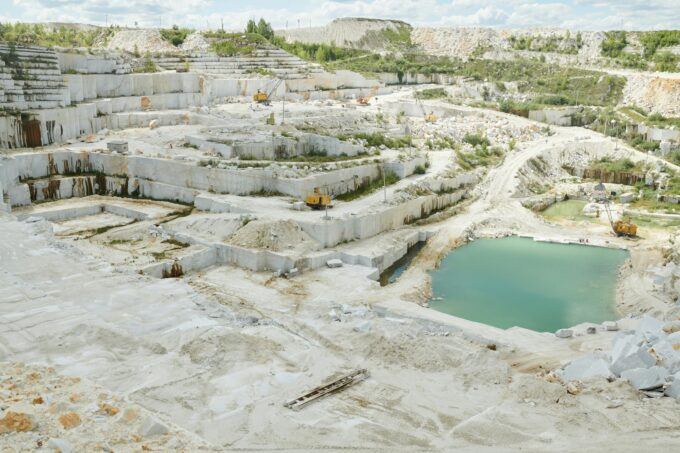
A lithium mine. Image Getty and Unsplash+.
As 2026 begins, what a strange planet we find ourselves on. The two great empires of my youth, the Soviet Union (now Russia) and my own country, are clearly experiencing some version of imperial decline, even if Vladimir Putin is acting otherwise in Ukraine (as is Donald Trump in his own strange fashion in the Caribbean Sea and Venezuela). No less curiously, the country visibly on the rise, China, is distinctly not acting like a typical imperial power of history (at least the history I’ve known). In a world where the United States still has 750 or so military bases around the world, China, as far as I can tell, has at most just one (in Djibouti, Africa). While its economy has become significant globally (imperially significant, you might say), unlike essentially every imperial power from the Portuguese and Spanish in the 15th and 16th centuries on, it has no colonies and only the most minimal military presence abroad, though it does continue to build up its military power (and its nuclear arsenal) at home.
Of course, it’s worth remembering that we are distinctly on a different planet than the one any of those older powers inhabited. And even if America’s great man (my joke!), President Donald J. Trump, doesn’t seem to know it, China’s leader, Xi Jinping, certainly does.
Vladimir Putin’s version of imperial aggression is, at present, aimed at Ukraine in a war that will in the — and yes, I can hardly avoid the word! — end undoubtedly prove a disaster, not just for Ukraine but for Russia and the rest of the planet, too. Meanwhile, Donald Trump’s version of imperial aggression, which is likely (again, in the end) to prove disastrous, is for the time being (and, with him, you always have to add a qualifier) aimed at the Caribbean Sea, the Eastern Pacific Ocean, and Venezuela (which he now seems intent on turning into an oil colony), even as he prepares to build his own “golden fleet,” including “Trump-class” (old-fashioned) battleships. On the other hand, China’s major “aggression” (and indeed, that word does have to be put in quotation marks!) is aimed — setting aside the island of Taiwan (which it claims not as a colony but as a part of China itself) — at the conquest of the future global green economy.
Or put another way, to give credit where it’s due, despite the fact that China continues to open coal plants in an unnerving fashion, its great-power desires are at least aimed at something — in fact, the thing — that truly matters on this distinctly beleaguered planet of ours. It is intent on becoming the Earth’s global powerhouse when it comes to the sale of green energy and the ways to produce it. Consider that its imperial target, one unlike any other in history (though perhaps a comparison could be made to the industrialization of what became imperial Great Britain in the nineteenth century). Moreover, it’s already selling and delivering green energy production units to countries globally, while far outpacing anyplace else on this planet in producing electric vehicles (EVs).
At War with the World
Last year, China installed more wind turbines and solar panels than any other country, indeed more than the rest of the planet combined. And as the New York Times reported earlier in 2025, “Not only does China already dominate global manufacturing of solar panels, wind turbines, batteries, EVs, and many other clean energy industries, but with each passing month it is widening its technological lead.”
While Donald Trump’s America is putting so much of its energy (so to speak) and money into coal, oil, and natural gas production, China’s government has been giving hundreds of billions of dollars in subsidies to wind, solar, and electric car manufacturers. And it is now hard at work spreading the products for producing wind and solar power globally. As the Times also reported, “Chinese firms are building wind turbines in Brazil and electric vehicles in Indonesia. In northern Kenya, Chinese developers have erected Africa’s biggest wind farm. And across the continent, in countries rich with minerals needed for clean energy technologies, such as Zambia, Chinese financing for all sorts of projects has left some governments deeply in debt to Chinese banks.”
And of course, China is unequaled in the production of electric vehicles. There are now at least 129 brands selling such vehicles in China and they are exporting more than one-fifth of their products globally, while Chinese companies continue to out-innovate those elsewhere on this planet.
On the other hand, Vladimir Putin, who once joked that global warming might be good for Russians because they could then “spend less on fur coats,” at least now acknowledges its reality. Nonetheless, he only recently signed a decree that would allow his country, already heating up 2.5 times faster than the global average, to increase its emissions of greenhouse gases 20% by 2035. And of course the United States is now led by a president who all too bluntly ran for office the second time around on the campaign slogan “drill, baby, drill” and is making policy based on “ending the green new scam.”
Only recently, in fact, his administration “paused” the leases on and halted the building of five major wind projects under construction off the east coast of the United States, supposedly due to “national security risks.” In essence, Donald Trump and crew have been doing their best to dismantle or get rid of anything in this country that might effectively impede climate change and the future broiling of Planet Earth. That is, in fact, the definition of his America, which is also the definition of decline on a scale that once would have been unimaginable. And remember, I’m talking about the same president who, last fall, told delegates from nations around the world at the United Nations that climate change was “the greatest con job ever perpetrated on the world,” while insisting that, “If you don’t get away from this green scam, your country is going to fail.”
In the bluntest terms, the greatest imperial power of the past century, the United States, is now in the Trumpian process of sending itself into a steep imperial decline on a distinctly beleaguered planet itself undoubtedly in decline. And part of the reason for that, Trump aside for a moment, is that we humans just can’t seem to stop making war on ourselves. After all, in addition to killing and wounding staggering numbers of us and doing untold damage to (even destroying) whole regions of the planet, wars also release stunning amounts of carbon dioxide into the atmosphere, as do what still pass for “peacetime” armies. In fact, the U.S. military, even when not at war, still releases more greenhouse gases than whole countries like Sweden or Norway. As it happens, it may be the single largest institutional emitter of such gases on planet Earth.
And worse yet, at such an increasingly dangerous moment in history, there are at least three significant wars underway on this planet of ours. In this distinctly post-modern age, there should be a term for such wars and the way — in addition to the hell on earth they have created since time immemorial — they are now helping produce an environmental hell through the release of greenhouse gases in vast quantities into the atmosphere. There is, of course, the never-ending war in Ukraine, the one (in partial — but only partial — remission) in the Middle East, and the brutal ongoing one in Africa. I’m thinking of Sudan, of course. (And don’t forget the more minor but still brutal one underway in the Congo.)
And when it comes to one conflict for which we have some figures on greenhouse gas emissions, the Guardian reported that, in the first 15 months of Israel’s war in Gaza, those emissions were “greater than the annual planet-warming emissions of a hundred individual countries.” It similarly reported that “the climate cost of the first two years of Russia’s war on Ukraine was greater than the annual greenhouse gas emissions generated individually by 175 countries.”
A Long-Term Definition of Suicidal on Planet Earth
So, at a time (and what a time!) when we’re experiencing one record hot year after another, ever fiercer forest fires, ever more horrific floods, ever more severe droughts, and so on (and on and on) — at a moment, in other words, when it increasingly seems as if humanity is ever more at war with this planet, the old form of imperial power, the one involving wars, colonies around the world, and global military bases, seems increasingly passé, even if the leaders of neither the U.S., nor Russia seem capable of recognizing that reality.
And in that context, those two imperial powers of the last century aren’t simply following the pathways of other imperial powers whose time was up. Yes, they are both distinctly heading downhill, but both of them, in an eerily purposeful fashion, seem (in climate-change terms) to be intent on taking down much of the rest of the planet with them. And none more purposefully (or so it seems) than Donald Trump’s America, which is distinctly focused on ensuring that, at least in the United States, wind power projects will be cancelled, solar energy projects avoided or wiped out, and ever larger areas from Alaska to more than a billion acres of ocean waters opened to the production of yet more fossil fuels. If you need a long-term definition of “suicidal” at both a national and a planetary level, that obviously should be it.
And it’s in just such a world that China, the rising power on this planet, is neither spreading its military might globally, nor creating military bases and seizing colonies around the world. Instead, its leaders are doing their damnedest to take control of the universe of green energy and so plowing new imperial ground by potentially becoming the unparalleled green-energy power on planet Earth.
Of course, it shouldn’t really be a surprise that, on a planet changing before our eyes in the most basic fashion, the meaning of the very word imperial would change or that the old war-making, colonizing version of it would be left to the history books (and to the increasingly ancient and outdated great powers whose leaders can no longer seem to imagine the actual nature of our future).
And this brings me to myself. In some ways, in my 82nd year on this planet, I just can’t believe the world I’m in, nor could I ever have guessed that it would be quite this way. Donald Trump, president of the United States… really? At a moment when it should have been all too obvious that humanity was in danger of creating an all-too-literal hell on earth, a near majority of my compatriots elected (for a second time!) a man who not only refuses to faintly grasp what’s happening but has made a clear and conscious decision to worsen our situation by promoting the further use of fossil fuels in every imaginable way.
All too sadly, though it’s not normally used that way, the word “suicidal” seems a reasonable description of his policies. I mean, what needed to be done really shouldn’t have been all that complicated — not on a planet where the most recent years have been the hottest in human history, the last 10 the hottest decade, 2024 the hottest year ever (and unsurprisingly, when the final figures are in, 2025 will undoubtedly be right up there, too); not on a planet where Arctic ice is melting, sea levels rising, and the weather (from storms to droughts) is growing ever more extreme by the year.
And yet, obvious as all that may be, Trump and crew have decided to actively intensify the ongoing disaster. And if that isn’t the definition of a once great imperial power going down (and attempting to take the rest of us with it), what is? To the extent that great power global politics even matter anymore, President Trump is literally turning this world, economically and ecologically, over to China, lock, stock, and rain barrel.
And all of that makes me wonder: How did I — how did any of us — end up here?
Yes, we’re clearly entering a new imperial age with China potentially at the helm of a planet that, in weather (and human) terms, will be going down, down, down.
It may be hard to believe, but that’s our reality — and I must admit that I find it painful to leave such a planet to my children and grandchildren. They truly deserved better.
This piece first appeared on TomDispatch.