Wednesday, February 25, 2026


India’s Swan Defense Shipyard Revives Old Projects as it Develops Yard

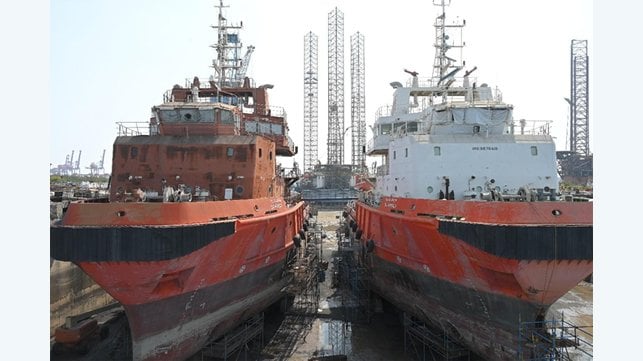
OSVs under construction at Swan Defense India
SDHI is successfully restarting old projects as it revitalized the shipbuilding operations (SDHI)

Published Feb 24, 2026 7:13 PM by The Maritime Executive


Efforts continue to show progress at reviving India’s shipbuilding industry at the yard in Pipavav, formerly operated by the Reliance Group. Relaunched as Swan Defence and Heavy Industries Limited, the yard reports it has received a contract to finish five ships ordered in 2009 and sitting idle for nearly a decade due to the collapse of the operations. It is the second deal recently announced by SDHI to revive old projects.

SDHI reports it completed a deal to sell the hulls of five incomplete offshore supply vessels (OSV) and has now received a contract to finish the construction of the vessels. The ships were originally part of an order placed in 2009 to build a dozen OSVs for India’s Oil and Natural Gas Corporation while the yard operated as Reliance Naval and Engineering. The first seven were completed and delivered before Reliance’s financial troubles, which delayed the next five ships. Work was stalled by 2017, and the yard later went into bankruptcy.

When the new owners bought the yard and began the efforts to relaunch the operations, the deal included a number of incomplete projects. SDHI reports it sold the five incomplete OSVs to San Maritime India, an offshore operator with more than 40 vessels. San Maritime acquired the ships on an “as is, where is” basis and has now contracted with SDHI to complete the construction of the vessels.

The OSV order came in the same month as SDHI also reported a defense export order from the Government of Oman. The Indian news outlet ETInfra writes that this order is also part of the efforts to “clear the baggage from the past.” It reports that the prior operators had received an order from the Indian Coast Guard for a training ship, which was also partially constructed before the bankruptcy.

SDHI reports the vessel is expected to be delivered within 18 months to the Royal Navy of Oman. It measures 104 meters (341 feet) and will have a displacement of approximately 3,500 tons. It will feature modern classrooms, training offices, and accommodations for up to 70 officer cadets. It will be outfitted with state-of-the-art navigation systems and communications and be capable of conducting helicopter operations.

Under the new leadership, the yard seeks to be a significant part of India’s efforts to expand its shipbuilding to become a key player in the global market. SDHI in January booked India’s first chemical tanker order and one of the largest deals for the Indian industry. It was contracted to build six 18,000 dwt chemical tankers for Rederiet Stenersen valued at $227 million. Each of the tankers will measure 150 meters (492 feet) and will be built to Ice Class 1A and feature advanced dual-fuel LNG-ready hybrid propulsion.

The company says these orders “reinforce India’s indigenous shipbuilding capabilities and its growing stature as a global maritime hub.”  The Government of India recently rolled out targeted financial assistance and incentive schemes to help support the expansion of the shipbuilding industry. SDHI highlights that it is creating a shipbuilding ecosystem that will support local vendors and service providers.


Digital Collaboration in Chemical Logistics

Decarbonization Is Turning Transport into a Chemical Logistics Coordination Challenge

energy transport

Published Feb 20, 2026 2:31 PM by Mikael Lind et al.


[By Mikael Lind, Wolfgang Lehmacher, Jeremy Bentham, Chye Poh Chua, Philippe Isler, Jens Lund-Nielsen, and Per Löfbom]

Transport still relies heavily on fossil fuels and accounts for roughly one quarter of global energy-related greenhouse gas emissions. Shifting this energy base to sustainable alternatives requires a systemic effort. As transport decarbonizes, the way fuels are supplied changes fundamentally. Crude oil and derived refined products are handled through mature infrastructure and well-established operating practices. In contrast, many low-carbon energy carriers fall outside this model as clean energy infrastructure remains materials-intensive and relies on polymers, composites, specialty gases, electrolytes, solvents, and coatings supplied by the chemical industry.

Hydrogen carriers, synthetic fuels, advanced biofuels, and e-fuels are produced, stored, and transported as chemical products that are contamination-sensitive, hazardous, and tightly linked to plant and storage operations. As with traditional fuels, moving them safely and efficiently typically requires specialized terminals, strict tank cleaning routines, careful sequencing, and close coordination among ships, storage, and inland transport. 

Maritime transport accounts for most of global trade by volume. It remains the backbone of world trade, with energy commodities such as crude oil, petroleum products, LNG (liquid natural gas), and LPG (liquid petroleum gas), accounting for the bulk of tanker capacity. Transition outlooks foresee part of this trade shifting toward chemically derived fuels such as methanol, ammonia, synthetic fuels, and advanced biofuels, which will largely move through existing ports, terminals, and ships serving the chemicals industry. Long-term decarbonization perspectives similarly point to low- and zero-carbon fuels supplying a growing share of shipping energy demand from a low base, often via regional hubs and corridors where these fuels move as chemical cargoes.

The challenge is therefore not only how to produce low-carbon fuels, but how to coordinate their movement reliably across complex, multi-actor chemical supply chains, and expand the use of more selectively applied just-in-time practices to the entire end-to-end supply chain. 

The Industry Is Optimized, but Lags End-to-End Coordination

Chemical logistics has been optimized within companies: shipping lines use advanced scheduling tools, terminals adhere to strict safety and quality standards, and producers manage production, storage, and deliveries with digital support. The main weakness lies in both fragmentation and coordination between organizations, where small differences in readiness, sequencing, or arrival times trigger last-minute changes to berth plans, tank assignments, and inland transport, necessitating buffers and emergency responses.

In a decarbonizing transport system that relies on tightly linked fuel and material flows, these coordination gaps increase costs, risks, and the likelihood of delays in scaling low-carbon solutions. The challenge is evident in liquid bulk, where tankers carry multiple chemicals in separate, compatibility-constrained tanks and terminals handle diverse, safety-sensitive products; when arrival times shift, tank planning, inland transport, and sometimes production must all be adjusted.

Chemical Logistics and the Business Logic of Dependency

Chemical logistics is structurally tight: many storage tanks are product-specific and integrated into production, blending, and safety systems, and many sites operate near capacity, leaving little room for error and disruption. Experts estimate logistics costs at 15–25% of product value, so delays and misalignment quickly erode margins, and even modest improvements in supply chain coordination unlock meaningful value and resilience.

In this environment, uncertainty is more damaging than delay: predictable lateness can be planned around, whereas uncertain arrivals force actors to hold extra inventory, reserve capacity “just in case”, and pay for back-up options. Operational experience across the chemical and liquid bulk chains shows that minor deviations early in the chain can materially degrade routing and sequencing efficiency, with knock-on effects on fleet use and plant performance. In this industry, commercial sensitivity is intrinsic, since data on readiness, sequencing, or prioritization can reveal production status, customer exposure, or market position, particularly in competitive tanker markets, so any coordination model must accept limited, selective information sharing.

Why Traditional Digital Coordination Models Fall Short

Many digital collaboration initiatives assume either a central orchestrator or a broad willingness to share detailed information, neither of which aligns with the realities of the supply chain industry, including chemical logistics. In liquid bulk, port authorities manage safety, access, and traffic, but not commercial supply chains; terminal operators act on behalf of cargo owners with only partial visibility; and there is usually no single operator or platform coordinating end-to-end.

Ownership structures reinforce fragmentation as cargo owners may own tanks or captive terminals and hold long-term capacity. Still, they cannot own port authorities, and ports are not natural custodians of commercially sensitive information. Shipping lines face similar constraints: ship positions are visible, but sharing precise arrival plans or onward employment can reveal strategy, making it hard to adopt systems that treat ETA (estimated time of arrival) as a fixed promise. The core issue is not data scarcity but the absence of governance arrangements that allow coordination without over-exposure, a gap that becomes more consequential as decarbonization makes chemical and energy flows more interdependent. This more interdependent future is expected to arrive sooner rather than later in the industry, making adjustments for better coordination in chemical and energy supply chains an urgent matter to protect margins and profits.

The Foundations of End-to-End Digital Collaboration

The key opportunity is to move interventions and activities from late, reactive alignment towards earlier, shared coordination along the end-to-end chains. The energy transition process makes an urgent necessity rather than a “nice to have”. Coordination works best when limited, pre-agreed sets of primary data are shared directly by those closest to the action and the chain of events, including shippers, cargo owners, terminals, shipping lines, and inland operators, rather than relying mainly on estimates derived from third-party data, which do not provide high accuracy and certainty.

In chemical and liquid bulk energy and feedstock flows, a small set of signals is often sufficient: planned, estimated, and actual arrival and departure times at transport nodes along the end-to-end chain, shared at the source and updated as conditions change, enable others to adjust in time. This can be transformative and  leads to three design principles: cargo owners decide who sees what, because they control readiness and bear much of the risk; ETAs are treated as intent, updated as conditions evolve, to facilitate early data sharing; and visibility is limited to actors directly involved in a flow, for a defined purpose and time window, to protect commercial interests.

These principles are well-suited to liquid bulk corridors for future fuels and critical intermediates, where tighter coordination is needed without undermining competition or confidentiality.

Principle and Practice: Primary Data with Ports in the Loop

Disturbances in chemical logistics tend to propagate across the full chain - from production sites to terminals, storage facilities, downstream plants, and inland transport. Coordination therefore needs to span the entire end-to-end flow, not just individual nodes. In practice, this points to a cargo-owner-driven, terminal-centred community model with port authorities in the loop. Producers, traders, suppliers, receivers and industrial users, terminal operators, shipping lines (tankers, container carriers, tank-container operators), inland transport providers, forwarders, and port authorities - including customs, safety bureaus, and other regulatory actors - form the core coordination group in chemical logistics. Given the layered nature of chemical value chains, where one actor’s output becomes the next downstream input, these flows often remain seaborne and interconnected across multiple stages and geographies.

Within this group, each participant shares their planned, estimated, and actual arrival and departure times, rather than only the cargo or vehicle's actual position, which usually provides limited value. This enables better sequencing, resource allocation, and contingency planning without revealing sensitive details. Ports and terminals benefit from structured pre-alerts on arrival windows, deviations, and actual movements, improving chain fluidity, safety, and energy transition planning and execution, while the commercial context remains within the individual companies. As analyses of emerging green shipping corridors show, linking short-sea trade lanes such as Sweden–Belgium with deep-sea bulk routes from South Africa to Northwest Europe can create corridor structures where stakeholders coordinate green ammonia production, fuel supply, and transport execution using limited shared signals. Such corridor-based coordination enables actors to absorb production or voyage delays, re-optimize berths, storage tanks, and inland flows, and reduce reliance on emergency storage, spot chartering, and losses of low-carbon fuels, while avoiding the disclosure of commercially sensitive information or counterparties1  (North Sea Port, 2024; Global Maritime Forum, 2025).

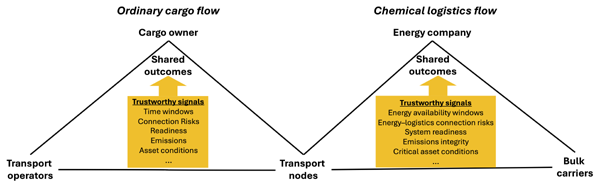
Building on the Trinity approach, the illustration below extends the coordination logic from ordinary cargo transport to a chemical flow transport system. While the same trustworthy signals - time windows, readiness, connection risks, emissions, and asset conditions - continue to sit between cargo owners, transport operators, and transport nodes, they are expanded to reflect energy availability and carbon integrity. In doing so, the model links transport execution directly to sustainable energy supply, ensuring that logistics flows are not only operationally aligned but also powered by verified low-carbon energy, without requiring the exchange of commercial data or contractual positions.


VWT as a Public Good Powered by TWIN

The Virtual Watch Tower (VWT) (www.virtualwatchtower.org) operationalizes this model as an emerging public good service for the global supply chain community rather than a proprietary platform or commercial intermediary. Its role is to provide neutral digital infrastructure for coordination, not to own or monetize data or manage transport flows.

The Trade Worldwide Information Network (TWIN.org) is a distributed system of independently operated nodes, organized in a decentralized (federated) trust architecture. Offering VWT the backbone for controlled, purpose-bound data sharing among a limited set of actors, backing VWT’s digital architecture (VWTnet), allowing data to remain with its owners while selected and limited planning, intent and progress signals are shared under agreed rules. VWT shows that it is possible to coordinate end-to-end flows in commercially sensitive environments without undesirable full transparency or centralized control, making governance - not technology - the main innovation. For liquid bulk chains, using this model at the terminal level can create a light-touch coordination layer across multiple ports, corridors, and value chains without imposing a single commercial orchestrator.

So What for CEOs and Policy Makers?

Senior business and policy decision makers should factor the following considerations into their strategic thinking around liquid bulk chains:

•    Supply-security and decarbonization are now coordination problems. Ensuring reliable access to future fuels and critical intermediates depends as much on end-to-end coordination of chemical logistics as on production capacity or shipping technology.

•    Governance is the bottleneck, not data or tools. The primary constraint is the lack of trusted frameworks for sharing minimal yet critical data signals among collaborating and lesser competitors, especially in liquid bulk ports and corridors.

•    Public good digital infrastructure is a strategic asset. Neutral architectures and services like VWTnet/TWIN can underpin clusters and corridors in ways commercial platforms cannot, making them a lever for industrial strategy and resilient decarbonization.

•    Early movers can shape the rules. Companies and ports that step into cargo-owner-driven, terminal-centric communities now will help define the standards, governance, and data conventions that others will later follow.

An Invitation to the Chemical Logistics Data-Sharing Community

Chemical logistics faces a huge opportunity. Although the industry is highly optimized for today’s reality, decarbonization, volatility, and tighter links between production and transport are increasing the cost of weak or delayed coordination, especially for liquid bulk flows that will carry future low-carbon fuels and key intermediates. At the same time, the sector already has a firm foundation in discipline and digital maturity. VWT offers a practical path for industry actors to co-create data-sharing infrastructure, starting with terminal and corridor communities that identify where uncertainty propagates, define trust boundaries, agree on a minimal set of intent and progress signals (estimates and actuals), and co-facilitate the necessary adjustments to existing tools like VWTnet, backed by TWIN.

As low-carbon fuels and materials scale, chemical logistics becomes critical infrastructure for the energy transition, and data-sharing for better coordination becomes a strategic and economic requirement and capability. Our invitation is to engage early, pragmatically, and collaboratively in building more reliable, better coordinated end-to-end chains that can support the decarbonization of global transport and logistics, of which liquid bulk is only one part. VWT provides a digital end-to-end infrastructure ready to support the necessary developments, gradually across all supply chains, with chemical logistics certainly a priority.


Global Maritime Forum (2025) Assessing the feasibility of the South Africa–Europe iron ore green shipping corridor. Global Maritime Forum, 30 October 2025; North Sea Port (2024) Sweden–Belgium Green Shipping Corridor expands ambition for world’s first green ammonia shipping corridor, 14 June 2024


About the authors

Mikael Lind is the world’s first (adjunct) Professor of Maritime Informatics engaged at Chalmers and Research Institutes of Sweden (RISE). He is a well-known expert frequently published in international trade press, is co-editor of the first two books on Maritime Informatics and is co-editor of the book Maritime Decarbonization.

Wolfgang Lehmacher is a global supply chain logistics expert. The former director at the World Economic Forum and CEO Emeritus of GeoPost Intercontinental is an advisory board member of The Logistics and Supply Chain Management Society, an ambassador for F&L, and an advisor to GlobalSF and RISE. He contributes to the knowledge base of Maritime Informatics and is co-editor of the book Maritime Decarbonization.

Jeremy Bentham is currently Co-Chair (scenarios) with the World Energy Council, a senior Fellow with Mission Possible Partnership, and a senior advisor to several international organisations including the World Business Council for Sustainable Development.  He was formerly the head of scenarios and strategy with international energy major, Shell.

Chye Poh Chua is a VC investor focused on disruptive technologies in maritime commerce and logistics. With four decades of experience across shipping, terminals, and maritime technology, he works at the intersection of commercial reality, governance, and digital infrastructure, with a particular interest in end-to-end coordination in complex, commercially sensitive supply chains.

Philippe Isler has spent more than 25 years designing and implementing solutions to facilitate and optimise international trade. After many years deploying and operating Single Window and traceability systems in developing countries on a commercial basis with SGS, he has, for the past decade, led the Global Alliance for Trade Facilitation at the World Economic Forum. In parallel, he has also served on an advisory board at Neste, contributing to efforts to advance the decarbonisation of commercial aviation. 

Jens Lund-Nielsen is a pioneer in public–private partnerships for global trade. He co-founded the Global Alliance for Trade Facilitation and the Logistics Emergency Teams with the World Food Programme, and has nearly two decades of experience from A.P. Moller – Maersk and PwC. He is co-founder of the TWIN Foundation and trade digitalisation initiatives including ADAPT, TLIP, and 3Sixty, and advises governments, the EU, the UK, and the World Economic Forum.

Per Löfbom is an experienced and certified IT architect with a strong background in IoT, e?navigation, integrations, and platform strategy. He has extensive experiences as an architect, project manager, and IT manager across industry, logistics, maritime and public sector. Additionally skilled in standardization, system design, system development and complex integration environments. 
The opinions expressed herein are the author's and not necessarily those of The Maritime Executive.


Fixing U.S. Maritime Starts With the Navy

At the heart of the GAO's criticisms of the Navy's shipbuilding practices is that it finds the Navy a "poor steward of taxpayer money."

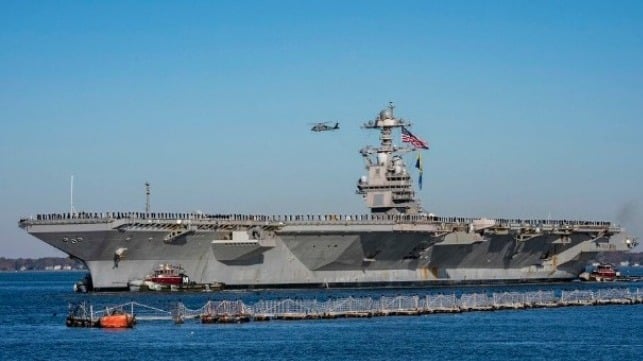
USS Ford
USN file image

Published Feb 22, 2026 5:32 PM by G. Allen Brooks

(Article originally published in Nov/Dec 2025 edition.)


The U.S. faces national security issues that President Donald Trump has acknowledged and is addressing.

The solution begins by revitalizing the U.S. maritime industry to both address the Navy's shortcomings and enhance the country's global shipping presence. The steps are multifaceted. We must rebuild our shipbuilding industry. New yards are needed. Existing yards must be upgraded, and operating efficiency must be improved. We need more skilled shipyard workers and more mariners to sail our ships.

In concept, these steps appear simple, but in reality they're challenging and will require time and money, both of which are in short supply.

In recent years, concern has grown over China's Navy having more ships than the U.S. Navy, even though our firepower is substantially greater. However, military experts note that the firepower gap is narrowing. No one knows the actual Chinese numbers, but for decades its large fleet has been primarily focused on coastal defense with significant numbers of smaller, faster, but less powerful vessels. Now, its fleet is expanding with larger, more powerful ships to protect China's global ambitions, assets and energy vulnerabilities.

The Trump Administration is considering an overhaul of the Navy's fleet. To counter China's growing global presence, the U.S. Navy is planning to create a fleet of diverse vessels and capabilities and more strategic firepower. Rather than back a specific target fleet size, the Administration is focusing on a range of 280-300 ships with a large number of unmanned vessels, referred to as "robotic and autonomous systems," to enhance the fleet's fighting capabilities. This fleet would essentially have a barbell shape with large ships at one end and small ships and unmanned vessels at the other end.

RETHINKING PROCUREMENT

Defense Secretary Pete Hegseth unveiled a new approach to military hardware purchases aimed at addressing the shortage of missiles and ammunition as well as the long, often-delayed delivery times of strategic weapons, including warships. The purchasing system overhaul is a dramatic rethinking of procurement processes.

Hegseth says the Pentagon has identified overregulation, diffused accountability and insufficient competition as weaknesses in the existing procurement process. The Pentagon aims to make a faster, more flexible system the norm, enabling the private sector to contribute to solving military problems. A challenge the Pentagon faces is overcoming the shrinking share of government spending going to our military at a time of increased geopolitical risks.

The decision to reduce defense spending in the mid-1990s, following the collapse of the Soviet Union, led defense contractors to consolidate, cut capital investments and focus on developing new and glamorous weapon systems. What happened on the supplier side was aided by failures within the military's procurement process.

The Navy has been criticized for its ship management failures. The most recent evaluation was presented in a March 2025 report from the Government Accountability Office (GAO) to Congress titled "NAVY SHIPBUILDING - Enduring Challenges Call for Systemic Change." The conclusions were devastating. The first paragraph in the summary highlights the Navy's record of problems:

Although maritime threats have been growing, the Navy has not increased its fleet size as planned over the past 20 years. Over this period, GAO has found that the Navy's shipbuilding acquisition practices consistently resulted in cost growth, delivery delays, and ships that do not perform as expected. For example, GAO identified schedule risks in 2024 for the Constellation class frigate program. Counter to leading ship design practices, construction for the lead ship started before the ship design work was complete, and delivery is expected to be delayed by at least 3 years.

The Constellation class frigate was to replace the seriously flawed Littoral Combat Ship platform, which was designed as a low-cost, flexible and modular answer to the Navy's modern warfighting needs. Instead, the program led to delays, cost overruns and malfunctioning ships, many of which have been repurposed or retired. A ProPublica investigation put the lifetime cost of the failure at $100 billion.

Testifying before the Senate's Subcommittee on Seapower, a GAO official noted that "the Navy has no more ships today than when it released its first 30-year shipbuilding plan in 2003." This has occurred despite a near-doubling of the Navy's shipbuilding budget in inflation-adjusted terms over the past two decades.

Such problems are not unusual, as the GAO report noted.

It pointed to its seven-year-old report on Navy shipbuilding, covering the period from 2008 to 2015. The report found that Navy ships cost billions more and take years longer to build than planned. Furthermore, they often fell short of quality and performance expectations. The GAO also noted that it had provided 90 recommendations to improve the shipbuilding process, but the Navy has addressed only 30 of them.

Resolving the Navy's problems will take a willingness and openness to change current practices. Demanding specifications that cannot be delivered at present is not a recipe for success. Fortunately, it appears that Hegseth is willing to address these shortcomings.

REVAMPING THE FLEET

The new fleet being discussed by White House and Navy officials would include a number of large warships carrying more long-range missiles as well as smaller ships such as corvettes, which are smaller than frigates. Today's 287-ship fleet is mostly destroyers, cruisers, aircraft carriers, amphibious ships and submarines.

Current and former officials involved in the fleet revamp discussions are considering ships that are more heavily armored, weighing 15,000-20,000 tons, and capable of carrying more powerful weapons, possibly including hypersonic missiles, in larger numbers than are currently carried on destroyers and cruisers. Ships in the current Navy vary in weight with aircraft carriers weighing over 110,000 tons and amphibious assault ships weighing over 40,000 tons. Many destroyers and cruisers fall within the 10,000-14,000 ton range while submarines typically weigh between 9,500 and 14,000 tons. Some specialty support vessels can weigh 15,000+ tons.

A plan to build new warships capable of carrying more and longer-range missiles is a recognition that China has an extensive anti-missile network and that the Pacific Ocean is a larger body of water with many scattered potential flashpoints that require a U.S. response. Maintaining a manned fleet comparable to today's helps address one concern – recruiting and retaining officers and sailors.

However, implementing such a massive overhaul of today's Navy must address existing challenges such as our lack of modern, efficient shipyard capacity to construct and maintain new naval vessels and our lack of a skilled shipyard workforce.

PARTNERING WITH SOUTH KOREA

Recent news about the shipbuilding relationship between South Korea and the U.S. suggests the Trump Administration may be making headway in its maritime revitalization effort.

Last year, South Korea's Hanwha Group purchased Philly Shipyard for $100 million, promising to invest upwards of $5 billion to improve and expand operations. The deal has led to joint U.S.-Korean projects including the repair of U.S. warships, the design of Navy supply ships and assisting American firms in expanding capacity, training shipyard workers and improving production efficiencies.

The Administration is also endorsing the construction in the Philly Shipyard of a nuclear submarine destined for South Korea. The idea is controversial, given the extent to which the U.S. controls its nuclear technology, and raises questions about the shipyard's preparedness for such a project.

However, the Hanwha U.S. shipping subsidiary earlier placed an order for 12 tankers and LNG carriers, the largest order in decades. The first ship is targeted for delivery in 2028. The new ships will significantly expand the U.S.-flag fleet, which currently consists of 188 vessels.

Philly Shipyard has delivered one ship a year recently, equivalent to the weekly output from Hanwha's Korean yards. The plan for the American shipyard is to boost production to 20 vessels a year. It will require expanding the shipyard's physical capacity while adding additional component manufacturing sites and significantly expanding its labor force.

Philly Shipyard has an apprentice program, which is also being expanded. Hundreds of people are applying for the company's 24 available openings in each class. Currently, the program adds more than 120 apprentices each year with plans to increase that to 500 annually.

FOCAL POINT

At the heart of the GAO's criticisms of the Navy's shipbuilding practices is that it finds the Navy a "poor steward of taxpayer money."

In an era when the U.S. government continually runs budget deficits and adds to the nation's debt, such performance cannot be tolerated. Furthermore, our primary adversary, China, is continuing to expand its naval fleet and upgrade its capabilities.

These trends are a threat to our national security. We expect shipbuilding and the maritime industry to be by necessity a focal point for the remainder of the Trump Administration. Correcting the Navy's problems is a good place to start.

The opinions expressed herein are the author's and not necessarily those of The Maritime Executive.


U.S. Hospital Ship Gets Under Way After Trump Greenland Announcement


USNS Mercy is due for a yard period in Portland and appears headed for a Panama Canal transit

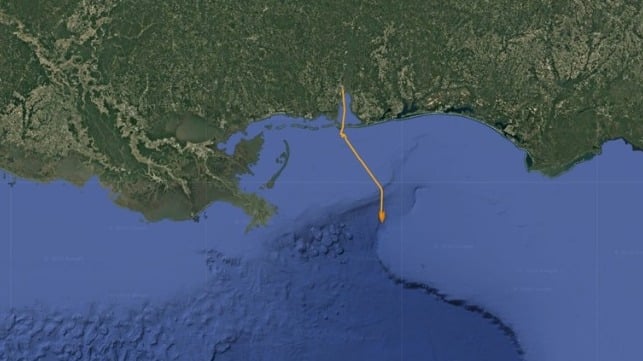
USNS Mercy headed southbound towards the Yucatan Channel, February 24 (Pole Star Global)

Published Feb 24, 2026 7:51 PM by The Maritime Executive

Three days after President Donald Trump declared that he had ordered a hospital ship to Greenland, the hospital ship USNS Mercy has departed a shipyard in Mobile, Alabama and gotten under way. Her next scheduled port call is at the Vigor shipyard in Portland, Oregon, where she is due to start a six-month drydocking on March 20. 

At Mercy's sea speed, it would take her more than 20 days of continuous sailing to reach Oregon, plus additional time spent transiting the Panama Canal. Departing today, she would arrive just in time to begin her drydocking period, which the Department of Defense paid $89 million to arrange.

If started on schedule, Mercy's yard period would run through September 20. The drydocking builds upon previous emergent repair work performed at Alabama Shipyard in Mobile; the ship has not yet completed the usual deep maintenance and inspections that would be done in a five-year drydocking. Sister ship USNS Comfort has just started a yard period at Alabama Shipyard and is said to be unavailable. 

Mercy's movements have been closely watched since Saturday, when President Donald Trump announced that his administration would "send a great hospital boat to Greenland to take care of the many people who are sick, and not being taken care of there." At the time, he said that the "boat" was on its way, and he shared an illustration of USNS Mercy. As of Monday, defense officials told the Wall Street Journal that no orders for Mercy's deployment had yet been received. 

The origins of President Trump's claimed Greenland mission are unclear. Danish and Greenlandic officials have rejected Trump's announcement and have said that the hospital ship is not needed in Greenland. As a Danish territory, Greenland offers free health care and prescription medications to all its citizens, along with free emergency care for visitors; in Alabama, the location from which USNS Mercy has just departed, an estimated eight percent of the population lacks health insurance coverage.

One unusual origin story for the proposed Greenland mission has emerged. A Greenlandic construction worker who has previously organized events for the Trump family in Nuuk, 52-year-old Jørgen Boassen, told the Wall Street Journal that he had mentioned a need for better free health care to Louisiana Governor and White House Greenland envoy Jeff Landry. Boassen met with Landry during a cultural exchange to Louisiana, and brought up the health care topic. Landry confirmed that he later relayed the request to Trump, who announced the hospital ship mission several hours later. (Boassen told the Journal that he had not had a hospital ship in mind.)

Trump has repeatedly expressed a desire to annex Greenland, sparking disagreement with Denmark. The U.S. enjoys unfettered treaty access to the island for defense purposes, but Trump asserts that it is necessary for strategic purposes for the U.S. to "own" the island.


U.S. Seizes Third Runaway Sanctioned Tanker in the Indian Ocean

tanker boarding by US forces
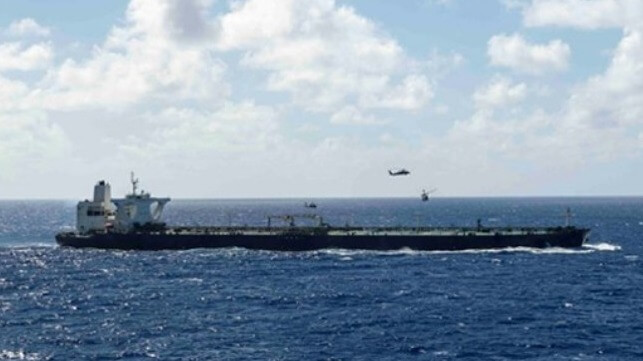
The tanker Bertha was boarded by U.S. forces in the Indian Ocean as the third runaway tanker from Venezuela (US Department of War)

Published Feb 24, 2026 10:46 AM by The Maritime Executive


The Pentagon confirmed that U.S. forces interdicted a third runaway tanker, named Bertha, while it was sailing in the Indian Ocean on February 24. It followed the previous seizures of the Aquila II and the Veronica III, also in the Indian Ocean, as part of a group of tankers that had fled Venezuela, likely bound for China with Venezuelan crude.

“From the Caribbean to the Indian Ocean, we tracked it and stopped it,” the posting on social media said. “International waters are not a refuge for sanctioned actors. By land, air, or sea, our forces will find you and deliver justice,” posted the Pentagon.

It cites the tanker for violating the “quarantine of sanctioned vessels in the Caribbean.” The tanker, however, was sanctioned by the United States in 2024 for its involvement with the Iranian oil trade. The Treasury Department cited the Bertha, which has also operated under the alias of Monica S, along with two other tankers managed by Shanghai Legendary Ship Management Company Limited. It said the Bertha had been involved in the Iranian oil exports since at least 2022.


The 305,442-dwt vessel departed Venezuela in early January carrying a reported 1.9 million barrels of heavy crude. The interdiction came as "a right-of-visit, maritime interdiction, and boarding," the statement said, happening in the Indian Ocean off the Maldives “without incident,” according to the Pentagon. TankerTrackers.com had pointed out more than a week ago, when the Veronica III was stopped, that the Bertha, which it says uses the zombie name Ekta, was the last of the runaway tankers that the U.S. had not yet interdicted.

Reuters is highlighting that the U.S. has stopped a total of 10 tankers since December and the start of the efforts against Venezuela. At least two of them have been released, while the Marinera (Bella 1) was tracked into the Atlantic, seized, and taken to Scotland. The U.S. recently indicted the captain of that tanker on charges related to sailing under a false flag and disobeying U.S. Coast Guard orders.

The tanker seized today has a long history and reports of false flag operations. It was built in 2004 and has been sailing as the Bertha since 2024. When the U.S. sanctioned the vessel, it was listed as registered in the Cook Islands, and reports today are still saying Cook Islands. Maritime Cook Islands (MCI), the Cook Islands Ships Registry, issued a statement in January clarifying that it had canceled the ship’s registry on November 25, 2024. It said the vessel had entered its registry in March 2024 and highlighted that the registry was canceled before the U.S. sanctions.

The Bertha is listed in Equasis as falsely claiming Curacao as its current flag. Lloyd’s Register withdrew its class in December 2024, while the databases list its last known port state inspection as April 2024.


'I'm very concerned': Marco Rubio triggers alarms of 'war' from intel lawmakers

Nicole Charky-Chami
February 24, 2026 
RAW STORY


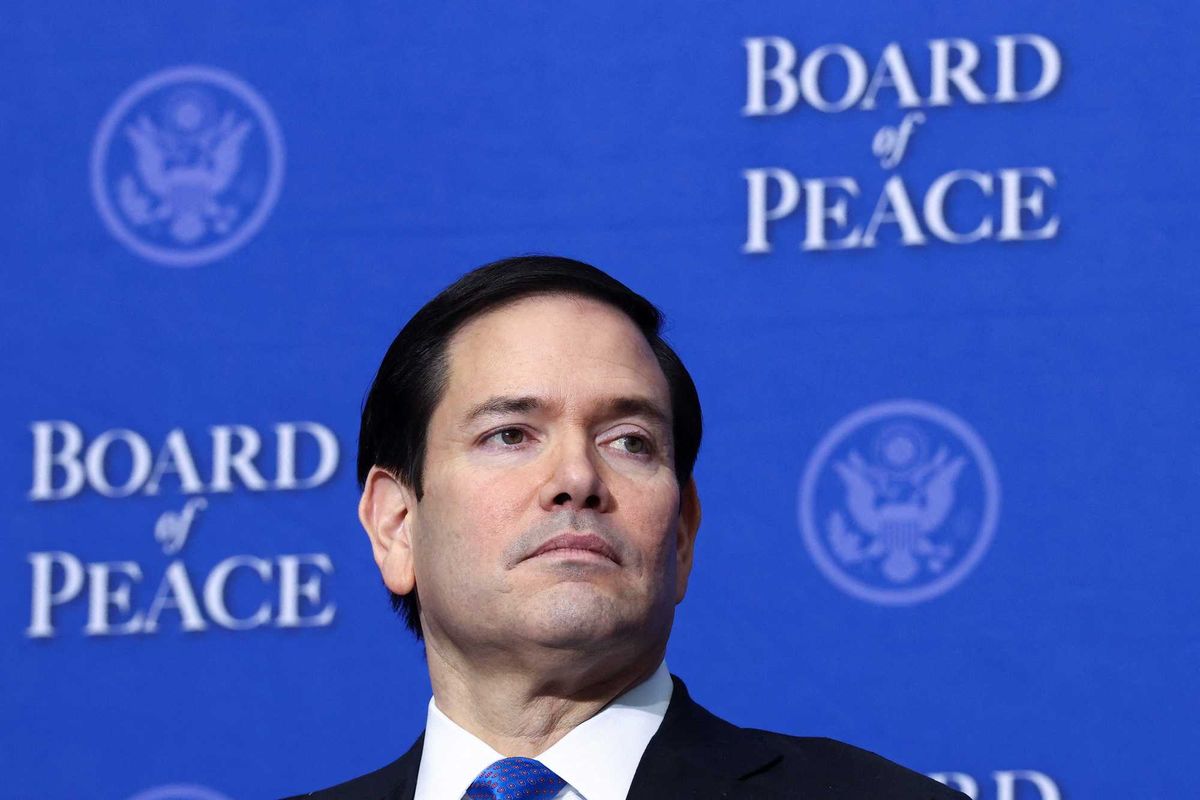
Secretary of State Marco Rubio listens as U.S President Donald Trump (not pictured) speaks at the inaugural Board of Peace meeting at the U.S. Institute of Peace in Washington, D.C. on Feb. 19, 2026. REUTERS/Kevin Lamarque


Secretary of State Marco Rubio held an unusual briefing on Tuesday that raised concerns among intel lawmakers over whether the U.S. may launch military attacks on Iran.

Rubio's private meeting was held virtually just hours before President Donald Trump's State of the Union address and included both Senate and House lawmakers, including high-ranking members of the House and Senate Intelligence Committees, Politico reported. The move has raised questions over the Trump administration's decision to take military action in the Middle East.

Rep. Jim Himes (D-CT) expressed alarm over Rubio's comments.

"Rep. Jim Himes, top Intel Committee Dem, on Trump and Iran: 'I'm very concerned. Wars in the Middle East don't go well for presidents, for the country, and we have not heard articulated a single good reason for why now is the moment to launch yet another war in the Middle East,'" Sahil Kapur, senior national political reporter for NBC News, wrote on X.

House Minority Leader Hakeem Jeffries (D-NY) shared his apprehension about Trump's previous statements on Iran and what could happen next. Last year Trump had claimed that U.S. military strikes in Iran had dismantled the country's nuclear program.

"What happened to Iran's nuclear program being 'completely and totally obliterated'?... Donald Trump's words, not our words. Clearly he was lying to the American people or he's lying right now," Jeffries said in an interview with reporters that was shared by journalist Aaron Rupar on X.

Iran Motivates Trump's Opposition to Transfer of Diego Garcia

B-2
A B-2 on the tarmac at Diego Garcia (USAF file image)

Published Feb 24, 2026 9:31 PM by The Maritime Executive


In a further twist to the Diego Garcia saga, Trump has issued a clear and unambiguous statement on the United States’ attitude towards the proposed Mauritius-United Kingdom sovereignty transfer deal over the British Indian Ocean Territories (BIOT), and the US Naval Support Facility on Diego Garcia in particular.

In a recent post, President Trump says it would be a surrender to Chinese interests to transfer BIOT to Mauritius, which would not be able to fend off Chinese pressure to compromise the continued operations of the Diego Garcia base. He makes the point that there is no decision in international law which requires the United Kingdom to give the archipelago to Mauritius, only pressure from what he describes as ‘woke’ internationalist interests. He urged the United Kingdom at this late stage to drop the deal. Karoline Leavitt, the White House press secretary, has confirmed that the post represents official US policy.

In his post, President Trump also referenced the critical strategic value of the US base on Diego Garcia, saying that ‘Should Iran decide not to make a deal, it may be necessary for the United States to use Diego Garcia, and the airfield located in Fairford, in order to eradicate a potential attack by a highly unstable and dangerous regime – an attack that would potentially be made on the United Kingdom, as well as other friendly countries.” President Trump has therefore linked the status of Diego Garcia with British authorization for the use of its bases in any potential attack on Iran.

The character of US force deployments into the Middle East has changed dramatically in recent days, switching from a ‘defend and respond’ character to preparedness to carry first strikes if negotiations with the Iranians fail to produce results.

A US delegation has been in Port Louis, the capital of Mauritius, to discuss the deal. They may be able to provide reassurance to Prime Minister Navin Ramgoolam, whose government is facing difficulties over corruption allegations, that Mauritius will not lose out financially if the deal is scrapped and modifications are made to current arrangements instead.

The UK government at the same time is having to deal with the arrival on the Île de Coin, the main island in the BIOT atoll of Peros Banhos, of Misley Mandarin, First Minister-elect of the BIOT, and his father Michel. The Chagossian returnees were issued with a notice to leave the island by the BIOT police shortly after landing.

The British government has a delicate political decision to make this week on whether to pursue the expulsion of the pair, given that Michel was born on Île de Coin. Under the terms of the present deal, Michel would see the place of his birth transferred to Mauritius without consultation or his consent. The deportation order was issued on the authority of Nishi Dholakia, the British Commissioner for BIOT.

In the latest developments, a court has permitted the re-settlers to remain on Île de Coin pending a hearing challenging the expulsion order. In the meantime, they are cleaning up the abandoned church and attempting to make other buildings habitable. The UK government has not timetabled a return of the enabling legislation to the House of Lords, and has confirmed that they are ‘thinking again’ about the legislation.

There is some speculation in the United Kingdom that President Trump’s change of heart over Diego Garcia has been prompted by British Prime Minister Sir Kier Starmer’s refusal to give permission for airstrikes on Iran to be mounted from British bases – until there have been substantive discussions on the rationale behind any such attack and what the post-action plan might be. In the meantime, the First Minister elect of the Chagos Islands, Misley Mandarin, currently still in residence on Île de Coin, has given full permission for President Trump to use Diego Garcia in any such attack.


Report: Iran Nears Deal to Buy Supersonic Antiship Missiles From China

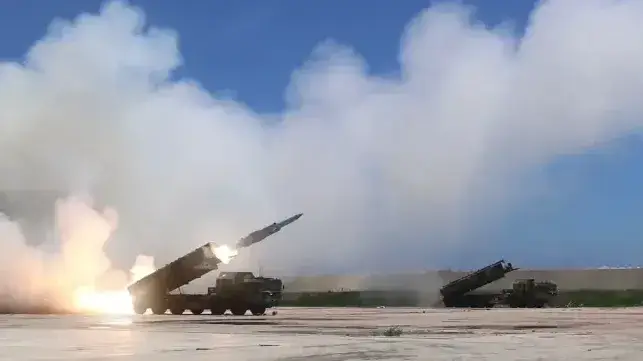
A test launch of the YJ-12 supersonic antiship missile (PLA Navy)

Published Feb 24, 2026 10:52 PM by The Maritime Executive


Iran may be closing on a deal to buy supersonic antiship missiles from China, which would complicate planning for the U.S. Navy in waters of the Persian Gulf, Strait of Hormuz and Gulf of Oman. 

According to Reuters, the Iranian government is close to a purchase of the Chinese CM-302 missile system, based on China's YJ-12. While not the most modern type in the swiftly-evolving Chinese inventory, it is considered a capable antiship cruise missile. The CM-302 is the export variant of the design, and has a warhead payload of up to 550 pounds and a range of about 150 nutical miles. The original version can attain speeds somewhere in excess of Mach 2, potentially as high as Mach 4. The YJ-12 has reportedly been deployed in shore-battery configuration at China's giant bases in the Spratly Islands. Pakistan's navy currently fields the ship-launched export variant of the missile. 

The missile's high speed in the terminal phase reduces the amount of time that the target vessel has to react and defend itself. It is expected that in Chinese service, the YJ-12 would be air-launched in large volleys for a saturation effect, but even one supersonic YJ-12 missile - programmed to conduct spiral evasive maneuvers as it closes in - would pose a stress test for an advanced warship's defenses. 

Six Iranian government officials confirmed the talks to Reuters, and said that negotiations have been under way for the past two years. 

"It’s a complete gamechanger if Iran has supersonic capability to attack ships in the area," Iran expert Danny Citrinowicz of Israel’s Institute for National Security Studies told New York Post. "These missiles are very difficult to intercept."

Other possible elements of the deal could include man-portable surface to air missiles (MANPADS), a threat to low-flying aircraft and helicopters. Per the report, the negotiations could extend to anti-ballistic missile systems or antisatellite missiles - some of the most technically-advanced weapons on earth. Approval of such a transfer would signify a high level of trust in Iran's ability to keep the technology secret. 

No word of the deal's completion has emerged yet; even if terms are agreed, it would take time for China to deliver the equipment and provide the adequate training to enable its use. The U.S. is already gearing up for potential military action in Iran, and discussions of a possible limited strike have been widely reported. 

Separately, Iran has reportedly signed a deal with Russia for the transfer of $590 million worth of man-portable antiaircraft missiles, according to the Financial Times. The arrangement covers 500 launch units and 2,500 missiles for the Verba MANPADS system, a modern guided missile launcher weighing just 38 pounds. Iran's weapons exports to Russia - like long-range attack drones used against Ukraine - may cover the cost of the transaction. For Navy aviators, Verba would be an unwelcome nuisance at altitudes up to 15,000 feet, the highest altitude lock range of any known MANPADS device. It is designed to be resistant to modern infrared countermeasures.