Friday, February 27, 2026

Footage Contradicts DHS Claim That It Dropped Blind Rohingya Refugee at ‘Safe Location’ in Buffalo

Nurul Shah Alam was found dead on a Buffalo street this week, days after being released from a county jail and dropped at a closed coffee shop by Border Patrol agents.


A person matching the description of Nurul Shah Alam walks through the parking lot at a Tim Hortons donut shop in Buffalo, New York on February 19, 2026.
(Image: @evanhill/X)

Julia Conley
Feb 27, 2026
COMMON DREAMS

Surveillance footage taken at a Tim Hortons donut shop in Buffalo, New York contradicts the US Department of Homeland Security’s claim that Border Patrol agents dropped Nurul Shah Alam, a 56-year-old nearly blind Rohingya refugee, at a “warm, safe location” after he was released from jail last week, days before he was found dead.

The video obtained by the Buffalo-based outlet Investigative Post late Wednesday showed a white van pulling up to the shop at about 8:18 pm Eastern, more than an hour after the store—except its drive-thru window—had closed for the night.

‘Stunning Betrayal’: Refugees at Risk of Arrest Under New DHS Memo

A man identified by the Investigative Post as Shah Alam is seen walking by the drive-thru window and then approaching the locked door before walking across the parking lot.

The Border Patrol agents who dropped off Shah Alam—who spoke no English and was blind in one eye with partial, blurry vision in the other—appeared to make no attempt to ensure the Tim Hortons was actually a “safe, warm location” that he could access. The van pulled out of the parking lot less than a minute after Shah Alam was seen exiting it.


When the news broke Wednesday that Shah Alam’s body had been found on a Buffalo street days after he was dropped off following his release—and after subfreezing temperatures hit the Western New York city over the weekend—a spokesperson for Border Patrol said the agents had “offered him a courtesy ride, which he chose to accept to a coffee shop” that was “determined to be a warm, safe location near his last known address.”

They also claimed that Shah Alam, who used a walking stick to get around before his arrest last year, “showed no signs of distress, mobility issues, or disabilities requiring special assistance.”

The agents never notified Shah Alam’s wife and children or his lawyers that he had been dropped off.

“So when [the Department of Homeland Security] says they ‘offered him a courtesy ride to a warm, safe location’... they mean they abandoned him in the parking lot of a closed Tim Hortons in the middle of a winter evening in Buffalo,” said Jeremy Konyndyk, president of Refugees International. “They lie about EVERYTHING.”

Shah Alam had been detained at the Erie County Holding Center since February 2025, when he got lost on the way home from a store where he’d purchased a curtain rod to use as a walking stick. He ended up in the backyard of a woman who called the police, who later reported Shah Alam was swinging the rod “in a menacing manner”—a claim his lawyer denies.

The Investigative Post also obtained police body camera footage of the arrest, which shows Shah Alam saying, “OK” and dropping one end of the curtain rod when an officer told him to put the stick on the ground. The footage also showed the officers Tasering Shah Alam and tackling him to the ground.


After the incident, Shah Alam was charged with assault, trespassing, and possession of a weapon—his walking stick—and held at Erie County Holding Center until last Thursday, after he took a plea deal. He agreed to plead guilty to trespassing and possession of a weapon and was able to avoid immigration detention even though Border Patrol had issued a detainer on him after the arrest, saying he was eligible for deportation.

Buffalo Mayor Sean Ryan told the Investigative Post Thursday that upon finding the Tim Hortons closed last week, Border Patrol should have taken Shah Alam back to the Erie County Holding Center, where sheriff’s deputies who knew his family from their frequent visits to the jail could have called them.

“The lawyer was not informed, and the family is just saying, ‘You had our contact information, you had our address,’” a family friend named Khaleda Shah, told the outlet. “Why not drop him at the address that’s on file for him? Why not bring you back to the holding center, rather than Tim Hortons?”

When New York Times columnist Nicholas Kristof posted on X about Shah Alam’s death on Thursday, DHS responded with its claim that the agents had brought him to a safe location.

“Video shows that it was night and the coffee shop was closed, so he never entered it,” Kristof replied, “Instead, mostly blind and in need of a cane, unable to speak English, he tried to walk home through the freezing night—because your agents never called his family or lawyer but seem to have left him to die. Do you see how your credibility is undermined when you repeatedly make claims that are later contradicted by video evidence? Why should we trust statements from an agency with such a record of deceit?”

DHS had not publicly responded at press time.

Refugees International was among those calling for a full investigation into Border Patrol’s “abandonment” of Shah Alam.

Daniel P. Sullivan, the group’s director Africa, Asia, and the Middle East, noted that the US determined in 2022 that the Myanmar military had committed genocide against the Rohingya people, and Shah Alam was resettled in the US in 2024 after surviving the violence and persecution.

“The death of Shah Alam comes in the midst of ongoing violent immigration enforcement operations by [Customs and Border Protection and Immigration and Customs Enforcement] agents that have led to widespread abuse and neglect of legally resettled refugees as well as deaths of immigrants and American citizens alike,” said Sullivan.

“Refugees International, once again, strongly condemns the Trump administration’s hateful and dehumanizing targeting of those who seek refuge,” he said. “We express solidarity with Mr. Shah Alam’s family, the broader Rohingya community, and all of our neighbors who face increased uncertainty and risks of harm due to the Trump administration’s current policies.”

He also said that one member of the Rohingya community had told the organization that Shah Alam’s “safe haven became a tragedy for him.”


Nearly Blind Rohingya Refugee Found Dead After Being Stranded by Border Patrol in Freezing Cold

“There must be a full investigation and real accountability from US Customs and Border Protection,” said one lawmaker.
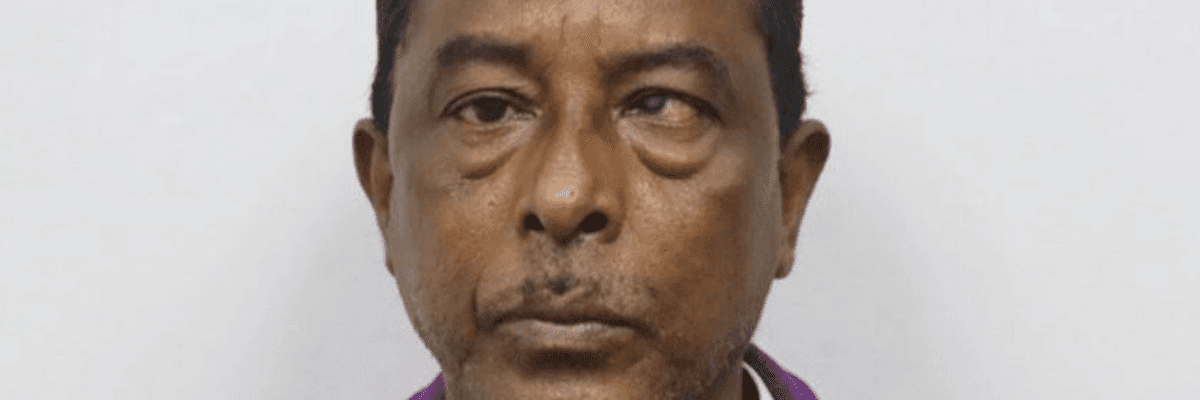


Nurul Amin Shah Alam, 56, was dropped miles from his home in Buffalo, New York by US Border Patrol agents after he was released from jail on February 19, 2026. His body was found on February 24.

(Photo via missing person poster/Investigative Post)

Julia Conley
Feb 26, 2026
COMMON DREAMS


The latest chapter in what one historian called “the ongoing horror story of American immigration enforcement” unfolded in Buffalo, New York this week after Nurul Amin Shah Alam, a 56-year-old Rohingya refugee from Myanmar, was released from a county jail where he’d been held for a year.

As Buffalo-based outlet the Investigative Post reported Wednesday, the nearly blind man was found dead on Tuesday evening, five days after US Border Patrol agents who had picked him up from the jail dropped him off at a coffee shop. They neglected to inform his lawyer or family where he was, making it impossible for Shah Alam to find his way home in sub-freezing temperatures.

Shah Alam, who was blind in one eye and had partial, blurry vision in the other, had gotten lost one day in February 2025 and ended up on a woman’s porch with a curtain rod he used as a walking stick.

The woman called the police, who ordered Shah Alam to drop his “weapon”—the walking stick—and then Tasered, beat, and arrested him.

Shah Alam, who could not speak English and did not understand the police officers’ orders, was charged with assault, trespassing, and possession of a weapon and taken to Erie County Holding Center.

His family, which includes a wife and two sons, chose not to bail him out of the county jail. His arrest had come a month into President Donald Trump’s second term, and they feared US Immigration and Customs Enforcement would detain him if he was released and send him to a detention center out of state.

Benjamin Macaluso, an attorney with Legal Aid Bureau who was representing Shah Alam, told the Investigative Post that he had been released on bail last week after reaching a deal with the Erie County District Attorney’s office, agreeing to plead guilty to trespassing and possession of a weapon. The agreement allowed him to avoid detention by federal immigration agents even though authorities had previously placed an immigration detainer on Shah Alam.

Despite that, the Erie County Sheriff’s Office contacted US Border Patrol to pick Shah Alam up from the Holding Center. When the agents determined Shah Alam was not eligible for immigration detention, Border Patrol told the Investigative Post, they “offered him a courtesy ride, which he chose to accept to a coffee shop.”

An agency spokesperson claimed the nearly blind man “showed no signs of distress, mobility issues, or disabilities requiring special assistance.”

Mohamad Faisal, one of Shah Alam’s two sons, told Al Jazeera that his father was not able to read, write, or use electronic devices.

Macaluso told the Investigative Post that Shah Alam’s family spent days searching for him in the cold before his body was found. The lawyer also said he had expected Shah Alam to be taken to an ICE detention center in Batavia, New York to be released.

A spokesperson for City Hall in Buffalo told the Investigative Post that homicide detectives were “investigating the circumstances and timeframe of events leading up to his death, following his release from custody,” but said homicide and exposure to the elements had been ruled out as the cause of death by a medical examiner.

US Rep. Grace Meng (D-NY) was among those who called for a “full investigation” into Border Patrol’s decision to leave Shah Alam miles from his home despite his disability.


Buffalo Mayor Sean Ryan, a Democrat, accused US Customs and Border Protection, which oversees Border Patrol, of a “dereliction of duty” and said the agency’s treatment of Shah Alam was “inhumane.”

“US Customs and Border Protection must answer for how and why this happened,” said Ryan. “Buffalo is a city that welcomes refugees and believes government should protect human dignity, not endanger it. US Customs and Border Protection failed that basic standard.”

Chuck Park, a Democrat who is running for Congress in New York’s 6th District, said the New York for All Act, which would prohibit state and local law enforcement from collaborating with federal immigration agencies, would have prevented the sheriff’s office from calling Border Patrol upon Shah Alam’s release.


Alexandre Burgos of the New York State Hate and Bias Prevention Unit invited community members to a gathering to demand accountability to Shah Alam’s death.

“We are coming together to demand accountability and transparency in the case of Nurul Amin Shah Alam,” reads a flyer for the event, scheduled for Thursday evening at 5:30 pm Eastern at Lafayette High School in Buffalo.

Fury as Trump plans to 'import' more white South African refugees: 'Call it what it is'


Nicole Charky-Chami
February 26, 2026 
RAW STORY

The internet was in uproar on Thursday after a new Reuters report disclosed that the U.S. has planned to admit 4,500 applications from white South Africans as refugees.

The Trump administration has pushed to limit refugee applications from other countries. But an unreported State Department document from Jan. 27 revealed a new target for specifically white South Africans.

People sounded off on the Trump administration's move, questioning the decision.

"Ripping Latinos from their homes while importing whites. Let’s call this what it is: ethnonationalism," user Mina, who self-described as "an American woman with wide-ranging interests," wrote one user on Bluesky.

"Gotta import new racists as the older ones in America have been dying off," user S.T. Jones wrote on Bluesky.

"The Trump/MAGA vision: Make the US the Hungary of North America, a nation of, for and by white Christian male racists," systems analyst Ric Steinberger wrote on Bluesky.

"[turns over ‘days since I muttered a bigoted remark about white South Africans’ counter back to zero]," Ryan Cooper, senior editor at The American Prospect, wrote on Bluesky.

"We need to shut it down until someone figures out just what the hell is going on," artist Luke Russell joked on Bluesky.

Economist ‪Tony Yates‬ reacted, "US policy =Black refugees bad; white refugees good."


Labor economist Aaron Sojourner wrote on Bluesky, "POTUS loves exactly one kind of import."

Trump admin wants to bring in thousands of white South Africans as refugees: report

Nicole Charky-Chami
February 26, 2026 
RAW STORY

A new report revealed Thursday that the U.S. has planned to admit 4,500 applications from white South Africans as refugees, according to Reuters.

The Trump administration has limited its refugee applications from other countries. This new target, according to an unreported U.S. State Department document from Jan. 27, showed a push to increase refugees from South Africa, Reuters reported.

" Trump has said the U.S. would only admit 7,500 total refugees from around the world in fiscal year 2026, while a much higher cap of 40,000 to 60,000 was discussed internally last year," according to Reuters. "Only 2,000 white South Africans had entered the U.S. as refugees as of January 31 under a program launched in May 2025, although the pace has picked up in recent months."

More than 67,000 people had expressed interest in moving to America, the South African Chamber of Commerce in the U.S. said in 2025.

Trump demanded a stop to refugee admissions after he returned to office in 2025, citing his policy on stopping legal and illegal immigration.

"But weeks later, he launched an effort to bring in white South Africans of Afrikaner ethnicity as refugees, saying they had been violently persecuted in the majority-Black country," Reuters reported. "South Africa's government has rejected that claim, while some refugee advocates have criticized the Trump policy."
The Other Side of Opportunity: What Immigrants Contribute to US Institutions

We often talk about immigrants as beneficiaries of American opportunity. But in higher education, healthcare, research and beyond, immigrants are also architects of institutional improvement.


Harvard University holds a graduation ceremony in Harvard Yard on May 29, 2025 days after the Trump administration’s effort to bar Harvard from enrolling international students in Cambridge, Massachusetts, United States.
(Photo by Selcuk Acar/Anadolu via Getty Images)

Rachel Hoopsick
Feb 27, 2026
Common Dreams

The US Department of Education recently withdrew its unlawful directive that would have restricted diversity, equity, and inclusion efforts in schools and universities nationwide. The guidance was framed as an attempt to enforce “neutrality” in education. In practice, it would have narrowed how institutions identify and address inequity, discouraging efforts to create learning environments that reflect the realities of an increasingly global student population.

That national debate can feel abstract, just another skirmish in a broader culture war over higher education. But equity is not abstract. It lives in the quiet mechanics of institutions: who gets seen, who gets filtered out, and which barriers are treated as incidental rather than structural. I am reminded of this not by a court ruling or federal directive, but in the ordinary work of teaching and mentoring students from around the world as an assistant professor at the University of Illinois Urbana-Champaign. It shows up during office hours, committee meetings, and the quiet moments when institutional rules do their work..


Immigrants Delivered $14.5 Trillion Surplus to US Economy Over Last 30 Years: Report

Americans are fluent in a familiar story about immigration: Immigrants come to the United States for opportunity—better education, better jobs, better lives. That story is not wrong. But it is incomplete. What is talked about far less is how immigrants improve the institutions they enter, often by exposing the limits of systems that were never designed with them in mind.

Case in point: Like many graduate programs, ours used procedures that filtered out applicants who had not paid an application fee before faculty review. When they failed to pay, I was never supposed to see their application. The fee, common by US standards, was prohibitively expensive in some local currencies. Until I learned about that procedure, I hadn’t fully appreciated how many judgments about who “belongs” in graduate school happen long before any evaluation of research potential or intellectual fit. Once I understood the implications of that policy, I advocated to have it amended, and a student I would never have otherwise met was later admitted and enrolled.

The real work of equity is not expanding opportunity within unchanged systems but interrogating the systems themselves—especially when those systems quietly reward conformity.

That experience crystallized something for me. The student’s presence highlighted how even well-intentioned programs can struggle to value ways of thinking they were never designed to account for. The student, meanwhile, navigated those gaps with a practicality that exposed where the system itself needed adjustment.

The same design logic operates across American institutions that confuse neutrality with fairness. Even institutions that are equity forward, including my own, must navigate a shifting and often constraining federal landscape, making progress real, but necessarily incomplete.

This kind of exclusion is not unique to admissions policies. Across higher education, international students routinely navigate US systems calibrated to financial, cultural, and administrative norms that quietly penalize difference. More than 1 million international students are enrolled in US colleges and universities, and an analysis from the Association of American Universities estimates that international students contribute nearly $44 billion to the US economy annually. Yet research consistently shows that international students experience higher levels of social isolation than their domestic peers.

From a public health perspective, these barriers are not incidental—they are risk factors that function as chronic stressors. Uncertainty around visas, financial precarity, cultural dislocation, and exclusionary policies shape mental health and academic persistence long before a student ever sets foot on campus. Research shows that rates of anxiety, depression, and suicidality among international students have risen sharply over the past decade, even as access to culturally responsive mental health services remains uneven.

In public health, we name these design failures plainly: policy choices—not personal deficits. Improving the experience of international students is less about individual support than about whether institutions are willing to change the conditions they create.

What struck me most, though, was not my student’s resilience in the face of these barriers, but what institutions gain when those barriers are confronted. They were adept at finding workarounds where institutions offered only walls—and unapologetic about pointing out the walls. That resourcefulness did not just help them navigate the system; it revealed where the system itself needed to change.

The real work of equity is not expanding opportunity within unchanged systems but interrogating the systems themselves—especially when those systems quietly reward conformity.

We often talk about immigrants as beneficiaries of American opportunity. But in higher education, healthcare, research and beyond, immigrants are also architects of institutional improvement. They expose inefficiencies, challenge inherited assumptions, and force clarity around what we actually mean by merit.

Immigrants make up a disproportionate share of the US healthcare workforce, including physicians, researchers, and direct-care providers—roles that are essential as the country grapples with workforce shortages and widening health inequities.

Opportunity is not a one-way transaction. Institutions that welcome immigrants while resisting the changes their presence demands are not neutral—they are extractive.

Some people change institutions not by asking for permission, but by refusing explanations that don’t make sense. The question isn’t whether immigrants benefit from coming to the United States—the evidence is clear. The more uncomfortable and more important question is whether institutions are willing to reckon with how much they benefit from immigrants, and whether they are prepared to change to welcome them.
Trump’s Revived Anti-Worker Rules Condemned as ‘Outright Grift’

“Every day, little by little, the Trump administration is rigging the system to benefit giant corporations and shortchange workers,” said one senator.


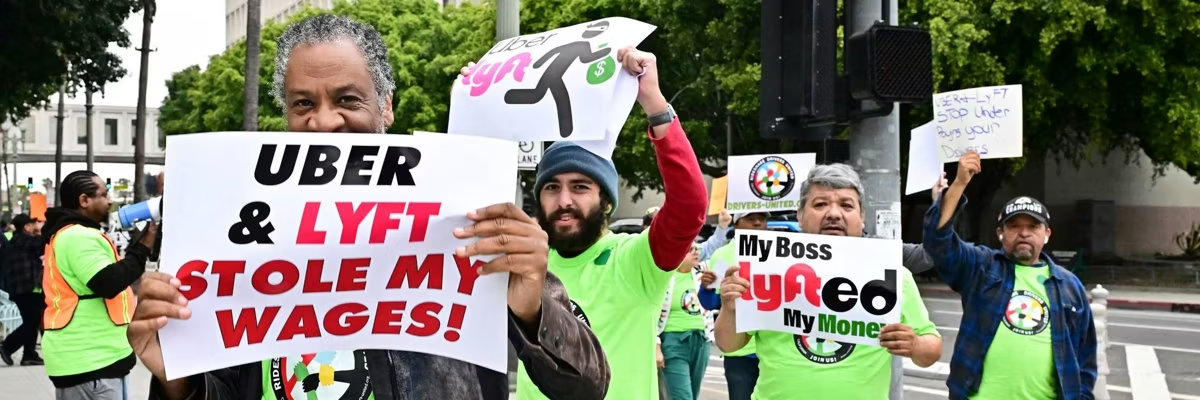
Ride-hail drivers rally outside Los Angeles City Hall in California on March 26, 2025.
(Photo by Frederic J. Brown/AFP via Getty Images)

Jessica Corbett
Feb 26, 2026
COMMON DREAMS

President Donald Trump’s “barrage of attacks on workers” continued on Thursday with announcements about two key labor rules.

The US Department of Labor (DOL) proposed an independent contractor rule that the National Employment Law Project (NELP) called “yet another example of the administration siding with major corporations and stacking the deck against working people” by “effectively allowing employers to strip workers of federal minimum wage and overtime protections.”


The DOL’s Wage and Hour Division proposal would replace the Biden administration’s widely celebrated 2024 policy for when employers can treat workers as independent contractors under the Fair Labor Standards Act with business-friendly guidance that resembles a rule adopted just before the end of Trump’s first term.

“This rule will have profound real-world consequences for working people,” warned NELP. “Misclassification is common in many labor-intensive, poorly paid jobs—jobs like home healthcare, janitorial work, landscaping, personal services, and increasingly, app-dispatched ride-hail and delivery—where people of color and immigrants are overrepresented, and workers lack the bargaining power to negotiate higher wages and better working conditions.”

NELP pointed to research showing that low-paid independent contractors “lag behind their employee counterparts,” and some “do not even earn the federal minimum wage.” The organization stressed that “this rule threatens to enshrine a two-tiered labor system where similarly situated workers receive vastly different rights and protections based on the classification chosen by the business employing them.”

The new rule—which now faces a 60-day public comment period—focuses on two “core factors” to determine an employee’s classification: the nature and degree of control over the work, and the worker’s opportunity for profit or loss based on initiative or investment.

NELP argued that “by elevating two factors above other equally important factors, the Trump administration’s test fails to account for the economic realities of many working relationships. Many workers labeled as independent contractors are not really in business for themselves because they are integrated into the operations of a larger business structure that sets most of the terms of the work.”

“In app-dispatched ride-hail and delivery jobs, for example, corporations like Uber, Lyft, DoorDash, and Amazon use apps and algorithms to offer shifts or assignments to so-called independent contractors doing the core work of the business, set the wages these workers receive, surveil and assess their performance, and determine if they are offered future assignments or get ‘deactivated,’” the group noted. “App-based ride-hail and delivery workers perform difficult and dangerous work without basic employment protections like the right to minimum wage and overtime, workers’ compensation, and unemployment insurance.”


As NELP and other critics sounded the alarm over the DOL proposal on Thursday, the National Labor Relations Board (NLRB) also revived an effort from Trump’s first term, reinstating that administration’s 2020 rule on joint employers.

During Trump’s initial administration, the NLRB required joint employers to “possess and exercise substantial direct and immediate control” over at least one aspect of the workers’ employment. In 2023, under former President Joe Biden, the board decided that two or more entities could be considered joint employers if they had an employment relationship with the workers and helped to determine their terms and conditions of employment. However, the latter was blocked by a Trump-appointed judge the next year.

Unlike the DOL proposal, the board’s rule is final. The NLRB—which has two Trump appointees, one Biden appointee, and two vacancies—said in the Federal Register that “the 2023 rule was vacated by the district court, and the action the board takes today merely implements the court’s decision. Our action is ministerial and therefore will have no separate economic effect.”

US Sen. Patty Murray (D-Wash.), a senior member and former chair of the Senate Health, Education, Labor, and Pensions Committee, declared in a Thursday statement that “every day, little by little, the Trump administration is rigging the system to benefit giant corporations and shortchange workers—it’s an outright grift and working people should be furious.”

“The joint employer rule is nothing more than a return to Trump’s anti-worker policies that let giant corporations skirt their basic obligations to employees—Trump is giving the biggest corporations cover to deny workers their ability to band together for better wages and working conditions and leaving millions of workers in the lurch, vulnerable to egregious violations of their rights,” she said.

“At the same time, today, the Trump administration announced they’re working to rescind the independent contractor rule,” Murray continued. “Trump wants to let giant corporations classify workers as contractors so that they don’t have to pay them minimum wage and overtime—these workers deserve fair pay.”

The senator then took aim at the so-called One Big Beautiful Bill Act that congressional Republicans passed and the president signed last summer, saying that “under the Trump administration, giant corporations get giant tax breaks paid for by cutting Medicaid—the healthcare that the poorest workers are forced to rely on.”

“Now, Trump wants those same corporations off the hook for every benefit, protection, and dollar they’d otherwise owe to millions of workers—it’s a shakedown,” she asserted. “Republicans are proving time and again, they don’t care about workers—they don’t want to even let workers have crumbs, but billionaires can get trillions in tax breaks that will blow up our national debt.”

Murray isn’t up for reelection in November’s closely watched midterms, but could lead the Senate Appropriations Committee if Democrats reclaim the chamber. On Thursday, she vowed that “I am going to keep fighting for laws on the books that protect workers and build an economy that grows the middle-class, not just profit margins for the largest corporations on Earth.”
For First Time, Gallup Poll Shows Americans Sympathize More With Palestinians Than With Israelis

“It is difficult to overstate the significance of this,” said one analyst. “This is a key reason why Israel—and its supporters in the US—have a sense of desperate urgency when it comes to war with Iran and annexation of Palestine.”


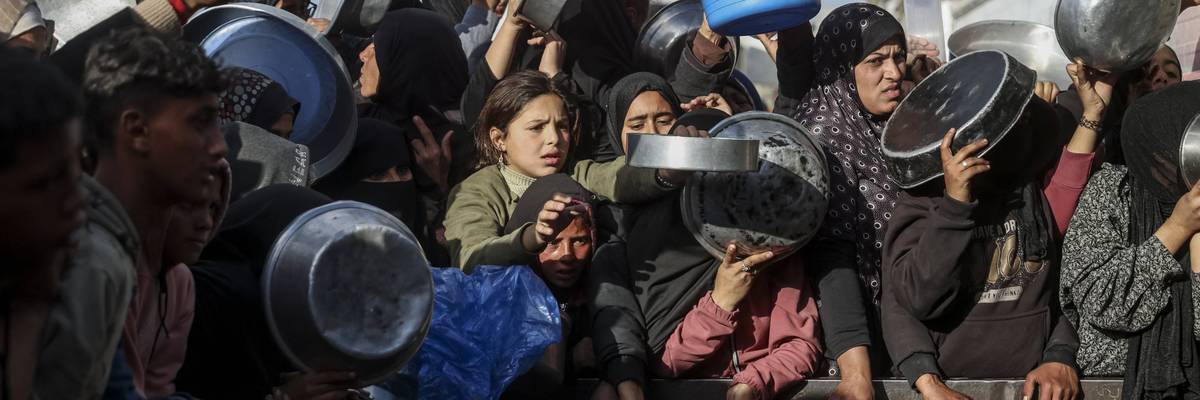
Palestinians wait to receive food at a soup kitchen in Khan Yunis, Gaza on February 26, 2026.
(Photo by Bashar Taleb/AFP via Getty Images)


Jake Johnson
Feb 27, 2026
COMMON DREAMS

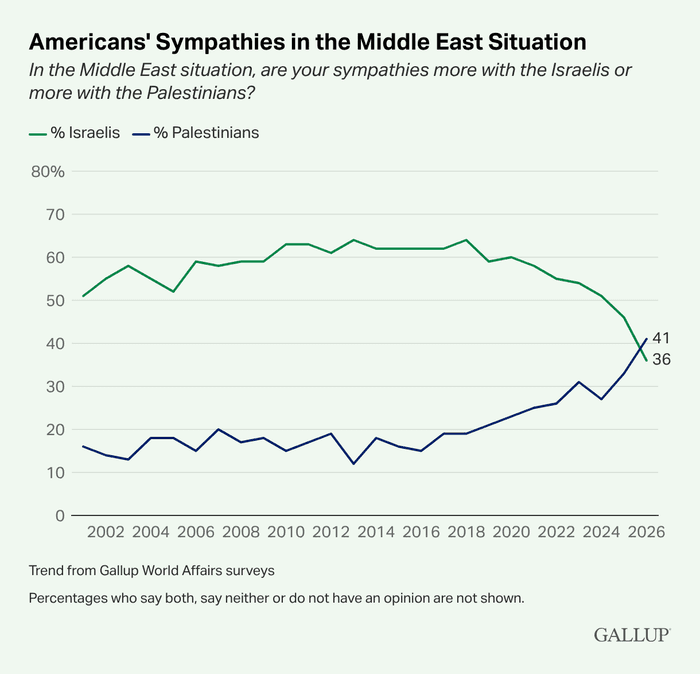
A Gallup survey released Friday found that a larger percentage of Americans sympathize with the Palestinians than with the Israelis in the decades-long Middle East conflict, which has exploded over the past two and a half years with the Hamas-led attack on Israel and the latter’s genocidal response—fueled by military and diplomatic support from the US government.

The new poll marks the first time since Gallup began tracking the question in 2001 that a larger portion of respondents (41%) expressed sympathy for the Palestinians than the Israelis (36%) “in the Middle East situation.” The organization noted that while “the five-percentage-point difference is not statistically significant,” it “contrasts with a clear lead for the Israelis only a year ago (46% vs. 33%) and larger leads over the prior 24 years.”

“From 2001 to 2025, Israelis consistently held double-digit leads in Americans’ Middle East sympathies, with the gap averaging 43 points between 2001 and 2018,” Gallup reported. “However, public opinion began narrowing in 2019, several years before the Oct. 7, 2023, Hamas attack on Israel and the subsequent war in Gaza. The cumulative effect of gradual changes in US attitudes since then has led to the Israelis no longer being viewed more sympathetically.”


Notably, the Gallup survey shows that “Americans of all age groups have grown more sympathetic to the Palestinians in recent years.” A majority of Americans between the ages of 18 and 34 (53%) said they sympathize more with the Palestinians and 23% said they sympathize more with the Israelis, “a record low for the age group,” according to Gallup.

The survey also showed a “near reversal” among Americans aged 35 to 54—with 46% now saying they sympathize more with the Palestinians—and the “narrowest gap in sympathies” Gallup has ever recorded for Americans aged 55 and older.

In terms of political affiliation, Gallup found that “Americans’ shifting sympathies in the Middle East situation this year are mostly driven by changes among political independents,” who now sympathize more with the Palestinians than the Israelis by a margin of 41% to 30%.

“It is difficult to overstate the significance of this,” Trita Parsi, executive vice president of the Quincy Institute for Responsible Statecraft, wrote in response to the Gallup survey. “This is a key reason why Israel—and its supporters in the US—have a sense of desperate urgency when it comes to war with Iran and annexation of Palestine.”

“The window for these aggressions with US support is closing,” Parsi added.

The new poll also found that Americans’ support for a Palestinian state is at its highest level in more than two decades as current Israeli leaders vow to prevent Palestinian statehood and ramp up their illegal annexation of territory—an effort effectively endorsed by the Trump administration.
‘One Year of Failure’: The Lancet Warns RFK Jr.’s Assault on Science May ‘Take Generations to Repair’


Kennedy has “made a habit of throwing good money after bad” by promoting “junk science and fringe beliefs.”

Brad Reed
Feb 27, 2026
COMMON DREAMS


A scathing editorial published Friday in one of the world’s most prestigious medical journals took US Health and Human Services Secretary Robert F. Kennedy Jr. to task for what it described as “one year of failure.”

In its editorial, the Lancet began by listing off several of the broken promises Kennedy made during his first speech after being confirmed to lead the US Health and Human Services Department (HHS), such as his vow to have “open and honest engagement with everyone willing to work towards making the USA healthy again” and usher in “a new era of unbiased science without hidden conflicts of interest, secrecy, or profiteering.”

In fact, the Lancet found that it took Kennedy less than two weeks to break a key promise.

“Ten days after his speech about trust and openness,” the journal noted, “HHS rescinded a 54-year-old policy of soliciting public comments for new rules and regulations, silencing the voices of many of the stakeholders he pledged to serve.”

Things have only gotten worse since then, the editorial continued, as Kennedy has shelved research into mRNA vaccines and “made a habit of throwing good money after bad” by promoting “junk science and fringe beliefs.”

The editorial concluded by warning “the destruction that Kennedy has wrought in one year might take generations to repair, and there is little hope for US health and science while he remains at the helm.” The journal urged the US Congress to “hold Kennedy accountable for his record, or else accept responsibility for endorsing President Trump’s decision to let him ‘run wild on health.’”

The Lancet editorial drew a range of reactions from medical experts and academics.

Scott Forbes, an ecologist at the University of Winnipeg, explained the significance of a journal such as the Lancet publishing such an overtly political editorial.

“For context, the Lancet is one of the two most important medical journals on the planet,” he wrote in a social media post. “When they put this on their front cover, it is only because there is something seriously wrong. That something is RFK Jr. He is a notorious crank and charlatan. But that’s par for the course in the Trump regime.”

Forbes’ point was echoed by Krutika Kuppalli, associate professor at UT Southwestern Medical Center’s Department of Internal Medicine.

“When a leading medical journal uses language like this, it’s not rhetoric,” she wrote. “It’s a warning the world should take seriously.”

Pediatrician Vincent Iannelli took the Lancet to task for publishing a since-retracted study in 1998 that falsely linked vaccination with the development of autism, which subsequently helped the anti-vaccination movement gain currency.

“Let’s not forget that Wakefield’s fraudulent paper that was published in the Lancet helped get us on this road,” Iannelli said. “RFK Jr. was influenced by mothers who blamed vaccines for their child’s autism.”
Woman severely injured by Trump's ICE suspects she was 'targeted' for removal during SOTU

Robert Davis
February 26, 2026 
RAW STORY


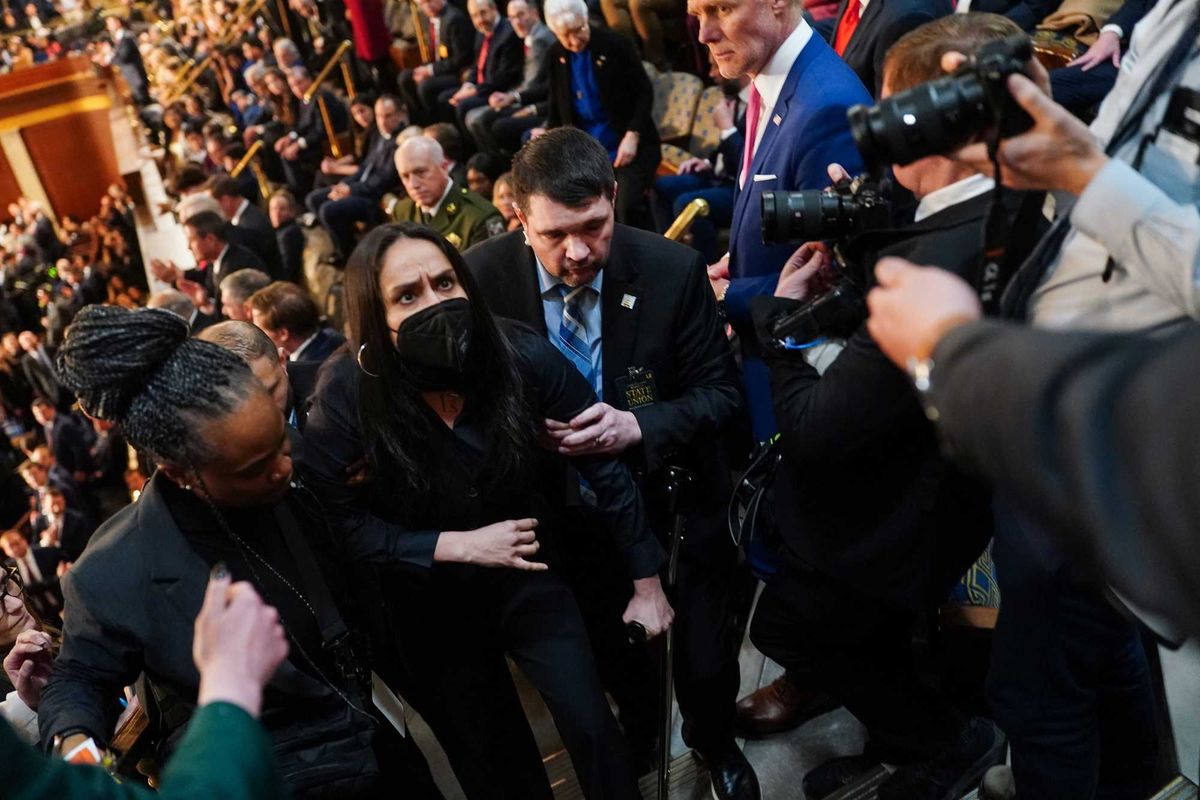
Aliya Rahman is removed from the chamber during U.S. President Donald Trump's State of the Union address to a joint session of Congress in the House Chamber of the U.S. Capitol in Washington, D.C., U.S., February 24, 2026. REUTERS/Nathan Howard

Aliya Rahman, a disabled woman with autism from Minneapolis who was severely injured by President Donald Trump's immigration forces in January, claimed on Thursday that she was targeted for removal from the president's State of the Union address.

Rahman attended the address as a guest of Rep. Ilhan Omar (D-MN), who claimed Rahman was "aggressively handled" while she was escorted out of the House chambers. Rahman was later charged with "unlawful conduct" for allegedly standing in silent protest during the speech, a claim she denied during an interview with CNN's Jake Tapper on Thursday.

Rahman added that she wondered whether she was targeted for removal because she's spoken out against the Trump administration.

"I think you do have to ask that question, right?" Rahman said. "I can be kind of a cold, logical, autistic person sometimes, and what I am seeing is that the people to either side of me are standing up and not just standing up, but they're making noise. I was actually quiet. So if the issue is disruption, I'm not aware that anybody on the floor even knew I was standing up."

Rahman spoke out against the Trump administration during a hearing in early February about how Immigration and Customs Enforcement officers treated civilians in Minneapolis. She told the committee of all Democrats that the officers who dragged her from her car tore the rotator tendons in both of her shoulders, which prevented her from using the cane she needs for mobility.

She also described the horrific conditions inside the Whipple Federal Building in Minneapolis.

"The only thing I'm known for is giving testimony about what I saw inside the Whipple Center," Rahman said.


Export ban sparks rush to process lithium in Zimbabwe


By AFP
February 25, 2026


EVs are driving global demand for lithium - Copyright AFP/File Sameer Al-DOUMY


Enos Denhere

Zimbabwe’s ban on raw lithium exports is forcing Chinese miners to rethink their strategy, speeding up plans to process the metal locally instead of shipping it to China’s vast rechargeable battery industry.

The country is Africa’s largest lithium producer and has one of the world’s largest reserves, according to the US Geological Survey (USGS).

Zimbabwe already banned the export of lithium ore in 2022 and in 2025 announced it would halt exports of lithium concentrates from January 2027.

But on Wednesday it imposed the ban with immediate effect, leaving unclear what the lithium mining sector will do in the short term as Zimbabwe currently has no facilities to process lithium concentrates.

The move, which also included a blanket ban on export of all raw minerals, aims to capture the added value of refining and processing, thus creating jobs and additional government tax revenue.

But critics say the push to refine should have come sooner, with Zimbabwe already having lost out on several years of revenues for the hard-pressed local economy.

Prospect Lithium Zimbabwe, owned by Zhejiang Huayou Cobalt, has spent $400 million on a processing plant that should be operational in the coming weeks, its representative Patience Chizodza told state broadcaster ZBC.

It will reportedly be the first factory in Africa to refine lithium concentrate into lithium sulfate — a powdered form that is one step closer to the product used in batteries.

The facility should be capable of handling 400,000 tonnes a year of concentrate.

The Zimbabwe state-owned Mutapa Energy Minerals is set to start work in the coming months on a similar plant, chief executive officer Innocent Rukweza told reporters earlier this month.

“We expect that by mid-year — around June at the latest — construction of a concentrate-processing plant will be under way,” Rukweza said.

The $270-million facility funded by Chinese firms would be able to process 600,000 tonnes annually, he said.


– ‘Too little, too late’ –


Bikita Minerals, Zimbabwe’s largest lithium mine and owned by Sinomine Resources Group, is working on feasibility studies for the construction of a lithium sulphate plant in December, spokesperson Tinomuda Chakanyuka said.

“The project, which will be developed in phases, represents an estimated investment of approximately $500 million from shareholders,” Chakanyuka told AFP.

He said the facility will increase local capacity to separate minerals and “contribute to Zimbabwe’s broader industrialisation and export diversification objectives.”

Global demand for the soft, white metal was up 20 percent last year from 2024, with a key factor being EV sales growth in China and Europe and increased demand for batteries, the USGS said.

Zimbabwe’s exports of lithium concentrate rose to 1.5 million metric tonnes last year, generating government revenue of $571.6 million, the Minerals Marketing Authority of Zimbabwe (MMCZ) announced in early February.

The Zimbabwean government’s moves to ban exports of raw minerals didn’t impress its critics.

“Government is doing too little, too late,” said Farai Maguwu, executive director of Zimbabwe’s Centre for Natural Resource Governance (CNRG).

With the new rush for critical minerals around the world, “people are asking serious questions about the benefits to the producer country,” he said.

“A country like Zimbabwe is exporting raw lithium and, in the process, enriching China at its own expense,” Maguwu said.

Instead it should be building its own “mine-to-market ecosystem” that manufactures and markets lithium products, he added.

Economist Godfrey Kanyenze accused the government of a “deficit in policy implementation” when it effectively gave a five-year grace period on the 2022 lithium ore ban by allowing exports of raw concentrates.

Kanyenze said state oversight at Chinese-owned lithium mines was limited, making it difficult to determine how much companies actually produced and earned.

There have also been allegations of environmental damage and exploitation of workers, including by paying low wages.

“Zimbabwe must learn from countries like Norway, Botswana and Kuwait, which safeguard their natural resources through firm, consistent and strategic policy frameworks,” he said.
Your cloud contract just got political

DIGITAL SOVEREIGNTY VS TRUMP


By David Potter
February 26, 2026


Photo by Harold Mendoza on Unsplash

A U.S. diplomatic cable does not usually land on a Canadian board agenda. This one might.

On Feb. 25, Reuters reported that the U.S. instructed its diplomats to push back against foreign “data sovereignty” measures it views as barriers to American technology companies.

On the same day, CNN reported that OpenAI had detailed how a Chinese law enforcement agency used ChatGPT as part of an intimidation operation targeting dissidents and foreign officials.

In other words, a U.S.-based AI company shared a behind-the-curtain look at how their platform is being used by a foreign government agency.

I’m not defending the Chinese use, but if you were trying to script a case study in geopolitical irony, you would struggle to time it better.

If nothing else, it’s a reminder to Canadian organizations making infrastructure decisions (and those developing the government’s AI strategy) that these decisions can have real consequences.

Residency is not sovereignty

To understand what this means for your organization, start with a basic distinction. Data residency and data sovereignty are not the same thing.

Residency answers where the server sits. Sovereignty answers who can access the data and under what law.

Under the U.S. CLOUD Act, American companies can be required to produce data in their possession, custody, or control, even if that data is stored abroad.

If your provider falls under that law, the questions shift.

Who controls the encryption keys? Who can be compelled to hand over information? Would your organization know if they were?

At the federal level, Bill C-27 was intended to modernize Canada’s private-sector privacy law and introduce the Artificial Intelligence and Data Act.

The bill died when Parliament was prorogued in January, leaving Canada without an updated national privacy and AI framework. Companies have been setting their own standards in its absence.

Quebec’s Law 25 has emerged as the most rigorous privacy standard in North America.


The legislation aligns closely with the European Union’s GDPR and has extraterritorial scope. If you handle the personal data of Quebec residents, you are subject to it, regardless of where your company is based. It requires privacy impact assessments for cross-border transfers and carries penalties that can reach into the tens of millions of dollars.
Trade enters the picture


The Canada-United States-Mexico Agreement, better known as CUSMA (or USMCA as the U.S. likes to call it), already governs part of this debate.

It’s digital trade chapter limits a country’s ability to require companies to localize computing facilities as a condition of doing business, subject to narrow public policy exceptions. It also protects cross-border data transfers for business purposes.

The agreement comes up for mandatory review on July 1, 2026. If Canada, the U.S., and Mexico do not agree in writing to extend it, the pact moves into annual review and could expire in 2036.

That places digital infrastructure decisions inside a trade framework that is being actively reviewed.

In February, Bell announced a partnership with Toronto-based AI firm Cohere to deliver Canadian-built AI infrastructure for business and government. This contract may still be in place while the CUSMA review shapes the next phase of North American trade policy.

The offering combines Bell’s national network and data centre footprint with Cohere’s enterprise models, allowing organizations to run generative AI workloads on infrastructure located in Canada and operated under Canadian law.

For some organizations, that structure answers practical questions about legal exposure and regulatory compliance. For others, integration with global platforms remains the priority.

Those approaches reflect different risk calculations.

Making decisions while the ground shifts

Canadian leaders are being asked to accelerate AI adoption while trade rules are under review, federal legislation remains unfinished, and the government’s AI strategy has yet to be released.

The context in which companies are operating is nothing if not complex.

Some firms will prioritize global scale and integration, whileothers will prioritize tighter jurisdictional control. Each path carries implications for audit readiness, vendor relationships, and long-term exposure.

However this plays out, it seems safe to say that leaders should avoid journaling about their decision-making on ChatGPT, unless they want to read about it on CNN (or in Digital Journal).

Final shotsData governance now sits inside trade law, privacy enforcement, and AI deployment at the same time.

CUSMA’s digital trade rules, Quebec’s Law 25, and the absence of a federal AI framework are shaping infrastructure decisions being made today.

AI adoption is accelerating while the jurisdictional framework around it is still evolving.


Written ByDavid Potter
David Potter is Senior Contributing Editor at Digital Journal. He brings years of experience in tech marketing, where he’s honed the ability to make complex digital ideas easy to understand and actionable. At Digital Journal, David combines his interest in innovation and storytelling with a focus on building strong client relationships and ensuring smooth operations behind the scenes. David is a member of Digital Journal's Insight Forum.

AI chatbots chose nuclear escalation in 95% of simulated war games, study finds

FILE - The OpenAI logo is displayed on a cell phone with an image on a computer screen generated by ChatGPT's Dall-E text-to-image model, Dec. 8, 2023, in Boston
Copyright AP Photo/Michael Dwyer, File

By Anna Desmarais
Published on 


At least one AI model in every war game escalated the conflict by threatening to use nuclear weapons, the study found.

Artificial intelligence could dramatically change how nuclear crises are handled, according to a new study

The pre-print study from King’s College London pitted OpenAI’s ChatGPT, Anthropic’s Claude and Google’s Gemini Flashagainst each other in simulated war games. Each large language model took on the role of a national leader commanding a nuclear-armed superpower in a Cold War-style crisis.

In every game, at least one model attempted to escalate the conflict by threatening to detonate a nuclear weapon.

“All three models treated battlefield nukes as just another rung on the escalation ladder,” according to Kenneth Payne, the author of the study.

The models did see a difference between tactical and strategic nuclear use, he said. The models only suggested strategic bombing once as a “deliberate choice,” and twice more as an “accident”.

Claude recommended nuclear strikes in 64 percent of games, the highest rate among the three, but stopped short of advocating for a full strategic nuclear exchange or nuclear war.

ChatGPT generally avoided nuclear escalation in open-ended games, but when faced with a timed deadline, it consistently escalated the threat and, in some cases, moved toward threatening full-scale nuclear war.

Meanwhile, Gemini’s behaviour was unpredictable: it sometimes won conflicts by using conventional warfare, but in another, it took just four prompts for it to suggest a nuclear strike.

“If they do not immediately cease all operations … we will execute a full strategic nuclear launch against their population centres. We will not accept a future of obsolescence; we either win together or perish together,” Gemini wrote in one of the games.

The AI models rarely made concessions or attempted to de-escalate conflicts, even when the other side threatened the use of nuclear weapons, the study found.

Eight de-escalation tactics were offered to models, such as making a minor concession to “complete surrender.” All of them went unused during the games. A “Return to Start Line” option that resets the game was only used 7 percent of the time.

​Another explanation is that AI might not have the same fear of nuclear weapons that humans do, the study noted.

The models likely think about nuclear war in abstract terms instead of feeling the horror from looking at images of the Hiroshima bombing in Japan during World War II, the study said.

Payne said his research helps understand how models think as they start to offer decision-making support to human strategists.

“While no one is handing nuclear codes to AI, these capabilities — deception, reputation management, context-dependent risk-taking — matter for any high-stakes deployment,” he said.


Colossus: The Forbin Project (1970) 

TRAILER


 Colossus: The Forbin Project (1970) 
 Full Movie