Wednesday, March 18, 2026

This Jew Does Not Believe in the Promised Land

Missiles over Canaan and the death cult of Zionism


undefined
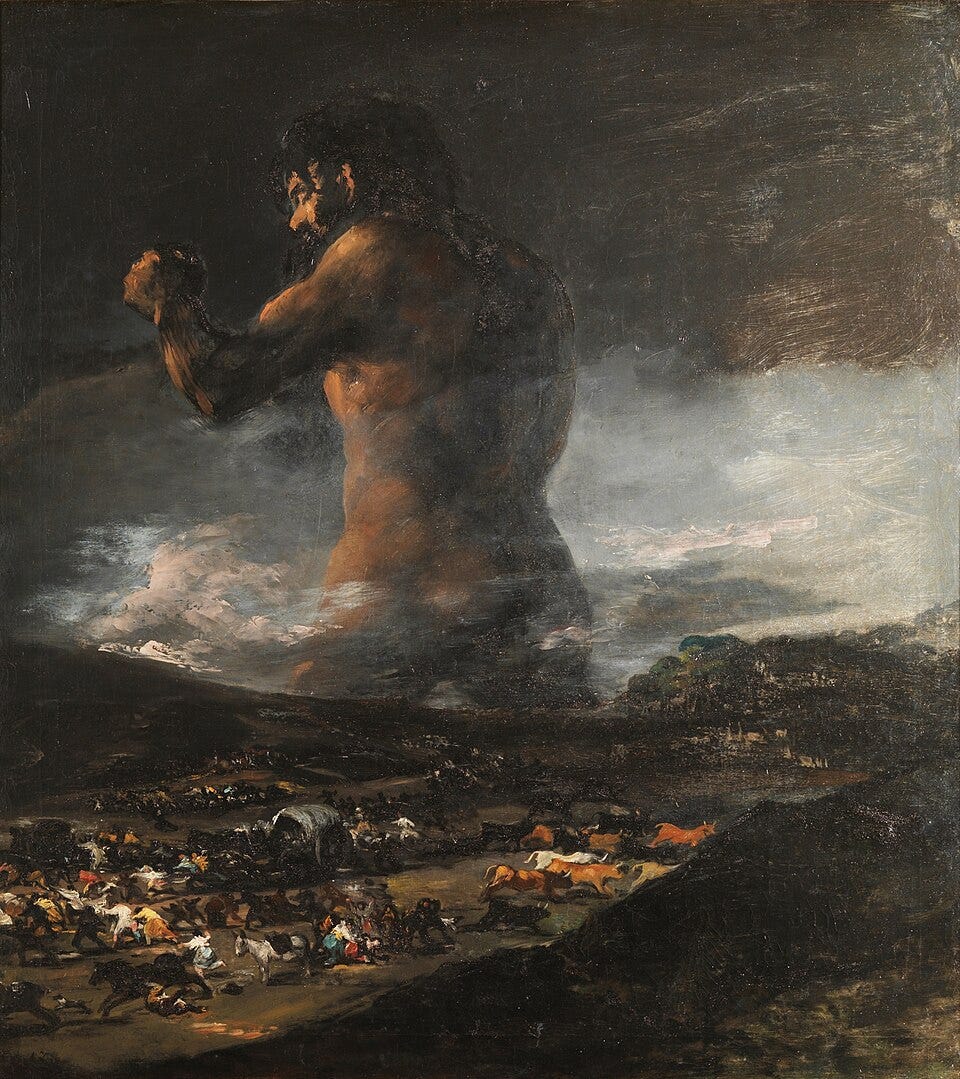
The Colossus, Francisco Goya

Tell me, should I feel guilt due to my anger-engendered desire for the collective butchers of Gaza (and Lebanon and Iran) i.e., Zionist true believers to experience a karmic dose of the pain and grief that they inflict, as a matter of routine, as Israeli Third Reich-adjacent state policy? Adding to the desire for Schadenfreude, the IDF’s war endless criminality is supported, in an overwhelming manner by the Israeli citizenry — polls reveal 88% of Israelis queried state they are in favor of the present war of aggression against the Lebanese and Iranian people, and the ongoing genocidal campaign perpetrated on Gaza.

When the vast majority of the Israeli citizenry have willingly clamored onboard the Zionist Death Juggernaut — designed to kill and destroy anything in its path — is it a sin against the soul to hope it crashes into an implacable Wall Of Comeuppance?

Israel’s barbarous, homicidal actions far surpass that of Iran, or for that matter, any other nation on the planet. Yet when resistance rises to confront Israel’s campaign of mass murder and terror, the resistance is labeled as terrorism. Israel, by intention, bombs hospitals, schools, universities, media organizations (murders reporters and journalists on the ground outright) civilian infrastructure e.g., sewage and water treatment plants, and inflicts, by design, famine.

In the (ongoing) Gaza genocide, there was a program of murderous intent called “Daddy’s home” designed to track men to their family’s home whereby their entire family would be targeted for slaughter by an IFD launched bombing attack. This is the stuff of Hollywood b-movie villainy. The practice continues now in the Israeli/US war perpetrated on the people of Iran.

Yet we hear, the war is being waged for the noble purpose of freeing the Iranian people from the grip of tyrannical rule. We were told by Washington officialdom the same lie about Vietnam, Iraq, Afghanistan, Nicaragua, Panama, Libya, Syria, and the list goes on and on.

Claiming the agenda of the Netanyahu/Trump war on Iran is a war waged to free the Iranians from tyranny is like addressing the grievances of Epstein’s victims by having them arrested by ICE and deported to Epstein Island.

Yet, in the US, regardless of our boasts and preening about our democratic republic, the nation, in reality, is a dictatorship of money and a (tottering, as evidenced by the destruction of the US’ trillion dollar military bases and installations in the Gulf States by Iran) military empire.

As Americans are – or should (at this late date) be learning a nation can be a republic or be a military empire but it cannot be both.

BANNED MEDIA MONTH #2: Der Krieg, by Otto Dix (1924) — SEVENCUT
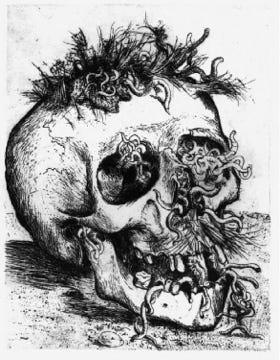
Otto Dix, Skull, fragment from Der Krieg

Yet the US was self-doomed from the nation’s inception. The imprecatory prayers of millions of ethnically cleansed/ genocidally slaughtered Indigenous peoples rise from the US’ watered-in-blood soil and hang miasmic in the nation’s air. This is the air that war criminal Trump (and his Whitehouse-squatting predecessors) and Christian-Zionist, End Time homicidal maniac Pete Hegseth and ICE bully boys, and congressional war perverts have breathed in every day of their dismal and deranged life.

This is the air of the Zionist state wrought by the arrival of European land-thieving, genocidally prone Zionist invaders. The noxious air that could soon be intermingled with irradiated fallout if the prevailing madness is not somehow and in some way dissipated by a mitigating atmosphere of sanity.

Sanity in the form of the Homicidal Maniac Class must be relieved of power.

Have you ever been subjected to jerkopathic behavior involving the following scenario? You are in a public space, perhaps, a barroom. A person, hostile in countenance, keeps staring in your direction. It seems as though the individual is attempting to make eye contact but you are hesitant to do so because the individual is emitting a forbidding vibe. When you finally relent, hoping to clear up some misunderstanding…perhaps they have mistaken you for someone else and, finally, you submit to making eye contact, the person snarls the provocation,

“What are you staring at?”

This is the mode of collective mind and deranged modus operandi of Israel. For nearly eight decades since the en masse arrival of European land-thieving bigots – who viewed themselves as entitled übermensch — and established, by means of the reign of terror known as the Nakba — their ethno-supremacist state, Zionist bullies have been glaring at their neighbors, claiming victimization and instigating violence, and as is the proclivity of bullies, as all the while, claiming to be the victim in the situation.

When the agenda is — what it has been since the establishment of the Zionist state — Greater Israel.

Imagine: A stranger knocks on your door, accuses you of committing some transgression against him, then brutalizes you, and demands you leave the premises upon the threat of death, then he moves in.

No, Israel, you cannot claim the world is clamoring for your annihilation based on your religious affiliation. We simply hope to see a barroom bully knocked off his barstool, cold-cocked by the smaller person he has been tormenting.

We are hoping that the psychopathic home invader is evicted from the property to which he laid claim by murderous intent.

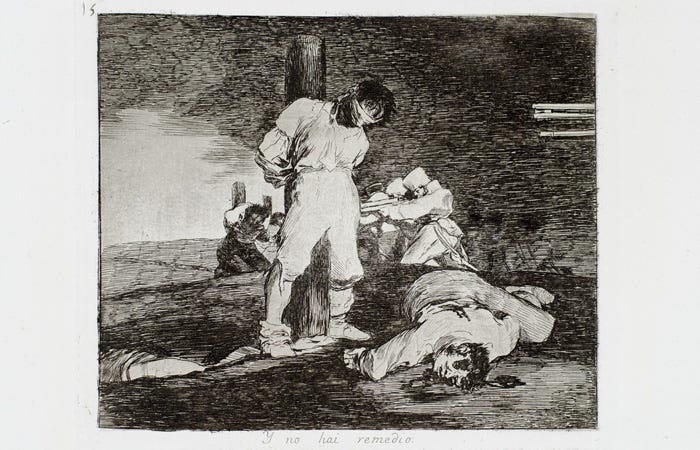
Francisco Goya. Contra el bien general (Against the Common Good) from The Disasters of War, ca. 1813–14

This is the reason people who are not hateful nor violent in nature, when seeing missiles raining down on Israel, despite our mortification regarding war still possess the desire to have the aggressor face some form of comeuppance or, at the very least, be thwarted in the odious compulsion to harm others.

Because the home invader has not faced consequences (e,g., divestment and sanctions) Israel’s agenda of imposing Greater Israel…as these words, are committed to pixel, Israel has broken the region…if not the world order.

Although Zionists, due to your soul-defying compulsion for aggression, you have condemned yourself to a life of fear amid the rubble of your ambitions.

Erev Shabbat Reflections on the Perpetual War-Making of the Zionist State. In late afternoon, last Friday, I wrote the following:

Although Zionism is a (death) cult dreamed up by European atheists, the cultural/socio mythology relating to an escape from fraught circumstances, the end of wandering, and the inspiration to wage war upon a people regarded as sinful, inferior, devoted to false gods by divine ordination remains the hallmark and touchstone of the present day people — i.e., Zionists — who claim to be the heirs of the ancient Israelites.

No photo description available.
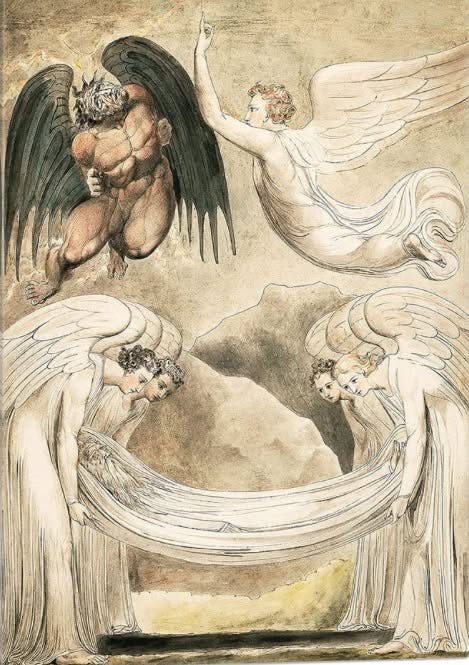
‘The Devil Rebuked (The Burial of Moses)’, by William Blake (c. 1805).

From The Book of Deuteronomy (28:64-66) “The LORD will scatter you among all peoples, from one end of the earth to the other… Among those nations you will find no peace, no rest for the sole of your foot. There the LORD will give you an anguished heart and eyes that fail and a spirit in despair. Your life will hang in doubt before you, and you will be in terror night and day and have no certainty of survival.”

As told by Old Testament mythos, The Book Of Deuteronomy limns in scripture Moses’ farewell evocation to a new generation of Israelites, gathered on the plains of Moab, their 40 years of wandering are coming to an end around the year 1400 BCE, as they prepare, en masse, to stride into the Canaan Land, then wage wars of ethnic cleansing with the intention of securing the establishment of O-Mighty God’s bestowed Promised Land. (Do you detect a pattern here: perpetual victimization, followed by land theft, and all in the name of survival — all of which is manifested as god-given entitlement to real estate granted to the tribe by Divine mandate?)

(Although the story of Exodus, on an historical basis, is the ethnocentric mythology that serves as the cultural foundation story of ancient Israel, DNA evidence reveals the Jews of Torah origin can be traced to hill country Canaanites, withal, the ancestors of present day Palestinians.)

In scholarly studies, in historical context, Deuteronomy was scribed in the 7th century BCE during King Josiah’s reign and involved the codification of Yahweh worship as an organizing principle insofar as the establishment of societal cohesion.

As survivors of The Shoah, my family’s history and attendant storyline of displacement, of wandering onto novel shores carries historical accuracy — when applied to their native born country of Germany: e.g., “Among those nations you will find no peace…Your life will hang in doubt before you, and you will be in terror night and day and have no certainty of survival.” — Deuteronomy 28:65-66

Yet the storyline is a forced fit insofar as Zionists Jews relationship to Palestinians and Israel’s Arab neighbors. When Zionists arrived from Europe, they were and remain the perpetrators of terror, night and day, and all the human beings within their reach are granted no certainty of survival.

As we are witnessing in regard to Zionism, historical narratives, ghosts of memory, when warped and displaced become a destructive force — malevolent agendas manifested in flesh and driven by harmful will. Instead, it is well past time, we proceed down to rivers of the collective mind, lay down or swords, shields, missiles, and drones and begin to adhere to an alternative (saner) passage of Old Testament scripture:

Micah 4:3:

He will judge between many peoples
and will settle disputes for strong nations far and wide.
They will beat their swords into plowshares
and their spears into pruning hooks.
Nation will not take up sword against nation,
nor will they train for war anymore.

undefined
The prophet Micah, as depicted by an 18th century Russian Orthodox icon from the iconostasis of a church on Kizhi Island in Karelia, Russia.

Phil Rockstroh is a poet, lyricist, and essayist. His poems, short fiction, poetry and essays have been published in numerous print publications and anthologies; his political essays have been widely posted on the progressive/left side of the internet.  Read other articles by Phil, or visit Phil's website.


Ontario Premier Doug Ford’s Palestine Exception Defeated in Court


Last Friday afternoon, Ontario Premier Doug Ford launched an attack on free speech, instructing his Attorney General to file an emergency injunction to prevent the Al-Quds Day march from taking place in Toronto. Ford’s action came just one day after his meeting with Israel’s Ambassador to Canada, Iddo Moed, and Israel’s Consul General in Toronto, Idit Shamir.

In response, we issued a statement condemning the use of state power to suppress a political demonstration in support of Palestinian rights. We argued that Doug Ford’s injunction posed a serious threat to the Charter-protected freedoms of expression and political assembly, and reflects a broader pattern of attempts to censor and stigmatize pro-Palestinian free speech and organizing in Canada.

Our quotes condemning this attack on civil liberties were picked up by CTV News Toronto and the Canadian Press, and published by newspapers across the country. We have also responded to misinformation and false claims about Al-Quds Day by the mainstream media.

Fortunately, Ford’s attempt to shut down Al-Quds Day failed. On Saturday afternoon, just hours before the demonstration was scheduled to begin, the judge ruled against the injunction, allowing for the demonstration to continue as planned. In his ruling, the judge affirmed that “the right to assemble and speak freely must be maintained in times of global conflict. Perhaps at no other time is the protection of our civil liberties more important.”

While we are relieved that this latest assault on free speech failed, we must ensure that our advocacy is not deterred. As Israel escalates its violent attacks against the people of Palestine, Lebanon, and Iran, its supporters at home are trying everything to stop Canadians from speaking out in support of Palestinian rights and freedoms.

CJPME’s mission is to enable Canadians of all backgrounds to promote justice, development and peace in the Middle East, and here at home in Canada. Read other articles by Canadians for Justice and Peace in the Middle East, or visit Canadians for Justice and Peace in the Middle East's website.

What Might Lenin Have Thought About the US-Israeli War on Iran (and the War in Ukraine)

What Might Lenin Have Thought About the US-Israeli War on Iran (and the War in Ukraine)?

Facit indignatio versum
(Indignation makes my verses) – Juvenal

In his analyses of the causes of the first world war, Lenin stressed the importance of understanding the policies the belligerent states pursued before the war. Borrowing from the Prussian military theorist Carl von Clausewitz, the Bolshevik leader argued that war is politics by other (namely, violent) means. Clausewitz put it this way: “War is policy itself, which takes up the sword in place of the pen.” Lenin echoed Clausewitz: All “war is but a continuation by violent means of the politics which the belligerent states and their ruling classes had been conducting for many years, sometimes for decades, before the outbreak of war.”

So, what policies were the belligerents pursuing by the pen, before they took up the sword? The answer, in Lenin’s view, explained what caused the war. If “you have not studied the policies of [the] belligerent groups over a period of decades … then you don’t understand what this war is all about,” he wrote.

All the belligerents, argued Lenin, were pursuing the same policy: they were reaching across the world for opportunities to dominate its economic surpluses wherever they could be found.  They had been able to do this, for a time, without each greatly impeding the other. However, they had arrived at the point where this was no longer possible. The sum total of opportunities had been completely claimed, and acquiring new ones, could only mean encroaching upon the opportunities that other states, or more specifically, other ruling classes, claimed for their own. The cause of the war, then, was “the whole policy of the entire system of European states in their economic and political interrelations.” The war, said Lenin “steadily and inevitably grew out of this system.”

The word ‘system’ is important. Lenin saw powerful states as actors hopelessly entangled in a system of inter-state relations which pit one against the other for economic advantage. This was a system in which individual states, acting on behalf of, and as the instruments of, individual ruling classes, competed for opportunities to exploit labor and acquire raw materials in order to appropriate as much of the world’s economic surpluses as they possibly could. As a class, said Engels, the bourgeoisie has a common interest and this community of interest, which is directed against the proletariat inside the country, is directed against bourgeois of other nations outside the country. What do ruling classes do? Exploit the labor of subordinate classes. So, when the common interest of one ruling class is directed against the common interest of another, it is directed against encroaching on territory over which the other exploits labor.  The community of interest against the ruling classes of other states took both non-violent (by the pen) and violent (by the sword) forms. “These policies,” argued Lenin, “show … continuous economic rivalry between the world’s … greatest giants, capitalist economies.”

In light of his analysis, Lenin believed that the question of which belligerent fired the first shot in the war—that is, which, in today’s terms, launched a war of aggression contra international law—was beside the point, for each was pursuing a policy that would inevitably lead to war.  As he put it: “This war is the continuation of a policy of … conquest, of capitalist robbery on the part of [the states] involved in the war. Obviously, the question of which [state] was the first to draw the knife is of small account to us.” Why? To reiterate: “Everybody was preparing for the war; the attack was made by the one who considered it most auspicious for himself at a given moment.” Another would have turned to the sword first, if, in the moment, violence was the means judged to be most suitable to the pursuit of policy.  For this reason, Lenin refused to blame Germany for starting the first world war, even though the Kaiser declared war on Russia and France and invaded Belgium.  “For decades,” explained Lenin, “three bandits (the bourgeoisie and governments of England, Russia, and France) armed themselves to despoil Germany. Is it surprising that the two bandits (Germany and Austria-Hungary) launched an attack before the three bandits succeeded in obtaining the new knives they had ordered?”

Much of the discourse on the current war in Ukraine is concerned with the question of which state started it. If we take Lenin’s view, the question is of no consequence, since the origin of the war lies not in Valdimir Putin’s decision to send Russian troops thundering across the border into Ukraine on 24 February 2022, or the decisions of US and NATO leaders to renege on their promises to assuage Russian security concerns by forbearing from NATO expansion into the former Russian sphere of influence. It lies instead in the rivalry between the Atlantic Alliance and Moscow for the economic interests of their respective ruling classes.

When I say the economic interests of the ruling classes I don’t mean specific deals, or pipeline routes, or mining concessions, although they may be involved. I mean, something broader: the ability of a ruling class to exploit opportunities for capital accumulation over as wide a territory as possible—which means at home, and if the state is strong enough, abroad. The existence of multiple ruling classes obviously complicates matters. Since there are multiple states, hence multiple ruling classes, there are multiple ongoing efforts to exploit the same economic spaces. This isn’t to say that security concerns aren’t relevant. The first job of a ruling class is to survive. Security concerns very likely played a part in Moscow’s decision to try to conquer Ukraine. But why do exploiting ruling classes want to survive? To exploit.

The Imperialism of Peace

Lenin’s analysis produces the interesting and important concept of the imperialism of peace. If war, in Lenin’s view is simply one means of pursuing a policy for economic space and opportunity, then soft-power, diplomacy, and other non-violent forms of inter-state intercourse, are but alternative methods of pursuing the same policy.  In the words of the German-Polish Marxist, and cofounder of the German Communist Party, the martyred Rosa Luxemburg, policy is pursued as either war or armed peace. Peace treaties may stay a violent hand for a time, but they do not eradicate the rivalry that gives rise to war. On this matter, Lenin and Luxemburg were ad idem with the eighteenth-century philosopher Immanuel Kant. Kant argued that a “treaty of peace makes an end to the war of the moment, but not to the conditions of war which at any time may afford a new pretext for opening hostilities” (emphasis added). This is a radical view. To end war, the conditions of war must be eradicated. Peace treaties simply paper over the problem and fail to address the root of war.

In the view of Lenin, Luxemburg, and Kant, inter-state rivalry is ubiquitous and interminable; competition among states is always present, even when violence is absent from their intercourse. If we define war as the effort of one ruling class to impose its will on another, then states are always at war, even if they are not using violence to get their way. Kant again: “A state of peace among men who live side by side is not the natural state, which is rather to be described as a state of war: that is to say, although there is not perhaps always actual open hostility, there is a constant threat that an outbreak may occur” and “the separate existence of a number of neighboring and independent states…is in itself already a state of war.”

Incessant struggle, even in times of formal peace, calls to mind the observations of numerous other thinkers. Lenin’s view was hardly novel.

Clinias of Crete, a character in Plato’s final dialogue, The Laws, contended that “Even what most men call peace is but a name. The reality is that every state, by a law of nature, is engaged at all times in an undeclared war against every other state.”

In 1651 Thomas Hobbes argued in Leviathan that: “In all times kings, and persons of sovereign authority, because of their independence, and in ceaseless competition [for power], are in the state and posture of gladiators; having their weapons pointing and their eyes fixed on one another; that is, their forts, garrisons, and guns, upon the frontiers of their kingdoms; and continual spies upon their neighbors; which is a position of war.”

British prime minister Pit the Elder in 1763 accurately predicted that the Treaty of Paris, ending the Seven Years’ War, would be nothing but an armed truce.

French marshal Ferdinand Foch presciently characterized the Treaty of Versailles as “not a peace [but] an armistice for 20 years.”

While every state may be at war with its neighbors, some states are more able, as a matter of their great size and strength, to wage it. Washington is at war with every state (that is every other ruling class) that does not submit to US hegemony. Almost always the war is carried out as the imperialism of peace. For decades, Washington has waged war on Iran by mainly economic means, punctuated, every now and then, by violence, but violence has been the exception. The rule has been daily non-violent coercion extending over decades. The US war on Iran aims to contain and weaken the state so that it is incapable of extending its own domain to territory the US state currently dominates; to demonstrate to other states that what happens to countries that fail to toe the US line is that they will be menaced, throttled, and undermined by the United States, its proxies, or both; and to make Tehran more compliant with US demands favorable to US ruling class interests.

Washington has long held Iran in a cruel economic vice that has immiserated Iranians. The predictable and intended outcome of this campaign has been civil unrest. The program has paid off handsomely for Washington, with the Iranian economy collapsing under the weight of US cruelty. Iranians took the street to demand their government provide relief from the pain, relief Tehran had not the power to provide. Even capitulating to US demands would not bring about the desired relief, since Washington refused to provide any immediate easing of its sanctions. On 20 January, the Wall Street Journal quoted US Treasury Scott Bessent: “U.S. financial pressure ‘has worked because in December, their economy collapsed. This is why the people took to the street. This is economic statecraft, no shots fired.’” To be clear, the reason why civil unrest erupted in Iran was because the United States brought it about, not by accident, not unintentionally, but by malice aforethought.

Bessent’s acknowledgement that the collapse of the Iranian economy is the product of US “economic statecraft”, which is to say the imperialism of peace, is virtually absent from the analyses of the quality, but all the same, Chauvinist and pro-imperialist, US media. No matter how sound their analyses might otherwise be, they cannot help but propagate the fiction that the collapse of economies undermined by US “economic statecraft” is due to the “economic mismanagement” of the targeted “regime.”  Thus, the victim is blamed for the miseries the US ruling class visits upon the victim’s citizens. This is true of the US imperialism of peace in Venezuela and Cuba as much as Iran.

As shocking and deplorable as the current US-Israeli attack on Iran is, is it any more shocking and deplorable than the decades-long dropping of economic atom bombs on the people of Iran by the US state and its bootlicking vassals, Canada, the UK, Germany, and so on? Indeed, it may turn out that US “economic statecraft” has created more misery in Iran than will be created by all the US and Israeli bombs that will be dropped and all the missiles that will be fired in the current campaign of violence. This isn’t to lessen the gravity of the violence unleashed on the Iranians, but to point out that a program of deliberately wrecking an economy and immiserating a people in order to expand the domain over which US and allied billionaires can dominate the world’s economic surpluses is equally deplorable and is as richly deserving of condemnation and opposition as the use of violence to achieve the same end.

Mendacity

As to the claim that Washington and its toadies are engaged in an operation to deter an Iranian threat, we can dispense with this piece of nonsense immediately. The notion that Iran is developing a nuclear arsenal and ICBMs to reach the United States is the kind of bald-faced, shameless, mendacity in which the US administration specializes. As the New York Times reported two days ago:

President Trump and his aides assert that Iran:

  • Has restarted its nuclear program;
  • Has enough available nuclear material to build a bomb within days; and
  • Is developing long-range missiles that will soon be capable of hitting the United States.

But:

  • There is no evidence that Iran has made active efforts to resume enriching uranium or trying to build a mechanism to detonate a bomb.
  • American intelligence agencies believe Iran is probably years away from having missiles that can hit the United States.

What’s more, US intelligence is of the view that Iran is not actively pursuing nuclear weapons.

Iran, a country dwarfed in population, GDP, and military assets by the United States alone, to say nothing of the United States and its allies, is no more of a threat to the United States than a Boy Scout troop armed with peashooters is a threat to a platoon of US Marines. All threats the chronically mendacious Washington cites are greatly inflated because Washington regards as a threat any state that 1) does not submit to US “leadership” and 2) has a means of self-defense. Iran will only be characterized as a non-threat when it has given up every means of defending itself. Indeed, US demands in its phony negotiations with Iran can be understood as an ultimatum to surrender all means of self-defense or face a withering attack.

Even if Iran had ICBMs and nuclear-warheads to place atop them it still wouldn’t be a threat to the physical safety of any person in the United States. North Korea is a nuclear-armed state with, what might very well be the ability to deliver warheads to the continental US by ICBMs, but it is hardly a threat. The reason why is that Pyongyang can’t survive a war with the United States, and therefore would never start one. The same would be true of a nuclear-armed Iran. What a nuclear-armed Iran is a threat to is Washington’s latitude to bully Tehran and impose its will on the state. That, in turn, is a threat to the US ruling class project of dominating as much of the world as possible. This, of course, is the aim of every exploiting ruling class, but few have the resources to pursue the goal. Most must be content with defending spheres of exploitation within their own territory, either by resisting the aggressions of larger states seeking to encroach on their own domestic sphere of exploitation, or coming to an arrangement that makes concessions to the larger state’s menacing demands. As for Iran, its failure to follow the path of North Korea is largely responsible for the peril in which it now finds itself. No country in Iran’s position that wishes to pursue an independent path free from the domination of the United States (or any other meddling great power) can afford to be without a nuclear deterrent.1

Washington may sincerely believe Tehran is pursuing a nuclear weapons program and developing ICBMs because it makes sense for the Iranian state to do so in light of Washington’s own conduct.  It should be clear by this point that a view that is consistent with Lenin’s would deny that Washington will ever refrain from behaving in ways that encourage its victims to proliferate. The raison d’etre of the US ruling class is not to live in peace with other ruling classes, but to weaken them and turn them into vassals, and if that can’t be done, to crush them. Letting them be is not an option, any more than choosing not to try to score goals is an option for a hockey team.

International Law

Lenin’s view of war raises a question about whether international law has any practical significance. I would say that the answer is manifestly in the negative and I would hardly be alone in this view. Kant, for example, observed that “Codes [of international law] whether couched in philosophical or diplomatic terms, have not—nor can have—the slightest legal force, because states, as such, are under no common external authority.” Nothing has changed in two hundred years to contradict Kant’s thinking. Large powers and their proteges regularly violate international law without the slightest reservation and do so with impunity. They get away with it because there is no overarching, independent, authority equipped with the means to enforce compliance with international law. The strong do as they will, and the weak suffer what they must. Given this sad reality, it is “an illusion,” remarked the Marxist economist Rudolf Hilferding, “to preach international law in a world … of capitalist struggle where [the] superiority of weapons is the final arbiter.”

I point this out because much discourse about war, apart from ignoring the imperialism of peace, attaches itself to outraged diatribes against the failure of various states (usually the United States and Israel, the accustomed miscreants) to abide by international law. Carrying on a discussion as if international law and the rules-based order have any significance as guardrails on the conduct of powerful states, focusses attention in the wrong place. The Tartuffe of international law, Canadian prime minister Mark Carney, admitted in his vaunted World Economic Forum address what anyone not stultified by the propaganda of the United States and its international lickspittles already knew: That “the story of the international rules-based order was partially false; that the strongest would exempt themselves when convenient; that trade rules were enforced asymmetrically. And we knew that international law applied with varying vigor depending on the identity of the accused or the victim.” If Venezuela, Iran, or Cuba were to violate international law, they would be held accountable and punished by the UN Security Council, largely a plaything and instrument of the United States.2 When the United States and its proxies (Israel especially) violate international law, as they regularly do, nothing happens, except that a chorus of progressive voices bleats fecklessly about US and Israeli crimes, on the assumption presumably that ‘speaking truth to power’ will make the malefactors mend their ways. As the nineteenth-century French novelist Balzac is reputed to have observed: “Laws are spider webs through which big flies pass and little ones get caught.” Despite all the bleating, the big flies continue to pass through the spider webs with scarcely a concern.

To echo Hilferding, it is an illusion to preach international law in a world of struggle among states where the superiority of weapons is the final arbiter. As Lenin, and before him, Marx, argued, though not precisely in these words, inter-state war ends when inter-state rivalry ends. And inter-state rivalry ends, when states end. What should not be forgotten is that the long-range project of socialism is not only the end of class, which is to say the end of exploitation of one group by another, but, as a consequence of this, the end of states.  We say, declared Lenin in a lecture on war and revolution, our aim “is to achieve a socialist system of society, which, by eliminating the division of mankind into classes, by eliminating all exploitation of man by man and nation by nation, will inevitably eliminate the very possibility of war.”

Notes
  • 1
    On the other hand, nuclear weapons would not be a panacea for Iran. While they would very like dampen the war-lust of Washington and Tel Aviv for bombing Iran, they would do little to stop the US-led siege warfare that cripples the country and immiserates its people.

    Moreover, Iran’s geopolitical situation is different from that of North Korea, and concluding that what is strategically sound for North Korea is also strategically sound for Iran, may be an error.

    North Korea borders two significant powers, Russia and China. As states outside the US orbit, Russia and China are willing to trade with Pyongyang if it’s to their advantage. This makes the DPRK less vulnerable to US economic warfare than Iran, which is isolated geographically from China.

    Additionally, Iran is located in, what is for Washington, a strategically important region. West Asia produces a substantial fraction of the world’s petroleum resources, which Washington aims to control in order to exercise leverage over China, Japan, and Europe, which depend on energy imports from the region. In order to control the region, Washington needs regional states to be submissive to US preferences. Inasmuch as Iran refuses to act as a US client, it has been the target of US conventional and economic warfare.

    North Korea, in contrast, occupies territory that is less strategically significant for Washington, and therefore, Pyongyang can be more readily ignored. It matters little from the US coign of vantage that North Korea zealously asserts its independence. Doing so doesn’t affect US strategic interests. While it is true that China is considered the United States’ single most important strategic threat, and North Korea abuts China, Washington’s focus on the Indo-pacific region is mainly confined to maintaining control of the First Island Chain, the belt of islands running from Japan through Tawain to the Philippines and Malaysia.

    An independent North Korea, then, is less of an impediment to US geopolitical ambitions than an independent Iran, and the United States is therefore less likely to be moved to attack it, nuclear arms or otherwise. It’s not clear that the same calculations apply to Iran. Why take a gamble on attacking North Korea, if the outcome might be a nuclear counter-strike? On the other hand, Washington might be prepared to gamble on attacking a nuclear-armed Iran, in light of Iran’s greater strategic importance.
  • 2
    While the Security Council by no means invariably produces resolutions reflecting US preferences, on matters that do not abridge the interests of other permanent members, the council tends to go along with US wishes. Witness, for example, UNSC Resolution 2803 of 17 November 2025, which effectively ceded Donald Trump a personal autocracy over Gaza.  It is from this very same resolution that Trump’s Board of Peace was born.  There has been much talk about Trump using his Board, of which he is the chairman, as an alternative to the Security Council.  A case might be made that the Security Council is not the plaything and instrument of the United States, for if it is, why would Trump seek to establish the Board of Peace as a new Security Council? It’s true that a whole loaf is better than nine-tenths of one, but wanting a whole loaf doesn’t prove that you don’t already have nine-tenths of it. In any event, the Board of Peace is comprised, apart from its chairman, of leaders of states with insignificant power that have joined to curry favor with the US president. The Board’s power is in no way equal, much less greater, than that of the Security Council.  It may be able to compel its few members to go along with Trump’s whims, but the Security Council, in theory anyway, can compel the compliance of every UN member state.

How Australia Exploited the Iranian Women’s Football Team


Opportunistic Asylum


When it comes to asylum seekers, the Australian political machine has prided itself on using cruelty and a purposely obtuse understanding of international law. Bolted sovereignty has been elevated over rights and humanitarianism, while political interests have abominated the dark, hungering hordes heading to the island continent on unseaworthy boats. From the early 1990s, the UN Refugee Convention became increasingly clipped, its applicability scorned in domestic politics. By the time the conservative government of John Howard assumed power in 1996, turning Australia into a vast village of suspicious citizens suffering from arrested development, the asylum seeker became electoral bait, hooked on fishing lines to lure in voters worried their comfortable lives would somehow be ruffled by the dark, brooding arrivals fleeing war-torn areas and predatory regimes.

From then on, a public relations machine was developed to dissuade and horrify those willing to make the journey to the fatal shore. Money was sunk into advertisements distributed through the Middle East warning those wishing to make their way across the seas. In February 2014, for instance, Australian authorities promoted a campaign with the slogan: “No way. They will not make Australia home”. Starring in this squalid effort was a graphic novel depicting asylum seekers in a detention centre suffering from enervating distress. Reality television shows mocking the unsuspecting foreigner at customs such as Border Security also became celluloid staples.

In March, the public exploitation of the asylum seeker suddenly switched. The Iranian Women’s Football team, participating in the AFC Women’s Asian Cup on Australian soil, had presented a magnificent opportunity to show that an Australian government might appreciate the asylum claims of those fleeing a Middle East regime. Prior to their match against South Korea, they had failed to sing the national anthem, prompting savage criticism by commentators back home.

The establishment was initially unclear about what to do. Journalists gathered on the ABC’s Insiders, an apt name suggesting how close Australia’s political scribes are to the linen and contents of power, gave an unspeakable display, refusing to emphasise the innate right to seek asylum. Fuzzy, fudged propositions were gingerly advanced: the visas of the team stay might be adjusted for a lengthier stay; some consideration for their welfare would be given; the Iranian regime was savage, propagandistic and so forth. But “asylum” remained dirty, ranking lower than “fuck” in the national broadcaster’s list of naughty words. That display was all the more contemptible given that Australia was in wholehearted agreement with the illegal attack on Iran, having refused to call it a breach of the United Nations Charter.

This, however, was too good a chance for the Albanese government to miss. The script was writing itself: oppressed women imprisoned in their hotel rooms; oppressive clerical regime in Tehran; fear, terror and surveillance. A mother reportedly warning her daughter not to return as “they’ll kill you.” Then came an intervention from US President Donald J. Trump, insisting Canberra was “making a terrible mistake” in permitting the squad “to be forced back to Iran, where they will most likely be killed”. Grant them asylum, came the call.

The grant of humanitarian visas for seven team members duly followed, though five, fearful for their family and assets in Iran, have since changed their mind. Transport Minister Catherine King tried to be wise, stating that every effort had been made to encourage them to stay. Rather despicably, she expressed pride “that Australia has offered that choice to these women.”

While there was much congratulatory back slapping for the granting of the humanitarian visas, the Janus-faced nature of Australia’s migration policy remained in play. Hours after the grant, the Albanese government introduced changes to the Migration Act 1958 (Cth) in the form of the Migration Amendment (2026 Measures No. 1) Bill 2026 (Cth) granting the Home Affairs Minister powers to block those already granted temporary visas from visiting Australia. According to Home Affairs officials in a 1.5-hour committee hearing regarding the hurried amendments, the travel ban would endure for six to 12 months, affecting anywhere up to 61,000 visa holders from the Middle East.

The Coalition found good reasons for the changes. As Liberal Senator Jonathon Duniam reasoned, one had every reason to be suspicious of those from “a region subject to conflict” who given temporary travel documents, be it a visitor or tourist visa “that they would stay beyond the expiry of that visa, potentially to seek asylum and perhaps stay on illegally.” (How opportunistic those fleeing war can be!) To salve his conscience and those of his party members, Duniam stated that such suspensions were temporary in nature. “This is not permanent prevention of people from coming into this country.”

Greens immigration spokesman, Senator David Shoebridge distilled the nature of the changes to reporters in Canberra. “On the same day that Labor gave that one chance to a handful of brave Iranian footballers, they shut the door to 7,200 other Iranians who had already been granted visas, who had security clearances”. When speaking against the amendments in parliament, Shoebridge found it churningly grotesque that these individuals “could not come to this country and seek protection from this regime, from Israeli bombs, from US missiles and from the acid rain and black rain that’s falling as a result of Israeli and US bombing.” The measures had been introduced, thought Shoebridge, in a fit of fear “about being outflanked by One Nation. You are responding to the Islamophobia of One Nation.”

The Australian Greens Leader, Senator Larissa Waters, observed the distasteful nature of the Home Affairs Minister Tony Burke’s self-lionising for “providing asylum to a handful of Iranian young women who’ve distinguished themselves on the soccer field while at the same time shutting the door on thousands more” who already had the right to come to Australia. “You’ve really rewritten the rules on how cruel a government can be.”

Independent Senator Lidia Thorpe was even more derisory, telling her fellow parliamentarians that this was “Labor’s new White Australia policy.” It was fitting for a government that proved to be “the first in the world to congratulate Trump and [Israeli Prime Minister Benjamin] Netanyahu for their illegal bombing of Iran.” Canberra had also added its complement to the conflict by sending defence personnel and an aircraft to the Gulf. “And the very moment that [the Albanese] government is helping escalate the violence, it is also slamming the door on the people who will inevitably forced to flee it.” Like Shoebridge and Waters, she saw the race card at generous play, an “example of how Labor, the Coalition and One Nation are all competing to be the cruellest and most racist because they think this is the path to political success.”

Thorpe can be taken to task at times for being so strident as to misshape an argument, but the spirit of cynicism shown by this government has been something to behold. Paul Power, co-CEO of the Refugee Council of Australia, saw an appropriately ghastly historical parallel in the proposed amendments. In the late 1930s, countries closed their doors to European Jews deprived of their citizenship. At the Evian Conference, convened in July 1938, delegates from 32 countries, including Australia, affirmed their general reluctance in admitting Jewish refugees. The dark star of the conference was Australia’s Trade and Customs Minister, Thomas White, who declared “that Australia would not help because it did not want to import a ‘racial problem’.” Governments come and go, but opportunism remains eternal.

Binoy Kampmark was a Commonwealth Scholar at Selwyn College, Cambridge. He lectures at RMIT University, Melbourne. Email: bkampmark@gmail.comRead other articles by Binoy.