Friday, April 24, 2026

France leaves climate change off G7 environment summit agenda to placate US

G7 environment ministers in Paris have excluded climate change from their agenda to placate the United States, which has withdrawn from global climate agreements.


Issued on: 24/04/2026 - RFI
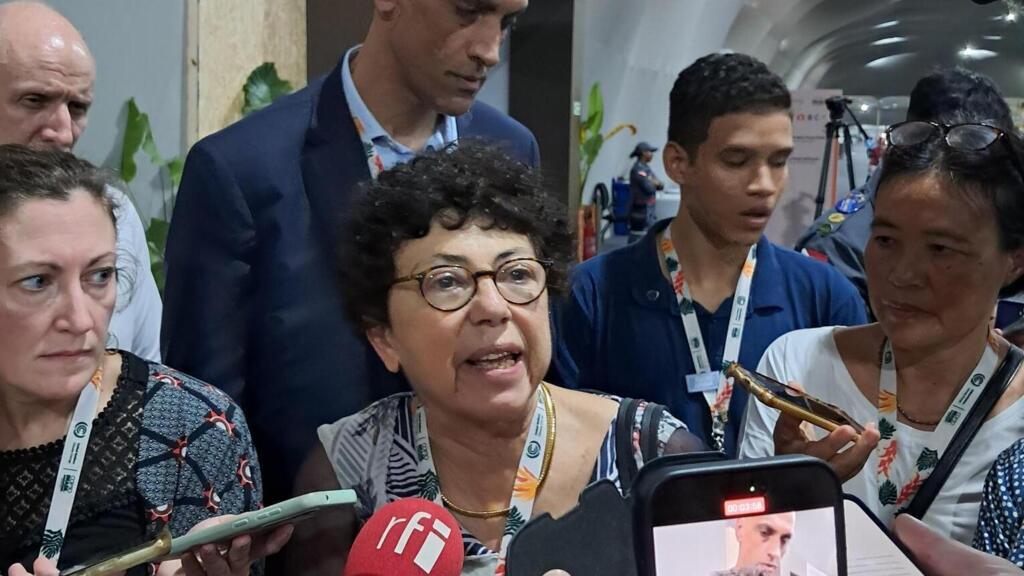
France’s Minister for Ecology Monique Barbut, host of the G7 environment minister meeting in Paris, which will address oceans, biodiversity and desertification, but not climate change, in order to avoid a row with the United States. © Géraud Bosman-Delzons/RFI

"We chose not to address the climate issue head-on, because the United States' positions on this subject are well known," France's ecology minister Monique Barbut, said.

Under President Donald Trump, the US, the largest and most powerful member of the Group of Seven industrialised economies, withdrawn from global agreements and rolled back environmental protections.

"We wanted to prioritise G7 unity, particularly to protect this forum," Barbut added, saying her ministry would instead focus on "less contentious issues".

Barbut is joined in Paris by the environment ministers of Italy, Canada, Japan, Germany and the United Kingdom.

The US is represented by Usha-Maria Turner, assistant administrator for the Office of International and Tribal Affairs at the US Environmental Protection Agency.

Representatives of Mongolia and Armenia, hosts of upcoming COPs on desertification and biodiversity will also attend.

Oceans, deserts, not climate

Barbut's office said the meeting will focus on ocean conservation, biodiversity funding, and the transformation of dry areas into desert.

The meeting takes less than a week before more than 50 countries are to meet in Santa Marta, Colombia, for the first-ever global conference dedicated to phasing out fossil fuels, the main driver of climate change.

France is hoping to win US and other countries’ backing for the new Nature and People Finance Alliance, an initiative it is spearheading to to raise public and private finance for the protection of biodiversity.

Barbut's ministry would like to use the occasion to announce $800 million (€684 million) in funding for protecting national parks in some 20 African countries.

The G7 meeting also hopes to reach a political declaration on desertification and security, while sessions on oceans will look to strengthen an alliance on marine protected areas.

Water pollution will be addressed in one session, while the ministers will visit the Fontainebleau forest south of Paris as part of a session dedicated to forests.

(with AFP)


Latin American migrants deported from US await their fate in DRC


The first group of Latin American migrants deported from the United States to the Democratic Republic of Congo has arrived in Kinshasa, under a controversial US scheme to transfer undocumented foreign nationals to third-party countries. They told RFI they feel "scared" in DRC.


Issued on: 24/04/2026 - RFI

Hugo Palencia, a Colombian who was among those deported to Kinshasa, 23 April. © Paulina Zidi / RFI


The group of 15, from Colombia, Ecuador and Peru, arrived last Friday in the central African country and are now being housed in Venus Village – run-down hotel complex on the outskirts of the capital.

Granted one-week visas on arrival, they must now decide whether to return to their home countries or remain in the Democratic Republic of Congo (DRC).

None of them speak French – the country's official language.

The DRC – one of a number of African nations that have agreed to take in deported migrants – is one of the world's 15 poorest countries, thousands of kilometres from the Americas.

“For now, my living conditions are stable. I have a room to sleep in, three meals a day and, at this stage, I feel fine,” Hugo Palencia, a 25-year-old Colombian, told RFI. He said he spent five months in US detention before being deported to DRC.

“I don’t go out – not on the streets or anywhere else. But for now, I'm OK,” he added.

Others, who chose to speak anonymously, told of their detention in US immigration centres, being given less than 24 hours warning of deportation and a rushed departure from Louisiana.

They spoke of a 27-hour flight with stopovers in Dakar and Accra, arriving at N’djili airport in the middle of the night, in heavy heat and humidity, before being taken to Venus Village.

Since then, they've rarely left the site.

'More scared here than in Colombia'

Kinshasa said in a statement earlier this month that the operation would be entirely financed by the US, without impacting the Congolese public treasury.

In addition to DRC, the US has signed deportation agreements with Cameroon, Equatorial Guinea, Eswatini, Ghana, Rwanda and South Sudan.

“I don’t understand why the United States makes agreements with African countries,” said Palencia.

“With all due respect, DRC is less developed than the US or our countries. There's extreme poverty here and more insecurity than in Colombia, where the situation is already difficult.”

Many said they were worried about what comes next.

A woman named Paola said they have until Friday, 24 April to decide whether to stay and apply for asylum in DRC, or to opt for voluntary return. The process could take several months.

The International Organisation for Migration (IOM), which takes charge of the deportees once they have obtained short-stay visas, told French news agency AFP it can offer "assisted voluntary return to migrants who request it".

Some have already made their choice.

“Honestly, I don’t intend to stay,” said Palencia. “I want to return to my country to see my son, my family, my father and my mother. They're waiting for me. With all due respect to DRC, I am more scared here than in Colombia.”

Hugo Palencia Ropero, 25, sits outside his room at a hotel on the outskirts of Kinshasa on 22 April, 2026. AFP - GLODY MURHABAZI


Court ruling ignored

Palencia said he is now in contact with the Colombian authorities and is waiting for travel documents.

“I want the foreign ministry or the Colombian consulates to contact the organisation in charge of us as soon as possible. We saw a statement from our president, Gustavo Petro, who wants us to return as quickly as possible.”

But he remains angry about his deportation. He claims he was protected by a US court ruling issued shortly before he was expelled.

Others made similar claims – Paola said she was also covered by a court decision.

Palencia says he does not understand how US immigration authorities were able to put him on a flight to Kinshasa without his consent – and despite a judge’s ruling.

This article was partially adapted from the original version in French by Pauline Zidi.

Cyprus: How the Iran war is shaping Europe’s closest frontier to the conflict


By Monica Pinna
Published on 

On 1 March, an Iranian-made Shahed drone launched from Lebanon hit the British airbase of Akrotiri in Cyprus, bringing the Iran war unexpectedly closer to Europe. This report explores the tensions shaping the European Union’s closest frontier to the conflict.

Cyprus, long seen as a stable country, is now emerging as a strategic frontline — caught between regional tensions, global powers and its own unresolved north-south division.

The British sovereign base areas of Akrotiri and Dhekelia cover around 3% of the Republic of Cyprus, in the south of the island. They go well beyond the perimeter of the bases, overlapping on almost 60% of the municipality of Kourion, home to 40,000 people.

In the village of Akrotiri, located just outside the base, residents are used to the constant presence of jets and patrols and around a third of the population works on the base.

When the drone struck, confusion followed.

Deputy Mayor of Akrotiri Giorgos Kostantinou showing reporter Monica Pinna the proximity of his village to the British Royal Airforce Base of Akrotiri Ivan Charalambous/Euronews March 2026


“There were sirens, but no clear instructions,” said deputy mayor of Akrotiri Giorgos Kostantinou. The evacuation order came only the next day. Around 1,000 people were temporarily displaced, relying on relatives, hotels and a nearby monastery.

The incident exposed a legal grey zone: Cypriot authorities have no jurisdiction over the British sovereign base areas, limiting their ability to act in emergencies.

Strategic asset or growing threat?

The bases have long been a sensitive issue in Cyprus. Retained by the UK after the island’s independence in 1960, they are seen by some as a colonial legacy.

The right-wing Cypriot government has raised questions about the future of the bases after the drone strike, with the issue remaining a long-standing source of political friction.

“For many people, the base is becoming a threat,” said Pantelis Georgiou, mayor of the Kourion municipality. “We need clarity on who is responsible, especially for civil protection.”

Mayor of Kourion municipality, Pantelis Georgiou, explains “People are starting to feel that having a military base of that size in the area is a threat.” Ivan Charalambous/Euronews March 2026


Cyprus, which currently holds the rotating presidency of the Council of the European Union, is not a NATO member and relies on its European allies and the UK for its defence.

Following the attack, several European countries deployed military assets to the region, including Greece, while the UK allowed the US to use its bases for "defensive operations".

Tourism caught in the crossfire

Despite security concerns, authorities are keen to project calm. Tourism — which accounts for about 12% of Cyprus’s GDP — remains a priority.

Industry representatives have downplayed the incident, but the impact was immediate. Hotel bookings dropped by nearly 40% in March, just as the season was beginning.

Officials insist the long-term impact will depend on how the conflict evolves.

The Middle East crisis is also reverberating through Cyprus’ lasting political divide.

The island has been split since 1974 between the internationally recognised Republic of Cyprus and the self-declared north Cyprus, recognised only by Turkey.

Military posturing on both sides has intensified, with Turkey reinforcing its presence in the north after European deployments in the south.

Nicosia: Checkpoint to cross into self-declared ‘Turkish Republic of Northern Cyprus’ recognised only by Turkey Monica Pinna/Euronews March 2026


Analysts warn that the Middle East conflict could deepen divisions and further delay reunification efforts.

For now, daily life continues much as before. But beneath the surface, the war is reshaping the island — politically, economically and socially.

Cyprus remains physically distant from the frontlines, yet increasingly exposed to their consequences. The question is no longer whether the conflict affects the island, but how far those effects will go.

EU and US deepen cooperation on critical minerals amid concerns over China’s dominance

Secretary of State Marco Rubio and EU Commissioner for Trade and Economic Security Maros Sefcovic at the State Department, Friday, April 24, 2026, in Washington.
Copyright AP Photo/Rod Lamkey, Jr.

By Emma De Ruiter
Published on 

EU Trade Commissioner Maroš Šefčovič said that with the Memorandum of Understanding, "we will be delivering on our goals much faster than before."

The European Union and United States signed an agreement Friday to coordinate on the supply of critical minerals needed for key industries including defence.

US Secretary of State Marco Rubio and EU Trade Commissioner Maroš Šefčovič signed a Memorandum of Understanding (MOU) on a Strategic Partnership for Critical Minerals in the Treaty Room of the State Department in Washington.

Rubio stated ahead of the signing that the awareness and commitment to the European Union shows "the importance of supply chains and critical minerals to the success of our economies, and to our national security."

Rubio highlighted that the over-concentration of these resources, and the fact that one or two places dominate them, is an unacceptable risk.

"We need diversity in our supply chains. Diversity in the places where they're critical in the world," Rubio added.

Šefčovič echoed the importance of the agreement, saying, "I believe that we will be even more strategic together. We will be delivering on our goals much faster than before. And we, of course, will be growing stronger together in this very important area."

Secretary of State Marco Rubio and EU Commissioner for Trade and Economic Security Maroš Šefčovič at the State Department, Friday, April 24, 2026, in Washington.
Secretary of State Marco Rubio and EU Commissioner for Trade and Economic Security Maroš Šefčovič at the State Department, Friday, April 24, 2026, in Washington. AP Photo/Rod Lamkey, Jr.

Countering China's dominance

The pact marks a rare embrace by President Donald Trump's administration of the role of the EU, which it often berates as it instead champions right-wing populists within Europe.

Flexing its muscle at times of tension, Beijing has restricted exports of critical minerals needed for products including semiconductors, electric vehicle batteries and weapons systems.

"We have to make sure that these supplies and these minerals are available for our futures and in ways that are not monopolised in one place or concentrated heavily in one place," he said.

They will also look at coordinating any subsidies and stockpiles of critical minerals, coordinate joint standards to ease trade across the Western world, and together invest in research.

The Trump administration has previously called for a preferential trade zone among allies on critical minerals.

Washington has also unveiled critical minerals action plans with Mexico and Japan, alongside a supply framework with Australia and others.

'Positive traction' needed on US steel tariffs

The EU is also seeking more progress in easing the effects of US steel tariffs, Šefčovič said, adding that talks are "going in a positive direction."

The bloc wants to align approaches with the United States towards third countries when it comes to steel trade, he added.

With US Commerce Secretary Howard Lutnick, "we agreed to accelerate this work at a technical level," Šefčovič told reporters.

But key issues remain in the transatlantic trade relationship.

Since Trump returned to the White House last year, European manufacturers have been hit by his sharp 50-percent tariff on steel and aluminum imports.

While Brussels and Washington clinched a deal last summer setting US tariffs at 15 percent for most EU goods, steel and aluminum products were not covered.

While Trump's administration recently simplified how its import tariffs on steel are applied, Šefčovič said: "We still have some issues with the remaining products which are listed."

"It would be very important to have positive traction on this," he added.

Šefčovič stressed that the United States and European Union both face an issue of overcapacity in the market, recounting the EU's recent decision to double tariffs on foreign steel to shield its industry from cheap Chinese exports.

"As a next step, we want to launch work with the US on steel ring-fencing, aligning our approaches towards third countries," Šefčovič said.

This would help to build a "defensive mechanism against subsidised steel, against global overcapacities," he added.


UK House of Lords accused of 'obstructionism' as time runs out on assisted dying bill

A campaigner holds a banner outside parliament in London as a proposed law to legalise assisted dying in England and Wales ran out of time, 24 April, 2026
Copyright AP Photo

By Gavin Blackburn
Published on 

MPs in the House of Commons had backed legalising euthanasia for adults who have been given less than six months to live and can clearly express a wish to die, in a historic vote last June.

A bill to legalise assisted dying for terminally ill adults in England and Wales failed in parliament on Friday after getting bogged down in Britain's unelected upper house, as campaigners vowed to fight on.

Charlie Falconer, who sponsored the legislation in the House of Lords, accused opponents of "pure obstructionism" after the bill simply ran out of time.

MPs in the House of Commons had backed legalising euthanasia for adults who have been given less than six months to live and can clearly express a wish to die, in a historic vote last June.

But more than 1,200 bill amendments subsequently introduced in the second chamber meant that after the end of Friday's debate there was no chance it would pass before parliament concludes its current session next week.

"It was an absolute travesty of our processes in which a few Lords manipulated by putting down 1,200 amendments... and then talking and talking and talking," Falconer said minutes after the bill failed.

"The problem was pure obstructionism by a small number," he insisted.

A campaigner holds a banner outside parliament in London as a proposed law to legalise assisted dying in England and Wales ran out of time, 24 April, 2026
A campaigner holds a banner outside parliament in London as a proposed law to legalise assisted dying in England and Wales ran out of time, 24 April, 2026 AP Photo

Kim Leadbeater, the MP who introduced the bill in the House of Commons in 2024, added she believed there was a "real sense of injustice...that what's happened is wrong."

Both chambers of Britain's parliament must approve legislation for it to become law and bills that are still in progress when a session ends usually fail.

"We're incredibly angry with what's happened but we're determined to get it through, this is not the end, we will not be stopped," campaigner Rebecca Wilcox told the AFP news agency.

Wilcox added assisted dying advocates hope that an MP will carry on the fight when parliament reconvenes for its next term in mid-May.

The current draft law was a private member's bill, not government legislation, which requires an MP to introduce it and faces a bigger challenge to get parliamentary time and get on the statute books.

"We're hoping one (MP) of them will resurrect this bill (and) it will go through parliament. We're pretty confident of that," Wilcox said.

Members of the House of Lords and guests take their seats in the Lords Chamber ahead of the State Opening of Parliament, 17 July, 2024
Members of the House of Lords and guests take their seats in the Lords Chamber ahead of the State Opening of Parliament, 17 July, 2024 AP Photo

'Deliberate delaying'

The Terminally Ill Adults (End of Life) Bill would have seen Britain emulate several other countries in Europe and elsewhere to allow some form of assisted dying.

More than 200 lawmakers signed a letter late on Thursday blaming the bill's scuppering on "deliberate delaying tactics pursued by a minority of peers opposed to its passage."

"I'm really sad, really upset, really disappointed, but also a little bit angry," Leadbeater said earlier on Friday, adding the terminally ill would continue to be denied "choice, compassion and dignity."

Campaigners hold a banner outside parliament in London as a proposed law to legalise assisted dying in England and Wales ran out of time, 24 April, 2026
Campaigners hold a banner outside parliament in London as a proposed law to legalise assisted dying in England and Wales ran out of time, 24 April, 2026 AP Photo

Leadbeater vowed supportive MPs will "go again" in the next parliamentary session, though the legislative process will have reset and a different MP will likely need to introduce a new bill.

"The issue is not going away, there's a very clear direction of travel around the world," she said, adding polling in Britain showed support for the change.

But critics, including the Christian Medical Fellowship (CMF) which represents medical professionals opposed to assisted dying, said they were "relieved."

"It is not possible to construct an assisted suicide service that is safe, equitable, and resistant to placing unacceptable pressure on the most vulnerable," a spokesperson said in statement.

Under the proposed legislation, any patient's wish to die would have to be signed off by two doctors and a panel of experts. They would have to be able to administer the life-ending substance themselves.

Its supporters said it would give people with an incurable illness dignity and choice at the end of their lives.

Assisted suicide is legal in countries including Australia, Belgium, Canada, Luxembourg, the Netherlands, New Zealand, Portugal, Spain, Switzerland and parts of the US.


War, satire & resistance: Peabody Awards 2026 winners revealed

Peabody Awards 2026
Copyright Yabayay Media / Antipode films - Apple TV - ZDF/Arte

By Mohammad Shayan Ahmad
Published on 

From 'Adolescence' and 'Pluribus' to Gaza war reporting, the 2026 Peabody winners highlight storytelling that prioritises impact over ratings, spanning entertainment, documentary and public service.

The winners of the 86th annual Peabody Awards have been announced, spotlighting a wide spectrum of storytelling, from late-night satire to urgent reporting from conflict zones.

A total of 34 winners were selected from more than 1,000 entries, following deliberations by a jury of industry professionals and scholars, underscoring the scale and competitiveness of the awards.

Established in 1940, the Peabodys honour stories that prioritise public impact and cultural significance across television, radio, podcasts and digital media, often looking beyond ratings to recognise work that has a tangible impact on society.

This year’s winners reflect that range.

In entertainment, titles such as AdolescenceJimmy Kimmel Live! and Pluribus were among those recognised.

The awards leaned into urgent global issues, with projects such as Fault Lines: Kids Under FireThe Disappearance of Dr. Abu Safiya and _The Rise and Fall of Terrorgram -_all recognised for their reporting on Gaza and online extremist networks, as well as investigations into immigration crackdowns and ICE operations.

In the documentary category, among the winners was the Oscar-winning Mr Nobody Against Putin. Based on secretly recorded footage by school teacher Pavel Talankin, who exposes how the Putin administration aims to indoctrinate schoolchildren in the aftermath of Russia’s invasion of Ukraine, this powerful piece of filmmaking has been recognised across the European documentary circuit for its political reporting. Last month, a Russian court banned the distribution of the award-winning documentary, after authorities claimed the film promoted “negative attitudes” about the government and the war in Ukraine.

Among other winners were No Other Land, which previously won the Academy Award for Best Documentary Feature in 2025, and The Alabama Solution, which received a 2026 Goldsmith Special Citation for Documentary Film.

The awards underline the global reach and prior acclaim of this year’s winners.

“The winners of the 86th annual Peabody Awards reflect Peabody’s mission to honor storytelling that has the potential to change culture, whether it’s examining the destructive tactics of ICE, viewing terminal illness through a deeply personal lens, or resisting attempts to stifle free speech,” said Jeffrey Jones, executive director of Peabody. “We look forward to recognizing and celebrating these winners.”

The 86th annual Peabody Awards winners will be recognized with a ceremony at the Beverly Wilshire Hotel on 31 May.

Here is the full list of winners:

News

  • Fault Lines: “Kids Under Fire” (Al Jazeera English)
  • Fault Lines: “The Disappearance of Dr. Abu Safiya” (Al Jazeera English)
  • The Rise and Fall of Terrorgram (FRONTLINE/ProPublica)
  • 60 Minutes: “The Uvalde Response” (CBS News)
  • PBS NewsHour: “America’s Child Care Crisis” (PBS)
  • Reuters: “Myanmar’s Hidden War”

Entertainment

  • Adolescence
  • Jimmy Kimmel Live!
  • The Pitt
  • Heated Rivalry
  • Andor
  • Pluribus
  • Reservation Dogs
  • Somebody Somewhere

Documentary

  • Mr. Nobody vs Putin
  • No Other Land
  • Come See Me in the Good Light
  • The Alabama Solution
  • 20 Days in Mariupol
  • Beyond Utopia

Interactive and immersive / digital storytelling

  • South of Midnight
  • Additional investigative and immersive projects

Children’s and youth / arts / podcast-radio / public service

  • Multiple winners across categories spanning educational, cultural and public-interest storytelling

Harrowing image of children clinging to detained father named World Press Photo of the Year

'Separated by ICE', taken by Carol Guzy Credit: Carol Guzy/World Press Photo 2026/Zuma Press


By Theo Farrant
Published on 


The image, showing two young girls clinging to their father as he is detained in New York, was chosen from over 57,000 entries.

The World Press Photo Foundation has announced its 2025 Photo of the Year, awarding the top prize to a powerful and deeply distressing image that captures the human impact of U.S. immigration enforcement.

Titled Separated by ICE, the photograph was taken by independent photojournalist Carol Guzy inside New York’s Jacob K. Javits Federal Building. It captures the moment two young girls cling desperately to their father, Luis, an Ecuadorian migrant, as he is detained by immigration authorities.

According to his family, Luis has no criminal record and was the sole provider for the household. His wife, Cocha, and their three children - aged seven, 13 and 15 - were "left inconsolable, facing immediate financial hardship and profound emotional trauma."

Shot for the Miami Herald in August 2025, it was selected from 57,376 entries submitted by more than 3,000 photographers worldwide. Judges praised the winning photo's raw emotional intensity and said it "serves as a witness to a policy that has turned courthouses into sites of shattered lives."

Global jury chair Kira Pollack described the image as a stark record of reality: "The Photo of the Year is evidence. It's proof, and it's a record of ground zero where a family is being separated and a father is being detained and taken away. And it's the moments before the unknown. This is a record of, quite literally, a disappearance."

She added: "This picture is chaotic. It's terrifying. It captures a very genuine expression of fear, terror, uncertainty and powerlessness. And what brings me into the picture, of course, are the daughters’ faces, trying to keep their father from being torn away. It allows us to look in. We cannot unsee it."

Guzy, who has spent years documenting the effects of immigration policy on families, said in a statement: "This photo should be painful to view, and I hope it stirs people out of any sense of complacency. This award highlights the critical importance of this story worldwide."

She added: "We bear witness to the suffering of countless families, but also to their grace, and resilience that transcends adversity and it's been quite humbling. Their courage to open up their lives to our cameras has allowed us to tell their stories. And certainly this award belongs to them, not me."

BEST PROTEST SONG OF ALL TIME

Thunderclap Newman was a British rock band that Pete Townshend of the Who and Kit Lambert formed in 1969 in a bid to showcase the talents of John "Speedy" Keen, Jimmy McCulloch, and Andy "Thunderclap" Newman. Their single, 

"Something in the Air", a 1969 UK number one hit, remains in demand for television commercials, film soundtracks and compilations. The band released a critically acclaimed rock album, Hollywood Dream, and three other singles (which appeared on the album), "Accidents", "The Reason" and "Wild Country". 

From 1969 until 1971, the nucleus of the band consisted of the songwriter John "Speedy" Keen (vocals, drums, guitar), Andy "Thunderclap" Newman (piano) and Jimmy McCulloch (guitar). Pete Townshend (using the alias "Bijou Drains") played bass guitar on their album and singles, all of which he had recorded and produced at the IBC Studio and his Twickenham home studio. 

The band augmented its personnel during its tours: in 1969 with James "Jim" Pitman-Avery (bass guitar) and Jack McCulloch (drums); and in 1971 with Ronnie Peel (bass guitar) and Roger Felice (drums). The band folded in April 1971 but was resurrected by Andy Newman with a new group around 2007.