Sunday, April 26, 2026

Record-Breaking World Heat

 April 24, 2026

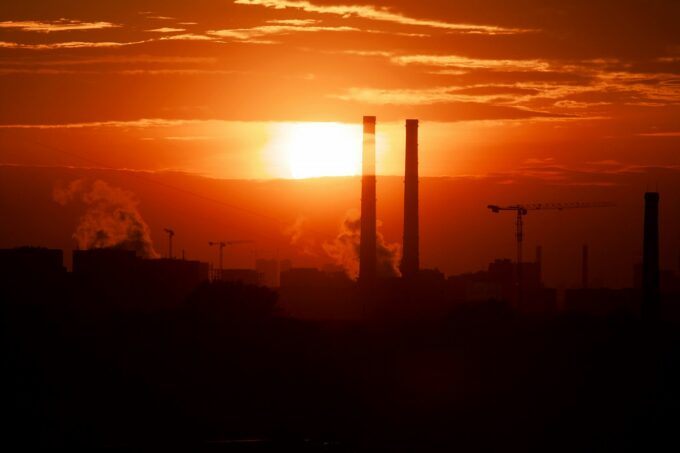
Image by Pavel Avakumov.

The world is its hottest in modern human history (circa 1500-present). Yet, fossil fuel CO2 emissions continue unabated, effectively creating an artificial blanket that retains heat. Despite decarbonization efforts, emissions continue to rise, driven by increasing energy demand and fossil fuel use. According to NOAA, over the past 60 years, carbon dioxide (CO2) in the atmosphere has increased 100-200 times faster than it did during the end of the last ice age. In essence, CO2 is the primary source, the genesis, of record-breaking heat.

Deadly Heat Thresholds Crossed on Five Continents, Non-survivable Conditions

recent study conducted by researchers from The Australian National University and the University of Sydney… “led by Professor Sarah Perkins-Kirkpatrick, looked at heat waves that occurred in Mecca (Saudi Arabia) during 2024, Bangkok (Thailand) during 2024, Phoenix (United States) during 2023, Mount Isa (Australia) during 2019, Larkana (Pakistan) during 2015 and Seville (Spain) in 2003. The events featured climatologically extreme conditions and, with the exception of Australia, were associated with at least 1000 deaths.”

Non-survivable thresholds were surpassed during all six of the events.

According to Professor Perkins-Kirkpatrick, of the ANU and the ARC Center of Excellence for the Weather of the 21st Century: “While many people are rightly concerned about the possible effects of future heat waves as global warming continues, our research shows that non-survivable conditions are occurring during present-day heat events,”

Clearly, record-breaking heat is a killer today. It has already struck five continents with deaths in each attributed to excessive heat waves.

Current Conditions- Breaking Records

“From Argentina to Australia to South Africa, record heat and raging wildfires are rampaging through the Southern Hemisphere at the start of 2026, with scientists predicting that even more extreme temperatures could lie ahead – and possibly another global annual high – after three of the hottest years on record.” (Record Heat and Raging Fires Ring in 2026 Across the Southern Hemisphere, Reuters)

Effective April 2026, Asia is under severe, early-season heatwaves with temperatures peaking at 45.4°C (113.7°F) in India, record-breaking heat in Southeast Asia, Indonesia, and East Asia. Regional temperatures are routinely exceeding 40°C (104°F) in India and 43°C (109.4°F) in Thailand driven by intense heat domes.(The Chosun Daily)

April 2025 to March 2026 was the hottest 12-month period on record for the continental U.S, according to data from the National Oceanic and Atmospheric Administration.

Just for laughs, President Donald Trump went on a climate change denial rant at a Turning Point event in Arizona d/d April 17th, 2026, claiming Earth is actually “getting cooler.”

Earth Beyond Limits

Alarming statistics about record-setting worldwide heat generates interesting ‘buzz’ amongst smart people that recognize risks, before the fact. The Buzz: Earth being “pushed beyond its limits,” is a well-founded proposition as the planet’s energy imbalance reaches record highs. This extremely disturbing fact comes via the World Meteorological Organization (WMO).

There’s also considerable ‘buzz’ about unlivable regions of the planet, growing worse by the year. It’s already an established trend. Alas, with major countries, such as the U.S., re-emphasizing fossil fuels and de-emphasizing renewables, the energy imbalance is likely to get out of hand, quickly.

For example, according to Where Climate Change Is Making Extreme Heat UnbearableBloomberg News d/d March 10, 2026: “Parts of Asia, Africa, Australia and North America are becoming unlivable for senior citizens… Younger adults also are losing time as climate-driven heat restricts their lives for 50 hours a year.”

“In Qatar, for instance, heat now makes it risky for older adults to engage in routine activities for a third of the year. Even 18-to-40-year-olds in that country must curb daily tasks for more than 800 hours a year or 10% of their time,” Ibid

Overall, more than a third of the global population resides in regions where heat severely affects daily life. Based upon current trends of fossil fuel usage and greenhouse gas emissions, it’ll get worse. When will countries finally squeal, “We can’t take it anymore!” Geez, what to do?

The WMO has confirmed 2015 to 2025 as the hottest 11 years ever measured.

Still, on the heels of that bleak report WMO delivered a bleaker message. The rising temperature on the surface that humans experienced was only a small percentage of the “faster-accumulating heat in the wider Earth system.” The oceans absorbed the great bulk of the heat imbalance. “The rate of ocean warming has doubled.” Indeed, this is the big-bad global heating bugaboo hidden from view that informed people believe will haunt society in due time, possibly sooner then later.

Astonishing Weather Events in SW US

In the United States, according to Yale Climate ConnectionsThe 2026 Southwest U.S. Heat Wave Was One of the Six Most Astonishing Weather Events of the Century: “March 2026 was the warmest March on record for the continental United States in 132 years, with temperatures 9.4°F above the 20th-century average. A severe heat dome in late March brought summer-like temperatures to the Southwest, marking one of the most astonishing extreme heat events of the century.”

“The burning of oil, gas, coal and forests releases heat-trapping greenhouse gases such as carbon dioxide, methane and nitrous oxide, which are all at their highest level in at least 800,000 years.” (Source: Earth Being ‘Pushed Beyond its Limits’ as Energy Imbalance Reaches Record High, The Guardian, March 23, 2026)

Scientists say the record-shattering heat in March in the SW was impossible without the impact of climate change. It’s shocking to get summer temperatures so early, which poses a question: Why does America promote oil and gas that directly influences scorching heat?

According to World Weather Attribution d/d March 20, 2026: “The impacts of this early-season heatwave are likely to extend beyond health and have environmental implications. High temperatures are expected to accelerate snowmelt in these parts, including the mountains of Colorado where the snowpack levels are already lowest since 1981 due to the preceding warm winter, and the Sierra Nevada region in California, where although snowfall was average, the high heat is likely to drive rapid snowmelt. Early snowmelt in these parts can reduce water availability during the summer months, increasing the risk of water shortages, prolonging and intensifying dry seasons and increasing wildfire danger,” Ibid.

Excessive CO2 fossil fuel emissions, like dominoes cascading one onto another, trap excessive heat impacting mountain snowpack reducing water availability intensifying dry season wildfires cranking up homeowner insurance premiums. The interconnectivity is remarkably precise.

The Production Gap – “Ten years on from the Paris Agreement, countries collectively plan even more fossil fuel production than before.”

According to a new study under the auspices of The Stockholm Environment Institute involving more than 80 researchers from several international institutes and the U.N. environmental agency, it warns that governments are planning to produce in 2030 more than twice the amount of fossil fuels than what’s consistent with complying with the Paris Agreement in 2015 signed by 193 countries pledging to cut emissions by 2030, they’re not. This guarantees more severe heat waves with additional crossings of the deadliest heat threshold in history, and it’s only going to get worse unless and until fossil fuels stop CO2 emissions, plus removal of current CO2 already in the system. But the technology to accomplish this is feeble.

Upcoming Research: There hasn’t been a March in America this dry in 131 years.

As of mid-April 2026, the US Drought Monitor has confirmed that much of America is locked in a vicious, dangerous drought. According to Yale Climate Connections, “Last month was the warmest March in records for the contiguous United States in national-scale data going back 132 years, according to NOAA’s monthly U.S. climate summary issued on April 8, 2026.”


Robert Hunziker lives in Los Angeles and can be reached at rlhunziker@gmail.com.

How Fascism Works Now: A Note about Trump as the Healing Christ


 April 24, 2026

Artist unknown (AI generated), Untitled (Trump as Healing Christ). TruthSocial.com@realdonaldtrump, April 12, 2026.

Hidden in plain sight

The image of a youthful Donald Trump, laying his hand on the forehead of a sick or dying man has by now been interred in the meme graveyard. By the time you read this, another will have taken its place, and then another, and so on. That’s one purpose of the AI barrage:  misdirection. By attending to obvious outrages – the supposed blasphemy of an image of Trump as Healing Christ — the public is more likely to overlook bigger, but less promoted ones, like weakened pollution standards, cuts to disease research, and of course, war. But there’s another, equally important communication strategy at work, and it’s hiding in plain sight: insipidness or kitsch. That’s the language of fascism now.

Iconography

For all the controversy it generated, the meme is barely coherent. Trump wears a loose-fitting white toga beneath a red poncho, though the latter equally resembles a kimono (it has sleeves) and a golf sweater casually draped over the shoulders. Rays of light emanate from the head of the recumbent man, suggesting he’s the holy figure, and Trump only a nurse or nurse’s aide checking the patient’s temperature. The president holds a ball of light in his left hand, like Disney’s “Never-fairies” who catch and hold sunbeams.

Surrounding the sick or dying man are four other figures. Clockwise from upper left, a middle-aged man with baseball cap and neatly trimmed white beard and moustache – in queer parlance a “wolf” or “daddy”; a youthful, clean-shaven marine; a young nurse –miniscule compared to the gargantuan Trump; and another young woman of no evident occupation, with auburn hair parted in the middle.  Middle-aged or older women were not invited to this party — unsurprising given the host. Craggy, right-hands at lower left and right suggest two other men apparently kneeling, their heads below the level of the hospital bed. Are they orderlies cleaning the floor with their other hands?

Finally, there are the soldiers floating in the sky, like Napoleon’s troops entering Valhalla in the famous painting from 1801 by Girodet-Trioson. The one in the middle appears to be in retreat and in drag, wearing a crown like the Statue of Liberty and carrying two standards. Also in the busy sky are a pair of bald eagles and three jet fighters risking mid-air collision or bird-strike. Beneath are the Statue of Liberty, Lincoln Memorial and another classical-looking building in the left background – possibly an AI scrambled U.S. Capital.

The reason the image was controversial is because it was understood by some Christians to be blasphemous. According to the four canonical gospel books, Christ regularly healed the sick: “And Jesus went about all the cities and villages, teaching in their synagogues, and preaching the gospel of the kingdom, and healing every sickness and every disease among the people” (Mathew: 4:23). His patients suffered from dropsy (edema), paralysis, blindness, and leprosy. Jesus also raised the dead.  To represent a politician – even a president – as Christ is not kosher. The first of the Ten Commandments reads: “Thou shalt have no other gods before me.”  A president who glows and heals by touch is godly.

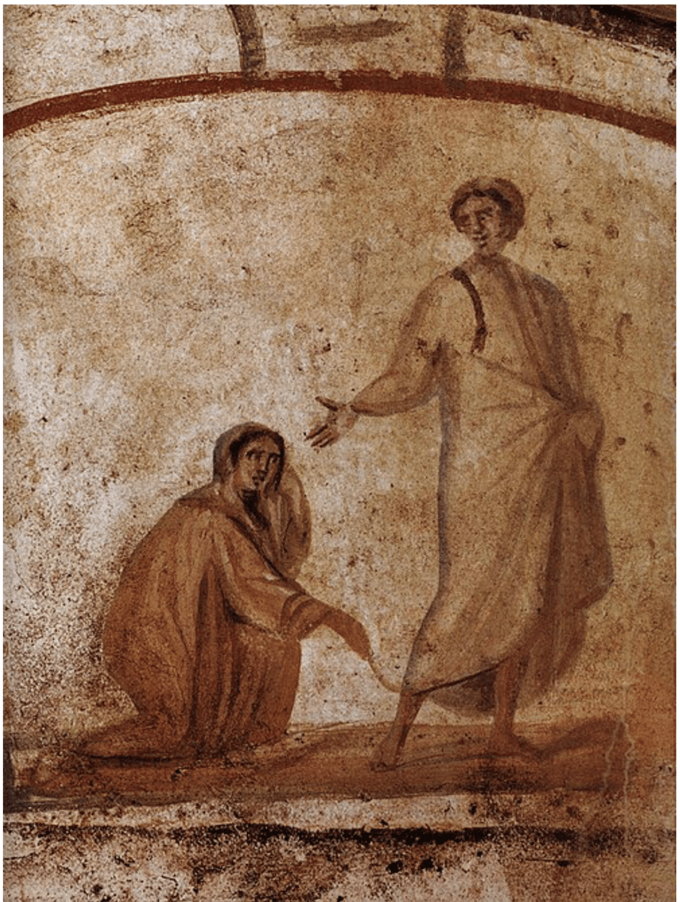
The association of Jesus with a doctor or healer is fundamental to Christian pictorial iconography. Among the earliest depictions of Jesus, preceding even scenes of crucifixion, is as a healer. The Catacombs of Peter and Marcellinus in Rome (4th C. CE) contain a fresco

Artist unknown, The healing of a bleeding woman, Rome, Catacombs of Marcellinus and Peter. 4th C. CE.

illustrating an episode from the book of Mark (the earliest gospel book): “And a certain woman, which had an issue of blood twelve years. And had suffered many things of many physicians, and had spent all that she had, and was nothing bettered, but rather grew worse.” (Mark 5: 25-26). After kneeling and touching the hem of Christ’s toga, she was cured.

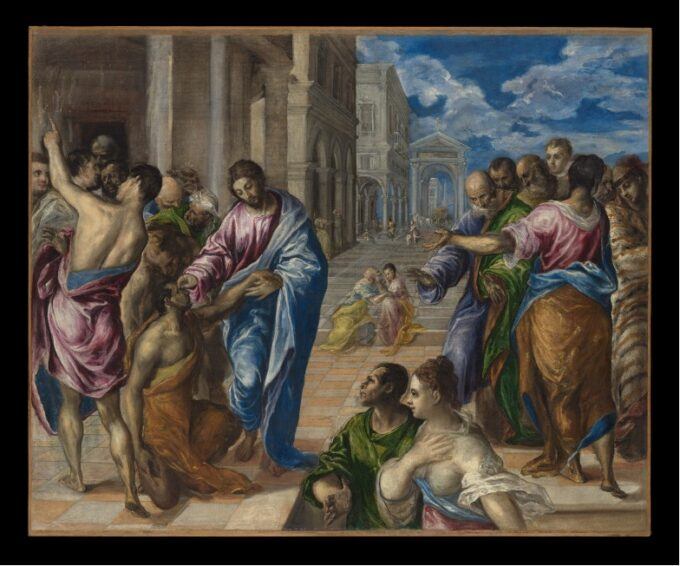
More than a thousand years after the Catacombs painting, the subject was still securely embedded in Christian iconography.  There are innumerable examples, including El Greco’s Christ Healing the Blind (c. 1570) at the Met, illustrating passages from John (9:1-41) and Mark (8:22-26).  It shares with the Trump meme the motif of hand touching forehead with classical architecture and sky in the background – but no Airforce jets.

El Greco, Christ Healing the Blind, c. 1570. New York: Metropolitan Museum of Art.

Given Trump’s frequent promises to devise a health insurance plan better than Obamacare, it’s understandable he would claim that the controversial meme concerns his medical, not spiritual prowess. He told an interviewer: “It’s supposed to be [me] as a doctor making people better. And I do make people better. I make people a lot better.” According to the president, the image shows him miraculously healing the American “people” – the body politic – not just a single, recumbent person.

Artist unknown (AI generated), Untitled Trump and Jesus). TruthSocial.com@realdonaldtrump, April 15, 2026.

A few days later, Trump undercut his own protestations against the charge of blasphemy by posting another meme. This time, he himself was not Jesus, just a man chosen and touched by Jesus. It’s a bust-length, double portrait of a white-berobed Jesus with left arm extended around the president’s shoulder and right hand on his chest. Like Christ, Trump’s eyes are closed or downcast, as if in prayer or asleep. (The photo-source must have been a cabinet meeting.) The gauziness of the image is purposeful — either Trump dreams of Christ, or Christ dreams of Trump.

In composition, the second image resembles Friedrich Overbeck’s Italia und Germania (1828), a painting that celebrates the supposed closeness of two cultures. During the 1930s, the work became an emblem of the German/Italian, Nordic/Mediterranean/ Nazi/Fascist alliance.  It was also taken as an example of healthy, German art in contrast to the “entartete” (“degenerate”) art of modernists like Picasso, Chagall, and Modigliani.

Freidrich Overbeck, Germania und Italia, 1811-28. Munich: Neue Pinakothek.

Nazi prototype for the healer and savior

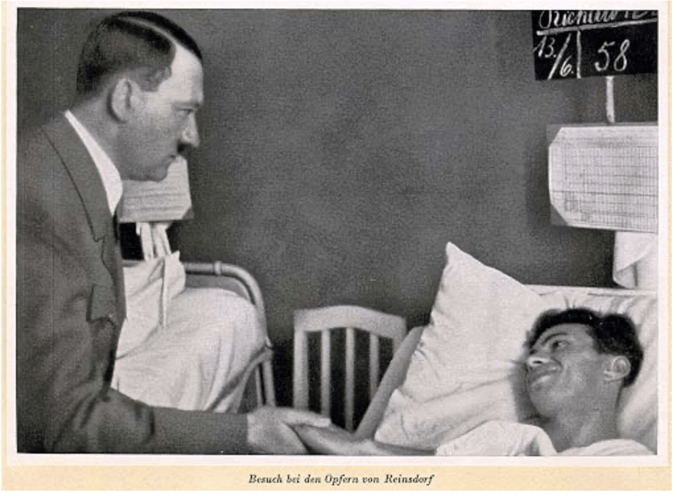
Though many national leaders and dictators have used the language of medicine and salvation as political metaphors, few did so as frequently or consequentially as Adolf Hitler. He was specifically described as “arzt der Deutschen volk” (doctor of the German people) and liked to be photographed laying hands upon the sick or injured, caressing the hands or heads of small children, and in at least one case, taking a child’s pulse. In his autobiography and manifesto, Mein Kampf (1925), Hitler wrote about “social disease,” “moral disease,” “political disease,” and “hereditary disease.” It was the task of the true leader —Hitler himself — to “recognize the nature of the disease…and seriously try to cure it.”

Photographer unknown, Adolf Hitler in hospital at Reinsdorf. From: Otto Dietrich, Adolf Hitler. Bilder aus dem Leben des Führers (Hamburg: Cigaretten/Bilderdienst Hamburg/Bahrenfeld, 1936). 

Hitler and his followers turned these metaphors into reality. They believed Jews, Bolsheviks, queers, Roma, the mentally ill and physically disabled were a pox on the national body and had to be excised – by genocide, so-called euthanasia (the cruel murder of people with disabilities or heritable diseases) and forced sterilization. And just as Hitler saw himself as a physician, he also understood himself as savior of the German people and nation. “We are admittedly small in number”, he wrote in 1919, soon after leaving military service: “But once another man stood up in Galilee, and today his teaching rules the whole world.” Later, he prophesied that after his death, he’d be described as: “A man who never capitulated, who never gave up, who never made compromises, who knew only one goal and the way toward it, who had a great faith named ‘Germany’.”  What Christ began, this imagined, future biographer would write, “Hitler, would accomplish.”

Trump’s association with Hitler – indeed his cribbing of the Fuhrer’s speeches – is well documented. In  2024, at a  Veterans Day rally in New Hampshire, Trump vowed to “root out the Communists, Marxists, Fascists, and Radical Left Thugs that live like vermin within the confines of our Country.”  Hitler wrote in Mein Kampf: “[The Jew] remains the eternal parasite, a sponger who, like a terrible bacillus, spreads out more and more as soon as a favorable medium invites him to do so.”  Two decades later, near the end of World War II, Hitler looked back over the previous years and summarized his aims: “To exterminate the vermin throughout Europe.”

Insipidness or kitsch as form and meaning

The president’s 2024 speech about “vermin” and others like it – and the current Trump/Jesus memes — are provocations, what child therapists call “attention-seeking behaviors.” For Trump and his regime, they are also a shell game, as suggested earlier, misdirection that hides from view some of the most vicious programs and policies the nation has ever known. But the social media and other Trump imagery should also be understood as part of a larger representational apparatus encompassing presidential portraits, banners, rallies, posters, stamps, coins, White House gilt decoration, the planned ballroom, triumphal arch, and NFTs. The last of these include corny and absurd depictions of the rotund, near-octogenarian president as cowboy, king, mobster, boxer, motorcyclist and action hero.

A recent Department of Labor social media campaign is equally corny and contemptable. It features images – suitable for printing as posters – of mostly white, male and blond workers and families. Recalling Norman Rockwell paintings, Nazi posters and Soviet socialist realism, they suggest that the future will soon resemble an imagined American past of unquestioned patriarchy, patriotism, Christian faith, white supremacy, and conjugal (nuclear) families.  Like the Trump/Christ memes, they have attracted considerable, negative publicity.

Artist unknown (AI generated), Posters/memes for U.S. Department of Labor, 2025-6.

All these images celebrate stereotype and cliché, in a word, kitsch — and everyone knows it. They thus invite audiences to believe they have been made privy to a media strategy – as indeed they have. They are insiders let in on a joke told at the expense of others: Democrats or political progressives, Black people, Latinos, immigrants, queers, or women.  The stigmatizing is obvious to all.

Trump’s offensive and insipid meme crusade therefore – like his kitschy White House gilding, gigantic ballroom, triumphal arch and all the rest — does its ideological work not by asking its audience to admire or accept the offensive messaging, but by inviting them to understand the game being played, the better to gratify their individual powers of aesthetic and political discernment. In short, they are asked to become absorbed in the works, and to naturalize them. That’s how fascism enters the house of capitalist democracy – through the front door.

What Trump and his enablers discourage is any criticism of the president’s policies or the man himself, except perhaps sniffing at his mischief. And that’s why the Trump as Healing Christ meme was quickly withdrawn from view — it failed to be entirely insipid. Whereas kitsch offers seamlessness (false resolution of contradiction), this image, as suggested earlier, was awkward and jarring, patched together like bricolage.  Its personages were hard to peg; its clichés threatened to collide – like the bald eagles and jet fighters. Its religious meaning was worse than offensive – it was unclear. The fascist image must be whole and complete; this one was cracked. So, the regime itself, bogged down in a foreign war, freighted by elevated prices, reduced health care, and rising insurance rates, risks the wrath or worse, disengagement of its faithful.

Stephen F. Eisenman is emeritus professor at Northwestern University and Honorary Research Fellow at the University of East Anglia. He is the author of a dozen books, the latest of which (with Sue Coe), is titled “The Young Person’s Illustrated Guide to American Fascism,” (OR Books, 2014). He is also co-founder of Anthropocene Alliance. Stephen welcomes comments and replies at s-eisenman@northwestern.edu