Wednesday, May 13, 2026

Trump’s New “Coalie” Mascot and Myth of “Clean, Beautiful Coal” have a Long History in Advertising


 May 13, 2026

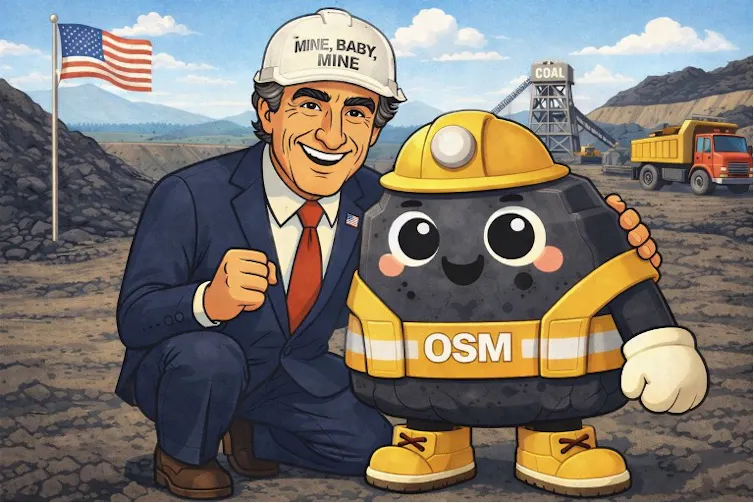
Interior Secretary Doug Burgum posted this cartoon of himself with ‘Coalie,’ a lump of coal. Interior Secretary Doug Burgam/X

If you follow the Trump administration’s social media posts, you might spot its new mascot: a cartoon lump of coal with big eyes and babylike features. “Coalie” sparked a backlash almost as soon as Interior Secretary Doug Burgum debuted it for the Office of Surface Mining and Reclamation Enforcement in early 2026.

Coalie’s design draws on a type of Japanese anime called Kawaii, a word meaning “cute” or “adorable.” It’s the latest in the White House’s efforts to pass off coal as harmless, despite the well-established environmental and human health harms of mining and burning the fossil fuel.

As a scholar of American literature and culture, I write about media portrayals of coal, beginning in the 19th century with its rise to become the leading fuel in the United States. Coal use grew until the early 2000s, when other sources became cheaper and its health and environmental damage became unacceptable to more of the public.

While “Coalie” might be new, the logic behind it is not. For centuries, coal’s promoters have worked hard to show coal as harmless – as well as “clean” and “beautiful,” to use President Donald Trump’s words.

“An Agreeable Heat”

Humans living with the effects of burning coal have disliked it for as long as they have burned it.

In 1578, Queen Elizabeth complained that she was “greatly grieved and annoyed with [its] taste and smoke” in the air. In 1661, John Evelyne’s treatise Fumifugium outlined negative health effects of breathing coal smoke.

The front page of a pamphlet published in 1661 with the title and test, including 'the inconveniencie of the aer and smoak of London.'
In his 1661 treatise Fumifugium, John Evelyne described health risks from breathing coal smoke. University of California San Diego Libraries/Wikimedia

English settlers were drawn to North America in part because of the continent’s abundant supply of timber, a substitute for coal that deforestation had made prohibitively expensive in England.

But by the 19th century, the price of timber had risen in America as well. When, in the 1820s, news spread of Pennsylvania’s rich veins of anthracite coal, urban consumers were eager for a cheaper source of fuel.

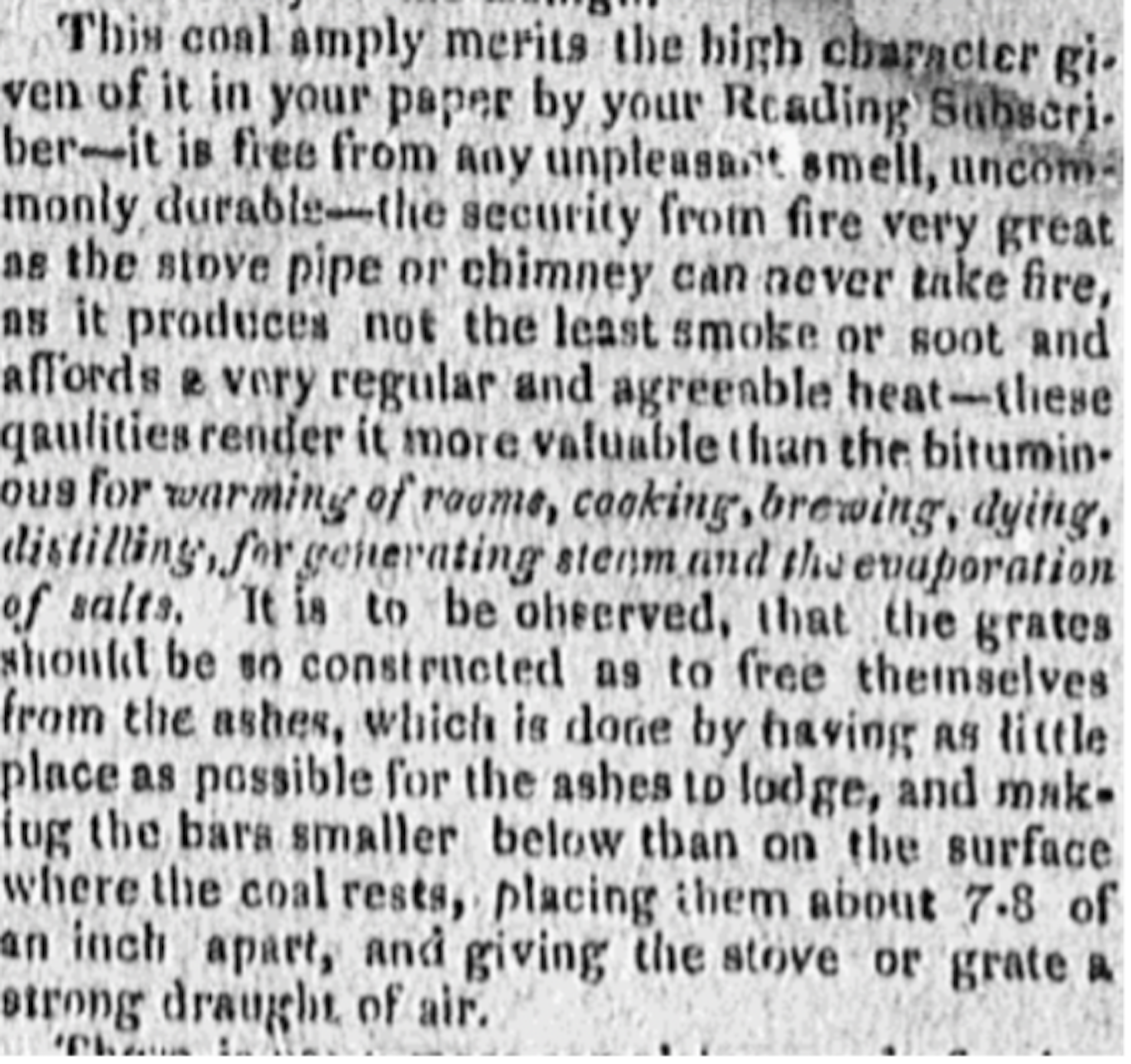
In addition to its lower price, anthracite coal grew desirable because of its high carbon, low-sulfur content, which produced less visible smoke when it was burned. An enthusiastic 1815 letter to the editor of the American Daily Advertiser captured increasingly common attitudes toward anthracite as “affor[ding] a very regular and agreeable heat.”

‘A healthful home’

The spread of anthracite also shored up tolerance for smokier but cheaper bituminous coal.

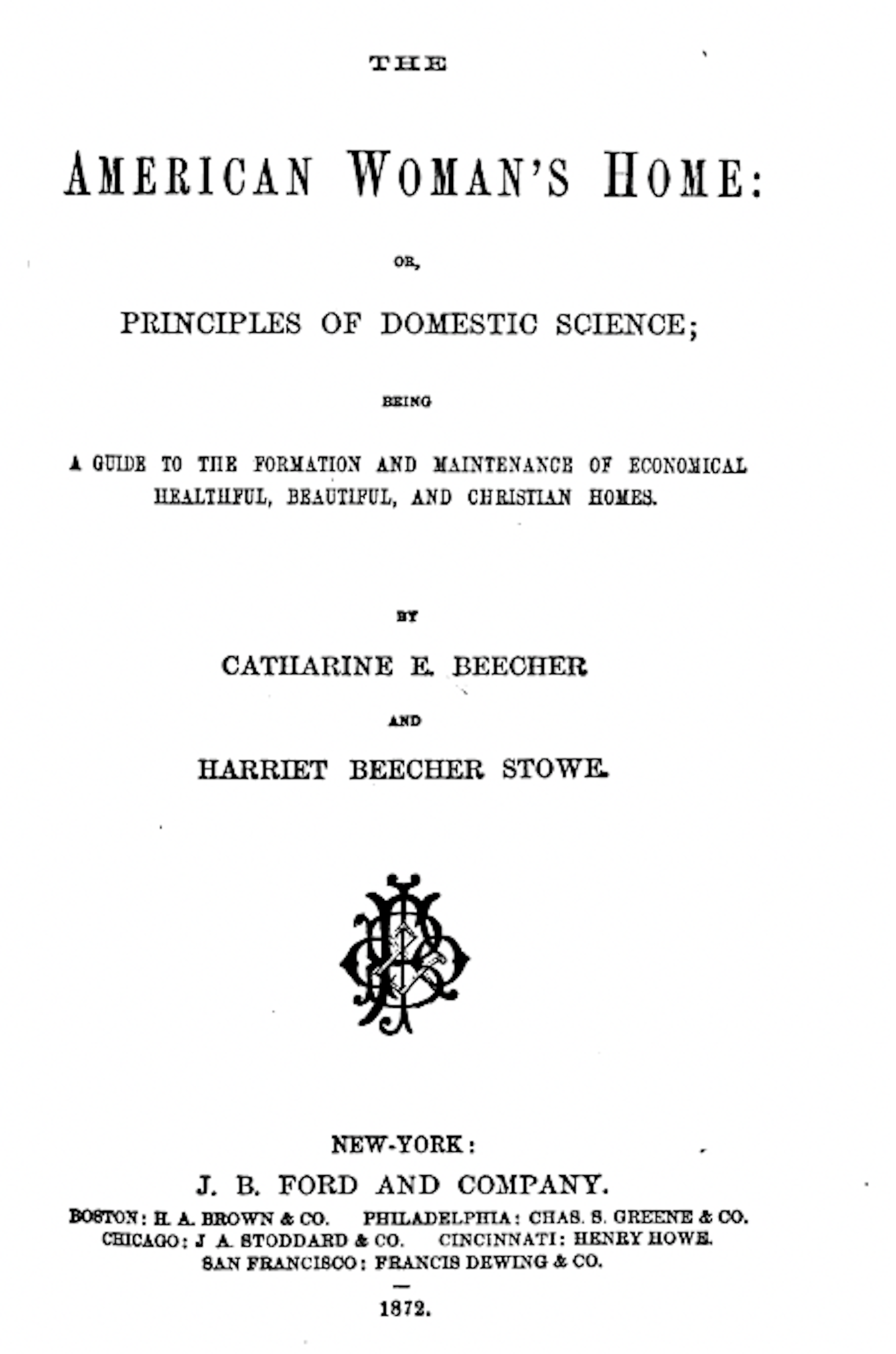
To help people, housekeeping manuals aimed at the fossil fuel’s mostly female users tried to invent workarounds for its smoke. In 1869, Harriet Beecher Stowe, best known as the author of “Uncle Tom’s Cabin,” and her sister Catharine Beecher wrote one of many 19th-century articles to acknowledge the “evils” of coal smoke, while outlining “modes of making a healthful home,” in the housekeeping manual American Woman’s Home.

Consumers provided temporary solutions for maintaining indoor air quality while burning coal by sending in suggestions that were published in housekeeping manuals, magazines and newspapers.

An add reading 'Why not?'
An 1892 advertisement in the Rocky Mountain News promoted a brand of coal stoves as ‘the best, handsomest and most economical.’ Nineteenth Century Newspapers.

At the same time, as the century progressed, coal and coal-stove companies began to suggest that burning coal was healthy, that it could improve indoor air as well as domestic aesthetics. One 1892 newspaper advertisement claimed that stoves were “necessary to heat, cheer, and beautify the home and preserve its health.”

To keep the children clean and bright …

In the 20th century, marketers churned out more colorful claims about the benefits of coal: One magazine advertisement showed a mother and child pointing at the crackling stove aflame with the company’s coal, saying it “cannot be excelled in purity, cleanliness, and free-burning qualities.”

An ad with a woman and child with a coal stove.
An ad for a coal stove described its ‘purity’ and ‘cleanliness.’
Madison HistoricalCC BY-NC-SA

Similarly, the Lackawanna Railroad Company came up with the classy, often rhyming, character of Phoebe Snow. In one ad, she points to the importance of comfort, suggesting that not only could anthracite fuel faster travel, but it could also make your travel – and your life – more comfortable.

A postcard ad for Lackawanna Railroad featuring Phoebe Snow, wearing white, talks about its use of anthracite coal.
A Phoebe Snow postcard ad from 1912 talked about avoiding ‘smoke and cinders’ with trains run on anthracite coal. Railroad Museum of Pennsylvania/Wikimedia Commons

Coal marketing often used children to suggest safety and reach parents. Another iteration of the Phoebe Snow series promised that anthracite-powered railway travel could keep children “clean and bright.”

Two women sit in a train car talking with well-behaved, very clean children.
One of the Phoebe Snow ads, in 1910, advertised Lackawanna Railway’s coal-powered trains using children and whiteness to suggest purity.
Photo Courtesy of Poster House/Poster House Permanent Collection

A 1930s advertisement went so far as to position a piece of anthracite coal next to a child in a bathtub, a visual proximity implying that coal was as good as soap.

In fact, soap made of “coal tar” – a liquid byproduct of producing coke, a fuel made from bituminous coal used in industrial blast furnaces – did (and does) exist. The British company Wright’s, also popular in the U.S., generated a slew of advertisements praising its soap as having antiseptic properties for children.

A smiling woman stands over a sleeping child in an ad for coal tar soap.
Wright’s Coal Tar Soap used a sleeping child dressed in white and sleeping on white sheets to advertise its ‘nursery soap,’ which it claimed protected children from infection, in 1922. Wikimedia Commons

Each of these advertisements tried to capitalize on a mother’s desire for healthy children. And they pushed back against the image of the tyrannical “King Coal” that had come about amid strikes by miners protesting dangerous, degraded working and living conditions as well as the rise of black lung disease.

‘Clean coal’

By the mid-20th century, petroleum took coal’s place as America’s main energy source. The U.S. environmental movement continued to grow, and people got interested in natural gas as an alternative to coal.

In response, coal companies doubled down on the fantasy of “clean” coal.

Two hands hold a lump of coal and a scrub brush and appear to be scrubbing the lump of coal. It says 'Can coal be cleaned before it's burned? Yes. Inside and out!'
An American Electric Power ad in The Wall Street Journal in 1976 talked about cleaning coal. Wall Street Journal archive.

1979 advertisement for American Electric Power, for example, flew in the face of Clean Air Act mandates that coal corporations employ “scrubbing” technology to remove sulfur dioxide from smoke – the ad depicted someone cleaning coal by hand.

The myth continues

Today, coal generates only 16.2% of America’s electricity, down from generating more than half of the U.S. power supply in the 1990s. But the country isn’t done with it. Even though coal production today is far below its peak, as companies try to shut down old uneconomic plants, Trump has promised to “reinvigorate” the coal industry.

In addition to ordering some coal plants to continue operating, the Trump administration has pulled out old coal promotion tactics from the past, including repeatedly referring to coal as “clean and beautiful.” One image inserts Coalie next to a coal-mining family that otherwise looks like an ad that could have appeared a century ago.

A drawing of a family with a cartoon coal lump looking like a toy.
A 2026 promotion for the Office of Surface Mining Reclamation and Enforcement includes a cartoon family with ‘Coalie’ added to the picture, looking like a child’s toy. OSMRE

And, like its predecessors, this picture tries to present an innocent image of a product that harms human health and the environment.

2018 study found that black lung disease was on the rise in Appalachia, where about 40% of America’s coal is mined today. Living near a fossil-fuel power plant exposes residents to pollutants that contribute to premature deaths, asthma and lung cancer, including tiny particulate matter known at PM 2.5, sulfur dioxide and mercury. Even when it’s just sitting in piles waiting to be used at a power plant, coal can harm human health as the wind blows across it and carries coal dust into the air and people’s lungs.

The myth of coal as healthy and family friendly has been around for centuries – but coal has never been clean, or cute.The Conversation

This article is republished from The Conversation under a Creative Commons license. Read the original article.

Annie Persons is a Lecturer in Literature at the University of Virginia.


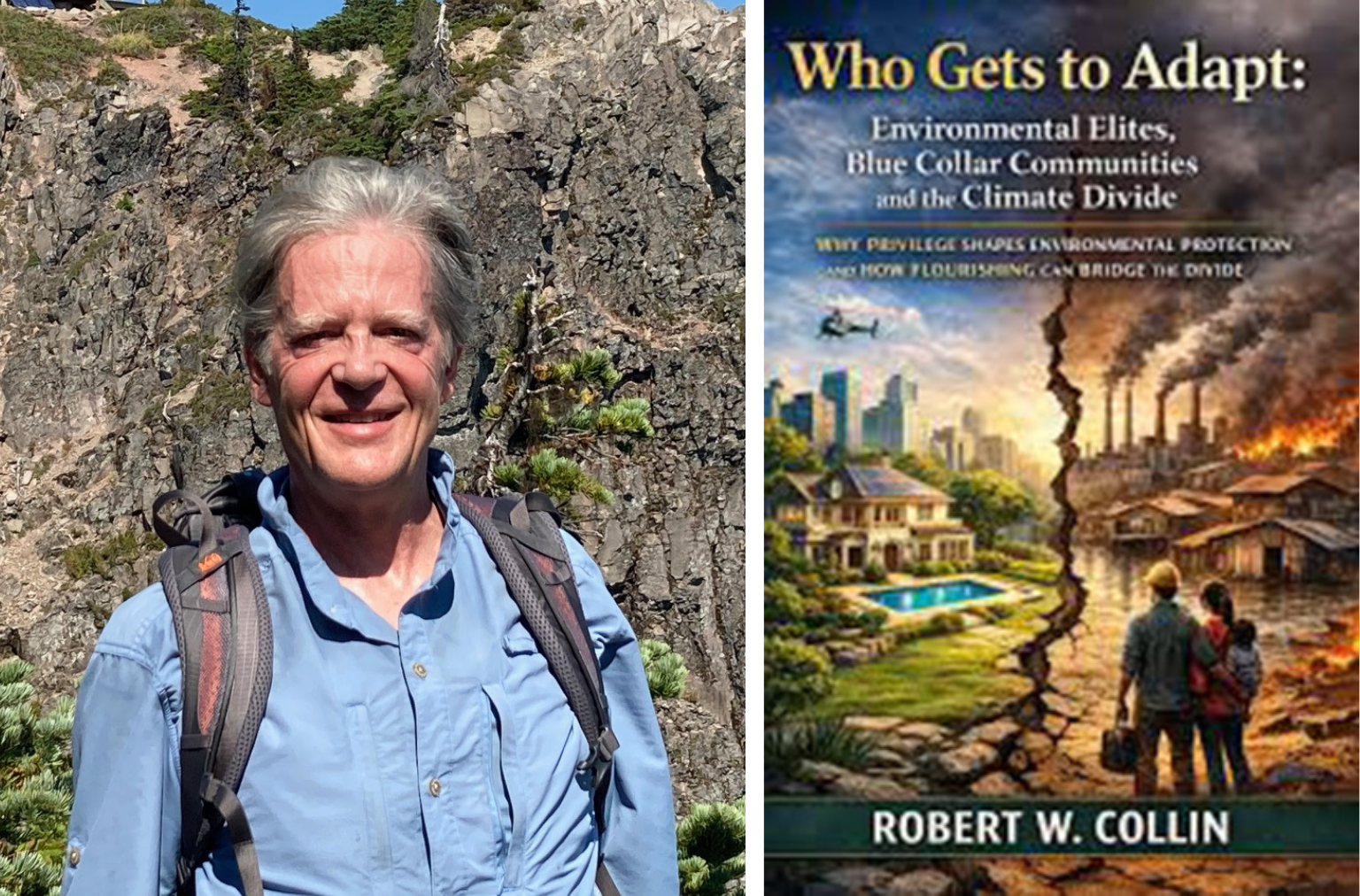
Who Gets to Adapt? Robert W. Collin on Climate Inequality and the Politics of Who is Protected

Source: Resilience

At the heart of the book is Collin’s concept of environmental elitism, which he defines as the concentration of environmental decision-making power in the hands of privileged institutions and actors. These include government agencies, large nonprofits, universities and the finance/insurance/real estate sector. Together, these institutions shape where adaptation funding goes, what kinds of solutions are prioritized and whose knowledge is considered legitimate. The result, Collin argues, is an adaptation system that consistently protects high-value assets while leaving vulnerable communities exposed.

Collin shows how this system works in practice. He shows how redlining, zoning and industrial siting have concentrated climate risk in low-income and minority communities. These same communities now face higher insurance costs, weaker infrastructure and fewer financial resources with which to recover from disasters. Meanwhile, funding for climate adaptation initiatives tends to flow toward well-resourced institutions better positioned to secure grants. These disparities are not abstract: Estimates suggest that climate change imposes nearly twice the economic burden on the average blue-collar American as on the average white-collar American.

Collin explains how the insurance and financial systems reinforce the climate divide. As climate risks intensify, insurers raise premiums or withdraw coverage from certain communities altogether. Wealthier households can relocate or absorb these costs; lower-income households cannot. The result is a pattern of displacement that Collin describes as “climate gentrification,” in which areas better protected from climate impacts become more expensive, in turn pushing out long-time residents who lack the means to keep up with rising costs. This dynamic is already affecting millions of homeowners in states like Florida, California, Oregon and Louisiana, where the phenomenon of insurance retreat has become particularly pronounced.

The solutions section is cogent and wide ranging. Collin argues that climate adaptation projects should be funded based on need, not property values, and that those investments should come with strong provisions to ensure vulnerable communities are protected against displacement. He’s critical of technocratic, market-driven solutions, which often come at the expense of simpler, more effective, more equitable ones. And he stresses the need for reforms to climate adaptation finance, which too often relies on loans that impoverish the very communities they’re meant to help.

Collin emphasizes that knowledge itself—in the form of climate data, planning tools and the know-how needed to successfully navigate the application process for climate adaptation grants—is a form of infrastructure. He shows how access to these resources is unevenly distributed, and how the resulting knowledge gap has become a key driver of inequality in communities’ ability to adapt. But he also points out ways in which the divide is beginning to narrow as these resources become more widely available.

One of the book’s most important contributions is its effort to redefine what counts as successful adaptation. Collin persuasively argues that adaptation should be measured not only by infrastructure protected or economic losses averted, but also by people’s ability to remain safely housed and healthy. Success should be judged by the degree to which it enables people and communities to flourish. This emphasis on flourishing sets the book apart from more conventional approaches to climate policy, which tend to put technical solutions and cost-benefit metrics above lived outcomes.

It’s also to Collin’s credit that he draws attention to the often-overlooked workers who make climate adaptation possible. He emphasizes that adaptation infrastructure is built by workers—construction crews, utility workers, emergency responders—who face some of the highest risks from heat, smoke and other hazardous conditions brought about by climate change. Yet these workers are rarely a priority in adaptation planning. He argues for stronger labor protections for those who make up the climate workforce.

He also stresses the importance of collective institutions like labor unions, community organizations and informal networks like amateur radio operators in building what he calls “community climate capacity.” These institutions empower communities to take action, rather than remaining dependent on outside institutions for help.

Apart from its critique of today’s prevailing climate adaptation systems, the book also functions as a practical handbook for those neglected by these systems. The book is filled with preparedness checklists and lists of resources aimed at both individuals and institutions. Collin makes clear the book isn’t just for policymakers and scholars, but also for workers, unions, community members and others seeking to understand and act within these systems.

The book isn’t perfect. Collin’s arguments are powerful, but they are often repeated across chapters with very similar wording each time. We read numerous times that insurance markets raise premiums and withdraw from high-risk areas, that wealthier communities receive investments in climate adaptation infrastructure while working-class neighborhoods remain exposed, and that adaptation systems tend to prioritize property and market value over people and the long-term stability of communities. This repetition dulls the book’s impact and makes its analysis feel less sharp than it could be.

Even so, Who Gets to Adapt? is an important, timely contribution to the field of climate policy. It challenges readers to rethink adaptation not as a neutral or purely technical set of solutions, but as a question of power, justice and collective responsibility. Collin makes a convincing case that unless adaptation efforts are reformed to include those most at risk, they will continue to deepen the inequalities they are meant to address.

Who Gets to Adapt?: Environmental Elites, Blue-Collar Communities, and the Climate Divide By Robert W. Collin. Environmental Policy Press, Kindle e-book edition, April 2026.

This article was originally published by Resilience; please consider supporting the original publication, and read the original version at the link above.
OPINION

Trump's latest deal likely to spike electricity prices for decades


The Conversation
May 9, 2026 

By Christopher Niezrecki, Director of the Center for Energy Innovation, UMass Lowell;
 Ben Link, Deputy Director of the Ralph O’Connor Sustainable Energy Institute, Johns Hopkins University, 
Zoe Getman-Pickering, Program Director of the Academic Center for Reliability and Resilience of Offshore Wind, UMass Amherst

The U.S. is in a bizarre situation in 2026: It’s facing a looming energy shortage, yet the Trump administration is making deals to pay offshore wind developers nearly US $2 billion in taxpayer money to walk away from energy projects.

These politically motivated moves are costing Americans far more than just the buyouts.

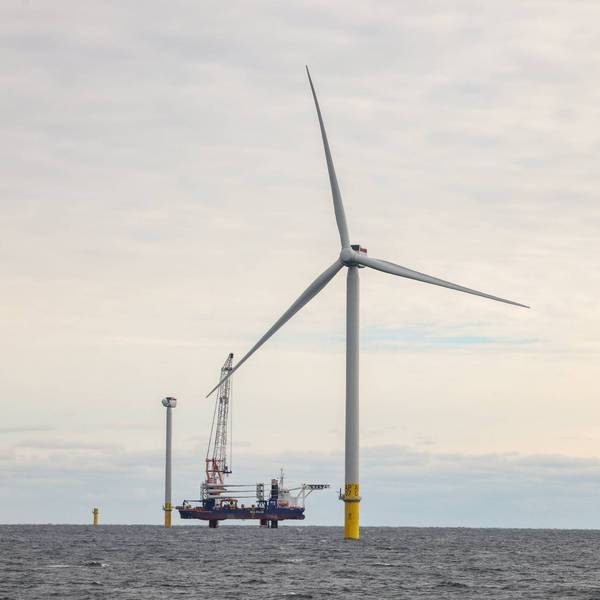
Communities have been laying the groundwork for offshore energy projects for years. Offshore wind development brings jobs and economic development that reshape regional economies, with the scale of public and private investment reaching into the hundreds of billions of dollars over years. East Coast communities have built up ports to support the industry and launched job-training programs to prepare workers. Construction, maintenance and shipping businesses have sprung up, along with secondary businesses that support the industry.

Losing the projects, and the threat of losing other planned wind farms, will also likely mean higher energy prices. And while some offshore wind farms are moving ahead, developers must account for both lost momentum and increased uncertainty from the Trump administration.

As a result, Americans will bear the economic brunt of these decisions for decades ahead.
How America got to this point

To understand how the U.S. arrived in this predicament, let’s take a step back.

In March 2023, leaders from three U.S. federal agencies under the Biden administration met with the CEOs from American technology and manufacturing giants Microsoft, Amazon, Ford, GM, Dow Chemical and GE at the annual ARPA-E Energy Innovation Summit, under the banner of “Affordable, Reliable and Secure American-Made Energy”.

They agreed on a key point: The nation was staring down a severe shortage of electrons to drive American business forward.

Fortunately, solutions abounded. Enormous amounts of onshore wind and solar power had been deployed during the previous five years. More than 80% of all new power additions to the U.S. grid had come from these two sources.

Particularly exciting were plans to build large offshore wind farms up and down the Eastern Seaboard. Taken together, the wind farms would generate 30 gigawatts of new power by 2030, enough to power more than 10 million homes and reduce volatility in energy pricing thanks to long-term power purchase agreements.

The U.S. had one small wind farm at the time, off Rhode Island, and two wind turbines off Virginia, but Europe had been operating large offshore wind projects for over two decades and was building more.

In the months following the 2023 meeting, leasing and permitting for the U.S. mega projects continued, and in some areas construction got underway.

A map of offshore wind lease areas shows how many companies have paid the U.S. to lease areas of ocean for offshore wind farms. A few wind farms off New England are already operating. The lease areas where the Trump administration used taxpayer money to persuade companies to drop their wind farm plans include two TotalEnergies leases – Attentive Energy, off New Jersey, and a lease area off South Carolina – and Bluepoint Wind, also off New Jersey.U.S. Bureau of Ocean Energy Management

Then, the Trump administration arrived in 2025. As president, Donald Trump immediately issued an executive order to halt offshore wind lease sales and any approvals, permits or loans for wind farms. He had made his disdain for wind power clear ever since he lost a fight to stop construction of a small wind farm near his golf course in Scotland in the 2010s.

After a federal judge declared Trump’s executive order unconstitutional in December 2025, the administration shifted strategies.

In March 2026, news outlets began reporting on deals struck in which the federal government would pay three offshore wind project developers hundreds of millions of dollars to cease development of their permitted projects, agree not to build others and repurpose the funds toward fossil fuel projects.

According to reported discussions involving the French energy company TotalEnergies, the money would be paid out through the Department of Interior’s Judgment Fund, intended for payment of legal settlements, despite there not being any active litigation with TotalEnergies.

The other projects agreeing to Trump’s buyouts as of early May were Golden State Wind, in California, and Bluepoint Wind, off New Jersey and New York. Both are co-owned by Ocean Winds, a joint venture of the French energy company Engie and EDP Renewables, headquartered in Spain. The California Energy Commission and members of Congress are now investigating the moves.
Offshore wind means local investment

Regardless of whether these buyouts are even legal, the losing parties will be the American taxpayers and a U.S. economy that needs more electrons on the grid, not fewer.

One analysis projected that deploying 40 GW along the U.S. East Coast by 2035 would generate roughly $140 billion in investment, much of it concentrated in port infrastructure and supply chain development.

New York in early 2026 announced a $300 million state grant program to expand port infrastructure supporting offshore wind. And the New Jersey Wind Port represents an investment exceeding $600 million to enable manufacturing and assembly of turbines.


Workers in New London, Conn., prepare a generator and its blades for transport to South Fork Wind’s offshore wind farm in 2023. To build an offshore wind farm requires manufacturing jobs, parts suppliers, dockworkers, crane operators, ship crews, as well as the wind farm construction crews and maintenance teams and many more businesses and their employees.AP Photo/Seth Wenig

In 2025, California state lawmakers authorized $225.7 million in spending for offshore wind ports and related facilities.

For these projects to pay off for local communities, however, the regions will need to see the development of wind farms.
Killing jobs

The cancellations of the planned projects also take jobs away from hard-working, blue-collar Americans.

The construction and installation of offshore wind turbines requires the expertise of skilled electrical workers, pipe fitters, welders, pile drivers, iron workers, machinists and carpenters.

Future offshore wind costs depend on investments today. As infrastructure is established and expertise grows, each subsequent project becomes easier to build, less risky and less expensive.

This pattern is already evident globally: The levelized cost of electricity from offshore wind globally fell by 62% between 2010 and 2024.

Canceling projects or buying back leases eliminates the electricity those projects would have generated. It also slows the accumulation of experience, scale and supply chain maturity that drive costs down over time.

The result is higher costs for future projects and for electricity ratepayers.
An energy crisis

Developing a robust offshore wind industry provides resilience in the face of an unstable global energy market.

Future U.S. and global energy demand is projected to grow significantly, largely driven by the rapid expansion of AI data centers and electrification of vehicles, homes and businesses.

Limiting the supply of homegrown energy will increase energy costs for Americans, especially in the regions where the wind farms were supposed to be located – New York, New Jersey, North Carolina and California.

With the federal buyouts, the U.S. is losing 8 GW of planned electricity generation, enough to power more than 3 million homes. That generation needs to be replaced by other energy sources and expanding power transmission lines that can take seven to 10 years to get permits for and build out. The leased projects were on their way to providing new clean power generation fairly quickly. Eliminating them restarts the project clock.

Reliance on dirtier, conventional forms of power generation will increase along with foreign energy imports, such as electricity delivered from Canada to New York, leading to higher and more volatile electricity prices.

Evidence from Europe shows that offshore wind can also reduce electricity costs for consumers by lowering wholesale prices and reducing dependence on fossil fuels and their volatile prices.

Vineyard Wind I, an offshore wind farm completed in 2026, with 806 MW of generation – enough to power about 400,000 homes – is projected to save Massachusetts customers about $1.4 billion on electricity bills over the next 20 years. With a fixed-price, 20-year contract, the project also lowered prices during cold snaps and peak demand for gas, reducing volatility and cost.

From jobs to local economic development to power costs, we believe canceling these offshore wind projects is a bad deal for American taxpayers.


The War on Wind Power Is 190-Proof Trumpism

A policy that feeds both President Trump’s appetite for corruption and supplies his narcissistic hunger—well, that’s a twofer that can’t be missed.


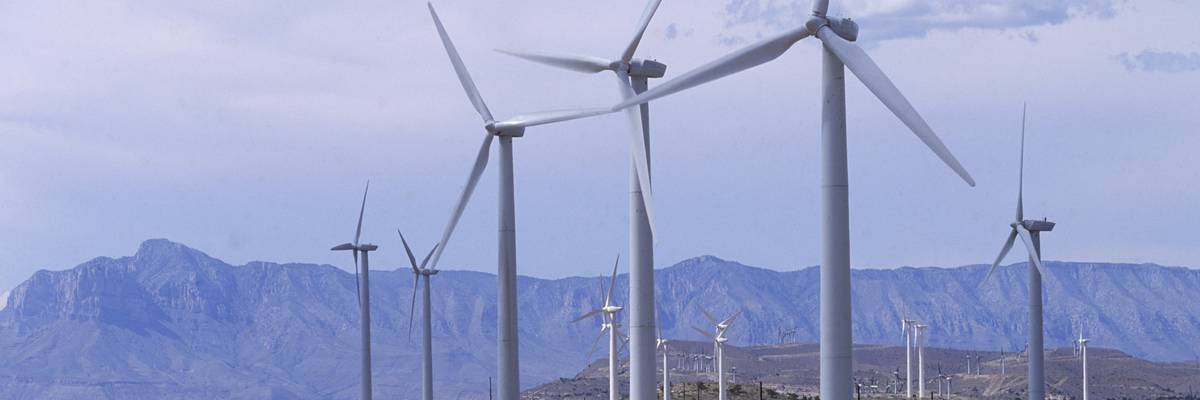
The Delaware Mountain Wind Farm is located in Culberson County, Texas.
(Photo by Greg Smith/CORBIS/Corbis via Getty Images)


Bill Mckibben
May 13, 2026
The Crucial Years


Those of us who came up in a different age still occasionally harbor the belief that facts, truth, science matters; that it hasn’t all just vanished into a tweeting flash of nonsense. In service of this delusion, I’m dedicating this newsletter to the topic of wind, because I think it distills the corruption and irrationality of our sad moment into its purest essence—190-proof Trumpism, the stuff that blinds you if you guzzle it.

My rant is occasioned by the news that the administration has stopped all approvals on wind farms across the country. As Katherine Krawczyk explains, for 15 years wind farms have applied to the Department of Defense (DOD) where:
they’re supposed to undergo a “timely, transparent, and repeatable process to evaluate potential impacts” to national security and military operations. It’s a routine that has spanned presidencies, including the first Trump administration, and that typically revolves around making sure turbines don’t interfere with radars or federal airspace.


Trump ‘Extrajudicially’ Blocks All New US Wind Projects—Which Could Power 15M Homes Amid Energy Crisis


Amid Energy Crisis of His Own Making, Trump Slammed for Using Taxpayer Money to Cancel Wind Projects

This has always been routine, until last summer when it became… impossible. Pete Hegseth’s DOD simply stopped replying, and didn’t explain why till last month when it sent a letter to developers saying it was “reevaluating how it reviews wind projects national security impacts.” Somewhere between 165 and 250 big projects are in limbo, and that’s obviously the point: Not only does it screw up their financing, it means they may not get done in time to qualify for what tax credits are left from the Biden Inflation Reduction Act.

Though sunlight must travel 93 million miles to reach the Earth, none of those miles go through the Strait of Hormuz. Similarly, there is no drone on Earth that can shoot the breeze.

To say that the national security grounds are bogus is to give them too much credit. As those radicals at the Financial Times explained, the security review used to take a “few days” to complete. These installations are on private land, far away from military bases. The government has used the same argument to try and block offshore wind farms, and the courts have overruled their objections. I imagine that in time judges will find in favor of these blocked onshore projects too, but the damage will have been done: No one in their right mind would invest in new wind power now, not when the president has declared quite frankly that his “goal is to not let any windmill be built.”

That this is stupid goes without saying. Those blocked projects constitute, the FT says, about 30 gigawatts of cheap clean energy at a time when we desperately need it. But it also goes without saying that the blockage serves two purposes. One is to artificially increase demand for fossil fuel (and the other Trump-favored power sources, like the expensive array of nuclear reactors whose development the government is currently generously funding). The other is to serve his febrile rage at the wind farm built off his Scottish golf course all those years ago. A policy that feeds both his appetite for corruption and supplies his narcissistic hunger—well, that’s a twofer that can’t be missed. Hegseth may have no idea how to win the war in Iran, but he knows how to win favor from dear leader.

Of course, it means indulging in a huge number of lies, from President Donald Trump’s claim that wind power is the most expensive energy on Earth (actually, second-cheapest, right behind solar) to his claim that it causes cancer (1 death in 5 on this planet comes from breathing the combustion byproducts of fossil fuel) to his claim that though the Chinese build and sell wind turbines they don’t actually use them. If he glances out the window of Qatar Force One on this week’s trip to China he’ll be forced to recant that one: The Chinese actually lead the world in producing not just wind turbines but wind energy. As Keith Bradsher reported last week:
Across China, hilltops are dotted with wind turbines, and long rows of them span many miles in western desertsUltrahigh-voltage power lines carry electricity thousands of miles to the energy-hungry factories along China’s coast.

Last year, China installed three times as much wind power capacity as the rest of the world combined, even as its turbine exports jumped. The global industry’s center of gravity has shifted decisively: All of the world’s six largest wind turbine manufacturers are Chinese, displacing once-dominant European firms and companies like General Electric.


In fact, perhaps his Chinese hosts could arrange a field trip to their newest wind turbine, installed this week off the shore from Yangjiang. It’s, what do you know, the largest single-unit floating wind platform ever installed on planet earth, a single windmill that will supply enough power for 24,000 homes. As Adriana Buljan reports at that must-read site OffShoreWindBiz:
The project incorporates several new technologies, including a novel mooring system, an active ballast system, a smart monitoring system, and a 66 kV dynamic subsea cable, the developer said.

The floater is secured by nine suction anchors, using a combination of anchor chains and high-performance polyester mooring lines, marking the first application of such polyester cables in China’s offshore wind sector.


It’s not just China, of course. A few weeks ago, the world’s largest offshore wind farm, Hornsea 3 in the North Sea, sent its first power back to the UK. When it’s fully finished at the end of next year, reports Evelyn Hart, it will “generate enough power to meet the average daily needs of a population larger than Greater Manchester, Liverpool, and Leeds combined.” Earlier Tuesday the sovereign wealth fund of Abu Dhabi announced a big investment in the project, reflecting what the fund’s head called its “approach of investing alongside experienced partners in high-quality infrastructure assets that support energy transition and deliver long-term value.”

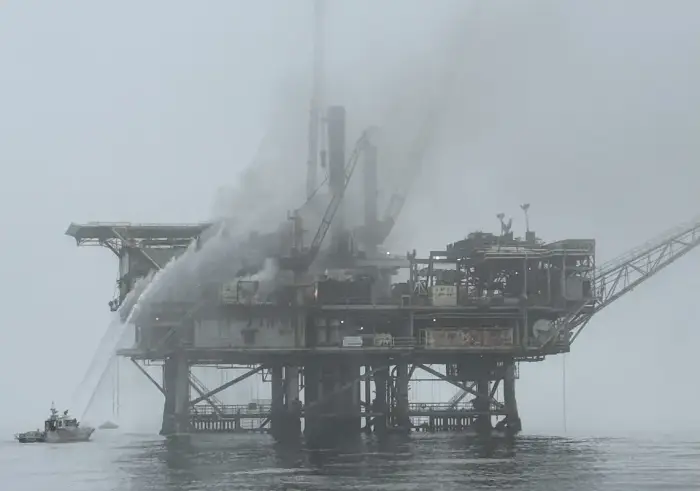
What might the Trump administration offer them as an alternative? Well, the administration has ordered the restart of fossil fuel drilling operations off Santa Barbara despite local and state opposition. On Monday an old platform in the area caught fire and burned—26 people were evacuated, and thankfully none were killed, though two were injured. Here’s what America’s technological prowess looks like today.


I think that sometimes wind gets shorter shrift than it should when we talk about renewable energy. It’s not quite as simple as a photovoltaic array—there’s still a moving part, that windmill blade. But of course this is just another form of solar energy (the wind rises when the sun heats the Earth more in some places than others) and it is a miracle. In fact, it’s a perfectly complementary miracle. Along a coast, for instance, because it takes a while for the sun to heat the air molecules that produce the breeze, wind tends to build in power later in the afternoon, as the photovoltaic effect begins to ebb. And the farther north you go, the stronger the wind gets, which is useful since Greece has more sunshine than Norway. And wind speeds tend to be higher in the winter than the summer, thanks to sharper temperature gradients.

If you want an in-depth technical explanation of this miracle, Mark Jacobson provides one in this 2021 study. Among many other things, he points out that:
In some locations, e.g. Europe, wind energy output follows heat load remarkably well on a diurnal basis. This is not only due to the day versus night wind speed peaks just discussed, but also due to the fact that low temperatures, which create heat loads, often occur behind cold fronts, where pressure gradients are strong, thus winds are fast. Low temperatures over land also often occur in the presence of strong temperature gradients, which produce strong pressure gradients and strong winds.


One irony of Trump’s anti-wind crusade is that this miracle was born here. Humans have long used wind, of course—to push boats, to grind grain. But we first put it to use to produce electricity on an industrial scale in the early 1940s at Grandpa’s Knob, about 50 miles south of my home in the Vermont mountains above the town of Castleton. An Massachusetts Institute of Technology grad named Palmer Putnam (and I was at MIT last week, and saw many impressive young people following in his wake) convinced the local utility to give him a shot at harnessing the Vermont winds (blowing 8 miles an hour in Castleton when I drove by this afternoon). Vannevar Bush—more irony here—was in charge of the nation’s scientific enterprises during World War II, and he thought it would be a good idea to see if we could produce power this way; Putnam’s design used two blades, each 66 feet long and weighing eight tons. It worked just fine from 1942 to 1943, when a shaft bearing failed, and wartime shortages meant no one could scrounge the part until 1945.

A study that year found that a block of six similar turbines similar to the prototype, producing nine megawatts, could be installed in Vermont for around US$190 per kilowatt. But in those days it was cheaper to get power other ways, and so the project was never replicated. In 2012 a new project was proposed for the area, but like all Vermont wind projects in recent years, local opposition doomed it, reminding us that Trump is not the only person who doesn’t like to look at windmills.

I do, though. I’ve always thought they were remarkably beautiful, Calder mobiles come to life. And they keep getting better. The first big American installation was on Altamont Pass, near Livermore California—6,700 small turbines lined either side of I-580. They produced lots of clean electrons, but because of their size and where they were sited, their fast-moving blades were a bit of a bird Cuisinart. To be clear, wind turbines never come within an order of magnitude of avian destruction compared with tall buildings and power lines, not to mention domestic cats, not to mention the effects of climate change now setting off a generalized extinction crisis on this Earth. But if bird mortality is not a reason to delay the move to clean energy, it’s also not something to be simply ignored. So here’s some good news: A recent “repowering project” on the pass replaced 569 of the old small turbines with just 23 newer and bigger ones, while still generating the same amount of electricity. Oh, and
Fewer turbines, spaced further apart, and equipped with modern bird-detection technology such as IndentiFlight, should reduce bird mortality in the Altamont Pass going forward.

“Brookfield Renewables has designed the [Mulqueeney Ranch] site and implemented state of the art technology to mitigate impacts to local and migratory avian species,” according to the MCE staff report.

“Turbines will be equipped with individual AI paired cameras to detect the presence of avian species which would trigger feathering/shut-off of specific turbines.”


And as Justin Gerdes reports, this kind of repowering could happen at every wind farm across the country:
“By replacing aging turbines with modern technology at existing sites, the United States could more than double its current onshore wind capacity and electricity generation without requiring new land,” write the authors of a Stanford University study published in March.

The study finds that repowering could increase the US’ onshore wind nameplate generating capacity from 153 gigawatts (GW) (as of 2024) to 314 GW at existing wind farms.

“Repowering is a key, yet overlooked, strategy to accelerate the transition to a sustainable energy future in the United States,” the authors conclude.

Data from the energy consultancy Wood Mackenzie confirms the near-term repowering opportunity in the US.

“The repowering market remains strong, as Wood Mackenzie projects that 18 projects will drive 2.5 GW of capacity additions in the next three years,” according to a December 2025 WoodMac press release.


I’ve been getting a lot of mileage out of my line that though sunlight must travel 93 million miles to reach the Earth, none of those miles go through the Strait of Hormuz. Similarly, there is no drone on Earth that can shoot the breeze. This is where the planet desperately wants to go. Our job is to change our nation’s politics so the wind can blow free.


© 2022 Bill McKibben


Bill Mckibben
Bill McKibben is the Schumann Distinguished Scholar at Middlebury College and co-founder of 350.org and ThirdAct.org. His most recent book is "Falter: Has the Human Game Begun to Play Itself Out?." He also authored "The End of Nature," "Eaarth: Making a Life on a Tough New Planet," and "Deep Economy: The Wealth of Communities and the Durable Future."
Full Bio >


$370 Million Payout to Largest Exporter in US of Liquefied Natural Gas

Source: Inside Climate News

Go behind the scenes with senior editor Corey Mitchell, reporter Phil McKenna, and data journalist Peter Aldhous as they discuss a new Senate probe over lucrative and questionable tax credits to the country’s largest exporter of liquefied natural gas.

Liquefied natural gas vessels are fueled by their cargo—they’re built specifically to make use of the gas boiling off from their tanks.

But Cheniere Energy, the largest U.S. exporter of LNG, requested “alternative fuel” tax credits for that. The claim baffled shipping experts, because what Cheniere Energy is doing isn’t, in any real sense, an alternative. It also provides little climate benefit over fueling the vessels with diesel and uses the credit in a way that tax specialists say was never intended. 

Yet the Internal Revenue Service approved a $370 million payout to the company, a huge windfall that Phil and Peter predicted in an exclusive investigation earlier this year. Now, a group of seven Senate Democrats have launched a probe over the controversial tax credits and financial boon to Cheniere Energy. 

Phil and Peter explain the debate over the tax credits, the complicated calculations they used to estimate Cheniere’s payout, and how this case fits into their larger investigation into the hidden climate costs of exporting liquefied natural gas. 

This article was originally published by Inside Climate News; please consider supporting the original publication, and read the original version at the link above.