Monday, July 13, 2026

Climate
There’s a class struggle under the sun; the heat is eating away at wages


Monday 13 July 2026, by Luigi Pandolfi
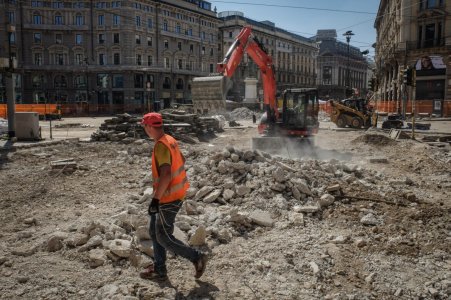


Three per cent of average annual income has already been eroded by climate change, with 5.6 million Europeans pushed into poverty: a devastating toll

It’s hot. For some, it’s just a matter of temperature. For the working class, however, it’s already a matter of health and finances: less income, higher prices, greater vulnerability. “The severe heat wave sweeping across Europe threatens people’s health, their livelihoods, and their ability to work,” Jessie Ruth Schleypen, a climate economist at Climate Analytics, told Bloomberg.

What appears to be a current emergency is actually a trend that has been underway for years now. A study published last Wednesday in the international journal Global Environmental Change shows that between 2004 and 2022, droughts and heat waves have already eroded nearly 3% of the average annual income of European households and pushed another 5.6 million citizens into poverty. And looking ahead, if the 1.5 °C limit set by the Paris Agreement is not met, household income could plummet by more than 21 percentage points by the end of the century.

Most at risk

The group most at risk is the poorest 20% of the population. Construction and logistics workers, farmhands, and manual laborers who bear the brunt of the climate’s impact. It’s a matter of class. Those in air-conditioned offices are protected, to some extent; those who work outdoors are not. Madrid is a prime example: according to the study, the Spanish capital has seen an income decline of nearly 10% in recent years, solely due to the effect of heat on productivity.

There are major problems for agriculture and livestock farming. In France and Spain, crops are paying the price for record-breaking temperatures, water shortages, and rising production costs. The situation in France is the most critical: 72 departments are on red alert, and hundreds of thousands of farm animals—especially poultry—have died due to the extreme conditions. In Spain and the United Kingdom as well, the heat is reducing productivity in livestock farming and fruit and vegetable production, putting pressure on entire supply chains. Among the hardest-hit crops is corn, which is suffering from reduced water resources and uncertainty about yields. The consequences are already visible in the markets: according to Euronext, corn futures have risen by 9% since mid-month, fueling fears of greater instability in global agricultural prices. Speculators could have a field day.

Meanwhile, demand for electricity is skyrocketing in cities. On Tuesday, June 23, European energy prices hit record highs: air conditioners running everywhere, the grid under strain, and insufficient supply. In Belgium, prices reached a staggering peak of 1,038 euros per megawatt-hour.

Food and energy

Food and energy becoming more expensive means higher inflation. And for low-income households—which allocate the largest share of their household budget to food and utility bills, with no ability to cut back on other expenses—rising prices have an immediate and disproportionate impact. According to economists, climate change could add between 0.3 and 1.2% per year to global inflation starting in 2035.

“We’re starting to see a situation where a new shock occurs every year,” argues Maximilian Kotz, a researcher at the Barcelona Supercomputing Center. And these shocks no longer affect only specific products: they impact entire supply chains, from energy to transportation, including insurance, water, and food.

But that’s not all. The climate crisis has also become a new source of financial instability. For some sectors of the economy, extreme events are taking on a significance comparable to that of geopolitical crises. Some market participants are already developing financial instruments to speculate on the frequency and intensity of phenomena linked to El Niño and climate anomalies. Les Finemore, chief investment officer at Moreton Capital Partners, has announced, in this vein, a new fund dedicated to trading on climate risks: “We’ve been focused on the war in Iran. The next event will be El Niño.”

A clear paradox: while extreme heat reduces workers’ incomes, increases the cost of living, and makes those with fewer resources more vulnerable, a segment of the financial sector is turning the very same phenomenon into an opportunity for profit.

And in Italy?

And in Italy? Things aren’t any better. According to a stress scenario developed by Allianz, between 2026 and 2030 the country risks a cumulative loss of nearly 150 billion euros in GDP. The hardest hit would be investment, which could plummet by 12.8% due to shrinking corporate profit margins. This combination opens the door to a stagflationary spiral: rising prices, falling productivity, and rising unemployment. The fiscal deficit is estimated to worsen by another 1.9 percentage points of GDP.

In this way, the climate crisis also functions as a social tax. But it is not a progressive tax. It hits those who have the least, with steep utility bills, more expensive food and mortgages, lost workdays, and growing health risks. The bottom line: temperatures are rising for everyone, but the cost of the heat continues to be distributed in a deeply unequal manner.

27 June 2026

Translated by International Viewpoint from Il Manifesto.

The Absurdity of World Trade Arrangements

Prabhat Patnaik |


The US is holding a gun to the heads of countries to make adjustments, insisting on a favourable deal for itself.


Consider a very simple picture, of a world in which there are only two countries that are engaged in trade. One of the two has a current account surplus while the other, by definition, has an identical current account deficit. It is reasonable to assume that since the surplus country is obviously more successful as an international competitor, it would be close to full capacity-use in a regime of free trade, while the deficit country that is weaker in its competitiveness would have much larger unutilised capacity.

Now, suppose the surplus country enlarges its domestic absorption of goods by increasing, say, the consumption of its workers; since it does not have much unutilised capacity, this larger absorption would entail a reduction in its exports and hence in its current account surplus. Since its surplus must be identical with the deficit of the other country, a reduction in it must mean a reduction in the second country’s current account deficit.

The mechanism through which this would occur is the following: as exports of the surplus country into the deficit country get reduced, the domestic producers in the latter can now get access to larger domestic markets, and hence produce more by utilising their unused capacity. The output, employment, and hence domestic consumption in the deficit country, therefore, will increase as a consequence of an increase in workers’ consumption in the surplus country.

Put differently, if the surplus country is forced to “adjust”, that is remove the current account imbalance between the two countries, then taking the world as a whole (which in the present case consists of only two countries), there will be larger output, employment and consumption, even as the current account imbalances are removed. 

It stands to reason, therefore, that the removal of current account imbalances must be sought through “adjustments” by the surplus country, since it leads to a better outcome for all concerned.

The current international trading arrangement, however, is just the opposite of this: it forces not the surplus country but the deficit country to make the adjustment by reducing its domestic absorption of goods and services. The argument here is that a reduction in domestic demand in the deficit country will mean a reduction not just in its domestic output but also in its imports, which would reduce its current account deficit (and ipso facto the current account surplus of the first country) and thereby achieve the desired adjustment. In the process, however, demand in the world economy goes down, and with it, world output and employment; and needless to say, the level of consumption in the world economy gets reduced by such adjustment.

We thus have two possible ways in which adjustment to eliminate current account imbalances can be made: if the surplus country is made to adjust then world output, employment and consumption increases, while if the deficit country is made to adjust, then world output, employment and consumption falls.

The rise in world consumption incidentally must occur in the first case, even if the increase in domestic absorption in the surplus country is not effected through a rise in workers’ consumption; since the output and employment in the deficit country increases, total world wage-bill and world consumption increases, no matter how the surplus economy increases its domestic absorption.

Amazingly, however, the world trading arrangements are such that the inferior mode of adjustment is carried out whenever there are imbalances, and not the superior mode of adjustment. This is the irrationality of the world trading arrangements under which we live.

When the Bretton Woods system was being set up in 1944, economist John Maynard Keynes had mooted the idea of making surplus countries also undertake some adjustment. But the US those days was an economy with a persistent current account surplus and opposed the idea of making surplus economies undertake adjustment: it preferred holding claims on other countries which gave it power over them, compared to increasing domestic absorption, the most obvious way of doing so being by raising workers’ consumption. A capitalist economy in any case would scarcely prioritise raising workers’ consumption.

Much, of course, has changed since 1944 when the Bretton Woods conference was held; the US which had been a surplus country then and for a long time after the war, started posting persistent current account deficits from the mid-1970s. Why, it may be wondered, did the US not start asking for adjustment by surplus countries when it stopped having surpluses itself?

There are three obvious reasons one can cite why it did not do so. First, having a deficit is something that the “leader” of the capitalist world would have to accept as part of the duties of “leadership”; for instance, the “leader” has to maintain a string of military bases around the world for its counter-revolutionary activities, which entail incurring expenditures abroad and hence a current account deficit. The US, therefore, was not unduly shocked or surprised by the current account deficits it started experiencing.

Second, since the US dollar played the role of being de facto “world money” which the rest of the world was willing to hold in almost unlimited amounts, the US had no problems in financing its deficit by making dollars (and dollar-denominated assets) available to surplus countries, and hence felt no need for any adjustment on its part or on the part of the surplus countries, at least no urgent need for any adjustment.

Third, much of the exports being made to the US by the surplus countries, in East Asia for instance, were produced by American capital itself relocating its manufacturing activities to these countries. Insisting on a reduction in the surplus of these countries therefore might mean hurting the interests of American capital which obviously no US administration would do unless urgently required.

For all these reasons, despite the changed international situation that saw the US incurring persistent current account deficits, there was no immediate demand on the part of the US to bring about any change in the world trading arrangements.

The US was content to let dollars and dollar-denominated assets pour into the world economy as the means of settling its current account deficit. Matters, however, have taken a different turn of late. With China moving away from holding dollar foreign exchange reserves, and with the threat of de-dollarisation looming on the horizon (however distant that threat may be as yet), the US now feels the need to reduce its current account deficit; but it is not concerned with altering the world trading arrangements in a way that would benefit the world economy as a whole. The recent Trump measures testify to that.

The Trump measures are not meant to overcome the irrationality of the world trading arrangement that we discussed above; they are meant only to ensure that the US does not suffer from its deficit position, that it overcomes its predicament of being a deficit country without making the usual adjustment involving a reduction in its domestic demand that a deficit country is supposed to do. Indeed, on the contrary the Trump measures are meant to reduce the US deficit even while increasing its domestic output and employment. Let us see how.

The two basic weapons used by Trump are: punitive tariffs, and unequal trade treaties imposed on trading partners (of which India is the first instance); these unequal treaties stipulate the exact amounts that a country is supposed to import from the US (without stipulating anything in the opposite direction). In fact, punitive tariffs are used as the punishment inflicted on any country that does not accept the unequal treaty; and countries accept the unequal treaty as the lesser of the two evils.

As the trade deficit narrows through such coercive means, the demand for domestic goods increases within the US and hence domestic output and employment too. But this does not amount to any alternative trading arrangement for the world economy as a whole that would be universally beneficial and hence constitute an embodiment of rationality. It is the US holding a gun to the heads of countries and insisting on a favourable deal for itself.

In fact, with a better deal for itself, it will join with even greater gusto in enforcing the irrational world trade arrangement that forces deficit countries to undertake adjustments, an irrational arrangement that the US itself had been instrumental in imposing on the world.

Prabhat Patnaik is Professor Emeritus, Centre for Economic Studies and Planning, Jawaharlal Nehru University, New Delhi. The views are personal.

Neo-Liberalism and Third World Intelligentsia


Prabhat Patnaik |


The intelligentsia has to wake up to the fact that the chasm between them and the people creates the soil for the ascendancy of neo-fascism.


One important feature of neo-liberal capitalism in a Third World country like India is the chasm it introduces between the working people and the intelligentsia. In the colonial period in India, several members of the intelligentsia took it upon themselves to highlight the misery to which the Indian people had been subjected by colonialism; and, of course, many joined the active resistance against colonialism, suffering incarceration and deprivation in the process. As a result, they earned the respect of the people, a respect which they continued to enjoy even after Independence, during the period of dirigiste development, by becoming honest and critical observers of the impact of the development strategy on people’s lives.

Pre-capitalist societies, even in normal times, have been characterised by a degree of deference by the common people toward the intelligentsia. This was strengthened by the role played by the intelligentsia during the anti-colonial struggle and the period of post-Independence dirigisme in countries like India.

Neo-liberalism, however, changes this situation. It seeks to build a no-holds-barred capitalist order, where domestic monopoly capital is integrated with international finance capital, the aim being to refashion society along familiar and conventional capitalist lines. It alters the position of the intelligentsia in several ways.

First, since the essence of capitalism is to break up all residual sense of community and to reduce social groups into a set of self-serving individuals, the intelligentsia too is reduced to the status of a group of individuals fending for themselves, rather than acting as tribunes of the people. Career concerns, the desire to utilise opportunities for personal advancement, both at home and abroad which have now opened up, are made to become the major pre-occupations of even the intelligentsia.

Second, the social role of the intelligentsia before the pre-neo-liberal period was supported by a certain theoretical perspective that it had adopted, namely, a perspective of anti-imperialism. True, among the different members of the intelligentsia there were major differences in theoretical positions, but most of them had in common a recognition of the extant reality of imperialism. This found a chord among the people and set the Third World intelligentsia apart from the dominant theoretical traditions in the West.

With neo-liberalism, however, there is a strenuous effort to obliterate these theoretical differences and to create a consensus both in the metropolis and in the Third World around only one view, namely, the one that is that dominant in the West, which generally has the support of both the World Bank and the International Monetary Fund. This view believes that the Third World’s development can be effected not by resisting imperialism but by embracing imperialism.

With oppositional voices in the theoretical domain stifled everywhere, with the dominant voice in the West speaking the same language now as the newly sprung-up voices in the Third World, not only do opportunities for employment open up for a larger segment of the Third World intelligentsia in the metropolis, but its distance from the Third World people becomes greater. This is because the experience of the people of the Third World does not conform to the conclusions of the theoretical consensus being developed between the respective intelligentsia in the metropolis and the Third World.

The role of the collapse of the Soviet Union, which had provided for decades, notwithstanding all its flaws, an alternative and inspiring model, must never be underestimated in this entire process of the development of a consensus between the metropolitan intelligentsia and the Third World intelligentsia. 

Read Also: Neo-Fascism’s Rise and Dismantling of Education

Third, the privatisation, and hence commoditisation that is a hall-mark of neo-liberalism, of important spheres of the economy, especially education, tends to destroy the pursuit of academic life as a critical activity. Since the objective of the private educational institutions that proliferate in the new situation is to produce students as marketable commodities, the basic purpose of education in a Third World society, which must be to produce, in Italian Marxist thinker Antonio Gramsci’s words, a set of “organic intellectuals” of the decolonised people, gets completely lost.

Indeed, the academics engaged in these private institutions are penalised if they inculcate in their students a sense of critical inquiry; and, of course, student organisations and student activism are discouraged in these institutions. All this further takes the intelligentsia away from the lives of the people, corralling them into a separate world of specialised intellectual commodity production. Neo-liberalism, in short, detaches the intelligentsia from the lives of the people.

A few days ago, a senior minister of the Bharatiya Janata Party or BJP government in West Bengal lamented the fact that Presidency College and Calcutta University, which had been intellectual beacons in the country in the past, had become lack-lustre institutions. He then went on to suggest that the lost academic glory of West Bengal could be regained with the help of the private sector.

The superficiality of the minister’s analysis of why West Bengal had fallen behind in academic standards is evident from the fact that he sees no connection between the starving of public funds for education and its reduction to mediocrity. He wanted to revive higher education in West Bengal (which itself was an ironic objective to have for a representative of a neo-fascist government) without spending much money from the budget!

The chasm between the intelligentsia and the people that develops under neo-liberalism has an important consequence, namely, it creates the soil for the ascendancy of neo-fascism. To be sure, there are several basic factors behind the rise of neo-fascism, above all, its promotion by monopoly capital which enters into an alliance with the neo-fascists in order to retain its hegemony in the midst of the crisis of neo-liberalism. But neo-fascist propaganda against a hapless minority to generate hatred against it within the majority, as a means of dividing the people and providing a distracting discourse, would not be as effective if the words of the intelligentsia carried the same weight with the people as they had done before the neo-liberal period.

In fact, neo-fascist ideas do not enjoy much genuine currency within the intelligentsia; but these ideas manage to gain some currency within the people because the anti-fascist voices within the intelligentsia, despite being the dominant ones, are not only silenced through intimidation, but also rendered relatively ineffective because of the chasm that neo-liberal capitalism introduces between the intelligentsia and the people. The loss of the credibility of the intelligentsia among the people is an important enabling factor behind the rise to ascendancy of neo-fascism.

Neo-liberalism thus prepares the ground for neo-fascism in several ways. The most important, of course, is the crisis it inevitably produces. With the relative size of the labour reserves in total labour-force not declining under the neo-liberal regime, indeed, on the contrary, increasing even when GDP growth apparently accelerates, real wages do not rise even as labour productivity rises. (This rise in labour productivity incidentally is the reason why the relative size of the labour reserves does not diminish). This raises the share of economic surplus in output and gives rise to a crisis of over-production by keeping down consumption demand relative to output.

It is this crisis that provides the setting for the corporate-Hindutva alliance, and for monopoly capital’s promotion of neo-fascism. But neo-liberalism contributes to this process in other ways, too, of which a very prominent one is the general loss of trust among the people for the intelligentsia that it brings about.

Marxism is almost unique in recognising the role of neo-liberalism in the rise to ascendancy of neo-fascism. Liberal analyses of this rise focus only on social and historical factors, but scarcely ever mention the political economy roots of the phenomenon. Not doing so, however, weakens the anti-neo-fascist struggle.

Even if perchance, the machinations of neo-fascism to perpetuate its hold over power are overcome and it is removed from power through the electoral process, as long as the neo-liberal character of the economy continues and the crisis that it has spawned persists, neo-fascism will always come back to power, as it has done in the US with Donald Trump’s re-election.

The struggle against neo-fascism, therefore, requires a transcendence of the conjuncture that gives rise to it, which requires in turn going beyond neo-liberal capitalism. The intelligentsia has to wake up to this fact; it has a historic responsibility to re-forge its links with the people. It is not enough just to warn them about the dangers of neo-fascism. An alternative economic agenda must be charted that takes them out of the crisis of stagnation and unemployment that neo-liberalism has consigned them to. Neo-fascism can be overcome only by simultaneously going beyond neo-liberalism. 

The writer is Professor Emeritus, Centre for Economic Studies and Planning, Jawaharlal Nehru University, New Delhi. The views are personal.  


Rising Poverty: Capitalism, Employment and History


Prabhat Patnaik |


The sooner people wake up to the necessity of ushering in an alternative path of development, based on the home market and use of the public sector to offset “investment strikes” by capitalists, the better it would be for mankind.

When industrial capitalism was developing in Britain in the late 18th and early 19th century, the new machine-made goods had displaced many artisan producers, giving rise to the Luddite movement against the introduction of machines. With increased unemployment, there was an increase in the relative magnitude of poverty, as Eric Hobsbawm had argued in a debate with another historian R.M. Hartwell. But then things improved later on in the course of the 19th century. The proportion of the population afflicted by absolute poverty stopped increasing and indeed came down, as did the proportion of the workforce afflicted by unemployment.

This experience of Britain is usually generalised as an intrinsic characteristic of capitalism, namely, that while it may initially give rise to an increase in poverty and unemployment, it eventually brings these down, causing a general improvement in living standards for all, even if income inequality increases compared to the initial situation.

This impression, namely, that the development of capitalism eventually necessarily causes an improvement in employment and a reduction in poverty, is so widespread that the standard panacea recommended for any country that is afflicted by mass unemployment and acute poverty today is to attract capitalists to invest within it; and exactly the same is recommended for any state within the Indian Union. “If you are poor, then offer fat concessions to capital to entice it to come and lift you out of it”, has become almost a standard mantra.

This, however, apart from lacking any theoretical basis whatsoever, is a complete misreading of what actually happened in history. If it was only a once-for-all introduction of a new machine, then, as long as the pace of accumulation of capital stock was high enough and did not slacken, then the initial unemployment caused by such introduction would not only be made up, but would be more than overcome.

But industrial capitalism is characterised by continuous process and product innovations, so that labour displacement occurs all the time. In such a situation there is no necessary reason why the unemployment caused by capitalism should disappear at all. There is, in short, no theoretical reason why capitalism should eventually cause a disappearance of unemployment.

Read Also: Reformed Capitalism, a Pipedream

Historically, too, the reason why the initially generated unemployment that had so angered the Luddites had eventually got alleviated has nothing to do with any innate tendency of capitalism. It occurred in the latter half of 19th century Britain for three quite distinct reasons.

The first was mass emigration from Britain (and from Continental Europe) to the temperate regions of white settlement. Economist W. Arthur Lewis pointed out that as many as 50 million Europeans migrated to Canada, the United States, Australia, New Zealand and South Africa in the “long nineteenth century” (stretching up to the first world war); they drove the local inhabitants off the land, herded them into reserved areas, and set themselves up substantially as agriculturists. The scale of emigration was so large that from Britain alone, roughly half the annual natural increase in population between 1815 and 1914, actually migrated to these “new lands”. This very substantially reduced the magnitude of unemployment in Britain.

A second factor that contributed to this was the other instance of colonialism, namely, the colonies of conquest as distinct from the colonies of settlement. Throughout the 19th century, especially in its latter half, machine-made goods were being exported to the colonies of conquest like India, displacing local pre-capitalist producers there through a process that has come to be known as “de-industrialization”. What this meant was that the machine-made goods, while not causing any further unemployment within Britain (since they were now being exported to the colonies), were reducing some domestic unemployment through larger production.

In addition to these two factors, there was also the additional factor that the production of machines themselves in the initial stages was highly labour-intensive (which is what may have made Marx believe that the organic composition of capital, C/V, would always tend to increase through technical progress). Hence, even though machine-made goods displaced some living labour, this was partially offset by the fact that machine-making itself absorbed a fair amount of labour.

These three factors, however, had nothing to do with any innate tendency of capitalism. The first two had to do with colonialism; even the last one, having to do with machine-making being labour-intensive, was a happenstance, not a necessary characteristic of capitalism and not always true.

It follows, therefore, that the conclusion typically drawn from European experience lacks validity, namely, that capitalism, no matter what transitional problems it may bring and no matter how differentially it may confer its benefits upon the population, necessarily and inevitably brings about an improvement in the material conditions of life for everyone. What happened in Europe was made possible by the specific context of those times; it does not constitute an inevitable outcome.

In fact, one can go further: capitalism today stands opposed to the agenda of “development”. Consider some figures: over the decade 2010-20 the annual rate of growth of world GDP was 2.6%, the lowest for any decade since the Second World War. The growth of world labour productivity, which was 1.8% in the first half of the decade, declined to 1.4% in the second half, so that we can take 1.6% as the average for the decade as a whole. This means that the rate of growth of employment in the world economy, which is the difference between the two, would have been about 1% annually over the decade.

But the rate of growth of the labour-force over the same period was anywhere between 1% and 1.5% annually, which means that the relative size of the labour reserves in total world labour-force would have increased over the decade. If we take the world economy as a whole, then, it follows that the unemployment rate would have increased during the pre-pandemic decade of neo-liberal capitalism.

Neo-liberal capitalism, which is the latest phase of capitalism, involves a slowing down of the GDP growth rate, both because of the increase in inequality it entails and also because of the inability of State intervention to jack up the growth rate through Keynesian measures. Neo-liberal capitalism, therefore, necessarily implies a slowing down of employment growth, too, and to levels even below the rate of growth of the world labour-force. A rise in the relative size of labour reserves is thus not just a fact of, but is necessarily associated with, contemporary neo-liberal capitalism.

This does not, of course, mean that all countries that adopt the capitalist panacea for overcoming unemployment and poverty would necessarily come a cropper. What it means is that those countries which do succeed through the capitalist panacea would be doing so only at the expense of other countries, that it is impossible for all countries to progress towards “development”, in the sense of alleviation of distress of the majority of the population, through the pursuit of the capitalist path of development.

Indeed, on the contrary, since the relative size of the labour reserves is a major factor underlying poverty, the pursuit of capitalism today would necessarily aggravate absolute poverty in the world economy as a whole.

The intellectual sleight-of-hand of institutions, such as the World Bank, becomes clear here. From the fact that some countries manage to shake off their backlog of poverty by promoting capitalist development, they suggest that all countries can do so, which is directly contradicted by the available statistics of the world economy. Those countries which shake off poverty do so only by making other countries wallow in even more accentuated poverty.

In fact, countries that are small in size, that have in absolute terms small labour reserves, and can attract the relocation of productive investment from the metropolis to their soils, can well succeed in overcoming poverty and effecting “development” through the pursuit of capitalism; but these constitute the exceptional cases, which, far from constituting the general situation, prove precisely the contrary.

What is true of the world economy as a whole, holds true for countries like India, which have enormous labour reserves inherited from the colonial times, reserves hidden away in particular in vast agrarian sectors. Expecting such economies to overcome their state of poverty and underdevelopment through the pursuit of capitalist development is the height of absurdity. This was a point well understood in the days before the launching of the neo-liberal onslaught. But so assiduous has been the “selling” of capitalism in the past few decades that this simple truth has been lost sight of.

The sooner people get over such illusions and wake up to the necessity of ushering in an alternative path of development, that is based on the home market (and hence sustained by the development of agriculture), that controls cross-border capital flows, and that makes use of the public sector to offset “investment strikes” by capitalists, the better it would be for mankind.

Prabhat Patnaik is Professor Emeritus, Centre for Economic Studies and Planning, Jawaharlal Nehru University, New Delhi. The views are personal.


France: Anti-Fascist Historian Marc Bloch Inducted Into National Panthéon


Pablo Meriguet |


The medievalist scholar was captured by the Gestapo while participating in the French Resistance and was later tortured and executed by firing squad.


Historian and resistance fighter Marc Bloch is inducted into French pantheon. Photo: AP

Those of us who studied history in university will likely remember the day a professor told us about the historian who changed the course of historical studies by moving away from the traditional way of recounting the past, which, until then, had focused on great figures, a military history of famous generals, and an almost obsessive examination of diplomatic documents.

This historian, along with other greats of the field, had set out to study the past in terms of its deep social interrelationships, drawing on methods from other sciences such as sociology, economics, and even psychology.

Up to that point, nothing in the story could inspire even the least enthusiastic of the students. But then the teachers told us about this historian’s life – or rather, about his death. A great lover of history and the French people, during World War II (after being removed from his professorship for being Jewish) he wrote a sort of academic testament in which he masterfully demonstrated what a historian’s work entails, but he never finished it because he decided to join the Resistance against the Nazis and their collaborators.

He was captured by the Gestapo, who tortured him for several hours before putting him before a firing squad. It is said that his last words were “Vive la France!” before the thunderous sound of German rifles ended the life of one of the most brilliant minds of the 20th century.

The legacy and the Panthéon

His name was Marc Bloch, and a few days ago the French government decided that his remains should be interred in the Panthéon, a place where the remains of some of the most important men and women in French history rest. Voltaire, Rousseau, Victor Hugo, Jean Jaurès, Marie Curie, Simone Veil, Aimé Césaire, among others, are part of a place that seeks to honor and immortalize the spirit of a nation – a place to which the historian is now added.

Bloch was born on July 6, 1886, in Lyon, into a Jewish family, although Bloch himself would say that the only time he would openly state that he was Jewish was when an anti-Semite was present. He fought in World War I, where he rose to the rank of sergeant and later to captain due to his valiant service, for which he was awarded the national Order of the Legion of Honor.

After the Great War, he returned to university classrooms, first in Strasbourg and then at the Sorbonne. In 1929, together with Lucien Febvre, he founded the now-famous “Annales d’histoire économique et sociale,” a journal that embodied the aspiration for a new way of telling history, focused on a vision of the past that moved away from mere biographies of great figures and accounts of major battles.

He wrote the now-classic history books “The Royal Touch: Monarchy and Miracles in France and England, Feudal Society,” and “Strange Defeat: A Statement of Evidence Written in 1940,” among others. But his most celebrated book is probably “The Historian’s Craft,” the aforementioned academic testament that seeks to synthesize his vision of the historian’s craft – a text that is absolutely indispensable for anyone interested in historical studies and that marked a turning point in the discipline.

And perhaps the most curious thing of all is that his most famous book is incomplete. Facing the nefarious Vichy regime, Bloch (who had already lost his property and his university positions because he was Jewish) decided to leave everything behind and join the French Resistance against the Nazis and the French collaborators. Precisely because he was a great historian, Bloch understood that although history is written in books, in moments of life such as those of World War II, it demands to be written even with one’s own spilled blood.

A symbol of resistance

The anti-fascist Bloch thus became a symbol of the militant historian – one who, most radically, breaks away from any conception of the academic as an immune sage detached from reality. This image of Bloch, forged over time, inspired thousands of history students to approach the past with the seriousness required of those who dare to change a reality that, by all accounts, falls short.

Furthermore, he definitively shattered the old myth of the historian as that unblemished being who, neutral in his aspirations, chooses not to get involved in history so as not to taint a judgment that was supposedly meant to remain pristine. Bloch knew that pursuing impartiality in the face of history was impossible, so he decided to give his life for a nation he loved deeply.

Macron and his intentions

President Emmanuel Macron has thus decided to induct another anti-fascist into the Panthéon. He had previously honored politician Simone Veil, artist Josephine Baker, and Armenian poet Missak Manouchian – all of whom, alongside Bloch, suffered and fought in their own way against the racist and predatory machinery of the Third Reich.

In his official speech, Macron highlighted Bloch’s “ardent defense of secularism.” “With heart and reason, a true republican, an ardent and tireless defender of secularism, Marc Bloch suffered the consequences of the state-sanctioned anti-Semitism instituted by Marshal Pétain’s government … Marc Bloch unites France and history, the Republic and science, government and reason. This approach and this connection remain today the best antidotes to the poisons of historical revisionism.”

Macron hopes to send a clear message against the far right, which appears to be growing by the day in France. In fact, the Bloch family requested that no representatives of any far-right political party be present at the induction of their ancestor into the Panthéon, a right that party leaders would normally have at such ceremonies.

This is because, curiously enough, intellectuals in France still play a very prominent role in public debate, and the far right’s reinterpretation of history – especially that which, in one way or another, vindicates the French far right to a greater or lesser extent (including those who collaborated with the Nazis and others) – has gained traction in recent years.

However, Macron is also facing criticism suggesting that his political decisions have facilitated the rise of the far right, such as when he dissolved parliament or, despite certain unofficial promises, decided to form a government without the participation of the left, which had pulled off a surprise victory at the polls despite the far right’s advance.

Despite this, the move has been applauded by most of the left, the center, and even by that nationalist wing of the French right that sees this medieval historian as a shining symbol amid a regression to very dark times for France. Bloch has thus become the heir to those who view the past as a fundamental tool for transforming the present.

And although he was a medieval historian, he was well aware of the dangers looming over France in the 1930s and 1940s precisely because he understood that history is sometimes a beast that seems very slow, but which at any moment can deliver a devastating blow that changes everything. Today, his example sheds light on the dark days of those who will come face to face with other beasts that are quickening their pace.

Courtesy: Breakthrough News