Monday, August 03, 2026


Europe's worst wildfire season in years flags a global El Nino already moving commodity markets

Europe's worst wildfire season in years flags a global El Nino already moving commodity markets
The World Meteorological Organization's official August-October outlook confirms a strengthening El Nino and a positive Indian Ocean Dipole - a combination that has already pushed food and power prices around the world before the season it describes has even started. / bne IntelliNews
By bne IntelliNews August 2, 2026

Several European countries are having their worst wildfire year in more than a decade and worst than last year’s record wildfires that burnt over one million hectares, according to data from the EU's Global Wildfire Information System published this week.

France's cumulative burnt area through July 29 is running 4.1 times its 2012-2025 median for the same point in the season, Spain 3.5 times, Germany 3 times, Portugal 2.3 times and the UK 1.8 times. The Balkans, by contrast, have had a quieter year, with Bosnia and Herzegovina, Serbia, Montenegro and North Macedonia all below their historical median.

The World Meteorological Organization's Global Seasonal Climate Update for August-October 2026, issued in July, forecasts above-normal temperatures across most of the world alongside a strengthening super El Niño and a developing positive Indian Ocean Dipole - a combination that tends to amplify, rather than offset, extreme rainfall swings in both directions: worse flooding in some regions, worse drought in others.

And it’s going to get worse. Europe's wildfire season is one of the first visible symptoms of a pattern the WMO is only now confirming officially for the months ahead\ through to October.

Markets have not waited for the official confirmation. IntelliNews has tracked a string of El Nino-linked commodity and inflation stories through the second and third quarters of 2026, from Latin American central banks to Southeast Asian crop belts - evidence that the economic transmission channel identified by the WMO's forecast is already live, not merely forecast.

A hotter, more extreme world for three months

The WMO's probabilistic model, built from a multi-model ensemble, shows above-normal temperature probability across almost the entire globe for August-October, with the strongest confidence in the tropics and mid-latitudes. Changes in rainfall patterns is going to make the biggest difference. The same forecast shows a mixed but pronounced pattern of above-normal rainfall probability across parts of South Asia and the tropical Pacific, and below-normal probability across swathes of southern Africa, parts of South America and the Mediterranean basin – a divergence that turns a single global weather pattern into a series of very different regional economic stories.

Already pricing in

Swiss bank UBS warned in mid-July that a strong El Nino threatens to reignite inflation and delay interest rate cuts across Latin America, singling out Colombia as most exposed given its high inflation and weak fiscal position, with Brazil and Peru also flagged and Venezuela's hydropower-dependent grid seen as vulnerable to drought. The US National Oceanic and Atmospheric Administration puts the probability of the current episode being powerful at 63%, with effects expected to persist into early 2027.

The pattern has already hit agricultural commodities further east. In June that Malaysia issued a sovereign warning over crop damage risk to its palm oil plantations even as near-term prices fell on unrelated demand weakness - agricultural economists note the biological lag between an El Nino heatwave and reduced fresh fruit bunch extraction typically runs several months, meaning any supply hit shows up closer to early 2027. Rice told a faster-moving version of the same story: Vietnam's rice export price for 5% broken rice rose to $412 a tonne in May on El Nino-linked drought fears across India, Thailand, Indonesia and Australia, with the UN's FAO Rice Price Index up 2.7% on the month.

Burning in Europe

Europe's wildfire numbers are the clearest evidence yet that this year's pattern is not merely a forecasting exercise. The divergence within Europe itself - a very bad year in France, Spain, Germany, Portugal and the UK against a calmer one in the Balkans - illustrates the WMO's own point about the Mediterranean basin sitting in the below-normal rainfall probability band, a dry bias that raises fire risk independent of any single heatwave.
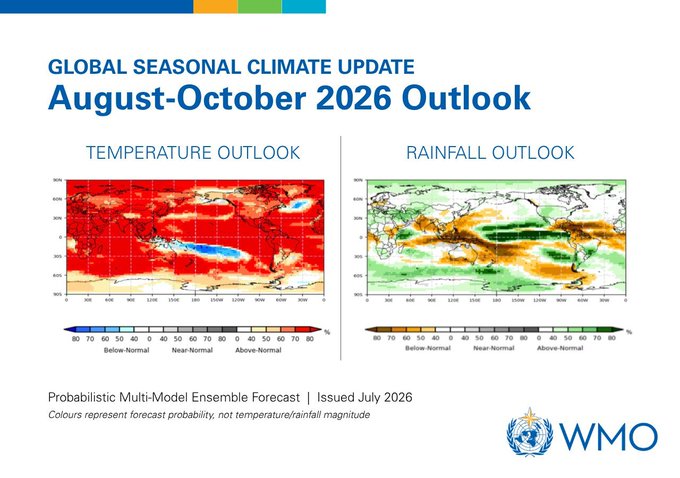
WMO Global Seasonal Climate Update: temperature and rainfall outlook for August-October 2026. Source: World Meteorological Organization.
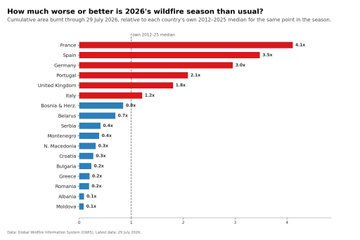
Cumulative burnt area, 2026 season to July 29, relative to each country's 2012-2025 median. Source: Global Wildfire Information System.

None of this guarantees a repeat performance for the rest of the WMO's three-month window - seasonal probabilistic forecasts describe likelihoods, not certainties, and the report itself stresses that its colours represent forecast probability rather than magnitude. But taken together with the commodity moves already logged this quarter, the wildfire data is the strongest sign yet that 2026's El Nino is behaving as advertised rather than fading, as some earlier and weaker episodes have done.

'Climate change is really here: We should seize this crisis moment to create a new momentum'

Issued on: 29/07/2026 - FRANCE24

Oliver Farry is pleased to welcome Jean-Pascal van Ypersele, Climate Scientist and Professor at the Universities of Louvain and Liège in Belgium. Europe's latest heatwave is further evidence of a structural transformation of the continent's climate, warns Professor van Ypersele. His central argument rejects both fatalism and complacency. While insisting that humanity has not yet reached "the point of no return," he argues that the world has entered a period of exceptional urgency in which the costs of delaying climate action are escalating rapidly. He develops three interconnected themes: extreme heat, wildfires and public health crises as manifestations of a changing climate; he criticises the inadequacy of current political responses, suggesting that governments continue to underestimate the scale and immediacy of the challenge despite mounting scientific evidence; and he argues that adaptation and mitigation must proceed simultaneously: societies must become more resilient to unavoidable climate impacts while accelerating the transition away from fossil fuels to prevent even greater disruption.


Video by:  Oliver FARRY

France's unprecedented wildfires: Convergence of climate change and historical landscape engineering


Issued on: 30/07/2026 - FRANCE24 


Delano D'Souza is pleased to welcome Dr. Melissa Sterry, Scientist, Designer, Strategist and Founding Director of Panarchic Codex® : Design for Living with Wildfire. Dr. Sterry reframes wildfire as a systemic phenomenon: climate change intensifies heat and drought, nineteenth century land engineering has produced highly combustible plantation forests, and expanding human activity increases ignition opportunities. Once these factors align, fires can evolve into autonomous systems that generate their own weather and even create new ignition sources. While she praises France's emergency response, Dr. Sterry contends that prevention and firefighting alone cannot solve the problem. The real challenge lies in redesigning landscapes before fires gain momentum, shifting policy from reacting to disasters towards preventing them through long-term ecological resistance and resilience.

Video by:  Delano D'SOUZA

'Rethink the forest' amid unprecedented wildfires: Return to 'ancestral ways of managing the land'?

Issued on: 29/07/2026 -  FRANCE24

Stuart Norval welcomes Jean-Luc Gleyze, President of the Departmental Council of the Gironde, and Stéphane Delpeyrat-Vincent, former firefighter and founder of WARUCENE, a research firm specialising in wildfire prevention. The Gironde wildfires expose the growing challenges of land management in a warming world. Offering complementary perspectives, Jean-Luc Gleyze, speaking from the front line of the emergency response, presents the fires as a test of social solidarity, institutional coordination, and public resilience. By contrast, Stéphane Delpeyrat-Vincent argues that increasingly destructive wildfires are not simply emergencies to be fought, but symptoms of a deeper structural failure: landscapes managed for a climate that no longer exists. Together, their analysis suggests that the challenge is no longer simply to improve firefighting capacity, but to rethink forests, communities, and urban planning in an era of accelerating climate change.


As France battles unprecedented wildfires, Caroit urges collective global action on climate change


Issued on: 30/07/2026 - FRANCE24

Delano D'Souza is pleased to welcome French Deputy Foreign Affairs Minister Éléonore Caroit. She frames France's response to unprecedented heatwaves and wildfires through three lenses: crisis management, international solidarity, and climate governance. Caroit distinguishes between the immediate demands of emergency response and the longer term structural challenges posed by climate change, including adaptation, infrastructure resilience, and urban planning. While arguing that governments must continually strengthen preparedness and invest in prevention and adaptation, she maintains that domestic policy must be matched by sustained international climate cooperation, making collective global engagement an essential component of both disaster response and long term climate resilience.

Video by: Delano D'SOUZA

In blazing Greece, anger grows among residents forced to evacuate

Issued on: 03/08/2026 - FRANCE24

Greece is facing a growing wildfire catastrophe after a week of destructive blazes across the country was compounded by a deadly mid-air collision between two firefighting helicopters. Fires have sparked across the country, including just seventy kilometres from Athens, forcing many residents to flee as countless homes were damaged or destroyed.

Video by:  Caitlin Brown


'A giant of the industry, Purja leaves behind a legacy that inspired a generation to climb higher'


Issued on: 01/08/2026 - FRANCE24

Renowned mountaineer Nirmal Purja and his nine climbing companions were killed by an avalanche in Pakistan during an ascent of one of the world's highest mountains, his expedition company said on Saturday, as rescuers tackled treacherous conditions to recover their bodies. A giant of the industry, Purja leaves behind a legacy that inspired a generation to climb higher. Click on this video report by Charlotte Lam for more.

Video by: Charlotte Lam

'The #Odyssey': What's missing from #Nolan's film according to Homer's translator

Issued on: 31/07/2026 
FRANCE 24


Since Christopher Nolan's "The Odyssey" came out, it has generated over $300 million… and a growing conversation about what is missing compared to the original poem. But what is that exactly? In a scathing review published recently, classicist and translator of Homer’s epic, Emily Wilson, had much to say about what differed from the original poem. Her translation, published in 2017, was widely acclaimed, and Nolan said she was one of the inspirations for his film in early publicity. FRANCE 24 spoke to her a few days before she published her review, and here’s what she had to say.

Video by: Ciara BOULMAN


'Pure political theatre': Ceuta migrant crisis 'used politically' to portray Europe as under attack

Cover image: © France 24   06:47
SPAIN
Issued on: 03/08/2026 - FRANCE24

Stuart Norval is pleased to welcome Camille Le Coz, Director at Migration Policy Institute Europe. Le Coz offers a nuanced interpretation of the recent events in Ceuta that challenges the dominant political narratives emerging across Europe. She shifts attention away from emotionally charged images toward the structural forces shaping migration: demographic pressures in North Africa, labour shortages in Europe, the role of smuggling networks amplified by social media, and the enduring tendency of migration crises to become instruments of domestic political competition. In doing so, she offers a reminder that Europe's migration debate is often driven less by the movement of people itself than by competing political narratives about what those movements represent.


Ceuta: more migrants leave but residents still in shock. Far-right leader visits


By Julian GOMEZ
Published on

Santiago Abascal, the leader of the far-right party Vox, visited the city today and accused the government of being in thrall to Morocco.

Here at the border between Ceuta and Morocco, the situation is much calmer than in recent days. According to Spanish authorities, the majority of the at least 60,000 people who crossed irregularly at this point on Thursday have already returned.

There is still a sporadic but steady stream of people heading back. Most of those returning tell us they entered Spain after receiving social media messages claiming the border was open and that no documentation was required.

Meanwhile, in the city, fear has given way to indignation. Virtually everyone I have spoken to cannot fathom how this situation could have happened and is demanding urgent explanations. It is a tense social atmosphere that is fuelling political debate.

A taxi driver told me:

"I got the feeling that people are very, very angry. I know they’re very angry right now. There are 85,000 of us here, and 60,000 are coming in. So, tell me. What do we do? What are we going to do? We can’t even buy bread. There was no bread. There was nothing. Nothing, nothing. Everything was closed."

While he was reluctant to attribute blame, some residents were more outspoken. Alluding to the initial legal difficulty of sending the migrants back immediately because they came via the sea, a middle-aged man called PM Pedro Sanchez an "accomplice", adding: "this is a disgrace— for me, a disgrace. This has never happened before in my life."

Some Ceutanos do point to a humanitarian duty in connection with the crisis. A 78-year old pensioner told me:

"If there are children there, they need to be given something to drink, they need to be given something to eat. It’s common sense, but that now all of Ceuta, all of Spain—and Spain stands with you—is with you."

However, the situation as a whole he cannot but condemn:

"This is a state of emergency and a declaration of martial law, just to go shopping at Mercadona? I have to pass a soldier every ten meters away from him ten or twenty meters away from him and feed the troops well and the police. That’s a state of siege, and it’s a of national emergency. There’s no question about it."

Santiago Abascal, the leader of Vox, visited the city today, accusing the government of being in thrall to Morocco.

Speaking to the media, Abascal placed the responsibility for what had happened on the government in Rabat and, above all, on Pedro Sánchez himself.

He argued that Morocco acted in the conviction that there would be neither response nor reprisals, because the Spanish prime minister is, in his words, "subservient to the African country".


Spain installs floating barrier in Ceuta after

migration influx


Spanish authorities said Saturday they were installing a floating barrier on the sea border between its North African territory of Ceuta and neighbouring Morocco after a deadly surge of tens of thousands of migrants into the territory earlier in the week prompted alarm across the European Union.


Issued on:02/08/2026 
By: FRANCE 24


A migrant looks out at a beach following mass crossings of migrants on foot and by sea from Morocco into Spanish territory in Ceuta, Spain, August 1, 2026. © Pedro Nunes, Reuters


Spain said migrant crossings into its North African enclave of Ceuta stopped overnight, as police began installing a 500-metre (1,640-foot) floating barrier on Saturday off its border with Morocco following a mass rush that killed at least 72 people.

According to Spanish authorities, about 60,000 people had crossed ​into Ceuta by land ‌and sea from Thursday in an unprecedented surge at one of the European Union's only land borders with Africa. More than ⁠48,000 of them returned to Morocco within 48 hours, Spain said.

Reuters video on Saturday showed Spanish soldiers and police patrolling a mostly empty Tarajal beach shrouded in fog.

EU calls emergency meeting

Civil Guard police started laying the new barrier ‌at 7:50am (0550 GMT) on the Tarajal breakwater, one of the main points used by people trying to enter the tiny Spanish territory, ⁠the government said in a statement.

The pneumatic barrier, alongside a line of anchored naval buoys, is designed to stand 30 to 70 centimetres (12 to 28 inches) above water and extend as much as one metre below the surface, it added, while a channel between the barriers will allow ​Civil Guard vessels to patrol the area.

The mass crossing prompted alarm across the European Union, and 22 member states wrote ‌a letter asking for coordinated action to protect external borders and other measures.

Ireland, which holds the rotating EU presidency, said it had called an emergency video conference meeting of the bloc's interior ministers to discuss the crisis on Tuesday.

Cover image: © France 24
01:57


Spain's centre-left Prime Minister Pedro Sanchez criticised Italy's decision on Friday to suspend passport-free Schengen travel arrangements with Madrid for one month.

"In the ‌current international context, the EU cannot afford this kind of selfish, polarising and unlawful reaction," Sanchez wrote in a letter to the EU Commission and European Council presidents.

Death toll rises

"The latest figure that we have is 72," the government's delegate to Ceuta, Miguel Angel Perez Triano, told reporters on Saturday when asked about the number of fatalities. Some migrants drowned and others were crushed while trying to climb the breakwater and border fence.

The previous toll was 67 deaths.

Many were driven to migrate by economic hardship and encouraged by social media rumours.

Spanish Interior Minister Fernando Grande-Marlaska blamed people-smuggling networks for exploiting vulnerable migrants and spreading misleading interpretations of a recent Spanish ​Supreme Court ruling that migrants intercepted at sea cannot be summarily returned in the absence of a physical barrier.

Speaking from Ceuta, Grande-Marlaska told reporters Spain had largely restored ​order within 24 hours, but warned that the crisis was not yet formally over and that reinforced police ​and military deployments would remain as long as needed, though overnight crossings had fallen to about zero.

"Morocco isn't any threat to Ceuta or the rest of Spain – it's a fully reliable partner," he said, adding there had been no intelligence indicating ​a mass entry was imminent.

The AUGC union for Spain's Civil Guard said it was asking for a reinforcement of at least 200 officers, and warned that more work was needed to stop people swimming round the new inflatable barrier.

Madrid said the people who entered Ceuta irregularly could not travel onwards to mainland Spain or elsewhere in the Schengen zone.

In a statement, the foreign ministry added that travellers leaving Ceuta by sea or air undergo police identity checks, representing a second layer of control after the land ⁠border with Morocco.

In contrast to most of Europe, Spain has adopted a more open stance on migrants, introducing a programme to grant residency to more than half a million undocumented people.

But it has rejected ⁠suggestions that the regularisation scheme had ​encouraged the rush into Ceuta, saying applicants must prove residence in Spain before January 1, 2026, and five continuous months of residence when applying.

(FRANCE 24 with Reuters)


Morocco blames Ceuta migrant rush on 'misleading information' on social media


Morocco on Sunday said 11 people died trying to reach Spain's North African exclave of Ceuta this week as the country's interior ministry blamed the sudden surge on the "spread of misleading information" on social media. Morocco’s figure is significantly lower than the death toll issued by Spain, which says at least 72 people died.

Issued on: 03/08/2026 
By: FRANCE 24
Video by: Morgan AYRE
Cover image: A migrant who crossed into Spain from Morocco sits on a shore in the Spanish enclave of Ceuta, Sunday, Aug. 2, 2026. © Antonio Sempere, AP
01:46

Morocco's interior ministry on Sunday issued its first toll for those who died trying to reach Spain's North African enclave of Ceuta last week, saying 11 people had died.
The figures are significantly lower than those issued by Spain, which says at least 72 people died.
Tens of thousands of would-be migrants crossed into the territory between Wednesday and Friday, sparking a diplomatic row within the European Union as some member states criticised Spain's migration policies
Rachid El Khalfi, a spokesman for Morocco's interior ministry, said that of the 11 who died, 10 had drowned, while an eleventh person fell from a rocky area.
'Pure political theatre': Ceuta migrant crisis 'used politically' to make Europe seem 'under attack'
Morocco was working with Spain to check the toll figures and to identify bodies found on Spanish territory.
The ministry blamed the sudden surge on the "malicious exploitation" of social media and the "spread of misleading information".
But it also cited the "misinterpretations of legal provisions" – a reference to a July 8 Spanish Supreme Court ruling that migrants arriving by sea should not be returned as quickly as others.
The ministry said there had been 40,000 attempts to cross into Ceuta illegally.
Another 1,135 people had tried to illegally enter the Spanish territory of Melilla, further east, but had been immediately returned to Moroccan territory, the ministry added.
Spain says more than 60,000 managed to enter Ceuta in recent days although most have now returned to Morocco.
The Moroccan Association for Human Rights (AMDH) has said there were "nearly 130 victims" with dozens more missing.
Prosecutors have opened an official investigation into what happened, said the ministry.
(FRANCE 24 with AFP)

Europe to hold meeting Tuesday over Ceuta after migration flux

Issued on: 02/08/2026 - FRANCE24

Spain has installed a 500-metre-long sea barrier between its North African enclave of Ceuta and neighbouring Morocco. It comes after tens of thousands of migrants breached the border earlier this week, with at least 67 people dying in the attempt. While most of those who crossed quickly returned to Morocco, the incident has reignited the immigration debate in Europe and beyond. The EU is due to hold an emergency video conference on the issue on Tuesday. Charlotte Hughes reports.


Trump blames Spain for migrant chaos despite return of tens of thousands to Morocco


US President Donald Trump and other far-right leaders on Friday seized on Spain's migration crisis to bolster their political messaging on immigration, while over half of the migrants who had crossed the border made their way back to Morocco voluntarily the same day.


Issued on: 31/07/2026 
By: FRANCE 24
Video by: Catherine Viette


Cover image: Migrants walk towards the border with Morocco to leave Spain, amid mass crossings of migrants on foot and by sea from Morocco into Spanish territory, in Ceuta, Spain, July 31, 2026. © Fabian Bimmer, Reuters
01:43


US President Donald Trump led far-right attempts Friday on both sides of the Atlantic to make political capital from Spain's migration crisis, portraying the migrant surge in Ceuta as a warning for America if his opponents get into power.

About 60,000 migrants have crossed from Morocco into Spain’s tiny Ceuta territory in the past 24 hours, Ceuta's president said Friday, a figure that is equivalent to 70% of the population of the city in North Africa.

But over half of them have already made their way back voluntarily, the Spanish government said, after the sudden arrival of so many migrants triggered chaos and a humanitarian crisis.

"I saw Spain yesterday, and I watched the catastrophe that took place," Trump told a meeting of his cabinet at the presidential Camp David retreat in Maryland.


"It looks like an invasion of a country by hundreds of thousands of people, and that same thing's going to happen to us if the Republicans don't get elected, except worse, much bigger."


'It took me two hours': 40,000 migrants swim from Morocco into Spain's Ceuta
Cover image: Migrantes cruzan desde Marruecos hacia el enclave español de Ceuta, el jueves 30 de julio de 2026. © AP Photo/Antonio Sempere - Antonio Sempere
01:42


With polls showing Trump's support has fallen into the low 30 percent range and opposition Democrats hoping to win at least partial control of Congress in the November midterm elections, the crisis in Spain offers Republicans a chance to return to one of their political strongpoints.

News footage of migrants overwhelming barriers to get into Ceuta – a tiny Spanish territory on the Moroccan coast – aired repeatedly on Fox News and went viral across right-wing Trump-allied social media accounts.

There were similar reactions from a range of right-wing and Trump-linked leaders in Europe.

Far-right Alternative for Germany (AfD) co-leader Alice Weidel claimed in an X post that "Ceuta was left in ruins overnight" by the mass influx from Morocco.

She argued that Germany is "likely the destination for most of these migrants".

"Germany must prepare itself: borders must be secured and rejections rigorously enforced," wrote Weidel, whose party is backed by top Trump officials.

Both Italy's right-wing prime minister Giorgia Meloni and the populist right-wing ruling coalition in Finland called for excluding Spain from the European visa-free zone as a result of the situation.

Czech Prime Minister Andrej Babis, a billionaire Trump supporter, said the Ceuta situation was caused by Spain's policy of offering hundreds of thousands of migrants already in the country a legal status.

"They are replacing Spaniards with migrants," Babis said.


'Invasion of the West'

Trump's election victory over Democrat Kamala Harris in 2024 was fueled by voter worries over uncontrolled migration on the US-Mexico border and his lurid warnings of migrants coming to murder Americans and even to eat their pets.

The Trump administration leapt on the Ceuta crisis in a coordinated messaging barrage.

The State Department issued a statement blaming Spain's government for "deliberate efforts to enable and facilitate mass illegal migration into Europe".

Without giving detail, the statement said Washington was "considering actions to defend Americans at home and abroad from this threat and stand ready to assist other European allies considering similar options".

Trump's vice president, JD Vance, posted news footage of the Ceuta migrant wave and said it highlighted "radical left-wing globalist policies that have enabled the Invasion of the West".

"These images out of Spain are an unfortunate reminder of the consequences of mass migration," Vance posted on X.

Late Thursday, White House Deputy Chief of Staff Stephen Miller, a chief architect of Trump's anti-migration crackdown, posted video of the Ceuta crisis and said: "Democrats will see your home trampled and stolen by invaders and they will rejoice."


Monoskop.org

https://monoskop.org/images/9/95/Hardt_Michael_Negri_Antonio_Empire.pdf

4.3 The Multitude against Empire. 393. Notes. 415. Index. 473. Page 11. PREFACE. Empire is materializing before our very eyes. Over the past several decades, as ...

Rebels-library.org

http://rebels-library.org/files/multitude.pdf

Page 1. MULTITUDE. WAR AND DEMOCRACY. IN THE AGE OF EMPIRE. MICHAEL HARDT ... Empire calls on war for its legitimation, the multitude calls on democracy as its ...


Newleftreview.org

https://newleftreview.org/issues/ii120/articles/empire-twenty-years-on.pdf

Just as today's. Empire was formed in response to the insurgencies of the multitudes from below, so too, potentially, it could fall to them, as long as those.


Capital One bank cites money-laundering probe to justify closing Trump Organization accounts

Capital One Financial on Friday defended its decision to close more than 300 Trump-affiliated bank accounts back in 2021, stating that it did so after a money-laundering review. The ‌disclosure marks the first time a bank has formally tied money-laundering concerns to US President Donald Trump's family business.


Issued on: 02/08/2026 
By: FRANCE 24


The Trump Taj Mahal casino sits along the boardwalk on August 28, 2015
 in Atlantic City, New Jersey. © John Moore, Getty Images via AFP


Concerns over money laundering by the Trump Organization led Capital One Financial to close more than 300 bank accounts in 2021, the US bank said on Friday as it defended its decision against a lawsuit for illegal debanking.

The ‌disclosure marks the first time a bank has formally tied money-laundering concerns to ⁠US President Donald Trump’s family business. Capital One is seeking to dismiss the case by casting doubt on claims of illegally debanking – or denying services on religious or ‌political grounds – the Trump Organization.

The Trump Organization and Capital One did not immediately respond to requests for ⁠comment.

Capital One has never accused the Trump Organization of illegal money laundering. But Friday’s filing argues that “documents and Plaintiffs’ own allegations make clear that Capital One closed Plaintiffs’ accounts for anti-money laundering (“AML”) reasons. The closures ​were the result of months of analysis and a careful review by Capital One’s AML team ‌in accordance with bank policies and regulatory guidance.”

Capital One gave notice of its plans to close more than 300 Trump-affiliated bank accounts in March 2021. The Trump Organization and Eric Trump, the president’s son, filed a lawsuit in March 2025 in a ‌Florida federal court, alleging the accounts were closed because of Capital One’s “woke” beliefs and its desire to benefit from the political mood after the January 6, 2021 riot ​at the US Capitol.


Trump pressure on large banks

The federal court in Miami has tossed two complaints in the Capital One case, but gave the plaintiffs opportunities each time to submit an amended complaint. Capital One said that the latest version, ​filed in July, “suffers from the same fundamental flaws as their prior two pleadings”.

Capital One said in Friday’s filing ​that the Trump Organization’s allegations of political pretext were “misguided” and “based on cherry-picked quotations unsupported ​by the full context” of documents submitted to the court.

“The transaction patterns identified by Capital One are among the types of activity flagged by federal banking guidance,” the filing said.

Since ​the start of Trump’s second term, his administration has put pressure on some large banks, echoing conservative complaints that the institutions are deliberately targeting the political right.


'Trump is tightening his grip on American economic policy and institutions'
Cover image: Donald Trump in August 2025 © FRANCE 24
01:28


Trump signed an executive order in August 2025 barring discriminatory debanking. In January, Trump filed a suit against JPMorgan Chase on the same grounds, underscoring the fraught policy environment Wall Street is navigating during the president’s second ⁠term.

In 2019, during his first term, Trump sued Capital One and Deutsche Bank in an attempt to prevent them from sharing financial records with ⁠Congress as part of ​a probe led by Democratic lawmakers. Anti-money laundering professionals at Deutsche Bank reportedly flagged a set of transactions, but executives ignored them; Deutsche Bank denied the report at the time.

(FRANCE 24 with Reuters)


Trump says US backed Japanese yen in rare currency intervention

President Donald Trump said on Sunday the United States had intervened to support the Japanese yen, describing the move as a "signal of friendship" that would benefit both the US and global economy. The Financial Times reported Washington and Tokyo had jointly backed the yen for the first time in nearly three decades.

Issued on: 03/08/2026 
By: FRANCE 24

This photo illustration taken on December 5, 2024 shows new Japanese 10,000 yen notes. © Richard A. Brooks, AFP


President Donald Trump on Sunday confirmed that the United States had intervened to support the Japanese yen, calling the move a "signal of friendship" that would financially benefit the US and world economy.

The Financial Times reported on Friday that the US Treasury had jointly intervened with Japan to prop up the yen for the first time in nearly three decades.

Asked aboard Air Force One why the US was moving to support Japan's currency, Trump said: "Because we have a good relationship with Japan."

The US will see "financial benefit" from the move and "it's also good for the world economy," Trump insisted, but "it was really more than anything else, it was a signal of friendship."

"We're very strong -- very very strong financially. They are, you know, they have a weakening yen, and they wanted a little bit of help. And we're always there for Japan. Japan's been very good to us, with the exception, of course, of Pearl Harbor," the president said.

In its statement, Japan's finance ministry said Friday's yen-buying intervention with the US Treasury Department "countered excessive volatility and disorderly movements in the Japanese yen in recent months".

"The Japanese Ministry ‌of Finance remains attentive and in close communication with our counterparts at the US Treasury," it added. "We will not hesitate to conduct further joint intervention."

The Financial Times reported, citing people familiar with the matter, that the Federal Reserve Bank of New York had taken the unusual step of selling euros to buy yen on behalf of the US Treasury on Friday.

The intervention came after the yen slid to 163.24 per dollar last month, its weakest level since 1986, as higher US interest rates, rising oil prices and persistent capital outflows weighed on the currency.

Washington's move came as the yen rebounded sharply last week, fuelling speculation that Japanese authorities had also intervened in currency markets.

Analysts cited by FT estimated Japan's intervention may have totalled about 8.45 trillion yen ($52.8 billion).

The Nikkei business daily put the amount at between 6 trillion and 7 trillion yen.

According to FT, the move would be the first coordinated US-Japan effort to support the yen since 1998.

(FRANCE 24 with AFP)
Pesticides, cadmium, PFAS: France reckons with the hidden toxins in food (1/2)

EXPLAINER

Concern over pesticides, PFAS “forever chemicals”, cadmium and other contaminants has been on the rise since a March report revealed French residents are up to four times more likely to register unsafe levels of cadmium than their European counterparts. For many, reducing exposure to these chemicals has become a priority – but also a source of anxiety. We spoke to two women campaigning to raise awareness of toxins in food.


Issued on:  01/08/2026 - 
FRANCE24
By: Cyrielle CABOT

Members of the agricultural unions FDSEA 72 and Jeunes Agriculteurs (JA) farmer unions, remove from shelves goods containing some acetamiprid, a neonicotinoid pesticide, during a protest operation at a supermarket in Mundolsheim, on August 20, 2025.
 © Frederick Florin, AFP

FRANCE 24 is launching a series of articles this week that examines the cocktail of contaminants increasingly found in everyday food.

A few months ago, Laura* was quietly scrolling through her social media feeds when a word she’d never heard before started to pop up: “cadmium”. “I’d never heard of it before,” recalls the 41-year-old Parisian, who works as a communications director. “When I realised what it was – a heavy metal that’s harmful to our health and found in lots of the foods we eat every day – I felt an immediate wave of anxiety.”

She said that literally overnight, all the packets of pasta, biscuits and rice that were in her kitchen cupboards – and that she had barely paid any attention to until then – had become “potentially harmful” to her, her husband and their three children.

“I’d heard about pesticides, endocrine disruptors and so on, but I didn’t really pay much attention to them. Cadmium was a real eye-opener,” she says. “I began to take a serious interest in food contamination and realised the scale of the risk and how important it is to choose our food carefully for the sake of our health.”

READ MORE‘Public health time bomb’: How France allowed cadmium to poison its crops and soil

In recent years, there has been a spate of food controversies: mercury in tuna, cadmium in pasta, potatoes and chocolate, hexane in certain oils, pervasive organic pollutants (PFAS) in seafood, pesticides in fruit and vegetables. These are all things Laura now tries to be mindful of.

Christine, a single mother and childcare worker from Savoie, started paying closer attention to what was on her plate when her first daughter was born six years ago. “I wanted to make sure I was giving her the best, both during breastfeeding and afterwards,” she says. “I tried to avoid ultra-processed foods and opted for organic products where possible, to avoid pesticides.”

Like Laura, she was shocked by the revelations about cadmium. “All this time, I’d never paid any attention to pasta, rice or bread. I had no idea.”
Radical dietary changes

Keen to rid their diets of as many contaminants as possible, Laura and Christine set themselves the same mission: to be extra vigilant about what they and their families eat. But having to shake up their eating habits has caused huge headaches when it comes to day-to-day grocery shopping.

As a first step, the women banned the most harmful foods from their shopping lists, even if it meant fewer foods actually made it onto their shopping lists compared to their “banned” lists.

At Christine’s house, salmon is off the menu due to mercury contamination, as is chocolate from Africa and pasta made in France because of cadmium. Instead, they opt for lentils and other pulses, fruit and vegetables bought from local producers, and meat that is, where possible, locally sourced.

READ MOREFrench population overexposed to cadmium through food, health agency says

Secondly, they have tried to prioritise products they consider healthier. When shopping, the women follow the same well-rehearsed routine. Smartphone in hand, they wander the aisles and compulsively scan every label using the Yuka app, which rates food and beauty products based on nutritional quality, additives and whether ingredients are organic. Products from different brands are meticulously compared; the “least worst” option is almost always chosen, and anything classified as red or orange – which is considered “harmful” – is immediately placed back on the shelf.

“And whenever possible, I make things from scratch,” says Laura. “Because that’s the best way to be sure of what we’re eating.”

The third step in their strategy has involved balancing all this against another important factor – price. Although Laura admits she’s fairly well-off, “with five mouths to feed, every penny counts”. She estimates that her food budget has increased by around €350 a month since she decided to change her habits.

“In the end, I find myself buying some food from organic shops, some from the supermarket, and certain fruit and vegetables from the greengrocer,” Laura says. “I base everything on the best value for money. It takes ages.”

She acknowledges that, despite her best efforts, the increase in household expenditure is having an impact on daily life.

“We’ve had to cut back on holidays. We’ll be going away for a shorter time this summer. And we’ve cancelled our annual weekend away over the May bank holidays.”

For lower income households with even tighter budgets, eating better sometimes means compromising on both quality and quantity. “I live alone with my two daughters. And eating well is expensive. So, unfortunately, sometimes I have to settle for ‘lower-quality food’ because I can’t afford the best,” Christine says. “But I try as much as possible to prioritise quality over quantity, even if it means I don’t get to eat enough.”
‘The agri-food industry is distancing us from what we eat’

Eating without risk of exposure to harmful chemicals has become a top priority for many consumers. According to the study “La France à table”, published in June 2025 by the Jean-Jaurès Foundation, 40 percent of French people believe that the quality of food products has deteriorated over the past five years while 22 percent feel it has deteriorated substantially.

By no means a new trend, the results nevertheless reflect declining consumer confidence in food, says Sophie Thiron, a food sociologist and senior lecturer at Jean-Jaurès University in Toulouse.

“It is rooted in a long history of food controversies from the past. As early as 1905, the media was blowing the whistle on the dairy industry, which was selling adulterated milk as pure milk. In more recent times, there was mad cow disease in 1996 and the horse meat scandal of 2013,” Thiron notes.

WATCHFrance overexposed to heavy metal cadmium due to food

“The revelations about cadmium, like those about pesticides before them, simply add to an already fertile ground of consumer concerns about what ends up on our plates,” she says. “And, in this case, it’s been further amplified by the widespread media coverage and health warnings from the scientific community.”

But Thiron believes that, at its root, all this wariness stems from the same problem: “The agri-food industry is distancing us from what we eat. We have less and less information about the origins or ingredients in our food. This gives the impression that we are not in control.”

Today, she acknowledges, there are several other factors exacerbating the situation. “Beyond the health aspect, more and more people are also thinking about their diet in terms of its impact on the environment or animal welfare.”

Added to this, she says, is the growing difficulty of “making sense of it all”.

“People are bombarded with messages – particularly from influencers – about what they should and shouldn’t eat, with information that is sometimes completely contradictory. It’s becoming very difficult to sort through it all, and everyone is overwhelmed.”
Anxiety and mental strain

For Laura and Christine, the constant need to weigh up every purchase has also become a source of anxiety.

“But all this anxiety is mainly linked to my daughters,” Christine explains. “Sometimes it keeps me awake at night. I feel as though I’m constantly thinking about it. I’m afraid of exposing them [to these contaminants] without even realising it,” she says.

“Especially as we know that no matter how hard we try, it’s impossible to protect ourselves completely. There are too many sources of contamination. There’s a saying, ‘We live to eat’. But I feel as though, whatever we do, we ‘eat to die’.”

WATCHToxic beginnings: Babies exposed to pesticides in the womb

“And beyond the logistics, constantly having to think about the best option when you want to eat something takes so much mental energy. It’s exhausting,” Laura says.

Although concerns about food safety cut across all demographics, women – particularly young mothers like Christine and Laura – appear to be especially affected. "Unfortunately, this reflects a broader societal issue: the responsibility for their children's health – and often that of their partners – still falls disproportionately on women," Thiron says.

This was highlighted when FRANCE 24 invited readers to share their experiences for this article and received responses exclusively from women.

"Contrary to popular belief, this anxiety affects the middle class just as much as the working class," Thiron adds. "It simply manifests itself differently. Middle-class households are more likely to respond by changing their purchasing habits in every way they can. Lower-income households, meanwhile, are often more inclined to distance themselves from the issue because they know they have fewer options.”
Grassroots campaign

Over time, however, the anxiety and frustration both women felt gave rise to a shared determination to push for political change.

"What we can do as individuals quickly reaches its limits. We need [collective] action so that politicians finally take this issue seriously and make it a priority," Christine says.

Laura admits that, until relatively recently, she "wasn't the slightest bit eco-conscious". She now describes herself as having made a "complete U-turn".

"I realised this was the root of the problem. Now I regularly hand out leaflets with environmental groups to raise awareness about pesticides and cadmium in particular," she says.

WATCHNew French bill aims to teach children how to eat better

Their campaigning has already gained political traction. On June 3, following months of public pressure, France’s National Assembly overwhelmingly passed a bill aimed at reducing the population’s exposure to cadmium. The legislation, however, was adopted against the government’s advice and must still be approved by the Senate before becoming law.

Looking ahead, both women say policies to reduce exposure to food contaminants will be a key factor in how they vote in France’s upcoming presidential election. Laura says that, if little changes, she has even considered leaving the country.

“To the Nordic countries? Elsewhere? In any case, somewhere where there’s a clear political commitment to tackling these contaminants and [where the government] is more proactive. My children’s health is at stake.”

* Names have been changed

This article is an adaptation from the original in French by Nicole Trian.


How can you keep yourself safe from forever chemicals and cadmium in food? (Part 2/2)

LONG READ


Food-related health warnings have become increasingly frequent in recent years, to the point where maintaining a diet free of contaminants can seem almost impossible. So what’s the best way to limit your exposure, and will there ever be a way to fully remove these harmful pollutants from our blood? FRANCE 24 breaks it down in part 2 of our 2-part series.


Issued on: 01/08/2026 
FRANCE24
By: Cyrielle CABOT


PFAS and cadmium: How to avoid ingesting (too much) poison. © Studio graphique France Médias Monde


Cadmium, forever chemicals… these contaminants poison the food we eat. From the anxieties these chemicals breed in the public mind and the best practices to adopt to avoid the worst impacts to the small towns struggling to decontaminate their drinking water, FRANCE 24 has prepared a three-part series to break down these mounting food scandals. You can read part 1 here.

In the beginning, there were pesticides. Then came PFAS: per- and polyfluoroalkyl substances quickly dubbed “forever chemicals” for their uncanny endurance in soil, water and living flesh. Most recently, it’s been cadmium.

Each time, health authorities issue variations of the same warning: all of these contaminants do us harm, and they are everywhere – even in our tap water.

While the most meaningful measures to fight against these contaminants are found in the realm of political action, there are still some things that individuals can do to reduce their risk. What foods should you avoid, and what should you be eating more of? FRANCE 24 draws together some of the best practices to follow to limit your exposure.

When it comes to cadmium, be careful with cereals

Along with tobacco, food is a main cause of cadmium poisoning, a vast study released by the France's National Food Safety Agency (ANSES) revealed in March. Being mindful about what exactly is on your plate is therefore an effective way to keep yourself safe from this heavy metal, which builds up in the liver and kidney and raises the risk of cancers and cardiovascular diseases.

But to do this, you need to look at two different factors: not just which ingredients are the most commonly contaminated, but also – most importantly – how often you’re eating them.

In 2012, the European Food Safety Authority (EFSA) analysed 144 food groups to measure their exposure to cadmium. That study remains one of the most detailed on the subject to date, and it created a list of the most highly contaminated foodstuffs.

READ MORE‘Public health time bomb’: How France allowed cadmium to poison its crops and soil

Among them, seaweed, oilseeds such as sunflower seeds, mushrooms, animal organs, molluscs – especially oysters, mussels and clams – frog legs, dark chocolate and crustaceans all have cadmium concentrations in excess of 10 micrograms per kilogram, considered a high contamination threshold. The first step, it would seem, would be to limit consumption of these foods.

That being said, unless one is an avid consumer of frog legs and oysters, these foods make up a relatively small proportion of the population’s overall exposure – most people eat them only very occasionally, and then in small amounts.

Unfortunately, most contamination comes largely from products that many people eat every day – cereals such as pasta, bread or biscuits, as well as potatoes and certain vegetables. Despite the fact that the amount of cadmium found in these foods remains relatively low, they’re things that are consumed regularly in many populations – even multiple times a day.

The foods the most and least contaminated by cadmium. © Studio graphique FMM

Without going so far as to push for the removal of baguettes and bucatini pasta from menus, Pierre Souvet, a cardiologist, president of the French Health and Environment Association and the author of a guide on minimising cadmium intake, advises “varying your diet as much as possible”.

If you’re already eating pasta for lunch, “you can replace breakfast cereals or cakes and biscuits as an afternoon snack with fruit compote and yogurt”, he suggests. “And regularly choose dishes made with legumes instead of pasta.”

And to choose these alternatives wisely, you can opt for the least-contaminated foods: dairy products, eggs, citrus and other types of fruit and legumes such as beans and lentils.

He also advised varying where in the world you’re buying your food from.

"We know that cadmium levels in food depend in part on where the food comes from, because some soils are rich in cadmium," he explains. This is the case with chocolate from South America, for example, which is often more contaminated than its African counterpart.

Souvet had one final piece of advice for those wanting to limit their cadmium exposure: watch out for possible deficiencies in iron, zinc or calcium, which increase the body’s risk of absorbing the heavy metal. In this area, he said, women tend to be more at risk than men.

READ MOREPesticides, cadmium, PFAS: France reckons with the hidden toxins in food (1/2)
When it comes to forever chemicals, watch out for fish

As with cadmium, food is the main way that the French, and likely many other, populations are exposed to certain forever chemicals – in particular, per- and polyfluoroalkyl substances, or PFAS, the EFSA warns. Despite this, there has long been a dearth of information about just how present these harmful substances are in food.

In 2025, environmental NGO Générations Futures sought to change that by analysing the official data that was available on thousands of samples tested in France, Germany, Denmark and the Netherlands for substances from the broader PFAS family – PFOS, PFOA, PFHxS and PFNA.

The results showed that 69 percent of fish, 55 percent of molluscs and animal organs, 39 percent of eggs, 27 percent of crustaceans, 23 percent of dairy products and 14 percent of meat were contaminated with at least one of the four regulated PFAS.

In France, where the data were limited to fish, animal organs and meat, contamination rates reached 88 percent, 56 percent and 35 percent, respectively. On the other hand, red meat and poultry (14 percent), vegetables (14 percent) and fruit (three percent) seemed to be the least affected.


The foods the most and least contaminated by PFAS. © Studio graphique FMM

Given these results, it might then be recommended to limit your consumption of freshwater fish, animal organs, molluscs, crustaceans and animal milk, instead seeking out fibre-rich foods like vegetables, fruit and legumes.

But Générations Futures spokesperson François Veillerette said these findings remained very general.

“In reality, PFAS concentrations can vary enormously within the same food category,” he says.

Among fish, for example, perch and eels contain high levels of PFAS, while sea bream and salmon contain very little.

“Even from one food to another, PFAS concentrations can vary widely,” he adds. “For example, some eggs may have high levels of PFAS, especially if they come from an area where a chemical plant is located. Others may have none at all.”

WATCH MOREEU moves to tighten rules on harmful pollutants: The invisible danger of 'forever chemicals'

"Unfortunately, though, there is often a lack of transparency regarding the origin of these products. Most of the time, we never know if our eggs come from a farm near a chemical plant, for example," he says.

As with cadmium, he adds, "the best thing to do is therefore to vary not only the types of food, but also the sources and brands for similar products”.

“In short, don’t put all your eggs in one basket.”

It’s also important to note that the NGO’s study only focuses on four substances among a vast array of forever chemicals.

For example, it has nothing to say about the presence or absence of trifluoroacetic acid (TFA), which is considered harmful to childbearing. When it comes to our understanding of just how present forever chemicals are in the food we eat, there’s a great deal of work left to be done.

Drinking water

Beyond what we put on our plates, drinking water is also often at the centre of the debate around PFAS pollution.

To keep an eye on the contamination levels of the tap water you drink during meals, Générations Futures launched an interactive map for the French population called "Dans mon eau" (“In My Water”). This citizen-driven tool collects and updates official data in real time, allowing people to find out the quality of the water coming out of their tap at home. It could serve as a model for other countries.

To reduce your exposure to tap-water-borne forever chemicals, you can use a water filter pitcher or – much more effective, but much more expensive – filtration systems that can be professionally installed under your sink.
Going organic

Whether it came to forever chemicals, cadmium or pesticides, both specialists had one broad recommendation in common: opt for organic produce.

"Organic foods are significantly less contaminated with pesticide residues and other pollutants,” Souvet says. “For example, a 2014 meta-analysis estimated that organic foods contained, on average, 48 percent less cadmium.”

A study titled BioNutriNet also shows that choosing an organic diet can be better for your health in general. The study found that eating organic food is associated with a reduction in a number of health risks, including cancer (-25 percent) – particularly breast cancer in postmenopausal women (-36 percent) and lymphoma (-75 percent). There is also a reduction in the risk of type 2 diabetes (-35 percent) and obesity (-31 percent).

Will we be able to de-contaminate?


"Unfortunately, all these efforts and best practices can, at best, help us adopt a low-risk approach," Veillerette says. "It seems unrealistic today to think that we can completely protect ourselves from any form of contamination."

In the face of this bitter truth, a vital question emerges: will we ever find a way to fully rid our bodies of these harmful substances?

Researchers have in recent years begun looking for ways to speed up the process, given that both PFAS and cadmium can endure for years in our bodies.

In Australia, for example, a team of researchers is currently studying the use of blood transfusions to decontaminate people heavily exposed to PFAS – which primarily bind to proteins in the body, particularly in the blood and liver.

Some 285 firefighters received blood or plasma transfusions every six weeks for one year. In both cases, these transfusions helped lower their PFAS levels.

Danish researchers have opted for a different approach, trying to intervene during the digestive process itself, during which certain PFAS are absorbed into the body instead of being evacuated.

To this end, they are studying the properties of cholestyramine, a drug normally used to lower cholesterol.

The drug was administered to residents of the town of Korsor, Denmark, identified as one of Europe’s main PFAS contamination “hot spots”. Within 12 weeks, their PFAS levels had decreased by 60 percent.

When it comes to cadmium, clinical trials are currently underway to study the effects of hemodialysis – that is to say, removing a patient’s blood and passing it through a filter outside their body to cut out toxic pollutants. As you might expect, it’s a treatment as invasive as it is costly – but one that could prove a necessary solution for people suffering from extreme contamination.

While these results may be promising, there’s a great deal of research still to be done to confirm their effectiveness – and assess their concrete effects on the patients’ long-term health.

“For now, the best course of action is to prevent contamination,” Souvet says.

And, both experts agreed, that means putting into action public policy measures that reduce contamination at the source.

This article has been translated from the original in French.