Sunday, August 30, 2026

Bombing Iran Is Not a Strategy

 August 28, 2026

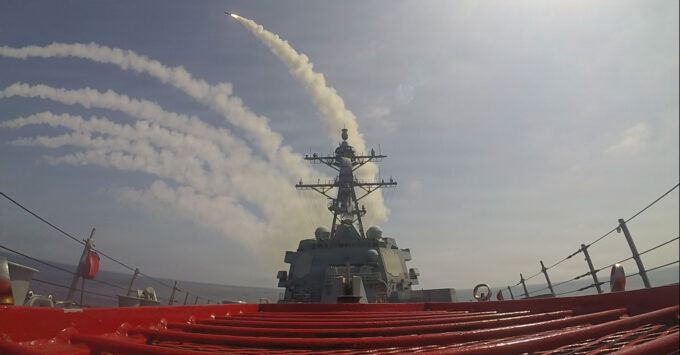
Arleigh Burke-class guided-missile destroyer USS Frank E. Petersen Jr. (DDG 121) fires a Tomahawk Land Attack Missile during operations in support of Operation Epic Fury, Feb. 28, 2026. (U.S. Navy Photo)

The limits of deterrence in the Iran war

On August 17, the 60-day deadline set by the June U.S.-Iran agreement expired without a final peace settlement. Tehran, meanwhile, warned that it was preparing to adopt a fully offensive posture in the Strait of Hormuz if diplomacy failed. The moment exposed the central problem confronting the United States in its prolonged confrontation with Iran: the question is no longer whether American military power can destroy targets. It plainly can. The harder question is whether destroying those targets can produce the political outcomes Washington seeks. After months of strikes, counterstrikes, threats, and negotiations, the answer is increasingly clear: weapons can destroy capabilities, but they cannot by themselves produce a political settlement.

That gap is the strategic weakness at the heart of the conflict. Washington possesses overwhelming conventional military superiority, yet firepower has not translated into political control. What began as an effort to eliminate specific Iranian threats has expanded into a confrontation involving Iran’s missile forces, nuclear infrastructure, regional networks, Gulf security, and the Strait of Hormuz. The result is not strategic resolution but a cycle in which each military action creates incentives for another.

Airpower is exceptionally effective at destroying physical targets. It can damage command centers, launchers, infrastructure, and military formations. But destroying targets is not the same as achieving political objectives. The danger is that Washington increasingly treats bombing as a shortcut to strategic success.

That is the essence of bombing without strategy: military operations become the strategy itself rather than an instrument of strategy. A coherent strategy should begin with a political objective and then determine how military force can contribute to achieving it. In the present conflict, that sequence increasingly appears to have been reversed.

Washington strikes to demonstrate resolve; Iran retaliates to demonstrate resilience; Washington threatens further escalation to restore deterrence; Tehran responds by raising the costs of escalation. Each side can claim tactical successes while the underlying political problem remains unresolved. Once credibility becomes tied to the willingness to use force, stepping back from escalation can itself be portrayed as weakness. The result is a strategic trap: force is used again because it was used before.

The Limits of Deterrence

Deterrence is not simply a matter of possessing superior weapons. It works when an adversary believes that continued resistance will impose unacceptable costs, and when those costs are sufficient to alter its political calculations. Washington has repeatedly tried to restore deterrence through escalation. But deterrence cannot be measured by the scale of a bombing campaign. The relevant question is whether the opponent changes its behavior as a result.

Iran’s response shows why that calculation is more complicated. Rather than collapsing under military pressure, Tehran has sought to increase the economic and political costs of the war, including through pressure on regional infrastructure and the Strait of Hormuz. This creates a paradox. The more Washington relies on military pressure to reassert deterrence, the stronger Iran’s incentive to expose the limits of American power. Deterrence therefore becomes reciprocal rather than unilateral: the United States seeks to convince Iran that escalation is too costly, while Iran seeks to convince Washington that continued escalation is costly as well.

For that reason, the assumption that every additional strike automatically strengthens American deterrence is misleading. A strike that fails to alter an adversary’s political calculations may display military capability without producing deterrence.

The conflict increasingly looks less like a coherent campaign designed to terminate the war and more like a succession of shows of force. Washington can destroy Iranian facilities; Iran can launch missiles and drones and threaten regional infrastructure. Both sides can prove their ability to inflict pain. But the ability to inflict pain is not the same as strategic success. Indeed, the need to demonstrate power again and again can itself expose the weakness of the previous demonstration.

If the first bombing campaign was supposed to establish deterrence, why is another required? If subsequent strikes were intended to force political concessions, why do negotiations remain necessary? And if American military superiority has already been demonstrated, why does Washington still confront the fundamental problem of persuading Tehran to accept an agreement?

The pattern risks becoming a cycle in which each new escalation is presented as the final warning, only to become the prelude to another round. Washington’s periodic return to negotiations exposes precisely this limit of military coercion. Even after extensive military operations, the desired end state ultimately requires political bargaining. That does not mean military power is irrelevant. It means military power has a ceiling.

That ceiling matters because the fundamental strategic mistake is to confuse degradation with transformation. American weapons can degrade Iranian military capabilities, destroy infrastructure, and increase the material cost of resistance. But they cannot determine who governs Iran, what Iranian elites believe, how Iranian society responds to external attack, what political coalition emerges after the war, or what terms Tehran will ultimately accept.

The distinction is particularly important in Iran. The country is not simply a collection of military installations. It is a large state with multiple institutions, competing political factions, and deep security structures. Military strikes can alter the balance of capabilities, but they do not automatically produce political compliance.

External attack can even strengthen the political structures that military pressure is intended to weaken. Security institutions may gain greater influence, political opponents can be portrayed as collaborators, and the leadership can frame resistance as a matter of national survival. Military pressure can certainly alter calculations. But altering calculations is not the same as controlling outcomes.

The same problem appears at the point of exit. The deepest weakness of the current approach is political rather than operational: Washington has demonstrated that it knows how to escalate, but it has struggled to define what successful termination looks like. A military campaign requires an end state. Without one, tactical success becomes strategically ambiguous. Destroying a missile factory may be militarily successful, but if Iran rebuilds it, what was achieved politically? Damaging nuclear infrastructure may delay a program, but if the consequence is renewed determination to preserve that capability, has the strategic problem been solved?

The United States remains vastly more powerful militarily than Iran. But the relevant measure of strategic effectiveness is not the number of targets destroyed. It is whether military action moves the conflict toward a stable political settlement. The continuing confrontation around the Strait of Hormuz illustrates the problem. Iran’s ability to disrupt maritime traffic has created a strategic challenge extending beyond the original military objectives. The fact that negotiations continue to revolve around issues such as the Strait, sanctions, and the cessation of hostilities demonstrates that the war cannot be concluded through bombardment alone.

From Escalation to Strategy

The alternative is not surrender or unilateral concession. It is strategy. Washington needs to distinguish between what its military can destroy and what its diplomacy must accomplish. Military force can create leverage; it cannot determine the final political bargain. It can raise costs; it cannot decide what costs an adversary is willing to absorb. It can delay capabilities; it cannot eliminate the political motivations that produced them.

The lesson, then, is not that American military power is weak. Quite the opposite. The United States possesses extraordinary destructive capacity. The problem is that destructive capacity has been mistaken for political leverage.

The danger now is that Washington responds to the failure of coercion with more coercion: more strikes, larger targets, and broader escalation. That would amount to repeating the same strategic experiment while expecting a different result.

The central question is no longer whether the United States can bomb Iran again. It unquestionably can. The question is what happens after the bombing. Without a credible answer, another campaign risks becoming merely another failed show of force: spectacular in tactical execution, potentially devastating in its consequences, but strategically incapable of producing the political outcome it was intended to deliver.

Weapons can destroy infrastructure. They can degrade armies. They can impose costs. But weapons cannot negotiate treaties, construct legitimacy, reconcile political interests, or decide the future of a state. Those are political tasks. Until Washington treats them as such, the war will remain a cycle of military action in search of a strategy rather than military action in service of one.

Sarah Neuman is an adjunct professor of political science at Humboldt University of Berlin.

Presidential Entitlement to Kill: The 1998 Bombing of Sudan


 August 28, 2026

Bill Clinton on the phone in the Oval Office. Photo: White House.

Last week was the 28th anniversary of the U.S. government bombing of a pharmaceutical factory in Sudan. Scott Horton, director of the Libertarian Institute, observed last week that that wanton assault by the Clinton administration “helped make a folk hero out of bin Laden, drove up recruitment for Al Qaeda and made it more difficult for the Taliban to give him up.” Operation Infinite Reach was a farce of the first order – and may have helped pave the way to the September 11 attacks.

That carnage resulted in a federal court ruling that practically gave presidents a license to kill any time that they claimed to have good intentions.

On August 7, 1998, two trucks loaded with explosives detonated nearly simultaneously, wrecking U.S. embassies in Nairobi, Kenya, and Dar es Salaam, Tanzania, killing 224 people, including 12 Americans, and wounding more than 4,000.

The U.S. government quickly concluded that the embassy attacks had been an al-Qaeda operation. Twelve days later the Clinton administration launched Operation Infinite Reach. In a failed attempt to kill Osama bin Laden, scores of Tomahawk cruise missiles struck al-Qaeda terrorist training camps in Afghanistan. Thirteen cruise missiles launched from U.S. ships in the Red Sea destroyed the El Shifa factory in Khartoum, Sudan.

President Clinton announced that “our goal was to destroy, in Sudan, the factory with which bin Laden’s network is associated.” Clinton declared that the attack on the “chemical weapons-related facility” was an “exercise of our inherent right of self-defense … to prevent and deter additional attacks by a clearly identified terrorist threat” and that the “terrorist-related facilities in Afghanistan and Sudan” were hit “because of the imminent threat they presented to our national security.”

In Washington press conferences on the day of the attack, National Security Adviser Sandy Berger continually referred to the “so-called pharmaceutical plant.” When a “senior intelligence official” speaking at a Pentagon briefing was asked, “What is this pharmaceutical facility supposed to make?” he replied, “We have no evidence – or have seen no products, commercial products that are sold out of this facility. The facility also has a secured perimeter and it’s patrolled by the Sudanese military.”

But the plant was actually wide open to visitors and had been visited by U.S. government officials, World Health Organization officials, and foreign diplomats in the months before the U.S. attack. There was no Sudanese military presence near the plant.

Earlier in 1998, El Shifa had been awarded (with U.S. government approval) a UN contract to ship a hundred thousand cartons of a veterinary antibiotic medicine to Iraq under a special exemption to the UN embargo on that country. In the days after the attack, journalists reported that the factory grounds were littered with “melted packets of pain relievers and bottles of antibiotics.” Before the smoke had ceased rising from the rubble, it was undeniable that El Shifa was the largest pharmaceutical producer in the Sudan.

The factory was destroyed in part because, when CIA whiz kids searched the Internet for information on it, the El Shifa website did not contain a list of drugs the factory manufactured. This supposedly proved the factory was a chemical-weapons site that must be destroyed.

Defense Secretary William Cohen announced, “We do know that [bin Laden] has had some financial interests in contributing to the – this particular facility.” Salah Idris, a Saudi Arabian banker and industrialist, bought the plant five months before the United States destroyed it, but the U.S. government was unaware that the factory had changed hands. After Idris approached the U.S. government to seek to correct its mistaken assumptions about bin Laden’s ownership, the U.S. government responded by notifying the Bank of America to freeze $24 million in Idris’s bank accounts in the United Kingdom under a U.S. regulation covering “pending investigations of interests of Specially Designated Terrorists.” U.S. government officials claimed to possess secret evidence linking Idris to bin Laden. Yet, though the freeze was based on suspicions that Idris was a terrorist financier, the U.S. government never bothered to officially list him as such.

Cohen announced that “the facility that was targeted in Khartoum produced the precursor chemicals that would allow the production of a type of VX nerve agent.” Administration officials stressed that the “only known use [of the precursor chemical discovered] is as a precursor ingredient in the nerve gas VX.” In reality, the precursor ingredient – known as EMPTA – is also used in pesticides.

El Shifa factory in Khartoum, Sudan. Photo: Wikimedia, Bertramz. CC BY-SA 3.0.

The Clinton administration’s smoking gun was little more than a cupful of dirt that a “CIA operative” had scooped up in December 1997 across the street from the factory – 60 feet from the factory entrance and on someone else’s property. The CIA did not bother to test the soil sample until July 1998. Former CIA official Milt Bearden later observed, “Never before has a single soil sample prompted an act of war against a sovereign state.”

The Clinton administration possessed a much stronger case for attacking the terrorist training camps in Afghanistan than the factory in the Sudan. But, especially with a name like “Operation Infinite Reach,” hitting only one country simply would not do. National Security Council official Richard Clarke later explained that since bin Laden showed his “global reach” by bombing U.S. embassies in two countries, President Clinton “obviously decided to attack in more than one place.”

In his August 20 announcement, Clinton declared, “Afghanistan and Sudan have been warned for years to stop harboring and supporting these terrorist groups. But countries that persistently host terrorists have no right to be safe havens.”

Two weeks after the bombing, the Sudanese ambassador to the United States, Mahdi Ibrahim Mahammad, declared that in May 1998 he had “delivered a formal letter of invitation to a senior official in the Federal Bureau of Investigation, offering to establish a joint effort between our two countries to see the possibilities, to explore them, of working together against international terrorism.” The United States scorned the Sudanese offer. Mahammad was angry that the U.S. government blocked a Sudanese request for a UN investigation of the bombing.

When State Department Undersecretary Thomas Pickering was asked why the U.S. government opposed a Sudanese request for an independent investigation headed by former President Jimmy Carter, Pickering replied, “I’ve just presented the evidence very clearly, I think, on why this was a target. I don’t believe that an international investigative committee needs to have an additional role. The evidence, in our view, is clear and persuasive.’

But the primary evidence presented was the assertion by a government official that the U.S. government possessed secret evidence – which, of course, it could not reveal.

The cruise missile attack came three days after President Clinton, in a deposition with Independent Counsel Ken Starr’s legal team, finally admitted he had had an “inappropriate” relationship with White House intern Monica Lewinsky. Clinton gave a brief television address on August 17 during which he seemed nearly out of control with rage. Lewinsky was returning to the grand jury for additional testimony on the day that Clinton bombed Afghanistan and Sudan – giving rise to the nickname “Monica’s Missiles” for the attacks.

In a speech eight days after the attack, Clinton bragged to an audience about how he had sacrificed himself to protect innocent Sudanese:

“The night before we took action against the terrorist operations in Afghanistan and Sudan, I was here on this island [Martha’s Vineyard], up until 2:30 in the morning, trying to make absolutely sure that at that chemical plant there was no night shift…. I didn’t want some person, who was a nobody to me but who may have a family to feed and a life to live and probably had no earthly idea what else was going on there, to die needlessly.”

One factory watchman was killed and ten other people were injured in the attack.

Clinton did not have a second thought about destroying the largest pharmaceutical factory in one of the poorest nations on Earth. The Sudanese, like many others in the Third World, cannot afford the more-expensive drugs produced in Western countries. El Shifa was the largest producer of malaria tablets in Africa. In the months after the attack, Sudanese government officials blamed the U.S. attack for a severe malaria epidemic.

Twelve days after the bombing, Defense Secretary Cohen “insisted that the incomplete intelligence was irrelevant to President Clinton’s decision to destroy” the factory, the New York Times reported. Cohen told reporters that the U.S. government “did not learn until at least three days after the attack on the plant that it made medicine.” This raises questions about government officials’ reading speeds, considering that the news was splashed all over the world’s media within hours of the attack.

Idris, the factory owner, hired one of the most respected law firms in Washington to file suit to have his assets unfrozen. On the day before the U.S. government was obliged to respond to his claims in federal court, it threw in the towel and permitted Idris to reclaim his $24 million. When Idris filed a second lawsuit to receive compensation for the destruction of his factory, the U.S. government effectively invoked sovereign immunity, refusing its permission to the lawsuit and thereby eliminating any chance for recompense.

The U.S. attack on the Sudanese factory exemplified a fatal mixture of bad intelligence and crass politics. When the operation turned out to be a fiasco, there was a total evasion of responsibility. Instead, the Clinton administration preferred to repeat banalities about the evil of terrorists. Clinton portrayed the destruction of the factory as a triumph of American idealism:

“Terrorists must have no doubt that in the face of their threats, America will protect its citizens and will continue to lead the world’s fight for peace, freedom, and security…. America is and will remain a target of terrorists precisely because … we act to advance peace, democracy, and basic human values; because we’re the most open society on Earth.”

Despite the lofty rhetoric, Clinton’s action, at best, did nothing more than protect Americans from Sudanese horse pills.

That Clinton shot at and missed bin Laden in the wake of the 1998 embassy bombings may have been the best thing that ever happened to bin Laden. At the time of the embassy bombings the Taliban were on the verge of expelling him from Afghanistan; they considered him to be a rude, trouble-making, publicity-hungry guest. But as a Wall Street Journal analysis concluded, the U.S. retaliation “turned Mr. bin Laden into a cult figure among Islamic radicals, made Afghanistan a rallying point for defiance of America and shut off Taliban discussion of expelling the militants. It also helped convince Mr. bin Laden that goading America to anger could help his cause, not hurt it.”

The New York Times concurred, noting that the failed U.S. counterstrike converted bin Laden into a “hero” and a “revered figure” among many Muslims.

Though the bombing policy was outrageous, it took a federal appeals court to convert one atrocity into a perpetual presidential license to kill. This doctrine provides a “get out of jail free” card for any president who itches to bomb foreign nations. The owners of the El-Shifa Pharmaceutical Industries plant—the largest pharmaceutical factory in East Africa—sued for compensation after Clinton’s attack demolished their facility. Eleven years later, a federal appeals court dismissed the case: “President Clinton, in his capacity as commander in chief, fired missiles at a target of his choosing to pursue a military objective he had determined was in the national interest. Under the Constitution, this decision is immune from judicial review.” Determinations based on secret (often false) information legally absolved presidents of any killings or calamities abroad.

As long as the president or his spokesmen claim benevolent motives, any killings they authorize are legally sacrosanct. This legal doctrine provided the shield for President Obama’s assassination program that claimed a right to kill Americans without a trial, without notice, and without any chance for targets to legally object.  The only legal liability for that program was limited to former NSA contractor Daniel Hale, who was convicted and imprisoned for disclosing that the Obama administration had no idea who it was killing with its drones and missile attacks abroad.

Unfortunately, few Americans realize that the U.S. government’s pattern of reckless bombing began long before George W. Bush’s 2003 invasion of Iraq.  Likewise, President Donald Trump’s bombing campaigns and invasions have thus far been impossible to thwart on the homefront.

** An earlier version of this piece was published by the Libertarian Institute.

James Bovard is the author of Attention Deficit Democracy, The Bush Betrayal, and Terrorism and Tyranny. His latest book is Last Rights: the Death of American Liberty. Bovard is on the USA Today Board of Contributors. He is on Twitter at @jimbovard. His website is at www.jimbovard.com