Friday, September 25, 2026

‘The Billion Dollar Deal’: Senate Democrats Detail How Trump Serves Fossil Fuel Industry

“Our new report exposes this old-fashioned corruption, by a thuggish government and a desperate industry, that is squeezing every last dollar out of Americans’ pocketbooks while they still can.”
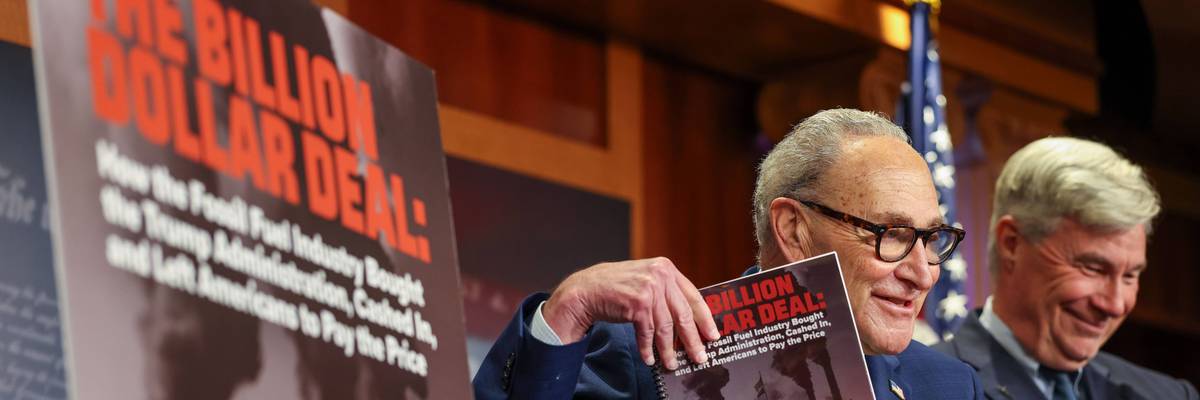


US Senate Minority Leader Chuck Schumer (D-NY) and Sen. Sheldon Whitehouse (D-RI) speak at a press conference on the fossil fuel industry’s connections to the Trump administration at the Capitol in Washington, DC on September 24, 2026.
(Photo by Tasos Katopodis/Getty Images)


Jessica Corbett
Sep 24, 2026
COMMON DREAMS

While running for president in 2024, Donald Trump told oil and gas executives that he would pursue their policy priorities if the industry raised $1 billion for his campaign—and after returning to office last year, the Republican did just that, enriching those invested in fossil fuels, including himself, at the expense of the public and planet.

That’s according to “The Billion Dollar Deal: How the Fossil Fuel Industry Bought the Trump Administration, Cashed In, and Left Americans to Pay the Price,” a report released Thursday by US Senate Minority Leader Chuck Schumer (D-NY) and Committee on Environment and Public Works Ranking Member Sheldon Whitehouse (D-RI).

“The fossil fuel industry and their allies bought their way into the Trump White House with hundreds of millions of dollars in political donations, after Trump promised fossil fuel bigwigs at a Mar-a-Lago fundraiser that he’d do anything and everything they wanted, for the right price,” Whitehouse said in a statement.

“Now, their minions run the government from the inside, driving up energy bills to deliver payouts to the donors that put Trump back in office,” he continued. “Our new report exposes this old-fashioned corruption, by a thuggish government and a desperate industry, that is squeezing every last dollar out of Americans’ pocketbooks while they still can.”

The report is based on 19 investigations into Environmental Protection Agency (EPA) regulatory rollbacks, 13 probes of nine other agencies, and 13 investigations into 88 separate polluters. Investigators from Schumer’s Anti-Corruption Working Group examined campaign finance filings, corporate earnings, and investor communications.

The document details how, in the aftermath of Trump’s quid pro quo offer at the Mar-a-Lago fundraiser in 2024, fossil fuel executives, along with their corporate political action committees (PACs) and dark money groups, contributed an estimated $201 million to support Trump and allied Republican lawmakers—plus $19 million toward the inaugural fund.

“These figures capture only traceable donations,” the report emphasizes. “Other substantial sums flowed to candidate Trump through 501(c)(4) organizations that are not legally required to disclose their contributors. Dark money groups—nonprofits and shell companies that do not reveal their donors—contributed over $1.9 billion into the 2024 elections, up from $1 billion in 2020.”

The report names key figures from “the fossil fuel donor class” and includes their estimated contribution to Trump’s latest election:Oil and banking heir Timothy Mellon: $151.5 million
Energy Transfer executive chair Kelcy Warren: $11 million
Elliott Management co-CEO Paul Singer: $8 million
CrownQuest Operating CEO Tim Dunn: $5 million
Continental Resources executive chair Harold Hamm: $4 million
Midland Energy founder and CEO Syed Javaid Anwar: $2 million
GeoSouthern Energy CEO George Bishop: $2 million
Alliance Resource Partners CEO Joseph Craft III: $2 million
Hilcorp Energy executive chair and founder Jeffery Hildebrand: $1.7 million
Sunoco board chari Ray Washburne: $611,000

There’s also former Liberty Energy CEO Chris Wright, who is now Trump’s energy secretary and gave an estimated $795,000. According to the report, “Lobbyists say that many CEOs now keep Secretary Wright’s personal phone number on speed dial.”

Wright is among at least a dozen former oil executives and lobbyists Trump installed at the EPA and departments of Energy, the Interior, and Justice to systematically dismantle “the regulatory architecture built over decades to protect American families from pollution and climate change,” the publication points out. “Those captured agencies delivered for the fossil fuel industry.”

The report calls out not only Wright but also Trump’s other “polluter worker bees,” including EPA Administrator Lee Zeldin, Interior Secretary Doug Burgum, and various other officials at their agencies who have ties to polluting industries.

It also calls out the GOP-controlled Congress, which last year sent to Trump’s desk the One Big Beautiful Bill Act, a law that includes “tens of billions in new and expanded direct subsidies to fossil fuel companies through tax breaks, royalty cuts, a suspension of the charge on methane pollution, and other giveaways. Combined with the subsidies already on the books, independent analysts estimate the industry will collect some $190 billion in tax breaks and subsidies over the next 10 years.”

“The costs of these gifts to the fossil fuel industry fall on everyone else,” the report stresses. “Climate-related disasters cost the United States at least $115 billion in direct damages in 2025 alone. Each year, the damages to public health from fossil fuel air pollution run at about $820 billion, or $2,500 per American, and contribute to approximately 91,000 premature deaths and 216,000 new cases of childhood asthma. Homeowners’ insurance has become unaffordable or unavailable across many parts of the country. These are just some of the existing costs associated with fossil fuel production and combustion.”
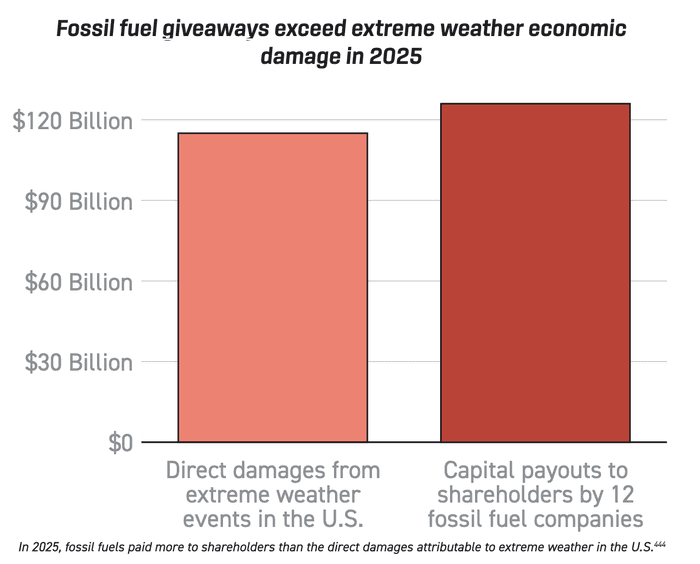


“The Trump administration’s regulatory rollbacks will drive them higher, as air and water pollution as well as climate change will all get worse,” the document warns, as the fossil fuel-driven climate emergency worsens, with deadly consequences worldwide.

The report notes that “canceled and delayed wind and solar projects are also raising electricity prices for consumers in multiple states, sending billions to fossil fuel plants. And the EPA itself has estimated that the elimination of tailpipe emission standards will cost Americans a minimum of $580 billion in added fuel costs alone over the next three decades. Hundreds of thousands of jobs are being lost as the United States cedes its industrial competitiveness in clean energy technologies to China and Europe.”

Trump also partnered with Israel to launch an illegal war on Iran—which has responded by restricting ship traffic through the the Strait of Hormuz, sending global fuel prices soaring. The publication highlights that “the 100 biggest oil and gas companies collectively earned an extra $30 million per hour in the first month of the Iran conflict alone—amounting to $23 billion in windfall profits—with $234 billion projected by year’s end if oil prices remain near $100 a barrel.”

“As the Trump administration’s war in Iran drives up gas prices—with analysts warning crude prices could reach $200—American
consumers pay directly for the chaos that Big Oil’s political investments helped purchase,” the report warns. Brown University’s Costs of War Project estimates the higher diesel and gasoline prices have so far cost Americans $115.7 billion, or $883 per household.


Trump’s war is also filling his own pockets. CNBC estimated earlier this month that the president has made up to $4.4 million from his investments in fossil fuel companies—and as Common Dreams reported earlier this week, he continues to make related trades.

“Donald Trump will always choose self-enrichment over helping American families, and as this report reveals, his fossil fuel corruption is costing Americans billions,” said Schumer. “Instead of using the presidency to address the affordability crisis, lower costs, and protect Americans’ health and safety, Trump has used his power to deliver for his billionaire buddies in the fossil fuel industry. The message from this administration is clear: Big Oil gets the profits, and American families get the bill.”

Released less than six weeks away from the midterm elections, Senate Democrats’ report not only lays out a range of issues, but offers some fixes, including demands to tax the windfall profits of Big Oil, as well as legislation that would “shine a light behind the dark money front groups and shell organizations that fossil fuel interests use to hide their spending.”

The report also calls for making polluters pay for planet-heating emissions and empowering lawsuits to hold them accountable. It further advocates for ending fossil fuel subsidies and directing that money to clean energy, consumer relief, and infrastructure resilience.

“The Trump administration is pumping public money into the fossil fuel industry and stripping public protections to pad the profits of some of the wealthiest corporations in the nation,” David Arkush, director of Public Citizen’s Climate Program, said in response to the report. “The campaign contributions to Donald Trump by Big Oil have paid dividends and have allowed the fossil fuel industry to continue to pollute our communities.”

“This administration has ceded our nation’s clean energy future to dirty energy and is doing its best to sacrifice the economy, public health, and the environment to Big Oil’s profits,” he added. “Every American family struggling with high costs is suffering because of the corrupt relationship between Donald Trump and the fossil fuel industry.”
Intensified by Fossil Fuel-Driven Climate Crisis, ‘Godzilla-Level’ El Niño Smashing Records Ahead of Peak

“As long as we continue to burn fossil fuels,” said one scientist, El Niño “occurs on an increasingly hotter baseline, making it much more difficult for communities to deal with the consequences.”


A firefighter douses flames as they push toward homes during the Creek Fire in the Cascadel Woods area of unincorporated Madera County, California on September 7, 2020. The El Niño event of 2026 is expected to cause a variety of extreme weather, including dry conditions in some regions and extreme rainfall in others, in 2027.
(Photo by Josh Edelson/AFP/Getty Images)

Julia Conley
Sep 22, 2026
COMMON DREAMS

Although “El Niño comes and goes,” as one climate scientist said of the naturally occurring warm-weather phenomenon on Monday, experts are in agreement that this year is different—with meteorologists already recording a temperature rise of 3.07°C in the Pacific Ocean, putting it at a statistical tie with November 2015, when El Niño caused the ocean to warm by 3.08°C.

The temperature rise is not expected to peak until November and December, when an average of 14 models examined by Zeke Hausfather of Carbon Brief and Berkeley Earth found that a temperature rise of 4.1°C is forecast.

The event has been underway since June, Hausfather wrote, and has been gathering strength “faster than any previous event on record.”

Scientists typically track the strength of El Niño—which leads to heavy rainfall, higher global temperatures, and other extreme weather as warmer Pacific waters are pushed to the south—using the Niño 3.4 anomaly, or ONI, which determines how much hotter the central Pacific is compared with a 30-year rolling average.

A temperature rise above 2.0°C is considered a “very strong” El Niño, and scientists and policymakers are already calling this year’s event a “super El Niño,” with some experts using the terms “Godzilla-level” and “jaw-dropping” to describe the weather conditions that can be expected in the coming months due to the warmer climate.

As Common Dreams reported late last month, planetary heating driven by fossil fuel emissions is intensifying El Niño, while the naturally occurring phenomenon can in turn worsen the impacts of the climate emergency.

In the last 40 years scientists have recorded a 16% increase in the strength of El Niño events, according to a study published in Science last month. They’ve also gotten 36% stronger than they were before industrialization began.

The “double whammy,” as The Guardian called it, could make 2027 the hottest year ever recorded, blowing through heat records that have just been set this year—and that have been linked to the deaths of people around the world from extreme heat and flooding.

“This event is a huge redistribution of energy in the climate system and is dangerous because it is unfolding on top of a much warmer, human-influenced climate system,” climate scientist Friederike Otto of Imperial College London told The Guardian. “So, in many places around the world we will see never-before-experienced heat extremes, with all their consequences on health, food security, and water stress.”

Despite the fact that El Niño predates the human-caused climate emergency, Otto said, “as long as we continue to burn fossil fuels, it occurs on an increasingly hotter baseline, making it much more difficult for communities to deal with the consequences.”

This year’s event is likely to be the most intense El Niño in 1,000 years, reported to The Guardian, with hotter and drier conditions already linked to deadly wildfires in Indonesia and crop losses in Central America and the Caribbean region due to drought conditions. Rice production this season is expected to fail in Indonesia, according to the Salata Institute for Climate and Sustainability at Harvard University.

As the Southern Hemisphere’s summer months approach, southern Africa and Australia are at heightened risk of wildfires and droughts as well. Meanwhile, cocoa production could be damaged by extreme rainfall in parts of South America.


“All strong El Niño events on record have continued to strengthen well into the winter—and the models are in near-unanimous agreement that this one will, too,” wrote Hausfather at Carbon Brief. “If the forecast holds, the current event will peak between November and January at a level far beyond any event previously observed in the instrumental record.”

In California on Monday, Democratic Gov. Gavin Newsom declared a state of emergency in an effort to prepare communities for El Niño’s impacts in the coming months, which could include coastal flooding and heavy snow in mountain regions.

Hausfather noted that strong El Niño events like those that occurred in 1997 and 2015 were also “associated with hundreds of billions of dollars in damages globally.”

“This event,” he told The Guardian, “is leaving those past ones in the dust.”

‘The Diagnosis Is Unambiguous’: 2026 Planetary Health Report Finds Pressure Mounting on Earth Systems

“Seven of nine planetary boundaries are transgressed, and pressure on all seven is at its highest recorded level,” said one scientist.


A protester is seen in Los Angeles during a climate change demonstration holding a placard that says, “There is no Planet B.”
(Photo by Ronen Tivony/SOPA Images/LightRocket via Getty Images)


Julia Conley
Sep 21, 2026
COMMON DREAMS

Like other recent warnings from climate scientists, the message sent by the latest Planetary Health Check report on Monday was clear: “We need to move fast,” as the director of the Potsdam Institute for Climate Impact Research, the group behind the report, said.

“Seven of nine planetary boundaries are transgressed, and pressure on all seven is at its highest recorded level,” said Johan Rockström, director of the Potsdam Institute (PIK).

The report finds that seven measures of the Earth’s health are no longer within the “safe operating space”: ocean acidification, freshwater change, land system change, climate change, modification of biogeochemical flows, introduction of novel entities, and change in biosphere integrity.

Just two markers, stratospheric ozone depletion and the increase in atmospheric aerosol loading, have shown improvement over the last decade, said the Planetary Boundaries Science Lab at PIK.


“The diagnosis is unambiguous,” said Boris Sakschewski, the lead author of the report. “Pressure is rising across every planetary boundary already outside the safe operating space. It means that the risk of large-scale, persistent, and potentially irreversible change is increasing, while our margin for error in tackling these problems is shrinking.”

The scientists behind the report emphasized that with recent news regarding the state of the planet’s crucial coral reefs, forests, and extreme weather events like heatwaves and flooding, it should come as no surprise that the Earth’s boundaries have been transgressed, as continued fossil fuel emissions have caused runaway planetary heating.

Earlier this month, United Nations scientists said the planet can no longer avoid at least a temporary temperature rise above 1.5°C over preindustrial levels.

Oceans have also become so warm that stressed coral reefs have less and less time to recover from climate damage, as Common Dreams reported last month, and a UN report last year found that the world’s governments are not moving fast enough to end the destruction of forests.

Last month and the summer of 2026 both set heat records, with extreme heat killing more than 1,000 people across Europe, and wildfires spreading across the continent and Canada. Record-breaking heat was also recorded in parts of Asia and the Middle East.

In June, the UN Children’s Fund found that nearly every child on Earth is now exposed to at least one climate hazard driven by fossil fuel emissions, including flooding, heatwaves, and drought.

“Pakistan’s 2025 monsoon floods affected more than 6.9 million people,” said PIK. “Global ocean heat content reached a new record in 2025, with Hurricane Melissa rapidly ramping up to a Category 5 hurricane and striking Jamaica after passing over exceptionally warm seas. From January 2023 to September 2025, bleaching-level heat stress impacted about 84.4% of the world’s coral reef area, making it the largest global coral-bleaching event observed to date.”

Hindou Oumarou Ibrahim, chair of Planetary Guardians, implored readers of the Planetary Health Check report to “read that list again: Pakistan, the Caribbean, Europe, the reefs beneath our oceans. These are not separate emergencies; the planet is telling us, in every region at once, that it is out of balance.”

“As chair of Planetary Guardians, I hear this same story wherever I go, whether from a pastoralist watching the rains fail season after season or a coastal community watching the sea rise,” said Ibrahim. “The 2026 Planetary Health Check puts data behind what communities on the frontlines already know from living it. We do not have the luxury of treating these as separate crises any longer.”

Rockström emphasized that while “we do not have the luxury of time... we do have the knowledge, capacity, and solutions to change course.”

“Accelerating action to return to the safe operating space across all planetary boundaries is essential to protect lives and livelihoods,” said Rockström, “and to deliver on the promise of shared future prosperity.”
Guterres Hailed for Fiery Outgoing Speech Demanding Polluters Pay for Climate Crisis

“We know that fossil fuel interests won’t step aside on their own,” said the UN chief. “When the harms of Big Tobacco became undeniable—governments acted. The climate crisis demands the same determination.”


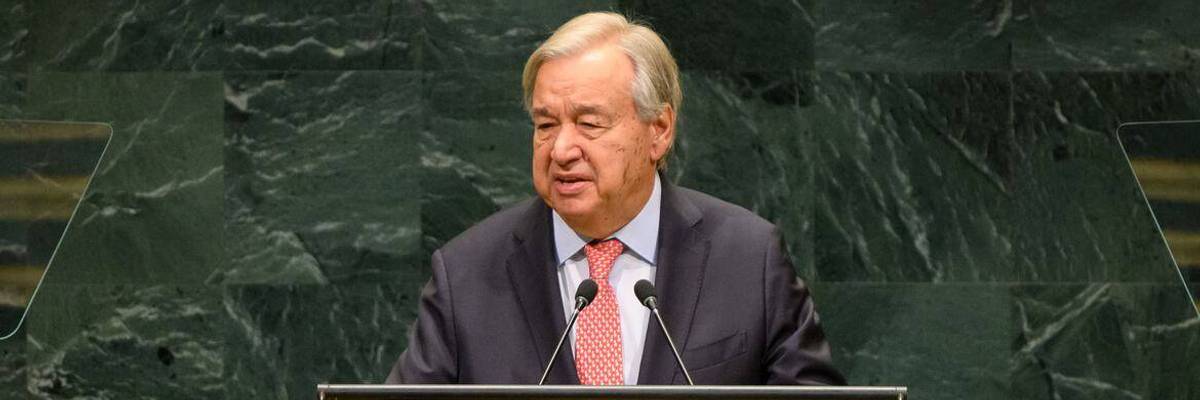
United Nations Secretary-General António Guterres addresses the opening of the general debate of the UN General Assembly’s 81st session in New York City on September 22, 2026.
(Photo by Loey Felipe/UN)

Jessica Corbett
Sep 22, 2026
COMMON DREAMS


With United Nations Secretary-General António Guterres set to leave his post at the end of this year, he used his final address to the UN General Assembly on Monday to share a familiar call: “Polluters must pay” for fueling the global climate emergency.

Since the Portuguese politician began his first five-year term leading the world body nearly a decade ago, he has repeatedly called for international action to rapidly phase out the coal, gas, and oil that are heating up the planet. In late 2023, he emphasized that “the science is clear. The 1.5°C limit is only possible if we ultimately stop burning all fossil fuels. Not reduce. Not abate.”

The UN chief announced at the end of 2024 that “the top 10 hottest years on record have happened in the last 10 years,” and declared: “This is climate breakdown in real time. We must exit this road to ruin.” Last year, he argued that fossil fuels represent “the greatest threat to energy security today,” and countries clinging to them are “sabotaging” their own economies and futures.

Earlier this month, after a UN report found that at least temporarily surpassing the Paris Agreement’s goal of limiting temperature rise this century to 1.5°C above preindustrial levels is now inevitable, Guterres stressed that “this summer’s scorching heat, raging wildfires, and deadly floods are a warning of what lies ahead,” and called for making the overshoot “as small and short as possible.”

Speaking to the General Assembly on Tuesday, he cited that recent finding: “Now we face a near-certain breach of the 1.5-degree limit, with a supersized El Niño speeding straight for humanity. The dangers are real. But so is the hope.”

“The sun belongs to no one. The wind cannot be embargoed. Innovation can come from everywhere,” he said. “Renewables are now the cheapest source of new electricity in most of the world. And the most viable path to energy security, independence, and sustainable growth... A future beyond fossil fuels is in sight. The question is how.”

“Will it be a just and orderly transition built on international cooperation—or chaotic and costly, leaving people and countries behind?” he asked, urging every government to adopt a Paris Agreement-aligned national plan to transition away from fossil fuels.

“We know that fossil fuel interests won’t step aside on their own. For decades, Big Oil has treated the atmosphere as an open sewer—and cashed in on the consequences,” he acknowledged. “We have seen this kind of abuse of power before. When the harms of Big Tobacco became undeniable—governments acted. The climate crisis demands the same determination.”


According to the UN chief: “Those who polluted the most—and profited the most—must do far more to repair the damage they caused. Polluters must pay. And to the leaders, cities, civil society and citizens working to hold them accountable: I say, you are on the right side of history. Keep going.”

“And governments must keep going on all fronts: To end deforestation. Invest in grids and storage. Cut methane emissions,” he continued. “But these actions are not enough: We need climate justice with a focus on adaptation and finance. Developed countries must respect their commitments. They must triple adaptation finance.And make the Loss and Damage Fund work at scale.”

“We must also ensure that the mining of critical minerals does not dig deeper into the inequities of the past,” he added. “Producing countries and affected communities must retain a far greater share of the value created from their resources. No more plundering. No more exploitation.”

While Guterres’ speech didn’t just focus on “the power fueling climate chaos and the war on nature”—it also addressed peace and security, inequality, and artificial intelligence in detail—climate campaigners welcomed the time he devoted to the crisis.


“When the UN secretary-general calls for fossil fuel companies to pay, you know this demand has become impossible to ignore,” said Louise Hutchins, co-convenor of the Make Polluters Pay International Coalition, in a statement. “Millions of people around the world are calling for it, and governments are starting to listen.”

His address came just a day after campaigners from groups around the world delivered over 2 million petition signatures calling on governments to make polluters pay to Selwin Hart, the UN’s assistant secretary-general for climate action, in New York City.

“For years, campaigners and communities on the frontlines have been saying the same thing: The companies that profited from fossil fuels must pay their fair share of the costs of the crisis they helped create. Today, that demand is moving into the mainstream,” 350.org executive director Anne Jellema noted after Guterres’ remarks. “The voices of more than 2 million people are now being brought to the UN. Governments have the power to make polluters pay, and they must use it.”


Amitabh Behar, executive director of Oxfam International, highlighted that “the people who have contributed least to the climate crisis are paying the highest price. They are losing homes, livelihoods, and access to food and facing an increasingly uncertain future, while fossil fuel corporations and their billionaire backers continue to profit. The call to make rich polluters pay is about justice. It is about ensuring that those who have benefited most from the fossil fuel economy pay for the damage it has caused.”

Greenpeace International executive director Mads Christensen pointed out that “Guterres has spent years warning leaders where fossil fuel dependence leads, and this year proved him right. From deadly heat to devastating fires and floods, the very dependence driving these disasters is shaking entire economies and leaving families exposed to volatile energy and food prices, while the companies behind it keep raking in the profits.”

“New rules forcing governments to align their taxes and spending with global climate goals would raise hundreds of billions of dollars to support the countries and communities least responsible, while incentivizing money out of fossil fuels and into secure, renewable energy that actually protects people,” he argued. “As long as destruction stays profitable, the transition to a safer, fairer future will keep being held back. Guterres has named the solution, governments must now act on it.”
‘Mamdani Moment’ in Germany as Leftist Elif Eralp in Line to Be Next Mayor of Berlin

A Left Party official said its strategy for the Berlin election was “explicitly inspired... by Zohran Mamdani’s campaign.”


German socialist Left Party’s lead candidate for Governing Mayor of Berlin, Elif Eralp, makes statements alongside party officials on election results at the state parliament in Berlin, Germany, on September 21, 2026.
(Photo by Halil Sagirkaya/Anadolu via Getty Images)

Brad Reed
Sep 21, 2026
COMMON DREAMS

Germany’s Left Party on Sunday made history by winning the 2026 Berlin state election, putting its lead candidate, socialist Elif Eralp, in position to become mayor of the country’s largest city.

In all, the Left Party won 26% of the overall vote in the election, with the center-right Christian Democratic Union capturing 19% and the far-right Alternative for Germany winning 16% of the vote.


The two other center-left parties—the Greens and the Social Democratic Party of Germany (SPD)—won 14% and 12% of the vote, respectively.

A Sunday report from Bloomberg News described the Left Party’s victory in Berlin as a “Mamdani moment,” in reference to democratic socialist Zohran Mamdani’s upset 2025 win in the New York City mayoral race.

Like Mamdani, Eralp and her party put affordability at the center of their campaign, with a particular emphasis on the rising cost of housing in the city.

As described by Euronews in a Monday report, Eralp “called for tighter regulation of rents, more social housing, and further moves towards bringing large housing portfolios into public ownership.”

The Euronews report also noted the connection to Mamdani, citing a quote from Eralp last year arguing that “if a left-wing candidate can win in New York, then there’s no reason it can’t happen in Berlin.”

According to a Saturday report in The Washington Post, the Left Party recently sent a delegation to New York City to learn about Mamdani’s campaign and even met with some of the mayor’s advisers to talk political strategy.

Liza Pflaum, the head of digital communications for the Left Party and a member of the delegation, told the Post that while her party had already embraced “a clear focus on issues relevant to affordable living” two years ago, it also was “explicitly inspired... by Zohran Mamdani’s campaign.”

While the Left Party received the most votes in the election, it did not receive enough to form an outright majority, meaning it will need coalition partners to form a government.

The Greens and SPD have indicated they are willing to form a coalition with the Left Party, but have claimed the party has allowed antisemitism to flourish in its ranks—an allegation that conservatives have made against left-wing candidates and political leaders in the US as well.

Progressives have warned against the conflation of antisemitism and criticism of Israel.

Eralp has disputed accusations of antisemitism in her party, which have focused on comments about the Israel Defense Forces at a campaign event and the presence of “an allegedly militant activist” at an election victory party.

“I will do everything to ensure that Jewish people—just like Muslims, queer people, and everyone in our city—can feel safe,” said Eralp.
‘Good Luck With That’: Critics Mock Trump for Hyping ‘Deal’ With Belarus to Replace Canadian Fertilizer


“Canada exports more potash to the US than Belarus produces.”


Brad Reed
Sep 21, 2026
COMMON DREAMS

President Donald Trump drew ridicule on Monday when he announced he was working on an agreement to import potash, an important fertilizer for US farmers, from Belarus.

In a social media post, Trump claimed that the “massive deal” with Belarus would let the US import potash for “substantially less than we are currently paying to Canada,” which he described as “very good news for our Farmers and Ranchers.”

‘Misled’ and ‘Strung Along’ by Trump, Financial Pain of Farmers Grows as Costs Continue to Skyrocket

Canada supplies roughly 80% of all potash used by US farmers, and Trump’s trade war against America’s largest trading partner has been putting upward pressure the prices of all Canadian imports.

However, even if Trump’s deal to buy potash from Belarus comes to fruition, it is unclear how much relief it would provide to US farmers, who have been also been paying a heavy price his illegal war with Iran, which has led to record-high diesel fuel prices.

As noted by a Monday report from Bloomberg, Belarus in 2021 only shipped around 700,000 tons of potassium fertilizers to the US before trade with the nation was restricted following Russia’s invasion of Ukraine. Canada, meanwhile, supplied the US with more than 10 million tons of such fertilizers last year.

Bloomberg also pointed out that “Belarus doesn’t have enough capacity to supply large volumes to the US” at the moment “because production for the year is already under contract.”

There are also several logistical challenges to shipping large quantities of fertilizer from Belarus.

Oil market researcher Rory Johnston observed in a social media post that Belarus is a landlocked country with no easy way to export its products to the west after Lithuania terminated its transit agreement with the country at the start of the Ukraine conflict.

Canada, Johnston added, is “right next door.”

Journalist Diana Henriques offered a similar assessment of the challenges of importing potash from Belarus.

“It is 5,080 miles from Nebraska to Minsk,” Henriques wrote. “It is about 700 miles from Nebraska to Saskatchewan, the source of most Canadian potash. That’s gonna have to be one heckuva discount to cover the transportation differential.”

Ross O’Connor, former foreign affairs and national security advisor to Canadian Prime Minister Stephen Harper, was openly dismissive of Trump’s Belarus gambit.

“Good luck with that,” O’Connor wrote. “Canada exports more potash to the US than Belarus produces.”

David Ryan Miller, professor of government at American University, offered a satirical summary of Trump’s latest geopolitical maneuver.

“We are spurning our longtime democratic ally directly to our north in favor of an autocratic regime aligned with [Russian President Vladimir] Putin that is 4,000+ miles away,” Miller wrote. “We are very smart, serious people!”
TRUMP GESTAPO


ICE Denounced for Enacting ‘Official Government Policy of Disappearing People’

“Hiding prisoners from the courts is unconstitutional,” said one expert.


Detainees stand by a window inside the federal immigration center at Delaney Hall in Newark, New Jersey, where US Immigration and Customs Enforcement is housing detained immigrants on May 26, 2026.

(Photo by Adam Gray/Getty Images)

Brad Reed
Sep 21, 2026
COMMON DREAMS


Critics reacted with horror to a Monday report from The Associated Press detailing how US Immigration and Customs Enforcement has abruptly ended its practice of disclosing the locations of thousands of detainees.

According to the AP, ICE “has stopped publicly revealing where it is holding... detainees who are subject to final deportation orders, an unannounced move that has made it far more difficult for lawyers and relatives to find them.”


Immigration attorneys who spoke with the AP said that their clients had “vanished” from the system after ICE removed them from its online detainee locator system last week.

Greg Chen, senior director of government relations at the American Immigration Lawyers Association, told the AP that families of detainees “are freaking out because they think the person has been deported and they don’t know where the person might be.”

Chen added that the new policy has “serious implications” for attorneys’ ability to make contact with their clients.

Michelle Mendez, legal director at the National Immigration Project, told the AP that the new policy is “just another iteration of disappearing people.”

“Why would we do that in the United States of America?” Mendez asked. “It’s something we’d hear about in another country and be concerned about individual rights and due process.”

Tom Jawetz, senior fellow at the Center for American Progress, echoed Mendez’s analysis, writing in a social media post that the AP report reveals “an official government policy of disappearing people,” as “systems for attorneys and loved ones to know where—even whether—a person with a final removal order is in ICE custody have been wiped clean.”

Aaron Reichlin-Melnick, senior fellow at the American Immigration Council, described the new ICE policy as “unprecedented” for US immigration enforcement.

“People who have been detained for months are suddenly disappearing from the locator system—even if they haven’t been moved anywhere,” Reichlin-Melnick explained. “And people newly arrested are not showing up at all, their location now hidden from view.”

Georgetown University political scientist Jonathan Ladd argued that the ICE policy was a fundamental violation of long-established rights in the US that date to before the country’s official founding.

“The government moving or hiding jailed people to avoid review by courts isn’t some loophole in our habeas corpus rights,” Ladd explained. “This government behavior has been considered a violation of the people’s habeas corpus rights since at least the Habeas Corpus Act of 1679.”

Ladd further pointed out that “habeas corpus rights are guaranteed by Article I of our Constitution,” which means “hiding prisoners from the courts is unconstitutional.”

Journalist Gillian Brockell observed that the new ICE policy “will make it nearly impossible to file habeas petitions, because attorneys won’t even know what federal district their client has been moved to to stage for their removal.”

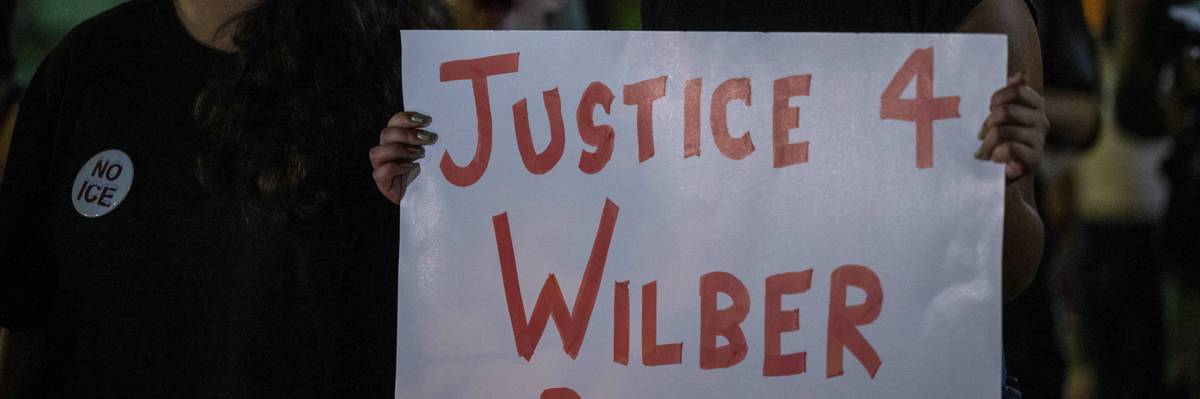
Among those sharing the AP report on social media was Kate Lincoln-Goldfinch, an attorney for Wilbur Rafael Garces Perez, a 28-year-old Venezuelan shot by ICE in Austin, Texas on Sunday.

Initially, she and the immigrant’s wife could not make contact with him, because ICE moved him from the hospital “to an undisclosed location,” but Lincoln-Goldfinch said Monday afternoon that her client “is being held at Pearsall for interrogation.”

“We got Wilber on the phone live from detention at the press conference,” the attorney added. “He says he still has the bullet lodged in his shoulder. He says he is not doing well and has not received the medical care he needs.”

Federal Judge Blocks DHS From Deporting Austin Man Shot by ICE


“DHS must not obstruct or otherwise interfere with this investigation by removing Mr. Garces Perez from the country,” said lawmakers.


Wilber Rafael Garces Perez, who was shot by an immigration agent on September 20, 2026, is seen in an undated photo.
(Photo: family photo via X)


Julia Conley
Sep 22, 2026
COMMON DREAMS


The attorney representing Wilber Rafael Garces Perez said Tuesday that a federal judge had granted her emergency request to block the Trump administration from deporting the 28-year-old delivery driver, who was shot by an immigration agent Sunday and has since been transferred multiple times between hospitals and a detention center—all while the officer’s bullet reportedly remains lodged in his back.

“We have filed a federal lawsuit, and the judge has ordered that he be present at the first hearing, which is scheduled for Wednesday, September 30,” said Kate Lincoln-Goldfinch. “And that means he won’t be deported in the meantime.”

Lincoln-Goldfinch applauded the rare piece of “good news” that has come out of Garces Perez’s case since he was shot by an Immigration and Customs Enforcement (ICE) agent while making DoorDash deliveries in his car Sunday afternoon.

As Common Dreams reported, Garces Perez was transferred from an ICE detention center in Pearsall, Texas to a hospital late Monday after reporting that he had lost feeling in the left side of his body, likely as a result of the bullet that remained close to his spine.

But Lincoln-Goldfinch and Rep. Joaquin Castro (D-Texas) said Tuesday that Garces Perez had again been taken back to the detention center.

Castro said he and Rep. Greg Casar (D-Texas) plan to visit Garces Perez at South Texas ICE Processing Center on Wednesday, to “check on his condition and demand his release.”

“It is nothing more than a prison,” said Castro. “Wilber came to the United States legally. He had work permits and was an asylum seeker. None of this should have ever happened.”

Garces Perez arrived in the US in 2024 from Venezuela, using a government program for asylum seekers and the CBP One app that was introduced by the Biden administration to make an appointment for approval from immigration agents. He received a work permit and applied for asylum.

He mistakenly missed an immigration hearing after a notice was sent to an old address, The New York Times reported, which led to his deportation order. He has no criminal history.

Lincoln-Goldfinch had been planning to visit her client in the hospital Tuesday, where he was taken after he called in to a press conference the lawyer was holding Monday and said that he had not received medical treatment for his gunshot wound.

After speaking to Garces Perez via a video call Tuesday morning, Lincoln-Goldfinch reported on social media:
Wilber tells me that after he spoke publicly, guards at the Pearsall detention center forcibly took the tablet from his hands, revoked his communication privileges, and moved him out of the infirmary into an isolated room with a flat bed that cannot be adjusted like a medical bed.

[...]

At the hospital, Wilber says doctors finally spoke directly to him about his care and gave him IV morphine for his pain. We now understand that the gunshot fractured his clavicle and that he has significant swelling and is wearing a sling. We still do not have clarity about the cause or extent of the loss of movement he experienced.

He was discharged back to Pearsall around midnight. Today, he tells me he is receiving only Tylenol and ibuprofen for pain. He remains in isolation, on a flat bed, and without the tablet he previously used to communicate. We are asking for his communication privileges to be immediately restored and for him to be provided an appropriate medical bed and adequate medical care. Most importantly, we are continuing to advocate for Wilber’s IMMEDIATE release.

Also on Tuesday, it was revealed that the ICE agent who shot Garces Perez was not wearing a body camera at the time of the shooting—similar to the case of Johan Sebastián Durán Guerrero, who was fatally shot by an ICE agent in Maine in July.


“Before we hear anything from ICE about, ‘We pulled him over, or he was fleeing, or he was aggressive,’ our response to any statements like that is, ‘We won’t believe you until you show us,’” said Goldfinch-Lincoln. “Show us your body cam footage, show us your dash cam footage.”

On Tuesday, more than 100 members of Congress signed a letter to Homeland Security Secretary Markwayne Mullin and acting ICE Director David Venturella, spearheaded by Casar, calling on ICE to release Garces Perez and “abandon efforts to swiftly deport him or remove him from Texas.”

“ICE has provided no justification for this shooting, and there is no indication Mr. Garces Perez posed a threat to officers,” reads the letter, noting that the Department of Homeland Security (DHS) “has a history of withholding information and attempting to obstruct active investigations into wrongdoing by its agency.”

“DHS must not obstruct or otherwise interfere with this investigation,” said the lawmakers, “by removing Mr. Garces Perez from the country or interfering with the release of footage, data, or other information by Texas state or local agencies involved in the operation.”


Austin Man Shot by ICE Facing Paralysis After Being Refused Medical Care

“This isn’t law enforcement,” said US Senate candidate James Talarico. “It’s lawlessness.”


People protest outside the Texas State Capitol in Austin, Texas, on September 21, 2026, a day after Wilber Rafael Garces Perez was shot and wounded by US Immigration and Customs Enforcement (ICE) operation.
(Photo by Ronaldo Schemidt/AFP via Getty Images)

Julia Conley
Sep 22, 2026
COMMON DREAMS

Democrats in Congress on Monday evening were demanding a full, independent investigation into US Immigration and Customs Enforcement’s shooting on Sunday of Wilber Rafael Garces Perez, as it was reported that he had been held in an ICE detention center with a bullet still lodged in his back—close to his spine—and that he was finally being taken to a hospital only after he lost feeling in the left side of his body.

In a video posted on social media, US Rep. Joaquin Castro (D-Texas) recounted how Perez was initially hospitalized after ICE agents in an unmarked SUV sideswiped his car as he was making DoorDash deliveries in Austin, Texas, and then shot him through his windshield as he was trying to pull over.

But “only a few hours after being shot, he was forced out of the hospital,” said Castro, “and sent over to what is known as STIPC, in Pearsall, Texas, along I-35, the South Texas ICE Processing Center.”

Castro and Rep. Greg Casar (D-Texas) spent Monday attempting to gain permission to visit with Perez and raising alarm over the fact that ICE’s bullet had not been removed from his back before he was taken to STIPC, where he was reportedly forced to sleep on a floor.

“He reported that he’s in incredible pain, that he’d not been given any medication,” said Castro. “It’s basically abuse that you would take somebody who has been shot and move them from a hospital to a prison, that kind of prison, within a matter of hours, and then also, it looks like, start the process to deport them immediately.”


Perez entered the country two years ago after using the CBP One application to set up an appointment with immigration agents. The app was introduced by the Biden administration, but President Donald Trump abruptly terminated it immediately after he took office last year. Perez was permitted to enter the country, applied for asylum, and received a work permit.

As Common Dreams reported Monday, Perez’s lawyer, Kate Goldfinch-Lincoln, and his wife were unable to make contact with him when he was first taken from the hospital on Sunday.

After Perez briefly called in from the detention center to a press conference held by Goldfinch-Lincoln on Monday, she said she received a call from another detainee who told her “that officers came in and handled Wilber roughly.”

“According to this detainee, Wilber then lost feeling on the left side of his body, including his arm and leg,” she said. “Wilber has a bullet lodged near his spine. I was told that he was handcuffed, shackled at the feet, placed in a waist chain, and taken to a hospital. I am waiting to find out how he is doing and what his current condition is. We need answers. We need to know that Wilber is safe and receiving appropriate medical care. So far, he has not.”


In response to the update on Perez’s condition, Democratic US Senate candidate James Talarico said: “This isn’t law enforcement. It’s lawlessness.”

Casar called Perez’s transfer back to the hospital “a positive first step,” and credited immigrant rights advocates and community members for “speaking up.”

“Now, we have to make sure he fully recovers, is reunited with his family, and gets to tell law enforcement the full story of how he was shot in the back by ICE,” said Casar.

Reps. Rashida Tlaib (D-Mich.), Ro Khanna (D-Calif.), and Maxwell Frost (D-Fla.) were among the lawmakers calling for a full investigation into the shooting and ICE’s treatment of Perez.

“This is absolutely horrific,” said Frost. “ICE must be stopped. Their regime of cruelty will continue until they are held accountable.”


‘Huge Blow’ to ‘Lawless’ Practices of Trump DHS as Court Orders End to Warrantless Construction Site Raids

“By setting aside those unconstitutional policies, the court has restored the rule of law.”


A worker is seen at a construction in Santa Clarita, California
(Photo by Hans Gutknecht/MediaNews Group/Los Angeles Daily News via Getty Images)

Julia Conley
Sep 21, 2026
COMMON DREAMS


A federal judge on Monday handed down a decision in a case brought by US citizen Leo Garcia Venegas, who was detained three times in the Trump administration’s immigration raids at construction sites—but the court’s order, said advocates, will protect workers across the country from federal agents’ warrantless, violent raids.

Chief US District Judge Jeffrey U. Beaverstock in the US District Court for the Southern District of Alabama temporarily blocked Department of Homeland Security officers from conducting raids at construction sites. He issued stays on three DHS policies while Venegas’ case proceeds and said agents had likely violated his Fourth Amendment rights.

The three practices Beaverstock blocked include DHS’ warrantless entry policy; its preemptive detention policy, which allows agents to detain a person simply based on suspicion, even without evidence, that they are an undocumented immigrant; and its continued detention policy, which permits officers to hold a person even after they show evidence of citizenship or lawful presence in the US.

Those policies have resulted in three arrests of Venegas since the spring of 2025, including one instance in which masked officers followed him home from the construction site where he worked, ripped him from his car, tackled him to the ground, and handcuffed and shackled him—all while he was trying to show them his REAL ID to prove his citizenship.

“They can suddenly show up and detain you without having done anything,” Venegas testified in May. “Now I don’t feel free to drive, to go to work, or go to the store.”

The Institute of Justice, which is representing Venegas, noted that the Trump administration has urged all Americans to get their REAL ID cards—which, in most states, have a symbol like a star on them to comply with new rules—and Venegas’ state of Alabama issues the cards only to citizens or those who are lawfully present. Yet a DHS official testified in Venegas’ case that REAL ID cards do not prove that someone is authorized to be in the US.

“Venegas was not promptly released following the production of his REAL ID to officers. Instead, the officers disregarded the veracity of his documentation and continued to detain him,” reads the court order. “A policy that permits such action is likely to run afoul of the Fourth Amendment.”

In the ruling, Beaverstock also noted that DHS last year had claimed Venegas tried to interfere with officers when he was first detained in May 2025—something that video of the arrest did not support.


DHS also claimed that the agency treats construction sites as “open fields” where agents do not need a warrant or even a reason to search the premises and make arrests—but Venegas works in closed construction sites that are posted with “No Trespassing” signs, and was working inside a house that was in the finishing stages of being built when he was arrested for a second time last June.

“Agents walked inside a house where Leo was working, surrounded him, and ordered him to follow them,” said the Institute for Justice last year when Venegas sued the Trump administration. “Again, Leo produced his REAL ID. Again, the agents refused to accept it. They marched him out of the development and detained him alongside other workers they had grabbed—only releasing him (and other lawful residents) 20 minutes later after confirming his citizenship.”

Beaverstock wrote that “the government has not convinced this court that the warrantless entry into a structure—which undisputedly occurred during the June encounter—does not implicate the Fourth Amendment.”

Jared McClain, senior attorney at the Institute for Justice, called the judge’s decision “a huge blow to DHS’ lawless enforcement practices.”

“The government stood up in court and argued that they don’t need warrants to enter private construction sites and round up all the workers, and that they can’t trust government-issued IDs,” said McClain. “By setting aside those unconstitutional policies, the court has restored the rule of law. Construction workers like Leo can finally go to work in peace again.”

As El-Sayed Champions Medicare for All, Michiganders Can’t Afford Basic Needs Due to Health Insurance Costs

“With everyday costs getting higher and higher, it is clear that we need a system like Medicare for All,” said the director of the group behind a new survey.


Democratic US Senate candidate Abdul El-Sayed speaks at Sen. Bernie Sanders’ (I-Vt.) “Fight Oligarchy” tour on May 3, 2026 at Mumford High School in Detroit.
(Photo by Sarah Rice/Getty Images)


Brett Wilkins
Sep 24, 2026
COMMON DREAMS


Nearly half of Michiganders surveyed for a poll published this week said they’re struggling to pay for groceries and gas because of the high and rising cost of health insurance, underscoring an affordability crisis that Democratic US Senate candidate Abdul El-Sayed has cited as one of the reasons why the United States needs Medicare for All.

Forty-nine percent of Michigan voters queried by Progress Michigan and Public Policy Polling said the cost of health insurance affects their ability to afford basic necessities at least some of the time. Twenty-four percent said it happens “all the time,” while another 25% said it happens “sometimes.” Among Black Michiganders, the figures were substantially higher, with 34% reporting the problem occurs all the time and 31% saying it happens sometimes.

“Half of Michigan is already struggling with the cost of health insurance,” Progress Michigan executive director Justin Mendoza said Thursday in a statement. “With everyday costs getting higher and higher, it is clear that we need a system like Medicare for All to help Michiganders improve their health and afford their lives.”

El-Sayed, a physician and former Detroit health official, has made universal healthcare one of the three policy pillars of his campaign, alongside getting money “out of politics” and putting it “in your pocket.”

At a Monday “Students vs. Billionaires” town hall at Western Michigan University in Kalamazoo, El-Sayed argued that healthcare should be treated as a basic public investment rather than a commodity.

“You need good healthcare. You need a good education. We need childcare. We need good roads and bridges,” he said. “We don’t need to send our money to big corporations to subsidize them, we need to be invested in people so they have the human capital to be able to do all the things as they graduate and come out. That’s how the system should work.”

El-Sayed has also repeatedly highlighted the plight of families who are insured but still cannot afford care because their deductibles are prohibitively expensive, and others who worry what will happen to their families’ healthcare if they lose their jobs—an increasingly likely prospect as artificial intelligence usurps human workers.

“Medicare for All would allow us to actually provide every single person cradle-to-grave insurance,” El-Sayed said in a recent CBS interview, “without having to worry about losing it” after changing jobs, losing employment, getting married, or reaching retirement age.

The health insurance affordability crisis is likely to worsen in 2027. Healthinsurance.org reports that insurers are proposing a median increase of roughly 15% for individual market premiums nationwide, with Michigan insurers seeking an average 14.2% increase. The final rates could change before approval.

“Imagine not having to pay that,” El-Sayed told CBS.

A new New York Times/Siena poll of Michigan voters found that 57% of respondents believe El-Sayed would do a better job on healthcare than Republican opponent Mike Rogers. Only 33% said Rogers would do a better job. Among all surveyed women, 67% said El-Sayed would be better for healthcare.


The overwhelming majority of voters ages 18-29 (86%) and Black voters (82%) agreed. Just 4% of Black respondents said Rogers would be better on healthcare. Among young voters, none—0%—said Rogers is the better choice for healthcare.