Sunday, September 27, 2026


Vitol told bank Radiant World contracts with CFO’s signature were fake

Vitol Group told Deutsche Bank AG in early August that contracts with Radiant World purportedly signed by Vitol’s chief financial officer weren’t real, according to a court ruling in Singapore. 

The confirmation from Vitol was one of the key factors that led Deutsche Bank to conclude that it had likely been defrauded by Radiant World, according to an order by the judge who on Thursday placed Radiant under interim judicial management.

The ruling sheds further light on lenders’ efforts to assess and contain their exposure to Radiant World after Bloomberg reported in July that top traders including Vitol had halted business with it amid concerns that it had supplied banks with fake documents to obtain loans. 

Details in the ruling show how Deutsche Bank had got in touch with Vitol and Glencore Plc following the story to check the veracity of documents underpinning loans it had extended to Radiant World earlier in the year. The German bank had purchased seven receivables from Radiant that were backed by invoices showing purported sales of iron ore to the two trading houses.

But in exchanges in early August, Vitol told the bank that it didn’t have any records of six of those invoices in its system. Moreover, contracts Radiant World had provided showing the name and signature of Vitol’s CFO, Jay Ng, had not been executed or authorized by him, according to the judge’s ruling, which was made following a petition by Mizuho Bank Ltd, another lender to Radiant. 

Vitol also told Deutsche Bank on Aug. 4 that documents provided by Radiant World to the bank as evidence of Vitol’s assent to the transactions “were all false,” the judge said.

A day later, Deutsche Bank notified Radiant World that it had reasonable grounds to believe that three of the Vitol transactions were false or fraudulent, and demanded that Radiant repurchase of the relevant receivables for about $48.6 million. It also transferred about $11.25 million of funds held in Radiant World accounts to Deutsche Bank’s Singapore subsidiary. 

On the same day, Deutsche Bank was also notified by Glencore that paperwork submitted by Radiant World referenced a transaction that had happened, but with different dates and under contractual terms that did not allow for Radiant to use the deal to raise finance elsewhere. On Aug. 7, Deutsche Bank demanded repayment of the remaining four receivables from Radiant World, saying it believed the Vitol receivables were false or fraudulent, and the Glencore receivable didn’t exist. 

Radiant World via its lawyers denied Deutsche Bank’s allegations that the documents it had sent were false. It has repeatedly denied wrongdoing. A spokesperson did not respond to a request for comment.

A spokesperson for Deutsche Bank declined to comment on the order, but referred to an earlier statement noting that it has a maximum exposure to Radiant World of $102.59 million, and is pursuing all available recovery options.

Spokespeople for Vitol and Glencore declined to comment.

(By Archie Hunter and Andrea Tan)


KPMG appointed interim manager for Singapore iron ore trader Radiant, sources say


Stock image.

A Singapore court appointed KPMG as interim judicial managers of iron ore trader Radiant World after creditor Mizuho Bank withdrew its push for rival Deloitte to take the role, according to two people with knowledge of the matter.

Radiant’s lawyers objected to Deloitte as the accountant, arguing the firm was conflicted because it audits London-listed Glencore (LON: GLEN), which is being sued by the iron ore trader for $2 billion in Singapore, according to one of the sources and a draft of a court document seen by Reuters.

The appointment of KPMG by the court was first reported by Bloomberg News.

Deloitte had filed a statutory declaration saying it was not conflicted, the source said, but Japan’s Mizuho (TYO: 8411) withdrew its nomination, the source said.

A spokesperson for Radiant World confirmed that its Singapore operating entity had been placed under interim judicial management, with KPMG appointed as the judicial managers.

Interim judicial managers typically take over management of companies while the court decides whether to appoint a full judicial manager. They effectively take control of bank accounts, contracts and counterparty relationships to keep the business functioning without initiating new business.

Glencore, KPMG and Mizuho declined to comment. Deloitte did not respond to a request for comment.

Radiant World has faced mounting challenges since banks and counterparties began distancing themselves due to concerns that invoices provided to its banks may not have been valid.

Singapore’s police force said last month that it was investigating Radiant World after receiving reports about the company, without giving further details.

Radiant World has denied any wrongdoing, calling the claims inaccurate and unsubstantiated and saying it “conducts its business to the highest commercial and legal standards”.

(Reporting by Solomon Cefai and Pratima DesaiEditing by Tony Munroe, Barbara Lewis and Ros Russell)

Gemfields takes $125M hit as Montepuez grades disappoint


Rubies from Montepuez. (Image courtesy of Gemfields.)

Gemfields (LON: GEM)(JSE: GML) expects to report a $73.5 million loss for the six months to June after taking a $125.2 million impairment against its Montepuez ruby mine in Mozambique, where it recovered fewer high-quality rubies than expected.

The coloured gemstones miner also increased an impairment on the mine taken in its 2025 financial year from $35 million to $65 million after identifying a further $30 million adjustment. It did not explain what caused the adjustment, saying only that more detail would be given with its interim results on September 30.

Gemfields said ruby recoveries had been lower than expected during the first half, although there had recently been some improvement.

“The first half of 2026 was a challenging period for Gemfields, driven by lower-than-expected premium ruby recoveries at MRM, which had a significant impact on the Group’s financial performance,” interim CEO David Lovett said.

The writedown raises the stakes for Gemfields’ efforts to improve output at Montepuez, one of the world’s most significant ruby deposits and a key source of the company’s revenue. Management is trying to determine the cause of weaker grades while improving mine planning and operating reliability as the company seeks to rebuild its balance sheet after two difficult years.

Eyes on new plant

Gemfields said the impairment reflects a more conservative forecast for recovered grades, particularly premium rubies, after disappointing production during the first half. Recent performance has shown early improvement, although the company said more evidence is needed before it can draw firm conclusions.

Management’s attention is also on PP2, the second processing plant at Montepuez. The plant has reached and at times exceeded its designed throughput, but final commissioning and optimization work continues.

PP2 is intended to triple Montepuez’s processing capacity to 600 tonnes per hour from 200 tonnes and help the mine work through stockpiles while providing greater flexibility to process ore from different parts of its large licence area.

The project has faced repeated setbacks. Completion was delayed last year by difficulties obtaining work permits for specialist electrical work, transportation problems that included damage to a key transformer, and security and operational disruptions related to illegal mining.

Further commissioning problems emerged after PP2 began operating in September 2025, including excessive wear on some components, equipment defects and choking in parts of the plant. Gemfields said in June that the problems had affected plant availability and operating consistency.

Montepuez generated $76.1 million in revenue during the first half, nearly double the $38.9 million recorded a year earlier. 

Gemfields cautioned that the periods are not directly comparable because a mixed-quality ruby auction originally scheduled for December 2025 was deferred until February.

Kagem, its emerald mine in Zambia, generated $26.7 million compared with $21.1 million a year earlier. Gemfields said the operation performed well and recovered good-quality premium emeralds, although operating costs remained elevated.

Financial pressure

Gemfields has been cutting costs and selling assets to shore up its finances after production interruptions constrained output, auction frequency and cash generation. The company reduced group operating costs by 17%, completed a $30-million rights offer and sold luxury jewellery brand Fabergé for $50 million as management prioritized debt reduction and financial flexibility.

Reliable production and regular auctions have become increasingly important as Gemfields seeks to convert gemstone inventories into cash while funding operations and investment.

Another risk lies outside the gemstone market. Rising geopolitical tensions in the Middle East have increased fuel costs and created potential supply problems for Gemfields’ diesel-dependent operations in Mozambique and Zambia. The company has warned of a possible fuel “pinch point” and considered measures including additional storage and alternative supply arrangements.

For now, Montepuez remains the immediate test. Lovett said Gemfields’ priority for the rest of 2026 is to demonstrate that the recent improvement in ruby recoveries can be sustained while maintaining financial discipline and flexibility.


TD sees rhodium surplus ending four-year squeeze


About 80% of the world’s rhodium production goes into catalytic converters. (Stock image by Toa555.)

Rhodium prices are poised to fall as weakening autocatalyst demand pushes the market into surplus next year, though exceptionally thin inventories leave the rare metal vulnerable to sharp supply-driven rallies, according to TD Commodity Strategy.

TD projects rhodium will fall from about $9,000 an ounce to $7,600 in 2027 and $6,500 in 2028. After four consecutive years of deficits, the bank expects a 20,000-oz. surplus next year as rising mine and recycled supply combines with flat-to-declining consumption.

The shift would mark the market’s first surplus since 2022 and follow a projected deficit of about 50,000 oz. this year. TD said the balance could have turned earlier had production at South Africa’s Amandelbult platinum-group metals mine not been delayed by shaft collapses in 2025.

The bearish longer-term outlook comes with a significant caveat. Above-ground inventories are expected to fall to little more than three months of demand, leaving little room to absorb an unexpected disruption at a major mine or refinery.

Supply squeeze

Rhodium’s unusually long processing cycle compounds the risk. Moving material from mine production to refined metal takes more than three months, compared with just over a month for platinum and palladium, according to TD.

That constraint could produce sudden price spikes even as the broader market moves towards surplus because the industry is already operating near full capacity. A disruption could leave producers unable to quickly replace lost supply.

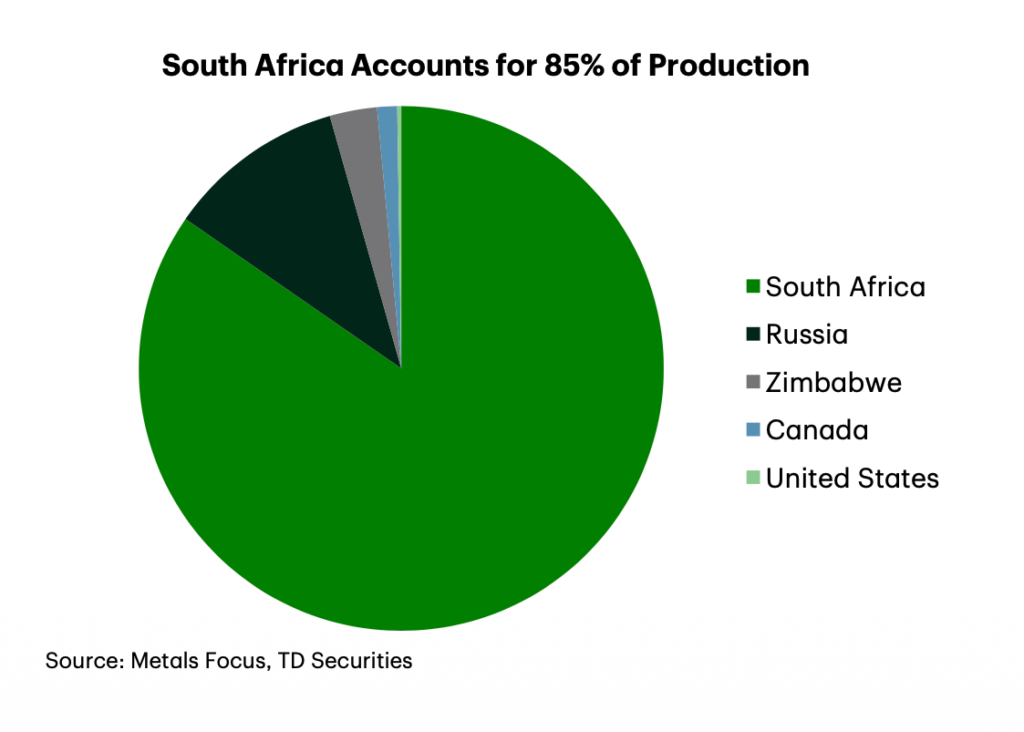
The vulnerability is heightened by extreme geographic concentration. South Africa supplies about 85% of the world’s primary rhodium, while only five of the country’s PGM mines account for roughly half of global output. Smaller South African operations, along with mines in Russia and Zimbabwe, produce most of the remainder.

Rhodium supply also responds poorly to its own price because the metal is largely produced as a by-product of platinum and palladium mining. Rhodium represents only about a quarter of mined PGM revenue, leaving development and production decisions primarily dependent on the economics of the broader PGM basket.

That structure creates an unusual market dynamic: falling rhodium demand may produce a surplus without necessarily encouraging miners to rapidly cut output, while supply disruptions can still have an outsized effect because inventories offer such a small buffer.

Auto slowdown

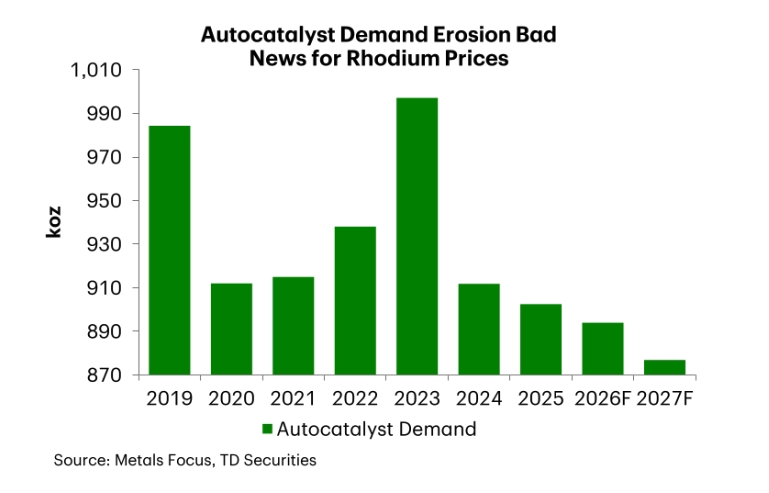
Demand presents the more persistent challenge. Autocatalysts account for most rhodium consumption, tying the metal closely to internal combustion engine vehicle production.

After years of expansion, autocatalyst demand has flattened as electric vehicles take a larger share of the automotive market. TD expects declining ICE vehicle sales to weigh further on rhodium consumption over the coming years.

Slower-than-anticipated EV adoption should temper that decline in the near term and reduce the likelihood of a prolonged price collapse. Longer vehicle lifespans also delay the return of rhodium contained in older catalytic converters to the recycling market.

Secondary supply should nevertheless increase steadily as older vehicles carrying heavier rhodium loadings reach the end of their lives. High metal prices have also encouraged greater recovery from scrap, although recycling remains constrained by imperfect recovery rates and limited processing equipment in some vehicle-retirement markets.

Substitution offers another potential pressure valve, but replacing rhodium is neither quick nor straightforward. Palladium is the usual alternative, yet TD estimates implementation can take 18 to 24 months and require five to eight times as much palladium as the rhodium being replaced.

Investors, meanwhile, have begun returning to the market. Rhodium exchange-traded funds have recorded positive inflows for the first time in more than a decade as retail and institutional investors seek physical precious-metals exposure.

Holdings remain well below levels reached in the early 2010s, leaving the market caught between weakening structural demand and a supply chain with little margin for error. The result could be lower prices over the next several years punctuated by abrupt rallies whenever production falters.


Critical minerals boom risks second funding gap as governance support shrinks 


Image from BHP.

Governments are pouring billions of dollars into critical minerals projects in a race to secure new supply chains, but a parallel pullback in funding for governance and community engagement could ultimately slow the very projects policymakers are trying to accelerate, according to a new report by the Trust, Accountability and Inclusion (TAI) Collaborative. 

The report, Thinking Strategically About Mineral Governance Funding, was commissioned by the BHP Foundation, a charitable organization registered in the US. The research found that demand for minerals is rising rapidly while funding for mineral governance appears to be tightening, with official development assistance contracting and some legacy philanthropies scaling back support. 

The Washington-based donor network says development finance for mines, processing facilities and other critical minerals infrastructure is expanding just as funding for transparency, regulatory capacity, civil society oversight and community participation is being cut. 

“Yes, there’s some eye-dropping sums being quoted and money flowing into the project development space and investment pipeline,” TAI executive director Michael Jarvis told MINING.COM in an interview. 

“But at the same time, money that used to go to ensuring good outcomes of all those projects — the governance agenda — has been cut.” 

Government donors that previously financed transparency and accountability programs around mining are shifting priorities toward strategic investment and dealmaking, Jarvis said. The trend extends beyond the US to donors in Europe, Japan and elsewhere. 

The shift comes as geopolitical competition over critical minerals is driving unprecedented government intervention in mining and processing. Government policy is expected to remain one of the biggest drivers of mining investment in 2026, with state-backed financing emerging as a central tool in developed markets. 

TAI argues that the resulting imbalance represents a second, largely overlooked financing gap: not the capital required to build mines and processing plants, but the much smaller amount needed to build the institutions and community relationships that allow those projects to operate. 

“It only needs to be a fraction of that bigger sum,” Jarvis said. “It’s not like this needs to be on par, but there isn’t even that 5% fraction of what’s going into the investment side that’s going on the good governance institutions around it at the moment.” 

$10 million could make a difference 

TAI, which has operated since 2010, brings together funders supporting governance work across mining, infrastructure and other sectors. Its work focuses on trust with communities, accountability over public resources and corporate conduct. 

The organization recently examined hundreds of funding streams as part of its research into mineral governance. Its March report on mineral governance funding found that demand for critical minerals is increasing while official development assistance and philanthropic support for governance work are tightening. 

Jarvis said even a relatively modest injection of capital could begin closing the gap. 

“At least a $10 million co-investment around mining governance, to be spent over the next two years, would make a surprising amount of difference,” he said, adding that the amount is roughly equivalent to cuts TAI has observed over the past year. 

Longer term, he said industry itself could contribute a small percentage of project investment toward community engagement and governance capacity. 

“We don’t need to be on equal firepower with the scale of investment that’s flowing into the sector,” Jarvis said. “But we need that thin layer that can make these things serve everyone’s interests better.” 

Among the areas particularly exposed are civil society organizations that work with mining communities and scrutinize project development. 

Several million dollars have been cut from support for international and in-country watchdog groups that can flag opaque dealmaking, questions about who benefits from projects and concerns about operators entering communities, Jarvis said. 

Those cuts are arriving at “the worst possible moment,” as national security and energy-transition pressures encourage governments to move faster on mineral development. 

“A few years from now, we’re going to regret that we made those cuts,” he said. 

Deregulation could backfire 

The funding pullback also coincides with pressure in several jurisdictions to accelerate permitting and reduce regulatory barriers. 

Jarvis questioned the assumption that weaker oversight will necessarily translate into faster mineral production. 

“There’s a hypothesis of some that if you deregulate, that speeds up projects, things can happen faster,” he said. “That might work in the short run, but I would argue that lack of good regulation in the long run creates more of these headaches and problems down the road.” 

Weakening government capacity can leave regulators without the staff or expertise required to manage projects, while cutting funding for civil society removes another layer of oversight, he said. 

TAI’s separate Mined the Gaps: Trust and Critical Minerals report similarly challenges the idea that regulation inherently obstructs development. It argues that procedural fairness, effective oversight and meaningful community participation can prevent conflicts and legal disputes that otherwise delay projects. 

One particular vulnerability occurs during exploration. 

Junior miners are typically incentivized to find deposits, secure financing and advance projects to the point where larger companies become involved. Environmental and community issues established during those early stages can therefore be inherited by the eventual mine developer. 

“In most cases, the communities are the last to know, the last to be engaged,” Jarvis said. 

While many juniors manage those relationships well, others do not, he added. 

“If there’s no understanding of what the issues and risks are amongst local community leaders — or even amongst the regulators, partly because some of them have been gutted, they don’t have staff anymore — you’re laying the seeds for things to blow up down the road.” 

Community relations as investment risk 

For investors evaluating early-stage miners, Jarvis said community relationships should therefore be taken seriously alongside geological results. 

Companies do not necessarily need huge budgets, he said, but they need staff capable of understanding local issues and engaging communities from the beginning. 

Mining projects can operate for decades, making those relationships an ongoing requirement rather than something companies address only during permitting. 

Communities may be consulted when a project initially moves forward, but projects subsequently change as costs, designs and management teams evolve. Community engagement needs to evolve with them, Jarvis said. 

There should be mechanisms for checking whether promised jobs are materializing, whether water use remains consistent with commitments and whether communities continue to support development. 

“We just need to get smarter and better at that interaction on an ongoing basis throughout the life cycle of the project,” he said. 

TAI argues the problem is not confined to developing economies. Similar tensions are emerging in Australia, Canada and the US. 

Nor is the organization’s objective to prevent mines from being built, Jarvis said. 

If he had $50 million to deploy, he said he would direct it toward networks that engage communities around mining projects and transfer knowledge about successful approaches between jurisdictions. 

“It’s not to block the mines,” Jarvis said. “It’s to ensure that these things work in a way that serves everyone’s benefit.” 

Pressure to get deals done 

The governance question also extends to how governments award the rapidly growing pool of public money available for critical minerals. 

Jarvis said transparency around funding awards, competitive bidding and contract terms becomes particularly important as governments take a larger role in selecting projects. 

“The more you make these things at risk of collusion or favoritism, it tends to not work well for the long-term outcomes for anybody’s benefit, except perhaps some individuals,” he said. 

Good operators also benefit from a level playing field, he added, while political pressure to rapidly select winners risks producing poor decisions. 

“It’s this trade-off between a push for speed and having announcements against actually what makes long-term good economic sense,” Jarvis said. “And I’m not sure the two match up very well right now.” 

With governments pursuing critical minerals for everything from renewable energy and batteries to national defense, TAI does not dispute the urgency of bringing more production online. 

Its warning is that financing alone will not get it accomplished. 

“For all the hype and boom, we’re not going to see the result we want unless we’re thinking about all the pieces that need to be put in place,” Jarvis said. 

“At the moment it’s all focused on the finance and not the rest of it.” 


Hapag-Lloyd and FIMI Submit Framework of Revised Structure for Zim Israel

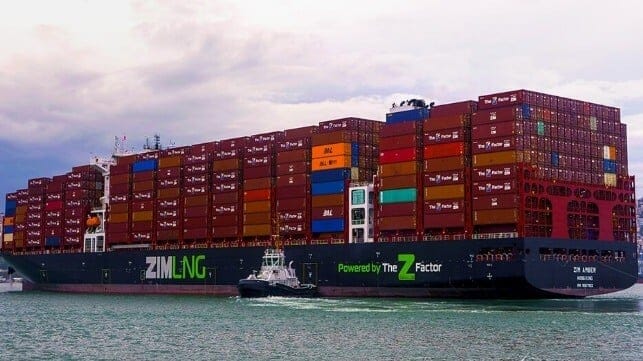
Zim containership
The proposed takeover of Zim is being revised to address concerns from the Israeli government (Zim)

Published Sep 24, 2026 6:42 PM by The Maritime Executive


Israeli media is reporting that Hapag-Lloyd CEO Rolf Habben Jansen flew to Israel and that, today, September 24, with Ishay Davidi’s FIMI Opportunity Funds, they submitted what they are calling a “significantly improved framework” for their proposed takeover of container carrier Zim. The companies are saying they understood the concerns raised by factions within the Israeli government and that they have addressed the issues, creating a stronger Zim Israel as the surviving Israeli company.

The Israeli government had indicated that it would vote to reject the proposed takeover of Zim by Hapag-Lloyd and the creation of a new, smaller Zim run by FIMI. Questions were raised about the financial viability of the new, smaller shipping company that was mostly focused on the Mediterranean and as a feeder to Hapag-Lloyd. Security concerns were also raised over Israel’s control of the shipping company and ability to maintain key supply chains.

The information submitted today is said to be a framework that outlines what the companies are calling “ten material improvements” to the structure of the deal. The companies said they would submit complete documentation within 45 days.

The Israeli outlet Calcalist, which was first to break the news of the pending takeover months ago, reports it reviewed the document submitted today. It says the new proposal enhances the Israeli ownership of Zim Israel and strengthens the so-called Golden Share. It reduces the threshold to trigger a government review and ensures that Zim Israel will remain an Israeli company.

One of the key objections was the limited routes for the new Zim. The revised proposal adds a weekly route to the Far East for Zim Israel in addition to the planned service in the Mediterranean and trans-Atlantic. It also proposed to increase the size of the Zim Israel fleet, doubling its current reefer capacity to protect the Israeli food chain.

Hapag-Lloyd will enter into a long-term commercial agreement with Zim Israel, providing it guaranteed global access. 

Zim Israel will maintain its vessel management and professional expertise in Israel. It will also have an independent IT system in Israel.

FIMI reports that, as part of the submission, it will present a new business plan for Zim Israel, which was reportedly validated by independent international consultants. Calcalist reports the plan projects increasing Zim Israel’s revenues over 10 years by $1.7 billion and a $200 million improvement in net operating profit.

International lawyers are also said to have reviewed Hapag-Lloyd’s corporate governance and will submit an opinion as part of the revised information packet. One of the concerns that had been raised related to the investment in Hapag by Arab sovereign wealth funds. The report says Hapag is also highlighting that it has maintained its service to Israel consistently since October 2023, despite periods of severe security disruptions.

To address issues raised by the unions in Israel, the deal is reported to include a special collective agreement guarantee for continued employment and training of Israeli seafarers. There is also a “10-year safety net,” enhanced terms for voluntary retirement, and a commitment to avoid layoffs through the end of 2027.

The Israeli media outlet Globes, however, highlights that the valuation of the proposed deal remains the same at $4.2 billion or $35 per share of Zim. It notes that the parties had a goal of closing the deal by the end of 2026, but it is now likely to extend until mid-2027.


Class Societies Join Maritime Anti-Corruption Network for the First Time

Corruption concerns vary by port, and MACN's members collect specific intelligence on specific risks (iStock / Around the World Photography file image)

Published Sep 24, 2026 9:33 PM by The Maritime Executive

The American Bureau of Shipping, DNV and RINA have agreed to join the Maritime Anti-Corruption Network (MACN), bringing new technical expertise to the global association for integrity in shipping. 

Historically, MACN's work has centered on combating facilitation payments (gratuities) in seaports, a longtime feature of interaction between ships' officers and local officials in certain port states around the world. Official solicitations for small payments of petty cash, food or cigarettes are common in some regions, and larger demands for bribes are not unheard-of. Seafarers are often at the receiving end, forced to decide whether to pay or to risk a made-up enforcement action that would delay their ship (and cost their company considerable amounts of money). Overall, MACN says that corruption can increase transport cost by 15 percent, and it has a global estimated cost of about $160 million per year - a cost that shipping stakeholders have to pass on to their customers or absorb on their balance sheets.

MACN's 200-plus members have banded together to resist these practices by sharing best practices; training seafarers on identifying and reporting corrupt practices; collecting incident reports of corrupt demands; sharing intelligence on port-specific corruption risks; and reporting patterns and problems to local authorities for action. The goal is to put up enough resistance and shed enough light on casual corruption that it gets addressed. 

Classification societies have expertise, reach and influence that can help MACN's broader goal to increase integrity in shipping, the organization said in a statement. They also have their own exposure to "integrity risks" when it comes to regulatory decisions, especially in high-risk operating environments. MACN's general assembly voted to allow class societies to join the group this April, and ABS, DNV and RINA are the first. 

"Trust is fundamental to the efficient functioning of global shipping. At ABS, we see integrity as an important part of maintaining confidence in the systems, standards, and relationships that support international trade. Joining MACN provides an opportunity to engage with industry partners, share expertise, and contribute to efforts that strengthen transparency and responsible business practices across the maritime sector," said John McDonald, ABS Chairman and CEO.


Though Balance Sheets are Strong, P&I Clubs Face Risk From Major Casualties

Bezengi
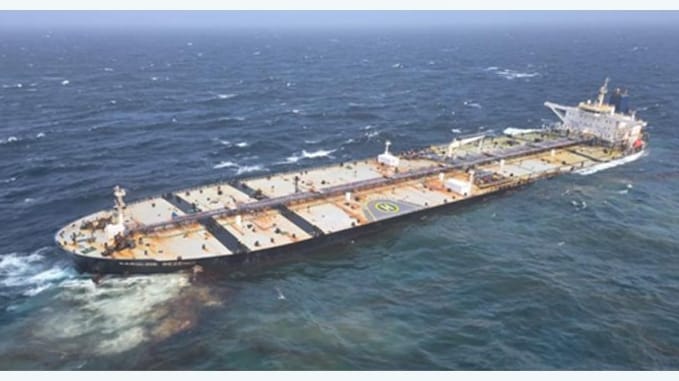
Insurers remain concerned about the risk of shadow-fleet vessels like Caroline Bezengi, above (file image courtesy Ambrey)

Published Sep 23, 2026 5:27 PM by The Maritime Executive


Lloyd's Market specialty insurance brokerage Tysers reports that the rising cost of major casualties will likely prompt P&I clubs to raise their premia by up to 7.5 percent in the coming year, despite their ever-growing free reserves and the strong market environment for investment earnings.  

Overall, the IG is very well capitalized, with total free reserves among the 12 clubs standing at $6.8 billion. Reinsurance and pooling add further strength to defend them against extreme claims, up to and including casualties the size of the Dali allision. But new hazards - conflict, sanctions, and the prospect of uninsured risks from the shadow fleet - create uncertainty in the market. 

The top players in the International Group have strong financial performance, Tysens notes. Juggernaut Gard leads the pack overall with more than 25 percent market share and free reserves of more than $1.7 billion, and enough investment income that it can afford to return premium to members. On technical performance, Japan P&I Club hit an enviable combined ratio of 70% in the last year, its fourth year in a row of strong earnings. 

But the prospect of unpredictable claims in a challenging operating environment will likely prompt higher rates, Tysers says - even though the clubs are sitting on large stockpiles of savings. 

"Many still have work to do to achieve a regular combined ratio around 100% against a background of claims
volatility and the increasing cost of serious casualties. There are strong arguments
that many Clubs are so well-reserved that premium increases are not needed.
However, we imagine they will argue they must continue to work to achieve
underwriting balance," the brokerage concluded. For the 2025 and 2026 years, target rate increases ranged from five to eight percent, and Tysers expects a repeat. 


McAllister’s Latest High-Tech Low-Emission Tug Arrives

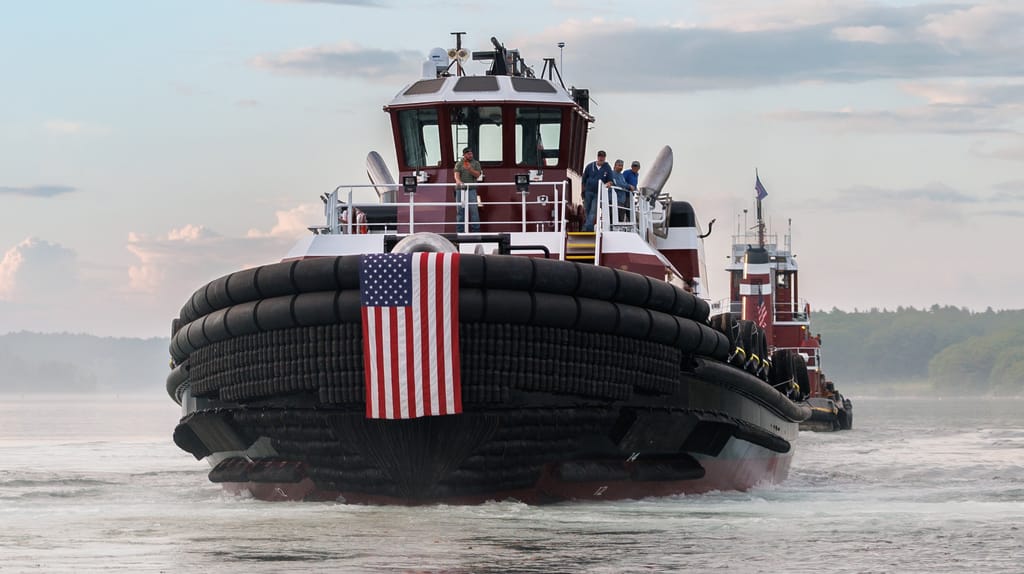
McAllister Towing introduces the MARY McAllister, a state-of-the-art tugboat designed for modern maritime challenges.

The MARY MCALLISTER: McAllister’s Latest High-Tech Low-Emission Tug Arrives

Published Sep 25, 2026 9:21 PM by The Maritime Executive


[By McAllister]

McAllister Towing is proud to announce our newest arrival! Welcome tug MARY McALLISTER. As our customer's vessels grow larger and services for these behemoths become increasingly demanding, McAllister continues to meet their needs with modern and environmentally conscious equipment.

American-built at Washburn & Doughty Associates, Inc. in Maine, MARY is the sixth in a seven-tug series of American Bureau of Shipping classed and certified 84-metric-ton bollard pull, low-emission tractor tugs. The MARY is powered by CAT Tier IV engines producing 6,770 horsepower. She is classed with the following certifications and endorsements from ABS: +A-1 Towing, +AMS, Fire Fighting (FiFi 1), Escort, Low Emissions Vessel. Her firefighting prowess includes pumps and monitors capable of producing 12,000 gallons of water and foam per minute.

The MARY is eventually bound for sunny Florida, but she'll get a little tour of the US East Coast before she gets there. The MARY left Washburn & Doughty just in time to ride out the approaching nor'easter. She will navigate her first North Atlantic storm in Portland before heading south. Joining her sister vessel, ISABEL, in Baltimore, MARY will receive her first work order as part of the McAllister fleet. After her Baltimore hitch, the MARY will proceed to her homeport in Port Everglades where she will be a dynamic force for years to come.

We welcome the MARY as our latest high-tech, low-emission, firefighting and mission-critical tug to global trade. From 1864 to today, we’ve stayed family-owned for five generations and are still investing in new, American-built, state-of-the-art tugs — with another coming in 2027.

The products and services herein described in this press release are not endorsed by The Maritime Executive.


Stena Extends Ferry Class with Order for Hybrid-Battery Vessels

Stena ferry design
Rendering of the next E-Flexer ferries which will be built as hybrids with battery propulsion capabilities (Stena RoRo)

Published Sep 24, 2026 8:28 PM by The Maritime Executive


Stena Line has ordered two hybrid-powered ferries that add battery capabilities to the company’s already successful hybrid E-Flexer ferry platform. Developed a decade ago by Stena RoRo, it is an adaptable class design that has seen a total of 17 vessels ordered, including seven operated by Stena Line and 10 on long-term charters to Stena RoRo customers.

The latest adaptation of the design was developed by Stena RoRo to enable future operation solely on battery power. It will be based on a diesel-electric propulsion system, with the company reporting it will be able to run on various fuels, including biodiesel. The engines will also be prepared for operation in methanol.

Stena RoRo highlights that it developed the design with dedicated spaces prepared for up to 85 MWh of battery capacity. It says it will be suited to a wide range of routes, and the battery concept adds another dimension to the design. Per Westling, CEO of Stena RoRo, says he is convinced that this vessel design will be developed further to suit a wide range of ferry routes.

Battery technology, the company notes, is developing rapidly, and the new vessels have therefore been designed to allow batteries to be installed in line with the ferry operators’ requirements and preferred pace. The amount of battery capacity installed may be determined by factors such as battery cost, energy density, and fire safety, as well as the company’s environmental policy and, not least, developments in regulations.

The latest order was placed for two vessels with an option for two additional vessels to be built at China Merchants Shipbuilding Industry (CMI) Weihai in China. The yard has delivered 13 E-Flexer RoPax vessels to date, with four additional vessels on order. It is also building four RoRo vessels for Stena based on two other designs. This new order calls for the two vessels to be delivered in 2030.

Stena Line reports the new vessels are intended as day ferries for the route between Gothenburg, Sweden, and Frederikshaven, Denmark. The ships will be 214.5 meters (704 feet) in length with three vehicle decks, one for cars and two for trucks. They will have a total of 2,750 lane meters and a passenger capacity of 1,500. Since they are designed as day ferries, they will only have 132 cabins in total for passengers and crew.

“With the new vessels, we are increasing our freight capacity, which we believe will be particularly valuable in connection with our upcoming move to a new port location in Arendal,” said Christina Bromander, Trade Director for Stena Line’s Denmark routes. “The conditions there are excellent for developing our freight business, with opportunities for increased intermodality thanks to the rail connection.”

The vessels currently operating on Stena Line’s Gothenburg–Frederikshavn route, Stena Danica and Stena Jutlandica, have served the route for many years. Stena Danica entered service on the route as early as 1984, while Stena Jutlandica followed in 1996. 

“Our existing vessels have been fantastic workhorses and have served us extremely well on our Denmark route for many years, but the next generation of E-Flexers will represent a major step forward for both our passengers and freight customers. They will enable us to offer a highly attractive and modern product, with significant improvements in sustainability, comfort, the onboard experience and freight capacity,” said Bromander.

Stena RoRo, which is the design arm for the group, will continue to manage the construction program in China.


NYK Expands Offshore Wind Business with SOV Newbuild

wind offshore SOV
NYK is expanding its offshore operations for wind energy with a newbuild SOV (NYK)

Published Sep 25, 2026 8:32 PM by The Maritime Executive


Japanese shipping major NYK is moving to strengthen its business in the offshore wind power segment. The group, best known for its operations in dry bulk and tankers, has said it views the offshore sector as a strong growth opportunity.

In its latest move, the company has ordered a newbuild service operation vessel (SOV) to support its operations in the Asia-Pacific region. The new 89-meter (292-foot) vessel will be built by PaxOcean Group, a member of Kuok Maritime Group, and will support the construction, operation, and maintenance of offshore wind farms. It will serve as an offshore base for personnel accommodation and logistical support. The company did not reveal the cost of the new vessel.

In recent years, NYK has been pushing to deepen its interests in the offshore wind sector. Last year, the company entered the European market by investing in Northern Offshore Group (NOG), a crew transfer vessel operator with over 60 vessels in the global offshore wind industry.

According to NYK, the investment in NOG in February last year was partially designed to ensure the company gains important operational experience in preparation for future expansion of offshore wind in waters closer to Japan.

With the SOV order, the company reports that the newbuild project is leveraging the expertise and experience accumulated in Europe, a move that will enable it to further develop its offshore wind business in the Asia-Pacific region where the market is recording significant growth. Data show that last year, investments in the region’s offshore wind exceeded $50 billion.

NYK says the new vessel will have a capacity of 120 persons and is designed to support logistics needs associated with offshore wind farm construction projects. The vessel will be equipped with a dynamic positioning system that can automatically calculate external forces such as wind and currents and uses thrusters and other propulsion devices to maintain its position at sea.

The vessel will also incorporate the twin x-stern design developed by Ulstein, which is expected to enhance maneuverability and station-keeping performance while helping reduce vessel motions, noise, and energy consumption. In addition, the vessel will be fitted with a motion-compensated gangway and a motion-compensated crane, enabling the safe transfer of personnel and cargo to offshore wind turbines.

Scheduled for delivery in 2029, the vessel will be deployed in offshore wind projects in Taiwan and across the Asia-Pacific region under a partnership with Taiwan-based offshore wind company IOVTEC and Hsin Chien Marine, a shipowner and ship management company

“By combining their expertise, networks, and resources, NYK, IOVTEC, and HCM aim to ensure the vessel’s safe and reliable operation while contributing to the continued development of the offshore wind industry,” said NYK in a statement.

The company added that the new SOV represents another step in expanding its business domain from “Ocean for shipping” to “Ocean as a workplace” through contributions across the offshore wind value chain.